Tag: Brain

  • Virginia Looks to Plug Brain Drain With More Internships

    Virginia Looks to Plug Brain Drain With More Internships

    Internships can be a meaningful step in a college student’s career development. That’s why the commonwealth of Virginia is working to guarantee that undergraduates have a fair shot at paid experiential learning.

    The Virginia Economic Development Partnership announced a new collaboration today with the job board Handshake as part of the state’s effort to train and retain local talent through internship opportunities.

    Virginia has committed to giving all undergraduate students at least one form of meaningful work-based learning before graduation, said Megan Healy, senior vice president of talent and workforce strategy at VEDP. Overseen by the Virginia Talent and Opportunity Partnership, this work-based learning could include experiential learning or a paid internship.

    The partnership with Handshake is one layer of a multifaceted approach to increasing opportunities for entry-level applicants to break into local job markets, helping to reduce brain drain and encourage economic development for evolving local markets.

    State of play: Internships provide students with skills and experience for future careers, but for many of them paid internships remain out of reach. A 2024 report from the Business–Higher Education Forum found that nearly half of students who wanted an internship didn’t participate in one, and of those who did, only 70 percent said it was a “high-quality experience.”

    A 2025 Student Voice survey by Inside Higher Ed and Generation Lab found that 38 percent of respondents believe their college should emphasize helping them find and access paid internships to enhance career services, and 30 percent want help making strong connections with potential employers.

    Virginia has recently seen a dramatic drop in available internship listings; when President Trump took office in January, he slashed the federal workforce, reducing available roles in the D.C., Maryland and Northern Virginia region. Internship postings dropped 36 percent in June 2025 compared to June 2024, according to Lightcast data—a 20-percentage-point-greater decline compared to similar metropolitan job markets.

    Brookings Institute

    VEDP’s partnership with Handshake includes data sharing within the platform and additional visibility into existing or future internship opportunities for students.

    Over 70 percent of colleges and universities in Virginia, representing 470,000 students, already connect to Handshake, said Christine Cruzvergara, the company’s chief education officer. In addition, 20,000 Virginia employers have posted more than 150,000 jobs and internships on the platform.

    Building better internships: One of Virginia’s goals is to develop opportunities for students outside of metropolitan hubs.

    “The state of Virginia is very diverse, and the majority of students that graduate from a lot of the Virginia schools end up going to Richmond or Northern Virginia—those are the two main hubs that most students go to,” said Cruzvergara, a former Virginia resident and college administrator herself. “But there are so many other regions of Virginia that also need amazing talent, and I think this particular initiative is going to help distribute more of that talent.”

    The state is partnering with local business in more rural areas—including near Virginia Tech in Blacksburg and in Charlottesville, where the University of Virginia is located—to establish more high-impact and paid internships to attract students from these universities.

    “We’re also looking at ways to connect students from those specific institutions,” Healy of VEDP said. “They also have the most out-of-state students because they’re very popular and very highly ranked.”

    To increase internship offerings across the state, VEDP hosts regular training sessions to help employers build meaningful internship experiences for students and assists them in listing jobs on Handshake. The state hopes that connecting students with employers on an already-trusted platform will help expand access to opportunities as well as meet talent demands in the commonwealth.

    Small businesses (employing 150 people or less) are also eligible for a grant program if they hire interns; the state will provide $7,500 in matched funds to compensate an intern for eight weeks and 120 hours making at least minimum wage.

    “I think this particular initiative is going to help distribute more of that talent, because they’re going to tap into the local economy and the local employers to create the internships and opportunities that will be needed to attract students and also help them see this could be a great place to live In Virginia,” said Cruzvergara.

    How is your college or university increasing opportunities for students to intern? Tell us more here.

    Source link

  • Teaching math the way the brain learns changes everything

    Teaching math the way the brain learns changes everything

    Key points:

    Far too many students enter math class expecting to fail. For them, math isn’t just a subject–it’s a source of anxiety that chips away at their confidence and makes them question their abilities. A growing conversation around math phobia is bringing this crisis into focus. A recent article, for example, unpacked the damage caused by the belief that “I’m just not a math person” and argued that traditional math instruction often leaves even bright, capable students feeling defeated.

    When a single subject holds such sway over not just academic outcomes but a student’s sense of self and future potential, we can’t afford to treat this as business as usual. It’s not enough to explore why this is happening. We need to focus on how to fix it. And I believe the answer lies in rethinking how we teach math, aligning instruction with the way the brain actually learns.

    Context first, then content

    A key shortcoming of traditional math curriculum–and a major contributor to students’ fear of math–is the lack of meaningful context. Our brains rely on context to make sense of new information, yet math is often taught in isolation from how we naturally learn. The fix isn’t simply throwing in more “real-world” examples. What students truly need is context, and visual examples are one of the best ways to get there. When math concepts are presented visually, students can better grasp the structure of a problem and follow the logic behind each step, building deeper understanding and confidence along the way.

    In traditional math instruction, students are often taught a new concept by being shown a procedure and then practicing it repeatedly in hopes that understanding will eventually follow. But this approach is backward. Our brains don’t learn that way, especially when it comes to math. Students need context first. Without existing schemas to draw from, they struggle to make sense of new ideas. Providing context helps them build the mental frameworks necessary for real understanding.

    Why visual-first context matters

    Visual-first context gives students the tools they need to truly understand math. A curriculum built around visual-first exploration allows students to have an interactive experience–poking and prodding at a problem, testing ideas, observing patterns, and discovering solutions. From there, students develop procedures organically, leading to a deeper, more complete understanding. Using visual-first curriculum activates multiple parts of the brain, creating a deeper, lasting understanding. Shifting to a math curriculum that prioritizes introducing new concepts through a visual context makes math more approachable and accessible by aligning with how the brain naturally learns.

    To overcome “math phobia,” we also need to rethink the heavy emphasis on memorization in today’s math instruction. Too often, students can solve problems not because they understand the underlying concepts, but because they’ve memorized a set of steps. This approach limits growth and deeper learning. Memorization of the right answers does not lead to understanding, but understanding can lead to the right answers.

    Take, for example, a third grader learning their times tables. The third grader can memorize the answers to each square on the times table along with its coordinating multipliers, but that doesn’t mean they understand multiplication. If, instead, they grasp how multiplication works–what it means–they can figure out the times tables on their own. The reverse isn’t true. Without conceptual understanding, students are limited to recall, which puts them at a disadvantage when trying to build off previous knowledge.

    Learning from other subjects

    To design a math curriculum that aligns with how the brain naturally learns new information, we can take cues from how other subjects are taught. In English, for example, students don’t start by memorizing grammar rules in isolation–they’re first exposed to those rules within the context of stories. Imagine asking a student to take a grammar quiz before they’ve ever read a sentence–that would seem absurd. Yet in math, we often expect students to master procedures before they’ve had any meaningful exposure to the concepts behind them.

    Most other subjects are built around context. Students gain background knowledge before being expected to apply what they’ve learned. By giving students a story or a visual context for the mind to process–breaking it down and making connections–students can approach problems like a puzzle or game, instead of a dreaded exercise. Math can do the same. By adopting the contextual strategies used in other subjects, math instruction can become more intuitive and engaging, moving beyond the traditional textbook filled with equations.

    Math doesn’t have to be a source of fear–it can be a source of joy, curiosity, and confidence. But only if we design it the way the brain learns: with visuals first, understanding at the center, and every student in mind. By using approaches that provide visual-first context, students can engage with math in a way that mirrors how the brain naturally learns. This shift in learning makes math more approachable and accessible for all learners.

    Source link

  • 10+ Years of Lasting Impact and Local Commitment

    10+ Years of Lasting Impact and Local Commitment

    Over 60,000 students have benefited from the math program built on how the brain naturally learns

    A new analysis shows that students using ST Math at Phillips 66-funded schools are achieving more than twice the annual growth in math performance compared to their peers. A recent analysis by MIND Research Institute, which included 3,240 students in grades 3-5 across 23 schools, found that this accelerated growth gave these schools a 12.4 percentile point advantage in spring 2024 state math rankings.

    These significant outcomes are the result of a more than 10-year partnership between Phillips 66 and MIND Research Institute. This collaboration has brought ST Math, created by MIND Education, the only PreK–8 supplemental math program built on the science of how the brain learns, fully funded to 126 schools, 23 districts, and more than 60,000 students nationwide. ST Math empowers students to explore, make sense of, and build lasting confidence in math through visual problem-solving.

    “Our elementary students love JiJi and ST Math! Students are building perseverance and a deep conceptual understanding of math while having fun,” said Kim Anthony, Executive Director of Elementary Education, Billings Public Schools. “By working through engaging puzzles, students are not only fostering a growth mindset and resilience in problem-solving, they’re learning critical math concepts.”

    The initiative began in 2014 as Phillips 66 sought a STEM education partner that could deliver measurable outcomes at scale. Since then, the relationship has grown steadily, and now, Phillips 66 funds 100% of the ST Math program in communities near its facilities in California, Washington, Montana, Oklahoma, Texas, Illinois, and New Jersey. Once involved, schools rarely leave the program.

    To complement the in-class use of ST Math, Phillips 66 and MIND introduced Family Math Nights. These events, hosted at local schools, bring students, families, and Phillips 66 employee volunteers together for engaging, hands-on activities. The goal is to build math confidence in a fun, interactive setting and to equip parents with a deeper understanding of the ST Math program and new tools to support their child’s learning at home.

    “At Phillips 66, we believe in building lasting relationships with the communities we serve,” said Courtney Meadows, Manager of Social Impact at Phillips 66. “This partnership is more than a program. It’s a decade of consistent, community-rooted support to build the next generation of thinkers and improve lives through enriching educational experiences.”

    ST Math has been used by millions of students across the country and has a proven track record of delivering a fundamentally different approach to learning math. Through visual and interactive puzzles, the program breaks down math’s abstract language barriers to benefit all learners, including English Learners, Special Education students, and Gifted and Talented students.

    “ST Math offers a learning experience that’s natural, intuitive, and empowering—while driving measurable gains in math proficiency,” said Brett Woudenberg, CEO of MIND Education. “At MIND, we believe math is a gateway to brighter futures. We’re proud to partner with Phillips 66 in expanding access to high-quality math learning for thousands of students in their communities.”

    Explore how ST Math is creating an impact in Phillips 66 communities with this impact story: https://www.mindeducation.org/success-story/brazosport-isd-texas/

    About MIND Education
    MIND Education engages, motivates and challenges students towards mathematical success through its mission to mathematically equip all students to solve the world’s most challenging problems. MIND is the creator of ST Math, a pre-K–8 visual instructional program that leverages the brain’s innate spatial-temporal reasoning ability to solve mathematical problems; and InsightMath, a neuroscience-based K-6 curriculum that transforms student learning by teaching math the way every brain learns so all students are equipped to succeed. Since its inception in 1998, MIND Education and ST Math has served millions and millions of students across the country. Visit MINDEducation.org.

    About Phillips 66
    Phillips 66 (NYSE: PSX) is a leading integrated downstream energy provider that manufactures, transports and markets products that drive the global economy. The company’s portfolio includes Midstream, Chemicals, Refining, Marketing and Specialties, and Renewable Fuels businesses. Headquartered in Houston, Phillips 66 has employees around the globe who are committed to safely and reliably providing energy and improving lives while pursuing a lower-carbon future. For more information, visit phillips66.com or follow @Phillips66Co on LinkedIn.

    eSchool News Staff
    Latest posts by eSchool News Staff (see all)

    Source link

  • How Witnessing Violence Impacts Brain Development (opinion)

    How Witnessing Violence Impacts Brain Development (opinion)

    On Sept. 10, a public lecture at Utah Valley University became the site of a nightmare when the political commentator Charlie Kirk was killed before thousands of students. Whatever one thinks of Kirk’s politics, the trauma endured by those young witnesses will last far longer than the news cycle. For adolescents, such moments do not fade when the cameras leave. They etch themselves into the brain—literally. Witnessing violence, even indirectly, negatively impacts brain development.

    At the University of Southern California’s Center for Affective Neuroscience, Development, Learning and Education (CANDLE), our colleagues recently studied how violence exposure shapes young people. Again and again, the evidence is stark: When adolescents witness or hear about violence in their communities, their developing brains bear the burden. The anterior cingulate cortex—a region critical for processing stress and pain, emotional regulation, motivation, learning, and social connection—has a greater decrease in gray-matter volume in adolescents exposed to more community violence. This pattern of gray-matter volume decrease has been seen in ground troops deployed to war and in people affected by post-traumatic stress disorder. It has been linked to anxiety, depression and difficulty sustaining attention.

    Yet neuroscience also points to a path forward. Our newest research, published this year in the Journal of Research on Adolescence, offers a striking counterpoint: Adolescents are not passive victims of their environments. They have within them the capacity to buffer these harms, within themselves and within society. That capacity is what we call transcendent thinking.

    Transcendent thinking is the ability to move beyond the immediate details of an event and consider the complexities that characterize a diverse society, to explore perspectives that differ or conflict with one’s own and to contemplate the bigger picture: What does this mean for me, for my community, for justice and fairness? When teenagers reflect in these ways, they are not escaping reality but engaging it more deeply. They are searching for meaning, considering multiple perspectives and placing their experience in a larger human story. This, in turn, helps them imagine how things might be different, and how they might contribute to the change.

    In our study of 55 urban adolescents, those who more frequently engaged in transcendent reflection about social issues showed a greater increase in gray-matter volume in the anterior cingulate cortex two years later—the very brain region seen to be most vulnerable to violence exposure. In other words, transcendent thinking didn’t erase the negative effects, but it appeared to give young people’s brains some scaffolding to adapt and heal.

    This has profound implications for how we respond to political and community violence. The instinct, understandably, is to shield young people from harsh realities. But shielding won’t work. Adolescents are already encountering violence—whether on the street, online or in lecture halls. What they need are the tools to make sense of it, to weave their experiences into narratives of purpose and agency rather than despair. And for this, they need curiosity about the experiences of others and safe opportunities to think across difference.

    Fortunately, transcendent thinking is not rarefied or inaccessible. It is something every young person can do and likely already does spontaneously. The challenge is to nurture it deliberately and thoughtfully. Schools and colleges can make space for students to grapple with complex social issues and to connect classroom learning with ethical and civic questions. Families and communities can invite adolescents into intergenerational storytelling, where young people see how others have wrestled with hardship and injustice. Education that emphasizes civic reasoning and dialogue can strengthen not only academic outcomes but also neurological resilience and long-term well-being.

    This is both a scientific and a civic imperative. Neuroscience is showing us that meaning making changes the brain. We need support for educators to find ways to translate that science into daily practices that help young people transform tragedy into purpose. Our vision is to illuminate the capacities that empower adolescents to question their and others’ beliefs, to engage across difference, to imagine futures and work to create the world they want to live in.

    The tragedy at Utah Valley University underscores how high the stakes have become. America’s young people are coming of age amid rising polarization and public acts of violence. We cannot protect them or shield them from it, but we can equip them to counter its developmental impacts.

    Transcendent thinking is not a cure-all. But it is a proven developmental asset that can buffer the effects of witnessing community violence on the brain. It is also a civic skill we urgently need: the ability to see beyond the present conflicts and tragedies to the larger questions of justice, community and meaning.

    If we want to safeguard both adolescent development and democratic life, we must equip schools, colleges, families and communities with the tools to cultivate transcendent thinking.

    Mary Helen Immordino-Yang is the Fahmy and Donna Attallah Professor of Humanistic Psychology and a professor of education, psychology and neuroscience at the University of Southern California and founding director of the USC Center for Affective Neuroscience, Development, Learning and Education.

    Kori Street is executive director of USC CANDLE.

    Source link

  • What really shapes the future of AI in education?

    What really shapes the future of AI in education?

    This post originally appeared on the Christensen Institute’s blog and is reposted here with permission.

    Key points:

    A few weeks ago, MIT’s Media Lab put out a study on how AI affects the brain. The study ignited a firestorm of posts and comments on social media, given its provocative finding that students who relied on ChatGPT for writing tasks showed lower brain engagement on EEG scans, hinting that offloading thinking to AI can literally dull our neural activity. For anyone who has used AI, it’s not hard to see how AI systems can become learning crutches that encourage mental laziness.

    But I don’t think a simple “AI harms learning” conclusion tells the whole story. In this blog post (adapted from a recent series of posts I shared on LinkedIn), I want to add to the conversation by tackling the potential impact of AI in education from four angles. I’ll explore how AI’s unique adaptability can reshape rigid systems, how it both fights and fuels misinformation, how AI can be both good and bad depending on how it is used, and why its funding model may ultimately determine whether AI serves learners or short-circuits their growth.

    What if the most transformative aspect of AI for schools isn’t its intelligence, but its adaptability?

    Most technologies make us adjust to them. We have to learn how they work and adapt our behavior. Industrial machines, enterprise software, even a basic thermostat—they all come with instructions and patterns we need to learn and follow.

    Education highlights this dynamic in a different way. How does education’s “factory model” work when students don’t come to school as standardized raw inputs? In many ways, schools expect students to conform to the requirements of the system—show up on time, sharpen your pencil before class, sit quietly while the teacher is talking, raise your hand if you want to speak. Those social norms are expectations we place on students so that standardized education can work. But as anyone who has tried to manage a group of six-year-olds knows, a class of students is full of complicated humans who never fully conform to what the system expects. So, teachers serve as the malleable middle layer. They adapt standardized systems to make them work for real students. Without that human adaptability, the system would collapse.

    Same thing in manufacturing. Edgar Schein notes that engineers aim to design systems that run themselves. But operators know systems never work perfectly. Their job—and often their sense of professional identity—is about having the expertise to adapt and adjust when things inevitably go off-script. Human adaptability in the face of rigid systems keeps everything running.

    So, how does this relate to AI? AI breaks the mold of most machines and systems humans have designed and dealt with throughout history. It doesn’t just follow its algorithm and expect us to learn how to use it. It adapts to us, like how teachers or factory operators adapt to the realities of the world to compensate for the rigidity of standardized systems.

    You don’t need a coding background or a manual. You just speak to it. (I literally hit the voice-to-text button and talk to it like I’m explaining something to a person.) Messy, natural human language—the age-old human-to-human interface that our brains are wired to pick up on as infants—has become the interface for large language models. In other words, what makes today’s AI models amazing is their ability to use our interface, rather than asking us to learn theirs.

    For me, the early hype about “prompt engineering” never really made sense. It assumed that success with AI required becoming an AI whisperer who knew how to speak AI’s language. But in my experience, working well with AI is less about learning special ways to talk to AI and more about just being a clear communicator, just like a good teacher or a good manager.

    Now imagine this: what if AI becomes the new malleable middle layer across all kinds of systems? Not just a tool, but an adaptive bridge that makes other rigid, standardized systems work well together. If AI can make interoperability nearly frictionless—adapting to each system and context, rather than forcing people to adapt to it—that could be transformative. It’s not hard to see how this shift might ripple far beyond technology into how we organize institutions, deliver services, and design learning experiences.

    Consider two concrete examples of how this might transform schools. First, our current system heavily relies on the written word as the medium for assessing students’ learning. To be clear, writing is an important skill that students need to develop to help them navigate the world beyond school. Yet at the same time, schools’ heavy reliance on writing as the medium for demonstrating learning creates barriers for students with learning disabilities, neurodivergent learners, or English language learners—all of whom may have a deep understanding but struggle to express it through writing in English. AI could serve as that adaptive layer, allowing students to demonstrate their knowledge and receive feedback through speech, visual representations, or even their native language, while still ensuring rigorous assessment of their actual understanding.

    Second, it’s obvious that students don’t all learn at the same pace—yet we’ve forced learning to happen at a uniform timeline because individualized pacing quickly becomes completely unmanageable when teachers are on their own to cover material and provide feedback to their students. So instead, everyone spends the same number of weeks on each unit of content and then moves to the next course or grade level together, regardless of individual readiness. Here again, AI could serve as that adaptive layer for keeping track of students’ individual learning progressions and then serving up customized feedback, explanations, and practice opportunities based on students’ individual needs.

    Third, success in school isn’t just about academics—it’s about knowing how to navigate the system itself. Students need to know how to approach teachers for help, track announcements for tryouts and auditions, fill out paperwork for course selections, and advocate for themselves to get into the classes they want. These navigation skills become even more critical for college applications and financial aid. But there are huge inequities here because much of this knowledge comes from social capital—having parents or peers who already understand how the system works. AI could help level the playing field by serving as that adaptive coaching layer, guiding any student through the bureaucratic maze rather than expecting them to figure it out on their own or rely on family connections to decode the system.

    Can AI help solve the problem of misinformation?

    Most people I talk to are skeptical of the idea in this subhead—and understandably so.

    We’ve all seen the headlines: deep fakes, hallucinated facts, bots that churn out clickbait. AI, many argue, will supercharge misinformation, not solve it. Others worry that overreliance on AI could make people less critical and more passive, outsourcing their thinking instead of sharpening it.

    But what if that’s not the whole story?

    Here’s what gives me hope: AI’s ability to spot falsehoods and surface truth at scale might be one of its most powerful—and underappreciated—capabilities.

    First, consider what makes misinformation so destructive. It’s not just that people believe wrong facts. It’s that people build vastly different mental models of what’s true and real. They lose any shared basis for reasoning through disagreements. Once that happens, dialogue breaks down. Facts don’t matter because facts aren’t shared.

    Traditionally, countering misinformation has required human judgment and painstaking research, both time-consuming and limited in scale. But AI changes the equation.

    Unlike any single person, a large language model (LLM) can draw from an enormous base of facts, concepts, and contextual knowledge. LLMs know far more facts from their training data than any person can learn in a lifetime. And when paired with tools like a web browser or citation database, they can investigate claims, check sources, and explain discrepancies.

    Imagine reading a social media post and getting a sidebar summary—courtesy of AI—that flags misleading statistics, offers missing context, and links to credible sources. Not months later, not buried in the comments—instantly, as the content appears. The technology to do this already exists.

    Of course, AI is not perfect as a fact-checker. When large language models generate text, they aren’t producing precise queries of facts; they’re making probabilistic guesses at what the right response should be based on their training, and sometimes those guesses are wrong. (Just like human experts, they also generate answers by drawing on their expertise, and they sometimes get things wrong.) AI also has its own blind spots and biases based on the biases it inherits from its training data. 

    But in many ways, both hallucinations and biases in AI are easier to detect and address than the false statements and biases that come from millions of human minds across the internet. AI’s decision rules can be audited. Its output can be tested. Its propensity to hallucinate can be curtailed. That makes it a promising foundation for improving trust, at least compared to the murky, decentralized mess of misinformation we’re living in now.

    This doesn’t mean AI will eliminate misinformation. But it could dramatically increase the accessibility of accurate information, and reduce the friction it takes to verify what’s true. Of course, most platforms don’t yet include built-in AI fact-checking, and even if they did, that approach would raise important concerns. Do we trust the sources that those companies prioritize? The rules their systems follow? The incentives that guide how their tools are designed? But beyond questions of trust, there’s a deeper concern: when AI passively flags errors or supplies corrections, it risks turning users into passive recipients of “answers” rather than active seekers of truth. Learning requires effort. It’s not just about having the right information—it’s about asking good questions, thinking critically, and grappling with ideas. That’s why I think one of the most important things to teach young people about how to use AI is to treat it as a tool for interrogating the information and ideas they encounter, both online and from AI itself. Just like we teach students to proofread their writing or double-check their math, we should help them develop habits of mind that use AI to spark their own inquiry—to question claims, explore perspectives, and dig deeper into the truth. 

    Still, this focuses on just one side of the story. As powerful as AI may be for fact-checking, it will inevitably be used to generate deepfakes and spin persuasive falsehoods.

    AI isn’t just good or bad—it’s both. The future of education depends on how we use it.

    Much of the commentary around AI takes a strong stance: either it’s an incredible force for progress or it’s a terrifying threat to humanity. These bold perspectives make for compelling headlines and persuasive arguments. But in reality, the world is messy. And most transformative innovations—AI included—cut both ways.

    History is full of examples of technologies that have advanced society in profound ways while also creating new risks and challenges. The Industrial Revolution made it possible to mass-produce goods that have dramatically improved the quality of life for billions. It has also fueled pollution and environmental degradation. The internet connects communities, opens access to knowledge, and accelerates scientific progress—but it also fuels misinformation, addiction, and division. Nuclear energy can power cities—or obliterate them.

    AI is no different. It will do amazing things. It will do terrible things. The question isn’t whether AI will be good or bad for humanity—it’s how the choices of its users and developers will determine the directions it takes. 

    Because I work in education, I’ve been especially focused on the impact of AI on learning. AI can make learning more engaging, more personalized, and more accessible. It can explain concepts in multiple ways, adapt to your level, provide feedback, generate practice exercises, or summarize key points. It’s like having a teaching assistant on demand to accelerate your learning.

    But it can also short-circuit the learning process. Why wrestle with a hard problem when AI will just give you the answer? Why wrestle with an idea when you can ask AI to write the essay for you? And even when students have every intention of learning, AI can create the illusion of learning while leaving understanding shallow.

    This double-edged dynamic isn’t limited to learning. It’s also apparent in the world of work. AI is already making it easier for individuals to take on entrepreneurial projects that would have previously required whole teams. A startup no longer needs to hire a designer to create its logo, a marketer to build its brand assets, or an editor to write its press releases. In the near future, you may not even need to know how to code to build a software product. AI can help individuals turn ideas into action with far fewer barriers. And for those who feel overwhelmed by the idea of starting something new, AI can coach them through it, step by step. We may be on the front end of a boom in entrepreneurship unlocked by AI.

    At the same time, however, AI is displacing many of the entry-level knowledge jobs that people have historically relied on to get their careers started. Tasks like drafting memos, doing basic research, or managing spreadsheets—once done by junior staff—can increasingly be handled by AI. That shift is making it harder for new graduates to break into the workforce and develop their skills on the job.

    One way to mitigate these challenges is to build AI tools that are designed to support learning, not circumvent it. For example, Khan Academy’s Khanmigo helps students think critically about the material they’re learning rather than just giving them answers. It encourages ideation, offers feedback, and prompts deeper understanding—serving as a thoughtful coach, not a shortcut. But the deeper issue AI brings into focus is that our education system often treats learning as a means to an end—a set of hoops to jump through on the way to a diploma. To truly prepare students for a world shaped by AI, we need to rethink that approach. First, we should focus less on teaching only the skills AI can already do well. And second, we should make learning more about pursuing goals students care about—goals that require curiosity, critical thinking, and perseverance. Rather than training students to follow a prescribed path, we should be helping them learn how to chart their own. That’s especially important in a world where career paths are becoming less predictable, and opportunities often require the kind of initiative and adaptability we associate with entrepreneurs.

    In short, AI is just the latest technological double-edged sword. It can support learning, or short-circuit it. Boost entrepreneurship—or displace entry-level jobs. The key isn’t to declare AI good or bad, but to recognize that it’s both, and then to be intentional about how we shape its trajectory. 

    That trajectory won’t be determined by technical capabilities alone. Who pays for AI, and what they pay it to do, will influence whether it evolves to support human learning, expertise, and connection, or to exploit our attention, take our jobs, and replace our relationships.

    What actually determines whether AI helps or harms?

    When people talk about the opportunities and risks of artificial intelligence, the conversation tends to focus on the technology’s capabilities—what it might be able to do, what it might replace, what breakthroughs lie ahead. But just focusing on what the technology does—both good and bad—doesn’t tell the whole story. The business model behind a technology influences how it evolves.

    For example, when advertisers are the paying customer, as they are for many social media platforms, products tend to evolve to maximize user engagement and time-on-platform. That’s how we ended up with doomscrolling—endless content feeds optimized to occupy our attention so companies can show us more ads, often at the expense of our well-being.

    That incentive could be particularly dangerous with AI. If you combine superhuman persuasion tools with an incentive to monopolize users’ attention, the results will be deeply manipulative. And this gets at a concern my colleague Julia Freeland Fisher has been raising: What happens if AI systems start to displace human connection? If AI becomes your go-to for friendship or emotional support, it risks crowding out the real relationships in your life.

    Whether or not AI ends up undermining human relationships depends a lot on how it’s paid for. An AI built to hold your attention and keep you coming back might try to be your best friend. But an AI built to help you solve problems in the real world will behave differently. That kind of AI might say, “Hey, we’ve been talking for a while—why not go try out some of the things we’ve discussed?” or “Sounds like it’s time to take a break and connect with someone you care about.”

    Some decisions made by the major AI companies seem encouraging. Sam Altman, OpenAI’s CEO, has said that adopting ads would be a last resort. “I’m not saying OpenAI would never consider ads, but I don’t like them in general, and I think that ads-plus-AI is sort of uniquely unsettling to me.” Instead, most AI developers like OpenAI and Anthropic have turned to user subscriptions, an incentive structure that doesn’t steer as hard toward addictiveness. OpenAI is also exploring AI-centric hardware as a business model—another experiment that seems more promising for user wellbeing.

    So far, we’ve been talking about the directions AI will take as companies develop their technologies for individual consumers, but there’s another angle worth considering: how AI gets adopted into the workplace. One of the big concerns is that AI will be used to replace people, not necessarily because it does the job better, but because it’s cheaper. That decision often comes down to incentives. Right now, businesses pay a lot in payroll taxes and benefits for every employee, but they get tax breaks when they invest in software and machines. So, from a purely financial standpoint, replacing people with technology can look like a smart move. In the book, The Once and Future Worker, Oren Cass discusses this problem and suggests flipping that script—taxing capital more and labor less—so companies aren’t nudged toward cutting jobs just to save money. That change wouldn’t stop companies from using AI, but it would encourage them to deploy it in ways that complement, rather than replace, human workers.

    Currently, while AI companies operate without sustainable business models, they’re buoyed by investor funding. Investors are willing to bankroll companies with little or no revenue today because they see the potential for massive profits in the future. But that investor model creates pressure to grow rapidly and acquire as many users as possible, since scale is often a key metric of success in venture-backed tech. That drive for rapid growth can push companies to prioritize user acquisition over thoughtful product development, potentially at the expense of safety, ethics, or long-term consequences. 

    Given these realities, what can parents and educators do? First, they can be discerning customers. There are many AI tools available, and the choices they make matter. Rather than simply opting for what’s most entertaining or immediately useful, they can support companies whose business models and design choices reflect a concern for users’ well-being and societal impact.

    Second, they can be vocal. Journalists, educators, and parents all have platforms—whether formal or informal—to raise questions, share concerns, and express what they hope to see from AI companies. Public dialogue helps shape media narratives, which in turn shape both market forces and policy decisions.

    Third, they can advocate for smart, balanced regulation. As I noted above, AI shouldn’t be regulated as if it’s either all good or all bad. But reasonable guardrails can ensure that AI is developed and used in ways that serve the public good. Just as the customers and investors in a company’s value network influence its priorities, so too can policymakers play a constructive role as value network actors by creating smart policies that promote general welfare when market incentives fall short.

    In sum, a company’s value network—who its investors are, who pays for its products, and what they hire those products to do—determines what companies optimize for. And in AI, that choice might shape not just how the technology evolves, but how it impacts our lives, our relationships, and our society.

    Latest posts by eSchool Media Contributors (see all)

    Source link

  • The UK can seize the opportunity from US academia’s brain drain

    The UK can seize the opportunity from US academia’s brain drain

    The American higher education system, long admired as a global bastion of innovation, faces an existential threat. Since early 2025, sweeping federal funding cuts and politically motivated restrictions have destabilised universities, echoing the mid-twentieth century flight of European scientists to the USA – but with the roles reversed.

    This time, the UK has a chance to emerge as a refuge for displaced talent. To do so, it must act decisively, blending strategic policy with moral clarity.

    Academia unravelled

    Federal grants have historically fuelled breakthroughs in US universities, from cancer therapies to artificial intelligence. However, recent policies have transformed funding into a tool of ideological control. Take Columbia University, which lost $400 million in federal contracts after refusing to dismantle its diversity initiatives. Or Dr Naomi Lee, a public health researcher in Arizona, whose decade-long NIH-funded programme linking indigenous students to STEM careers was abruptly defunded. “They told us our work ‘promoted division,’” she says. “But our data showed it was bridging gaps.”

    The consequences ripple beyond individual projects. At Johns Hopkins, layoffs have gutted labs studying pediatric vaccines. Graduate students at Southern Illinois University, already grappling with shrinking state support, now face indefinite pauses on dissertations reliant on federal grants. “I’ve seen colleagues pack up microscopes and hard drives,” says Dr Raj Patel, a materials scientist at SIU. “They’re not just leaving institutions – they’re leaving the country.”

    This climate of fear mirrors Europe’s 1930s, when scholars fled fascism for American shores. Albert Einstein, denied a professorship in Nazi Germany, reshaped US physics. Enrico Fermi’s reactor experiments at the University of Chicago laid groundwork for the atomic age. Today, the US risks squandering this legacy – and the UK can learn from history.

    Post-war America’s scientific dominance wasn’t accidental. Programmes like the Rockefeller Foundation’s refugee fellowships lured talent with visas, funding, and academic freedom. Similarly, the UK’s response must be proactive. Canada’s “Tech Talent Strategy,” which fast-tracked visas for 3,000 displaced US researchers in 2025, offers a blueprint. But Britain’s advantages – language, elite universities, and shared research traditions – could yield even greater rewards.

    Here’s how

    Simplify pathways for displaced scholars: the UK’s Global Talent Visa, while robust, remains underutilised. Streamlining applications for researchers in contested fields – climate science, EDI, public health – would signal openness. Pair this with grants to offset relocation costs, as Germany’s Alexander von Humboldt Foundation does.

    Forge strategic institutional partnerships: UK higher education institutions should leverage ties with US peers under duress. Imagine Cambridge and Columbia co-funding a “satellite lab” in Cambridge for researchers fleeing US restrictions. During the Cold War, the CERN particle accelerator thrived through multinational collaboration.

    Target gaps in the US research landscape: The Trump administration’s aversion to “politicised” fields has left vacuums. The NIH’s 2025 freeze on gender-affirming care research stalled dozens of clinical trials. By prioritising such areas, UK funders could attract top talent while addressing unmet needs.

    Mobilise private and philanthropic support: A modern “research sanctuary fund” could operate on this principle – pooling resources from philanthropic organisations, ethical investors, and forward-thinking corporations to create a safety net for displaced researchers. Unlike traditional grants tied to narrow deliverables, this fund might prioritise intellectual freedom, offering multi-year support for teams whose work has been deemed “controversial” or politically inconvenient elsewhere.

    The power of such a fund lies in its ability to align diverse interests. Corporate partners, for instance, could gain early access to breakthroughs in exchange for underwriting lab costs, while higher education institutions might leverage these partnerships to expand their global research networks. To attract talent, the fund could experiment with hybrid models – pairing academic stipends with industry fellowships, or offering “innovation visas” that fast-track relocation for researchers whose expertise fills critical gaps in national priorities like AI ethics or climate resilience.

    Speed would be essential. When a government abruptly withdraws funding, researchers don’t have years to navigate bureaucracy. A streamlined application process – perhaps involving peer endorsements rather than exhaustive proposal requirements – could allow decisions within weeks, not months. The goal? To position the UK as the default destination for thinkers seeking stability, not just survival.

    Critics might argue this approach risks politicising philanthropy. But that’s precisely the point. In an era where knowledge itself is increasingly weaponised, protecting open inquiry becomes a radical act. By framing the fund as a defence of academic sovereignty, backers could transcend traditional charity narratives, appealing to those who view intellectual migration not as a crisis to manage but a talent pipeline to cultivate.

    Navigating challenges

    Any ambitions for the UK to become a global hub for displaced academic talent face undeniable obstacles. Lingering funding shortfalls following Brexit, coupled with persistent political resistance to immigration, threaten to undermine even the most well-intentioned initiatives. The bureaucratic realities – such as visa processing times stretching to six months – create additional friction at precisely the moment when speed and flexibility are most critical.

    Yet these challenges only underscore the urgency of action. The competition for top-tier researchers has never been more intense. Countries like Canada and Germany have already streamlined their immigration systems to capitalize on the shifting academic landscape, offering faster visa approvals and more generous relocation packages. Every day of delay risks ceding ground to these rivals, eroding the UK’s long-term position as a leader in research and innovation.

    The choice is stark: adapt quickly or accept a diminished role in shaping the future of global scholarship. Addressing these hurdles will require more than piecemeal solutions – it demands a fundamental rethinking of how the UK attracts and retains intellectual talent. This means not only expediting visa processes but also confronting deeper questions about funding priorities and public narratives around immigration. The alternative – watching as the world’s best minds bypass Britain for more welcoming shores – would represent a historic missed opportunity.

    A question of values

    This isn’t merely about poaching talent. It’s about safeguarding the ethos of academia – curiosity, collaboration, dissent – at a time when the US is retreating from these principles. When the University of Frankfurt dismissed Einstein in 1933, he didn’t just bring equations to Princeton; he brought a belief that science should transcend borders and ideologies.

    The UK now faces a similar crossroads. By opening its doors, it can honour the spirit of figures like Rosalind Franklin, whose X-ray work in London (though overlooked in her lifetime) underpinned DNA discovery. It can also modernise its economy: a 2024 Royal Society study found that every pound invested in migrant researchers yields four pounds in patents and spin-offs.

    History rarely offers second chances. The UK has an extraordinary, fleeting opportunity to redefine itself as a global hub for free inquiry – one that could echo America’s post-war ascent. This requires more than visas and funding; it demands a public commitment to academia as a force for progress, not a political pawn.

    Source link

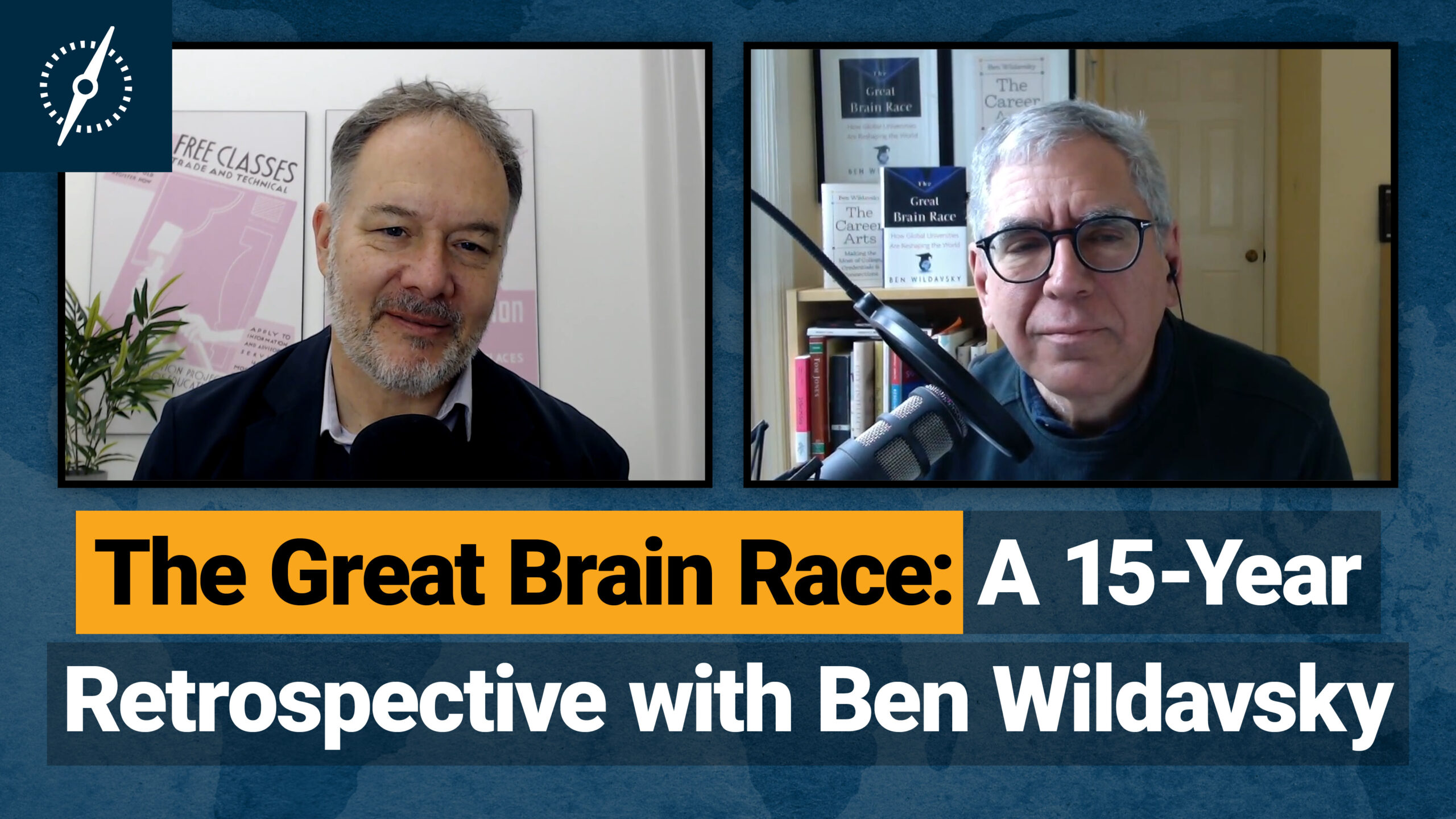
  • The Great Brain Race, 15 years later with Ben Wildavsky

    The Great Brain Race, 15 years later with Ben Wildavsky

    Sometimes books can be time machines. A few months ago, I started re-reading Ben Wildavsky’s excellent ‘The Great Brain Race: How Global Universities are Reshaping the World‘. First published by Princeton University Press in 2010. And it took me literally to another planet. An optimistic one where higher education and globalization went hand in hand to enrich the lives of students everywhere and which powered universities to new heights of competition and discovery. When the book came out, I remember reading all of this and being somewhat skeptical. But with all of the nonsense of the past decade or so in global higher education, frankly, it all sounds pretty good to me right now.

    Ben is, of course, a prolific author, and he’s written a great deal on the topic of higher education, most recently, ‘The Career Arts: Making the Most of Colleges, Credentials, and Connections‘. I could have asked Ben to come on to speak about pretty much any of them, but boy, did I want to talk about The Great Brain Race because it’s such a nostalgia sugar high.

    And so, on what is roughly the 15th anniversary of its publication, Ben agreed to come on and enlighten us about what seemed new and fresh back in 2010, things like global rankings and lavishly funded branch campuses, and let me ask him annoying questions, about whether and how it’s all gone wrong. And I’m very happy that he did.

    And so enough for me, let’s throw things over to Ben.


    The World of Higher Education Podcast
    Episode 3.19 | The Great Brain Race, 15 years later with Ben Wildavsky

    Transcript

    Alex Usher (AU): Ben, 15 years ago, you wrote The Great Brain Race. What was the thesis? What trends were you trying to illustrate?

    Ben Wildavsky (BW):  I was trying to take the much-discussed phenomenon of globalization—which, of course, we heard a lot about, including in bestsellers like The World is Flat by Tom Friedman—and apply that to higher education. I felt there was already so much evidence, both emerging and well-established, that globalization had made a significant impact on higher ed.

    I wanted the book to be both descriptive and, to some extent, prescriptive. I set out to highlight what I saw as a remarkable but somewhat under-discussed phenomenon: the massive mobility of students around the world. And beyond that, the mobility of faculty as well.

    Actually, David Lodge just passed away last week—he wrote a wonderful trilogy of academic novels that had an impact on me because he was such a sharp observer. But basically, I was looking at the mobility of students, faculty, and research. And to some extent, even the mobility of campuses themselves, with the rise of branch campuses and the increasing influence of global university rankings, which acted as a way to keep score.

    So, at its core, the book’s thesis was that much like I believe in markets and free trade as beneficial for the world economically, I also made the case for what I called free trade in minds—arguing that the global exchange of knowledge and talent has overwhelmingly positive effects. That idea sometimes faces backlash, often based on what I called academic mercantilism—the notion that countries should cling to their share of knowledge and fear if others start producing more PhDs.

    But I argued that knowledge is not a zero-sum game. In fact, we should welcome the expansion of education worldwide. If more people gain access to better education, it benefits the world as a whole.

    AU: You start the book by talking about the global war for talent. I have to say, I haven’t heard that term in a few years. We’re now in a world of tariffs and growing concerns about immigration. You actually interviewed me about this about a year ago. So, are we still in a global war for talent or not?

    BW: You know, I think there are two ways to answer that. I don’t know that we hear the rhetoric about the war for talent as much anymore, but if you talk to people in the global corporate world, they are still acutely aware of their need for well-trained workers. On the consumer side—on the student side—there’s still a strong demand for building human capital. And the evidence that education is critical for economic advancement seems as strong as ever.

    So, whether or not we still use the phrase war for talent, I don’t know. But look at what’s happening right now—we’re recording this on the verge of the second Trump administration. There’s a huge internal battle among Republicans over H-1B visas, which are issued to highly skilled university graduates. The assumption is that these graduates have talent since they’ve studied at American universities, and many foreign students want to stay and work in the U.S.

    This tension has existed in the Republican Party for a long time. Not to get sidetracked, but when I started working in Washington in 1995 for National Journal, the first article I wrote was about Republican infighting over free trade. Back then, people like Pat Buchanan represented the more economic nationalist wing of the party. That strain has become much more dominant in the Trump era. However, you still have figures like Elon Musk and others in Silicon Valley—people who see the clear benefits of allowing talented foreign graduates to stay in the U.S. and contribute to the innovation economy.

    So, again, whether or not we still use the term war for talent, I think there’s a strong awareness of the connection between education, experience, and economic growth.

    AU: So, to the extent that there is—or was—a war for talent 15 years ago, one of the ways people thought a country like the U.S. could win was by building what they called world-class universities. Our mutual friend, Jamil Salmi, even wrote a book with that title, right? And quite famously, I guess, just before your book came out. But the record of actually achieving world-class status is pretty small, isn’t it? Obviously, you have Harvard, Stanford, and Yale—places that were built 150 years ago and reached that status at least 50 years ago. Who has actually become a world-class university since then? A few in China, maybe the National University of Singapore, maybe Paris-Saclay through the merger process. Why do you think we haven’t seen more of this? Is achieving world-class status simply too difficult?

    BW: That’s a great question. To some extent, it depends on expectations—should we have seen an equal distribution of world-class universities around the globe by now, proportional to population or economic development? I don’t think so. I see it more as an aspirational goal.

    Many places—China, Germany with its Excellence Initiative, and others—clearly recognized the need to build high-quality research universities modeled on the U.S. system. And of course, as you know, and as you’ve discussed with other guests—and as I mention in my book—that U.S. model itself was originally based on the German Humboldtian Research University of the 19th century. So, there’s been this back-and-forth influence over time.

    But I think the more important question isn’t necessarily how many institutions have achieved world-class status. Sure, you can point to the National University of Singapore, some Chinese universities, and Paris-Saclay. But what really stands out—something Jamil Salmi wrote about so well—is why certain institutions have succeeded.

    Take the National University of Singapore. It embraced the merit principle, while the University of Malaya took a more insular approach—implementing admission quotas for certain ethnic groups instead of competing globally for top talent. NUS made a conscious decision to compete on a level playing field of excellence.

    So, I’m not trying to dodge the question, but I think in academia, not every institution is aiming for world-class status. Many universities focus on serving the masses, which is valuable in its own right. But at the top level, whether or not you break into the top 10 or top 20, if research excellence is your North Star, then that, to me, is a triumph of the aspirational principle of being world-class.

    AU: One way people tried to keep score in the world-class university race was through rankings. You dedicate a whole chapter to global rankings in your book. At the time, I remember thinking that this seemed newer to Americans than to everyone else. The U.S. started rankings back in the 1980s with U.S. News & World Report, but those rankings focused on very different factors. Now, we have more and more rankings—it feels like a new one comes out every couple of months. But do these rankings actually matter? Have they become more consequential over time, or not? Because I don’t get the sense that they’re driving policy the way they used to. And in your country, in the U.S., I don’t see much awareness of how far down the rankings the second- and third-tier American universities have fallen. The top-tier schools are still at the top, but the U.S. used to have 40% of the top 500 universities—now it’s maybe 20–25%. A lot of those second-tier institutions have dropped off, yet there’s been no reaction in the U.S. Why do you think global rankings have had less impact than expected?

    BW: Honestly, Alex, I can’t say I follow this as closely as I once did. But looking at the U.S. side of things, we’ve always been—famously or infamously—insular when it comes to higher education.

    We tend to focus more on how states compare to one another or on issues like student access to top institutions, especially economic access, which I think is a valid concern. But we don’t really worry about how our universities stack up internationally in the rankings. That’s partly a reflection of noblesse oblige—we’ve been such a dominant global force in higher education for so long that there hasn’t been a real sense of urgency.

    Despite the backlash against globalization and growing protectionist trends, the U.S. still remains the top destination for international students. And unlike many countries that have just one or two standout universities, we have what people in sports would call a deep bench—not just a few great universities, but dozens of truly world-class institutions.

    So, when I mention noblesse oblige, I’m half-joking, but the reality is that there’s never been much concern about losing that top-tier status. At the highest levels, sure, people care about reputation, but the U.S. doesn’t have a centralized Ministry of Education or a national funding mechanism that directly ties money to rankings, the way some other countries do.

    Our mutual friend Ellen Hazelkorn has written a lot about how rankings can create problematic policy incentives, but that’s just never been a major factor in the U.S. In other countries, I’m not sure how much weight rankings still carry, but I think there’s probably still a sporting interest in the latest Times Higher Education or QS rankings—seeing where universities land each year.

    That said, the idea that universities can directly link funding decisions to ranking outcomes—and that improving a ranking will necessarily lead to positive consequences—seems to be something people are increasingly skeptical about. From what I can tell, there’s a lot more agnosticism about rankings than there used to be.

    AU: Back in 2010, one of the things you were really interested in was the still-new rise of branch campuses. I think you spent time in Education City in Doha and spoke with John Sexton of NYU in Abu Dhabi. At the time, you saw these as representing a new stage of globalization—I think that’s the phrase you used in the book. How do you think these branch campuses have turned out? And what do you make of Texas A&M recently cutting and running from Education City?

    BW: Well, before getting into Texas A&M, I’d rather start with the broader picture. I certainly don’t want to be defensive about it—things change over time. But I don’t think I ever presented branch campuses as the next stage of globalization or the ideal model for every university. I saw them as part of a period of experimentation, and I think I made that pretty clear.

    These campuses were an effort to see what worked in different contexts—and, frankly, financial factors played a huge role. NYU wouldn’t be in Abu Dhabi without significant funding from the Emirates. The same goes for Georgetown, Texas A&M (when it was there), and the other universities in Qatar. A lot of money was poured into these initiatives.

    There was never really an argument that these campuses emerged purely from market forces. The free market alone wasn’t driving these incentives. But some of these institutions—especially the better-known ones—had strong global reputations. There was demand for their degrees from the same students who were eager to study in the U.S. because of the prestige of American research universities.

    For some students—particularly women in the Emirates—studying closer to home was especially appealing. Cultural norms made it more difficult for them to travel abroad, and even today, there are restrictions. So having branch campuses nearby offered opportunities that wouldn’t have otherwise been available.

    You still see NYU operating in both Abu Dhabi and Shanghai, even though John Sexton is now emeritus. Education City has lost Texas A&M, but as far as I know, none of the other American universities have left.

    AU: No, none of the other American ones have left.

    BW: That’s right. But to some extent, each case is unique. Qatar is in a complex geopolitical position—it presents itself as a mediator in the Israel-Hamas conflict while also having provided significant support to Hamas over the years. While many people are suffering in both Israel and Gaza, some Hamas leaders are living in luxury in Qatar.

    Now, I don’t know the exact reasons why Texas A&M left, but the optics of maintaining a campus there are certainly problematic—especially for a state institution from Texas. You could argue Qatar wants to have it both ways: pursuing forward-thinking educational initiatives, which I applaud, while also being a problematic actor in other ways. That tension likely played a role.

    It’s actually surprising that China, despite being a highly problematic state in different ways, has managed to maintain relatively strong relationships with American universities. There aren’t as many partnerships as there once were, but many U.S. institutions still have a presence there.

    AU: Those branch campuses were at least as much an experiment in cultural power as they were in education, right? That’s what people were after—a halo effect. That was certainly what the Emir of Abu Dhabi was aiming for.

    BW: I think that’s a fair point. And I should add—there’s still ongoing tracking of branch campuses worldwide. My former colleagues at SUNY, the State University of New York, have a great site that monitors the number of branch campuses across different universities.

    Kevin Kinser and others have been involved in that work, though I don’t know the exact numbers today. But I don’t think branch campuses have shrunk dramatically—it’s just that expansion hasn’t continued at the same rapid pace as before.

    AU: I guess a similar area at the time was global for-profit universities. These were still quite new back then. The dominant player at the time was Laureate, though there have been new entrants and a lot of movement in that market since. I was struck by one sentence in your book—let me read it to you: “The multinational for-profit firm could turn out to be the vehicle best suited for providing broad-scale access to practical higher education, benefiting students who might otherwise have had far fewer opportunities.” Do you think that statement still holds in 2025?

    BW: Great question. In a funny way, what comes to mind is that across all sectors, there’s a huge interest in what’s now called experiential learning. The idea of practical postsecondary education is as relevant as ever. And that doesn’t just mean vocational training—it’s something beyond secondary education, but still career-oriented.

    In fact, this is a topic I’m working on for a new book. There’s a major push to develop education that’s both advanced and directly connected to workforce needs. And that’s happening not just in the for-profit sector, but in the public and mainstream higher education sectors as well.

    So, perhaps you could argue that what I described in my book has been discovered more broadly. Despite some backlash against certain forms of higher education in the U.S., globally, there’s still a strong push to expand educational opportunities beyond secondary school. The OECD continues to track educational attainment by country, and there’s concern in many places about falling behind.

    As for whether the for-profit sector has unique advantages, I’m not sure. But in the parts of the sector I still follow, things like pathway programs—which help international students gain exposure to Western universities, either in their home country or abroad—are still popular. For-profit providers like Kaplan, which I do some consulting work with, remain very active in that space. They’re particularly effective at recruiting students and providing them with the preparation they need. It’s a win-win: students want access to universities, and universities want to fill seats. That’s one area where for-profits continue to play a role.

    I’m less familiar with what’s happening in Latin America today, but when I was researching for my book, I was particularly struck by places like Brazil. There, the idea of free public education at elite universities sounded noble. People in the U.S. often ask, Why don’t we have free public higher education? But when you look closer, the students who attend these elite public universities often come from wealthy families who could afford expensive secondary schooling.

    So, in practice, free higher education often ended up being free for the wealthy. Meanwhile, for-profit universities, which some critics saw as problematic, were actually serving middle- and lower-middle-class students—offering practical programs in fields like nursing, IT, and business.

    Again, I haven’t kept up as closely with what’s happening now, but I’d say that the demand for career-focused education has been increasingly absorbed by the mainstream higher ed sector as well.

    AU: A part of what’s happened is that the vocationalization of higher education has shifted more to the master’s level—or at least the post-baccalaureate level. That’s where a lot of these private, global universities are focusing now. It’s that master’s degree space—a practical degree, like you said. It’s post-bachelor’s, so there’s something both global and vocational about it, but it might not align with the way we typically think about access.

    Listen, when I reread your book, I had a smile on my face the whole time because I thought, Oh my God, this is such an optimistic book! You don’t really see optimistic books about globalization or higher education anymore. I’m not sure anyone has written one that optimistic since you did—maybe you were the last one. So let me ask: Do you think you were overly optimistic? Or did something specific happen that derailed the future you envisioned? Is it as simple as saying, Xi Jinping, Donald Trump, and Vladimir Putin ruined everything? What happened?

    BW: Well, I love that shorthand as a way of describing where we are today—but I don’t actually think it gives a full picture of what’s happened. And I proudly wear the optimist badge.

    I don’t think I was excessively optimistic. Of course, I could point to plenty of caveats and shades of gray in the book—I made it clear that this was a work in progress.

    Our mutual friend, Phil Altbach—who’s really the dean of global higher ed scholars, and a wonderful guy—was actually quite direct with me about this. He was kind enough to blurb my book, but he also made it very clear that he thought I was way too optimistic. He tends to have a more jaundiced view of some of these developments.

    That said, I don’t think I was being a Pollyanna about it. I never argued that every development was wonderful. But I do see globalization in higher education as similar to free trade. If you were writing about free trade—now, I’m not comparing myself to Adam Smith or John Stuart Mill—but if you were setting out the principles of free trade, you’d focus on the long-term economic benefits.

    There are always setbacks, political arguments, and waves of protectionism—like the tariffs and nationalist policies we saw during the Trump administration, which, frankly, some Democrats also supported. But none of that changes the fundamental principle that free trade is economically beneficial.

    In the same way, I still believe that global higher education is expanding in ways that are, ultimately, beneficial. When I wrote the book, there were about 3 million students studying abroad for a year or more. By 2019, that number had doubled to around 6 million. The OECD had projected 8 million by 2025. I don’t know exactly where we are now, but we’re certainly in the ballpark.

    So just in sheer numbers, this expansion is happening. People are getting more educated. Claudia Goldin, the Nobel Prize-winning economist, described the 20th century as the human capital century, and I think that trend is continuing—both in places like the U.S. and Canada and on a global scale.

    Yes, you can point to a million different setbacks. There have been waves of backlash against international students in the U.K., Canada, Australia, and sometimes in the U.S. Governments implement bad policies that create temporary setbacks. But if you look at the big picture, the historical trajectory suggests that people will keep seeking opportunities to get ahead.

    What I argued in the book is that people want to get ahead based on what they know and what they can learn—not based on where they’re from or how much money they have.

    Of course, in the first waves of internationalization, wealthier students had the most access to global education. But in the long run, I believe in a more meritocratic world—one where more and more people can improve their circumstances through education, with fewer barriers standing in their way.

    That’s not just idealism—I think it’s a reality that’s unfolding, incrementally, for more and more people.

    AU: The arc of higher education is long, but it bends toward globalization?

    BW: I would say so, yes.

    AU: How do we make it bend faster? If we come back here in 15 years, what do you think will have changed to speed things up? Or will anything? What’s your sense of how things will evolve over the next few years?

    BW: To some extent, it depends on things like global economic growth. If the global economy continues—maybe with some fits and starts—but generally moves forward, and if the world becomes wealthier, then I think people will continue to recognize that human capital is king. Education and economic development are deeply connected, and as long as that remains true, people will keep seeking out educational opportunities.

    In their own countries, I hope we’ll continue to see expanded access to education, higher completion rates, and greater equity across race and class. Obviously, in the U.S., we’ve had big fights over affirmative action, but regardless of what happens on that front, people will still want more education and opportunity. And I think the same will be true globally.

    So, the real question is: What can we do to stay out of the way? How do we prevent unnecessary restrictions on international students? How do we ensure there’s a sustainable funding model? On that point, I’m somewhat agnostic—there are relatively low-cost, mass-access universities that provide real opportunities, and there are incredibly expensive elite universities. I think we probably need both.

    AU: Ben Wildavsky, thanks so much for joining us.

    BW: Thanks so much for having me. It was a great conversation.AU: And that just leaves me to thank our excellent producers, Tiffany MacLennan and Sam Pufek, and you—the reader, viewer, or listener—for joining us. If you have any questions or comments about today’s episode, don’t hesitate to get in touch at [email protected]. And don’t forget to subscribe to our YouTube channel—sign up and never miss an episode of The World of Higher Education. Join us next week when our guest will be Duncan Ross, former Chief Data Officer at Times Higher Education. He’ll be talking with us about the world of global university rankings. Bye for now.

    *This podcast transcript was generated using an AI transcription service with limited editing. Please forgive any errors made through this service.


    Source link