Tag: Break

  • Five Things to Know About McMahon’s Plan to Break Up ED

    Five Things to Know About McMahon’s Plan to Break Up ED

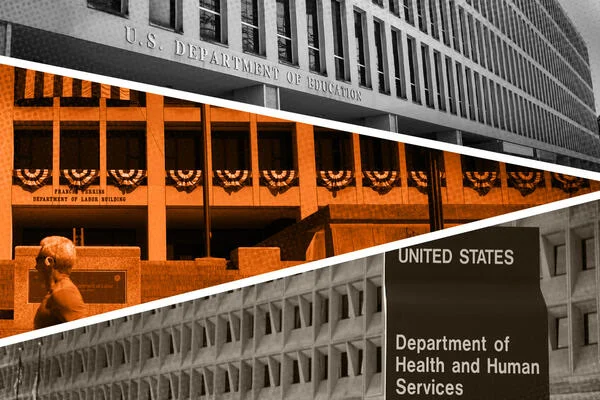
    Dozens of the Education Department’s programs were scattered across Washington D.C. last week, but a few core components remain at the Lyndon B. Johnson Building on Maryland Avenue: the offices for civil rights, special education and federal student aid (FSA).

    These three offices, particularly FSA, oversee some of the department’s most direct services to taxpayers—including the Pell grant, federal student loans, discrimination complaints and individualized education programs for students with disabilities—so moving them would likely be more complicated and controversial.

    Since President Trump first took office, some of the more vocal pushback to his plan for shutting down the department has come from the parents, families and advocacy groups who depend on these offices. But other programs at ED, including those in the Office of Postsecondary Education, were outsourced to other agencies Tuesday through a series of six interagency agreements as part of a broader effort to diminish the department. And even though the three offices were spared in this latest round of dismantling, they may not be safe in the long run.

    President Trump has talked about moving FSA to the Small Business Association and sending special education to the Department of Health and Human Services. Plus, as the Department of Justice has become increasingly involved in education issues, several experts anticipate OCR could be relocated there.

    A senior department official told reporters last week that ED is “still exploring the best plan” for those offices and the programs they oversee.

    In the meantime, here’s a rundown of what we know about Trump’s latest effort to dismantle ED.

    Why is ED Doing This?

    The Trump administration has been clear from the start: its “final mission” is to shut down the department. Officials touted this latest action as a key step toward that goal.

    Even though ED is still going to oversee the programs, this move is a way for Trump officials to show they don’t need the department itself to ensure “the effective and uninterrupted delivery of services, programs, and benefits on which Americans rely,” as stated in Trump’s executive order.

    don’t delete this space/it’s for the chart

    Education Secretary Linda McMahon told department staff last week that it’s all part of an effort to “streamline bureaucracy” and “return power to the states.” But she acknowledged that the agreements are a temporary solution and that Congress will need to sign off eventually.

    Further, she told staff that it’s important to explain to the American public that, in the long run, shutting down the department doesn’t mean getting rid of all its programs.

    “So it is important how we message that,” McMahon said, citing survey data that showed the majority of Americans opposed shutting down the department but that changed when they learned the programs would remain. “Because honestly, folks, and I’m not trying to sugarcoat this, in the end of this the goal will be to have Congressional votes to close the Department of Education.”

    This move comes after years of conservatives lambasting the department for being too woke. They, like McMahon, have said reducing the federal role in education will be a way to protect students’ and parents’ rights.

    “Each of us in this room has a chance to be part of history,” McMahon said.

    What’s Actually Changing?

    Many higher education policy analysts say not much. Aside from outsourcing dozens of grant programs and adding extra steps to the award allocation process, little is expected to change (at least directly). Still, higher ed experts are divided on whether the funding system can survive such a transition.

    Congress will still decide how much money is available and what it should go toward. And the Department of Education will still receive funding, post grant applications and set guidelines for the competitions. But now, rather than that money going directly from ED to institutions, it will be funneled through four other agencies: the Departments of Health, Interior, Labor, and State, which will then dole out the money to colleges and universities.

    These agencies, particularly the Department of Labor and its Employment and Training Administration, will now be the ones to actually run the competition, decide who wins and allocate the funds. When colleges have questions about drawing down federal dollars or staying in compliance with department policies, it won’t be ED they contact.

    don’t delete // space for chart

    Why the Department of Labor?

    Most of the higher education grant programs are heading to the Department of Labor, including TRIO, programs supporting historically Black colleges and universities and the Fund for the Improvement of Postsecondary Education.

    This shift follows a growing push across the country to better align higher education with workforce demands. Some, including the Trump administration argue that it makes sense to move college grant programs to the Department of Labor, where the mission is improving “the welfare of the wage earners” and “advanc[ing] opportunities for profitable employment.”

    Nineteen higher ed programs at moving to the Labor Department.

    Photo by Andrew Harnik/Getty Images

    One senior department official told reporters that if education is about creating the workers of tomorrow then “nowhere is it better housed than at the Department of Labor [which] thinks about this night and day.” In fact, the department has already integrated its Office of Career Technical and Adult Education with Labor and a handful of states have merged their departments of education and workforce. (During President Trump’s first term, officials briefly proposed merging Education and Labor, though that idea didn’t move forward.)

    But critics fear that Labor won’t be able to effectively oversee grants for short-term, technical training programs, let alone broader initiatives focused on college access, equity and student success. Largely, they worry that the plan could sow confusion, weaken accountability measures and eventually lead to the consolidation of programs that are similar but not duplicative and intentionally separate.

    Angela Hanks, a Democrat who previously served as ETA’s acting assistant secretary, said in a social media post that “it’s hard to describe” the “nonsensical” nature of what Trump and McMahon are doing and compared the transfer of power to “having a frog carry a camel on its back.”

    Currently, Hanks said, the main youth-focused program at Labor serves about 130,000 students while TRIO alone serves about 870,000. The office would also take on even larger programs like Title I funding for low-income kids at K-12 schools, which serve up to 26 million students.

    What’s in the Fine Print?

    The interagency agreements do appear to maintain the operation of existing programs for now, but critics argue details both large and small in the text that add bureaucracy and confusion to the process rather than reducing it.

    For example, while the seven grant programs for minority-serving institutions are still expected to continue, various parts are being sent off to different agencies. Four grants that involve Alaskan-, Native American–, Asian American– and Pacific Islander–serving institutions will be housed at the Department of Interior. Labor will oversee the remaining three, which support HBCUs as well as predominantly Black- and Hispanic-serving institutions.

    Federal policy restricts some institutions from receiving multiple awards across different grant designations despite being eligible, but spreading out various MSI grants could still create complications. Historically, when deciding which grant program is the best fit or clarifying compliance standards, institutions could go to one office for the answers. Now, they may have to contact multiple different staffers.

    Multiple higher ed experts have also expressed the concern that rather than cutting grant funds, which only Congress can do, the Trump administration may try to consolidate programs that are similar but not identical.

    For example, CCAMPIS, a program focused on subsidizing child care for student parents, is being moved to HHS, which already oversees the Community Services and Child Care and Development Block Grants. These programs target a broader swath of low-income individuals and families, so college access advocates fear that if the funding pots are merged, it could pull grant dollars away from the student parents they were intended for.

    Language describing such efforts to “integrate” programs appears in the announcement’s news release, as well as in the fact sheets and agreements. But legal experts say that’s what Congress was trying to avoid by creating ED, and they expect the agreements to face court challenges.

    “The Department’s actions will expand federal involvement, rather than streamline it,” said Josie Eskow Skinner, a former general counsel attorney at ED who is now a partner at Sligo Law Group. “As a result of these agreements, states will now have to deal with the potentially conflicting or duplicative demands of multiple federal agencies with no central point of coordination or technical assistance.”

    How Does It Align With Project 2025?

    In a hearing held by the House Education and Workforce Committee the day after McMahon announced the interagency agreements, Rep. Suzanne Bonamici, an Oregon Democrat, said the Heritage Foundation’s Project 2025 “laid the groundwork for this illegal move of this program and shutting down the Department of Education.”

    Project 2025, a sweeping 900-page manual, outlines a multitude of recommended changes across nearly all sectors of the federal government, including how to shut down ED. Following last week’s decision, the Trump administration has made several of the suggested changes including moving career education and postsecondary programs to Labor and transferring tribal college programs to the Interior Department. (Lindsey Burke, who now serves as ED’s deputy chief of staff for policy and programs, authored the manual’s education chapter.)

    Still remaining on the Project 2025 to-do list include moving the Office for Civil Rights to the Department of Justice and giving Treasury control of federal student aid.

    Trump has repeatedly denied involvement with the project, even though actions in the first few months closely follow the project’s recommendations.

    But there’s one key way McMahon’s actions so far differ from Project 2025—she’s not making funding cuts or eliminating programs. Project 2025 recommends doing so through an act of Congress.

    Source link

  • With better coordination we can break down barriers to academic policy engagement

    With better coordination we can break down barriers to academic policy engagement

    How can universities best support the UK’s research base to deliver better outcomes for people? This is becoming an ever more urgent challenge for our sector, in the context of a changing geopolitical landscape and the desire of the UK government for research and innovation to better serve the public good.

    One route to deriving greater public benefit from academic research lies in research better connecting with and informing public policy development. Recent years have seen a growing number of universities establishing policy units – at least 46, at the last count, and almost certainly more now. There has also been increased investment in policy-focused activity from research funders, for example, Research England’s Policy Support Fund, UKRI policy fellowships, and ESRC investments to increase policymaker engagement with research. New mechanisms to strengthen evidence use, such as government areas of research interest and parliamentary thematic research leads, have been introduced, alongside an increased focus on building capacity for evidence use across sub-national government.

    Through the Covid-19 pandemic, we saw the myriad ways in which research evidence informed policy to deliver benefits for people, whether understanding and treating the disease, informing the public health response, or mitigating the wider social impacts.

    You can’t always get what you want

    “Academic-policy engagement” is becoming increasingly mainstream, as part of universities’ wider knowledge exchange or civic engagement strategies. However, considerable barriers to engagement between academic researchers and policymakers remain. These include significant cultural differences, lack of incentives and investment, mismatched timescales and approaches, lack of access to academic research, and difficulties in parsing an ever-growing volume of information.

    Policymakers often express a desire for a streamlined, “one stop” interface with academics to enable them to quickly and easily reach the right expertise at the right time. Given such barriers, this is much easier said than done.

    Too often, where interaction does happen, it is short-term, ad hoc, dependent on individual contacts, and enabled through fixed-term funding rather than sustainable approaches. Many institutions lack both the capacity and the necessary capabilities to respond to policy needs.

    There is no systematic mechanism for policymakers to engage with universities in order to identify and access the expertise they need, or for universities and researchers to identify policy needs, still less provide a coordinated response. This means that policymakers do not necessarily have access to the best evidence, only that which is most readily available.

    What is now required is a serious focus on establishing a more systematic and sustainable approach. Such an approach requires organisational capacity and individual capability, alongside greater collaboration and coordination across the academic-policy ecosystem.

    The policy connection cavalry is here

    This is where the Universities Policy Engagement Network (UPEN) comes in. Established in 2018 UPEN is a voluntary network of over 120 universities, research centres, and policy organisations across the UK, currently hosted at UCL. Our university members comprise diverse institutions, from large, research-intensive to small, specialist institutions, across all parts of the UK. UPEN provides an interface between all areas of academic research and public policymaking, with strong relationships with the UK’s four national legislatures and 25 government departments and growing links with local and regional policymakers.

    UPEN has until now been powered by the contributions of our members: both financial and, crucially, time. With a new funding award from Research England and ESRC, we now have the opportunity to build a national “connective infrastructure” which can respond to growing policy demand, at multiple levels of government, for academic expertise and evidence.

    Enhancing UPEN’s ability to provide this interface will enable us as a sector to work in a more coordinated and efficient way. It will also foster greater diversity in academic-policy engagement by ensuring a greater breadth of evidence and voices are heard. And it will build on previous UKRI investments to underpin stronger collaboration and collective action to harness the full potential of the university research base.

    Our new programmes of work will focus on three key areas. First, supporting universities to strengthen their academic engagement with public policy by enhancing individual and organisational capabilities. Second, strengthening place-based approaches to academic-policy engagement. Third, developing a national knowledge brokerage function to mobilise academic expertise to respond at the point of policy need.

    The UK government is grappling with multiple complex and cross-cutting policy challenges – from bolstering a weak economy, to improving energy security and sustainability, to tackling problems with the health service, to addressing housing needs. It is time for us, as a sector, to better leverage the knowledge of universities to address these challenges in order to deliver better outcomes for citizens across the UK.

    Source link

  • 3 ways to break down silos between general and special education

    3 ways to break down silos between general and special education

    This audio is auto-generated. Please let us know if you have feedback.

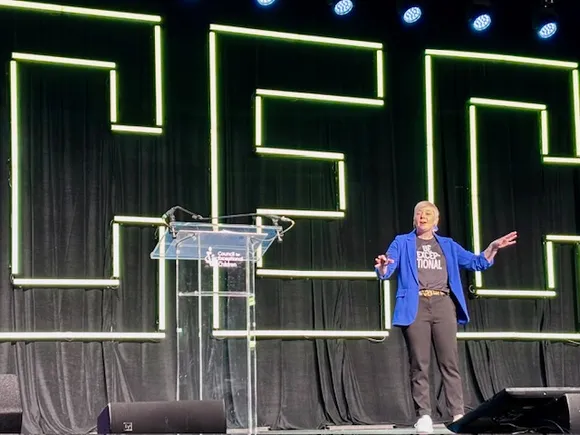
    BALTIMORE — When educators operate with separate goals and don’t engage in authentic collaboration, it creates friction and can ultimately hurt student progress, said Casey Watts, an educator and team leadership expert, in the opening keynote address at the Council for Exceptional Children’s annual convention on Wednesday.

    “I believe that people deserve to be part of collaborative teams that move forward, make an impact together and leave them feeling empowered, inspired and essential,” said Watts, who is also a pre-K-5 instructional coach at Hudson Independent School District in Lufkin, Texas.

    When educators and administrators are siloed, there can be an “us versus them” mentality, she said. “I believe that when we function in silos as educators, we unintentionally create silos in our students.” 

    To dismantle barriers between general and special educators and between teachers and administrators, Watts recommends three core concepts: 

    Have an ‘elevator pitch’

    Maintaining a strong sense of identity and purpose in your work can help eliminate ambiguities and assumptions others have of your role at school, Casey said. This goes for all educators in the school, including special education teachers, general education teachers, counselors, administrators and others.

    To ensure clarity, educators should work on their “elevator pitch,” or a brief summary of their role in the school. “When you create an elevator pitch, what you are essentially doing is pulling people in to become the main character of the story, and you are addressing their pain points, and you’re giving them new narratives for your position, which in essence, is bridging the gaps that exist between us as adults in education,” Watts said.

    In developing their elevator pitches, educators should think about how their role serves others in the school building and the skills they offer to educators and students.

    Engage in authentic collaboration

    Authentic collaboration is easier said than done, Watts said. And some “faux collaborations” can seem promising — such as an offer to share resources and materials — but really don’t break down barriers among educators.

    True collaboration takes courage and vulnerability and can include difficult conversations. It also means using everyone’s strengths and listening to all voices, she said.

    Establishing protocols where each person in the school community is a contributor can help break down silos, Watts said.

    Bring clarity to goals

    When everyone is on the same path, they know where the team is headed and how to get there. But when goals are unclear or the path is uncertain, people can get off track or operate independently, Watts said.

    When that happens, teachers go into their classrooms, close the door and vow to do what’s best for their students. But that can lead to unintentional gaps in student learning.

    “As I work with teams in districts across the nation, I hear so often leaders say ‘our teachers just won’t get on board,’” Watts said. “On the flip side of that, I’m hearing from teachers and staff who are saying the opposite: ‘We just never know what’s going on.’ There are two different narratives at play.”

    A lack of clarity creates unproductive confusion, Watts said. As a result, educators and administrators might lack confidence and feel defeated, frustrated and distrustful, she said.

    Setting out clear goals will boost confidence and capacity in educators, resulting in a collective efficacy, Watts said. That, in turn, will have “a significant impact on student learning,” she said.

    Source link

  • Did the Ivy League really break America? (opinion)

    Did the Ivy League really break America? (opinion)

    Are many of the ills that plague American society caused by Ivy League admission policies?

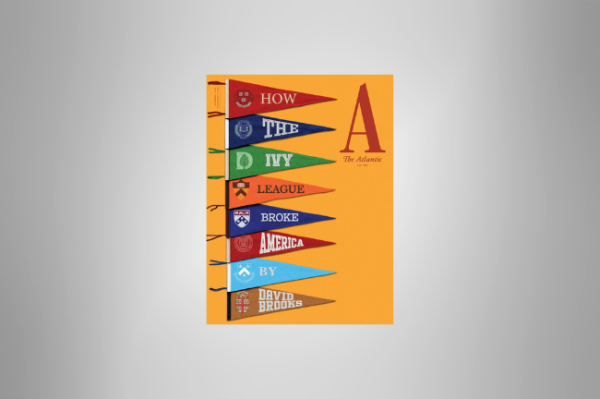
    That is the premise of David Brooks’s cover story for the December issue of The Atlantic, “How the Ivy League Broke America.” Brooks blames the Ivies and “meritocracy” for a host of societal problems, including:

    • Overbearing parenting
    • Less time for recess (as well as art and shop) in schools
    • An economy that doesn’t provide opportunities for those without a college degree
    • The death of civic organizations like Elks Lodge and Kiwanis Club
    • The high percentage of Ivy League graduates who choose careers in finance and consulting
    • The rise of populism based on “crude exaggerations, gross generalizations, and bald-faced lies.”

    Brooks somehow left the decline of small-town mom-and-pop businesses and the popularity of reality television off his laundry list.

    You may be wondering how the Ivies contributed to or caused all these problems. The essence of Brooks’s argument is that “every coherent society has a social ideal—an image of what the superior person looks like.” His hypothesis is that America’s social ideals reflect and are determined by the qualities that Ivy League universities value in admission.

    One hundred years ago, the Ivy League social ideal was what Brooks terms the “Well-Bred Man”—white, male, aristocratic and preppy, athletic, good-looking, and personable. What was not part of the ideal was intellectual brilliance or academic prowess, and in fact those who cared about studying were social outcasts. Applying to the Ivies resembled applying for membership to elite social clubs.

    That changed starting in the 1930s when a group of educational leaders, the most prominent being Harvard president James Conant, worried that the United States was not producing leaders capable of dealing with the problems it would face in the future. Their solution was to move to an admission process that rewarded intelligence rather than family lineage. They believed that intelligence was the highest human trait, one that is innate and distributed randomly throughout the population. Conant and his peers believed the change would lead to a nation with greater opportunities for social mobility.

    Brooks seems far from sure that the change was positive for America. He acknowledges that “the amount of bigotry—against women, Black people, the LGBTQ community—has declined” (that might be debatable given the current political climate), but observes that the previous ideal produced the New Deal, victory in World War II, NATO and the postwar world led by America, while the products of the ideal pushed by Conant have produced “quagmires in Vietnam and Afghanistan, needless carnage in Iraq, the 2008 financial crisis, the toxic rise of social media, and our current age of political dysfunction.” Those examples seem cherry-picked.

    In the essay, Brooks cites a number of troubling societal problems and trends, all supported with extensive research, but the weakness of his argument is that he tries to find a single cause to explain all of them. That common denominator is what he calls “meritocracy.”

    Meritocracy, a society with opportunities based on merit, is an appealing concept in theory, but defining merit is where things get sticky. Merit may be similar to Supreme Court justice Potter Stewart’s description of pornography, in that you know it when you see it. Does merit consist of talent alone? Talent combined with work ethic? Talent, work ethic and character?

    Merit is in the eye of the beholder. If I was admitted to an Ivy League university, it was obviously because I had merit. If someone else, especially someone from an underrepresented population, got the acceptance instead of me, factors other than merit must have been at play. If two candidates have identical transcripts but different SAT scores, which one possesses more merit? Complicating the discussion is the fact that many things cited as measures of merit are in fact measures of privilege.

    For Brooks, Ivy League meritocracy involves an overreliance on intelligence and academic achievement, to the detriment of noncognitive skills that are more central to success and happiness in life. He argues that “success in school is not the same thing as success in life,” with success in school primarily being individual while success in life is team-based. He quotes Adam Grant’s argument that academic excellence is not a strong predictor of career excellence.

    Ultimately, he argues that “meritocracy” has spurred the creation of “an American caste system,” one in which “a chasm divides the educated from the less well-educated,” triggering “a populist backlash that is tearing society apart.” Yet Brooks’s beef is not so much with meritocracy as it is with a mindset that he attributes to Conant and his brethren. He equates meritocracy with a belief in rationalism and social engineering that assumes that anything of value can be measured and counted. What he is criticizing is something different from meritocracy, or at least reflects a narrow definition of meritocracy.

    Even if we don’t agree with Brooks’s definitions, or the implication that Ivy League admission policies are responsible for the ills of society, his article raises a number of important questions about the college admission process at elite colleges and universities.

    First, is the worship of standardized testing misplaced? The SAT became prominent in college admission at around the same time that Conant and others were changing the Ivy League admission paradigm. They believed that intelligence could be measured and latched onto the SAT as a “pure,” objective measure of aptitude. Today, of course, we recognize that test scores are correlated with family income and that scores can be manipulated through test preparation. And the “A” in SAT no longer stands for aptitude.

    Do we measure what we value or do we value what we can measure? Brooks criticizes the Ivies for focusing on academic achievement in school at the expense of “noncognitive skills” that might be more important to success in life after college, things like curiosity, relationship-building skills and work ethic. He’s right, but there are two reasons for the current emphasis. One is that going to college is going to school, so an admission process focused on scholastic academic achievement is defensible. The other is that we haven’t developed a good mechanism for measuring noncognitive skills.

    That raises a larger question. What do we want the admission process to accomplish? The SAT is intended to predict freshman year college GPA (in conjunction with high school grades). Is that a satisfactory goal? Shouldn’t we have a larger lens, aiming to identify those who will be most successful at the end of college, or after college? Should we admit those with the greatest potential, those who will grow the most from the college experience, or those who will make the greatest contribution to society after college?

    Brooks questions elite colleges’ preferences for “spiky” students over those who are well-rounded. Is a student body full of spiky students really better? An even more important question arises from a distinction Brooks made some years ago between “résumé virtues” and “eulogy virtues.”

    Does the elite college admission process as currently constituted reward and encourage students who are good at building résumés? A former student attending an elite university commented that almost every classmate had done independent academic research and started a nonprofit. Do students aspiring to the Ivies choose activities because they really care about them or because they think they will impress admission officers, and can admission officers tell the difference? What is the consequence of having a student body full of those who are good at playing the résumé-building game?

    There is one other issue raised by Brooks that I find particularly important. He argues that those who are successful in the elite admission process end up possessing greater “hubris,” in that they believe their success is the product of their talent and hard work rather than privilege and luck. Rather than appreciating their good fortune, they may believe they are entitled to it. That misconception may also fuel the populist backlash to elites that has increased the division within our country.

    I don’t buy Brooks’s definition of meritocracy or his contention that the Ivy League “broke” America, but his article nevertheless merits reading and discussion.

    Jim Jump recently retired after 33 years as the academic dean and director of college counseling at St. Christopher’s School in Richmond, Va. He previously served as an admissions officer, philosophy instructor and women’s basketball coach at the college level and is a past president of the National Association for College Admission Counseling. He is the 2024 recipient of NACAC’s John B. Muir Excellence in Media Award.

    Source link

  • Maximize Your Winter Break: College Class Benefits

    Maximize Your Winter Break: College Class Benefits


    Maximize Your Winter Break: College Class Benefits


    Source link

  • HR Book Recommendations for Winter Break

    HR Book Recommendations for Winter Break

    by Julie Burrell | December 4, 2024

    The holiday break is a perfect time for leveling up your knowledge, igniting your HR spark, and collecting wisdom to share with your team. These book recommendations have been hand-picked by CUPA-HR colleagues for their insights into topics like change management, inclusion and belonging, and daring leadership. They make great team book club reads, too!

    Grab a warm beverage and cozy up with one of these HR reads.

    For bold leaders…

    Vulnerability might not spring to mind as the most important trait in a leader, but in Dare to Lead, Brené Brown encourages leaders to tune into their hearts as much as their minds.

    For the everyday superstar…

    In Hidden Potential, Adam Grant, a Wharton School of Business professor, says that we all have the ability to improve. You don’t have to be a prodigy or work yourself to the point of burnout, but instead be willing to learn and develop your character.

    For the inventor…   

    If you’ve ever pondered creative ways to do more with less, check out A Beautiful Constraint by Adam Morgan and Mark Barden. Jay Stephens, vice president of people and culture at the University of Montana, says “it’s a great book for higher ed, where we tend to live with a scarcity mindset.”

    For the team leader who’s always learning…

    The Five Dysfunctions of a Team by Patrick Lencioni is a perennially popular book. Written in the form of a fable, it addresses some common team issues, like lack of trust, fear of conflict, and avoidance of accountability.

    For those looking to stress less…

    Jennifer Moss, a keynote speaker at the 2024 CUPA-HR Annual Conference and Expo, is a leading voice in fighting burnout. The Burnout Epidemic argues that organizations must take the lead in developing an anti-burnout strategy that moves beyond apps, wellness programs, and perks.

    For out-of-the-box thinkers…

    Miranda Arjona, assistant director of HR at Rollins College, encourages embracing the qualities that make children special (and that we tend to forget when we’re all grown up). Oh, the Places You’ll Go by Dr. Seuss “encourages readers to embrace new experiences, face obstacles with courage, and keep moving forward,” while Curious George by H.A. Rey and Margret Rey “emphasizes the importance of curiosity, exploration, and learning from one’s mistakes.” Winnie-the-Pooh by A.A. Milne “offers insights into the importance of enjoying the present moment, valuing simple pleasures, and appreciating the quirks of those around us.”

    Bonus tips for the book club leader (no required reading!)…

    As the content specialist in training and development, Corrie Grint hosts two different book clubs at the University of Utah. Here are her tips for success.

    • Vary book choices. Grint chooses a mix of classic leadership books, new and popular books, and untraditional books.
    • Build in flexible participation. Grint bases her questions on the general principles of books like Atomic Habits, “so anyone can participate, even if they haven’t read the book.”
    • Structure clubs inclusively. Participation is virtual and capped at one hour.
    • Offer pre-session and during-session support. A week before, Grant emails out other options to supplement or replace the reading, such as a book summary PDF or YouTube video. She also provides questions similar to the ones they’ll discuss. During the meeting, she provides a summary of the principles taught, along with quotes, and asks questions along the way.


    Here’s the full list of recommendations, chosen by CUPA-HR colleagues:

    An Astronaut’s Guide to Life on Earth: What Going to Space Taught Me About Ingenuity, Determination, and Being Prepared for Anything by Chris Hadfield

    Atomic Habits: An Easy and Proven Way to Build Good Habits and Break Bad Ones by James Clear

    A Beautiful Constraint: How To Transform Your Limitations Into Advantages, and Why It’s Everyone’s Business by Adam Morgan and Mark Barden

    Big Feelings: How to Be Okay When Things Are Not Okay by Liz Fosslien and Molly West Duffy

    The Burnout Epidemic: The Rise of Chronic Stress and How We Can Fix It by Jennifer Moss

    Career Self-Care: Find Your Happiness, Success, and Fulfillment at Work by Minda Zetlin

    Crucial Conversations: Tools for Talking When Stakes are High by Joseph Grenny and others

    Curious George by H.A. and Margaret Rey

    Dare to Lead: Brave Work. Tough Conversations. Whole Hearts. by Brené Brown

    Daring Greatly: How the Courage to Be Vulnerable Transforms the Way We Live, Love, Parent, and Lead by Brené Brown

    Do Better: Spiritual Activism for Fighting and Healing from White Supremacy by Rachel Ricketts

    The Dream Manager: The Secret to Attracting, Engaging, and Retaining Talent by Matthew Kelly

    Emotional Intelligence 2.0 by Travis Bradberry and Jean Greaves

    Endurance: A Year in Space and a Lifetime of Discovery by Scott Kelly

    The Energy Bus: 10 Rules to Fuel Your Life, Work, and Team with Positive Energy by Jon Gordon

    First, Break All the Rules: What the World’s Greatest Managers Do Differently by Marcus Buckingham

    Fish!: A Proven Way to Boost Morale and Improve Results by Lundin, Christensen, and Paul

    The Five Dysfunctions of a Team: A Leadership Fable by Patrick M. Lencioni

    The 5 Languages of Appreciation in the Workplace: Empowering Organizations by Encouraging People by Gary Chapman and Paul White

    Ghost Soldiers: The Epic Account of World War II’s Greatest Rescue Mission by Hampton Sides

    Goodnight Moon by Margaret Wise Brown

    The Guide to Good Leading series by Ari Weinzweig

    Hidden Potential: The Science of Achieving Greater Things by Adam Grant

    HR on Purpose: Developing Deliberate People Passion by Steve Browne

    I’m No Philosopher, But I Got Thoughts: Mini-Meditations for Saints, Sinners, and the Rest of Us by Kristen Chenoweth

    Invisible Women: Data Bias in a World Designed for Men by Caroline Criado-Perez

    Just Mercy: A Story of Justice and Redemption by Bryan Stevenson

    Leadership and Self-Deception, Fourth Edition: The Secret to Transforming Relationships and Unleashing Results by The Arbinger Institute

    The Life-Changing Magic of Tidying Up: The Japanese Art of Decluttering and Organizing by Marie Kondo

    The Long-Distance Teammate: Stay Engaged and Connected While Working Anywhere by Kevin Eikenberry and Wayne Turmel

    Managing Transitions: Making the Most of Change by William Bridges

    No Ego: How Leaders Can Cut the Cost of Workplace Drama, End Entitlement, and Drive Big Results by Cy Wakeman

    Oh, the Places You’ll Go! by Dr. Seuss

    The Outward Mindset: Seeing Beyond Ourselves by The Arbinger Institute

    Own Your Own Work Journey! The Path to Meaningful Work and Happiness in the Age of Smart Technology and Radical Change by Edward D. Hess

    The Power of Habit: Why We Do What We Do in Life and Business by Charles Duhigg

    Radical Candor: Be a Kick-Ass Boss Without Losing Your Humanity by Kim Scott

    Set Boundaries, Find Peace: A Guide to Reclaiming Yourself by Nedra Glover Tawwab

    The 7 Habits of Highly Effective People by Stephen R. Covey

    Smart Brevity: The Power of Saying More with Less by Jim VandeHei and others

    Supercommunicators: How to Unlock the Secret Language of Connection by Charles Duhigg

    Thanks for the Feedback: The Science and Art of Receiving Feedback Well by Douglas Stone and Sheila Heen

    Think Again: The Power of Knowing What You Don’t Know by Adam Grant

    Unreasonable Hospitality: The Remarkable Power of Giving People More Than They Expect by Will Guidara

    When Everyone Leads: How The Toughest Challenges Get Seen and Solved by Ed O’Malley and Julia Fabris McBride

    Who Moved My Cheese? by Spencer Johnson

    Winnie-the-Pooh by A. A. Milne


    Source link

  • Take a Break With These Meditation Resources – CUPA-HR

    Take a Break With These Meditation Resources – CUPA-HR

    by Melissa Fuesting | February 9, 2022

    Meditation is an umbrella term for achieving an intense level of focus. Humans have been meditating in various ways for thousands of years, and research suggests there’s good reason why. Meditation can increase concentration, reduce stress, reduce anxiety and depression, improve physical health and help us become more resilient in our personal and professional lives.

    If you’d like to dip your toe into meditation, try one of the free resources below. Don’t be afraid to try a few different approaches — some methods might click with you better than others. If meditation intimidates you, try starting with guided imagery meditation or a physical form of meditation like yoga or tai chi.

    Mantra Meditation

    Create deep focus by continuously chanting or mentally repeating a word or phrase.

    Guided Meditation

    Create deep focus by using as many of your five senses as possible to anchor yourself in the moment.

    Mindfulness Meditation

    Create deep focus by increasing your awareness of the moment. This method of meditation usually involves focusing on your breath.

    Physical Forms of Meditation

    Check out this blog post and on-demand webinar for more practical steps HR pros can take to build resilience into work and life. 


    Source link