This story was originally published by CalMatters. Sign up for their newsletters.
For years, California schools have pushed to change the way the state pays for K-12 education: by basing funding on enrollment, instead of attendance. That’s the way 45 other states do it, and it would mean an extra $6 billion annually in school coffers.
But such a move might cause more harm than good in the long run, because linking funding to enrollment means schools have little incentive to lure students to class every day, according to a report released Tuesday by the nonpartisan Legislative Analyst’s Office. Without that incentive, attendance would drop, and students would suffer.
If the Legislature wants to boost school funding, analysts argued, it should use the existing attendance-based model and funnel more money to schools with high numbers of low-income students, students in foster care and English learners.
When it comes to attendance, money talks, the report noted. For more than a century, California has funded schools based on average daily attendance – how many students show up every day. In the 1980s and ’90s, the state started to look at alternatives. A pilot study from that time period showed that attendance at high schools rose 5.4% and attendance at elementary schools rose 3.1% when those schools had a financial incentive to boost attendance.
This is not the time to ease up on attendance matters, the report said. Although attendance has improved somewhat since campuses closed during the pandemic, it remains well below pre-COVID-19 levels. In 2019, nearly 96% of students showed up to school every day. The number dropped to about 90% during COVID-19, when most schools switched to remote learning, but still remains about 2 percentage points below its previous high.
Attendance is tied to a host of student success measurements. Students with strong attendance tend to have higher test scores, higher levels of reading proficiency and higher graduation rates.
“It’s a thoughtful analysis that weighs the pros and cons,” said Hedy Chang, president of the nonprofit research and advocacy organization Attendance Works. “For some districts there might be benefits to a funding switch, but it also helps when districts have a concrete incentive for encouraging kids to show up.”
True cost of educating kids
Schools have long asked the Legislature to change the funding formula, which they say doesn’t cover the actual costs of educating students, especially those with high needs. The issue came up repeatedly at a recent conference of the California School Boards Association, and there’s been at least one recent bill that addressed the issue.
The bill, by former Sen. Anthony Portantino, a Democrat from the La Cañada Flintridge area, initially called for a change to the funding formula, but the final version merely asked the Legislative Analyst’s Office to study the issue. The bill passed in 2024.
A 2022 report by Policy Analysis for California Education also noted the risks of removing schools’ financial incentive to prioritize attendance. But it also said that increasing school funding overall would give districts more stability.
Enrollment is a better funding metric because schools have to plan for the number of students who sign up, not the number who show up, said Troy Flint, spokesman for the California School Boards Association.
He also noted that schools with higher rates of absenteeism also tend to have higher numbers of students who need extra help, such as English learners, migrant students and low-income students. Tying funding to daily attendance — which in some districts is as low as 60% — brings less money to those schools, ultimately hurting the students who need the most assistance, he said.
“It just compounds the problem, creating a vicious cycle,” Flint said.
To really boost attendance, schools need extra funding to serve those students.
Switching to an enrollment-based funding model would increase K-12 funding by more than $6 billion, according to the Legislative Analyst’s Office. Currently, schools receive about $15,000 annually per student through the state’s main funding mechanism, the Local Control Funding Formula, with an additional $7,000 coming from the federal government, block grants, lottery money, special education funds and other sources. Overall, California spent more than $100 billion on schools last year, according to the Legislative Analyst.
Motivated by money?
Flint’s group also questioned whether schools are solely motivated by money to entice students to class.
“Most people in education desperately want kids in class every day,” Flint said. “These are some of the most dedicated, motivated people I’ve met, and they care greatly about students’ welfare.”
Josh Schultz, superintendent of the Napa County Office of Education, agreed. Napa schools that are funded through attendance actually have lower attendance than schools that are considered “basic aid,” and funded through local property taxes. Both types of schools have high numbers of English learners and migrant students.
“I can understand the logic (of the LAO’s assertion) but I don’t know if it bears out in reality, at least here,” Schultz said. “Both kinds of schools see great value in having kids show up to school every day.”
Not everyone around the world celebrates Christmas. But it does seem that on December 25 of each year, much of the world takes a bit of a breather. In many countries, everything shuts down so that even those who don’t celebrate Christmas take the day off.
For this December 25, we give you some stories from across the world from our correspondents and students that you might have missed this past year and that might leave you feeling better about the world you inhabit. Wait till after the new year to begin working on those resolutions and worrying about obligations.
We’re approaching the end of a year that was at various times frightening, difficult and downright ridiculous. We hope that, despite the struggles higher education faced this year, you can still find something to be thankful for this holiday season, whether it’s generous donors making big differences for small campuses, colleges striving to improve cost transparency, or institutions supporting their communities through tough times.
If not, maybe you can take some inspiration from the videos below.
Here are Inside Higher Ed’s favorite holiday greetings, from the wacky to the artsy to the classy, showcasing the talents and holiday spirit of students, staff and faculty across the country.
Quinnipiac University, Hamden, Conn.
This slapstick sketch depicts Quinnipiac’s mascot, Boomer the Bobcat, messily preparing to welcome community members to his abode for Christmas dinner. Despite mishaps like spilling a bowl of assorted vegetables all over the floor and whisking what looks like mashed potatoes so feverishly they go flying, Boomer ends up putting out a beautiful spread—roast turkey, green beans, deviled eggs and more—for his delighted guests.
University of Louisiana at Monroe
The ULM Chamber Singers bring us a stirring adaptation of the 12 Days of Christmas entitled, no surprise, the 12 Days of Finals. Among the listed gifts is “ten paddlers paddling,” referring to the campus’s unique access to Bayou DeSiard, where students can borrow a kayak for free and paddle around to their heart’s delight.
Salt Lake Community College, Salt Lake City, Utah
Salt Lake Community College brings us another musical video, this time in the form of a tribute to Mister Rogers’ Neighborhood. President Greg Peterson takes on the titular role, singing: “We’ve made the most of this beautiful year, full of big hopes and holiday cheer. It’s education for you—it’s SLCC.edu. Will you join us next year?” Fuzzy video filters take the viewer back to old-school PBS, making the homage all the more nostalgic.
The University of Texas, Dallas’s Harry W. Bass Jr. School of Arts, Humanities, and Technology
This video highlights an annual tradition in an animation business development course at UT Dallas. The students are asked to design a holiday card and their peers then vote on the 10 best cards in the class. The winners’ cards are then printed and sold to fundraise for the school’s Student Emergency Fund. “I’m glad that our class is helping people have the reassurance that they need that they’re safe on campus and that somebody’s looking out for them if something does happen,” one of this year’s participants said.
Gonzaga University, Spokane, Wash.
College holiday greetings love to get a little bit meta. In this greeting, Gonzaga president Katia Passerini realizes she has forgotten to write a poem for this year’s holiday video. Luckily, student Alexis Sandoval just so happens to have a Christmas poem prepared, saving the day. Different members from the campus community, from a security leader to the university chaplain, recite the poem, bidding viewers to “rejoice in faith, carry peace and love into a happy New Year.”
Moraine Valley Community College, Palos Hills, Ill.
In this feel-good sketch, President Pamela Haney tries to bake a sweet treat for the college’s leadership team, but is missing a few key ingredients, including kindness and dedication. Luckily, teams from across the campus come to the rescue, bringing Haney everything she needs to finish making the cake. As one administrator says, “it’s amazing what we can do when we all work together.”
Wellesley College, Wellesley, Mass.
This year, the women’s liberal arts college celebrated 150 years since it welcomed its first class in 1875. As part of that celebration, the holiday video this year compiled archival footage and images submitted by alumni of winters on campus over the past century-and-a-half. The video, which features students sledding, ice skating, skiing and playing in the snow, is set over a song composed for the Class of 1948’s junior class show, which bemoans leaving Wellesley’s campus behind.
Community College of Philadelphia
“My Favorite Things” from The Sound of Music is everyone’s favorite non-Christmas Christmas song. Why has it entered the holiday songs zeitgeist? Who can say for sure, but I think we’re all glad it has. This particular rendition by CCP students and faculty sets the classic tune against a hip-hop beat and features a sick guitar solo.
University of Alabama, Tuscaloosa, Ala.
Uh-oh—President Peter Mohler is supposed to be helping write Christmas cards, but he’s nowhere to be found! This cheeky sketch shows that he’s shirking his responsibilities to do much cooler and more fun things, like play video games with students or shoot hoops with Big Al, the institution’s elephant mascot. Luckily, when his colleagues finally find him, he’s already finished the holiday cards. Crisis averted!
Tulane University, New Orleans, Louisiana
“What’s one Tulane memory you hope never melts away?” this video asks a gaggle of sweater-clad Tulane students. More than one note a once-in-a-lifetime Gulf Coast blizzard that shocked and delighted Tulane students this past January, with one saying it was “like a dream.” Others mention friends, sports championships and exploring the city of New Orleans.
The post-16 white paper promised to strengthen statutory guidance on local skills improvement plans (LSIPs), including “clearer expectations on higher education providers to engage” and a move to make the plans cover skills all the way up to level 8.
Now, the revised guidance has been published – and the push for higher education providers to play a more central role has indeed materialised.
This is a local shop
LSIPs were introduced in the Skills and Post-16 Education Act under the last government as employer-owned priorities and actions around skills needs and the provision of technical education in a designated local area of England. Some 38 different plans were approved by the Secretary of State in summer 2023, with annual progress reports following – you can find them all on this page if you don’t mind navigating through some confusingly designed websites.
That legislation also introduced mechanisms to assess how well education providers were contributing to the plans – for example, accountability agreements for further education colleges. For higher education institutions, the only mention of accountability in the old guidance was an enjoinder to make a note of activity related to LSIP priorities in strategic plans. The previous government framing around LSIPs was notably quiet on the role of higher education, as we’ve noted before – which is not to say that many HE institutions didn’t get involved, to greater or lesser extents (the progress reports linked above demonstrate this, though in a non-systematic way).
LSIPs cover a three-year period, so a new round in summer 2026 is Labour’s big chance to reshape them in its preferred fashion. Today’s guidance is to be used for an LSIP draft submitted by the end of March, and – pending government approval – the new plans will be published in or around June next year.
The areas covered by LSIPs, and the corresponding employer representative bodies (ERBs), have also been shifting – today we get the latest areas confirmed, now sensibly contiguous with local authority areas. An additional wrinkle that Labour announced in last year’s devolution white paper is for so-called strategic authorities (“mayoral and non-mayoral combined authorities, combined county authorities, and the Greater London Authority”) to take joint ownership of LSIPs, along with ERBs. Eventually everywhere will be in a strategic authority – one day – but today’s guidance is in many places split depending on whether the LSIP is or is not in a more devolved part of England.
Best laid plans
LSIPs are a complicated undertaking at the best of times – as the government puts it, they “unite employers, strategic authorities, higher education, further education and independent training providers and wider stakeholders in solving skills challenges together.” Their effectiveness in really driving change remains unproven but – in theory – they respond to calls for a skills system that is planned at a local rather than central government level (or one that is not planned at all).
The new guidance confirms just quite how complex an endeavour putting a plan together has become. New LSIPs will need to join up with the industrial strategy and its sector plans, “as far as they relate to industries within the local area.” This will also create synergies (or cross-purposes) with the new local growth plans for mayoral authorities announced at the spending review, which focus on economic development, and the Local Get Britain Working Plans (GBWPs) which are supposed to be looking at “broader causes of economic inactivity.”
The guidance references a need for a read-across to the clean energy jobs plan (the LSIPs legislation placed a requirement on the plans to consider the environment), but this presumably will equally apply all the other forthcoming workforce strategies – now renamed as jobs plans, keep up – that different sectors are being obliged to come up with for purposes of linking migration and skills.
And in perhaps the most notable shift of all, the new Labour version of the LSIP is instructed to pay heed to the post-16 white paper, and specifically the new prime ministerial targets for participation in higher-level learning. This is even presented as the first bullet point in the list of what the Secretary of State will take into account in the approval process. Reading between the lines, it looks like the government will be wanting plans which are relatively bullish on the growth of provision, including – but not only – at levels 4 and 5.
Skills England is tasked with monitoring and oversight, as well as providing copious data to inform the plans’ development.
Get HE in
As set out in the new guidance at least, each LSIP will function as a little microcosm of the more coherent and cooperative education and skills landscape that Labour is swinging for in its white paper vision. Whether the plans can really drive these reforms, or simply reflect their framing, is another question – but there’s similar language about asking both further and higher education providers to lean in and
work together in support of the ambitions set out in their respective LSIP, creating a more coherent post-16 education system with better pathways and opportunities to progress from entry up to higher level skills, enabled by the Lifelong Learning Entitlement.
As mentioned, LSIPs will now be required to run the full gamut of technical education from entry level up to level 8, having previously been limited to level 6 provision as a cut-off. Asking employers and local areas to think about postgraduate-level skills needs is a bit of a watershed moment, even if the government itself seems to have only limited appetite for much policy change, and it will be fascinating to see what comes of it.
Perhaps it’s the paucity of much proper government support for the higher education sector in recent years which leads me to celebrate this, but the language in the guidance around higher education’s fit within local systems feels spot on, in terms of how the sector would like itself to be understood:
Higher education providers (HEPs) are focal points for higher level technical skills, research and innovation. The differences in mission, specialisms and strategic objectives between different types of institutions mean that HEPs can add unique value to local skill systems in a variety of ways, including through industry partnerships, research-led innovation, and national and international development initiatives; as well as feeding in higher education specific intelligence, such as graduate outcomes or skills pipeline data, to complement and add to further education and employer data.
What getting stuck in looks like
Both HE and FE providers will be expected to play a role in LSIP governance. Core elements of the new plans will need to include details of how both types of providers have been engaged in shaping the priorities and actions, as well as identifying challenges, and set out how they will support implementation and review progress.
The potential actions included within LSIPs are varied, but it’s anticipated that they will speak to both improving the local skills “offer” – including changes that higher and further education providers can make to better align provision with the skills needs of the area and to simplify access – and to raise awareness of existing provision, helping both employers and learners to better understand what’s available.
On the latter, there’s a nice moment where the guidance makes a genuinely sensible suggestion:
Where engagement between higher education providers and LSIPs has not previously taken place, ERBs (and Strategic Authorities) may find engaging with the heads of careers and employability (who tend to work on skills development and measuring skills impact) a useful starting point.
Higher education institutions will be “expected” (more on that later) to help ERBs and local government structures help map higher technical skills needs, share information about what they currently offer, and reflect on how their provision can be more responsive. And help with evaluation, and use their subject expertise and industry links to help develop the technical skills of staff elsewhere. And employ their national and international reach to gather best practice. It’s almost as if universities are teeming hives of resource and capable people, rather than ivory towers intent on remaining aloof from their local areas.
Plus there’s an expectation for collaboration with further education and with other higher education providers to, “where appropriate”,
create a more strategically planned response to skills needs, leading to improved local and regional coverage and coordination.
It all sounds very nice if it works – and it all helps to flesh out the how of the white paper’s grand but largely un-operationalised ideas.
Who’s accountable then?
In its promises to give universities a “seat at the table” in LSIPs, it sounded like there was the possibility of Labour introducing a degree of accountability for higher education institutions, in the same way that applies to further education colleges (both through accountability agreements with DfE, and in a growing emphasis on local skills in Ofsted inspections). Research from the Association of Colleges has previously highlighted universities’ lack of formal accountability within the LSIP system as a mild bone of contention among stakeholders.
This hasn’t happened – as far as accountability applies to higher education institutions’ role in the plans, it will remain limited to an expectation that activity is recorded in strategic or business plans, as was previously the case. There is now also encouragement for HEIs to “publicly communicate their role in the LSIP in other ways.” What we do get much more of is an emphasis on those responsible for the plans to seek out and involve the higher education sector.
We therefore run up against the same issues that dog Labour’s HE agenda elsewhere – there might be an attractive vision of collaboration and coherence, which all things being equal the sector would be well-disposed towards, but at a time of maximum turmoil and with incentives pointing in other directions, can it really gel? Otherwise put: is dedicating enormous resource, goodwill and strategic direction to local needs a prudent choice for institutions battling to survive, or would they be better off focusing on recruiting every single last international student they can get their hands on for the rest of the Parliament? To which we might also add that the retrenchment in higher education civic work that seems to be taking place in some areas has likely already damaged some of the required structures and led to the loss of needed expertise.
It’s a similar story elsewhere in the system: local government structures have never been more stretched, devolution-related reforms are still in their infancy, and while employer groupings may be well-placed to say what skills they would like more of, are they really effective stewards of fiendishly complicated local projects involving multiple actors and spotty data?
A set of 39 well thought through and carefully monitored LSIPs at the heart of a responsive ecosystem of employers, HE and FE, and local government – each with one eye on the industrial strategy, and another on an area’s own specific character – would do wonders for Labour’s education and skills agenda. But the conditions need to be in place for it to emerge, and right now it feels like quite the reach.
by Tanishia Lavette Williams, The Hechinger Report November 4, 2025
The year I co-taught world history and English language arts with two colleagues, we were tasked with telling the story of the world in 180 days to about 120 ninth graders. We invited students to consider how texts and histories speak to one another: “The Analects” as imperial governance, “Sundiata” as Mali’s political memory, “Julius Caesar” as a window into the unraveling of a republic.
By winter, our students had given us nicknames. Some days, we were a triumvirate. Some days, we were Cerberus, the three-headed hound of Hades. It was a joke, but it held a deeper meaning. Our students were learning to make connections by weaving us into the histories they studied. They were building a worldview, and they saw themselves in it.
Designed to foster critical thinking, this teaching was deeply human. It involved combing through texts for missing voices, adapting lessons to reflect the interests of the students in front of us and trusting that learning, like understanding, unfolds slowly. That labor can’t be optimized for efficiency.
Yet, today, there’s a growing push to teach faster. Thousands of New York teachers are being trained to use AI tools for lesson planning, part of a $23 million initiative backed by OpenAI, Microsoft and Anthropic. The program promises to reduce teacher burnout and streamline planning. At the same time, a new private school in Manhattan is touting an AI-driven model that “speed-teaches” core subjects in just two hours of instruction each day while deliberately avoiding politically controversial issues.
Marketed as innovation, this stripped-down vision of education treats learning as a technical output rather than as a human process in which students ask hard questions and teachers cultivate the critical thinking that fuels curiosity. A recent analysis of AI-generated civics lesson plans found that they consistently lacked multicultural content and prompts for critical thinking. These AI tools are fast, but shallow. They fail to capture the nuance, care and complexity that deep learning demands.
When I was a teacher, I often reviewed lesson plans to help colleagues refine their teaching practices. Later, as a principal in Washington, D.C., and New York City, I came to understand that lesson plans, the documents connecting curriculum and achievement, were among the few steady examples of classroom practice. Despite their importance, lesson plans were rarely evaluated for their effectiveness.
When I wrote my dissertation, after 20 years of working in schools, lesson plan analysis was a core part of my research. Analyzing plans across multiple schools, I found that the activities and tasks included in lesson plans were reliable indicators of the depth of knowledge teachers required and, by extension, the limits of what students were asked to learn.
Reviewing hundreds of plans made clear that most lessons rarely offered more than a single dominant voice — and thus confined both what counted as knowledge and what qualified as achievement. Shifting plans toward deeper, more inclusive student learning required deliberate effort to incorporate primary sources, weave together multiple narratives and design tasks that push students beyond mere recall.
I also found that creating the conditions for such learning takes time. There is no substitute for that. Where this work took hold, students were making meaning, seeing patterns, asking why and finding themselves in the story.
That’s the transformation AI can’t deliver. When curriculum tools are trained on the same data that has long omitted perspectives, they don’t correct bias; they reproduce it. The developers of ChatGPT acknowledge that the model is “skewed toward Western views and performs best in English” and warn educators to review its content carefully for stereotypes and bias. Those same distortions appear at the systems level — a 2025 study in the World Journal of Advanced Research and Reviews found that biased educational algorithms can shape students’ educational paths and create new structural barriers.
Ask an AI tool for a lesson on westward expansion, and you’ll get a tidy narrative about pioneers and Manifest Destiny. Request a unit on the Civil Rights Movement and you may get a few lines on Martin Luther King Jr., but hardly a word about Ella Baker, Fannie Lou Hamer or the grassroots organizers who made the movement possible. Native nations, meanwhile, are reduced to footnotes or omitted altogether.
Curriculum redlining — the systematic exclusion or downplaying of entire histories, perspectives and communities — has already been embedded in educational materials for generations. So what happens when “efficiency” becomes the goal? Whose histories are deemed too complex, too political or too inconvenient to make the cut?
None of this is theoretical. It’s already happening in classrooms across the country. Educators are under pressure to teach more with less: less time, fewer resources, narrower guardrails. AI promises relief but overlooks profound ethical questions.
Students don’t benefit from autogenerated worksheets. They benefit from lessons that challenge them, invite them to wrestle with complexity and help them connect learning to the world around them. That requires deliberate planning and professional judgment from a human who views education as a mechanism to spark inquiry.
Recently, I asked my students at Brandeis University to use AI to generate a list of individuals who embody concepts such as beauty, knowledge and leadership. The results, overwhelmingly white, male and Western, mirrored what is pervasive in textbooks.
My students responded with sharp analysis. One student created color palettes to demonstrate the narrow scope of skin tones generated by AI. Another student developed a “Missing Gender” summary to highlight omissions. It was a clear reminder that students are ready to think critically but require opportunities to do so.
AI can only do what it’s programmed to do, which means it draws from existing, stratified information and lags behind new paradigms. That makes it both backward-looking and vulnerable to reproducing bias.
Teaching with humanity, by contrast, requires judgment, care and cultural knowledge. These are qualities no algorithm can automate. When we surrender lesson planning to AI, we don’t just lose stories; we also lose the opportunity to engage with them. We lose the critical habits of inquiry and connection that teaching is meant to foster.
Tanishia Lavette Williams is the inaugural education stratification postdoctoral fellow at the Institute on Race, Power and Political Economy, a Kay fellow at Brandeis University and a visiting scholar at Harvard University.
This <a target=”_blank” href=”https://hechingerreport.org/opinion-the-new-ai-tools-are-fast-but-cant-replace-the-judgment-care-and-cultural-knowledge-teachers-bring-to-the-table/”>article</a> first appeared on <a target=”_blank” href=”https://hechingerreport.org”>The Hechinger Report</a> and is republished here under a <a target=”_blank” href=”https://creativecommons.org/licenses/by-nc-nd/4.0/”>Creative Commons Attribution-NonCommercial-NoDerivatives 4.0 International License</a>.<img src=”https://i0.wp.com/hechingerreport.org/wp-content/uploads/2018/06/cropped-favicon.jpg?fit=150%2C150&ssl=1″ style=”width:1em;height:1em;margin-left:10px;”>
They can be a useful sources when you’re trying to find out what needs to happen or why something is happening. When your story relates to solutions to development or climate change in a specific country or region, find experts from that country or region, as they have a better understanding of the situation on the ground.
Don’t grab just anyone.
Journalists often find themselves short on time and under tight deadlines. They can easily fall into the trap of grabbing sources who will get back to them quickly, or turning to sources eager for the publicity or the attention that being quoted in a news story will get them.
The result is that journalists often ignore the many people with important stories to tell or information to impart: groundbreaking scientists, people experiencing the damaging effects of climate change every day, individuals and groups working on systemic and just solutions.
The perspectives that we find in the media are therefore limited. The problem here is that the sources can then shape the story and that many perspectives go unheard. Bear that in mind that when you go looking for your sources.
And remember: there is a big difference between a stakeholder and an expert. While an expert can help you identify a problem and explain its causes and effects, a stakeholder gives you the first person accounts and the emotions — anger, fear, pain, frustration — that make a story compelling and urgent. The first person accounts are what will connect with readers or listeners.
If you only have stakeholders, you won’t give your readers a sense of scale or the context needed to understand the problem and figure out how to solve it. But if you only have experts, the story will feel cold and readers won’t connect to it. When you’re telling a story about the climate crisis, for example, you need experts to tell your audience what is happening and what we can do and you need humans on the ground to tell your audience why it matters.
Where to start looking for people
It can be tricky to find stakeholders. People who are victims of some problem might not advertise themselves as such. Here are some ways to find them:
Start with people you already know. They might have relatives, friends and colleagues who you can ask. Those people have relatives, friends and colleagues. Through your own personal network you have access to many, many different people. Let everyone know the story you are working on and the types of people you are looking for.
You will find people in surprising places: Cafes, markets, doctors offices and schools. But they won’t come to you if they don’t know you want to speak to them. And don’t forget the power of social media. Just one person you know who has 2,000 social media friends can reach a lot of people you might not know.
The leaders in your local church, mosque or community center know a lot of people. School organizations are great networking places. So are trade groups, environmental and social advocacy groups and labor unions.
Visit places where people live and gather. There is nothing as good as face to face interactions.
Search out the comments sections of news articles. People often post about their own experiences at the end of articles. Sometimes you might be able to contact them through those comment chats.
The best stories reflect multiple perspectives and include both people’s emotions and opinions and information from experts. The ability to find and talk to these people is the best part of being a journalist.
One year after I reported on New York City parents’ reactions to a proposed ban on cellphones in the classroom, students and teachers have returned to schools with that ban in place.
When I asked families on my 4,000-plus-member NYC School Secrets mailing list how they felt about the new restriction, I received answers ranging from enthusiasm to concern.
“Phones and smartwatches in classrooms and school hallways are more than just a distraction — they’re a barrier to learning, focus and social development,” according to Manhattan’s Arwynn H.J.
“Bring on the ban,” cheered Bronx parent and teacher Jackie Marashlian. “My high school students were ready to air-scroll me toward the ceiling with their fingers, so bored with whatever it was I was trying to impart to them. One day we had a WiFi glitch and I saw my students’ beautiful eyes for the very first time. Bring kids back to face-to-face interaction and socializing during lunch breaks.”
“As a middle school teacher in the Bronx and parent of an eighth grader, I think the cellphone ban is fantastic,” agreed Debra. “While my son is ‘devastated’ he can’t have his phone, it scares me that he’s said he doesn’t know what to do at lunch/recess without a phone. Kids have become so reliant on technology, even when they are with their peers, that often they are not really WITH their peers; they are all just staring at their phones. I hope the cellphone ban leads more students to be both physically and mentally present.”
For mom Elaine Daly, the phone ban affects her more than her special-needs daughter. “My child is 11 and knows she is not to use the phone in school. My parental controls blocks, locks and limits access. But I need her phone to be on so I can also track her, since the NYCSchools bus app always says: Driver offline.”
Jen C., who reported the ban has been going well with her child in elementary school, sees a bigger issue for her high school-age son. “He has homework online and likes to get started during his free periods. However, he’s not allowed to use his laptop, and there are not enough school issued laptops. I feel that teachers should give off-line work, or the school needs to give access to laptops.”
Parents of older students were the ones most likely to be against the blanket edict.
“You can’t have the same policy for kids 6 years old and for 17 years old,” mom Pilar Ruiz Cobo raged. “This policy is crazy for seniors. Yesterday, my daughter had her first college adviser class, and only five kids could work because the rest didn’t remember their passwords to Naviance and the Common App. The verification code was sent only to their phones. Children who don’t study, don’t study with and without phones, now the children who actually work have to work double at home.”
A Queens mom pinpointed another problem. “Many high school students leave the premises for lunch, and my son’s school is one of those. He said they’re not allowed to take their phones. Children need to use phones outside of school for various reasons; to use phone pay, to contact their parents for lunch money or any updates, etc…”
The policy varies from school to school. At some, students are allowed to request their phones back when temporarily leaving the premises. However, the larger the school, the less likely it is to have enough staff to handle such exchanges.
“An interesting aspect of this policy is that although it was presented as a smartphone ban, it’s actually much more expansive, including tablets and laptops,” pointed out dad Adam C. “This presents a challenge for high school students who rely on laptops for receiving, completing and submitting assignments through Google Classroom.”
“They say parents have to provide their own laptop pouch (there are none similar to Yonder), and they can’t store laptops in backpacks,” confirmed Queens mom Y.N. “My son has afterschool sports activities and likes to do his homework on his laptop in between. I think he’ll have to take it with him and hope they don’t confiscate.”
“While I’m not opposed to keeping students off platforms like Snapchat during school hours,” Adam continued, “They should be able to connect a laptop to a school-managed Wi-Fi network for school-related purposes, and the current policy doesn’t provide the schools with much leeway around this.”
But Y.N. doesn’t believe that’s accurate. “I already voiced my concern to the Student Leadership Team (SLT). At the Panel for Education Policy, they said these rules are fluid. Because the regulations came after the SLTs were done for the year, the chancellor said they should be able to change them. She said a plan had to be made before Day One, but it doesn’t mean that adjustments can’t be made at the school level. ‘Tinkering’ was the word they kept using.”
If that’s the case, perhaps NYC can pull back from its traditional one-size-fits-all approach and allow individual schools to “tinker” and set limitations based on the needs and feedback of their community, adjusting policy based on grade level, academic requirements and a multitude of other factors.
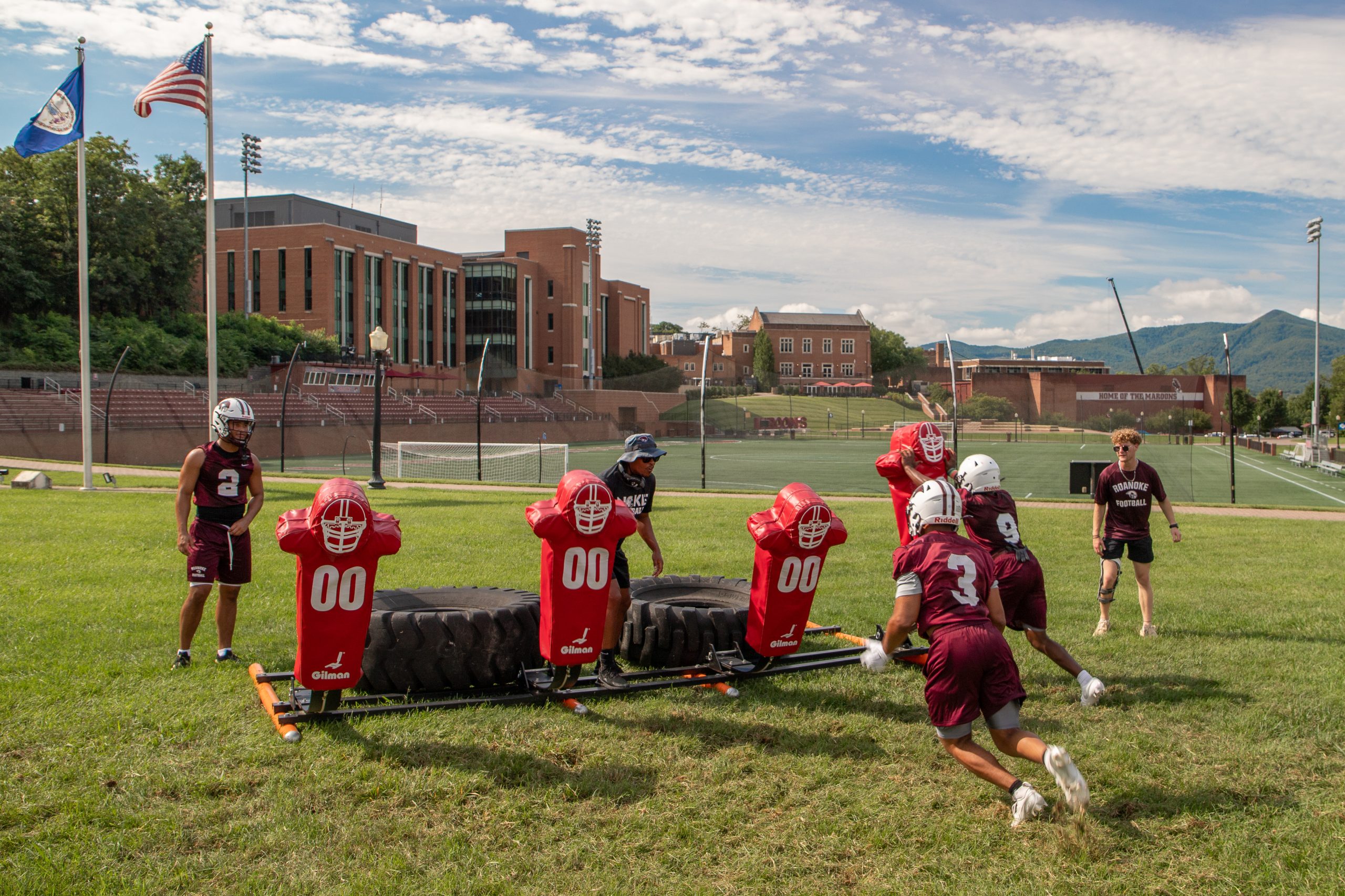
SALEM, Va. — On a hot and humid August morning in this southwestern Virginia town, football training camp is in full swing at Roanoke College. Players cheer as a receiver makes a leaping one-handed catch, and linemen sweat through blocking drills. Practice hums along like a well-oiled machine — yet this is the first day this team has practiced, ever.
In fact, it’s the first day of practice for a Roanoke College varsity football team since 1942, when the college dropped football in the midst of World War II.
Roanoke is one of about a dozen schools that have added football programs in the last two years, with several more set to do so in 2026. They hope that having a team will increase enrollment, especially of men, whose ranks in college have been falling. Yet research consistently finds that while enrollment may spike initially, adding football does not produce long-term enrollment gains, or if it does, it is only for a few years.
Roanoke’s president, Frank Shushok Jr., nonetheless believes that bringing back football – and the various spirit-raising activities that go with it — will attract more students, especially men. The small liberal arts college lost nearly 300 students between 2019 and 2022, and things were likely to get worse; the country’s population of 18-year-olds is about to decline and colleges everywhere are competing for students from a smaller pool.
“Do I think adding sports strategically is helping the college maintain its enrollment base? It absolutely has for us,” said Shushok. “And it has in a time when men in particular aren’t going to college.”
Women outnumber men by about 60 percent to 40 percent at four-year colleges nationwide. Roanoke is a part of this trend. In 2019, the college had 1,125 women students and 817 men.
This fall, Roanoke will have 1,738 students altogether, about half men and half women. But the incoming freshman class is more than 55 percent male.
Sophomore linebacker Ethan Mapstone (26) jogs to the sideline at the end of a drill. Mapstone said he hadn’t planned to play college football until Roanoke head coach Bryan Stinespring recruited him. Credit: Miles MacClure for The Hechinger Report
“The goal was that football would, in a couple of years, bring in at least an additional hundred students to the college,” said Curtis Campbell, Roanoke’s athletic director, as he observed the first day of practice. “We’ve got 97 kids out there on the field. So we’re already at the goal.”
That number was 91 players as the season began, on Sept. 6 — and the Maroons won their first game, 23-7, over Virginia University of Lynchburg, on what Shushok called “a brilliant day full of community spirit and pride.”
“Our students were out in force, side by side with community members spanning the generations,” he said via email. “In a time when we all need more to celebrate and opportunities to gather, it is easy to say our first football game since 1942 was both historic and invigorating.”
Related: Interested in more news about colleges and universities? Subscribe to our free biweekly higher education newsletter.
In the NCAA’s Division III, where Roanoke teams compete, athletic scholarships are not permitted. Athletes pay tuition or receive financial aid in the same way as other students, so adding football players will add revenue. For a small college, this can be significant.
Shushok said it’s not just about enrollment, though: He wants a livelier campus with more school spirit. Along with football, he started a marching band and a competitive cheerleading team.
“It plays to something that’s really important to 18- to 22-year-olds right now, which is a sense of belonging and spirit and excitement,” said Shushok, who came to Roanoke after being vice president of student affairs at Virginia Tech. Its Division I football team plays in a 65,000-seat stadium where fans jump up and down in unison to Metallica’s “Enter Sandman” as the players take the field.
The Maroons play in the local high school stadium — it seats 7,157 — and pay the city of Salem $2,850 per game in rent. The college raised $1.3 million from alumni and corporate sponsors to get the team up and running.
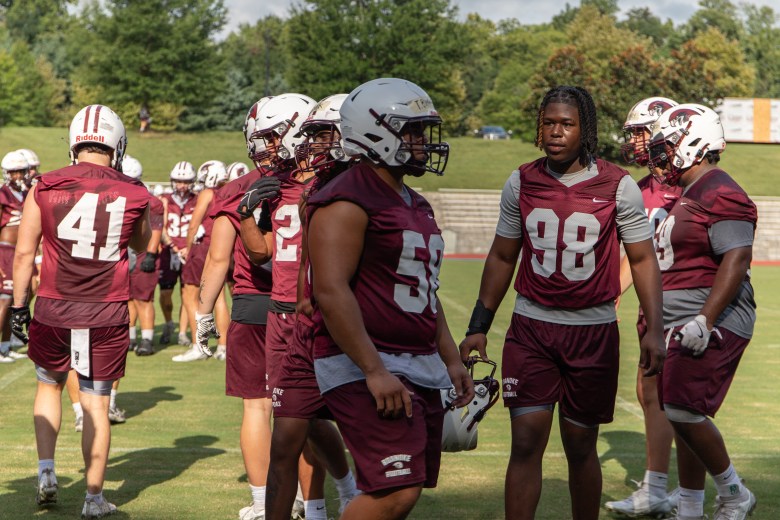
Roanoke College players gather on the sidelines during practice. Credit: Miles MacClure for The Hechinger Report
Despite the research showing limited enrollment gains from adding football, colleges keep doing it. About a dozen have added or relaunched football programs in the last two years, including New England College in New Hampshire and the University of Texas Rio Grande Valley. Several more plan to add football in 2026, including Chicago State University and Azusa Pacific University in California.
Calvin University in Michigan recently added football even though the student body was already half men, half women. The school wanted to broaden its overall appeal, Calvin Provost Noah Toly said, citing “school spirit, tradition, leadership development,” as well as the increased enrollment and “strengthened pipelines with feeder schools.”
“What you see is basically a one-year spike in male enrollment around guys who come to that school to help be part of starting up a team, but then that effect fades out over the next couple of years,” said Welch Suggs, an associate professor there and the lead author of that study. It found early modest enrollment spikes at colleges that added football compared to peers that didn’t and “statistically indistinguishable” differences after the first two years.
”What happens is that you have a substitution effect going on,” Suggs said. “There’s a population of students that really want to go to a football school; the football culture and everything with it really attracts some students. And there are others who really do not care one way or the other. And so I think what happens is that you are simply recruiting from different pools.”
Today, college leaders value any pool that includes men. Most prefer the campus population to be balanced between the sexes, and, considering the low number of male high school graduates going to college at all (39 percent in the last Pew survey), many worry about too few men being prepared for the future workforce.
“ I don’t know that we have done a good job of articulating the value, and of programming to the particular needs that some of our young men are bringing in this moment,” Shushok said. “I think it’s pretty obvious, if you read the literature out there, that a lot of men are feeling undervalued and perhaps unseen in our culture.”
Roanoke College President Frank Shushok Jr. in his office. Shushok said he brought football back to Roanoke to boost enrollment and create a livelier campus. Credit: Miles MacClure for The Hechinger Report
Shushok said that Roanoke’s enrollment-building strategy was not centered on athletics. The college has also forged partnerships with local community colleges, guaranteeing students admission after they complete their associate degree, and has added nine new majors in 2024, including cannabis studies. Shushok pointed out that while freshman enrollment is down slightly this year, the community college program has produced a big increase in transfer students, from 65 in fall of 2024 to 91 this fall.
About 55 percent of Roanoke’s students come from Virginia, but 75 of the football team’s 91 players are Virginians. The head coach, Bryan Stinespring, a 61-year-old Virginia native, knows that recruiting territory, having worked on the coaching staffs at several Virginia universities in his career.
When Stinespring took over as head coach in 2023, hoping to inspire existing students and potential applicants to join his new team, there was no locker room, no shoulder pads or tackling dummies, no uniforms.
“The first set of recruits that came on campus, we ran down to Dick’s, got a football, went to the bookstore, got a sweatshirt,” said Stinespring, referring to a local Dick’s Sporting Goods store. “These kids came on campus and they had to believe in the vision that we had.”
Students bought into that vision; 61 of them joined a club team last fall, which played four exhibition games in preparation for this year. The community bought in, too; 9,200 fans showed up to the first club game, about 2,000 of them perched on a grassy hill overlooking the end zone.
Linebackers Connor Cox (40) and Austin Fisher (20) look on from the sidelines. Credit: Miles MacClure for The Hechinger Report
Before Ethan Mapstone, a sophomore, committed to Roanoke, he was on the verge of giving up football, having sustained several injuries in high school. Then Stinespring called.
“I could hear by the tone of his voice how serious he meant everything he was saying,” said Mapstone, a 6-foot-1-inch linebacker from Virginia Beach. “I was on a visit a week later, committed two weeks later.”
To him, the football leaders at Roanoke seemed to be “a bunch of people on a mission ready to make something happen, and I think that’s what drove me in.”
KJ Bratton, a junior wide receiver and transfer student from the University of Virginia, said he was drawn to Roanoke not because of football but because of the focus on individual attention in small classes. “You definitely get that one-on-one attention with your teacher, that definitely helps you in the long run,” said Bratton.
Jaden Davis, a sophomore wide receiver who was an honor roll student in high school, said, “ The staff, they care about all the students. They’ll pull you aside, they know you personally, they’ll send you emails, invite you to office hours, and they just work with you to do the best you can.”
Not everyone was on board with football returning to the college when the plan was first announced. Some faculty and administrators were concerned football would change the campus culture, said Campbell, the athletic director.
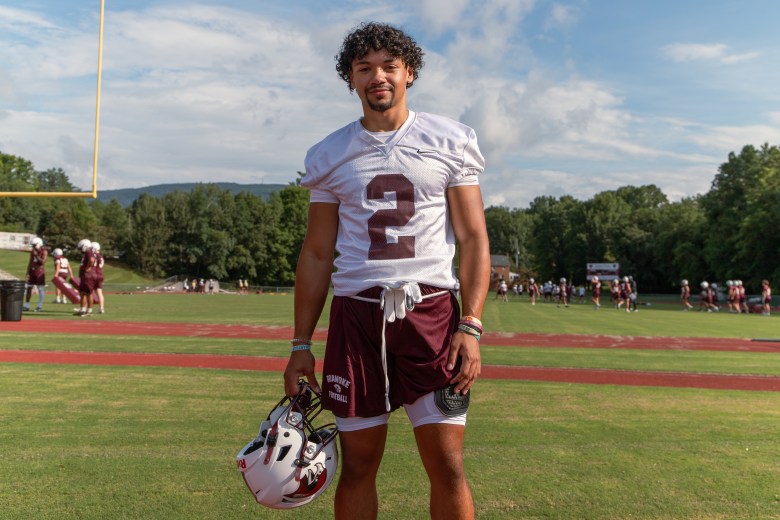
Sophomore wide receiver Jaden Davis poses for a photograph before the first practice of the season. Davis said the individual attention he could get from professors is what attracted him to Roanoke. Credit: Miles MacClure for The Hechinger Report
“There were just stereotypes about football players,” he said. “You know, they’re not smart, they’re troublemakers. They’re gonna do this and they’re gonna do that, be disruptive.”
But the stereotypes turned out to be unwarranted,he said.When the club team started, he said, “I got so many compliments last year from faculty and staff and campus security about how respectful and polite and nice our students were, how they behaved in the classroom, sitting in the front row and just being role models.”
Payton Rigney, a junior who helps out with the football team, concurred. “All the professors like them because they say ‘yes, sir’ and ‘no, ma’am,’” she said.
Like most Division III athletes, the Roanoke players know that they have little chance of making football a professional career. Mapstone said there are other reasons to embrace the sport.
“It’s a great blessing to be able to do what we do,” he said. “There’s many people that I speak to who are older and, and they reminisce about the times that they had to play football, and it’s very limited time.
“And even though there’s not a future for it, I love it. It’s a Thursday, my only problem in the world is that there’s dew on my shoes.”
Contact editor Lawrie Mifflin at (212) 678-4078 or [email protected].
The Hechinger Report provides in-depth, fact-based, unbiased reporting on education that is free to all readers. But that doesn’t mean it’s free to produce. Our work keeps educators and the public informed about pressing issues at schools and on campuses throughout the country. We tell the whole story, even when the details are inconvenient. Help us keep doing that.
Each year, Global Youth & News Media recognizes news organizations that are innovating in ways that include or help young readers and young journalists.
The France-based nonprofit, founded in 2018, seeks to reinforce connections between young people and news media.
This year, it held a global competition to find projects that could show how young people are helping news organizations survive in a world where too many of them are shutting down.
“I was looking at who was helping local news for a different project and noticed that nearly every journalism-related NGO I knew was doing something to help local news survive,” said Aralynn McMane, executive director at Global Youth & News Media. “And new nonprofits were emerging only for that purpose.”
The problem, though, was that she didn’t see much sharing of that knowledge. So one of the aims of the competition was to create cross-pollination — highlight projects that could be replicated by other organizations elsewhere and provide a forum for the sharing of lessons learned.
“This was a particularly satisfying competition for us because we found so many great win-win cases of meaningful youth-local news collaborations from all over the world with lessons for newsrooms most anywhere,” McMane said.
Can we fertilize the news deserts?
News Decoder is deeply concerned about the emergence of “news deserts”: localities that no longer have any news outlets as profit-driven corporate owners pull the plug on local newspapers.
A study in 2023 found that more news outlets in the UK were closing than were being launched. In Canada, between 2008 and 1 April 2025, more than 500 local news outlets closed in some 370 communities across the country, according to the Local News Map crowd-sourcing data initiative. Meanwhile, a report from the Brookings Institution found that in the United States in 2023, some 2.5 local news outlets folded every week.
That’s why I was honored to serve as one of 26 judges from 17 countries in the competition. While the entries taken as a whole gave me reason to hope, the winners left me inspired.
The competition found dozens of collaborations across six continents. They served to remind us of the vital public service mission local news organizations perform when they have the resources to do so.
Consider The Westsider in Melbourne, Australia. The staff there recognized the need for voters to be informed about the candidates in local elections and how they stand on important local issues. But to chase down dozens of candidates takes staffing that The Westsider doesn’t have. So with a small grant from a local journalism organization, the paper recruited 72 students from RMIT University to chase down every candidate running for a local office and ask them a series of questions. From that funding the paper produced a non-partisan voter’s guide.
Youth can tell important local stories.
Another standout was Phralipen of Croatia, who collaborated with Youth Roma Congress to produce stories about the Roma community through reporting, multilingual content and participatory journalism.
Then there was the Contra Costa Youth Journalism program in Northern California, a collaboration between the Contra Costa County Office of Education and Bay City News/Local News Matters, a news organization based in Berkeley, California. The program recruits and trains young people from underserved communities to be journalists and has published more than 70 stories from these areas as a result.
Katherine Rowlands, the founder and publisher of Bay City News and Local News Matters, said programs that bring young people into journalism are important.
“It is critical to train and inspire the next generation of journalists so we create a pipeline of future reporters to inform, question and make sense of the world,” Rowlands said. “It is also really important for us to include these younger voices in the journalism we do now so that we more accurately reflect our communities and bring their issues to the forefront.”
From Pakistan to Botswana, Bolivia to Tanzania, the competition identified news organizations finding ways to bring young people into their newsrooms to ensure that what young people do, and the issues that are important to them, are not left out of local news coverage. In the process, they are finding that for organizations that are short-staffed and short of funds, young people are a key resource that has been long overlooked.
The entries were graded on the impact on the local community and transferability — whether the project could easily be replicated by other news organizations in other places.
One thing we’ve learned at News Decoder — and which the results of this competition clearly showed — is that young people are eager to have their voices heard and see journalism as an effective way to do that.
News organizations can benefit from their passion and energy and also from the perspectives they bring.
The full list of winners
GOLD AWARD (most transferable, clearest on impact)
The Westsider with RMIT University (Australia)
Stamp Media (Belgium)
Phralipen and the local Roma community (Croatia)
The Greenline (Canada)
Časoris and Črni Vrh primary school (Slovenia)
Landshuter Zeitung/Mediengruppe Attenkofer podcast mies keck (Germany)
Bay City News Foundation with Contra Costa Youth Journalism (United States)
The Spotlight News with The University at Albany (United States)
SILVER AWARD (transferability and clarity of impact)
Critics abroad and in Congo accuse DRC president Tshisekedi and his government of being distant, corrupt and ineffective and continually failing to meet promises or even talk to the rebels.
“I am exhausted with Tshisekedi’s governance,” said one Congolese citizen.
There have been strong and repeated accusations by the United Nations and others that the M23, which is now part of the broader Alliance Fleuve Congo (AFC), receives both funding and tangible support from Rwanda and its army, that it has been responsible for excessive violence — including reports of rape in a Goma prison last week — and that it has benefited from the increasing control of lucrative mineral mines in the region.
A multinational push for peace
The actual truth is much more complex, nuanced and difficult to distinguish, especially given the direct involvement of national army soldiers on the ground, not just from the DRC and Rwanda but from other countries, such as Burundi, South Africa and Tanzania.
There are also about 14,000 UN peacekeeping forces in the region, as well as more than 100 other militia groups and even mercenaries from Eastern Europe. Rwanda recently ensured the safe repatriation of 300 of them back to Romania.
And then there are powerful political and business leaders in the United States, Europe, Russia and China who somewhat cynically want to ensure the continued supply of precious minerals — such as cobalt, coltan and tantalum — for their cars, cellphones and computers.
On a more personal level, I live with my Rwandan wife and young son in a newly-built house just south of Rwanda’s capital city of Kigali, which lies only 150 kilometres away from the current conflict zone and which has been repeatedly threatened by DRC president Tshisekedi and leading government officials.
Just last week, Rwanda’s ambassador to the UN in Geneva, James Ngango, accused the DRC of amassing a stockpile of weapons — including rockets, kamikaze drones and heavy artillery guns — that are pointed straight at Rwanda.
Fears that violence will cross borders
My wife Merveille — whose father and three brothers may well have been murdered by some of the current FDLR militia fighters in eastern DRC — still has nightmares about them possibly attacking or even taking back Rwanda.
A Rwanda security expert texted me that the threat to “attack Rwanda immediately” was real before the M23 rebels took over Goma and there are still concerns about large weapon stockpiles in South Kivu province. He added that if the M23 can now secure the regional capital of Bukavu and the nearby Kavumu airport “all security risks against Rwanda will be reduced/mitigated.”
This will allay our personal concerns but we are still worried about the security of some close friends in Goma, who fell silent for five whole days after the M23 rebels took control of their city in late January but thankfully got back in contact right after power and WiFi service were restored.
Daily life in Goma has returned to something like normal over the last week or so but the nighttime is different.
One of our friends texted me on Tuesday: “Safety in Goma is degrading day in, day out. Getting armed looters at night. From this night alone we register more than seven deaths. A friend was visited as well. He let them in and his life was spared and his family. He said this morning that it was hard to determine their identity because they had no military uniforms but we all suspect they are they are the Wazalendo or prisoners who escaped from Munzenze prison. They come in to steal, rape and kill who ever shows resistance.”
The Wazalendo — meaning “patriots” or “nationalists” — are a group of irregular fighters in North Kivu province, who are allied with the Congolese army and opposed to the M23.
Our friend in Goma said that he still has enough security in his house but when asked about the potentially revitalised multilateral peace process, he said: “I am actually speechless right now, I don’t know what to think about all this. So much has happened.”
The weekend summit’s joint communiqué did call for an immediate end to the violence and for defense ministers to come up with concrete plans for sustainable peace measures, such as the resumption of “direct negotiations and dialogue with all state and non-state parties,” including the M23 that DRC president Tshisekedi has long tried to resist.
Observers see this as a positive sign and there are renewed hopes — along with lingering doubts after so many earlier failed initiatives — that this unusual and timely degree of coordinated Africa-based action and support at the highest levels could mean that the fighting, killing and disruption may wane soon and a long-lasting, peaceful solution can be reached.
In the words of the sadly-departed Rabbi Lord Jonathan Sacks of the UK: “The greatest single antidote to violence is conversation, speaking our fears, listening to the fears of others, and in that sharing of vulnerabilities, discovering a genesis of hope.”
Three questions to consider:
1. Why is the situation in Eastern DRC so difficult to sort out? 2. Think of a time when you, someone you knew or someone you respected used “direct negotiations and dialogue” to achieve a positive outcome to a challenging problem. 3. What would you say or do if you were one of the regional African leaders trying to achieve a sustainable, non-violent solution to the Eastern DRC crisis?