Bringing back birds
Vallocchia’s work has also taken her to Malta and Mexico. She’s been with Maui Forest Bird Recovery for four years. As avian research field supervisor, she works on honeycreeper surveys, counting the relatively few remaining birds from what was once a thriving bird paradise with more than 50 species of honeycreeper.
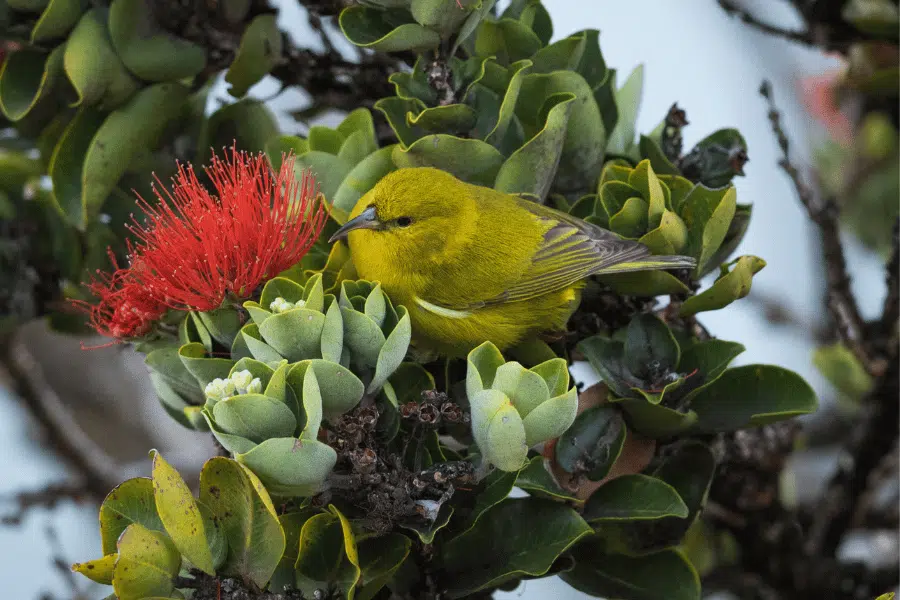
On Maui, Vallocchia says, six species of honeycreeper remain. Three of these are endemic to Maui, found nowhere else. Vallocchia and her colleagues track populations of Kiwikiu (Maui parrotbill) and ʻĀkohekohe (crested honeycreeper).
Vallocchia and her colleagues camp out in various locations on Maui, tracking birds and their activities at predetermined spots or transects on a specific line through a forest. This gives them a consistent scientific way to count the birds.
Right now, fewer than 150 kiwikiu remain, Vallocchia says.
“The native birds, you see how special they are here,” Hebebrand says. “When I saw a kiwikiu in the wild for the first time, I cried.”
The soundscape of Hawaii
Some native birds are spotted closer to the project’s home office. A Hawai’i ‘amakihi was spotted recently feeding on a hibiscus plant in the yard, delighting the staff.
Program manager Hanna Mounce describes the work of Maui Forest Bird Recovery Project as an investment in ecosystems, cultural connections and the next generation.
“I’m hopeful that our work today will help ensure these birds are still here for our children and grandchildren,” Mounce says. “Every day, I work alongside a team deeply committed to protecting something bigger than themselves.”
Hawai’ian birds often make the sounds of their names. The kiwikiu might screech keee-eee-eee or tree-tree or kiwi-kiwi-kiwi-kiwi.
“It’s so varied,” Vallocchia said.
What tourists don’t see or hear
These songs most likely won’t be heard by visitors coming to the islands on vacation. People relaxing at resorts may not know they’re missing the native wildlife and birds of the Hawai’ian islands.
“Millions of people visit Hawaiʻi every year,” says Chris Warren, forest bird program coordinator at Haleakalā National Park, “and only a fraction of those get a chance to see an ʻiʻiwi or other fabulous native birds. People can grow up here and never experience a native forest.”
Warren worked for MFBRP for more than a decade and continues to partner with the organization.
“The project has always been driven by passion and a deep desire to save these species from extinction,” Warren says. His own understanding of extinction dates back to his work at the Joseph Moore Museum of Natural History in Indiana. He encountered specimens of extinct birds like passenger pigeons and Bachman’s warblers.
“There is something profound about holding an animal in your hand that will never be seen alive again,” Warren says. “And to know that that extinction was preventable made a deep impact on me.”
Protecting without disturbing
Warren says one of the biggest challenges to forest bird recovery involves educating the public, who may not know these birds exist. People care more deeply about things that they’ve personally experienced, he says.
Vallocchia agrees. She invites visitors to explore accessible areas of Maui, hiking into its fragile forests with awareness and care.
“For people to want to protect something, they need to see it, experience it, understand the beauty of it,” Vallocchia says. “Being part of nature is not disturbing nature if it’s done in the right way.”
Camping with permits is possible in places like Haleakalā National Park.
“You could wake up to the song of the honeycreeper,” Vallocchia says.
Recommended:
The award-winning documentary “Vanishing Voices” combines interviews with bird recovery workers and animation to explain the science being used to save birds from extinction.
Questions to consider:
1. What are some threats to the honeycreepers on Maui?
2. How are conservationists trying to restore the population of alalā?
3. What birds can you spot where you live?