
Tag: Broader

  • UC System Warns of Broader Risks in Federal Funding Fight

    UC System Warns of Broader Risks in Federal Funding Fight

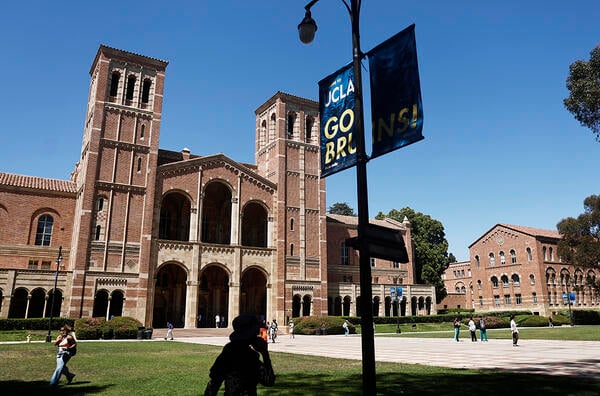
    The University of California system is warning state lawmakers that federal funding cuts could extend well beyond UCLA as tensions between the Trump administration and American colleges continue to rise.

    UC president James B. Milliken wrote a letter to dozens of local elected officials Tuesday explaining that “the stakes are high and the risks are very real.” The system’s 10 institutions could lose billions of dollars in aid, forcing its leaders to make tough calls about staffing, the continuation of certain academic programs and more, he said.

    President Trump has already frozen more than $500 million in grants at UCLA, allegedly because the Justice Department accused the university of violating Jewish students’ civil rights. The president demanded the university pay a $1.2 billion fine to unlock the funds, and system officials are worried that more funding cuts are likely. California lawmakers have repeatedly urged the UC system not to capitulate.

    In an August letter, State Sen. Scott Wiener, a Democrat and chair of the Joint Legislative Budget Committee, and 33 other lawmakers told Milliken that Trump’s actions were “an extortion attempt and a page out of the authoritarian playbook,” the Los Angeles Times reported

    Milliken wrote in Tuesday’s letter that a loss in funding would “devastate” the system and harm students, among other groups.

    “Classes and student services would be reduced, patients would be turned away, tens of thousands of jobs would be lost, and we would see UC’s world-renowned researchers leaving our state for other more seemingly stable opportunities in the US or abroad,” he wrote.

    If the UC system loses federal funding, it would need about $4 to $5 billion a year to make up the difference, Milliken added. “That is what fighting for the people of California will take.”

    Source link

  • A Broader Look at Labor Market Strain

    A Broader Look at Labor Market Strain

    The U‑6 unemployment rate, the broadest measure of labor underutilization reported by the Bureau of Labor Statistics (BLS), is showing signs of upward pressure. Unlike the headline U‑3 rate, which only includes those actively seeking work, the U‑6 figure captures a more complete picture of employment. It includes discouraged workers, marginally attached individuals, and those working part-time for economic reasons.

    According to the most recent data from the BLS and the Federal Reserve Bank of St. Louis, the U‑6 rate inched up from 7.7 percent in June 2024 to a recent peak of 8.0 percent in February 2025. Since then, it has remained elevated, recording 7.9 percent in March and 7.8 percent in both April and May. The June 2025 figure dropped slightly to 7.7 percent but remains among the highest levels seen since 2023.

    The U‑6 rate tends to rise when more people are involuntarily working part-time or when marginally attached workers reenter the job search but fail to secure full-time employment. These dynamics suggest that while headline unemployment may appear stable—hovering around 4.1 percent in June—the underlying labor market may be more fragile than it seems.

    This persistence in underemployment raises concerns about the quality of jobs available, wage stagnation, and economic resilience, particularly for lower-income workers and those in precarious positions. A growing number of Americans want full-time employment but are unable to find it. Others are technically outside the labor force but remain discouraged or marginally attached to it.

    In the broader context, the U‑6 rate serves as a counterbalance to optimistic economic narratives. The apparent stability in the U‑3 rate masks lingering vulnerabilities, especially as sectors like retail, hospitality, and education continue to rely heavily on part-time labor or are facing budgetary constraints. For those watching the post-pandemic economy, particularly in relation to student debt, workforce readiness, and higher education policy, these indicators suggest a structural weakness in job creation and labor absorption.

    The gradual rise of U‑6 is not just a statistical footnote. It signals that the labor market is not fully healed and that a portion of the population remains economically sidelined. It is a metric worth monitoring as debates around economic recovery, fiscal policy, and employment strategies continue.

    For readers of the Higher Education Inquirer, this trend reinforces the need to consider broader employment conditions when evaluating the health of the U.S. economy, particularly for recent graduates, contingent faculty, and other workers navigating a precarious job landscape.

    Sources

    Bureau of Labor Statistics, Table A-15. Alternative measures of labor underutilization: https://www.bls.gov/news.release/empsit.t15.htm

    Federal Reserve Bank of St. Louis (FRED), U‑6 Unemployment Rate: https://fred.stlouisfed.org/series/U6RATE

    TradingEconomics, U‑6 Unemployment Rate: https://tradingeconomics.com/united-states/u6-unemployment-rate

    Source link