

Fully online programs are no longer emerging alternatives. They are established, competitive, and increasingly scrutinized. Prospective students understand that online learning is widely available. What they question is whether a specific program is credible, engaging, supportive, and capable of delivering real outcomes.
This shift has fundamentally changed how institutions must approach online program marketing. Generic messaging, polished stock imagery, and surface-level claims no longer build confidence. Today’s prospects are looking for proof. They want to understand what learning actually looks like, who they will interact with, how support works in practice, and what outcomes they can realistically expect after graduation.
This is where authentic content for online programs becomes one of the most powerful enrollment drivers available. Authenticity reduces perceived risk, shortens decision cycles, and builds trust in online learning long before a prospect ever speaks with an admissions advisor.
At Higher Education Marketing, we see this pattern repeatedly. Institutions that invest in proof-driven storytelling—grounded in real student experiences, outcomes, and transparency—consistently outperform those that rely on abstract promises. This guide breaks down how to create creative content for online courses that earns trust, clarifies the learning experience, and supports sustainable enrollment growth.
What “Authentic Content” Really Means in Online Program Marketing
Authenticity in education marketing is often misunderstood. It does not mean being informal, unpolished, or casual with institutional branding. Authentic content is defined by credibility, specificity, and verifiability. In short, it must sound true—and be true.
A useful test: if your content could appear on another institution’s website with little or no change in meaning, it isn’t authentic enough.
Authentic content for online programs should:
- Demonstrate how learning actually works in your online environment
- Feature real students, instructors, and support staff—not stock representations
- Address both benefits and challenges of online learning
- Set clear expectations around workload, timelines, and outcomes
- Support claims with concrete examples or data
Authenticity also means answering the questions prospective students are already asking. What is faculty engagement like online? How often do students interact with peers? What support exists if they fall behind? Will this credential lead to real career opportunities?
When institutions answer these questions clearly—and support them with evidence such as course previews, alumni outcomes, or faculty welcome videos—they build trust by default. This type of content does not rely on slogans. It earns confidence by being specific, transparent, and grounded in lived experience.
How do you make online programs feel real to prospective students?
Show how learning actually happens. LMS walkthroughs, assignment previews, and real student stories turn an abstract promise into a tangible experience.
Are you looking for education marketing services?
Our expert digital marketing services can help you attract and enroll more students!
Why Trust Is the Primary Conversion Barrier for Fully Online Programs
Unlike on-campus programs, fully online offerings must build trust without physical presence. Prospective students cannot tour facilities, attend in-person events, or casually meet faculty. Every credibility signal must come through digital touchpoints.
This creates a trust gap—and it is often the biggest barrier to conversion.
Common concerns include:
- Will I feel isolated?
- Are instructors accessible and engaged?
- Will employers value this credential?
- What academic and career support will I receive?
- Can I realistically balance this program with work and family life?
Institutions must address these concerns directly. Not with reassurance, but with evidence. Trust-building content should reduce uncertainty at every stage of the funnel—from search and program pages to nurture emails and application follow-up.
Effective trust signals include:
- Online-specific student success stories
- Transparent explanations of course structure and faculty engagement
- Visible instructor presence
- Clear depictions of peer interaction and community
- Outcome data supported by alumni or employer validation
Trust is not built with a single asset. It requires consistency. When credibility signals appear throughout the student journey, confidence grows—and conversions follow.
The Proof Stack: Seven Trust Signals That Convert Online Prospects
High-performing online program marketing is built on proof, not promises. Leading institutions deploy a layered proof stack—a coordinated system of content assets designed to address specific student concerns.
Each layer removes friction. Together, they create clarity.
1. Outcome Proof
Show what happens after graduation by highlighting graduate success stories within your authentic content for online programs. Share specific, verifiable outcomes such as job placements, promotions, salary growth, licensure results, or portfolio examples. Concrete evidence like this does far more to build trust in online learning than broad claims about “career readiness.”
2. Experience Proof
Show the learning environment itself. LMS screenshots, sample assignments, course modules, and weekly schedules demystify the experience and reduce anxiety.
3. Faculty Proof
Instructor quality matters deeply online. Introduce faculty as active educators. Short videos, interviews, or Q&As explaining feedback style and engagement expectations build confidence.
4. Support Proof
Demonstrate how advising, tutoring, technical help, and career services function for online students. Testimonials describing real support moments are especially powerful.
5. Community Proof
Isolation is a common fear. Counter it with visible evidence of interaction: discussion boards, cohort models, group projects, and virtual events.
6. Credibility Proof
Accreditation, rankings, partnerships, and employer recognition reinforce legitimacy—especially when tied specifically to online offerings.
7. Integrity Proof
Be honest. Clarify who the program is—and is not—for. Address time commitments and expectations openly. Transparency builds credibility faster than perfection.
No single asset builds trust alone. The strongest strategies distribute proof across the funnel, allowing evidence—not persuasion—to do the work.
Creative Content for Online Courses: Proof-Driven Ideas That Scale
Effective online course marketing is not about flashy production. It’s about relevance. Creativity in this context means answering real questions with clarity and evidence.
Scalable, high-impact ideas include:
- “A week in the life” student profiles
- LMS walkthrough videos
- Assignment-to-career skill explainers
- Faculty office-hour previews
- Student decision-journey testimonials
- Alumni outcome spotlights
- Discussion board or live session previews
- Short FAQ videos addressing workload and flexibility
Each asset should serve a single purpose: reduce doubt and build confidence. When content answers real concerns with real proof, it becomes both creative and effective.
What types of content build trust fastest for fully online courses?
Proof-focused content—outcomes, faculty presence, support visibility, and clear expectations—outperforms general promotional messaging.
Showcasing the Online Learning Experience (Without Overproduction)
Prospective students do not need cinematic videos. They need visibility.
Screen recordings, narrated walkthroughs, and lesson previews are effective storytelling formats because they show what learning actually looks like. A simple LMS tour or assignment walkthrough answers practical questions and builds familiarity.
When video is not possible, authentic storytelling can still be delivered through:
- Written graduate success stories that highlight real outcomes
- Anonymized learning journey case studies that show progress over time
- Instructor-led lesson explanations that clarify teaching style and expectations
- Platform demos that reveal how students engage with course materials
- Audio interviews that capture candid student or faculty perspectives
Clarity beats polish. When students can visualize the experience through effective storytelling, uncertainty fades—and confidence follows.
Online Student Testimonials That Feel Credible
Strong testimonials follow a narrative structure:
- Starting point: Who is the student, and why did they enroll?
- Challenge: What concerns or obstacles did they face?
- Support moment: Where did the institution make a difference?
- Outcome: What changed as a result of the program?
- Advice: What would they tell future students?
Avoid anonymous praise. Specificity builds trust. Include names, programs, timelines, and real outcomes whenever possible.
What makes an online testimonial credible?
Context, specificity, and lived experience. Avoid generic statements and overly polished language.
Online Learning Community Building: Making Connection Visible
Community is one of the most questioned—and misunderstood—aspects of fully online education. Prospective students often assume that without physical proximity, meaningful connection is limited or nonexistent. If they cannot see interaction, collaboration, and peer engagement, they assume it simply does not exist.
This perception represents a major emotional barrier to enrollment. While flexibility and access attract interest, uncertainty around belonging and support often stalls decision-making. In online education, absence of visible community is interpreted as absence of community itself.
This is where intentional storytelling becomes critical.
To counter skepticism, institutions must actively show how students connect, collaborate, and support one another throughout the online learning experience. Community cannot be implied; it must be demonstrated through clear, observable proof points embedded across program pages, content hubs, and recruitment campaigns.
Effective community-focused storytelling does not rely on vague claims about “engagement” or “collaboration.” Instead, it makes interaction tangible by revealing how connection actually unfolds in day-to-day learning.
High-impact examples include:
- Screenshots or short clips of live class sessions with visible discussion, questions, and instructor facilitation
- Real examples of group projects, including collaboration tools (shared documents, discussion threads, virtual workspaces)
- Clear overviews of mentorship programs, highlighting how peer mentors, alumni, and faculty interact with students
- Spotlights on student-led initiatives, clubs, or virtual events that extend beyond coursework
- Evidence of consistent instructor presence through discussion board participation, feedback examples, and guided conversations
When presented well, this type of storytelling reframes online learning from a solitary experience into a shared academic journey. Prospective students begin to visualize themselves participating—not passively consuming content, but actively engaging with peers, instructors, and a broader learning network.
Crucially, visible community reduces one of the most powerful emotional objections to online education: the fear of going through the experience alone. When connection is made explicit, confidence replaces hesitation.
Real-World Examples From Prestigious Institutions
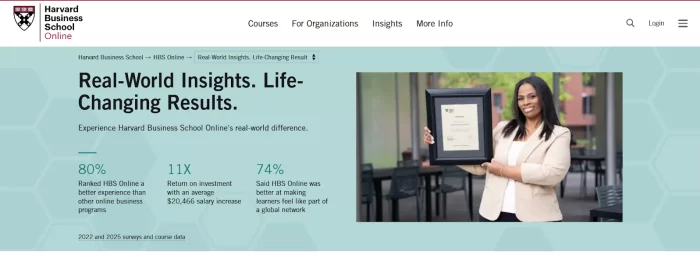
Harvard Business School Online: HBS Online emphasizes learner outcomes and authenticity by showcasing real student success stories and measurable results. On its site, the school highlights how its certificate programs lead to tangible career advancements – learners report job promotions, salary increases, and career transitions as a direct result of the online courses. The inclusion of learner testimonials and outcome data builds credibility, allowing prospective students to see the real-world impact of HBS Online’s programs.
Source: Harvard Business School Online
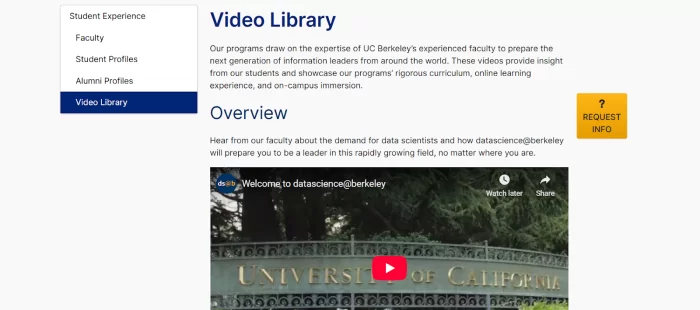
UC Berkeley School of Information: Berkeley’s I School provides an online experience video library that offers an authentic window into its programs. These videos feature faculty insights and student perspectives, showcasing the rigorous curriculum, collaborative online environment, and even on-campus immersion sessions. By letting prospective students virtually “step inside” the learning experience, Berkeley illustrates transparency in course design and highlights faculty visibility and student interaction in a compelling, real way.
Source: UC Berkeley School of Information
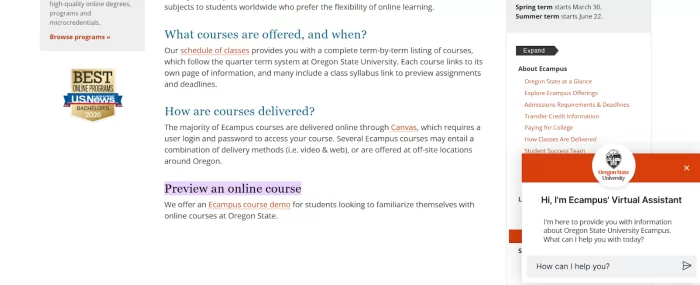
Oregon State University Ecampus: OSU Ecampus prioritizes learning experience transparency through its online course demos. The Ecampus “Preview an online course” feature allows prospective students to explore actual course modules and interactive elements before enrolling. From instructor introduction videos to virtual labs and quizzes, these previews give an authentic taste of the online classroom. This strategy demystifies online learning and demonstrates the innovative technology and teaching methods OSU uses to keep students engaged.
Source: Oregon State University Ecampus
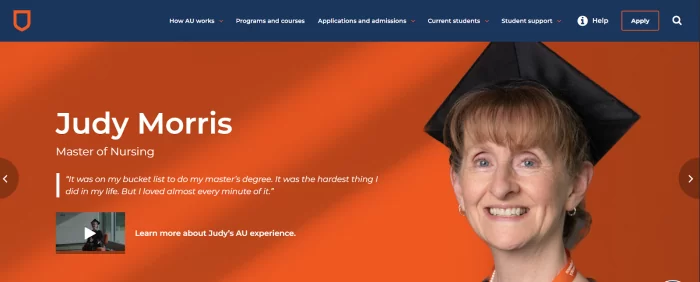
Athabasca University: Athabasca University’s website prominently features student success stories to build authenticity and trust. These first-hand accounts from graduates of its fully online programs highlight personal achievements and career outcomes. For example, one alumna credits landing a new tech job to the skills gained through her Athabasca degree. By sharing such testimonials (often in the students’ own words), Athabasca underscores the real successes of its learners and the supportive, flexible environment that helped them thrive.
Source: Athabasca University
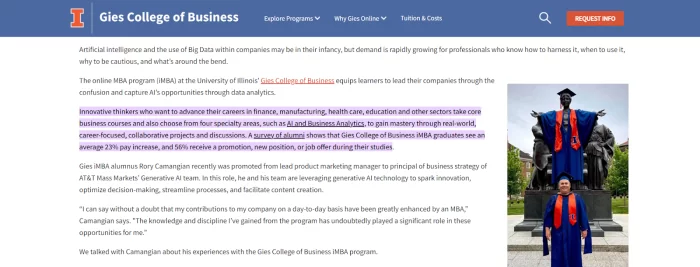
University of Illinois – Gies College of Business: Gies showcases online MBA alumni outcomes as proof of its program’s value. In its news and updates, the college reports impressive career results for graduates of the iMBA program. Surveys of alumni indicate an average 23% salary increase post-degree, and over half of online MBA students earn a promotion or new job offer during their studies. By publicizing these ROI metrics and alumni success stories, Gies effectively communicates the credibility and real-world career impact of its online programs.
Source: University of Illinois – Gies College of Business
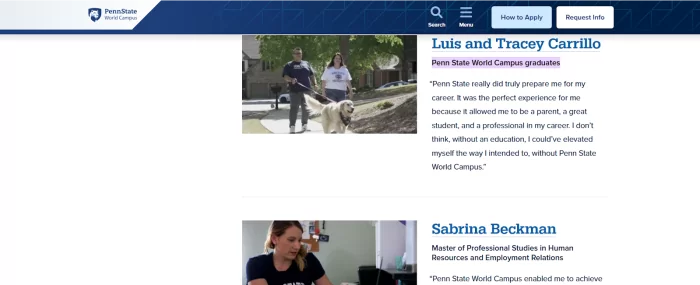
Penn State World Campus: Penn State’s World Campus highlights numerous online graduate success stories to demonstrate authenticity and outcomes. Its “Success Stories” section shares profiles of adult learners who balanced work, life, and education to earn their degrees online. Graduates speak to how the flexible Penn State online format enabled their career advancement and personal growth (one student noted it allowed her to be “a parent, a great student, and a professional” all at once). These real narratives exemplify the supportive learning community and tangible benefits that World Campus provides.
Source: Penn State World Campus
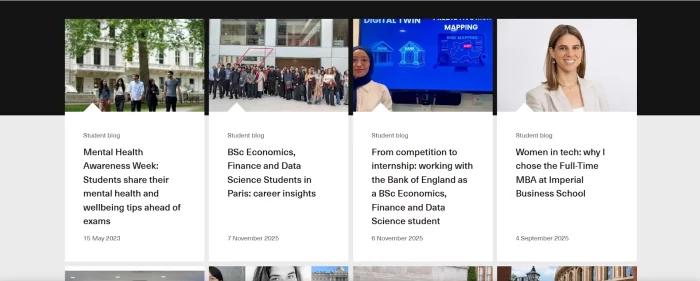
Imperial College Business School: Imperial engages students as content creators through its online student blog. Current students across various programs (including online and part-time degrees) write blog posts about their experiences, challenges, and insights. This first-person content – for instance, students discussing their MBA journey or sharing an “on-campus week” from an online program perspective – adds a highly authentic voice to Imperial’s marketing. By spotlighting student-written stories, the Business School enhances transparency and relatability, letting prospective students hear directly from their peers.
Source: Imperial College Business School
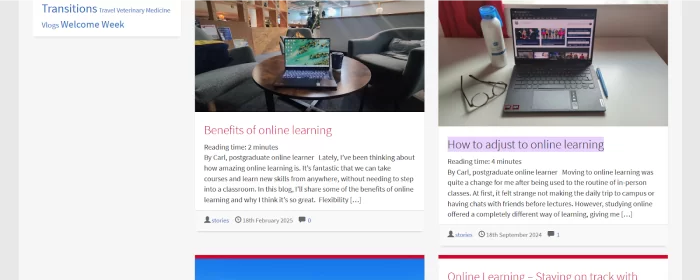
University of Edinburgh: The University of Edinburgh provides rich online student experience content for its distance learners. Its official online learning pages and student-driven blogs offer guidance on how online programs work, tools for success, and genuine accounts from students. Prospective learners can find tips from current online students on topics like time management and balancing studies, as well as blog posts detailing personal experiences of adjusting to online learning. By openly sharing these resources and stories, Edinburgh ensures transparency about the online learning journey and fosters authenticity through the voices of its student community.
Source: University of Edinburgh
Trust Is Earned, Not Claimed
Fully online programs succeed when trust is earned, not assumed. The institutions seeing the most sustainable enrollment growth are not the ones making the boldest claims, but the ones providing the clearest answers.
Authentic, proof-driven content does more than attract attention. It qualifies leads, supports faster decision-making, and builds long-term credibility. Prospective students are no longer persuaded by marketing gloss. They want to see how a program works, who it serves, and what it delivers.
Authenticity is not about volume or tone. It’s about substance. It means showing real student journeys, revealing how support systems function, and making the learning experience transparent from day one.
In a digital education market defined by choice and skepticism, trust is your most valuable differentiator. And trust isn’t something you say you have—it’s something you prove, consistently, through the content you publish.
Do you need tailored and actionable online course marketing ideas to help reenergize your student recruitment efforts?
Are you looking for education marketing services?
Our expert digital marketing services can help you attract and enroll more students!
FAQs
How do you make online programs feel “real” to prospective students?
Show how learning actually happens: include LMS walkthroughs, assignment previews, and real student stories. Avoid abstract claims. Clarity and visibility around the experience make it tangible.
What types of content build trust fastest for fully online courses?
Proof-focused content: student outcomes, faculty presence, support interactions, and clear course expectations. Specifics convert better than general claims.
What should an online program testimonial include to feel credible?
A credible online program testimonial should include the student’s background, challenges faced, how they were supported, and the outcome achieved. It should reference their program and timeline, and ideally end with advice for future students. Specificity and context are key—avoid anonymous or overly polished quotes.