When a school building fails, everything it supports comes to a halt. Learning stops. Families scramble. Community stability is shaken. And while fire drills and lockdown procedures prepare students and staff for specific emergencies, the buildings themselves often fall short in facing the unexpected.
Between extreme weather events, aging infrastructure, and rising operational demands, facility leaders face mounting pressure to think beyond routine upkeep. Resilience should guide every decision to help schools stay safe, meet compliance demands, and remain prepared for whatever lies ahead.
According to a recent infrastructure report card from the American Society of Civil Engineers, the nation’s 98,000 PK-12 schools received a D+ for physical condition–a clear signal that more proactive design and maintenance strategies are urgently needed.
Designing for resilience means planning for continuity. It’s about integrating smarter materials, better systems, and proactive partnerships so that learning environments can bounce back quickly–or never go down at all.
Start with smarter material choices
The durability of a school begins at ground level. Building materials that resist moisture, mold, impact, and corrosion play a critical role in long-term school resilience and functionality. For example, in flood-prone regions, concrete blocks and fiber-reinforced panels outperform drywall in both durability and recovery time. Surfaces that are easy to clean, dry quickly, and don’t retain contaminants can make the difference between reopening in days versus weeks.
Limit downtime by planning ahead
Downtime is costly, but it’s not always unavoidable. What is avoidable is the scramble that follows when there’s no plan in place. Developing a disaster-response protocol that includes vendors, contact trees, and restoration procedures can significantly reduce response time. Schools that partner with recovery experts before an event occurs often find themselves first in line when restoration resources are stretched thin.
FEMA’s National Resilience Guidance stresses the need to integrate preparedness and long-term recovery planning at the facility level, particularly for schools that often serve as vital community hubs during emergencies.
Maintenance as the first line of defense
Preventative maintenance might not generate headlines, but it can prevent them. Regular inspections of roofing, HVAC, plumbing, and electrical systems help uncover vulnerabilities before they lead to shutdowns. Smart maintenance schedules can extend the lifespan of critical systems and reduce the risk of emergency failures, which are almost always more expensive.
Build flexibility into the design
Truly resilient spaces are defined by their ability to adapt, not just their physical strength. Multi-use rooms that can shift from classroom to shelter, or gymnasiums that double as community command centers, offer critical flexibility during emergencies. Facilities should also consider redundancies in HVAC and power systems to ensure critical areas like server rooms or nurse stations remain functional during outages.
Include restoration experts early
Design and construction teams are essential, but so are the people who will step in after a disaster. Involving restoration professionals during the planning or renovation phase helps ensure the layout and materials selected won’t hinder recovery later. Features like water-resistant flooring, interior drainage, and strategically placed shut-off valves can dramatically cut cleanup and repair times.
Think beyond the building
Resilient schools need more than solid walls. They need protected data, reliable communication systems, and clear procedures for remote learning if the physical space becomes temporarily inaccessible. Facility decisions should consider how technology, security, and backup systems intersect with the physical environment to maintain educational continuity.
Schools are more than schools during a crisis
In many communities, schools become the default support hub during a crisis. They house evacuees, store supplies, and provide a place for neighbors to connect. Resilient infrastructure supports student safety while also reinforcing a school’s role as a vital part of the community. Designs should support this extended role, with access-controlled entries, backup power, and health and sanitation considerations built in from the start.
A resilient mindset starts with leadership
Resilience begins with leadership and is reflected in the decisions that shape a school’s physical and operational readiness. Facility managers, superintendents, and administrative teams must advocate for resilient investments early in the planning process. This includes aligning capital improvement budgets, bond proposals, and RFP language with long-term resilience goals.
There’s no such thing as a truly disaster-proof building. But there are schools that recover faster, withstand more, and serve their communities more effectively during crises. The difference is often found in early choices: what’s designed, built, and maintained before disaster strikes.
When resilience guides every decision, school facilities are better prepared to safeguard students and maintain continuity through disruption.
John Scott Mooring, Mooring USA
John Scott Mooring is the Chief Executive Officer at Mooring USA, bringing nearly four decades of experience in disaster recovery and restoration services. With deep roots in a family-run business that helped pioneer the industry, he leads Mooring in delivering turnkey solutions for emergency response, remediation, and commercial construction across the U.S.
Latest posts by eSchool Media Contributors (see all)
Lead technology transformation with confidence, clarity, and control.
IT isn’t just a cost center. It’s a critical enabler of your institution’s strategic goals. But too often, campus technology operations are under-resourced, fragmented, and reactive. That leaves CFOs in the dark about what’s working, what’s wasted, and where to invest next.
We built this free guide specifically for higher ed finance leaders who are ready to shift from maintenance mode to a more strategic, future-ready approach.
What you’ll learn:
Why most institutions struggle to modernize their IT function—and how to break the cycle
How to assess infrastructure health, team capabilities, and tech ROI using a practical evaluation framework
Where to find hidden costs, duplication, and vendor inefficiencies
What a high-performing IT operation looks like—and how to build one at your institution
Steps you can take today to align IT investments with institutional priorities
Who it’s for:
CFOs and finance leaders
COOs, CIOs, and enrollment executives involved in tech decision-making
Presidents and provosts seeking better visibility into IT performance
Whether you’re facing outdated systems, overwhelmed teams, or rising IT costs with unclear returns, this guide will give you the insight and structure to lead with impact.
Submit the form on the right to get your free copy.
Our mission is to enable impact in higher education. We help our partners achieve more, deliver superior experiences, and drive impact across the entire student lifecycle by leveraging and aligning data, technology, and talent.
Using Data to Inform Your Institution’s Year-in-Review Process
Strategic organizational development, when applied to higher education institutions, demands setting accountability standards across the student journey — from staffing and advising to course planning and graduation. In my previous post, I discussed the importance of performing an annual review to set the strategy for the coming year. Now, let’s take a look at the importance of using data to inform that strategy.
At the start of the annual review process, teams should look at all the available data, starting at the beginning of a prospective student’s journey. Institutions should ask questions such as:
How are leads coming in?
How are prospects converting to admitted students who are registering for class?
Are there peak enrollment seasons to plan for?
Are students receiving sufficient support during classes?
Institutions need to evaluate their transparency in the reporting on and ownership of every touchpoint. By ensuring that all available metrics are digested to inform their strategy, rather than only using data points that paint a picture that is different from reality, institutions are better able to avoid confirmation bias.
For planning that bears fruit, teams must be truthful about what changes are necessary, and data should always be used to identify issues and inform an institution’s direction.
Tools to Support Institutional Goal Setting
When it comes to considering their goals for the next year, an essential principle that institutions need to remember is that the efforts of the team executing a process and the student experience must go hand in hand. Success and satisfaction must be considered not only for the students but also for the staff, the faculty, and the communities they serve.
Feedback Analysis
Universities should gather feedback on the student experience early and often. Examining feedback loops throughout the student journey — including in lead nurturing, enrollment, and course surveys — offers clues into where to focus an institution’s energy and resources in future plans.
Interviews with team members from all functional areas in the organization help leaders align the institution’s operations with its growth goals. Open communication also can reduce the effects of departments functioning independently, becoming a catalyst for more collaboration across teams and better consistency in the institution’s messaging.
Real-Time Data Dashboards
Executive dashboards need to be used consistently to track progress across marketing, enrollment, and academics. Points to analyze include audits of marketing campaign performance and student enrollment trends. Using this real-time data to inform the decision-making at assessment checkpoints ensures teams stay aligned on the institution’s long-term goals.
Organizational Development Frameworks
Leaders can use postmortem frameworks and planning worksheets to translate data-driven insights into manageable plans and timelines. Tools such as Archer’s Readiness Assessment and Good, Better, Best framework can help institutions gain a better understanding of where they are and where they want to be in the near future.
Applying Learnings to Daily Operations
Conducting an annual review will start an institution on the path toward creating smarter, evidence-based strategies. Once the past year’s operations have been analyzed, leadership teams must compare the institution’s progress against its vision and locate where adjustments are needed — such as in student enrollment support, resource planning, or program design processes — to support the institution’s growth.
Employing effective change management processes can ensure an institution’s plans are actionable instead of theoretical. Establishing effective change management policies can help the institution navigate the operational shifts and cultural adjustments that are needed to maintain and scale its programs while maintaining collaboration and communication among its different departments.
Leadership and teams must be held accountable with targeted checkpoints and milestones throughout the year. With agreed-upon dates for delivery, leaders can identify where additional support is needed and what adjustments to make, if necessary.
The task of analyzing large volumes of institutional data and turning it into actionable strategies can be overwhelming. When an institution decides to engage with a partner to help it conduct a thorough review, it should look for a vendor that offers flexible contracts that allow teams to adapt instead of restrictive long-term agreements. This also applies to any third-party partnerships that an institution enters to fill its capacity gaps, such as with partners that provide course planning, digital systems development, or marketing and enrollment management services.
Key Takeaways
Institutions should connect lessons from 2025 to their 2026 priorities to create a strategic road map that fosters high-quality growth in the following year and beyond.
By leveraging data, collaboration, and iterative improvement strategies, institutions use proven organizational development techniques to stay competitive.
Scheduling routine check-ins across departments helps institutions maintain forward momentum and ensure all contributors and stakeholders are engaged and have what they need to reach their goals.
Let Archer Support Your Data-Informed Strategic Review Process
At Archer Education, we understand that deep discovery, organizational development, sufficient investment, best-in-class technology, and a laser focus on the student experience are essential for institutional growth.
Are you ready to expand your student enrollments, deepen your online program offerings, and future-proof your team? Archer’s team of higher education experts can help your institution establish an annual review process that will set you on the path toward scalable, sustainable growth.
If you’d like to learn more, contact our team and explore our technology-enabled strategy, marketing, enrollment, and retention services today.
It happens every time. Months ahead of the event, I sign up to attend a teaching conference and essentially commit to spending three days (sometimes more with travel) away from home. Then the semester starts, and I get caught up in the whack-a-mole that is higher education—student emails, course preparation, reviews to do, committee work—all on top of the demands of human life. Going to a professional meeting seems to only add to the already strained cognitive load of life, especially given that it means a lot of catching up to do on my return. But then I go. Without fail, immersing myself in talks on teaching, surrounding myself with passionate teachers, and having the opportunity to discuss solutions to the challenges of the teaching life end up not just nurturing my teaching mind but giving me more energy. How do you get your energy and teaching rejuvenation?
Emotion researcher Lisa Feldman Barrett uses the concept of a body budget, which is useful to consider in the context of preventing teacher burnout. According to Barrett, our brains are always anticipating when our bodies need energy and often nonconsciously allocating resources to prepare us to deal with potential stressors or using energy to cope with ongoing challenges. I have kept the neuroscience out of it; a full read of the relevant research (see Barrett [2018] for a great overview) suggests it is sound. The important part is that we can build our body budget so that we can cope better with stress and experience fewer negative emotions.
Building a body budget in general is a good thing. With more in your reserves, you can cope with more challenges and anticipate and plan to avoid potential stressors; when you do face unexpected challenges, you will experience less distress and be more resilient. The main ways to build your body budget will be familiar—get physical activity, eat well, get enough sleep, do not abuse alcohol or alcoholic substances. But a few items jump out. Practicing mindfulness and doing yoga in particular are major contributors to building a body budget. My favorite? Reading fiction. Apparently, transporting yourself into a fictional story and immersing yourself in different worlds (fantasy and sci-fi, anyone?) can do wonders for coping. As if I needed more justification to buy books!
But what about building your Teaching Mind Budget (TMB)? Surveys of teachers show that most do not have enough resources for pedagogical development and the building of teaching skills. Only about 20 percent of college and university campuses have a center for teaching and learning (Wright, 2023). In one study of close to 1,000 introductory psychology instructors, only 10 percent reported getting release time for teacher development, while only 12 percent got promotion credit for professional development related to teaching (Richmond et al., 2021). On the upside, over half reported that their institutions provided in-house training (56 percent) or stipends for teaching related travel (55 percent), and two-thirds reported attending teaching conferences (64 percent).
The Richmond et al. (2021) survey also provided some key insights into how some faculty may be building their TMBs, with suggestions for us all. Close to three-quarters of respondents (72 percent) reported reading teaching journals to develop their pedagogical skills, with 60 percent making time to read teaching books and 66 percent reading teaching blogs. Again, it may seem difficult to build all these activities into an already busy life, but in the grand scheme of things, creating time to focus on what can make you a more effective and efficient teacher is time well spent. The devil is always in the details. Here are some possible activities to consider.
Let’s start with teaching conferences. Nearly every discipline either has a standalone conference on teaching or features sessions on teaching at the annual conference for the discipline. In psychology, the Society for the Teaching of Psychology puts on an annual conference of teaching. Yes, this is the one that for brief moments prior to the event I dread going to because of all the class emails and teaching activity that I would have to put aside. Getting into the habit of going is one of the best things you can do to build your TMB. Regardless of location, commit to going to one teaching conference per year and arrange to get funding to do it. Online conferences may be great if you’re financially strapped, but “attending” a virtual event while juggling the other routine demands on your time can make it difficult to really soak in all you are getting. Furthermore, you miss out on exchanges where perhaps the most pedagogical growth can take place—over meals and in the hallways outside the meeting rooms. A teaching conference is worth saving, requesting, and applying money for.
There are a few other habits you should try and build into your routine. Try and carve out some time every week (or every two weeks even) to read either a book or a journal article on teaching. I hope you reserve some time every month to read The Teaching Professor “cover to cover.” Subscribe to the Chronicle of Higher Education’s Thursday teaching newsletter. Both are wonderful ways to immerse yourself in elements of your craft of teaching.
There is one more pragmatic way to build your TMB that capitalizes on the rich research literature on the benefits of community and social support. While annual conferences and regular electronic communiques with teaching friends about the country can be helpful, try and set up regular meetings with someone on your campus. If there are fellow teaching enthusiasts in your department, that’s great, but sitting down with someone outside your department is often even better. I have coffee every two weeks or so with a statistician friend from the business school who cares a lot about teaching. Almost every time we meet, we chance upon some neat teaching strategy or idea, and I leave every meeting with things I want to try or think more about.
So yes, the academic year can be full of challenges, especially if you are teaching multiple classes. Paradoxically, building in more teaching-related activities that are distinct from the core parts of our teaching lives (grading, course preparation) can actually serve to reduce our stress. Find your own ways to build in TMB activities. Your mental health will thank you.
Regan A. R. Gurung, PhD, is professor of psychological science at Oregon State University. His latest books are Study Like a Champ and Thriving in Academia. Follow him on X @ReganARGurung.
It happens every time. Months ahead of the event, I sign up to attend a teaching conference and essentially commit to spending three days (sometimes more with travel) away from home. Then the semester starts, and I get caught up in the whack-a-mole that is higher education—student emails, course preparation, reviews to do, committee work—all on top of the demands of human life. Going to a professional meeting seems to only add to the already strained cognitive load of life, especially given that it means a lot of catching up to do on my return. But then I go. Without fail, immersing myself in talks on teaching, surrounding myself with passionate teachers, and having the opportunity to discuss solutions to the challenges of the teaching life end up not just nurturing my teaching mind but giving me more energy. How do you get your energy and teaching rejuvenation?
Emotion researcher Lisa Feldman Barrett uses the concept of a body budget, which is useful to consider in the context of preventing teacher burnout. According to Barrett, our brains are always anticipating when our bodies need energy and often nonconsciously allocating resources to prepare us to deal with potential stressors or using energy to cope with ongoing challenges. I have kept the neuroscience out of it; a full read of the relevant research (see Barrett [2018] for a great overview) suggests it is sound. The important part is that we can build our body budget so that we can cope better with stress and experience fewer negative emotions.
Building a body budget in general is a good thing. With more in your reserves, you can cope with more challenges and anticipate and plan to avoid potential stressors; when you do face unexpected challenges, you will experience less distress and be more resilient. The main ways to build your body budget will be familiar—get physical activity, eat well, get enough sleep, do not abuse alcohol or alcoholic substances. But a few items jump out. Practicing mindfulness and doing yoga in particular are major contributors to building a body budget. My favorite? Reading fiction. Apparently, transporting yourself into a fictional story and immersing yourself in different worlds (fantasy and sci-fi, anyone?) can do wonders for coping. As if I needed more justification to buy books!
But what about building your Teaching Mind Budget (TMB)? Surveys of teachers show that most do not have enough resources for pedagogical development and the building of teaching skills. Only about 20 percent of college and university campuses have a center for teaching and learning (Wright, 2023). In one study of close to 1,000 introductory psychology instructors, only 10 percent reported getting release time for teacher development, while only 12 percent got promotion credit for professional development related to teaching (Richmond et al., 2021). On the upside, over half reported that their institutions provided in-house training (56 percent) or stipends for teaching related travel (55 percent), and two-thirds reported attending teaching conferences (64 percent).
The Richmond et al. (2021) survey also provided some key insights into how some faculty may be building their TMBs, with suggestions for us all. Close to three-quarters of respondents (72 percent) reported reading teaching journals to develop their pedagogical skills, with 60 percent making time to read teaching books and 66 percent reading teaching blogs. Again, it may seem difficult to build all these activities into an already busy life, but in the grand scheme of things, creating time to focus on what can make you a more effective and efficient teacher is time well spent. The devil is always in the details. Here are some possible activities to consider.
Let’s start with teaching conferences. Nearly every discipline either has a standalone conference on teaching or features sessions on teaching at the annual conference for the discipline. In psychology, the Society for the Teaching of Psychology puts on an annual conference of teaching. Yes, this is the one that for brief moments prior to the event I dread going to because of all the class emails and teaching activity that I would have to put aside. Getting into the habit of going is one of the best things you can do to build your TMB. Regardless of location, commit to going to one teaching conference per year and arrange to get funding to do it. Online conferences may be great if you’re financially strapped, but “attending” a virtual event while juggling the other routine demands on your time can make it difficult to really soak in all you are getting. Furthermore, you miss out on exchanges where perhaps the most pedagogical growth can take place—over meals and in the hallways outside the meeting rooms. A teaching conference is worth saving, requesting, and applying money for.
There are a few other habits you should try and build into your routine. Try and carve out some time every week (or every two weeks even) to read either a book or a journal article on teaching. I hope you reserve some time every month to read The Teaching Professor “cover to cover.” Subscribe to the Chronicle of Higher Education’s Thursday teaching newsletter. Both are wonderful ways to immerse yourself in elements of your craft of teaching.
There is one more pragmatic way to build your TMB that capitalizes on the rich research literature on the benefits of community and social support. While annual conferences and regular electronic communiques with teaching friends about the country can be helpful, try and set up regular meetings with someone on your campus. If there are fellow teaching enthusiasts in your department, that’s great, but sitting down with someone outside your department is often even better. I have coffee every two weeks or so with a statistician friend from the business school who cares a lot about teaching. Almost every time we meet, we chance upon some neat teaching strategy or idea, and I leave every meeting with things I want to try or think more about.
So yes, the academic year can be full of challenges, especially if you are teaching multiple classes. Paradoxically, building in more teaching-related activities that are distinct from the core parts of our teaching lives (grading, course preparation) can actually serve to reduce our stress. Find your own ways to build in TMB activities. Your mental health will thank you.
Regan A. R. Gurung, PhD, is professor of psychological science at Oregon State University. His latest books are Study Like a Champ and Thriving in Academia. Follow him on X @ReganARGurung.
This story was produced by The 19th and reprinted with permission.
The mother was just arriving to pick up her girls at their elementary school in Chicago when someone with a bullhorn at the nearby shopping center let everyone know: ICE is here.
The white van screeched to a halt right next to where she was parked, and three Immigration and Customs Enforcement agents piled out. They said something in English that she couldn’t decipher, then arrested her on the spot. Her family later said they never asked about her documentation.
She was only able to get one phone call out before she was taken away. “The girls,” was all she said to her sister. Her daughters, a third grader and a fourth grader, were still waiting for her inside the school.
Luckily, the girls’ child care provider had prepared for this very moment.
Sandra had been taking care of the girls since they were babies, and now watched them after school. She’d been encouraging the family to get American passports for the kids and signed documents detailing their wishes should the mother be detained.
When Sandra got the call that day in September, she headed straight to the school to pick up the girls.
Since President Donald Trump won a second term, Sandra has been prepping the 10 families at her home-based day care, including some who lack permanent legal status, for the possibility that they may be detained. (The 19th is only using Sandra’s first name and not naming the mother to protect their identities.)
She’s worked with families to get temporary guardianship papers sorted and put a plan in place in case they were detained and their kids were left behind. She even had a psychologist come and speak to the families about the events that had been unfolding across the country to help the children understand that there are certain situations their parents can’t control, and give them the opportunity to talk through their fears that, one day, mamá and papá might not be there to pick them up.
Read more
And for two elementary school kids, that day did come. Sandra met them outside the school.
“When they saw me, they knew something wasn’t right,” Sandra said in Spanish. “Are we never going to see our mom again?” they asked.
For all her planning, she was speechless.
“One prepares for these things, but still doesn’t have the words on what to say,” Sandra said.
Related: Young children have unique needs and providing the right care can be a challenge. Our free early childhood education newsletter tracks the issues.
After that day, Sandra worked with the mother’s sister to get the girls situated to fly to Texas, where their mother, who had full custody of them, was being detained, and then eventually to Mexico. She hasn’t heard from them in over a month. The girls were born in the United States and know nothing of Mexico.
“I think about them in a strange country,” Sandra said. “‘Who is going to care for them like I do?’ Now with this situation I get sad because I think they are the ones who are going to suffer.”
In this year of immigration raids, child care providers have stepped up to keep families unified amid incredible uncertainty. Some are agreeing to be temporary guardians for kids should something happen to their parents. The workers themselves are also under threat — 1 in 5 child care workers are immigrant women, most of them Latinas, who are also having to prepare in case they are detained, particularly while children are in their care. Already, child care workers across the country have been detained and deported.
“The immigration and the child care movements, they are one in the same now,” said Anali Alegria, the director of federal advocacy and media relations at the Child Care for Every Family Network, a national child care advocacy group. “Child care is not just something that keeps the economy going, while it does. It’s also really integral to people’s community and family lives. And so when you’re destabilizing it, you’re also destabilizing something much more fundamental and very tender to that child and that family’s life.”
A loose network of resistance has emerged, with detailed protection plans, ICE lookout patrols, and Signal or Whatsapp chats. Home-based providers like Sandra have been especially involved in that effort because their work often means their lives are even more intertwined with the families they care for.
“All the families we have in our program, I consider them family. We arrive in this country and we don’t have family, and when we get support, advice or the simple act of caring for kids, as child care providers we are essential in many of these families — even more in these times,” said Sandra, who has been caring for children in the United States for 25 years. All the families she cares for are Latinx, 70 percent without permanent legal status.
According to advocacy groups, child care providers are increasingly being asked to look after kids in case they are detained, typically because they are the only trusted person the family knows with U.S. citizenship or legal permanent residence. Parents are asking child care workers to be emergency contacts, short-term guardians and, in some cases, even long-term guardians.
“We heard this under the first Trump administration, and we’re hearing it much more now. It’s not so much a matter of if, but when, right now, and it used to be the other way around,” said Wendy Cervantes, the director of immigration and immigrant families at the Center for Law and Social Policy, an anti-poverty nonprofit. “It adds just additional stress and trauma because they deeply care about these kids. Many of them have kids of their own and obviously have modest incomes, so as much as they want to say, ‘yes’, they can’t in some cases.”
The question was posed to Claudia Pellecer a couple weeks ago. A home-based child care provider in Chicago for 17 years, Pellecer cares for numerous Latinx families, at least one of whom doesn’t have permanent legal status.
In October, one of those moms was due to appear before ICE for a regular check-in as part of her ongoing asylum case. But she knew that many have been detained at those appointments this year.
The mother asked Pellecer to be her 1-year-old son’s legal guardian should she be taken away.
“I couldn’t say no because I am human, I am a mother,” Pellecer said.
Claudia Pellecer, who runs a small daycare for young children out of her home, stands for a portrait outside her house. Credit: Jamie Kelter Davis for The 19th
They got to work getting the baby a passport and filling out the necessary guardianship paperwork. Pellecer kept the originals and copies. The mother closed her bank account, cleaned out her apartment and prepped two bags, one for her and one for the baby. If the mother was deported, Pellecer would fly with him to meet her in Ecuador, they agreed.
The day of the appointment, she dropped the baby off with Pellecer and set the final plan. Her appointment was at 1 p.m. “If at 6 p.m. you haven’t heard from me, that means I was detained,” she told Pellecer, who cried and wished her luck.
At the appointment, the judge asked her three sets of questions:
“Why are you here?”
“Are you working? Do you have a family?”
“Do you have proof of what happened to you in your country?”
Claudia Pellecer plays games with children in the living room of her home daycare, where she cares for up to eight young children a day. Credit: Jamie Kelter Davis for The 19th
The judge agreed to let her stay and told her to continue working. The mother won’t have a court date again until 2027.
“We learned our lesson,” Pellecer said. “We had to prepare for the worst and hope for the best.”
But their relief was short-lived. Recent events in Chicago have sent child care workers and families into panic, as the people who have tried to keep families together are now being targeted.
Resistance networks have sprung up rapidly in Chicago in recent weeks after a child care worker was followed to Spanish immersion day care Rayito de Sol on the city’s North Side and arrested in front of children and other teachers. The arrest was caught on camera and has sparked demonstrations across the city.
Erin Horetski, whose son, Harrison, was cared for by the worker who was arrested at Rayito de Sol in early November, said parents there had been worried ICE might one day target them because the center specifically hired Spanish-speaking staff.
The morning of the arrest, parents were texting each other once they heard ICE was in the shopping center where the day care is located.
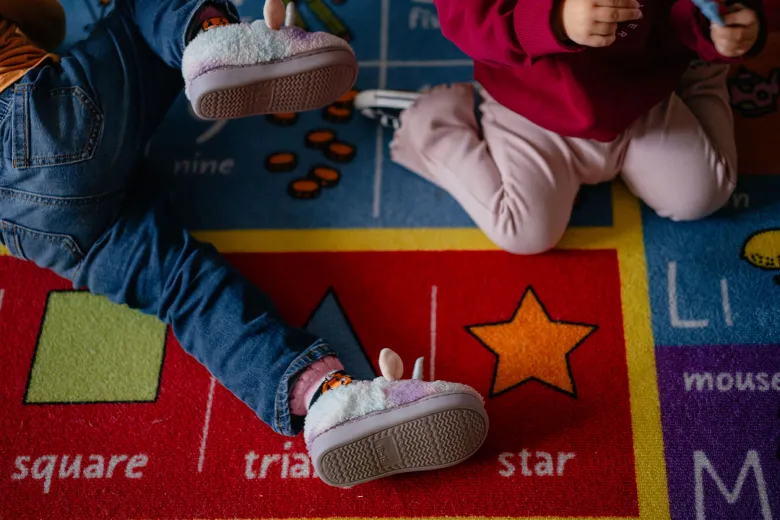
Children crawl on a colorful rug while playing educational games at Claudia Pellecer’s home daycare. Credit: Jamie Kelter Davis for The 19th
Her husband was just arriving to drop off their boys as ICE was leaving. The first thing out of his mouth when he called her: “They took Miss Diana.”
Agents entered the school without a warrant to arrest infant class teacher Diana Patricia Santillana Galeano, an immigrant from Colombia. DHS said part of the reason for her arrest was because she helped bring her two teenage children across the southern U.S. border this year. “Facilitating human smuggling is a crime,” DHS said. Santillana Galeano fled Colombia fearing for her safety in 2023, filed for asylum and was given a work permit through November 2029, according to court documents. She has no known criminal record. After her arrest, a federal judge ruled that her detention without access to a bond hearing was illegal and she was released November 12.
Horetski said the incident, the first known ICE arrest inside a day care, has spurred the community to action. A GoFundMe account set up by Horetski to support Santillana Galeano, has raised more than $150,000.
Horetski said what’s been lost in the story of what happened at Rayito is the humanity of the person at the center of it, someone she said was “like a second mother” to her son.
“At the end of the day, she was a person and a friend and a mother and provider to our kids — I think we need to remember that,” Horetski said.
Now, the parents are the ones coming together to put in place a safety plan for the teachers, most of whom have continued to come to the school and care for their children.
They are working on establishing a safe passage patrol, setting up parents with whistles at the front of the school to stand guard during arrival and dismissal time to ensure teachers can come and go to their cars or to public transit safely. Parents are also establishing escorts for teachers who may need a ride to work or someone to accompany them on the bus or the train. A meal train set up by the parents is helping to send food to the teachers through Thanksgiving, and two local restaurants have pitched in with discounts. Some of the parents are also lawyers who are considering setting up a legal clinic to ensure workers know their rights, Horetski said.
A young child watches an educational TV show in the living room of Claudia Pellecer’s home daycare in Chicago. Credit: Jamie Kelter Davis for The 19th
Figuring out how to come together to support teachers and the children who now have questions about safety is something that “continues to circle in all of our minds and brains,” Horeski said. “It’s hard to not have the answers or know how to best move forward. We’re in such uncharted territory that you’re like, ‘Where do you go from here?’ So we’re kind of paving that because this is the first time that something like this has happened.”
Prep is top of mind now for organizers including at the Service Employees International Union, where Sandra and Pellecer are members,who are convening emergency child care worker trainings to set up procedures, such as posted signs that say ICE cannot enter without a warrant, showing them what the warrants must include to be binding, helping them set a designated person to speak to ICE should they enter and talking to their families to offer support.
Cervantes has been doing this work since Trump’s first term, when it was clear immigration was going to be a key focus for the president. This year has been different, though. Child care centers were previously protected under a “sensitive locations” directive that advised ICE to not conduct enforcement in places like schools and day cares. But Trump removed that protection on his first day in office this year, signaling a more aggressive approach to ICE enforcement was coming.
Cervantes and her team are currently in the midst of a research project about child care workers across the country, conversations that are also illuminating for them just how dire the situation has become for providers.
“We are asking providers to make protocols for what is basically a man-made disaster,” she said. “They shouldn’t have to worry about protecting children and staff from the government.”
Since you made it to the bottom of this article, we have a small favor to ask.
We’re in the midst of our end-of-year campaign, our most important fundraising effort of the year. Thanks to NewsMatch, every dollar you give will be doubled through December 31.
If you believe stories like the one you just finished matter, please consider pitching in what you can. This effort helps ensure our reporting and resources stay free and accessible to everyone—teachers, parents, policymakers—invested in the future of education.
Higher education leaders face a constant balancing act. Shifting enrollment, tightening budgets, and rapidly evolving technology create pressure to stay nimble while maintaining operational excellence. In this environment, procurement teams are playing a new strategic role, moving beyond cost-cutting to become enablers of institutional agility.
The most agile institutions understand that procurement agility isn’t just about faster purchasing. It means building systems that anticipate needs, optimize every dollar in real time, and empower campus-wide decision-making. When procurement teams can redirect spending toward emerging priorities while maintaining compliance and transparency, they create institutional resilience: the ability to respond confidently to whatever comes next.
Closing higher ed’s agility gap
Traditional procurement creates bottlenecks precisely when agility is needed most: lengthy approval cycles that delay critical purchases, fragmented systems that prevent comprehensive spend analysis, and limited visibility that leaves leaders making decisions without complete financial data.
The stakes are significant. With 25% of operating budgets flowing through procurement—possibly more for institutions with extensive outsourcing—efficiency directly impacts your ability to respond quickly to changing circumstances.[1]
There’s encouraging momentum, though. In a survey of nearly 3,500 procurement and organizational leaders, 24% of senior leaders identified “becoming more agile or resilient” as a priority above reducing spend (19%).[2] This signals growing recognition that adaptability drives long-term institutional success more than cost-cutting alone.
Five pillars of agile procurement
So how can institutions actually close this agility gap? Many procurement leaders are turning to technology solutions, and for good reason. The right tools can magnify agility across campus operations, but only when they address the right fundamentals. These five pillars provide a framework for building procurement systems that enhance rather than hinder institutional responsiveness:
Unified systems: Consolidated purchasing transforms how campuses operate, improving user experience, spend transparency, and analytics. Administrators should be able to track campus-wide purchasing patterns, identify savings opportunities, and make data-driven decisions across all departments. When the University of Washington (UW) consolidated purchasing across its numerous academic departments through a single master account, it gained the visibility and simplified management that had previously been impossible.
Streamlined interfaces: A centralized purchasing interface removes manual work and complexity, allowing staff to focus on higher-impact activities while maintaining oversight. Ray Hsu, executive director of procurement services at the University of Washington, explains: “Imagine you’re managing the drama department and your scene shop needs to find ten different things to outfit your next production. Imagine how many different sources you visit to find costumes, supplies, and other items for that use case. Centralize that.”
Aligned purchasing: The right tools enable alignment with shifting institutional priorities—sustainability goals, minority-owned businesses, compliance requirements—through preferred vendor selection in a way that’s frictionless for buyers. Hsu describes how this works at UW: “When people search for items, they don’t even know they’re searching for a sustainable product. It just comes up in their search results, supporting our policy without them having to be mindful of it.”
Smart comparison: Pricing, delivery, and vendor comparison mechanisms help buyers to easily identify their most cost-effective options without searching multiple sources or juggling spreadsheets. Time saved on research translates to faster response when priorities shift.
Real-time monitoring: Proactive systems flag overspending or policy compliance issues before they become problems, giving administrators the breathing room to focus on strategic opportunities.
Real-world impact
The University of Washington example illustrates how these pillars work together in practice. Beyond the streamlined purchasing process described earlier, the transformation also revealed deeper lessons about building sustainable agility.
When UW decided to modernize its procurement, it faced a familiar challenge: staff were already purchasing from multiple vendors without central oversight. Instead of changing staff behavior, the university introduced a centralized system that preserved the flexibility departments valued while adding the visibility and control the university needed.
“There’s a saying, ‘I want an Amazon-like experience.’ We thought, let’s just go get the real thing and bring Amazon to our campus,” Hsu recalls.[3]
The shift delivered more than operational efficiency. “With Amazon Business Analytics, I can visualize information on an intuitive dashboard and have a conversation with my boss: ‘Here’s how we’re doing at a glance,’” says Hsu. That visibility changes how procurement conversations happen, moving from reactive problem-solving to proactive strategic discussions.
Perhaps most importantly, UW discovered that agility doesn’t require forcing behavior change. When the right systems build compliance and best practices into everyday workflows, adoption happens naturally. The drama department gets what it needs faster. Sustainability goals are met through preferred policies. And procurement leaders gain the strategic insights they need to guide institutional priorities.
Building sustainable agility
Building more agility into your procurement operations starts with a few key fundamentals:
Start with visibility into spend. Understand where your money goes. With 25% of operating budgets spent on goods and services, visibility is essential for agile resource allocation.[4]
Centralize for control. As Hsu notes, “Chances are your internal customers are already buying from Amazon in a decentralized and unmanaged fashion. My suggestion is to centralize that management into a unified system.”
Simplify user experience. Make compliance and best practices seamless. “Make it easy so it’s not a conscious decision—just part of their everyday buying experience,” advises Hsu.
Focus on consolidation. Look for opportunities to consolidate processes. Listen to solution providers who are experts in this area and implement their suggestions when they make sense to your organization, Hsu adds.
Agility as an institutional advantage
Agile procurement enables both resource optimization and faster response to opportunities. The goal isn’t just efficient purchasing, but procurement that enhances decision-making.
When procurement teams can redirect resources quickly, spot savings in real time, and adhere to campus purchasing policies, they free their institutions to focus on mission and seize opportunities as they arise.
It is tempting to regard AI as a panacea for addressing our most urgent global challenges, from climate change to resource scarcity. Yet the truth is more complex: unless we pair innovation with responsibility, the very tools designed to accelerate sustainability may exacerbate its contradictions.
A transformative potential
Let us first acknowledge how AI is already reshaping sustainable development. By mapping patterns in vast datasets, AI enables us to anticipate environmental risks, optimise resource flows and strengthen supply chains. Evidence suggests that by 2030, AI systems will touch the lives of more than 8.5 billion people and influence the health of both human and natural ecosystems in ways we have never seen before. Research published in Nature indicates that AI could support progress towards 79% of the Sustainable Development Goals (SDGs), helping advance 134 specific targets. Yet the same research also cautions that AI may impede 59 of those targets if deployed without care or control.
In practice, this means smarter energy grids that balance load and demand, precision agriculture that reduces fertiliser waste and environmental monitoring systems that detect deforestation or pollution in real time. For a planet under pressure, these scenarios offer hope to do less harm and build more resilience.
The hidden costs
Even so, we must confront the shadows cast by AI’s advancements. An investigation published earlier this year warns that AI systems could account for nearly half of global data-centre power consumption before the decade’s end. Consider the sheer scale: vast server arrays, intensive cooling systems, rare-earth mining and water-consuming infrastructure all underpin generative AI’s ubiquity. Worse still, indirect carbon emissions tied to major AI-capable firms reportedly rose by 150% between 2020 and 2023. In short, innovation meant to serve sustainability imposes a growing ecological burden.
Navigating trade-offs
This tension presents an essential question: how can we reconcile AI’s promise with its cost? Scholars warn that we must move beyond the assumption that ‘AI for good’ is always good enough. The moment demands a new discipline of ‘sustainable AI’: a framework that treats resource use, algorithmic bias, lifecycle impact and societal equity as first-order concerns.
Practitioners must ask not only what AI can do, but how it is built, powered, governed and retired. Efficiency gains that drive consumption higher will not deliver sustainability; they may merely escalate resource demands in disguise.
A moral and strategic imperative
For educators, policymakers and business leaders, this is more than a technical issue; it is a moral and strategic one. To realise AI’s true potential in advancing sustainable development, we must commit to three priorities:
Energy and resource transparency: Organisations must measure and report the footprint of their AI models, including data-centre use, water cooling, e-waste and supply-chain impacts. Transparency is foundational to accountability.
Ethical alignment and fairness: AI must be trained and deployed with due regard to bias, social impact and inclusivity. Its benefits must not reinforce inequality or externalise environmental harms onto vulnerable communities.
Integrative education and collaboration: We need multidisciplinary expertise, engineers fluent in ecology, ethicists fluent in algorithms and managers fluent in sustainability. Institutions must upskill young learners and working professionals to orient AI within the broader context of planetary boundaries and human flourishing.
MLA College’s focus and contribution
At MLA College, we recognise our role in equipping professionals at this exact intersection. Our programs emphasise the interrelationship between technology, sustainability and leadership. Graduates of distance-learning and part-time formats engage with the complexities of AI, maritime operations, global sustainable development and marine engineering by bringing insight to sectors vital to the planet’s future.
When responsibly guided, AI becomes an amplifier of purpose rather than a contraption of risk. Our challenge is to ensure that every algorithm, model and deployment contributes to regenerative systems, not extractive ones.
The promise of AI is compelling: more accurate climate modelling, smarter cities, adaptive infrastructure and just-in-time supply chains. But the challenge is equally formidable: rising energy demands, resource-intensive infrastructures and ungoverned expansion.
When responsibly guided, AI becomes an amplifier of purpose rather than a contraption of risk
Our collective role, as educators and practitioners, is to shape the ethical architecture of this era. We must ask whether our technologies will serve humanity and the environment or simply accelerate old dynamics under new wrappers.
The verdict will not be written on lines of code or boardroom decisions alone. It will be inscribed in the fields that fail to regenerate, in the communities excluded from progress, in the data centres humming with waste and in the next generation seeking meaning in technology’s promise.
About the author: Professor Mohammad Dastbaz is the principal and CEO of MLA College, an international leader in distance and sustainability-focused higher education. With over three decades in academia, he has held senior positions including deputy vice-chancellor at the University of Suffolk and pro vice-chancellor at Leeds Beckett University.
A Fellow of the British Computer Society, the Higher Education Academy, and the Royal Society of Arts, Professor Dastbaz is a prominent researcher and author in the fields of sustainable development, smart cities, and digital innovation in education.
His latest publication, Decarbonization or Demise – Sustainable Solutions for Resilient Communities (Springer, 2025), brings together cutting-edge global research on sustainability, climate resilience, and the urgent need for decarbonisation. The book builds on his ongoing commitment to advancing the UN Sustainable Development Goals through education and research.
At MLA College, Professor Dastbaz continues to lead transformative learning initiatives that combine academic excellence with real-world impact, empowering students to shape a sustainable future.
One of my quietest students once came up to me after class and said, “I’ve never felt comfortable speaking in English before this course.” That single sentence reminded me that what we build in the classroom goes far beyond lectures or grading. It’s the atmosphere we create that allows learning to happen. For this student, the turning point wasn’t grammar drills or vocabulary tests. It was trust.
As educators, we often focus on the what and how of teaching. But who the student in front of us matters just as much. In my experience, building genuine rapport is one of the most overlooked yet powerful strategies for helping students feel safe enough to participate, take risks, and grow.
What Rapport Really Means
Rapport is not about being the “fun” professor or trying to be everyone’s favorite. It’s about creating a space where students feel respected, seen, and supported not just academically, but as people.
In my classrooms, especially with my work with adult ESL learners in Kuwait, rapport means:
Greeting students by name and with warmth
Encouraging participation without pressure
Acknowledging their challenges as second-language users
Listening actively to their concerns and ideas
When students feel this kind of connection, they are far more willing to ask questions, attempt difficult tasks, and take ownership of their learning.
How I Build Rapport (and How You Can Too)
Here are five practical habits I’ve developed that have made a noticeable difference in student engagement and classroom climate.
1. Be Present Beyond the Podium
I make time before and after class for informal conversations, even brief ones. A simple, “How’s your week going?” can open doors. Students need to know we are not just grading machines. We are humans too.
2. Learn Names Quickly
It seems like a small detail, but using students’ names early in the semester changes everything. When I call on “Fatima” instead of “you in the third row,” I signal that her presence matters.
3. Use Encouragement Thoughtfully
When a student takes a risk, especially with speaking, I make sure to acknowledge the effort. Saying, “That was a great attempt,” helps build confidence and normalizes the learning process.
4. Normalize Mistakes
Learning is full of errors. I often point out my own slips and laugh with the class. This sets the tone that mistakes are part of the process, not something to fear.
5. Ask for Feedback and Act on It
I regularly ask students what’s helping and what’s not. If I change something based on their feedback, I let them know. This builds trust and shows them that their voices shape the learning experience too.
A Moment I’ll Never Forget
I remember one student, Yousef, who barely spoke during the first few weeks of class. He sat near the back, avoided eye contact, and never volunteered. I made a point to greet him by name each class, ask simple follow-up questions, and check in privately after group work. Slowly, he started opening up. First, he answered yes-no questions. Then, short phrases. By the end of the semester, he stood up and gave a short presentation in English. It wasn’t perfect, but it was powerful. Afterward, he told me, “You made me feel like I could do it.” That comment stays with me to this day.
How Rapport Transforms Feedback
One area where rapport makes a real difference is in how students receive feedback. Constructive feedback is essential for improvement, but it only works if students feel it comes from a place of support.
Once, I had to correct a student’s repeated grammatical mistake. It could have felt embarrassing, but because we had already built trust, she laughed and said, “I knew you would catch that.” She didn’t feel attacked. She knew the correction was about helping her grow.
This kind of response isn’t automatic. It comes from creating a consistent environment where feedback is expected, respected, and grounded in care.
The Ripple Effect of Strong Rapport
The impact of strong rapport is not limited to one assignment or one semester. I have seen students who once hesitated to speak now take initiative in group discussions, volunteer for peer mentoring, or continue English practice long after the course ends.
Rapport also builds community. When students see the teacher modeling kindness, encouragement, and open communication, they begin to do the same with each other. This shifts the classroom from a silent space to one that is collaborative and supportive.
What You Can Try This Week
If you’re looking to build rapport in your own classroom, here are three simple practices you can try immediately:
Learn and use student names within the first two weeks. Use name tents if needed. If you’re at mid-semester, consistent use of student names shows you care and value their presence which helps strengthen classroom connections.
Ask for anonymous feedback midway through the term. Just two questions: “What’s helping you learn?” and “What would you change?”
Set aside two minutes at the end of class to praise a risk taken, a great question asked, or a quiet win. This reinforces the kind of behavior you want to see more of.
These small actions compound over time. They send a clear message to students that they matter and that their growth is the shared goal of the classroom.
Final Thoughts: What They’ll Remember
As educators, we hope students walk away from our courses remembering the material. But what they often remember most is how we made them feel. Did they feel respected? Encouraged? Safe enough to take a risk?
If the answer is yes, then we have done more than teach. We have helped them build confidence, resilience, and the courage to use their voice.
That is the kind of learning that stays with them long after the final exam.
Fahad Ameen is a PhD researcher in Applied Linguistics at the University of Nottingham and an English language instructor at Kuwait University’s College of Education. His work focuses on student motivation, gamified learning, and building meaningful teacher–student relationships in Arab ESL contexts.
One of my quietest students once came up to me after class and said, “I’ve never felt comfortable speaking in English before this course.” That single sentence reminded me that what we build in the classroom goes far beyond lectures or grading. It’s the atmosphere we create that allows learning to happen. For this student, the turning point wasn’t grammar drills or vocabulary tests. It was trust.
As educators, we often focus on the what and how of teaching. But who the student in front of us matters just as much. In my experience, building genuine rapport is one of the most overlooked yet powerful strategies for helping students feel safe enough to participate, take risks, and grow.
What Rapport Really Means
Rapport is not about being the “fun” professor or trying to be everyone’s favorite. It’s about creating a space where students feel respected, seen, and supported not just academically, but as people.
In my classrooms, especially with my work with adult ESL learners in Kuwait, rapport means:
Greeting students by name and with warmth
Encouraging participation without pressure
Acknowledging their challenges as second-language users
Listening actively to their concerns and ideas
When students feel this kind of connection, they are far more willing to ask questions, attempt difficult tasks, and take ownership of their learning.
How I Build Rapport (and How You Can Too)
Here are five practical habits I’ve developed that have made a noticeable difference in student engagement and classroom climate.
1. Be Present Beyond the Podium
I make time before and after class for informal conversations, even brief ones. A simple, “How’s your week going?” can open doors. Students need to know we are not just grading machines. We are humans too.
2. Learn Names Quickly
It seems like a small detail, but using students’ names early in the semester changes everything. When I call on “Fatima” instead of “you in the third row,” I signal that her presence matters.
3. Use Encouragement Thoughtfully
When a student takes a risk, especially with speaking, I make sure to acknowledge the effort. Saying, “That was a great attempt,” helps build confidence and normalizes the learning process.
4. Normalize Mistakes
Learning is full of errors. I often point out my own slips and laugh with the class. This sets the tone that mistakes are part of the process, not something to fear.
5. Ask for Feedback and Act on It
I regularly ask students what’s helping and what’s not. If I change something based on their feedback, I let them know. This builds trust and shows them that their voices shape the learning experience too.
A Moment I’ll Never Forget
I remember one student, Yousef, who barely spoke during the first few weeks of class. He sat near the back, avoided eye contact, and never volunteered. I made a point to greet him by name each class, ask simple follow-up questions, and check in privately after group work. Slowly, he started opening up. First, he answered yes-no questions. Then, short phrases. By the end of the semester, he stood up and gave a short presentation in English. It wasn’t perfect, but it was powerful. Afterward, he told me, “You made me feel like I could do it.” That comment stays with me to this day.
How Rapport Transforms Feedback
One area where rapport makes a real difference is in how students receive feedback. Constructive feedback is essential for improvement, but it only works if students feel it comes from a place of support.
Once, I had to correct a student’s repeated grammatical mistake. It could have felt embarrassing, but because we had already built trust, she laughed and said, “I knew you would catch that.” She didn’t feel attacked. She knew the correction was about helping her grow.
This kind of response isn’t automatic. It comes from creating a consistent environment where feedback is expected, respected, and grounded in care.
The Ripple Effect of Strong Rapport
The impact of strong rapport is not limited to one assignment or one semester. I have seen students who once hesitated to speak now take initiative in group discussions, volunteer for peer mentoring, or continue English practice long after the course ends.
Rapport also builds community. When students see the teacher modeling kindness, encouragement, and open communication, they begin to do the same with each other. This shifts the classroom from a silent space to one that is collaborative and supportive.
What You Can Try This Week
If you’re looking to build rapport in your own classroom, here are three simple practices you can try immediately:
Learn and use student names within the first two weeks. Use name tents if needed. If you’re at mid-semester, consistent use of student names shows you care and value their presence which helps strengthen classroom connections.
Ask for anonymous feedback midway through the term. Just two questions: “What’s helping you learn?” and “What would you change?”
Set aside two minutes at the end of class to praise a risk taken, a great question asked, or a quiet win. This reinforces the kind of behavior you want to see more of.
These small actions compound over time. They send a clear message to students that they matter and that their growth is the shared goal of the classroom.
Final Thoughts: What They’ll Remember
As educators, we hope students walk away from our courses remembering the material. But what they often remember most is how we made them feel. Did they feel respected? Encouraged? Safe enough to take a risk?
If the answer is yes, then we have done more than teach. We have helped them build confidence, resilience, and the courage to use their voice.
That is the kind of learning that stays with them long after the final exam.
Fahad Ameen is a PhD researcher in Applied Linguistics at the University of Nottingham and an English language instructor at Kuwait University’s College of Education. His work focuses on student motivation, gamified learning, and building meaningful teacher–student relationships in Arab ESL contexts.


![The Higher Ed CFO’s Guide to Building a High-Performing IT Operation [eBook]](https://blog.college-counseling.com/wp-content/uploads/2025/12/The-Higher-Ed-CFOs-Guide-to-Building-a-High-Performing-IT.jpg)