Teacher evaluations have been the subject of debate for decades. Breakthroughs have been attempted, but rarely sustained. Researchers have learned that context, transparency, and autonomy matter. What’s been missing is technology that enhances these at scale inside the evaluation process–not around it.
As an edtech executive in the AI era, I see exciting possibilities to bring new technology to bear on these factors in the longstanding dilemma of observing and rating teacher effectiveness.
At the most fundamental level, the goals are simple, just as they are in other professions: provide accountability, celebrate areas of strong performance, and identify where improvement is needed. However, K-12 education is a uniquely visible and important industry. Between 2000 and 2015, quality control in K-12 education became more complex, with states, foundations, and federal policy all shaping the definition and measurement of a “proficient” teacher.
For instance, today’s observation cycle might include pre- and post-observation conferences plus scheduled and unscheduled classroom visits. Due to the potential for bias in personal observation, more weight has been given to student achievement, but after critics highlighted problems with measuring teacher performance via standardized test scores, additional metrics and artifacts were included as well.
All of these changes have resulted in administrators spending more time on observation and evaluation, followed by copying notes between systems and drafting comments–rather than on timely, specific feedback that actually changes practice. “Even when I use Gemini or ChatGPT, I still spend 45 minutes rewriting to fit the district rubric,” one administrator noted.
“When I think about the evaluation landscape, two challenges rise to the surface,” said Dr. Quintin Shepherd, superintendent at Pflugerville Independent School District in Texas. “The first is the overwhelming volume of information evaluators must gather, interpret, and synthesize. The second is the persistent perception among teachers that evaluation is something being done to them rather than something being done for them. Both challenges point in the same direction: the need for a resource that gives evaluators more capacity and teachers more clarity, immediacy, and ownership. This is where AI becomes essential.”
What’s at stake
School leaders are under tremendous pressure. Time and resources are tight. Achieving benchmarks is non-negotiable. There’s plenty of data available to identify patterns and understand what’s working–but analyzing it is not easy when the data is housed in multiple platforms that may not interface with one another. Generic AI tools haven’t solved this.
For teachers, professional development opportunities abound, and student data is readily available. But often they don’t receive adequate instructional mentoring to ideate and try out new strategies.
Districts that have experimented with AI to provide automated feedback of transcribed recordings of instruction have found limited impact on teaching practices. Teachers report skepticism that the evolving tech tools are able to accurately assess what is happening in their classrooms. Recent randomized controlled trials show that automated feedback can move specific practices when teachers engage with it. But that’s exactly the challenge: Engagement is optional. Evaluations are not.
Teachers whose observations and evaluations are compromised or whose growth is stymied by lost opportunities for mentoring may lose out financially. For example, in Texas, the 2025-26 school year is the data capture period for the Teacher Incentive Allotment. This means fair and objective reviews are more important than ever for educators’ future earning potential.
For all of these reasons, the next wave of innovation has to live inside the required evaluation cycle, not off to the side as another “nice-to-have” tool.
Streamlining the process
My background at edtech companies has shown me how eager school leaders are to make data-informed decisions. But I know from countless conversations with administrators that they did not enter the education field to crunch numbers. They are motivated by seeing students thrive.
The breakthrough we need now is an AI-powered workspace that sits inside the evaluation system. Shepherd would like to see “AI that quietly assists with continuous evidence collection not through surveillance, but pattern recognition. It might analyze lesson materials for cognitive rigor, scan student work products to detect growth, or help teachers tag artifacts connected to standards.”
We have the technology to create a collaborative workspace that can be mapped to the district’s framework and used by administrators, coaches, support teams, and educators to capture notes from observations, link them to goals, provide guidance, share lesson artifacts, engage in feedback discussions, and track growth across cycles. After participating in a pilot of one such collaborative workspace, an evaluator said that “for the first time, I wasn’t rewriting my notes to make them fit the rubric. The system kept the feedback clear and instructional instead of just compliance-based.”
As a superintendent, Shepherd looks forward to AI support for helping make sense of complexity. “Evaluators juggle enormous qualitative loads: classroom culture, student engagement, instructional clarity, differentiation, formative assessment, and more. AI can act as a thinking partner, organizing trends, highlighting possible connections, identifying where to probe deeper, or offering research-based framing for feedback.”
The evaluation process will always be scrutinized, but what must change is whether it continues to drain time and trust or becomes a catalyst for better teaching. Shepherd expects the pace of adoption to pick up speed as the benefits for educators become clear: “Teachers will have access to immediate feedback loops and tools that help them analyze student work, reconsider lesson structures, or reflect on pacing and questioning. This strengthens professional agency and shifts evaluation from a compliance ritual to a growth process.”
Real leadership means moving beyond outdated processes and redesigning evaluation to center evidence, clarity, and authentic feedback. When evaluation stops being something to get through and becomes something that improves practice, we will finally see technology drive better teaching and learning.
Jena Draper, RefynED
Jena Draper is the CEO and founder of RefynED and a proven edtech entrepreneur who previously built CatchOn and led it through two successful acquisitions after reshaping how schools use data for instructional decision-making. She is now applying that same foresight to reinvent teacher evaluation as a catalyst for educator growth rather than compliance. Draper is recognized for turning systemic challenges into category-defining innovation that improves instructional practice at scale.
Latest posts by eSchool Media Contributors (see all)
The 2026 landscape makes one thing clear: institutions that rely on incremental change will not make it in this new era of higher ed.
Student expectations are shifting, competition is intensifying and AI is reshaping how people search, compare and choose. The Modern Learner is moving faster than most institutions—clear on what they want and decisive about where they spend time and money.
In this reality, doing a little more of what you’ve always done isn’t neutral. It’s a liability.
At EducationDynamics, we think differently. We believe in the transformative power of education, and we believe higher ed can rise above the noise to better serve the Modern Learner.
That belief drives InsightsEDU. InsightsEDU 2026 gathers the leaders ready to reinvent—those willing to transform their programs, positioning and culture for the era ahead. From February 17–19 in Fort Lauderdale, presidents, marketers, enrollment leaders and more will come together not to trade small tweaks, but to rethink how their institutions serve learners, tell their stories and grow.
Why InsightsEDU Exists
We believe your institution’s why is its strongest enrollment tool. Yet on most campuses, brand, strategy and culture are owned by different teams and rarely viewed as one story—InsightsEDU is designed to collapse those silos and give leaders a holistic view of the learner journey from first impression to long-term outcomes.
Modern Learners don’t see your brand and enrollment funnel as separate. They experience one journey: a promise made in your brand, a reality in your programs and support and a decision shaped by how clearly you communicate value. When those pieces align, you build reputation and revenue. When they don’t, both erode.
InsightsEDU 2026 exists to close that gap. It’s the live expression of how we believe higher ed must operate now—designing around the Modern Learner, treating reputation and revenue as one integrated strategy, and running enrollment as a unified system that connects an institution’s entire ecosystem.
This isn’t another conference. It’s a launchpad for institutional reinvention.
The Future Unbound: Your Institution’s Growth Mandate
This year’s theme, The Future Unbound, is a mandate to stop waiting and start unbinding.
At InsightsEDU, that means letting go of the assumption that yesterday’s playbook will carry you through tomorrow. It means challenging structures and habits that separate brand, enrollment and student success even though students experience them as one continuum. It means pressure-testing who you serve, how they find you and whether your story still matches reality.
This conference is devoted to that mission: transformation in the face of uncertainty. Every session is intentionally crafted to equip leaders to navigate this environment and reinforce higher education’s value proposition.
What Makes InsightsEDU Different
You’ve been to enough events where you swap business cards, collect slide decks and go home unchanged. Explore how InsightsEDU 2026 is different by design.
A Keynote That Resets Your Why
At the center of InsightsEDU 2026 is a keynote from visionary Matt Dunsmoor from Simon Sinek’s The Optimism Company. He’s not here to offer feel-good inspiration you forget by next week. He’s here to confront a hard truth: when strategy and culture are disconnected, your why collapses—and your enrollment strategy with it.
The keynote will help you sharpen your institution’s why in ways that resonate with Modern Learners, expose where culture undercuts the story you tell and push you to reconnect purpose, people and plans so reputation and revenue move together.
An Exclusive First Look at the 2026 Modern Learner Report
If putting the Modern Learner first is non-negotiable, InsightsEDU is where you need to be.
Attendees receive an exclusive first look at EducationDynamics’ 2026 Modern Learner report, presented by EducationDynamics’ President of Enrollment Management, Greg Clayton, and Senior Director of Analytics and Business Intelligence, Katie Tomlinson. You’ll see what today’s students value in higher education and how that shapes their decisions; how brand and reputation influence their search; and how to engage Modern Learners where they are with messages that land.
The report shares insights from our survey of Modern Learners and lays out a framework for a strategic approach built on stronger reputation and smarter engagement.
InsightsEDU 2026 is grounded in this data—real students, real behavior and real tradeoffs. Throughout the conference, you’ll use these insights to test your messaging, rethink programs and refine your enrollment strategy so it reflects how students actually behave in today’s landscape, not how they used to.
A Clear Directive on What Actually Moves the Needle
Many conferences leave you energized but unfocused. InsightsEDU is built to narrow your focus to what truly moves the needle. Most conferences still split your reality into tracks—leadership talking mission in one room, marketing talking campaigns in another; enrollment trading tactics down the hall. InsightsEDU starts from a different assumption: in 2026, those divides are the problem.
The agenda is built around the idea that every function ultimately feeds your brand. By bringing everyone into the same general sessions and then into focus-specific tracks, InsightsEDU gives leaders a shared picture of the full enrollment ecosystem and a practical toolkit to decide which levers will actually change the trajectory of their institution.
Real Tactics from Real Higher Ed Leaders & Industry Pros
Reinvention doesn’t happen in theory. It happens when real people in real roles make different choices.
You will also hear from platform insiders bringing expertise from the digital front lines of Google, Reddit, Snapchat, Meta and LinkedIn—the very places where Modern Learners search, scroll and decide what to do next. These leaders will unpack the trends and behavioral shifts they observe in the market, offering a tactical look at how these ecosystems are evolving and what that means for your institution’s strategy.
The result: a conference that doesn’t just tell you what to change but prepares you for the leadership required to make change stick.
This conference is for leaders who feel the urgency of this moment and are ready to act—presidents and cabinet members responsible for both mission and margin; CMOs and marketing executives tired of disconnected campaigns that don’t translate into enrollment; enrollment leaders who live every day with the pressure of pipelines, outcomes and student success; and online, adult and continuing ed leaders who already live in the Modern Learner reality and want their institutions aligned to that same pace and expectation.
If you’re looking for another safe year of marginal change, you don’t need this conference. If you’re aiming for sustainable growth, stronger reputation and genuine student success, this is the room you need to be in.
What You’ll Take Back to Campus
When you leave Fort Lauderdale, you won’t just be inspired—you’ll know what to do next.
Expect to go home with:
A Modern Learner–informed strategy for 2026 and beyond Concrete shifts in programs, positioning and experience based on fresh data about what students value, how they search and what drives trust.
A Unified Enrollment Framewrok A practical model for breaking down silos and aligning marketing, enrollment and student success into one system that drives reputation and revenue.
A Playbook You Can Actually Use Top priorities you’ll pursue immediately supported by metrics that create alignment across leadership, marketing and enrollment teams.
A Network You Can Activate Connections with peers and industry partners you can tap long after the conference—people who will share results, compare notes and help you keep pushing your strategy forward.
The Conference for Transformation
You don’t need another conference that leaves your strategy unchanged.
InsightsEDU 2026 is built for leaders who are ready to confront what’s not working, commit to the Modern Learner and move their institutions from incremental adjustment to true reinvention.
If you’re ready to move beyond tweaks and start the work of institutional reinvention, join us in Fort Lauderdale for The Future Unbound.
Evan Scott is a lifelong New Jersey resident, a veteran, and a retired military service member. He holds a bachelor’s degree in education and was elected to his hometown’s Board of Education in 1988. Now living in Evesham Township, NJ, he continues to advocate for fair and transparent school funding.
New Jersey spends about $40 billion each year on public education for roughly 1.3 million children. That’s one of the highest per-pupil spending levels in the country. We have a constitutional guarantee of a “thorough and efficient” education, a sophisticated school funding formula, a powerful state department of education, and layer upon layer of regulations and oversight.
And yet: our statewide test scores are still below pre-pandemic levels. Achievement gaps by race, income, disability, and language remain enormous. In some grades and subjects, they’re widening.
If you built a machine to spend this much money and still fail to close gaps year after year, it would look exactly like New Jersey’s education system.
The System Optimizes for the Wrong Thing
On paper, New Jersey’s education system is supposed to deliver a thorough and efficient education for every child, with equity across race and income, leading to college and career readiness.
In practice, the system optimizes for compliance with regulations, political stability, and avoiding lawsuits and strikes.
The proof is everywhere. We produce beautiful policy documents, voluminous regulations, complex aid tables, and endless reports. But ask a simple question — “what exactly are we doing differently in classrooms to get more third graders reading on grade level?” — and the answers get vague fast.
We have built a machine to show we are doing something. We have not built a machine engineered to maximize student learning.
$40 Billion Is Not $40 Billion of Teaching
That enormous figure pays for instruction, sure. But also: support services, administration, operations and maintenance, transportation and food, debt, pensions, and legacy costs. Nationally, barely half of K-12 spending reaches the classroom as direct instruction. New Jersey is no exception.
The problem isn’t that buses or nurses are wasteful. The problem is this: we are spending tens of billions of dollars through a system that does not prioritize the highest-impact instructional uses of the next dollar.
New money goes first to contractual raises, benefit increases, new programs layered on old ones without evaluation, and rising facility costs. Almost none of this is evaluated through the brutal question a serious system would ask: “If we invest this next $100 million, what evidence says it will move reading and math outcomes for our most vulnerable students?”
We don’t ask that. We just roll the machine forward.
The State Knows Better—But Only in Science
The Department of Education has already shown us what a more serious approach looks like. On its own website, NJDOE concedes that less than 20 percent of classroom materials are aligned to standards in science, and has responded by building a Model Science Curriculum around vetted, high-quality resources.
In other words: the Department knows that standards alone are not enough. Teachers need specific, evidence-based materials, and many districts aren’t getting them on their own.
But why only science? Our most urgent gaps are in early reading and middle-grades math. If the Department can curate model units for science, it can create a K-3 literacy framework aligned with the science of reading and a model math sequence built around proven materials.
Instead, New Jersey treats curriculum as a hyper-local, 600-district procurement hobby — and then acts surprised when quality is all over the map and only half our students read or do math on grade level.
600 Districts, Zero Instructional Coherence
New Jersey has hundreds of school districts, each with its own superintendent, business administrator, HR department, and curriculum staff. Many are tiny. Above them sits NJDOE and county superintendents, responsible for standards, accountability, and oversight.
What does the state actually control? It sets standards, not curriculum. Districts must “align” to the New Jersey Student Learning Standards, but the state does not mandate or approve specific programs.
The result: strong standards and a huge compliance apparatus at the top. A fragmented, district-by-district free-for-all in curriculum and instruction at the bottom.
Contrast that with Mississippi and Louisiana, which have seen real gains in early reading. Their state agencies didn’t stop at standards. They rated and recommended specific curricula aligned to the science of reading. They tied professional development to those exact materials. They used state power to make instructional coherence non-negotiable in early grades.
New Jersey has allowed 600 different answers to “what does reading instruction look like in K-3?” and then acts surprised when results are uneven and gaps persist.
Our administrative machine is big enough to boss districts around on paperwork and testing windows. It is somehow too shy to insist on evidence-based literacy instruction for six-year-olds.
SFRA: A Formula Without a Steering Wheel
New Jersey’s School Funding Reform Act is, in theory, a rational way to calculate how much each district needs, with extra weights for poverty, language, and special education.
But SFRA answers “how much?” It says almost nothing about “for what?”
You can be billions closer to full funding and still have districts spending above adequacy with mediocre outcomes, districts below adequacy left on their own to figure out interventions, and no systematic connection between spending patterns and student outcomes.
SFRA is a clever formula for filling tanks. It is not a steering wheel.
A System That Protects Itself Better Than It Protects Children
Step back and the obscenity becomes stark:
We tolerate enormous fixed administrative overhead spread across hundreds of districts that could consolidate or share services. We accept a patchwork of curricula in early literacy even as other states prove you can do better. We pour in new money with minimal discipline about which interventions actually work. We allow graduation standards to be quietly lowered so statistics look smoother.
All of this is defended in the name of “local control,” “flexibility,” and “respecting stakeholders.”
Meanwhile, a third grader in Trenton is still far less likely to read on grade level than a third grader in a wealthy suburb — despite living in one of the highest-spending education systems on Earth.
New Jersey’s system is extremely good at sustaining itself. It is not nearly good enough at changing itself when children are not learning.
What a First-Principles Reset Would Look Like
If we were designing a $40 billion system for learning, rather than inheriting a $40 billion system of habits:
Clear, public goals. By 2030: 80% of third graders reading proficiently, with racial and income gaps below 10 percentage points. By 8th grade: 70% proficient in math, same gap constraint. By graduation: diplomas tied to real college and career readiness benchmarks.
Evidence-based spending rules. The next billion in state aid goes first to high-dosage tutoring for students below proficiency, smaller K-3 class sizes in high-poverty schools, literacy and math coaches tied to vetted curricula, and high-quality pre-K expansion. Not to automatic expansion of everything we already do.
State leadership on curriculum. NJDOE should review and rate K-8 ELA and math curricula and publish a short list of high-quality options. Professional development should be built around those choices. Districts can still choose — but from good choices.
Rationalized administration. Require consolidation and shared services where appropriate. Reinvest savings into classroom-facing roles: teachers, aides, interventionists, counselors.
Real accountability for results. Public dashboards showing, for each district: spending per pupil broken out by category, proficiency rates and gaps by subgroup, and whether things are improving. Tie flexibility and funding to demonstrated ability to turn dollars into learning.
The Courage We Actually Need
New Jersey doesn’t need one more glossy plan or press release celebrating “investments in education.” It needs the political courage to admit that our current system is not designed to do the thing we say we value most.
It will take courage to challenge the sacredness of local administrative fiefdoms. To tell high-spending districts that dollars above adequacy must be justified by outcomes. To insist that early literacy is not a matter of preference but of evidence. To rebuild NJDOE from compliance cop to instructional engine.
We are not a poor state. We are not a low-spending state. Our children’s struggles are not about scarcity. They are about design — the design of a system that has learned to protect adults, institutions, and routines more effectively than it has learned to teach children to read, write, and think.
To understand how we arrived here, it is not enough to point at the Trump administration, the ideological crusade against “Housing First,” or the White House Faith Office now shaping federal grantmaking. One must also examine the educated neoliberals who built and normalized the system that made this possible.
HUD’s policy change overturns decades of federal commitment to permanent supportive housing, an evidence-backed model that dramatically reduces chronic homelessness. The new Notice of Funding Opportunity caps permanent housing at just 30 percent of CoC dollars, down from 87 percent in prior years, while the remainder is funneled toward transitional housing, work or service requirements, mandatory treatment, and faith-based compliance programs. The total funding for 2026 is roughly $3.9 billion across 7,000 grants. That amount, spread across hundreds of thousands of people experiencing homelessness, is barely sufficient to provide minimal assistance, let alone stable housing or the comprehensive services this population needs. One-third of existing programs will run out of funds before the new awards are issued in May, leaving vulnerable individuals exposed to eviction during the harshest months of winter. Ann Oliva, CEO of the National Alliance to End Homelessness and a former HUD official, described the rollout as deeply irresponsible, warning that the administration is setting communities up for failure.
For decades, U.S. policy has been shaped not just by conservatives but also by a sprawling class of highly educated managers: MBAs, MPPs, JDs, think-tank fellows, foundation executives, nonprofit administrators, and “innovation” consultants. They came from America’s elite universities, fluent in market logic, managerialism, and austerity politics. They preached efficiency, accountability, metrics, and self-sufficiency. Many also personally accumulated wealth, often owning multiple homes, benefiting from investment income, and exploiting loopholes to minimize or avoid taxes. Meanwhile, the programs they manage shrink support for the poor and vulnerable.
Through their influence, housing became a program, not a public good. Public housing construction largely disappeared, replaced by a grant-driven, nonprofit marketplace controlled by elite professionals. Even the funding allocated for CoC programs, though nominally in the billions, is deliberately minimal. This scarcity forces competition, instability, and suffering among poor people. Nonprofit executives, most of whom depend on federal contracts and foundation dollars, rarely challenge the economic and political structures that produce homelessness. Accountability rhetoric replaced structural change, reframing homelessness as an issue of individual behavior rather than a systemic failure. The academy normalized the idea that poor people should suffer, teaching a generation of managers to prioritize markets, metrics, and “innovation” over human need. This bipartisan, university-trained professional class laid the foundation for the HUD cuts now threatening hundreds of thousands of lives.
HUD argues that the new model “restores accountability” and reduces the purported waste of Housing First, but decades of research contradict that claim. Permanent supportive housing reduces chronic homelessness, lowers emergency and policing costs, stabilizes people with disabilities, and is cheaper than institutionalization or shelters. Transitional housing with mandatory compliance, on the other hand, repeatedly pushes people back to the streets, disproportionately harms people with disabilities, increases mortality, inflates administrative costs, and creates churn rather than stability. The policy is not a mistake; it reflects the calculated priorities of an elite managerial class whose worldview demands austerity for the poor while allowing them to flourish materially.
The response in Washington has been striking. Forty-two Senate Democrats warned HUD that the shift violates the McKinney-Vento Act, undermines local decision-making, and rejects decades of federally funded research. Even twenty House Republicans urged careful implementation to avoid destabilizing services for seniors and disabled people. Yet decades of neoliberal policymaking—funded and legitimized by universities, foundations, and think tanks—have already created a system in which poverty and suffering are baked into federal policy. This latest HUD action simply codifies that worldview.
The crisis unfolding now is not just the product of Trump’s ideological war on Housing First. It is the logical endpoint of decades of privatization, the erosion of public housing, elite consensus around austerity, credentialed managerialism, the nonprofit-industrial complex, the foundation-university revolving door, and the belief—deeply embedded in higher education—that markets and metrics should govern everything. Many of these policymakers and nonprofit executives own multiple homes, refuse to pay taxes, and structure federal policy to ensure the poor remain dependent, unstable, and suffering. The people most directly harmed are those with the least political power: disabled people, elderly tenants, veterans, people with serious mental illness, women fleeing violence, and families trying to survive an economy that no longer works for them. Behind them stands a class of educated neoliberals who built the systems that made this outcome possible, often congratulating themselves for “innovation” while allowing misery to proliferate. This is not failure. This is design.
Sources:
Politico, “HUD to Cut Permanent Housing Funding for Homeless Programs,” 2025.
National Alliance to End Homelessness, internal HUD funding documents, 2025.
Ann Oliva, National Alliance to End Homelessness, statements to POLITICO, 2025.
McKinney-Vento Homeless Assistance Act, 1987.
HUD Notice of Funding Opportunity, 2026 Continuum of Care Program.
Executive Order: “Ending Crime and Disorder on America’s Streets,” White House, 2025.
For decades, curriculum, pedagogy, and technology have evolved to meet the changing needs of students. But in many schools, the classroom environment itself hasn’t kept pace. Classic layouts that typically feature rows of desks, limited flexibility, and a single focal point can often make it harder for educators to support the dynamic ways students learn today.
Classrooms are more than places to sit–when curated intentionally, they can become powerful tools for learning. These spaces can either constrain or amplify great teaching. By reimagining how classrooms are designed and used, schools can create environments that foster engagement, reduce stress, and help both teachers and students thrive.
Designing a classroom for student learning outcomes and well-being
Many educators naturally draw on their own school experiences when shaping classroom environments, often carrying forward familiar setups that reflect how they once learned. Over time, these classic arrangements have become the norm, even as today’s students benefit from more flexible, adaptable spaces that align with modern teaching and learning needs.
The challenge is that classic classroom setups don’t always align with the ways students learn and interact today. With technology woven into nearly every aspect of their lives, students are used to engaging in environments that are more dynamic, collaborative, and responsive. Classrooms designed with flexibility in mind can better mirror these experiences, supporting teaching and learning in meaningful ways, even without using technology.
To truly engage students, the classroom must become an active participant in the learning process. Educational psychologist Loris Malaguzzi famously described the classroom as the “third teacher,” claiming it has just as much influence in a child’s development as parents or educators. With that in mind, teachers should be able to lean on this “teacher” to help keep students engaged and attentive, rather than doing all the heavy lifting themselves.
For example, rows of desks often limit interaction and activity, forcing a singular, passive learning style. Flexible seating, on the other hand, encourages active participation and peer-to-peer learning, allowing students to easily move and reconfigure their learning spaces for group work or individual work time.
I saw this firsthand when I was a teacher. When I moved into one of my third-grade classrooms, I was met with tables that quickly proved insufficient for the needs of my students. I requested a change, integrating alternative seating options and giving students the freedom to choose where they felt most comfortable learning. The results exceeded my expectations. My students were noticeably more engaged, collaborative, and invested in class discussions and activities. That experience showed me that even the simplest changes to the physical learning environment can have a profound impact on student motivation and learning outcomes.
Allowing students to select their preferred spot for a given activity or day gives them agency over their learning experience. Students with this choice are more likely to engage in discussions, share ideas, and develop a sense of community. A comfortable and deliberately designed environment can also reduce anxiety and improve focus. This means teachers experience fewer disruptions and less need for intervention, directly alleviating a major source of stress by decreasing the disciplinary actions educators must make to resolve classroom misbehavior. With less disruption, teachers can focus on instruction.
Supporting teachers’ well-being
Just as classroom design can directly benefit student outcomes, it can also contribute to teacher well-being. Creating spaces that support collaboration among staff, provide opportunities to reset, and reduce the demands of the job is a tangible first step towards developing a more sustainable environment for educators and can be one factor in reducing turnover.
Intentional classroom design should balance consistency with teacher voice. Schools don’t need a one-size-fits-all model for every room, but they can establish adaptable design standards for each type of space, such as science labs, elementary classrooms, or collaboration areas. Within those frameworks, teachers should be active partners in shaping how the space works best for their instruction. This approach honors teacher expertise while ensuring that learning environments across the school are both flexible and cohesive.
Supporting teacher voice and expertise also encourages “early adopters” to try new things. While some teachers may jump at the opportunity to redesign their space, others might be more hesitant. For those teachers, school leaders can help ease these concerns by reinforcing that meaningful change doesn’t require a full-scale overhaul. Even small steps, like rearranging existing furniture or introducing one or two new pieces, can make a space feel refreshed and more responsive to both teaching and learning needs. To support this process, schools can also collaborate with learning environment specialists to help educators identify practical starting points and design solutions tailored to their goals.
Designing a brighter future for education
Investing in thoughtfully designed school environments that prioritize teacher well-being isn’t just about creating a more pleasant workplace; it’s a strategic move to build a stronger, more sustainable educational system. By providing teachers with flexible, adaptable, and future-ready classrooms, schools can address issues like stress, burnout, and student disengagement. When educators feel valued and empowered in their spaces, they create a better work environment for themselves and a better learning experience for their students. Ultimately, a supportive, well-designed classroom is an environment that sets both educators and students up for success.
Dr. Sue Ann Highland, School Specialty
Dr. Sue Ann Highland is the Lead National Education Strategist at School Specialty.
Latest posts by eSchool Media Contributors (see all)
Todd S. Nelson rose from academic beginnings—a B.S. from Brigham Young University and an MBA from the University of Nevada, Reno—to dominate the for-profit higher education space. Over nearly four decades, Nelson has amassed vast personal wealth leading University of Phoenix, Education Management Corporation (EDMC), and Perdoceo Education, even as each institution left embattled students and regulatory fallout in its wake.
Under Nelson’s leadership, Apollo Group (parent of University of Phoenix) mountains of revenue—$2.2 billion and over 300,000 students by 2006—coincided with a $41 million payday in that year alone. He resigned amid pressure over deceptive admissions practices.
Nelson’s move to EDMC in 2007 triggered another enrollment explosion—from 82,000 to over 160,000 students by 2011—propelled by federal student aid. Annual revenues reached nearly $2.8 billion, even as employees were alleged to be encouraged to enroll “anyone and everyone” to meet quotas. This aggressive focus on recruitment came with enormous personal compensation—approximately $13.1 million annually—while students endured mounting debt and dwindling outcomes.
A 2015 landmark settlement exposed EDMC’s alleged violations under the False Claims Act. The Justice Department accused the company of operating as a “recruitment mill,” illegally funneling federal funds through false certifications. EDMC agreed to pay $95.5 million in damages and forgive more than $102 million in student loans, affecting about 80,000 former students—averaging around $1,370 per student.Internal documents and court filings paint a grim picture: incentive-based pay for recruiters, breach of fiduciary duties, and a business model the trustee called “fundamentally fraudulent.”
Nelson’s chapter at Career Education Corporation (later Perdoceo) echoed the same script. Campuses shuttered, including Le Cordon Bleu and Sanford-Brown, left students stranded with untransferable credits—and yet Nelson’s compensation remained soaring. In 2019, he earned $7.4 million and held about $12 million in equity.
Whistleblower accounts from inside Perdoceo’s operations are damning. One former recruiter described pressure to enroll students “by any means necessary,” including coercive calls and emotional manipulation—often targeting vulnerable applicants with low income or lacking basic readiness. Despite those practices, Perdoceo reaped profits, with Nelson publicly touting revenue growth even as the Department of Education issued a formal notice in May 2021: thousands of borrower defense claims were pending against the company, alleging misrepresentations on credits, employment prospects, and accreditation.
Further regulatory investigations deepened through early 2022, focusing on recruiting, marketing, and financial aid practices—yet no executive accountability has followed.
The narrative that emerges is stark: Todd S. Nelson repeatedly led institutions to profit-fueled expansion using students’ federal dollars, while suppressing outcomes and exposing students to debilitating debt. Lawsuits, settlements, and investigative reports expose deceptive enrollment practices, false claims, and regulatory violations—but the executives—including Nelson—walk away with wealth and are rarely held personally responsible.
Sources
Wikipedia: Todd S. Nelson—compensation figures and resignation amid scrutiny.
TribLIVE: Allegations of “anyone and everyone” being enrolled to meet quotas under Nelson’s reign at EDMC.
Career Education Review: Insights on quality decline amid enrollment growth at EDMC and Perdoceo.
Department of Justice and NASFAA: 2015 EDMC settlement—$95.5 million damages, $102 million in loan forgiveness for hundreds of thousands.
Bankruptcy court filings: Allegations of fraudulent business model and incentive-driven recruitment.
Republic Report & USA Today: Whistleblower testimony on Perdoceo’s predatory recruiting tactics.
BELOIT, Wis. — As Chris Hooker eyed a newly built piece of ductwork inside Beloit Memorial High School, a wry smile crept over his face. “If you worked for me,” he told a student, considering the obviously crooked vent, “I might ask if your level was broken.”
Hooker, the HVAC manager of Lloyd’s Plumbing and Heating Corp. in nearby Janesville, was standing inside a hangar-sized classroom in the school’s advanced manufacturing academy, where students construct full-size rooms, hang drywall and learn the basics of masonry. His company sends him to the school twice a week for about two months a year to help teach general heating, venting and air conditioning concepts to students.
“I cover the mountaintop stuff,” he said, noting that at a minimum students will understand HVAC when they become homeowners.
But the bigger potential payoff is that these students could wind up working alongside Hooker after they graduate. If his firm has an opening, any student recommended by teacher Mike Wagner would be a “done deal,” Hooker said. “Plus, if they come through this class, I know them.”
Manufacturing and construction dominate the business needs inside Beloit, a small city of 36,000 just minutes from the Illinois border. Sitting at the nexus of two major highways, and within 100 miles of Chicago, Milwaukee and Madison, Beloit is home to a range of businesses that include a Frito-Lay production plant, an Amazon distribution center and a Navy subcontractor. In the next two years, a $500 million casino and hotel complex is scheduled to open.
But staffing these companies into the future is a major concern. Across the country, the average age of manufacturing workers is increasing, and one in four of these workers is age 55 or older, according to U.S. Bureau of Labor Statistics’ 2021 figures, the most recent available. In many other jobs the workforce is aging, too. Wisconsin is one of several states looking to boost career and technical education, or CTE, as a possible solution to the aging and shrinking workforce.
Having industry standard machines is a key part of Beloit Memorial High School’s manufacturing program; here a student uses a JET metalworking machine to create precise cuts for his project. Credit: Wayne D’Orio for The Hechinger Report
While the unemployment rate of Rock County, which includes Beloit, is 3.6 percent, only slightly higher than the state’s 3.2 percent, there’s a worker mismatch in the city, according to Drew Pennington, its economic development director.
Every day, 14,000 city residents travel outside of Beloit to work, while the same number commute into the city to fill mostly higher-paying jobs, said Pennington.
So when Beloit decided to revamp its public high school in 2018, CTE and work-based learning were at the forefront of the transformation.
The 1,225-student school now has three academies that cover 13 different career paths. After ninth grade, students choose to concentrate in an area, which means taking several courses in a specific field. Students also have the option to do work-based learning, which can mean internships, a youth apprenticeship or working at high-end simulated job sites inside the school.
“This creates not just a pipeline to jobs but also to career choices,” said Jeff Stenroos, the district’s director of CTE and alternative education.
“There are a lot of really good-paying jobs in this area. Students don’t need to leave, or go earn a four-year degree,” Stenroos said. An auto mechanic can “earn six figures by the age of 26 and that’s more than an educator with a master’s degree,” he said.
Beloit’s effort is a shift in high school emphasis similar to the extensive CTE programs being run in other places, notably Indiana, Kentucky and Alabama. In 2024, 40 states enacted 152 CTE-related policies, the biggest push in five years, according to Advance CTE, a nonprofit group that represents state CTE officials. Nationwide, about 20 percent of high school students take a concentration of CTE courses, it says, adding that the high school graduation rate for students who concentrate in CTE is 90 percent, 15 percentage points higher than the national average.
Three years ago, Wisconsin called for 7 percent of its high school students to be in workplace learning programs by 2026. Beloit’s progress puts it far ahead of that target. In Beloit Memorial, nearly 1 in 3 students meet this designation today, Stenroos said.
The high school features a cavernous construction area where students build full-scale rooms, learn masonry and complete plumbing and electrical wiring projects. The metal shop offers 16 welding stations and a die-cutter machine that allows students to create customized pieces to fit projects. Down the street, the school runs an eight-bay car repair center, a space it took over when a Sears autobody shop left town.
These spaces are “better than a lot of technical colleges,” Stenroos said.
In addition to their high school courses, Beloit Memorial students pile up industry-recognized certifications, Stenroos said. More than 40 percent of its students graduate with at least one certification, and 1 in 4 of them has multiple certifications.
While some simple certifications, such as OSHA Workplace Safety, can be accomplished in just 10 hours, others, such as those for the American Welding Society, require up to 500 hours of student work, he added. The state has called for 9 percent of graduating high school students to have earned at least one certification by next year. To incentivize schools to offer these opportunities, the state’s Department of Workforce Development pays schools for each student who earns a certification; in 2024, Beloit received $85,000 through this program, Stenroos said.
One of the school’s best automotive students, Geiry Lopez, graduated this year with five Automotive Service Excellence certifications. Standing less than 5 feet tall, Lopez said she is not bothered that she might not look like a typical mechanic. “I know I can do this,” she said, adding that she hopes to work on heavy machinery such as tractor trailers after she graduates.
She’s worked on her own car, with some fellow students, replacing the brakes, a front axle, rotors and wheel bearings at the school’s garage, she said, although she still hasn’t been able to drive it.
“My dad is taking forever to teach me how to drive,” she said.
The garage operates like an actual business, but the only customers are teachers and other Beloit staffers and students. Students estimate work costs, order parts and communicate with customers before any repairs take place. While oil changes and brake replacements are common, some students are totally rebuilding an engine in one car.
Over in the welding room, rising senior Cole Mellom was putting the finishing touches on a smoker he built in less than a month’s time. He said he loved the creativity of finding a plan, cutting the metal and building something that he could sell, all while in school. Plus, he knows that welding is a key skill needed for his dream job, race-car fabrication.
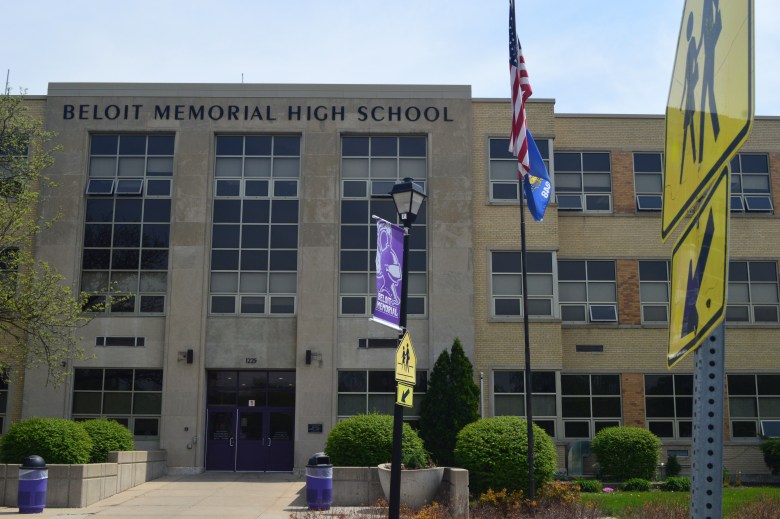
Officials revamped the Beloit Memorial High School in 2018 to funnel students into academies that are connected to jobs in the area and the state. Credit: Wayne D’Orio for The Hechinger Report
In the past, students created a custom-made protective plate that the city’s police use on a bomb squad vehicle.
The welding program has 125 students this year and had to turn away 65 more because of space limitations, Stenroos said; last year, 17 of the school’s welding academy graduates enlisted in the armed forces to specialize in welding.
These programs are designed to help meet the future needs of the state’s workforce. More than one-third of Wisconsin jobs will require education beyond high school but less than a bachelor’s degree by 2031, according to the Association for Career and Technical Education. For the last four years, the state has had more job openings than people on unemployment.
“There’s more jobs than there are people to fill them right now,” said Deb Prowse, a former career academy coach at Beloit Memorial who now works at Craftsman with Character, an area nonprofit that helps train students for careers in skilled trades.
Hooker, the Lloyd’s Plumbing HVAC manager, agreed. “Every project we work on has a delay, from a multimillion-dollar mansion to a three-bedroom spec,” he said. “There aren’t enough workers.”
The main reason Beloit Memorial has been able to zoom past state and national goals for both CTE and work-based learning is the school’s single-minded focus since 2018 on helping to ensure that its graduates will understand what businesses need and giving them a head start toward gaining those skills.
High school officials actually pared back the program from 44 pathways to 13, Stenroos said, part of an effort to tie each pathway to specific jobs. About 75 percent of pathways target area jobs, with the remaining quarter highlighting prominent professions within the state, he added.
Even though three straight budget referendum defeats have left the district with a $6.2 million funding gap, Stenroos said he’s been able to keep the CTE equipment modernized through donations and strategic allocation of the school’s federal Perkins grant and the state reimbursement for student certifications. In one instance, the school recently bought a $20,000 scanner for its automotive program; the machine can not only help diagnose a car problem, but also connect students to garages throughout the country that have successfully fixed the specified problem.
“It’s an expensive piece of equipment,” Stenroos said, “but it’s industry-certified and will give students real-life experience.”
Each of the three academies has an advisory board of teachers and industry professionals who work out how to embed practical lessons in classroom curriculum. “We ask business people, ‘What do you need, and how can we help our kids get there?’” said Stenroos.
“It’s really cool how receptive the school is to feedback,” said Heather Dobson, the business development manager at Corporate Contractors, Inc., a 200-person general contracting firm.
She explained that the district has incorporated small changes over the years, such as having students work in Microsoft programs instead of Google Classroom apps and teaching them how to write a professional email.
“Rarely is there an idea presented that they don’t embrace,” said Celestino Ruffini, the CEO of Visit Beloit, a nonprofit that promotes tourism of the city. The school is expanding its hospitality program because of the expected influx of jobs connected to the new casino and hotel, he said.
All the changes aren’t at the high school, however. In order to employ Beloit Memorial students, Frito-Lay had to alter its corporate policy of not allowing anyone under 18 to work in its plants, according to Angela Slagle, a supply chain manager there. The company now hires Beloit Memorial students for its career exploration youth apprenticeship program, she added.
The connection to area businesses goes beyond the school’s leaders. Each year, about 10 teachers complete an externship in which they spend one week of their summer at a local business. Teachers are paid $1,000 for the 20 hours, and they not only learn about what jobs a company may have but also find ways to incorporate real-world problems into their classroom lessons.
A few summers back, math teacher Michelle Kelly spent a week at Corporate Contractors. She was searching for different ways to use construction-based math problems with her students. In addition to using math to estimate a bid for a project or calculate the surface area of a job, she realized that complex math is needed to build a truss, the framework used to support a roof or bridge.
Because the triangular truss is supported by different lengths of wood inside its structure, Kelly said, building one requires the calculation of angles, total area, how much wood is needed and more. Since all her algebra students were in the school’s construction academy, she partnered with those teachers to go beyond blueprints and have the 10th graders build trusses, a collection of which sit in the back of her classroom.
A student’s detailed outline for creating a truss in Michelle Kelly’s 10th grade algebra class at Beloit Memorial High School, which is embracing career and technical education. Credit: Wayne D’Orio for The Hechinger Report
She sees this work as one way to help counter the chronic absenteeism that has existed since Covid. Teaching with this kind of hands-on work makes students see the relevance of algebra, she said. “Would it be easier to just have them take a test? Yes.”
Beloit Memorial Principal Emily Pelz said the school’s work is paying off. In the last four years, the school’s four-year graduation rate has ticked up slightly, from 83.4 percent in 2021-22 to 85.2 percent in 2024-25, while its attendance went from 78.5 percent to 84.8 percent in the same period, Pelz said.
Rik Thomas, a rising senior who already has his own business repairing and modifying cars, said this work has definitely made him more interested in school. While he thought the academy would merely explain what a construction career might include, “It’s nice to find out how to do the work.” His father works in construction and, Thomas added, “He loves that I take this program.”
Thomas and his classmates built a wooden shed earlier this year and were able to sell it for $2,500, with the money going to pay for more materials. Likewise, the first smoker created in the welding class was bought by Stenroos; the students are looking forward to posting the second one for sale after they determine how much they should charge.
While the school’s construction and other trade-related fields have drawn the most attention, its three academies also offer career paths in healthcare, education, business, the arts, hospitality and more.
For example, rising senior Tayvon Cates said he hopes to study pre-med at a historically Black college or university on his way to becoming a cardiology radiologist. Cates, who is in the school’s health and education academy, said, “If you want to do something, the school can help you do it.”
The Hechinger Report provides in-depth, fact-based, unbiased reporting on education that is free to all readers. But that doesn’t mean it’s free to produce. Our work keeps educators and the public informed about pressing issues at schools and on campuses throughout the country. We tell the whole story, even when the details are inconvenient. Help us keep doing that.
Why would you settle for a generic LMS when your university deserves one based on its own learning path? Custom LMS development creates a customized experience that drives student achievement from day one, not only provides tools.
Why Universities Need a Custom LMS
Custom LMS systems are much needed in modern institutions since off-the-shevel LMS solutions usually fail to satisfy their various needs. Custom LMS development is hence quite relevant. Customized solutions can fit the processes, academic framework, and student needs of your university, therefore promoting improved institutional effectiveness and learning results.
Did you realize?
A 2023 EDUCAUSE study shows that 78% of leaders in higher education feel that tailored learning environments directly help to ensure student success.
Using custom LMS solutions, universities noted a 25% increase in student involvement and a 19% increase in course completion rates.
Key Benefits of a Custom LMS Development for Student Success
Students advance at their own speed under customized content delivery depending on performance.
Interactive materials, multimedia integration, and group projects all help to keep students engaged.
Modern analytics—real-time student performance—allows teachers to modify their plans to raise results.
Linkages with current SIS, CRM, and outside tools help to simplify procedures.
Flexibility and scalability help you to ensure long-term viability as your university develops.
How to Develop a Custom LMS for Universities
Customizing the best LMS for student success is about matching the platform with the mission of your university, not only about technology. Here’s a breakdown:
Name the main goals: Describe for your university what student success means.
Plot the course of the student. Recognize several student kinds, from those needing more help to fast learners.
Design for User Experience: Make sure teachers and students alike have a simple, mobile-friendly interface.
Leverage data: To create reporting and analytics tools to monitor performance and interaction.
Test, refine, and scale: Beginning with a pilot program, get comments, and always improve.
The Future of Learning with Creatrix Campus
Creatrix Campus provides a best-in-class LMS for student success, therefore enabling universities to design individualized, data-driven learning environments. Features like automatic reporting, assignment administration, and engagement tracking enable our platform to help colleges uncover new academic successes without sacrificing cost-effectiveness.
Ready to change the educational process at your university? Your way, let us create an best LMS for student success that propels student success.
Mackintosh power station. A new centre of excellence will train Tasmania’s renewable energy workers of the future to build wind, solar, and hydro power infrastructure. Picture: Hydro Tasmania
A new $27m Clean Energy Centre of Excellence will be established in Burnie, where students will be trained to help expedite the nation’s transition to net zero emissions.
Please login below to view content or subscribe now.
New CUPA-HR data show some improvement in turnover in the higher ed workforce, but staffing hasn’t fully bounced back to pre-pandemic levels. Managers still face challenges filling positions and maintaining morale, while employees are seeking jobs where their satisfaction and well-being are prioritized.
Professional development programs driven by employees’ interests
Effective supervisor-employee communication, including stay interviews
Actionable campus climate surveys using liaisons
Mentoring programs and leadership pipelines
Recognition programs and community-building events
Employee Resource Groups to enhance belonging
Here are some of the highlights from their programs.
Stay Interviews at Drake University
A stay interview is a structured, informal conversation between an employee and a trained supervisor — and can be key to retaining top talent. Maureen De Armond, executive director of human resources at Drake, considers stay interviews to be a critical tool that nevertheless go underused in higher ed. Overall, only 8% of employees stated that they participated in a stay interview in the past year, according to The CUPA-HR 2023 Higher Education Employee Retention Survey.
De Armond stresses that stay interviews can build trust, increase communication, and show that you care about employees as people, not just their job performance. If you’re looking to get started, De Armond recommends checking out the Stay Interviews Toolkit.
Actionable Climate Surveys at the University of Texas Rio Grande Valley
What’s worse than not conducting a climate survey? Not doing anything with the answers employees have taken the time to provide, says Nicole Englitsch, organizational development manager at UTRGV. To make surveys actionable, they’ve enlisted campus climate liaisons.
These liaisons, who are mostly HR professionals, are assigned to specific departments. The liaisons have been trained by their external survey partners to help their departments understand the results and engage in action planning, guided by a three-year timeline. This network of partners helps ensure that UTRGV’s goals of making survey results both transparent and actionable are achieved.
Recognition and Community-Building at Rollins College
How can institutions create a culture of belonging and valuing employees? David Zajchowski, director of human resources at Rollins, explains how their high-impact recognition and community-building programs range from informal coffee-and-doughnuts gatherings to special awards ceremonies for employees.
Probably the most popular way of valuing employees while increasing connection is Rollins’s annual Fox Day. On a random day in spring, the president surprises employees and students with a day off from work and class to participate in community-building college traditions.
Despite the effectiveness of employee recognition, many employers may be leaving this low-cost retention incentive on the table, as only 59% of higher ed employees said they received regular verbal recognition for their work in the Employee Retention Survey. Wondering how your employee recognition program stacks up? See a comparison of recognition programs and take a self-assessment here.