Get stories like this delivered straight to your inbox. Sign up for The 74 Newsletter
New York City’s troubled yellow school bus system is in the spotlight once again, with threats of a service disruption and looming mass layoffs due to a contract dispute with the city.
The city’s largest school bus companies notified the state Department of Labor that they are preparing to shut down operations and lay off employees on Nov. 1 if they don’t receive a contract extension, the New York Post first reported Monday.
Lawmakers, advocates, and city officials immediately condemned the bus companies’ threat, with schools Chancellor Melissa Aviles-Ramos calling the move “deeply upsetting and an act of bad faith.”
The timing of the bus company’s push, just before November’s mayoral election, for a five-year extension that would outlast the incoming mayor’s first term, “effectively bypassed the oversight of voters and elected officials who manage these vital services,” Aviles-Ramos said.
Mayoral frontrunner Zohran Mamdani agreed, telling reporters at an unrelated Tuesday press conference that the oversight panel in charge of approving the contract “is right to not give in to the threats.”
The bus companies argue they have no choice because their temporary contract is expiring and they can no longer operate without a longer-term agreement.
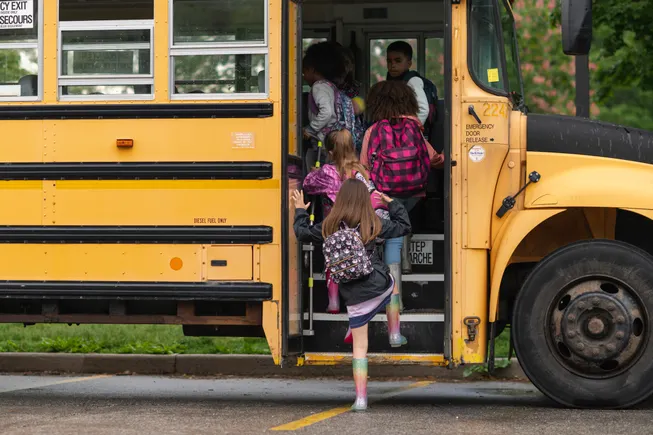
The episode is the latest in a long history of conflicts over how to manage the sprawling yellow bus system, which relies on a patchwork of largely for-profit companies to ferry some 150,000 students across nearly 19,000 routes each day. All told, the city spent nearly $2 billion on school busing last year.
Parents and advocates hope this clash can draw renewed attention to problems in a system notorious for delayed and no-show buses, long rides without sufficient AC, and a lack of transparency.
“There’s this tug of war over the money,” said Sara Catalinotto, the executive director of the advocacy group Parents for Improving School Transportation. “But this is a service, and without it these kids are discriminated against.”
What’s the history behind these bus contracts?
The current dispute springs from a disagreement over how to handle the city’s “legacy” school bus contracts, which date back to the 1970s and are typically renewed every five years. They most recently expired in June.
In the months before the contracts expired, city Education Department officials signaled they were interested in rebidding the contracts, or soliciting offers from a new set of companies to more efficiently modernize buses, increase service, and strengthen sanctions for contract violations.
Simply renewing the existing contracts gives the city “far less negotiating ability … because we have to continue with this same set of vendors,” Emma Vadehra, the Education Department’s former deputy chancellor, told the City Council in May.
But city officials say they can’t move forward with rebidding without the option to offer something called the “Employee Protection Provision,” or EPP.
That protection — built into the legacy contracts for decades — ensures unionized bus workers laid off by one company are prioritized for hiring by other companies, at their existing wages. Drivers and union officials consider the provision a dealbreaker — and would almost certainly strike without it.
But city officials say a 2011 state court decision prohibits them from inserting EPP into new contracts if they rebid — and only allows them to keep EPP if they extend existing contracts. The only fix, city officials say, is changing state law — an effort that has so far stalled in Albany.
Without that state legislation, city officials faced a choice: inking another five-year extension or pushing for a shorter-term contract in the hopes state lawmakers quickly clear the way for a rebid.
Who is opposed to a five-year contract renewal?
While the city moved ahead with negotiations for a five-year extension, a growing number of advocates, parents, and lawmakers flooded meetings of the Panel for Educational Policy, or PEP — the body that approves Education Department contracts — to push for a shorter-term contract.
“Do not vote yes to extend for some long period of time,” said Christi Angel, a parent leader in District 75, which serves students with significant disabilities who disproportionately rely on busing, at the September PEP meeting. Roughly 43% of students who ride school buses have disabilities. “Don’t reward bad behavior,” Angel said. “This is a broken system.”
Their arguments quickly gained traction in the PEP, where multiple members expressed their opposition to a five-year extension at September’s meeting.
The panel is expected to vote on the five-year extension next month, after the mayoral election, said PEP Chair Greg Faulkner, though he would prefer to wait until the new mayor takes office in January.
“Shouldn’t the mayor-elect have some say in a billion dollar contract?” said Faulkner. “I just think that’s sound governance.”
Why are the city and bus companies at odds right now?
Over the summer, the city and bus companies agreed to two emergency extensions to keep service running, the second of which expires on Oct. 31.
Without a guarantee of an active contract after that date — since the PEP is not voting this month — the bus companies claim they have no choice but to consider layoffs.
The city, however, had “long planned” to offer an emergency extension for November and December, and officials delivered the agreement to the bus companies on Monday, Aviles-Ramos said.
The PEP only votes on those extensions after they’ve already taken effect, Faulkner noted.
The bus companies, he said, are attempting to “create confusion in order to hold us hostage for a longer term agreement.”
The bus companies reject that assertion and say they simply cannot survive any longer on emergency extensions, which don’t allow them the kind of long-term certainty they need to operate their businesses.
“Banks will not finance 30-day extensions, buses can’t be bought, payroll cannot be paid,” said Sean Crowley, a lawyer representing several companies. “Enough is enough!”
The companies claim that they have already worked out the contours of a new five-year contract extension with the city and are just awaiting the PEP’s approval, though Faulkner said the Education Department hasn’t yet presented the PEP with the contract.
What happens from here?
A spokesperson confirmed that several bus companies had received the city’s offer for another emergency contract extension and were reviewing the documents.
Aviles-Ramos said the city is working to get “alternative transportation services” in place if that falls through.
But even if the bus companies and city do manage to avoid a service shutdown Nov. 1, the episode raises larger questions about how to make lasting improvements in the troubled system. Ongoing driver shortages make that task even harder.
The bus companies argue that the five-year contract agreement they sketched out with the city would achieve many of those goals, including stricter accountability to ensure drivers use GPS tracking, more staffing to field parent complaints, and monetary penalties for companies that underperform, according to testimony submitted to the PEP in September.
But critics continue to push for a shorter-term extension to give the state legislature time to pass EPP legislation, and clear the way for a rebid.
Mamdani has not offered specifics about how he would manage the school bus system, but said Tuesday that given the many concerns about yellow bus service, any contract extension deserves a “hard look.”
Some reformers point to changes already underway. Under Mayor Bill de Blasio, the city bought out the largest bus company and turned it over to a nonprofit overseen by the city.
Matt Berlin, the CEO of that nonprofit, called NYCSBUS, and former director of the city’s Office of Pupil Transportation, believes the nonprofit model has “a lot to offer the city” and could expand.
Chalkbeat is a nonprofit news site covering educational change in public schools. This story was originally published by Chalkbeat. Sign up for their newsletters at ckbe.at/newsletters.
Did you use this article in your work?
We’d love to hear how The 74’s reporting is helping educators, researchers, and policymakers. Tell us how