Tag: California

  • California Schools Now Offer Free Preschool for 4-Year-Olds. Here’s What They Learn – The 74

    California Schools Now Offer Free Preschool for 4-Year-Olds. Here’s What They Learn – The 74


    Join our zero2eight Substack community for more discussion about the latest news in early care and education. Sign up now.

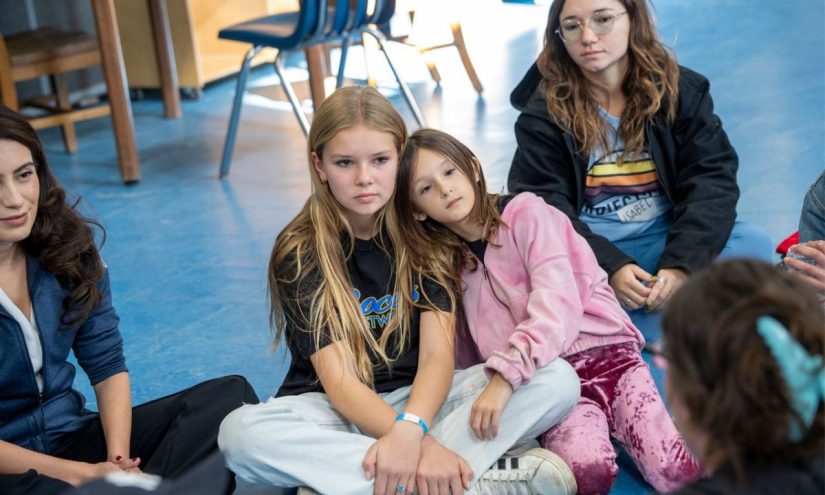
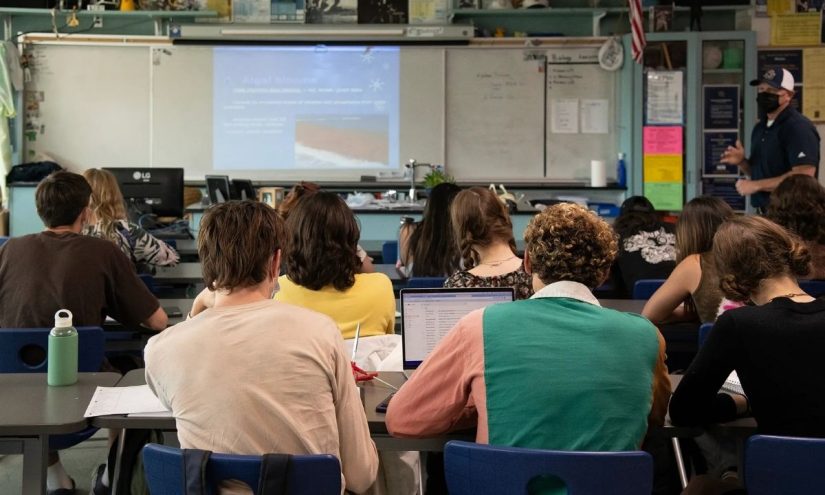
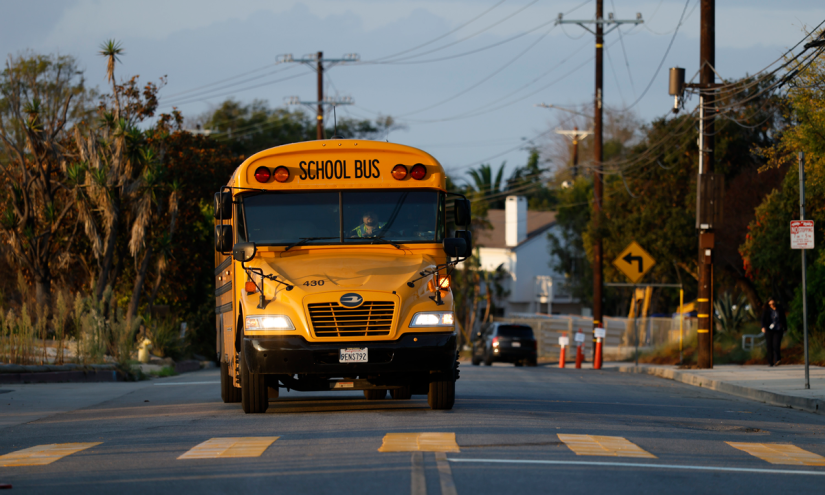
    Every 4-year-old in California can now go to school for free in their local districts. The new grade is called transitional kindergarten — or TK — and it’s part of the state’s effort to expand universal preschool.

    In 2021, Gov. Gavin Newsom and the state legislature moved to expand transitional kindergarten in a $2.7 billion plan so that all 4-year-olds could attend by the 2025-26 school year. (Prior to this, TK was only available for kids who missed the kindergarten age cutoff by a few months). While it’s not mandatory for students to attend, districts must offer them as an alternative to private preschool.

    As a free option, it can save parents a lot of money. Parents also must weigh how sending their kids into a school-based environment compares to a preschool they might already know and like, as well as other needs like all-day care, and how much play their child does.

    One big question we’ve heard: What do kids actually do and learn in a TK classroom? Educators say it’s intended to emphasize play, but what does that mean?

    A social skill students can learn in transitional kindergarten is how to take turns on the playground. (Mariana Dale/LAist)

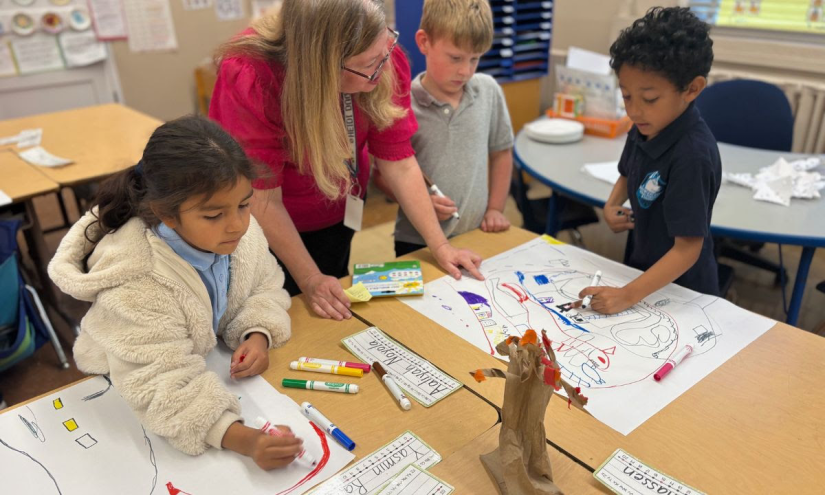
    To help parents get a better sense of this new grade as they make their decisions, LAist reporters spent the day in three different classrooms across the Southland. Here are five things we saw children do.

    Get used to the structure and routines of school

    For many students, transitional kindergarten is their first introduction to a formal school preschool setting. Crystal Ramirez sent her 4-year-old to TK at Marguerita Elementary School in Alhambra, so he could get used to the rhythm and rigors of school.

    “I didn’t wanna put him straight into kindergarten when he was five, six, so he at least knows a routine, already,” she said. “Now, as soon as he sees that we’re in school, he loves it.”

    TK students, like other elementary school students, follow a schedule: morning bell, recess, lunch, second recess and dismissal. They’re also learning how to listen to instructions or stand in a line. Some are learning to go to the cafeteria for lunch.

    “ I wanna make sure that their first experience in a public school setting is one that is joyful, where they feel loved, where they feel welcomed, where they get to really transition nicely into like the rigor of the school,” said Lauren Bush, a TK teacher at Lucille Smith Elementary in Lawndale.

    Claudia Ralston, a TK teacher at Marguerita Elementary, said it can be hard for young kids to get up early and leave their moms and dads. But seven weeks in, many of her students have learned their routines already. She helps with the morning transitions by turning on soft instrumental music in the classroom, and allowing them free play until they regroup on the mat to discuss the day.

    “They’re four years old. I want them to feel safe at school, know that this is a special place for learning and that they play,” she said.

    Learn how to socialize and communicate

    In TK, social-emotional learning is a big part of the curriculum. That’s a fancy word, but it just means they’re learning how to be in touch with their emotions

    At Price Elementary in Downey, the teacher has her kids give an affirmation: “I am safe. I am kind. I matter. I make good choices. I can do hard things. All of my problems have solutions!” (They also have these sentences on classroom wall signs.)

    The children also learn how to interact with their peers. In some schools, there are no assigned desks so the kids can learn how to share the space.

    “ They’re able to problem solve. They’re able to use communication to get their needs, regulating their emotions. They do better than students who come in without this experience,” said Cristal Moore, principal at Lucille Smith Elementary.

    On the playground, a student named Ava told teacher assistant Lizbeth Orozco that another student pushed her.

    “How did that make you feel?” Orozco asked.

    “Mad!”

    Orozco encouraged Ava to express her feelings to her classmate.

    “ We give them options of how to solve a problem and then they go in and solve it themselves,” Orozco said. “If they need extra help, they always come back and we can help them.”

    Arguing over toys can be a common occurrence in a TK classroom. At Price Elementary in Downey, educators help kids work through a solution. On a recent morning, one 4-year-old used two tongs to pick up paper shapes in a sensory bin, leaving another kid upset.

    “What’s the rule about sharing?” asked Alexandria Pellegrino, a teacher who gives extra support for one TK classroom.

    The boy handed over a tong to his peer. “Thank you so much for being a good friend,” Pellegrino said.

    “[It’s]  about being kind friends and making friends and using our manners. So we do build that foundation at the beginning of the year,” said Samantha Elliot, the classroom’s lead instructor.

    At the end of the day in Alvarez’s Lawndale TK class, she counts up the stars next to each student’s name earned throughout the day — earned for positive behavior like being kind, solving problems, trying something challenging, or showing effort in other ways. Ten stars earns a small prize from the treasure chest.

    “If we don’t get something today are we going to get mad?” Alvarez asked the class.

    “No!” they responded.

    “I’m not going to cry!” one boy piped up, followed by his classmate and a “Me too!” from another student.

    “That’s [a] positive attitude,” Alvarez said. “Because tomorrow you can get more stars!”

    Get exposed to numbers, shapes, letters

    In Elliot’s TK class, students use their own little lightsabers to trace letters in the air.

    “They’re learning the letter, the sound, and then a little action to go with it. They’re wiggling and moving and they’re also learning those letter sounds and they don’t really realize, so it’s incorporating instruction,” she said.

    There’s no mandated curriculum in TK, but instruction is supposed to align with the state’s Preschool/Transitional Kindergarten Learning Foundations. “Kindergarten is basically where the state standards go and kick in. There are standards in TK, but it’s a little bit different,” said Tom Kohout, principal at Marguerita Elementary.

    Students might put playdough into letter molds, or the teacher might pull out toys from a bag that all start with a letter “E.” Kids will play with little plastic toys that connect — or “manipulatives” — that can help them recognize numbers and patterns.

    “It’s play with a purpose,” Ralston said. “They’re just being introduced to the numbers, the colors, writing. But again, we’re not doing worksheets.”

    Build fine motor skills

    Molding pretend cakes with kinetic sand. Connecting small LEGO bricks. Cutting playdough. It might not seem like much, but children this age are still learning how to use their bodies.

    “Tearing paper is really hard and it’s a really amazing fine motor skill for them because the same muscles you use to tear paper are the same muscles that you use to hold a pen or a pencil,” said Lauren Bush, a TK teacher at Lucille Smith Elementary in Lawndale.

    “You see kids playing with dinosaurs. I see kids sorting by color, doing visual, you know, eye hand coordination and visual discrimination. I see them using their fine motor skills,” she said.

    At lunch, kids learn how to open up a milk carton or open a packaged muffin. At PE, they learn to balance on a block or walk in a straight line — learning spatial awareness.

    “They’re learning how to run, stop, things like that and playing because their bodies are so young,” said Principal Kohout.

    Learn independence

    For some kids, it might be the first time where mom and dad aren’t there to help carry their backpacks or help them go to the bathroom. TK is meant to help focus on their independence, though aides can help.

    TK classrooms are also usually set up with play centers, so kids can have the choice to explore on their own.

    “ I want them to be independent, to be able to solve their problems, you know, with assistance,” Ralston said.

    Samantha Elliot, the TK teacher in Downey, says she encourages kids to talk to their teammates first to figure out an activity before going to a teacher.

    “It’s just gaining the confidence and building that independence from basically the start of the school year,” she said.

    Parent Crystal Ramirez has already noticed a change in her 4-year-old this year since starting school. “ [He’s] socializing a little bit more, talking a little bit more, trying to express himself as well.”


    Did you use this article in your work?

    We’d love to hear how The 74’s reporting is helping educators, researchers, and policymakers. Tell us how

    Source link

  • Fewer New International Students Enroll at U.S. Colleges Amid Trump Restrictions – The 74

    Fewer New International Students Enroll at U.S. Colleges Amid Trump Restrictions – The 74


    Get stories like this delivered straight to your inbox. Sign up for The 74 Newsletter

    New international students enrolling at U.S. colleges declined sharply this fall, a concerning development for universities that rely on those students for research, tuition revenue and the diversity they bring to campus culture. It could, however, create more space for U.S. residents at those campuses.

    Enrollments of new international students were down 17% compared to fall 2024, according to a report released Monday by the Institute of International Education, which surveyed more than 800 colleges about their fall 2025 enrollments. The institute, a nonprofit organization based in New York, publishes an annual report that examines the enrollment of international students. 

    The fall data was not broken down by state, so the scale of decline in California is unclear. At USC, which enrolls more international students than any other California college, overall enrollment of international students is down 3% this fall, according to a campus spokesperson. That includes returning and first-time students, so the drop could be much higher for new arrivals. USC this fall enrolls about 12,000 international students, or 26% of its total student population, according to the college. About half of those students are from China. 

    The declines come amid a changing landscape for international students under the Trump administration, which has delayed visa processing, created travel restrictions and pressured some campuses to recruit and admit fewer students from other countries. The colleges surveyed this fall by the institute cited visa application concerns and travel restrictions as top factors in the decline. 

    “We are confronting major headwinds with what I would say are poor policy decisions that the administration is taking. And that is creating a climate for international students that signals that you’re not welcome here,” said Fanta Aw, CEO of NAFSA, a nonprofit for international education and exchange.

    President Donald Trump has said that he wants to lower the number of international students at U.S. colleges to leave more room at those campuses for U.S. students. “It’s too much because we have Americans that want to go there and to other places, and they can’t go there,” he said earlier this year, referencing the number of international students at Harvard and other universities.

    For the full 2024-25 academic year, new international student enrollments were down by 7%, driven by a 15% drop among new international graduate students, compared to 2023-24. However, the number of new undergraduates was up by 5%. Trump took office in January, just before the start of the spring semester at most colleges. 

    In the U.S., students from India were the largest group of international students, accounting for 30.8% of all international students, followed by students from China, with 22.6% of enrollments.

    In the 2024-25 academic year in California, the largest share of international students were from China, and they made up 35.4% of enrollments, followed by students from India at 20.9%. Overall enrollment of international students in California was down 1.1% in 2024-25. 

    USC enrolled the most international students of any California university, followed by four University of California campuses: Berkeley, Los Angeles, San Diego and Irvine. According to the report, the total number of enrolled international students were: 12,020 at Berkeley, 10,769 at UCLA, 10,545 at San Diego, and 7,638 at Irvine.

    Across the state, international students make up about 7% of enrollments at four-year colleges, according to the Public Policy Institute of California. They make up a large share of graduate students, accounting for 31% of graduate students at UC campuses, 15% at private nonprofit universities, and 12% at California State University campuses. 

    Freya Vijay, 20, a third-year student from Canada studying business administration at USC, said she always planned to come to the United States for college. 

    “In terms of business and just the economy, you have Wall Street, you have New York, Chicago, L.A., and San Francisco, all these big cities that dominate what’s going on in the world,” she said. “So immediately, in terms of opportunity, my mind was set on the States.” 

    In addition to visa and travel restrictions, the Trump administration has directly requested — or threatened, as some have called it — California campuses to limit enrollments of international students. The administration’s compact offer to USC last month would have forced the university to cap international enrollment at 15% for undergraduates and limit enrollment from any one country to 5%.

    USC has since rejected the compact, which also would have required the university to make a number of other changes, including committing to “transforming or abolishing institutional units that purposefully punish, belittle and even spark violence against conservative ideas.” 

    Separately, in a settlement proposal to UCLA, the Trump administration calls on the campus to ensure that “foreign students likely to engage in anti-Western, anti-American, or antisemitic disruptions or harassment” are not admitted. UCLA is still in negotiations with the administration and has not yet reached a deal. The Trump administration has charged the campus with antisemitism and civil rights violations. 

    Even amid the turmoil, experts say they expect California universities to continue recruiting international students. Julie Posselt, a professor of education at USC’s Rossier School of Education, noted that at research universities, much of the research is being carried out by international graduate students. 

    “Especially in STEM fields, international students are really central to the research functions of universities,” Posselt said. “Enrolling international students is not optional. It is absolutely a part of the fabric of what makes universities great.” 

    On top of that, colleges have financial incentives to enroll international students. That’s especially true at UC campuses, which charge international students and students from other states much higher rates of tuition than California residents. In the 2026-27 academic year, new international and out-of-state undergraduates at UC will pay nearly $52,000 in tuition, more than triple what in-state students will be charged. Nonresidents in graduate programs also generally pay higher rates than residents.

    Facing pressure from the state Legislature to make more room for California residents, UC in 2017 passed a policy to cap nonresident enrollment at 18%, with a higher percentage allowed for campuses that were already above that mark. But the system still gets significant tuition revenue from nonresidents, including international students, which UC says supports the system’s core operations and helps to lower the cost of attendance for California residents.  

    In a Nov. 10 interview with Fox News, Trump seemed to acknowledge the importance of international students, saying colleges might “go out of business” without them.

    “You don’t want to cut half of the people, half of the students from all over the world that are coming into our country — destroy our entire university and college system — I don’t want to do that,” he said. 

    International students also bring diverse perspectives and “a richness to the campus culture,” said Stett Holbrook, a spokesperson for the University of California system. “That’s something we really appreciate and try to cultivate.”

    At USC, the presence of international students from more than 130 countries means there are “innumerable opportunities at USC to encounter different perspectives” and “experience new cultures,” a spokesperson said in a statement. 

    Vijay, the USC student from Canada, said she regularly boasts about USC to friends, adding that she hopes attending remains an option for other international students. 

    “I always think it’s just such a great opportunity and that no international student should ever take it for granted,” she said. “I wish other internationals could experience it.”

    This story was originally published on EdSource.


    Did you use this article in your work?

    We’d love to hear how The 74’s reporting is helping educators, researchers, and policymakers. Tell us how

    Source link

  • DOJ Sues California Over In-State Tuition for Noncitizens

    DOJ Sues California Over In-State Tuition for Noncitizens

    The U.S. Department of Justice sued the state of California on Thursday, challenging a state law that allows undocumented students to pay in-state tuition rates. The lawsuit also targets the California Dream Act, which offers state financial aid to undocumented students who meet certain requirements.

    The complaint, filed in the Eastern District of California, targets the state, Governor Gavin Newsom, state attorney general Rob Bonta, the University of California Board of Regents, the California State University Board of Trustees and the California Community Colleges’ Board of Governors.

    “California is illegally discriminating against American students and families by offering exclusive tuition benefits for non-citizens,” Attorney General Pamela Bondi said in a statement.

    California marks the sixth state the federal government has sued over such policies, but unlike some of the others, California plans to fight back. The state is home to more than 102,000 undocumented students, who have been permitted to pay in-state tuition rates since 2001 if they met certain requirements. Undocumented students have also been allowed to access state financial aid for more than a decade, according to the Higher Education Immigration Portal.

    Newsom has repeatedly pushed back on the Trump administration’s policies, including immigration crackdowns. The DOJ filed another lawsuit against the state on Monday, after Newsom signed a bill banning face coverings for federal immigration agents. The DOJ also recently sued Newsom and California Secretary of State Shirley Weber over the state’s redistricting plan.

    Bondi said in her statement that the DOJ will “continue bringing litigation against California until the state ceases its flagrant disregard for federal law.”

    But Newsom isn’t backing down.

    “The DOJ has now filed three meritless, politically motivated lawsuits against California in a single week,” Marissa Saldivar, a spokesperson for the governor’s office, said in a statement to Inside Higher Ed. “Good luck, Trump. We’ll see you in court.”

    By contrast, Texas and Oklahoma, faced with similar lawsuits this summer, swiftly sided with the DOJ, quashing in-state tuition benefits for their undocumented students. The Kentucky Council on Postsecondary Education also agreed to stop offering in-state tuition to noncitizens in September, a few months after the DOJ sued, but the legal battle is ongoing. A judge recently allowed a group of Kentucky undocumented students, represented by the Mexican American Legal Defense and Educational Fund, to intervene in the case. Legal fights in Minnesota and Illinois have also continued as the states defend their in-state tuition policies against DOJ challenges.

    The government argues that such laws violate a federal statutory provision that says undocumented people can’t receive higher ed benefits unless citizens are also eligible. The DOJ has asserted that states can’t permit undocumented students in a state to pay lower tuition rates while denying out-of-state citizens the same benefit. Proponents of California’s current policy argue it allows any nonresident who meets certain requirements—including spending three years in a California high school—to access in-state tuition, not just undocumented students.

    Rachel Zaentz, a spokesperson for the University of California system, said system leaders believe they’ve acted within the law.

    “For decades, the University of California has followed applicable state and federal laws regarding eligibility for in-state tuition, financial aid, and scholarships,” Zaentz said in a statement sent to Inside Higher Ed. “While we will, of course, comply with the law as determined by the courts, we believe our policies and practices are consistent with current legal standards.”

    California Community Colleges Chancellor Sonya Christian said in a similar memo that the system “will follow all legal obligations and fully participate in the judicial process alongside our state partners” but “statutes referenced in the lawsuit have been in place for many years and have been implemented in accordance with long-standing legal guidance.”

    “Although we cannot comment on ongoing litigation, our commitment remains unchanged: we will continue to ensure that all students who qualify under state law have access to an affordable, high-quality education,” Christian said. “We will also continue to comply fully with all current federal and state requirements.”

    Iliana Perez, executive director of the advocacy organization Immigrants Rising, called the latest lawsuit an “an affront to the decades of hard-fought student-led advocacy for equitable access to postsecondary education.” She also noted the challenge comes just a week before college applications are due at public four-year institutions in the state.

    “This challenge is a callous attempt to have students second-guess their dreams,” Perez said in a statement. “We have one message for this Administration; we will not be deterred!”

    Source link

  • DOJ sues California over in-state tuition for undocumented students

    DOJ sues California over in-state tuition for undocumented students

    Dive Brief:

    • The U.S. Department of Justice is suing California over its laws allowing certain undocumented college students to pay in-state tuition rates at public colleges and receive state-administered scholarships.
    • In a Thursday court filing, the agency argued that in-state tuition rates for undocumented students illegally provide benefits not offered to all U.S. citizens and asked a federal judge to rule California’s laws unconstitutional.
    • The lawsuit, which also names as defendants Gov. Gavin Newsom and the governing boards of California’s three public college systems, marks the sixth the DOJ has brought against states with in-state tuition policies for certain undocumented students.

    Dive Insight:

    California is home to roughly 103,000 undocumented residents enrolled in higher education — accounting for about a fifth of some 510,000 undocumented students in the U.S. — according to the Higher Ed Immigration Portal.

    Since 2001, a California law known as AB 540 has allowed students to pay in-state tuition at its three public higher ed systems if they attended a state high school for at least three years and earned their high school diploma or equivalent in California. Undocumented students must also sign an affidavit saying they have either filed an application to gain legal status or plan to once they are eligible.

    A 2017 law broadened that eligibility and permits students to reach the three-year attendance threshold by combining any time spent at a California high school, community college, adult school or carceral education program.

    It also allows students who completed at least three years full-time high school coursework anywhere to qualify for the waiver if they attended at least three years of their K-12 education in California.

    Leaders from the state’s public college systems — the University of California, California State University, and California Community Colleges — supported the expansion of the in-state tuition policy.

    Both laws apply to both U.S. citizens and immigrants without legal status.

    But U.S. Attorney General Pamela Bondi said in a Thursday statement that policies are “illegally discriminating against American students and families” and that California is demonstrating “flagrant disregard for federal law.”

    Since 1998, U.S. law has prohibited immigrants without legal status from receiving any higher education benefit based on their residency, “unless a citizen or national of the United States is eligible for such a benefit … without regard to whether the citizen or national is such a resident.”

    The agency’s lawsuit is not the first time California’s in-state tuition law has faced legal opposition. One challenge to AB 540 that similarly argued the policy violated federal law made it to the California Supreme Court in 2010.

    However, the court upheld AB 540, ruling it did not violate federal law because students seeking in-state tuition status did not need to be California residents.

    The DOJ argued Thursday that this decision was incorrect and that federal courts should reject it. 

    “Allocating lower tuition rates on the basis of high school attendance is a proxy for residence,” running afoul of federal law, the agency said.

    Using the same argument, the DOJ lawsuit also targets a 2011 law permitting AB 540-eligible undocumented students to receive state-administered scholarships and aid and a law passed in 2014 establishing a student loan program for them.

    Gaining an in-state tuition waiver for California can have big cost implications for prospective students, as the state’s public colleges charge some of the highest out-of-state tuition premiums in the U.S., according to the College Board.

    The University of California published tuition and fees for out-of-state students who started in 2025-26 were $37,602 more a year than for their in-state counterparts.

    At the University of California, Berkeley, that means out-of-state, full-time undergraduates who first enrolled this fall would pay $55,080 if they did not receive financial aid or scholarships — more than double the $17,478 their in-state counterparts would pay sans aid.

    Even with aid and institutional scholarships, out-of-state students saw a stark difference. U.S. News & World Report estimated that the average total cost of attendance at UC Berkeley for those receiving need-based aid was $16,636 for in-state students and $66,625 for those from outside of California.

    The Cal State system’s published tuition and fees for out-of-state are also higher than for in-state students. Its 23 campuses charge a base rate of $6,450 for in-state undergraduate tuition and fees for the 2025-26 academic year. This year, out-of-state students pay at least $444 more per credit.

    Source link

  • California State University Embraces Direct Admissions

    California State University Embraces Direct Admissions

    Photo illustration by Justin Morrison/Inside Higher Ed | gemenacom, ghoststone, Jose Gonzalez Buenaposada and vi73777/iStock/Getty Images

    The California State University system launched a direct admissions pilot last year, offering qualifying high school seniors at school districts in Riverside County admission to 10 of its institutions. The program turned out to be an unqualified success: The number of graduates from the district who enrolled at a CSU campus this fall jumped 9 percent.

    Now the system is expanding the program, thanks to legislation signed last month that will allow CSU to extend offers to students in every school district in the state starting in the 2026–27 admission cycle. The offers will grant admission to 16 of the 22 CSU campuses; the six most selective institutions will not participate.

    The program ties in with the system’s goal of creating access to higher education for all Californians, said April Grommo, CSU’s assistant vice chancellor of strategic enrollment management.

    “Being able to proactively inform students that they are eligible for the CSU has provided a lot of positive results,” she said. “We had a lot of students and families that did not realize they were eligible to go to a four-year university.”

    With this program, California joins a cohort of about 15 states that offer students some form of direct, guaranteed or simplified admissions. The intent is to streamline the admissions process and make students aware of institutions they may not have otherwise considered, as well as to bolster institutions’ enrollment. Such programs have proven broadly successful, according to Taylor Odle, a professor of education policy studies at the University of Wisconsin.

    “My work, in partnership with states and national nonprofit organizations, shows that direct admissions programs can not only increase students’ early-college going behaviors but also subsequently raise their college enrollment outcomes,” Odle wrote in an email to Inside Higher Ed. “These benefits are particularly large for students of color, those who will be the first in their family to attend college, and those from lower-income communities. States who have implemented direct admissions also consistently report higher enrollment levels following implementation.”

    While different states use the term “direct admissions” slightly differently, Odle defined a true direct admissions program as “guaranteed (students are admitted to college; not an invitation to apply), universal (all students can participate), proactive (students don’t need to do anything to receive a direct admissions offer), simplified (students don’t need to apply; simply ‘claim their spot’ via a streamlined process), and free (no cost).”

    In CSU’s case, qualified students—those who meet the system’s requirements regarding the courses they took in high school and who have a minimum 2.5 grade point average—receive mailers informing them that they have been admitted to all 16 participating campuses.

    In the Riverside County pilot program, about 17,400 graduating seniors received admission offers. The system saw a 15 percent year-over-year increase in students from the county who completed an application for a CSU institution—direct admits don’t complete the full application, just a truncated version of it in order to accept the offer of admission—and led to the subsequent bump in enrollees. The majority ended up at Cal State San Bernardino, the closest campus to Riverside County—across the state, most CSU students attend an institution within 50 miles of their home—but others traveled farther, in some cases to study in specialized programs.

    Along with the direct admissions offers, the system also launched a series of events to expose Riverside County students to CSU’s different campuses and programs. Called Discover CSU Days, the events featured panels of current students from Riverside County.

    “A lot of Riverside County students are first-generation and low-income, so we talked to them about why the CSU is a good option for them,” said Grommo.

    Students could enroll that same day, with some campuses waiving housing and tuition deposits for those who did.

    Odle said that with so many institutions reporting positive outcomes from their direct admissions programs, such initiatives may soon become the “new norm.”

    “More states and systems of higher education should be in the business of identifying challenges, designing and implementing pilot programs to address them, rigorously studying them, and then making expansion decisions (like this) based on evidence,” he wrote. “Given CSU’s access and service mission to the state, it makes sense that it joins a variety of other systems nationally at implementing this evidence-based practice to raise enrollments and reduce gaps in access.”

    Source link

  • Improving Community College Transfer in California

    Improving Community College Transfer in California

    California has established significant goals for postsecondary attainment, with the stated aim of having 70 percent of working-age adults hold a credential of value by 2035. To meet this goal, the state has invested time and resources into the community college system and upward transfer processes, seeking to create affordable and accessible pathways in and through higher education.

    A recently published report by the Public Policy Institute of California Higher Education Center found that a large share of community college students are applying to and enrolling in state universities to complete a bachelor’s degree, but equity gaps persist among certain demographic groups.

    The data highlights the importance of focusing on early benchmarks of academic progress—including credit completion rates, GPA and the stated goal of transfer—to help students succeed in making the transition to a four-year university. The report also underscores that some transfer students are willing to pay more and travel farther to attend a more selective institution.

    The background: California’s public higher education system is the largest and most diverse in the country, the report authors note. The California Community College system includes 116 institutions enrolling over 2.1 million students, and the California State University system consists of 22 institutions educating nearly half a million students. Within the state, the system is the top destination for upward transfer, with 58 percent of community college students going on to enroll at a CSU campus.

    Over the past decade, the two college systems have partnered to streamline transfer opportunities. One innovation is the associate degree for transfer (A.D.T.), a group of 40 academic pathways that guarantee admission to students who complete 60 credits toward a bachelor’s degree in a specific major. Another is the CSU Transfer Planner, which provides insights for students to navigate transferable credits, degree programs and campus requirements for transfer.

    The report looks at student demographic information, academic progress and participation in transfer pathways such as A.D.T. to identify success indicators in the transfer pipeline.

    Methodology

    Researchers analyzed data from the CSU Application and Admission Dashboard and longitudinal student-level data from fall 2018 and fall 2023.

    In the sample, 48 percent of transfer applicants were Latino, 26 percent white, 15 percent Asian and 4.5 percent Black. A majority were 24 years old or younger, and 75 percent received a California Promise Grant or a Pell Grant while in community college.

    The data: The average student spends nine semesters at a community college before applying to a CSU institution, researchers found.

    Students are required to complete 60 credits to transfer with junior-level standing, but the median student completed 71.5 credits. Only half of applicants had earned an A.D.T. before applying, and 22 percent earned a local associate degree, meaning about 30 percent of students applied for transfer without a credential.

    Researchers noted that students who made significant progress in their first year of community college were more likely to transfer. Those who successfully completed transfer-level math in their first year applied to CSU after seven terms on average, whereas student who didn’t applied after 10 community college terms.

    Students who were 25 or older, Black or financial aid recipients were less likely to meet early milestones and therefore less likely to transfer. Conversely, students with high GPAs were more likely to transfer.

    The data also indicated a gap between students eligible for admission at a CSU and those who actually applied. One in five students who completed an A.D.T. never applied to CSU despite having guaranteed admission. Of those, 43 percent enrolled at a different university, many in the University of California system.

    In total, 87 percent of A.D.T. recipients declared a transfer goal while at community college, but approximately 20 percent of them didn’t continue on to a bachelor’s degree program.

    A majority (92 percent) of all transfers were eventually admitted to at least one CSU, and 63 percent of all transfers enrolled. Three in 10 applied more than once, and almost half of them (47 percent) had their application denied the first time.

    “It is possible that these students were initially rejected from the campus of their choice (or to all campuses), took more community college classes, and then gained admission,” researchers wrote. On the flip side, a large share of those whose transfer applications were rejected applied only once (88 percent), and to only one campus (61 percent).

    Admissions data also revealed the importance of academic benchmarks early in the student’s community college career. Admission rates for students who took transfer-level math or English in their first year were higher compared to their peers who did not; similarly, students who earned 24 transferable credits were more likely to gain admission to a CSU. Unsurprisingly, students who stated a transfer goal, completed the A.D.T. or had a GPA of 3.25 or higher also had high admittance rates.

    One trend researchers noted is that students who were admitted to a CSU but chose to enroll at a different institution were more likely to select a college that was farther away or more expensive, indicating that cost and proximity are not deciding factors. Transfers also enrolled at more selective colleges compared to their peers who opted to enroll at CSU, though some students selected universities with lower graduation rates than CSU.

    Over all, transfer students had high graduation rates. Among the incoming fall 2020 cohort, 76 percent graduated with their bachelor’s degree in four years, and 69 percent completed it in three years. About 19 percent of students left the CSU system without graduating three years after enrolling, and these students were more likely to be Black, Latino, male or older or have financial need.

    Recommendations: Based on their findings, researchers identified three opportunities for improvement:

    1. Invest in the student’s first year. Interventions including dual enrollment, corequisite English and math courses, proactive advising, and flexible scheduling can promote early momentum and academic success for community college students.
    2. Collect additional data on enrollment decisions. While system data showed that some students opt out of a four-year degree program, researchers emphasized the need for student voices to understand why those admitted would not enroll at CSU. Researchers also noted a need for campus-specific data, “because there is high variation across individual CSUs in both acceptance and enrollment rates.”
    3. Create space at selective campuses and in high-demand majors. “Some of the students who were never admitted to CSU were competitive applicants, but they applied to the most in-demand campuses,” the authors wrote. To increase capacity for these students, researchers suggest flexible course scheduling options, co-locating campuses or expanding online degree programs.

    Source link

  • How a San Diego Preschool Serves Kids After Trauma – The 74

    How a San Diego Preschool Serves Kids After Trauma – The 74


    Join our zero2eight Substack community for more discussion about the latest news in early care and education. Sign up now.

    Almost 20 years ago a San Diego nonprofit created a preschool to focus on the “little guys” — children who experience domestic violence and other serious traumatic events before kindergarten. 

    Today, Mi Escuelita is still going strong and it’s something of a model in showing other schools how to address childhood trauma.

    Mi Escuelita provides services for kids in a single location that for most other families would require intricate coordination among multiple health care providers, educators and social programs. 

    The children learn in a classroom that is always staffed with at least one therapist, they participate in one-on-one therapy, and join group therapy sessions. Their parents take part in special classes, too, where they learn ways to support their children.

    Researchers from UC San Diego have paid close attention to Mi Escuelita and followed how its graduates fared after leaving the preschool. The university also works with the school to evaluate outcomes from each cohort of students. Here are four takeaways from those reports.

    The kids leave ready for kindergarten

    Students who graduate from Mi Escuelia outperform or do at least well as their peers in kindergarten, according to a UC San Diego analysis of their scores in reading and math tests.

    It looked at kindergarten students in the Chula Vista Elementary School District from 2007 to 2013 and found a higher percentage of Mi Escuelita met math, reading and writing standards than the district’s general population.

    That’s not a given because research shows that children exposed to domestic violence have lower verbal ability than their peers, which can set them back in school. 

    And they do well for years

    The length of UC San Diego’s study allowed its team to follow Mi Escuelita graduates through fifth grade. The results suggested that their preschool experience helped the kids throughout their childhoods. 

    Their average scores on several standardized tests exceeded those of the general population at Chula Vista Elementary School District, especially in math.

    “Taken together, the Mi Escuelita program demonstrates clear benefits to children who may otherwise fall quickly and unsparingly behind with regard to school readiness,” the UC San Diego researchers wrote. 

    Better relationships at home

    Some families turn to Mi Escuelita in moments of distress, such as after experiencing domestic violence. The preschool provides counseling for parents and students alike, which may contribute to behavioral improvements at home.

    Over the past five years, 64% of the families in the program reported sensing fewer conflicts and 83% of them noticed an increase in closeness. 

    “Families reported that children’s communication, behavior, and listening skills improved both at home and at school,” a UC San Diego team wrote in an evaluation of student and parent surveys that spanned 2020 to 2024. 

    It takes a village

    Running Mi Escuelita costs about $1.3 million a year, a sum that nonprofit South Bay Community Services raises through a mix of donations and government funding. That cost — along with the challenge of hiring trained educators and therapists — makes the program difficult to replicate. 

    But, other schools and government agencies are watching Mi Escuelita to see what kind of services they can carry over to other venues. 

    “We can spend less later on intervention programs and alternative facilities,” said Hilaria Bauer, chief early learning services officer at Kidango, a Bay Area nonprofit childcare provider. “There will be less truancy, less big behaviors or expulsions or alternative programs, and all of those ‘fix’ initiatives if we really focus on the time in the life of a child that really makes a change.”


    Get stories like these delivered straight to your inbox. Sign up for The 74 Newsletter

    Source link

  • Penn, U of Southern California Reject Trump Compact

    Penn, U of Southern California Reject Trump Compact

    Photo illustration by Justin Morrison/Inside Higher Ed | Jumping Rocks/Universal Images Group/Getty Images | Mario Tama/Getty Images

    The Universities of Pennsylvania and Southern California have now refused to sign the Trump administration’s “Compact for Academic Excellence in Higher Education,” making them the third and fourth of the nine initial institutions that were presented the deal to publicly turn it down. No institution has agreed to sign so far.

    Both announcements came Thursday, a few days before the Oct. 20 deadline to provide feedback on the proposal. Beong-Soo Kim, interim president of the University of Southern California, shared his message to Education Secretary Linda McMahon, which outlined how USC already seems to adhere to the compact.

    “Notwithstanding these areas of alignment, we are concerned that even though the Compact would be voluntary, tying research benefits to it would, over time, undermine the same values of free inquiry and academic excellence that the Compact seeks to promote,” Kim wrote. “Other countries whose governments lack America’s commitment to freedom and democracy have shown how academic excellence can suffer when shifting external priorities tilt the research playing field away from free, meritocratic competition.”

    Kim added that the compact does raise issues “worthy of a broader national conversation to which USC would be eager to contribute its insights and expertise.”

    California governor Gavin Newsom, a possible Democratic presidential contender in 2028, had threatened that any university in his state that signed the compact would “instantly” lose billions of state dollars.

    Over at Penn, President J. Larry Jameson wrote in a message to his community Thursday that his university “respectfully declines to sign the proposed Compact.” He added that his university did provide feedback to the department on the proposal.

    Penn spokespeople didn’t say Thursday whether the university would sign any possible amended version of the compact that addressed the university’s concerns, nor did they provide Inside Higher Ed a copy of the feedback provided to the Trump administration. (Penn is the only university of the four that didn’t provide its response to McMahon.)

    The White House also didn’t provide a copy of Penn’s feedback, but it emailed a statement apparently threatening funding cuts for universities that don’t sign the compact.

    “Merit should be the primary criteria for federal grant funding. Yet too many universities have abandoned academic excellence in favor of divisive and destructive efforts such as ‘diversity, equity, and inclusion,’” spokesperson Liz Huston said in the statement. “The Compact for Academic Excellence embraces universities that reform their institutions to elevate common sense once again, ushering a new era of American innovation. Any higher education institution unwilling to assume accountability and confront these overdue and necessary reforms will find itself without future government and taxpayers support.”

    Brown University announced it had rejected the compact Wednesday, and the Massachusetts Institute of Technology did the same last Friday. Following MIT’s rejection, the Trump administration said the compact was open to all colleges and universities that want to sign it.

    The compact is a boilerplate contract asking colleges to voluntarily agree to overhaul or abolish departments “that purposefully punish, belittle, and even spark violence against conservative ideas,” without further defining what those terms mean. It also asks universities to, among other things, commit to not considering transgender women to be women, to reject foreign applicants “who demonstrate hostility to the United States, its allies, or its values” and to freeze “effective tuition rates charged to American students for the next five years.”

    In exchange for these agreements, the White House has said signatories would “be given [funding] priority when possible as well as invitations to collaborate with the White House.” But the White House hasn’t revealed how much extra funding universities would be eligible for, and the nine-page compact doesn’t detail the potential benefits. The compact, and the Thursday statement from the White House, can also be read as threatening colleges’ current federal funding if they don’t sign. Multiple higher ed organizations have allied in calling on universities to reject the compact.

    Jameson said in his statement that “at Penn, we are committed to merit-based achievement and accountability.”

    Earlier this year, the Trump administration said that Penn violated Title IX of the Education Amendments of 1972 when it allowed a transgender woman to swim on the women’s team in 2022, and officials issued several demands to the university. Penn ultimately conceded to those demands over the summer, a decision that the administration said restored about $175 million in frozen federal funds.

    Marc Rowan, a Penn graduate with two degrees from its Wharton School of Business who’s now chief executive officer and board chair for Apollo Global Management, wrote in The New York Times that he “played a part in the compact’s initial formulation, working alongside an administration working group.” Rowan argued that the compact doesn’t threaten free speech or academic freedom.

    Apollo has funded the online, for-profit University of Phoenix. AP VIII Queso Holdings LP—the previous name for majority owner of the University of Phoenix—was the successor of Apollo Education Group, which went private in 2017 in a $1.1 billion deal backed by Apollo Global Management Inc. and the Vistria Group.

    AP VIII Queso Holdings LP was recently renamed Phoenix Education Partners as part of a new deal to take the company public once again. Phoenix Education Partners, now owner of the University of Phoenix and backed by both Apollo and Vistria, started trading on the stock market last week and was valued at about $1.35 billion after the first day.

    Source link

  • Penn, U of Southern California Reject Trump Compact

    Penn, U of Southern California Reject Trump Compact

    Photo illustration by Justin Morrison/Inside Higher Ed | Jumping Rocks/Universal Images Group/Getty Images | Mario Tama/Getty Images

    The Universities of Pennsylvania and Southern California have now refused to sign the Trump administration’s “Compact for Academic Excellence in Higher Education,” making them the third and fourth of the nine initial institutions that were presented the deal to publicly turn it down. No institution has agreed to sign so far.

    Both announcements came Thursday, a few days before the Oct. 20 deadline to provide feedback on the proposal. Beong-Soo Kim, interim president of the University of Southern California, shared his message to Education Secretary Linda McMahon, which outlined how USC already seems to adhere to the compact.

    “Notwithstanding these areas of alignment, we are concerned that even though the Compact would be voluntary, tying research benefits to it would, over time, undermine the same values of free inquiry and academic excellence that the Compact seeks to promote,” Kim wrote. “Other countries whose governments lack America’s commitment to freedom and democracy have shown how academic excellence can suffer when shifting external priorities tilt the research playing field away from free, meritocratic competition.”

    Kim added that the compact does raise issues “worthy of a broader national conversation to which USC would be eager to contribute its insights and expertise.”

    California governor Gavin Newsom, a possible Democratic presidential contender in 2028, had threatened that any university in his state that signed the compact would “instantly” lose billions of state dollars.

    Over at Penn, President J. Larry Jameson wrote in a message to his community Thursday that his university “respectfully declines to sign the proposed Compact.” He added that his university did provide feedback to the department on the proposal.

    Penn spokespeople didn’t say Thursday whether the university would sign any possible amended version of the compact that addressed the university’s concerns, nor did they provide Inside Higher Ed a copy of the feedback provided to the Trump administration. (Penn is the only university of the four that didn’t provide its response to McMahon.)

    The White House also didn’t provide a copy of Penn’s feedback, but it emailed a statement apparently threatening funding cuts for universities that don’t sign the compact.

    “Merit should be the primary criteria for federal grant funding. Yet too many universities have abandoned academic excellence in favor of divisive and destructive efforts such as ‘diversity, equity, and inclusion,’” spokesperson Liz Huston said in the statement. “The Compact for Academic Excellence embraces universities that reform their institutions to elevate common sense once again, ushering a new era of American innovation. Any higher education institution unwilling to assume accountability and confront these overdue and necessary reforms will find itself without future government and taxpayers support.”

    Brown University announced it had rejected the compact Wednesday, and the Massachusetts Institute of Technology did the same last Friday. Following MIT’s rejection, the Trump administration said the compact was open to all colleges and universities that want to sign it.

    The compact is a boilerplate contract asking colleges to voluntarily agree to overhaul or abolish departments “that purposefully punish, belittle, and even spark violence against conservative ideas,” without further defining what those terms mean. It also asks universities to, among other things, commit to not considering transgender women to be women, to reject foreign applicants “who demonstrate hostility to the United States, its allies, or its values” and to freeze “effective tuition rates charged to American students for the next five years.”

    In exchange for these agreements, the White House has said signatories would “be given [funding] priority when possible as well as invitations to collaborate with the White House.” But the White House hasn’t revealed how much extra funding universities would be eligible for, and the nine-page compact doesn’t detail the potential benefits. The compact, and the Thursday statement from the White House, can also be read as threatening colleges’ current federal funding if they don’t sign. Multiple higher ed organizations have allied in calling on universities to reject the compact.

    Jameson said in his statement that “at Penn, we are committed to merit-based achievement and accountability.”

    Earlier this year, the Trump administration said that Penn violated Title IX of the Education Amendments of 1972 when it allowed a transgender woman to swim on the women’s team in 2022, and officials issued several demands to the university. Penn ultimately conceded to those demands over the summer, a decision that the administration said restored about $175 million in frozen federal funds.

    Marc Rowan, a Penn graduate with two degrees from its Wharton School of Business who’s now chief executive officer and board chair for Apollo Global Management, wrote in The New York Times that he “played a part in the compact’s initial formulation, working alongside an administration working group.” Rowan argued that the compact doesn’t threaten free speech or academic freedom.

    Apollo has funded the online, for-profit University of Phoenix. AP VIII Queso Holdings LP—the previous name for majority owner of the University of Phoenix—was the successor of Apollo Education Group, which went private in 2017 in a $1.1 billion deal backed by Apollo Global Management Inc. and the Vistria Group.

    AP VIII Queso Holdings LP was recently renamed Phoenix Education Partners as part of a new deal to take the company public once again. Phoenix Education Partners, now owner of the University of Phoenix and backed by both Apollo and Vistria, started trading on the stock market last week and was valued at about $1.35 billion after the first day.

    Source link

  • California wants to make platforms pay for offensive user posts. The First Amendment and Section 230 say otherwise.

    California wants to make platforms pay for offensive user posts. The First Amendment and Section 230 say otherwise.

    This week, FIRE wrote to California Governor Gavin Newsom, urging him to veto SB 771, a bill that would allow users and government enforcers to sue large social media platforms for enormous sums if their algorithms relay user-generated content that contributes to violation of certain civil rights laws.

    Obviously, platforms are going to have a difficult time knowing if any given post might later be alleged to have violated a civil rights law. So to avoid the risk of huge penalties, they will simply suppress any content (and user) that is hateful or controversial — even when it is fully protected by the First Amendment.

    And that’s exactly what the California legislature wants. In its bill analysis, the staff of the Senate Judiciary Committee chair made clear that their goal was not just to target unlawful speech, but to make platforms wary of hosting “hate speech” more generally:

    This cause of action is intended to impose meaningful consequences on social media platforms that continue to push hate speech . . . to provide a meaningful incentive for social media platforms to pay more attention to hate speech . . . and to be more diligent about not serving such content.

    Supporters have tried to evade SB 771’s First Amendment and Section 230 concerns, largely by obfuscating what the bill actually does. To hear them tell it, SB 711 doesn’t create any new liability, it just holds social media companies responsible if their algorithms aid and abet a violation of civil rights law, which is already illegal.

    But if you look just a little bit closer, that explanation doesn’t quite hold up. To understand why, it’s important to clarify what “aiding and abetting” liability is. Fortunately, the Supreme Court explained this just recently — and in a case also about social media algorithms to boot. 

    In Twitter v. Taamneh, the plaintiffs claimed that social media platforms had aided and abetted acts of terrorism by algorithmically arranging, promoting, and connecting users to ISIS content, and by failing to prevent ISIS from using their services after being made aware of the unlawful use.

    The Supreme Court ruled that they had not successfully made out a claim. Because aiding and abetting requires not just awareness of the wrongful goals, but also a “conscious intent to participate in, and actively further, the specific wrongful act.” All the social media platforms had done was create a communications infrastructure, which treated ISIS content just like any other content — and that is not enough.

    California law also requires knowledge, intent, and active assistance to be liable for aiding. But nobody really thinks the platforms have designed their algorithms to facilitate civil rights violations. So SB 771 has a problem. Under the existing standard, it’s never going to do anything, which is obviously not what its supporters intend. Therefore, they hope to create a new form of liability — recklessly aiding and abetting — for when platforms know there’s a serious risk of harm and choose to ignore it.

    But wait, there’s more.

    SB 771 also says that, by law, platforms are considered to have actual knowledge of how their algorithms interact with every user, including why every single piece of content will or will not be shown to them. This is just another way of saying that every platform knows there’s a chance users will be exposed to harmful content. All that’s left is for users to show that a platform consciously ignored that risk. 

    That will be trivially easy. Here’s the argument: the platform knew of the risk and still deployed the algorithm instead of trying to make it “safer.” 

    Soon, social media platforms will be liable solely for using an “unsafe” algorithm, even if they were entirely unaware of the offending content, let alone have any reason to think it’s unlawful.

    But the First Amendment requires that any liability for distributing speech must require the distributor to have knowledge of the expression’s nature and character. Otherwise, nobody would be able to distribute expression they haven’t inspected, which would “would tend to restrict the public’s access to [expression] the State could not constitutionally suppress directly.” Unfortunately for California, the very goal they want SB 771 to accomplish is what makes it unconstitutional.

    And this liability is not restricted to content recommendation algorithms (though it would still be unconstitutional if it were). SB 771 doesn’t define “algorithm” beyond the function of “relay[ing] content to users.” But every piece of content on social media, whether in a chronological or recommendation-based feed, is displayed to users using an algorithm. So SB 771 will impose liability every time any piece of content is shown on social media to any user.

    This is where Section 230 also has something to say. One of the most consequential laws governing the internet, Section 230 states, “No provider or user of an interactive computer service shall be treated as the publisher or speaker of any information provided by another information content provider,” and prohibits states from imposing any liability inconsistent with it. In other words, the creator of the unlawful content is responsible for it, not the service they used to do so. Section 230 has been critical to the internet’s speech-enabling character. Without it, hosting the speech of others at any meaningful scale would be far too risky.

    SB 771 tries to make an end-run around Section 230 by providing that “deploying an algorithm that relays content to users may be considered to be an act of the platform independent from the message of the content relayed.” In other words, California is trying to redefine the liability: “we’re not treating you as the publisher of that speech, we’re just holding you liable for what your algorithm does.”

    But there can be no liability without the content relayed by the algorithm. By itself, the algorithm does not cause any harm recognized by law. It’s the user-generated content that causes the ostensible civil rights violation.

    And that’s not to mention the fact that because all social media content is relayed by algorithm, it would effectively nullify Section 230 by imposing liability on all content. California cannot evade federal law by waving a magic wand and declaring the thing Section 230 protects to be something else.

    Newsom has until October 13 to make a decision. If signed, the law takes effect on Jan. 1, 2027, and in the interim, other states will likely follow suit. The result will be a less free Internet, and less free speech — until the courts inevitably strike down SB 771 after costly, wasteful litigation. Newsom must not let it come to that. The best time to avoid violating the First Amendment is now. 

    The second best time is also now.

    Source link