Tag: calls

  • McMahon Calls for Improving Efficiency, Civilizing Discourse

    McMahon Calls for Improving Efficiency, Civilizing Discourse

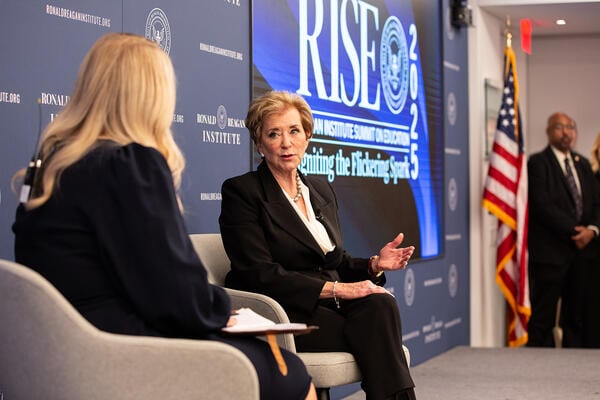
    Connor McLaren for the Ronald Reagan Institute

    Washington, D.C.—Education Secretary Linda McMahon made clear at a series of policy summits this week that while she remains committed to one day shuttering her department, there’s still much work left to be done.

    “You don’t just shut off the lights and walk out the door if you are trying to return education to the states,” McMahon said at one event Wednesday, adding that offices like Civil Rights and Federal Student Aid can’t simply be eliminated. “Really, what we’re trying to do is to show how we can move different parts of the Department of Education to show that they can be more efficient operating in other agencies.”

    Throughout her remarks at both events—the Education Law and Policy Conference hosted by the Federalist Society and the Defense of Freedom Institute on Wednesday and the Reagan Institute Summit on Education on Thursday—the secretary stressed that a key way to test this concept is by moving workforce development programs to the Department of Labor.

    “Let’s be sure that we are not moving hastily, but that we are taking the right steps at the right pace for success,” McMahon told the Federalist Society audience. “And if we show that this is an incredibly efficient and effective way to manage these programs, it is my hope that Congress will look at that and approve these moves.”

    However, some advocates for students, institutional lobbyists, Democrats in Congress and left-leaning policy analysts have taken issue with the plan to move adult, career and technical education programs to the Labor Department, arguing that it’s illegal and will create more headaches for the providers who rely on the money.

    Regardless, the Trump administration is moving forward with its plans. ED signed an interagency agreement with the Department of Labor earlier this spring and has more recently moved many of its staff members to the DOL office. (Funding for the salaries of these employees and the programs they lead, however, will still come from the Education Department budget.)

    On Thursday at the Reagan Institute, McMahon noted that the combined staff is working on a new learning and employment report as well as a “skills wallet” that will help show employers what students have learned and students what employers are looking for.

    “It’s an exciting time in labor development in that country, but it’s a challenge and a real responsibility for us to not get stuck,” she said.

    Aside from career and technical education and some of her other priorities, such as cracking down on alleged campus antisemitism and racial preferencing, much of the conversation both days was centered around the recent shooting of conservative figurehead Charlie Kirk at Utah Valley University and how to prevent political violence on campus.

    McMahon was quick to describe the Turning Point USA president’s death as a travesty and to charge colleges with the responsibility of promoting more healthy civic discourse. At both events, she cited Kirk himself as a prime example of what such debate looks like, saying that while his approach was at times “aggressive,” he was always “very polite” and “civil.”

    “He wasn’t antagonistic, but he was challenging. And there’s a clever art to being able to do that,” she said. “I don’t think that we show our students how to do that enough.”

    Thursday, she denounced the faculty, staff and students who appeared to have been apathetic toward or allegedly celebrated Kirk’s death, building upon comments she made in a social media video earlier this week. But just as she suggested condemning certain individuals for crossing an “ethical line,” she added that “if you shut down the speech of one side to allow the freedom of speech for another, you’d have actually compromised the entire principle, and that we cannot have.”

    She closed on Thursday by urging educators to foster their students’ compassion.

    “We’ve lost a little of our humanity,” she said. “Let’s make sure we grab that back in peace and show it through leadership.”
    Source link

  • Extremist Group Claims Responsibility for “Swatting” Calls

    Extremist Group Claims Responsibility for “Swatting” Calls

    Aaron Ontiveroz/The Denver Post/Getty Images

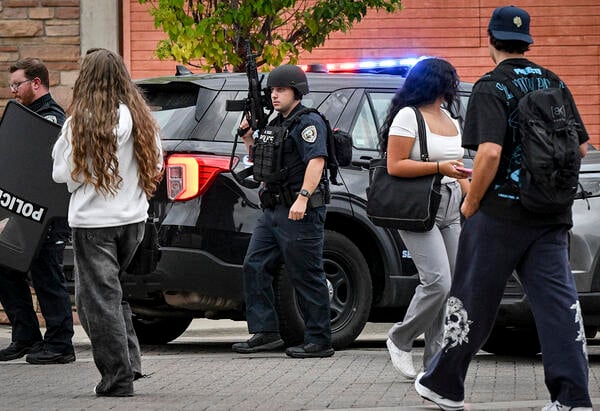
    A person who goes by the name Gores online claimed responsibility for the flurry of so-called swatting calls made to colleges and universities over the past several days, Wired reported.

    Gores is the self-proclaimed leader of an online group called Purgatory, which is linked to a violent online extremist network called The Com, according to Wired. Alongside another Purgatory member called tor, Gores began placing fake calls to campus and local emergency services about active shooters about noon Aug. 21, the same day the University of Tennessee at Chattanooga and Villanova University received swatting calls. 

    As of Wednesday afternoon, Inside Higher Ed counted 19 confirmed swatting calls since Aug. 19, including at Mercer University, the University of Wisconsin at Madison, the University of Utah and the University of New Hampshire.

    Not all of the calls placed by Purgatory have been successful. In some cases, authorities correctly identified the calls as hoaxes. When the group placed a call to Bucknell University in Lewisburg, Pa., a researcher listening in on the call was able to alert the university. The FBI is investigating the uptick in swatting calls and has not publicly confirmed Purgatory’s involvement. Gores told Wired that the swatting spree will continue for another two months. 

    Purgatory offers to make swatting calls for as little as $20, though the price has increased to $95 since this recent campaign of calls began, according to Wired. Three members of Purgatory were arrested in 2024 and pleaded guilty earlier this year for threats made to a Delaware high school, a trailer park in Alabama, Albany International Airport, an Ohio casino and a private residence in Georgia. 

    Ashley Mowreader contributed to this article.

    Source link

  • Sharpton Calls for March on Wall Street, Warns of ‘Giants’ in Fiery Howard University Sermon

    Sharpton Calls for March on Wall Street, Warns of ‘Giants’ in Fiery Howard University Sermon

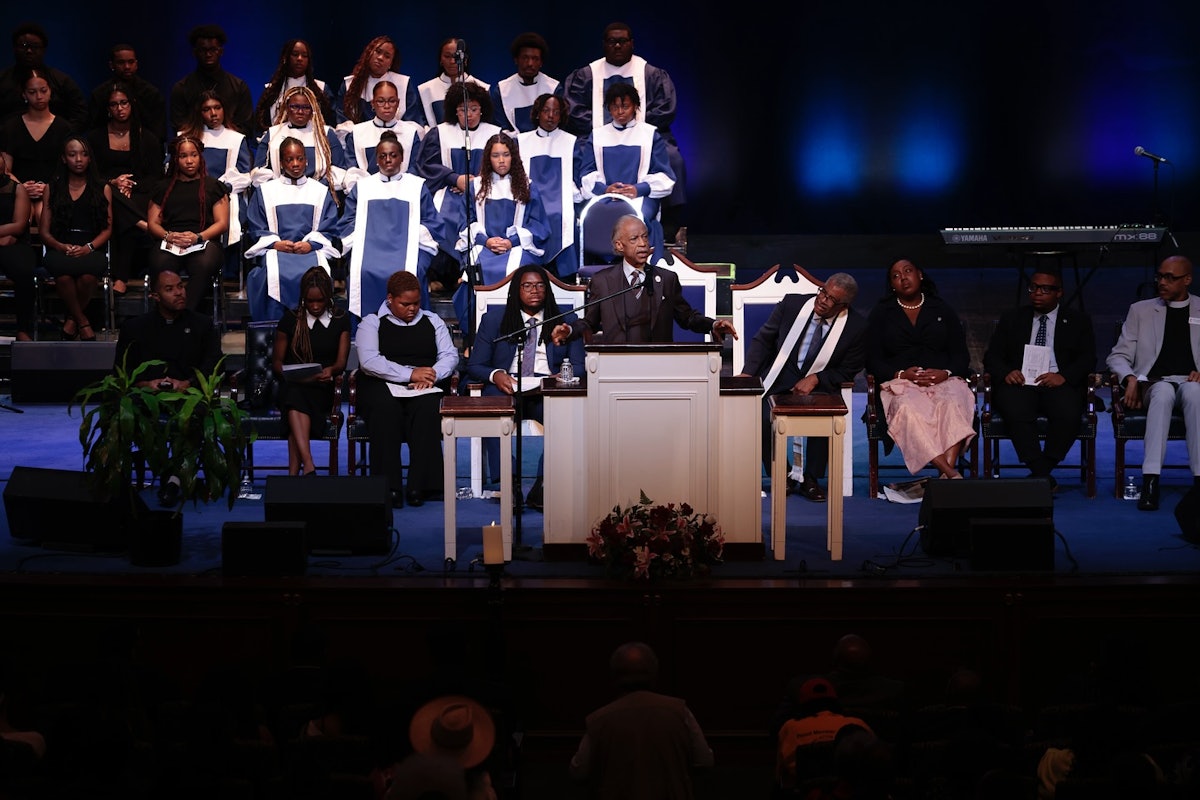
    The gospel choir’s voices echoed through Cramton Auditorium, their blue and white robes swaying as they filled Howard University’s historic venue with spiritual melodies. Just a week after classes resumed at the prestigious HBCU, Rev. Al Sharpton took the stage to deliver a sermon that was equal parts spiritual guidance and a political rallying cry.

    Reverend Al Sharpton meets with Howard University students ahead of Thursday’s March on Wall Street. Speaking to a packed auditorium days before the August 28th anniversary of the historic 1963 March on Washington, the National Action Network founder urged the Howard community to “stand up to the giants” of inequality and injustice while announcing a bold strategic shift for this year’s commemoration.

    Rather than gathering in the nation’s capital this year, Sharpton announced that thousands of demonstrators—including college students from across the country—will converge on New York’s financial district this Thursday for a March on Wall Street, starting at 10 a.m. at the African Burial Ground and marching directly to Wall Street.

    “The real people that are deferring the dream are on Wall Street,” Sharpton told the audience. “They’re the ones that are financing the moves for redistricting and robbing us of our right to vote and representation. So rather than come to Washington, we said, ‘We going to Wall Street this year, where they do business.’”

    Using the biblical story of David facing Goliath as his central theme, Sharpton challenged the congregation to confront contemporary challenges with biblical courage.

    The prominent civil rights leader was particularly pointed in his political criticism of President Donald J. Trump and his attacks on diversity, equity and inclusion and U.S. cities led by Black mayors.

    Sharpton delivered some of his harshest criticism when addressing attempts to sanitize American history, particularly regarding slavery. He expressed outrage at what he described as efforts to downplay historical injustices.

    “The fact that they are threatening institutions,” Sharpton said, his voice rising. “Can you imagine? It’s almost unthinkable to me that they’re saying that we are going through the Smithsonian Museum to make sure that they are in line with the feelings of one man at history.”

    Sharpton said that he was incensed by suggestions that historical narratives should be altered and he chided the president who claimed that the museums focus too much on “how bad slavery was.”  

    In one of the sermon’s most powerful moments, Sharpton shared his family’s connection to slavery, describing how genealogical research in 2007 revealed that his great-grandfather had been enslaved on a South Carolina plantation owned by the late Senator Strom Thurmond’s ancestors.

    “My great grandfather was a slave,” he told the audience. “And it occurred to me for the first time that my name Sharpton is really the owner’s name of my great grandfather. I don’t know my name, and you don’t know your name.”

    Now, Sharpton added, is the time for Americans—particularly students—to fight back against the assault on history. 

    “If we are afraid to stand up, then we are not deserving of those that stood up and gave their lives so we could have a life worth living,” he said.

    Howard University students, led by senior Tabia J. Lee, president of the school’s National Action Network chapter, will bring a delegation to participate in Thursday’s march. The student involvement, she said, represents Sharpton’s challenge that young people take a broader leadership role in today’s social justice movements.

    Howard students noted that Sharpton’s visit to campus came as Howard University faces its own transition, with Dr. Ben Vinson announcing his resignation last week as president and former president Dr. Wayne A.I. Frederick returning to lead the storied institution on an interim basis.

    Throughout the nearly hour-long address, Sharpton wove together themes of personal faith, historical memory, and political action. He reminded the audience of their ancestors’ resilience.

    “Do you know when they walked off that plantation in 1863? After being in slavery 246 years, they had no money because they worked for no wages. They had no education; it was against the law for them to read or write… All you had is God.”

    The March on Wall Street, he said, represents more than just a protest location change—it’s a strategic pivot toward confronting economic inequality at its source. And he challenged the college students to take their stand.  

    “Do you know in ’63 when they marched here in Washington? They were still segregated. They didn’t have the Civil Rights Act until ’64. People rode the bus all night, had chicken sandwiches in a paper bag, because there wasn’t a restaurant that would serve them on the way. Had to go in the woods to use the bathroom because they couldn’t use a rest stop, but they came anyhow,” he said. “And here you are, 60 years later, eating at any restaurant you want, checking into any hotel you want, living in any community you want, and somebody got to beg you to stand up? How broke down have we got?”


    Source link

  • ASALH Condemns White House Directive to Review Smithsonian Museums, Calls for Resistance

    ASALH Condemns White House Directive to Review Smithsonian Museums, Calls for Resistance

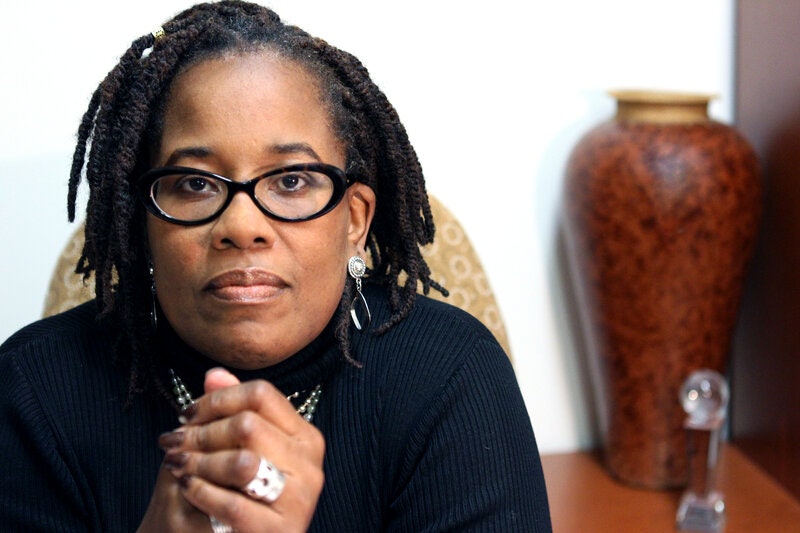
    Dr. Karsonya “Kaye” Wise WhiteheadThe Association for the Study of African American Life and History (ASALH) has issued a forceful condemnation of the White House’s directive calling for a comprehensive review of Smithsonian Institution museums, warning that the move represents an attempt to “erase or distort” Black history.

    The directive follows President Donald Trump’s social media post attacking the Smithsonian museums as “OUT OF CONTROL,” claiming they focus only on “how horrible our Country is, how bad Slavery was, and how unaccomplished the downtrodden have been.” The White House subsequently ordered a full review of all archival materials to determine alignment with Executive Order 14235, aimed at “Restore Truth and Sanity to American History.”

    “ASALH stands in fierce opposition to this latest directive and all efforts to erase or distort our history, to silence our voices, and to minimize our story,” said ASALH President Dr. Karsonya “Kaye” Wise Whitehead.

    The 110-year-old organization, which founded Black History Month, partnered with the African American Policy Forum to co-lead a “Hands Off Our History” rally at the Smithsonian’s National Museum of African American History & Culture in Washington, D.C.

    Whitehead characterized the museum review as part of a broader pattern of attacks on diversity and inclusion efforts. She cited the 2023 banning of over 10,000 books, many featuring people of color, and recent executive orders eliminating Diversity, Equity, and Inclusion programs in higher education, medicine, and K-12 history courses.

    “These steps are veiled attempts to rewrite and distort the narrative by removing any mention of the racist actions, words, and deeds that have shaped American history,” Whitehead added.

    The ASALH president described the current moment as part of an escalating campaign that began with what she termed the “whitelash election” of 2017, followed by increased white supremacy after George Floyd’s murder, and culminating in current efforts to “defund libraries, whitewash history curricula, zero-base the Department of Education.”

    ASALH, founded in 1915, positions itself as a bridge between scholars and the public in preserving and promoting Black history. The organization is preparing for its annual conference in Atlanta, scheduled for September 24-28, 2025, which Whitehead said will serve as an opportunity to “organize and prepare ourselves to counter his next steps.”

    The controversy highlights ongoing tensions over how American history is taught and presented in educational and cultural institutions, with particular focus on narratives involving slavery, civil rights, and systemic racism.

    Whitehead added that the organization’s resistance draws inspiration from historical figures including Dr. Carter G. Woodson, Dr. W.E.B. Du Bois, and Harriet Tubman, stating: “Our work as truth seekers obliges us to ‘speak the truth to the people’ and demands that we stay ready.”

    The Smithsonian Institution has not yet responded to requests for comment regarding the White House directive.

    Source link

  • Mizzou Calls Black 2 Class Event Example of “Discrimination”

    Mizzou Calls Black 2 Class Event Example of “Discrimination”

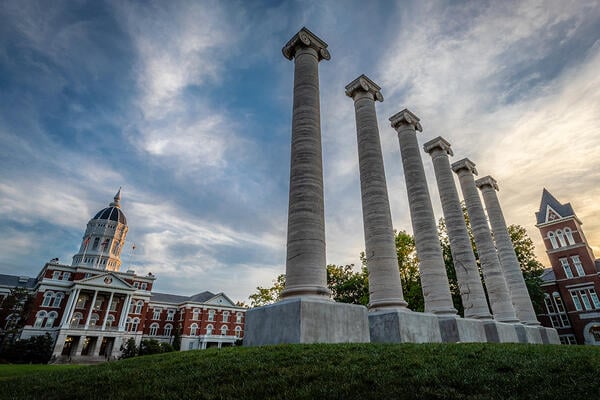
    For the second year in a row, a Black student group at the University of Missouri is facing pushback from administrators over their attempt to hold a back-to-school event with the word “Black” in the name.

    The Legion of Black Collegians, a long-standing Black student government at Mizzou, had planned to host the on-campus Black 2 Class Block Party this week, but the group said in a social media post Wednesday that university administrators had canceled it.

    A university spokesperson told Inside Higher Ed that Mizzou is “committed to fostering an environment free of unlawful discrimination,” and that the name of the event “suggested it was race exclusive.”

    Likewise, Mizzou President Mun Choi added in a statement that “when holding events using university facilities, student organizations must avoid excluding individuals based on race.”

    This follows a similar dispute last year, when the university changed the name of a similar LBC event from the Welcome Black BBQ to the Welcome Black and Gold BBQ, a nod to the university’s colors. This year, LBC declined to participate, letting university officials know in July.

    Student success experts and advocates for racial minority groups say the tension at Mizzou is just one example of an ongoing change in campus cultures nationwide. As various pieces of anti-DEI legislation take effect in red states and the Trump administration attempts to crack down on practices of so-called liberal indoctrination across the country, many students of color could lose access to vital hubs of cultural recognition, they say.

    “There’s no question that the political context, the messaging from this administration and the confluence of what’s happening at state levels are extremely influential for white universities, who are often public schools that take public money,” said Eric Duncan, a policy director with EdTrust. “We’re not surprised, but we’re disappointed in what’s happening to Black students at Missouri.”

    In addition to publicizing the cancellation, LBC also noted on Instagram that incidents of racism and hate speech on campus are on the rise and demanded that the institution schedule a town hall meeting within 60 days, publicly condemn racial harassment and send out an annual notification explaining the college’s antidiscrimination policies.

    “Let’s be clear,” the student group wrote. “These actions are a deliberate act of erasure … Recreational spaces for students of all identities are CRUCIAL.”

    Choi said the university “will not respond to demands.” A university spokesperson later told Inside Higher Ed that the university is “not aware of increased discrimination against Black students on campus.”

    Amaya Morgan, the current LBC president, said she met with Choi and other administrators to discuss the cancellation on Thursday afternoon—a meeting the university later said was confidential and declined to comment on.

    In an effort to avoid federal scrutiny, universities across the country have canceled events and closed diversity centers following Trump’s ban on race-based programming and activities. A federal judge recently struck down one such order from the Department of Education, but in many cases colleges have already complied. Some institutional leaders have indicated they have few good options except to keep their heads down.

    But for Morgan, the priority is for the university “to have our back.”

    “We know we can’t do anything about the block party now,” she said, adding that racially driven harassment must still be addressed. “Obviously what we’re doing to prevent discrimination right now is not working. So we’re asking, how can we work toward a solution? That is why those demands were listed out like that.”

    Colleges Put ‘a Lot at Stake’

    Decisions to close minority student centers, shut down ethnic group–based organizations and cancel culturally specific events are not new and started before Trump took office. News organizations and nonprofit groups have been tracking such actions, especially in Republican-led states, since the Supreme Court blocked the consideration of race in college admissions in 2023.

    For example, colleges in Utah closed cultural centers and the University of Iowa terminated LGBTQ+ and Latino living-learning communities. Mizzou axed its Inclusion, Diversity and Equity Division in summer 2024 along with certain race-based scholarships and first-year student success programs like the Mizzou Black Men’s and Women’s Initiatives.

    As a Black man who attended two predominantly white institutions, Duncan, of EdTrust, said that by shuttering these parts of campus life, universities are putting “a lot at stake.” For underrepresented students, many of whom are also first-generation, these programs are critical to retention and degree completion, adding that there’s evidence—anecdotal and data-based—to prove it.

    “When Black and brown students and different cultures step onto college campuses, a lot of times they’re looking for signals of inclusivity. ‘Is this a place that I belong?’” Duncan said. “Removing [these welcoming and affirming spaces] not just passively, but by coming out and saying, ‘We don’t support this,’ is a signal to people that maybe this is not a space of belonging for me.”

    Shaun Harper, a professor of education, public policy and business at the University of Southern California, echoed Duncan’s remarks. He pointed to a paper he published in 2013 that showed that it’s critical for Black students at predominantly white institutions to connect and teach one another how to navigate environments filled with microaggressions, racism and loneliness. Black student groups were key to this, the qualitative data showed.

    Harper added that just because something is run by a Black student organization doesn’t make it exclusive to other learners.

    “There’s never been a sign on the Black culture center door that says, ‘Blacks only.’ If white students, Asian students, Latino students and others, Indigenous students, wanted to come to those spaces, they were always welcome,” he said. “The reason why I’m so annoyed is that anybody who has ever attended [an event like Mizzou’s barbecue] knows that they are not discriminatory, divisive spaces. In fact, they’re spaces that are familial.”

    A History of Racial Tension

    As Mizzou’s LBC once again draws attention to what they call a lack of representation on campus, the university is also approaching the 10-year anniversary of protests that rocked the campus and made national headlines in November 2015.

    One student went on a hunger strike to draw attention to racism on campus, and other students camped out on the quad in solidarity. Eventually, the football team joined the efforts. The strike ended when two university leaders resigned on the same day.

    When Inside Higher Ed asked university administrators how they had addressed the campus climate since then, university spokesperson Christopher Ave said, “It is difficult to accurately measure the campus climate.” But he pointed to a record number of applications from prospective students, the increase in the percentage of underrepresented students and an improved retention rate on campus—all of which, he said, “illustrate that students want to attend and continue their education at the University of Missouri.”

    Ave added that calling off the block party doesn’t mean that the university also considers its Black cultural center or LBC as examples of discrimination.

    “This decision was based on the circumstances of this event, which was promoted with a name that suggested it was race exclusive and contrary to [federal civil rights law],” he said. “Each event or program must be considered on its own in context and the decision on this event does not dictate what will happen in any other circumstance.”

    Morgan from LBC declined to comment on whether they were seeking aid from outside groups to hold events like the block party off campus. The primary goal, she said, is to “protect the safety of Black students moving forward.”

    “I’ll be honest, I don’t have a very clear path forward, but I know that as a Legion, we will still continue to do whatever we can to make sure that students are heard and make sure that our identities are heard and seen,” she said. “As a Legion, we have existed for nearly 60 years. Excuse my language, but there’s absolutely no way in hell that we [will] go, especially not under my watch.”


    Source link

  • Mizzou Calls Black 2 Class Event Example of “Discrimination”

    Mizzou Calls Black 2 Class Event Example of “Discrimination”

    For the second year in a row, a Black student group at the University of Missouri is facing pushback from administrators over their attempt to hold a back-to-school event with the word “Black” in the name.

    The Legion of Black Collegians, a long-standing Black student government at Mizzou, had planned to host the on-campus Black 2 Class Block Party this week, but the group said in a social media post Wednesday that university administrators had canceled it.

    A university spokesperson told Inside Higher Ed that Mizzou is “committed to fostering an environment free of unlawful discrimination,” and that the name of the event “suggested it was race exclusive.”

    Likewise, Mizzou President Mun Choi added in a statement that “when holding events using university facilities, student organizations must avoid excluding individuals based on race.”

    This follows a similar dispute last year, when the university changed the name of a similar LBC event from the Welcome Black BBQ to the Welcome Black and Gold BBQ, a nod to the university’s colors. This year, LBC declined to participate, letting university officials know in July.

    Student success experts and advocates for racial minority groups say the tension at Mizzou is just one example of an ongoing change in campus cultures nationwide. As various pieces of anti-DEI legislation take effect in red states and the Trump administration attempts to crack down on practices of so-called liberal indoctrination across the country, many students of color could lose access to vital hubs of cultural recognition, they say.

    “There’s no question that the political context, the messaging from this administration and the confluence of what’s happening at state levels are extremely influential for white universities, who are often public schools that take public money,” said Eric Duncan, a policy director with EdTrust. “We’re not surprised, but we’re disappointed in what’s happening to Black students at Missouri.”

    In addition to publicizing the cancellation, LBC also noted on Instagram that incidents of racism and hate speech on campus are on the rise and demanded that the institution schedule a town hall meeting within 60 days, publicly condemn racial harassment and send out an annual notification explaining the college’s antidiscrimination policies.

    “Let’s be clear,” the student group wrote. “These actions are a deliberate act of erasure … Recreational spaces for students of all identities are CRUCIAL.”

    Choi said the university “will not respond to demands.” A university spokesperson later told Inside Higher Ed that the university is “not aware of increased discrimination against Black students on campus.”

    Amaya Morgan, the current LBC president, said she met with Choi and other administrators to discuss the cancellation on Thursday afternoon—a meeting the university later said was confidential and declined to comment on.

    In an effort to avoid federal scrutiny, universities across the country have canceled events and closed diversity centers following Trump’s ban on race-based programming and activities. A federal judge recently struck down one such order from the Department of Education, but in many cases colleges have already complied. Some institutional leaders have indicated they have few good options except to keep their heads down.

    But for Morgan, the priority is for the university “to have our back.”

    “We know we can’t do anything about the block party now,” she said, adding that racially driven harassment must still be addressed. “Obviously what we’re doing to prevent discrimination right now is not working. So we’re asking, how can we work toward a solution? That is why those demands were listed out like that.”

    Colleges Put ‘a Lot at Stake’

    Decisions to close minority student centers, shut down ethnic group–based organizations and cancel culturally specific events are not new and started before Trump took office. News organizations and nonprofit groups have been tracking such actions, especially in Republican-led states, since the Supreme Court blocked the consideration of race in college admissions in 2023.

    For example, colleges in Utah closed cultural centers and the University of Iowa terminated LGBTQ+ and Latino living-learning communities. Mizzou axed its Inclusion, Diversity and Equity Division in summer 2024 along with certain race-based scholarships and first-year student success programs like the Mizzou Black Men’s and Women’s Initiatives.

    As a Black man who attended two predominantly white institutions, Duncan, of EdTrust, said that by shuttering these parts of campus life, universities are putting “a lot at stake.” For underrepresented students, many of whom are also first-generation, these programs are critical to retention and degree completion, adding that there’s evidence—anecdotal and data-based—to prove it.

    “When Black and brown students and different cultures step onto college campuses, a lot of times they’re looking for signals of inclusivity. ‘Is this a place that I belong?’” Duncan said. “Removing [these welcoming and affirming spaces] not just passively, but by coming out and saying, ‘We don’t support this,’ is a signal to people that maybe this is not a space of belonging for me.”

    Shaun Harper, a professor of education, public policy and business at the University of Southern California, echoed Duncan’s remarks. He pointed to a paper he published in 2013 that showed that it’s critical for Black students at predominantly white institutions to connect and teach one another how to navigate environments filled with microaggressions, racism and loneliness. Black student groups were key to this, the qualitative data showed.

    Harper added that just because something is run by a Black student organization doesn’t make it exclusive to other learners.

    “There’s never been a sign on the Black culture center door that says, ‘Blacks only.’ If white students, Asian students, Latino students and others, Indigenous students, wanted to come to those spaces, they were always welcome,” he said. “The reason why I’m so annoyed is that anybody who has ever attended [an event like Mizzou’s barbecue] knows that they are not discriminatory, divisive spaces. In fact, they’re spaces that are familial.”

    A History of Racial Tension

    As Mizzou’s LBC once again draws attention to what they call a lack of representation on campus, the university is also approaching the 10-year anniversary of protests that rocked the campus and made national headlines in November 2015.

    One student went on a hunger strike to draw attention to racism on campus, and other students camped out on the quad in solidarity. Eventually, the football team joined the efforts. The strike ended when two university leaders resigned on the same day.

    When Inside Higher Ed asked university administrators how they had addressed the campus climate since then, university spokesperson Christopher Ave said, “It is difficult to accurately measure the campus climate.” But he pointed to a record number of applications from prospective students, the increase in the percentage of underrepresented students and an improved retention rate on campus—all of which, he said, “illustrate that students want to attend and continue their education at the University of Missouri.”

    Ave added that calling off the block party doesn’t mean that the university also considers its Black cultural center or LBC as examples of discrimination.

    “This decision was based on the circumstances of this event, which was promoted with a name that suggested it was race exclusive and contrary to [federal civil rights law],” he said. “Each event or program must be considered on its own in context and the decision on this event does not dictate what will happen in any other circumstance.”

    Morgan from LBC declined to comment on whether they were seeking aid from outside groups to hold events like the block party off campus. The primary goal, she said, is to “protect the safety of Black students moving forward.”

    “I’ll be honest, I don’t have a very clear path forward, but I know that as a Legion, we will still continue to do whatever we can to make sure that students are heard and make sure that our identities are heard and seen,” she said. “As a Legion, we have existed for nearly 60 years. Excuse my language, but there’s absolutely no way in hell that we [will] go, especially not under my watch.”


    Source link

  • How should higher education respond to calls to be relevant?

    How should higher education respond to calls to be relevant?

    In their examination of ten trends that will shape the future of the campus university, Edward Peck, Ben McCarthy and Jenny Shaw set out a compelling account of the factors that will shape English higher education. As a result of these factors, they argue that, in the future, ‘Academic awards will focus as much on the development of employment and generic skills as the acquisition and retention of specific knowledge’. Given that it is co-authored by a long-standing vice chancellor, who will shortly take on the role of the Chair of the higher education regulator, this can be read as an urgent call for higher education to be clear about how it produces graduates who will make important contributions to society.

    While I agree that higher education needs to be open to discussing the value of its education for graduates and society, I do not think a convincing case can be made by focusing on the distinction between generic skills and specific knowledge. Instead, my argument is that higher education needs to develop a much better account of how the knowledge that students engage with through their degrees prepares them to make important contributions to society. There are four elements to this. 

    First, the development of generic skills and the acquisition of specific knowledge are not alternative educational objectives for degree programmes. Rather, they are different elements of a rich educational environment. More fundamentally, the educational power of higher education does not lie in either of these options. What is educationally powerful about higher education is the way in which it offers students access to structured bodies of knowledge. Seeing these bodies of knowledge from the inside gives students and graduates the opportunity to view themselves and the world differently. It is the structure of these bodies of knowledge that allows students and graduates to develop ways of engaging with the world that make use of this knowledge and related skills in a diverse range of contexts. Generic skills and specific knowledge are generated as part of this engagement with structured bodies of knowledge, but they are not where the educational treasure of higher education lies. Indeed, our seven-year international longitudinal study of those who studied degrees in Chemistry and in Chemical Engineering found that those who focused on specific knowledge rather than the ways of engaging with the world they gained from their degrees tended to benefit less from their education. 

    Second, showing that higher education is about gaining access to structured bodies of knowledge explains why it requires programmatic study over the three or four years of a degree. If it were simply about generic skills or specific knowledge, then there would be no need for the systematic and sustained engagement that we currently demand of students. Presenting higher education as about generic skills or specific knowledge risks it appearing very obvious that demanding several years of sustained study is an unnecessary and expensive luxury. It is only by showing the importance of students’ gaining access of bodies of knowledge that we can explain why alternative forms of higher education that are already boxing higher education in, such as micro-credentials, are not up to the job of supporting students to see these bodies of knowledge from the inside and engaging with the world from the perspective of this knowledge.

    Third, understanding the importance of the structured nature of this knowledge helps to highlight the importance of producing graduates from a rich diversity of disciplinary, interdisciplinary and professional subjects, who engage with the world in different ways. Addressing the challenges facing the world will require drawing on the diversity of these perspectives which cannot be gained through being taught generic skills or unconnected stores of specific knowledge.

    Fourth, ensuring that higher education maintains its focus on structured bodies of knowledge is key to challenging educational inequalities. Otherwise, it is entirely predictable that the education offered by ‘elite’ institutions will remain focused on structured bodies of knowledge while ‘mass’ higher education shifts to focus on generic skills. Given that those with the greatest resources are most likely to access elite higher education, the poor will be left with an education that leaves them rooted in the contexts in which they have developed their generic skills whereas the privileged will benefit from the ways in which structured bodies of knowledge support them to move between contexts.

    The great higher education advocate David Watson urged universities and academics to ‘guard your treasure’. The treasure of higher education is the collective structured bodies of knowledge that we are stewards of for society. Our role is to support society and students to understand the power of this knowledge and what it can do in the world. In response to the important questions raised by Edward Peck, Ben McCarthy and Jenny Shaw, we need to develop much more compelling accounts of how access to these structured bodies of knowledge provides an education that is qualitatively different from an education focused on developing generic skills and specific knowledge. We need to show how this qualitative difference is crucial in offering a relevant education that has the potential to change students and society.  If we fail to do this, then we are in great danger of throwing away our greatest treasure.

    Source link

  • Bill Shorten calls out ‘ivory tower’ unis – Campus Review

    Bill Shorten calls out ‘ivory tower’ unis – Campus Review

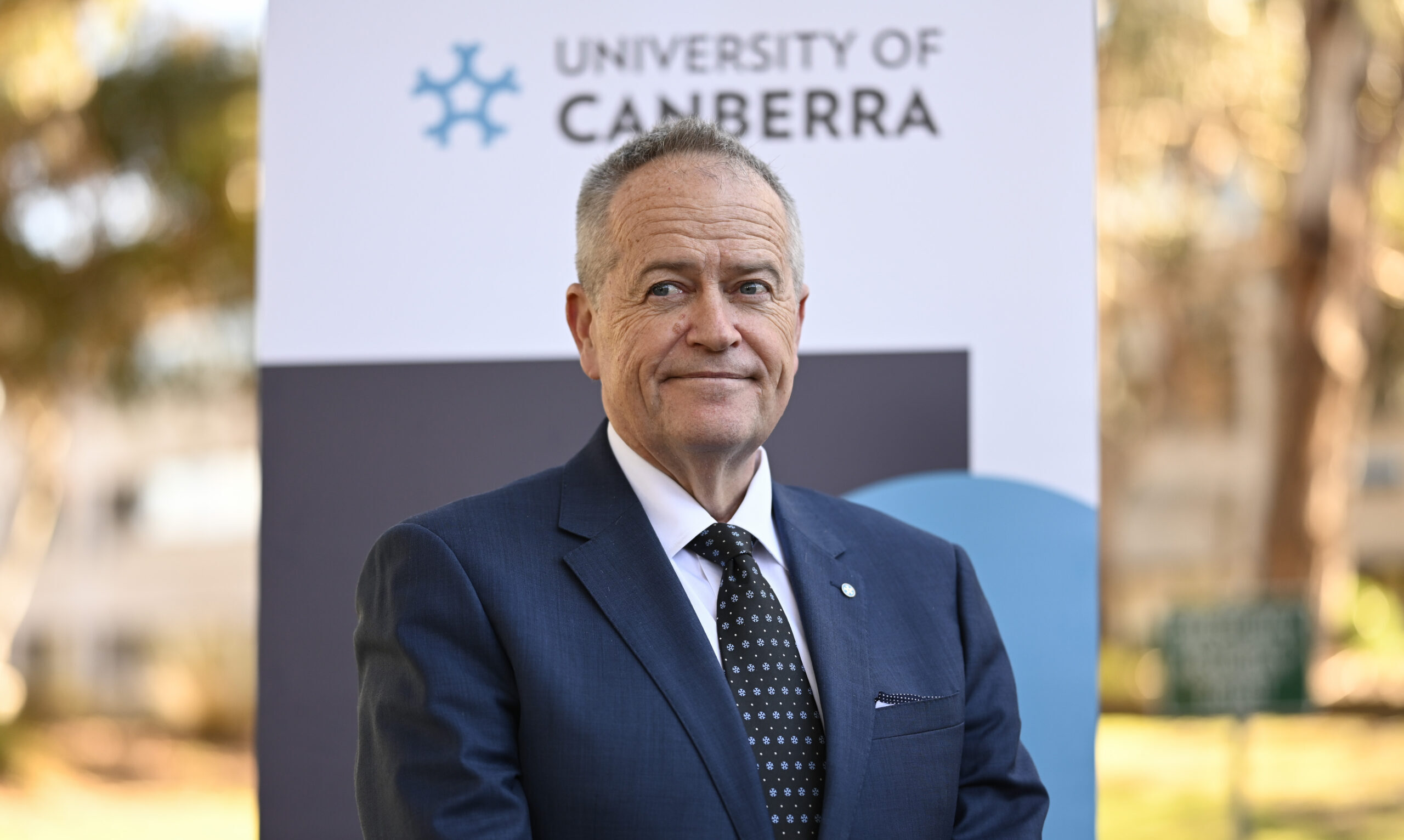
    New University of Canberra (UC) vice-chancellor Bill Shorten has scolded the higher education sector for not keeping up with students’ demands in a piece he penned for The Australian on Thursday.

    Please login below to view content or subscribe now.

    Membership Login

    Source link

  • Legacy and Purpose: Congresswoman Jasmine Crockett Calls Tougaloo Graduates to Action

    Legacy and Purpose: Congresswoman Jasmine Crockett Calls Tougaloo Graduates to Action

    –JACKSON, Mississippi

    Texas Congresswoman Jasmine CrockettIn a powerful address that wove together civil rights history with present-day challenges, U.S. Representative Jasmine Crockett (D-Texas) delivered an impassioned commencement speech at Tougaloo College’s graduation ceremony on Sunday, urging graduates to embrace their purpose in continuing the fight for progress.

    Standing on the historic grounds of the private Mississippi HBCU—once a sanctuary and launch pad for the Civil Rights Movement—the Congresswoman reflected on the paradoxical nature of the moment: that in 2025, her very presence as a speaker remained controversial.

    “As I stand here in this safe space, still only one of the few places that an institution can invite me to speak… to think about the fact that people have to be fearful of having a sitting member of Congress come and address their graduates tells us that we still got a lot of work to do,” she told the graduates.

    Drawing parallels between past and present struggles, she reminded the audience that Tougaloo was one of a few places in Mississippi where Dr. Martin Luther King Jr. could speak during the Civil Rights Movement. Now, decades later, she noted the irony of similar limitations placed on Black voices in positions of power.

    “The president of the United States having a temper tantrum that strips funding because I’m Black and I’m proud should not be something that we are dealing with in 2025,” she stated, her voice rising with conviction.

    The Congresswoman, who acknowledged working multiple jobs during her own college years, spoke candidly about personal struggles and the fatigue that comes with fighting systemic barriers. Invoking the refrain from the gospel song “I Don’t Feel No Ways Tired,” she encouraged graduates to persevere despite exhaustion.

    “I just can’t give up now. I’ve come too far from where I started from,” she recited, asking graduates to reflect on their own journeys through college—the multiple jobs, the stepping away and stepping back in—all while excelling despite the challenges.

    Her message anchored in both acknowledgment of weariness and the necessity of continued struggle, themes particularly relevant at an institution with Tougaloo’s civil rights legacy. The college was home to the “Tougaloo Nine,” students who organized sit-ins at segregated libraries, and alumni like Anne Moody and Memphis Norman, who participated in the historic Woolworth’s lunch counter sit-in in 1963.

    “Sitting in these very classrooms is just as much of a protest as Anne and Memphis pulling up to Woolworths in 1963,” she said, emphasizing how education remains an act of resistance.

    The Congresswoman warned graduates about attempts to erase this history, not just from textbooks but through policies targeting diversity initiatives and institutions serving Black communities. “Jim Crow never died,” she declared. “He just lied in wait.”

    She shared personal experiences of being labeled “ghetto” and “unqualified” despite her impressive credentials—modern versions of racial epithets—connecting these attacks to historical patterns of undermining Black achievement and institutions.

    Looking to the future, she issued a direct challenge to the graduates.

    “If you are waiting on somebody to come and save you, they are not coming,” she warned. “You are the person that you’ve been waiting on.”

    Reminding them that every significant social justice movement has been led by young people, she noted that she is now older than Medgar Evers, Dr. Martin Luther King Jr., and Malcolm X were when they were assassinated.

    “Your moment is not in the future. Your moment is now,” she urged. “This country is relying on each and every one of you to walk into your purpose and to walk in greatness with your head held high.”

    The Congresswoman’s speech resonated deeply with the graduates and assembled families at Tougaloo, an institution that has persisted in its educational mission despite historical and ongoing challenges.

    “She was dynamic and passionate,” said Rose Lucas, whose niece was among the more than 120 undergraduates to receive their diploma. “At a time when so many of our politicians are afraid to speak out against the injustices in Washington, I am encouraged by the Congresswoman’s passion and commitment.” 

    As Crockett concluded with a call to action, she left the new alumni with a poignant message about belonging. 

    “There are people that are going to tell you that there is not a table in which there is a seat for you, but I am here to remind you of Montgomery and those folding chairs.”

    Source link

  • HELU Calls on Academic Workers to Stand Up (Higher Ed Labor United)

    HELU Calls on Academic Workers to Stand Up (Higher Ed Labor United)

    If institutions won’t stand up to the Trump administration, then it’s up to academic workers, students, communities, and citizens to stand up for them. Because we have the strongest levers of power over our local institutions. 

    While international students have become the first target on campuses, it’s important to remember that a portion of faculty (and in particular contingent faculty who are more precarious), administration, and campus service workers are also vulnerable to ICE. The consequences of these actions could have far-reaching effects. Due process of the law is not for specific groups. We all have it or no one has it. 

    This absolutely is an attempt to silence dissent in the country, especially on college campuses.

    This absolutely is authoritarianism.

    This absolutely is in line with the current attacks on higher education which were laid out in Project 2025. And in line with the crackdown on student protests before Trump took office. 

    And what’s worse is that many of our institutions are refusing to stand up for students. 

    Thankfully, unions are already responding.

    We have to rise to this moment or higher education will never be the same.

    Source link