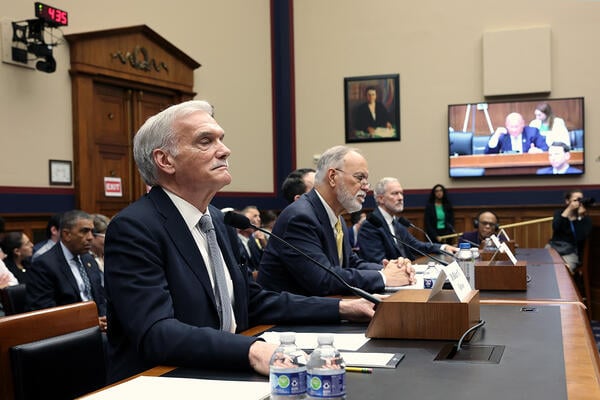
For the fifth time since late 2023, congressional Republicans on Tuesday interrogated a group of university leaders about campus antisemitism. But unlike previous hearings, this one was short on fireworks and viral moments, even as the three leaders—Georgetown University interim president Robert Groves; University of California, Berkeley, chancellor Rich Lyons; and City University of New York chancellor Félix V. Matos Rodríguez—faced a grilling over faculty remarks, foreign funding and alleged failures to protect Jewish students from discrimination and harassment.
While the first hearing, in December 2023, contributed to the ouster of the presidents of Harvard University and the University of Pennsylvania, who equivocated on a hypothetical question about calls for the genocide of Jewish students, subsequent sessions have not had the same impact.
Conducted by the Republican-led Committee on Education and the Workforce, Tuesday’s hearing—titled “Antisemitism in Higher Education: Examining the Role of Faculty, Funding and Ideology”—spanned more than three hours and was interrupted several times by pro-Palestinian protesters, who were quickly removed. In sometimes-heated questioning, lawmakers focused on controversial social media posts by college employees and hypothetical situations, such as whether a faculty union might demand a boycott of Israel in collective bargaining agreements.
But the campus leaders largely avoided gaffes and appeared to emerge mostly unscathed.
Here are highlights from Tuesday’s hearing.
Social Media in the Spotlight
While past hearings often centered on what happened on campus—particularly at institutions that had pro-Palestinian encampments—at Tuesday’s hearing lawmakers focused more on social media, questioning and condemning posts by professors that were critical of Israel. Some posts also seemed to show support for Hamas’s terrorist attack on Israel on Oct. 7, 2023.
Rep. Glenn Thompson, a Pennsylvania Republican, specifically highlighted a social media post from Georgetown employee Mobashra Tazamal, associate director of a multiyear research project on Islamophobia who allegedly reposted a statement that said, “Israel has been recreating Auschwitz in Gaza for two years.” Thompson asked interim president Robert Groves if he thought it was “appropriate for a Georgetown-affiliated scholar to publicly endorse a statement comparing Israel actions in Gaza to the evil of Auschwitz.”
Groves made it clear that he rejected the statement and apologized to anyone harmed by it. But he also defended Georgetown officials for not disciplining Tazamal for the post.
“That’s behavior covered under the First Amendment on social media that we don’t intervene on,” Groves told Thompson in response. “What we do intervene on quickly is behavior that affects our students in the classroom and research-related activities that involve students.”
Republican lawmakers also asked about posts by Ussama Makdisi at UC Berkeley, zeroing in on one that read, “I could have been one of those who broke through the siege on October 7,” the title of an article sympathetic to the Palestinian plight that praised the “determination and courage” of the attackers.
Several Republicans pressed Berkeley chancellor Rich Lyons on how he perceived that post and why Makdisi, a Palestinian American scholar who teaches history, was hired in the first place. Lyons, who became chancellor last July, acknowledged his concerns about the post.
“I believe it was a celebration of the terrorist attack on Oct. 7,” he told lawmakers.
Despite that acknowledgement, Lyons twice defended Makdisi as “a fine scholar” and said he was hired as the inaugural chair of a new Palestinian and Arab Studies program based on his qualifications. His defense prompted a sharp rebuke from Lisa McClain, a Michigan Republican.
“I’m sure there’s a lot of murderers in prison that are fine people, too, fine scholars, but they do some pretty nefarious and heinous acts,” McClain responded to Lyons.
Protest Interruptions
Pro-Palestinian protesters interrupted Tuesday’s proceedings at least four times. Authorities quickly shut down and removed protesters, who were not visible and only faintly audible via live stream.
The protesters seemed to be targeting City University of New York chancellor Félix V. Matos Rodríguez, given that the interruptions occurred when he was speaking or being questioned by Congress. Partial phrases audible over the live stream included “blood on your hands” and “genocidal warmonger.”
Florida Republican Randy Fine fired back after one such interruption.
“Shut up and get out of here,” he bellowed at a protester, calling them a “loser” before blaming campus leaders for the disruption. “I hold you all responsible for this. It is the attitude that you have allowed on your college campuses that make people think that this is OK.”
Stefanik Targets Legal Clinic
New York Republican Elise Stefanik made headlines in prior hearings when she asked the hypothetical genocide question that tripped up the presidents of Harvard, Penn and the Massachusetts Institute of Technology. But for the first time in five antisemitism hearings, she did not ask that question. Instead she focused on a legal clinic at the CUNY School of Law
She expressed concern that the legal clinic, CUNY CLEAR, is representing Mahmoud Khalil, the Columbia University graduate who was arrested without charge and incarcerated for three months for his role in organizing pro-Palestinian campus protests.
Khalil, who was freed last month, has not been accused of a crime and has subsequently sued the Trump administration, alleging he was falsely imprisoned and smeared by the federal government for First Amendment–protected activism.
“Does it concern you that New York taxpayers are paying the salary for the legal defense fund of Mahmoud Khalil?” Stefanik asked Rodriguez. ”And I’ll remind you who Mahmoud Khalil is: This is the chief pro-Hamas agitator that led to the antisemitic encampments at Columbia, the rioting and violent takeover of Hamilton Hall, the harassment and physical assault of Jewish students.”
The CUNY chancellor told Stefanik he was not aware CUNY CLEAR was representing Khalil, but that such decisions are “made in the clinics” and at the individual campus level.
Dems Needle the GOP
Democratic lawmakers focused less on the presidents on the stand than on the hearing itself. Several cast antisemitism concerns as pretext for the Trump administration’s crackdown on higher education. They also criticized the administration for slashing staff at the Office for Civil Rights, the enforcement arm of the Department of Education tasked with investigating antisemitism and other complaints.
Suzanne Bonamici, an Oregon Democrat, argued that Republicans are “weaponizing the real problems of the Jewish community” to attack higher education. She also noted that Republicans have been largely silent about President Donald Trump’s own antisemitic remarks recently.
Bobby Scott, a Virginia Democrat and ranking member of the Education and Workforce Committee, argued that the Trump administration is not approaching concerns about antisemitism in good faith but rather as a way to exert control.
“The Trump administration is destabilizing higher education itself, eroding trust, silencing dissent and undermining universities’ ability to promote diversity and critical inquiry, while at the same time sabotaging the Office [for] Civil Rights,” he said in closing remarks. “Who suffers most from this strategy? It’s the students, Jewish and non-Jewish, marginalized and unrepresented. They’re the ones who will be left vulnerable and voiceless. This should not be a partisan debate. It should be about ensuring that our schools are safe, inclusive and intellectually vibrant.”
However, House Education and Workforce chairman Tim Walberg, a Michigan Republican, made it clear that despite criticism from Democrats, such hearings will continue to be held.
“We need to continue to highlight bad actors in our higher education institutions,” Walberg said.