Tag: Campus

  • Daring students to take risks and be wrong is key to solving the campus culture wars

    Daring students to take risks and be wrong is key to solving the campus culture wars

    Goodbye then, the Higher Education (Freedom of Speech) Act parts A3, A4, A7 and parts of A8 – we hardly knew you.

    The legal tort – a mechanism that seemed somehow to be designed to say “we’ve told the regulator to set up a rapid alternative mechanism to avoid having to lawyer up, but here’s a fast track way to bypass it anyway”, is to be deleted.

    The complaints scheme – a wheeze which allowed an installed Director for Freedom of Speech and Academic Freedom to rapidly rule on whatever it was that the Sunday papers were upset about that week – will now be “free” (expected) to not take up every dispute thrown its way.

    Students themselves with a complaint about a free speech issue will no longer have to flip a coin between a widely respected way of avoiding legal disputes and an untested but apparently faster one operated by the Director which was to be flagged in Freshers’ handbooks. The OIA it is.

    Foreign funding measures – bodged into the act by China hawks who could never work out whether the security services, the Foreign Office or the Department for Education were more to blame for encouraging universities to take on Chinese students – will now likely form part of the revised “Foreign Influence Registration Scheme” created by the National Security Act 2023.

    A measure banning universities from silencing victims of harassment via a non-disclosure agreement will stay, despite OfS saying it was going to ban NDAs anyway – although nobody seems able to explain why their use will still be fine for other victims with other complaints.

    And direct regulation of students’ unions – a measure that had somehow fallen for the fanciful idea that their activities are neither regulated nor controlled by powerless university managements and the Charity Commission – will also go. The “parent” institution will, as has always been the case, revert to reasonably practicable steps – like yanking its funding.

    As such, save for a new and vague duty to “promote” free speech and academic freedom, the new government’s intended partial repeal of legislation that somehow took the old one two parliaments to pass – a period of gestation that always seemed more designed to extend the issue’s prevalence in the press than to perfect its provisions – now leaves the sector largely back in the framework it’s been in for the best part of 40 years.

    That the Secretary of State says that all of the above is about proceeding in a way that “actually works” will raise an eyebrow from those who think a crisis in the academy has been growing – especially when the government’s position is that the problem to be fixed is as follows:

    In a university or a polytechnic, above all places, there should be room for discussion of all issues, for the willingness to hear and to dispute all views including those that are unpopular or eccentric or wrong.

    Actually, that was a quote from Education Secretary Keith Joseph in 1986, writing to the National Union of Students over free speech measures in the 1986 act. But Bridget Phillipson’s quote wasn’t much different:

    These fundamental freedoms are more important—much more important—than the wishes of some students not to be offended. University is a place for ideas to be exposed and debated, to be tried and tested. For young people, it is a space for horizons to be broadened, perspectives to be challenged and ideas to be examined. It is not a place for students to shut down any view with which they disagree.

    The message for vice chancellors who fail to take this seriously couldn’t have been clearer – “protect free speech on your campuses or face the consequences”. But if it’s true that for “too long, too many universities have been too relaxed about these issues”, and that “too few took them seriously enough” – what is it that that must now change?

    Back to the future

    There is no point rehearsing here the arguments that the “problem” has been overblown, centring on a handful of incidents in a part of the sector more likely to have been populated by the lawmakers and journalists whose thirst for crises to crack down on needs constant fuel. And anyway, for those on the wrong end of cancellation, the pain is real.

    There is little to be gained here from pointing out the endless inconsistencies in an agenda that seemed to have been designed to offer a simplistically minimalist definition of harassment and harm and a simplistically maximalist definition of free speech – until October 7th 2023 turned all that on its head.

    There isn’t a lot of benefit in pointing out how unhelpful the conflation between academic freedom and freedom of speech has been – one that made sense for gender-critical academics feeling the force of protest, but has been of no help for almost anyone involved in a discipline attempting to find truth in historic or systemic reasons for other equality disparities in contemporary society.

    Others write better than me, sometimes in ways I don’t recognise, sometimes in ways I do, about the way in which the need to competitively recruit students, or keep funders happy, or to not be the victim of a fresh round of course cuts inhibits challenge, drains the bravery to be unpopular, and is the real cause of a culture of “safetyism” on campus.

    And while of course it is the case that higher education isn’t what it was – which even in its “new universities” manifestations in the 1960s imagined small parts of the population engaging in small-group discussions between liberal-minded individuals able to indulge in activism before a life of elitism – I’ve grown tired of pointing out that the higher education that people sometimes call for isn’t what it is, either.

    What I’m most concerned about isn’t a nostalgic return to elite HE, or business-as-usual return to whatever it was or wasn’t done in the name of academic freedom or freedom of speech in a mass age – and nor is it whatever universities or their SUs might do to either demonstrate or promote a more complex reality. I’m most concerned about students’ confidence.

    The real crisis on campus

    Back in early 2023, we had seen surveys that told us about self-censorship, pamphlets that professed to show a culture of campus “silent” no platforming, and polling data that invited alarm at students’ apparent preference for safety rather than freedom.

    But one thing that I’d found consistently frustrating about the findings was the lack of intelligence on why students were responding the way they apparently were.

    For the endless agents drawing conclusions, it was too easy to project their own assumptions and prejudices, forged in generational memory loss and their own experiences of HE. Too easy to worry about the 14 per cent of undergrads who went on to say they didn’t feel free to express themselves in the NSS – and too easy to guess “why” that minority said so.

    As part of our work with our partners at Cibyl and a group of SUs, we polled a sample of 1,600 students and weighted for gender and age.

    We found that men were almost ten percentage points higher than women on “very free”, although there was gender consistency across the two “not free” options. Disabled students felt less free than non-disabled peers, privately educated students felt more free than those from the state system, and those eligible for means-tested bursaries were less confident than those who weren’t.

    In the stats, those who felt part of a community of students and staff were significantly more likely to feel free to express themselves than those who didn’t – and we know that it’s the socio-economic factors that are most likely to cause feelings of not “fitting in”.

    But it was the qualitative comments that stuck with me. Of those ticking one of the “not free” options, one said that because the students on their course were majority white students, they “often felt intimidated to speak about certain things”.

    Another said that northern state school students are minorities – and didn’t really have voices there:

    Tends to be posher middle class private school educated students who are heard.

    Mature students aren’t part of the majority and what I have said in the past tends to get ignored.

    Many talked about the sort of high-level technical courses that policymakers still imagine universities don’t deliver. “Engineering doesn’t leave much room for opinion like other courses”, said one. “Not a lot of room in my degree for expression” said another.

    And another gave real challenge to those in the culture wars that believe that all opinions are somehow valid:

    My course doesn’t necessarily allow me to express my freedom as everything is researched based with facts.

    Ask anyone that attempted to run a seminar on Zoom during Covid-19, and you get the same story – switched-off cameras, long silences, students seemingly afraid to say something for fear of being ostracised, or laughed at, or “getting it wrong”.

    As a former SU President put it on the site in 2023:

    This year there have been lecture halls on every campus stacked with students who don’t know how to start up a conversation with the person sat next to them. There were emails waiting to be sent, the cursor flashing at the start of a sentence, that the struggling student didn’t know how to word… This question is whether or not the next generation is actually being taught how to interact and be comfortable in their own skin… They have to if they’re claiming to.

    Freedom from fear?

    The biggest contradiction of all in both the freedom of speech and academic freedom debates that have engulfed the sector in recent years was not a lack of freedom – it was the idea that you can legislate to cause people to take advantage of it:

    In lectures and seminars there is often complete silence. The unanimity of asking a question or communicating becomes daunting when you’re the only one.

    Fear you’ll be laughed at or judged if you get it wrong

    In terms of lectures, the students in my class feel shy to share opinions which affects me when I want to share.

    Again this is a personal thing I don’t often like expressing my points of view in person to people I don’t know very well. Also they probably won’t be listened to so I don’t see the point.

    I feel very free amongst my other students in our WhatsApp groups (not governed by the university). However, freedom of expression in support sessions often ends up not occurring as everyone is anxious due to how the class has been set up.

    Once in class I simply got one word mixed up with another and the lecturer laughed and said. ‘yes…well…they do mean the same thing so that has already been stated.’ Making me and also my fellow students reluctant to ask any questions at all as we then feel some questions are ridiculous to ask. How are we to express our thoughts if we feel we will be ridiculed or made to feel ridiculous?

    For those not on programmes especially suited to endless moral and philosophical debates, a system where the time to take part in extracurriculars is squeezed by part-time work or public transport delays is not one that builds confidence to take part in them.

    The stratification of the sector – where both within universities and between them, students of a particular type and characteristic cluster in ways that few want to admit – drives a lack of diversity within the encounters that students do have in the classroom.

    And even for those whose seminars offer the opportunity for “debate”, why would you? Students have been in social media bubbles and form political opinions long before they enrol. And Leo Bursztyn and David Yang’s paper demonstrates that people think everyone in their group shares the same views, and that everyone in the outgroup believes the opposite.

    As Harvard political scientist David Deming argues here:

    Suppose a politically progressive person offers a commonly held progressive view on an issue like Israel-Palestine, affirmative action, or some other topic. Fearing social sanction, people in the out-group remain silent. But so do in-group members who disagree with their group’s stance on that particular issue. They stay silent because they assume that they are the only ones in the group who disagree, and they do not want to be isolated from their group. The only people who speak up are those who agree with the original speaker, and so the perception of in-group unanimity gets reinforced.

    Deming’s solution is that universities should tackle “pluralistic ignorance” – where most people hold an opinion privately but believe incorrectly that other people believe the opposite.

    He argues that fear of social isolation silences dissenting views within an in-group, and reinforces the belief that such views are not widely shared – and so suggests making use of classroom polling tech to elicit views anonymously, and for students to get to know each other privately first, giving people space to say things like “yes I’m progressive, but my views differ on topic X.”

    Promoting free speech?

    Within that new “promote” duty, it may be that pedagogical innovation of that sort within the curriculum will make a difference. It may also be that extracurricular innovation – from bringing seemingly opposed activist groups on campus together to listen to each other, through to carefully crafted induction talks on what free speech and academic means in practice – would help. Whether it’s possible to be positive about EDI in the face of the right to disagree with it remains to be seen.

    Upstream work on this agenda might help too – it’s odd that a “problem” that must be partly about what happens in schools and colleges is never mentioned in the APP outreach agenda, just as it’s frustrating that the surface diversity of a provider is celebrated while inside, the differences in characteristics between, say, medical students and those studying Business and Management are as vast as ever.

    Students unions – relieved of direct scrutiny on the basis that they are neither “equipped nor funded” to navigate such a complex regulatory environment – might argue that the solution is to equip them and fund them, not remove the regulation. They might also revisit work we coordinated back in 2021 – much of which was about strengthening political debate in their own structures as a way to demonstrate that democracy can work.

    Overall, though, someone somewhere is going to get something wrong again. They’ll fail to act to protect something lawful; or they’ll send a signal that something was OK, or wrong, when they should have decided the opposite.

    As such, I’ve long believed that the practice of being “wrong” needs to be role-modelled as strongly as that of being right. If universities really are spaces of debate and the lines between free speech and harassment are contested and context-specific, the sector needs to find a way to adjudicate conflict within universities rather than leaving that to the OIA, OfS, the courts or that other court of public opinion – because once it gets that far, the endless allegations of “bad faith” on both sides prevent nuance, resolution and trust.

    Perhaps internal resolution can be carried out in the way we found in use in Poland on our study tour, using trusted figures appointed from within – and perhaps it can be done by identifying types of democratic debate within both academic and corporate governance that give space to groups of staff and students with which one can agree or disagree.

    If nothing else, if Arif Ahmed is right – and “speech and expression were essential to Civil Rights protestors, just as censorship was their opponents’ most convenient weapon”, we will have to accept that “nonviolent direct action seeks to… dramatize an issue that it can no longer be ignored” – and it has as much a place on campus as the romantic ideals of a seminar room exploring nuance.

    Lightbulb moments need electricity

    But even if that helps, I’m still stuck with the horse/water/drink problem – that however much you promote the importance of something, you still need to create the conditions to take up what’s on offer. What is desired feels rich – when the contemporary student experience is often, in reality, thin. What if the real problem isn’t student protest going too far, but too few students willing to say anything out loud at all?

    Students (and their representatives) left Twitter/X/Bluesky half a decade ago, preferring the positivity of LinkedIn to being piled-onto for an opinion. Spend half an hour on Reddit’s r/UniUK and you can see it all – students terrified that one wrong move, one bad grade, one conversation taken the wrong way, one email to a tutor asking why their mark was the way it was – will lead to disaster. The stakes are too high, and the cushion for getting anything wrong too thin, to risk anything.

    Just as strong messages about the importance of extracurricular participation don’t work if you’re holding down a full-time job and live 90 minutes from campus, saying that exploring the nuances of moral and political debate is important will fall flat if you’re a first-in-family student hanging on by a thread.

    Much of this all, for me, comes back to time. Whatever else people think higher education is there to do, it only provides the opportunity to get things wrong once the pressure is off on always getting things right. Huge class sizes, that British obsession with sorting and grading rather than passing or failing, precarious employment (of staff and students) and models of student finance that render being full-time into part-time are not circumstances that lead anyone to exploring and challenging their ideas.

    Put another way, the government’s desire that higher education offers something which allows horizons to be broadened, perspectives to be challenged and ideas to be examined is laudable. But if it really wants it happen, it does have to have a much better understanding of – and a desire to improve – the hopeless precarity that students find themselves in now.

    Source link

  • Resolving the tensions in campus culture requires leadership from within

    Resolving the tensions in campus culture requires leadership from within

    You’ve heard a version of this story before.

    The 16 days against gender-based violence campaign has been running around the world for over 30 years now, and manifestations on campus can include everything from assertiveness and self-defense workshops to panels on violence, discrimination and harassment in student life.

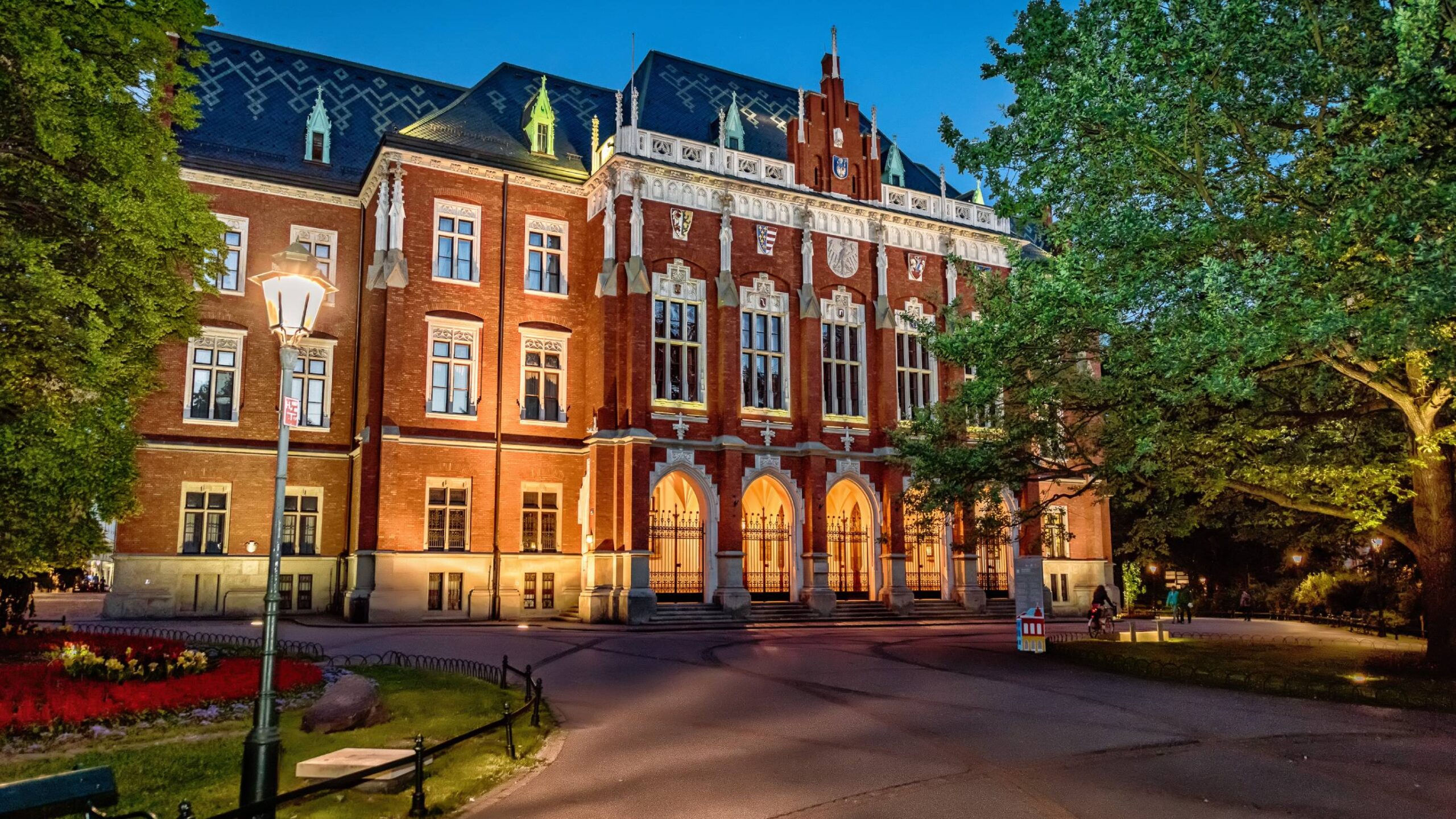
    Back in 2021, students at the oldest university in Poland had put together a programme of activity for the campaign that included a lecture on the criminological aspects of the murders of women from a lecturer in the Department of Criminology.

    But days before she was due to give the talk, the Forensic Psychology Section of the Scientific Association of Psychology Students at Jagiellonian University in Krakow (one of the co-organisers alongside the LGBTQ+ society and the SU) announced that the lecture had been cancelled:

    When inviting Dr. Magdalena Grzyb to give a lecture, we were not aware of the views she represents. We would also like to point out that we absolutely do not agree with the opinions she expresses, and we do not consent to any manifestations of transphobia in the university space.

    The previous year, Grzyb had penned a piece in Kultura Liberalna – a weekly Polish magazine focusing on liberal values, intellectual debate, and cultural analysis – critiquing the acceptance of non-binary and queer identities in liberal and progressive circles, suggesting that prioritising individual self-identification over systemic efforts to deconstruct stereotypes and achieve real gender equality was a problem:

    Does every man, even a serial rapist or a domestic torturer, if he says he feels like a woman, have the right to demand to be placed in a cell with women, often victims of such men? (…) A woman who repairs a dishwasher at home is also non-binary. Heck, a woman who earns more than her husband is also non-binary. A man who irons his clothes and washes the floor with a mop is also non-binary. (…) Do they deserve special treatment and a place in a cell with women because of this?

    A few days later Jerzy Pisuliński, Dean of the Faculty of Law and Administration at Jagiellonian, issued a statement making clear that the lecture would take place after all, on the basis that the university should be a place for “debate on important social problems” and that it “cannot avoid controversial topics”.

    Setting an example

    That was an announcement welcomed by HE minister Przemysław Czarnek, whose conservative and nationalist Law and Justice Party (Prawo i Sprawiedliwość, PiS) had only months previously, egged on by the Ordo Iuris Institute for Legal Culture, proposed an amendment to the Law on Higher Education that sought to tackle wokery and cancel culture:

    I welcome with satisfaction the decision of the Rector of the Jagiellonian University to restore the lecture of Ms. Dr. Magdalena Grzyb. The Jagiellonian University is setting an example.

    A year previous a sociology lecturer at the University of Silesia in Katowice resigned in protest after students accused her of promoting intolerant anti-choice and homophobic views in her classes. The university’s disciplinary official found evidence of intolerance – prompting Czarnek’s predecessor Jarosław Gowin to condemn what he termed “ideological censorship”:

    The Bill will be intended to help the university community and the rector to ensure that these freedoms are not violated, that the university is a temple of freedom of speech, freedom of exchange of views and discussion.

    When it eventually appeared a few months later, it proposed to guarantee academic teachers’ freedoms in teaching, speech, research, and publication; protect the expression of religious, philosophical, or worldview beliefs, ensuring they would not constitute disciplinary offenses; and oblige university rectors to uphold respect for these freedoms, all aimed at guaranteeing an environment of “ideological pluralism” within academic institutions.

    Campaign groups weren’t happy – arguing that student organisations should be able to invite or not invite lecturers to their events:

    …that is their sacred right, just as it is not a restriction of freedom of speech that I or any other person was not invited. Other people may not like it and may criticise this decision.

    Just as in the UK, some argued that the reforms could undermine the independence of academic institutions – allowing government influence over academic discourse and research priorities, and discouraging open discussion and critical analysis on topics that might conflict with the government’s conservative stance.

    Others puzzled over the practical differences between not refusing a speaker and forcing a voluntary student group to go ahead with one even if it didn’t want to – the sort of detail lost in the noise in cases like this.

    But back at Jagiellonian, there was the thorny issue of Ernest Figiel to resolve.

    Enemies of the people

    Figiel, a trans activist student at Jagiellonian had accused Grzyb of being a Trans-Exclusionary Radical Feminist, and in the process had called for TERFs to be “thrown into a sack and into a lake”, disposed of “in lime pits” and had praised Stalin’s methods of dealing with “enemies of the people” – which he thought should apply to Grzyb and her ilk.

    And as disciplinary proceedings against Figiel ensued and a counter campaign kicked off, it was down to Beata Kowalska, who in 2020 became the university’s first Advocate [Ombusperson] for Academic Rights and Values, to chart a way through:

    It does not matter who the hate speech comes from. Allegations of hate speech are carefully investigated in the case of any member of the university community. As is well known, hate speech can have disastrous consequences when used publicly, sometimes contrary to the original intentions of the sender… Figiel publicly used polemical statements of a dehumanizing nature against his opponents, using extermination and genocidal metaphors…

    Such statements are unacceptable in the academic community. Trivializing the extermination or using in an allegedly humorous way images of genocide, which Mr. Figiel publicly wished for his opponents, constitute a flagrant transgression of the boundaries of freedom of speech.

    The full statement is excellent – carefully integrating concerns that discrimination against non-heteronormative people had intensified with the need to uphold freedom of speech as a “pillar of democratic debate”. And while that was not a universally popular intervention, it pretty much doused the flames and helped the university community move on. The question is how and why.

    What goes on tour

    Jagiellonian in Krakow and Silesia in Katowice were two of the universities we visited on this year’s Wonkhe SUs January bus tour of students’ unions – which took in the Visegrad countries of Hungary, Slovakia, Czechia and Poland.

    Over the past few years, we’ve been assembling groups of SU officers (and the staff that support them) to meet with students’ unions, guilds, associations across countries in Europe – and we’ve seen any number of fascinating projects, initiatives, buildings, services and schemes that students deliver in the student interest.

    But on the long (and often winding) roads between university towns and cities across Europe, we’ve also been trying to work out what it is that underpins all of the impressive stuff that we’ve seen.

    Much like the other three countries’ systems, Polish higher education’s governance is effectively a communitarian power-sharing arrangement that “combines the preferences of policymakers towards the market model” with the legacy of the “institutionalized, deeply-entrenched, and change-resistant academic self-governance model” that was reintroduced in 1990 after communist rule.

    The Law on Higher Education has an extensive section on student rights – setting out a positive role for students’ unions to deliver training on those rights to students, as well as recognising their role in giving voice to student concerns, and organising activities aimed at the social integration and cultural development of students.

    Built almost entirely on pyramids of faculty-based student involvement that start with summer student integration camps and talks for new students on rights and obligations, we met any number of impressive, unpaid student leaders who were keen to support other students because they themselves had experienced being supported by others.

    The law also provides for state universities to be partially democratically run both at faculty and institutional level – with students given at least 20 per cent of seats and veto power over key decisions like who gets to be Dean or Rector, and what goes into study programmes.

    At Silesia, the SU President – who started his talk with a slide quoting from the law – concluded by turning to the Vice-Rector for Student Affairs to say that “we often argue, but we couldn’t wish for anyone better for the job”. That’s partly because to get elected, she had to command the confidence of those electing her. And it’s partly because him and his colleagues obviously thought they had real power in the process.

    He, like all the other SUs we had met in Poland, had mentioned the Ombudsperson at the university as a key figure that students had the right to access – and as we burned through SIM data between visits, we set about trying to understand why.

    Law 2.0

    In 2018, ruling party PiS had enacted a new Law on Higher Education and Science, commonly known as Law 2.0, to modernize higher education. University councils (as opposed to Senates) were given external stakeholders, funding mechanisms were modernised to promote research excellence, universities were given more flexibility in financial management, and toughened duties were placed on universities to uphold ethical standards, including those related to freedom of speech and debate.

    A handful of academic ombudspeople were already in place at the University of Warsaw, the Nicolaus Copernicus University in Toruń, the Catholic University in Lublin and the Medical University of Warsaw – but Law 2.0 gave a group of universities the opportunity to integrate democratic governance and student rights and obligations into an optional model charter for universities, Section V of which provided for the appointment of an ombudsman for academic rights and values.

    Jagiellonian’s students and staff were among those who’d spotted a need to be seen to be both integrating and providing leadership on EDI and freedom of speech – and the job spec for their first ombuds oozes a need to command confidence.

    They have to be an academic teacher who has been employed at the university for at least ten years and holds a professor or university professor position. They can’t hold any managerial or governing roles and should be widely respected within the university community, demonstrating strong social sensitivity.

    Candidates can be nominated by various groups, including the Senate, university employees, both the UG and doctoral SUs, and the trade unions. Their job is to monitor and address violations of academic rights and values, provide support to affected parties, mediate disputes, and collaborate with university entities to create a respectful academic environment.

    They investigate reported violations, recommend corrective measures to university bodies, and advocate for affected individuals during proceedings. They also have the authority to advise on initiating disciplinary or mediation processes and can request information or documentation from university bodies as needed. And every year, they submit a comprehensive report to the Senate detailing their activities and cases handled – which is subsequently made publicly available.

    No to parameterization

    This interview with the inaugural postholder Beata Kowalska – a feminist sociologist involved in the Scholars at Risk Network – is inspiring:

    A university is not a place where we collect points and are subjected to parameterization, but rather a community of people who work together. They do not work only individually to build their own careers, the mission of the university is much broader.

    Universities are spaces where academic freedom and equality should flourish. This means identifying solutions, sharing good practices, and creating tools that will support these goals. I plan to hold discussions on topics like climate change and academic integrity. Recently, we even used sociological “teams” during the pandemic lockdown to address social isolation among students.

    One challenge is bridging the gap between academic life and society. Universities must be critical spaces where ideas are debated freely and without fear of discrimination or exclusion. This applies not only to faculty and students but to the broader society they serve.

    In year one, Kowalska’s office handled 236 cases involving staff, students, and doctoral candidates, addressing issues like academic ethics, workplace conditions, and conflict resolution, as well as the promotion of academic values, mediation efforts, and educational programmes to support a culture of respect and dialogue within the university.

    And since then her office and team of mediators have gone on to tackle violations of students’ rights by academics, wider academic values, workplace conditions, unwanted behaviours and harassment, complaints about study organisation, anti-discrimination training and cultural events – as well as collaborating internationally.

    Somehow we know more about how the University of Jagiellonian has been handling disputes between students, staff and the university by using Google Translate on a couple of PDFs than pretty much any university in the UK with their bulletproof PR processes and bland press statements when a row ensues.

    And so successful have the institutional ombudspeople been at commanding confidence that PiS backed off on further reforms – and now, along with announcements on encouraging mergers (federalisation first), financial aid for doctoral students, a plan to build more places in dorms and scholarships for students engaged in running activities for others, last September the new government announced that it would strengthen the powers of student and doctoral student ombuds.

    In December HE minister Dariusz Wieczorek ended up embroiled in some kind of whistleblowing scandal, but you get a real sense that the Donald Tusk-led coalition has students’ concerns at heart:

    According to the Central Statistical Office, there are over a million students in Poland. I really want each of you to have the best possible conditions for learning and pursuing your passions, so that your studies are a chance for you to deepen your knowledge, acquire new skills, but also a time for making friends and comprehensive development. That is why at the Ministry of Science and Higher Education we consistently introduce solutions that will ensure high quality of education at Polish universities, we transfer funds for investments related to the teaching activities of universities, and we also co-finance the construction and modernization of dormitories.

    In addition, a student culture support program will be launched in the first quarter of 2025, aimed at clubs, teams and organizations operating in higher education institutions. I am convinced that it will allow for the activation and integration of the environment, and above all, it will contribute to the development of student culture in Poland.

    Commanding confidence

    As ever on our study tours, back on the bus we tended to conclude that there’s lots to be proud of in the UK – in particular, for all of the issues that present, we figure that our sector’s work on mental health and the progress being made on harassment and sexual misconduct and access and participation really is streets ahead of many other countries’ efforts.

    But when it comes to treating students as real stakeholders, it’s not the size of the SU’s block grant that matters – and when it comes to the tensions between academic freedom and EDI, the pausing of the implementation of the Higher Education (Freedom of Speech) Act is less a defeat or victory, and more a reflection of the “jury’s out” position that pretty much everyone has on the sector’s ability to reconcile the tensions in a way that will command real confidence.

    Democracy in universities – real democracy, not events where you can scrawl ideas that consultants ignore on sheets of flipchart paper – is in pretty short supply in a UK sector that has largely abolished it in universities and only really turns to it for a popularity contest for leaders in March in SUs. And universities back home are never wrong – at least not in public.

    If nothing else, what we saw in various forms across the Visegrad group this year was real democracy in action – imperfect, messy, bureaucratic and uncomfortably open, but powerfully symbolic of the sort of society that universities hope their graduates will want to build in the future.

    Back on the academic freedom and freedom of speech issue, the truth is that there have always been and always will be tensions and conflicts – between freedom from harm and freedom to speak, between supporters of Israel and Palestine, between protecting the university and protecting students, between the young keen to be on the right side of history and an older generation defensive of it, and between the role that universities play both critiquing society and being a part of it. Conflicts require resolution.

    Having the confidence to take the national widespread credibility of the OIA and establish local versions of it like that exemplified by Beata Kowalska at Jagiellonian – commanding the confidence of students, staff, management, politicians and the wider public by being somewhere independent where folk can raise and resolve disputes – wouldn’t be a defeat for the UK sector, and nor would it represent a risk.

    It would be a reflection of what higher education in the UK often says it is – an open, reflective, capable and self-critical community of students and staff – but all too often is too defensive and too proud to trust its own people to make it a reality.

    Source link

  • Univ. of Arizona Global Campus faculty respond to professor

    Univ. of Arizona Global Campus faculty respond to professor

    In a recent article, “Dear Prospective UAGC Students: Stay Away,” a professor from the University of Arizona discourages students from attending the University of Arizona Global Campus (UAGC). Unfortunately, this article was based on the author’s perspective rather than on facts and thus lacked the academic rigor of factual data from credible sources. This opinion piece was a collection of baseless assumptions, completely overlooking the true mission of UAGC, its faculty, and the diverse students we proudly serve. Frankly, the article has no merit.

    There is power in knowledge and truth. As such, the article could have accurately depicted the realities of UAGC instead of relying on inaccurate critiques about educational quality, enrollment numbers, adjunct faculty, and alleged student dissatisfaction. To set the record straight, UAGC is committed to providing online higher education for non-traditional students, including working adults, military personnel, parents, and underserved communities. Our students juggle countless responsibilities, and UAGC offers the flexibility and support they need. UAGC is vital in making higher education accessible to those who need it most, breaking barriers that traditional institutions often ignore.

    Furthermore, UAGC is unwavering in its commitment to supporting students, staff, and faculty, ensuring consistent educational quality and professional growth. As we continue to evolve, we focus on transparent evolution and collaboration, learning from past oversights to create an environment where our students can improve employment opportunities. Our pursuit of high-quality education is not a destination but an ongoing journey to which UAGC is deeply committed. Like any reputable university, we conduct regular course and program reviews, embrace continuous improvement, and acknowledge areas for development as a perpetual process. This commitment to educational quality is a cornerstone of our institution, ensuring our students receive the best education possible and can be confident in our dedication to their success. 

    The UAGC faculty, the backbone of our institution, is growing increasingly weary of misleading and disparaging remarks against the university and the faculty. It is time to move forward constructively and collegially. In the name of higher education, we implore you to stop defaming our university, staff, faculty, and students. To that end, we welcome meeting and educating any skeptical faculty or staff on our university’s mission and approach to serving non-traditional adult learners. Above all, we’re eager to clear any misconceptions by providing accurate data, helping to ensure that your words align more closely with the truth moving forward.

    As we look to the future (Dr. Cabrera), the late President Franklin D. Roosevelt, who signed the unprecedented G.I. Bill into legislation, stated, “A smooth sea never made a skilled sailor” (Roosevelt, n.d.).”


    Yvonne M Lozano, Ph.D. UAGC Faculty Council Co-Chair
    Teresa Handy, Ph.D. UAGC Faculty Council Representative
    Deanna Lauer, UAGC Associate Faculty Council Representative
    Carl Marquez, UAGC Faculty Council Representative
    Cara Metz, Ph.D. UAGC Faculty Council Co-Chair
    Darla Branda, Ph.D. UAGC Program Chair

    Source link

  • Kansas State University’s Braggin’ Wagon Offers a Unique Way to Recognize Campus Employees – CUPA-HR

    Kansas State University’s Braggin’ Wagon Offers a Unique Way to Recognize Campus Employees – CUPA-HR

    by CUPA-HR | October 19, 2022

    Think about a time you were recognized by a colleague for a job well done. Whether it was a grand gesture or a small act of recognition, chances are the personal shoutout put some pep in your step. Positive recognition in any form is a sure mood booster and helps move campus well-being in the right direction.

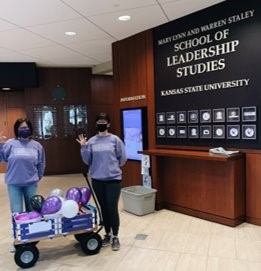
    In a recent CUPA-HR webinar, Refuel, Invest and Inspire Campus Well-Being, presenters from Kansas State University (K-State) shared a unique way of recognizing teams and departments on campus: the Braggin’ Wagon.

    The Braggin’ Wagon was developed by K-State’s Staley School of Leadership, which has a strong partnership with HR. The decorative travelling wagon is filled with treats, candy, small toys and other fun items for the receiving team to enjoy. Once the wagon is delivered to a department, it is up to that department to restock the wagon and deliver it to another department in order to keep the recognition going.

    This simple yet powerful way of recognizing campus employees serves a double purpose — it adds an element of fun to the work day for the team being recognized (who doesn’t love getting a surprise treat in the middle of a work day?), and it also gives the team passing on the wagon an opportunity to get out of the office for some exercise and take a mental break in the work day.

    When K-State resumed in-person work, it was important to put the emphasis on our employees and the solid work they were doing to make a difference. The Braggin’ Wagon was a way for departments to recognize other university partners who contributed to their work in a positive way,” says Shanna Legleiter, associate vice president of human capital services at K-State.

    With the Braggin’ Wagon as inspiration, what are some other creative ways HR can shine a spotlight on employees who work hard to keep campus operations running smoothly? Are there campus partnerships that can be formed to bring ideas for recognition to life? Don’t be afraid to think outside of the box when it comes to recognition opportunities!


    Source link