In South Korea, education has long been the most powerful route to social mobility and prestige, but a recent study shows how that pursuit is changing. Published in the Asia Pacific Education Review (2025), one of the newest article in transnational education (TNE) research investigates why Korean students are now choosing to study at US branch campuses located inside their own country rather than traveling abroad. Focusing on N University, a US-affiliated institution within the Incheon Global Campus, the study explores how students balance ambition, constraint, and identity in one of the world’s most competitive education systems.
Korea’s higher education landscape is characterised by rigid hierarchies in which the name of a university often outweighs individual academic or professional ability. Admission to elite institutions such as Seoul National, Korea, and Yonsei University is still viewed as a ticket to success. At the same time, US degrees continue to hold exceptional symbolic power, representing international competence, social status, and career advantage. Yet, for many families, studying abroad is prohibitively expensive, while competition for domestic university places remains intense. The result is that a growing number of students are enrolling in American branch campuses at home, institutions that promise the prestige of a US education without the cost and distance of overseas study.
To explain this trend, the researchers propose a Trilateral Push–Pull Model. Traditional models of student mobility describe decision-making as a process between two countries or schools: one that pushes students out and another that pulls them in. However, international branch campuses (IBCs) add a third dimension. Korean universities push students away through limited access and rigid hierarchies. US universities attract them with prestige and global capital but are often out of reach financially and logistically. The IBC exists between these poles, offering an American degree and English-language instruction within Korea’s borders. This framework captures how students navigate overlapping pressures from domestic and global systems.
Drawing on interviews with 21 Korean students, the study reveals several interconnected findings. Many participants viewed the IBC as a second choice, not their first preference but a realistic and strategic option when other routes were blocked. They were attracted by the prestige of American degree, USstyle curriculum (in English), smaller classes, and opportunities for studying at the home campus abroad. At the same time, they expressed anxiety about the ambiguous status of their institution. Several students described N University as “in between”, uncertain whether it was truly American or fully Korean. This ambiguity, they said, made it difficult to explain their school to relatives, peers, or teachers, who were unfamiliar with the branch campus model. In a culture where school reputation carries great weight, such uncertainty caused unease even when students were satisfied with their learning experience.
The study also underscores the continuing role of family influence and educational aspiration. Many students reported growing up in households where parents believed education was the only reliable path to success and were willing to make sacrifices for English proficiency and global exposure. For these families, IBCs offered a middle ground: a way to obtain a foreign education without leaving home or paying international tuition. Students who attended Korean secondary schools typically saw the IBC as an alternative after failing to gain admission to top domestic universities. Those with international or bilingual school backgrounds viewed it as a substitute for studying abroad, particularly after the COVID-19 pandemic made overseas education less appealing or feasible.
In both groups, the IBC served as a strategic compromise. It allowed students to maintain a sense of global ambition while avoiding the financial, emotional, and logistical risks of full international mobility. It also provided a form of what sociologist Jongyoung Kim calls global cultural capital: the symbolic value and recognition that come with foreign credentials. By earning an American degree at home, students could claim global status without physically migrating. This pattern illustrates how globalisation in higher education is increasingly taking place within national borders.
Beyond individual motivations, the study connects these choices to larger demographic and policy challenges. Korea’s declining college-age population and government-imposed tuition freezes have created fierce competition among universities for a shrinking pool of students. In this environment, IBCs serve dual roles: they act as pressure valves that absorb unmet domestic demand and as prestige bridges that connect local students to the symbolic power of American education. However, their long-term sustainability remains uncertain. Many IBCs struggle with limited public visibility, uneven recognition, and questions about academic legitimacy. Unless they establish a clearer institutional identity and stronger integration within the local higher education system, they risk being viewed as peripheral rather than prestigious.
The research also broadens theoretical understanding of international education. By incorporating the IBC as a third actor in the push–pull framework, the study challenges the assumption that global learning always requires cross-border mobility. It also refines the concept of global cultural capital, showing that students can now accumulate globally valued credentials and symbolic advantage through domestic avenues. In countries like South Korea, where education is deeply tied to social status, this shift represents an important transformation. The global and the local are no longer opposites but increasingly intertwined within the same institutional spaces.
In conclusion, Korean students’ choices to enroll in US branch campuses reveal a strategic negotiation between aspiration and limitation. These institutions appeal not to those lacking ambition but to those who seek to reconcile global goals with financial and social realities. They reflect a world in which higher education is simultaneously global and local, mobile and immobile. For IBCs to thrive, they must move beyond copying Western models and instead cultivate programs that are meaningful in their local contexts while maintaining international quality.
California State University, Fresno, celebrated the launch of a new program this fall called Finish in Five, which allows students to earn both a bachelor’s and master’s degree within five years. University leaders were eager to offer students at the Central Valley campus—which serves large populations of first-generation and low-income students, many the children of local farmworkers—a streamlined pathway to high-demand STEM fields in an economically distressed region.
But less than a month later, the program’s funding, which came from a Hispanic-serving institution grant, abruptly ended. The Education Department stopped awarding grants for HSIs and many other minority-serving institutions last month, claiming the federal programs amounted to “discrimination.” Officials argued the programs are “unconstitutional” because they require institutions to enroll certain percentages of students from specific racial or ethnic backgrounds, among other criteria.
Saúl Jiménez-Sandoval, president of Fresno State, said he doesn’t know what’s going to happen to the Finish in Five program now that the money is gone. In the past, the campus relied on about $5 million annually in HSI funding, which fueled a wide range of student supports and programs. The university was also expecting to receive $250,000 this fiscal year as an Asian American and Native American Pacific Islander–serving institution.
“In the grander scheme of things, most of the innovative programs that we have at Fresno State that further student success and graduation rates started with an HSI grant or with an MSI grant,” Jiménez-Sandoval said.
Similar stories are playing out across the California State University system. Hispanic students account for almost half of the system’s more than 450,000 students. Out of the CSU’s 22 campuses, 21 are Hispanic-serving institutions, meaning they enroll at least 25 percent Hispanic students and at least half low-income students. In addition, 11 are AANAPISIs, which have the same low-income student threshold and enroll at least 10 percent Asian and Pacific Islander students. CSU officials estimate ED’s axing of the grant programs leaves the system $43 million short on funds it expected for the 2025–26 fiscal year.
CSU chancellor Mildred García called the move “deeply troubling.”
“This action will have an immediate impact and irreparable harm to our entire community,” García said in a statement. “Without this funding, students will lose the critical support they need to succeed in the classroom, complete their degrees on time, and achieve social mobility for themselves and their families.”
Potential for ‘Great Devastation’
The sudden loss of funding caught system and campus leaders off guard.
Jeff Cullen, CSU’s assistant vice chancellor for federal relations, said he knew the HSI program was at risk when the state of Tennessee and the advocacy group Students for Fair Admissions sued the Education Department in June over such programs, questioning their constitutionality. But he expected the case to wind its way through the courts. He said ED’s swift decision to end the grant programs robbed campuses of time to prepare or fight on MSIs’ behalf. Cullen also pointed out that CSU campuses qualify as HSIs because of the demographics of their surrounding communities—not because they rely on affirmative action in admissions, one of the issues raised in the lawsuit; California banned affirmative action in 1996.
“Canceling grants midcycle and right in the middle of the semester creates unprecedented confusion and chaos,” Cullen said. “Our central goal is student success and getting students across the stage with a degree in hand. And this just continually undermines those efforts to do that.”
Meanwhile, CSU has no way to make up for the full extent of the funding losses, said Dilcie Perez, the system’s deputy vice chancellor of academic and student affairs. She called the abrupt end of MSI grants a “triple blow” at a time when the system’s campuses are already facing a $144 million cut in state support. The system also has only $760 million in reserves, a meager emergency fund compared to the endowments of wealthier institutions. She expects campus leaders will have to make painful choices, including cutting faculty and staff positions, to make the numbers work.
“I think the reality is we don’t know the magnitude yet,” Perez said, “but what we know is … we have folks who have lost positions, we have students who have lost support services, and that is not OK. What I know to be true is that no one campus can completely replace any of the funding that they lost.”
Jiménez-Sandoval, of Fresno State, said because of state-level cuts, he’s had to scrape together funds for “the basics,” leaving the university to rely on HSI funding to afford efforts to boost retention and graduation rates. More than 60 percent of Fresno State’s students are Latino, and about 65 percent qualify for Pell Grants and are the first in their families to attend college; many of them “need an extra little push in order to support them through their college career,” he said.
Despite some success with fundraising, he doesn’t believe philanthropy will ever make up for the missing funds.
The HSI program “is systemic and comprehensive in its support, and likewise, it is systemic and comprehensive in the tragic hit that we are taking right now,” he said.
Ronald S. Rochon, president of California State University, Fullerton, said he’s reaching out to alumni, donors and industry leaders in the hopes of keeping programs previously supported by HSI funding alive.
The end of HSI grants cost the campus at least $4.2 million, he said, endangering a range of student services. For example, money evaporated for the university’s Establishing Roots to Grow STEMs program, which offers peer mentoring and other supports to math and science majors, as well as the Fullerton ASPIRE program, which aims to improve graduation and retention rates for underserved students, including first-generation and community college transfer students.
Rochon plans to “fight hard” to preserve such programs. He emphasized that the university’s student success goals aren’t going to change, despite the losses. But he also pleaded with policymakers to “reconsider.”
While 54 percent of CSUF’s more than 45,000 students are Hispanic, “this is not just impacting students who identify as Hispanic,” Rochon stressed. “This impacts our entire campus community.” Some of these losses risk bringing “great devastation to our student body.”
Perez worries that the full effects of the funding losses on CSU students won’t be clear for years. She expects the sudden end of MSI funding will get in the way of the system’s long-term goals for students, including increasing graduation rates.
“More likely than not, there will be students who are not able to hit the finish line in the same time frame as they would have with this support and with this funding,” Perez said. CSU leaders are scrambling to figure out “how do we mitigate that as much as possible, because we’re not OK with students not crossing the finish line.”
At first, the question seemed simple: “Why do we go to school?”
I had asked it many times before, in many different districts. I’m a planner and designer specializing in K-12 school projects, and as part of a community-driven design process, we invite students to dream with us and help shape the spaces where they’ll learn, grow, and make sense of the world.
In February of 2023, I was leading a visioning workshop with a group of middle schoolers in Southern California. Their energy was vibrant, their curiosity sharp. We began with a simple activity: Students answered a series of prompts, each one building on the last.
“We go to school because …”
“We need to learn because …”
“We want to be successful because …”
As the conversation deepened, so did their responses. One student wrote, “We want to get further in life.” Another added, “We need to help our families.” And then came the line that stopped me in my tracks: “We go to school because we want future generations to look up to us.”
I’ve worked with a lot of middle schoolers. They’re funny, unfiltered, and often far more insightful than adults give them credit for. But this answer felt different. It wasn’t about homework, or college, or even a dream job. It was about legacy. At that moment, I realized I wasn’t just asking kids to talk about school. I was asking them to articulate their hopes for the world and their role in shaping it.
As a designer, I came prepared to talk about flexible furniture, natural light, and outdoor learning spaces. The students approached the conversation through the lens of purpose, identity, and intergenerational impact. They reminded me that school isn’t just a place to pass through — it’s a place to imagine who you might become and how you might leave the world better than you found it.
I’ve now led dozens of school visioning sessions, no two being alike. In most cases, adults are the ones at the table: district leaders, architects, engineers, and community members. Their perspectives are important, of course. But when we exclude students from shaping the environments they spend most days in, we send an implicit message that this place is not really theirs to shape.
However, when we do invite them in, the difference is immediate. Students are not only willing participants, they’re often the most honest and imaginative contributors in the room. They see past the buzzwords like 21st-century learning, flexible furniture, student-centered design, and collaborative zones, and talk about what actually matters: where they feel safe, where they feel seen, where they can be themselves.
During that workshop when the student spoke about legacy, other young participants asked for more flexible learning spaces, places to move around and collaborate, better food, outdoor classrooms, and quiet areas for mental health breaks. One asked for sign language classes to better communicate with her hard-of-hearing best friend. Another asked for furniture that can move from inside to outside. These aren’t requests that tend to show up on state-issued planning checklists, which are more likely to focus on square footage, capacity, and code compliance, but they reflect an extraordinary level of thought about access, well-being, and inclusion.
The lesson: When we take students seriously, we get more than better design. We get better schools.
There’s a popular saying in architecture: Form follows function. But in school design, I’d argue that form should follow voice. If we want to build learning environments that support joy, connection, and growth, we need to start by asking students what those things look and feel like to them — and then believe them.
Listening isn’t a checkbox. It’s a practice. And it has to start early, not once construction drawings are finalized, but when goals and priorities are still being devised. That’s when student input can shift the direction of a plan, not just decorate it.
It’s also not just about asking the right questions, but being open to answers we didn’t expect. When a student says, “Why do the adults always get the rooms with windows?” — as one did in another workshop I led — that’s not a complaint. That’s a lesson in power dynamics, spatial equity, and the unspoken messages our buildings send.
Since that day, about a year and a half ago, when I heard, “We want future generations to look up to us,” I’ve carried that line with me into every planning session. It’s a reminder that students aren’t just users of school space. They’re stewards of something bigger than themselves.
So if you’re a school leader, a planner, a teacher, or a policymaker, invite students in early. Make space for their voices, not just as a formality but as a source of wisdom. Ask questions that go beyond what color the walls should be. And don’t be surprised when the answers you get are deeper than you imagined. Be willing to let their vision shift yours.
Because when we design with students, not just for them, we create schools that don’t just house learning. We create schools that help define what learning is for. And if we do it right, maybe one day, future generations will look up to today’s students not just because of what they learned, but because of the spaces they helped shape.
Chalkbeat is a nonprofit news site covering educational change in public schools.
For more news on district and school management, visit eSN’s Educational Leadership hub.
Enrico Giori, Chalkbeat
Enrico Giori is a California-based planner and designer at Architecture for Education, or A4E, specializing in K-12 educational facilities. He focuses on agency-driven school design that promotes equitable and future-thinking learning environments.
Latest posts by eSchool Media Contributors (see all)
Across higher ed, the financial squeeze is tightening. Between shrinking enrollment and uncertain funding, colleges and universities are scrambling to deliver value with far less cash. Every purchase, from lab beakers to toner cartridges, now faces intense scrutiny. After all, one way to uncover excess spending is to identify blind spots and inefficiencies in how organizations buy.
That drive for savings puts procurement teams squarely in the hot seat. Seven in ten procurement leaders rank cost management as their most critical capability today and for the years ahead, according to Economist Impact. Yet decentralized purchasing, patchwork systems, and limited spend visibility continue to drain institutional resources.
Savvy institutions are flipping that script, moving from reactive penny-pinching to proactive value creation by consolidating spend, leveraging supplier partnerships, and centralizing purchasing oversight.
From reactive buying to proactive value creation
Financial uncertainty now dominates the higher ed landscape. To navigate it successfully, universities must shift from tactical price checks to total-value management, leveraging lessons from other industries that have successfully implemented AI-powered automations to boost efficiencies and cut costs, University Business reports. It’s the difference between playing defense and offense—both matter, but one drives wins.
This strategic transformation requires three foundational moves: gaining real-time visibility into campuswide spending patterns, establishing centralized oversight without bureaucratic friction, and building supplier relationships that deliver value beyond the initial purchase price.
“Reducing spend is important, but increasing value matters more,” shares Rosie Grigsby, senior sales manager for higher education at Amazon Business. “When you’re looking at things only from a price perspective, you’re missing out on other value aspects like quality, lifecycle, support, training, and more,” she explains. “When thinking about total value, I’m thinking about how a supplier is enhancing student experiences while giving university employees time back through efficiencies.”
To make that possible, procurement leaders would be wise to prioritize the visibility problem: You can’t optimize what you can’t see. Gaining visibility into campuswide spending starts with breaking down the silos that keep procurement teams in the dark.
Visibility and control: Centralizing spend without adding bureaucracy
Imagine navigating unfamiliar terrain with a GPS that only shows you one street at a time. When departments buy in silos, institutions lose their ability to see the bigger picture, eroding spend leverage, killing negotiating power, and complicating compliance. Each isolated purchase decision chips away at potential savings and strategic control.
Consider the cascading impact: With fragmented purchasing, universities could be paying different prices for the same product across departments, missing significant volume discounts, and discovering duplicate software licenses only during audits. Worse yet, audits could reveal policy violations that were invisible until it was too late.
Unsurprisingly, research by the IBM Center for the Business of Government shows that centralized procurement correlates with higher savings, efficiencies, and compliance. Even so, many procurement leaders struggle with organization-wide visibility.
The solution isn’t building a bureaucratic fortress around every purchase decision. Rather, modern procurement solutions maintain centralized control while giving end users the flexibility they need, eliminating the process bottlenecks that drive departments to work around procurement entirely.
Solutions could be lying dormant in tools you already own. “Universities often underutilize e-procurement systems and automations they already have licenses for,” Grigsby notes. “Electronic catalogs, automated approval workflows, single sign-ons (SSOs), analytics—tools like these cut time from sourcing to receiving while enhancing compliance and reducing errors.” What once took days of spreadsheet analysis can now happen automatically, freeing teams to focus on strategy, not data entry.
Building strategic supplier relationships
Too many institutions treat suppliers as vendors, not partners. Transactional supplier relationships are short-term and price-focused: you buy something, and you’re done. Strategic supplier relationships, on the other hand, are ongoing partnerships built on trust and alignment with the university’s mission.
“Without strong supplier relationships, you’re missing out on partners who help you anticipate needs, drive innovation, and uncover creative solutions,” Grigsby explains. “True partners embrace your university’s mission as their own and work to maintain or increase service levels through collaborative, strategic sourcing.”
These partnerships prove especially valuable during budget crunches, Grigsby adds, citing the ongoing collaboration between procurement teams and Amazon Business account executives as an example. “Our higher ed clients often leverage the know-how, experience, and ideas we’ve gleaned from working with their peers across the nation,” she explains. “Whether they’re pursuing sustainability goals or 100% automation in procurement, we help them identify ideal partners or find solutions that have worked well for other institutions facing similar challenges.”
Real results at Emory University
Emory University faced the classic procurement challenge: fragmented purchasing and spend visibility. By adopting a centralized purchasing approach through Amazon Business, procurement leaders reclaimed oversight, optimized workflows for users across the organization, and uncovered dramatic savings.
Guided buying and integrated search features brought the intuitive Amazon Business shopping experience right into Emory’s purchasing system. These integrations drove adherence to procurement policies while giving users flexibility to conduct price comparisons and complete purchases directly within Emory’s existing system. Plus, buyers enjoyed savings through Business Prime shipping and tax exemption on eligible purchases.
The payoff was significant, averaging thousands of dollars in savings each month. “Pretty hefty savings,” as one administrator put it.
Roadmap to resilience
As institutions rework purchasing strategies to boost value and savings, how can procurement teams position themselves as problem solvers instead of gatekeepers? Grigsby recommends three essential practices:
Proactive collaboration: Low collaboration with non-procurement buyers increases rogue buying risk, yet leaders currently rate collaboration as the least essential skill in procurement, according to Economist Impact. “When procurement reaches out to departments early to understand their pain points, especially in times of budget stress, they can engage, identify alternatives, and help internal customers reach their goals without being a blocker,” Grigsby advises.
Streamlined processes: Efficient procurement automates mundane tasks like recurring orders, approval workflows, and spend analysis while centralizing oversight. “Customers want to source, reconcile, and receive products easily so they can focus on mission-critical tasks,” Grigsby points out.
Broadcast successes: Procurement wins often go unnoticed despite their organizational impact. Share those wins—whether through newsletters, internal communications channels, or dashboards showing how much departments saved—to foster trust and collaboration.
Looking ahead, the financial pressures facing higher education make procurement transformation a necessity, not a luxury. Modern, cost-conscious procurement isn’t about saying no; it’s about finding better ways to say yes.
Leslie Ortega is pursuing her second bachelor’s degree in botany at a university in California. She earned her first degree in business administration back in December 2016. That was before U.S. President Donald Trump took office. The experience was much different then.
“Obama was president when I was in college from 2012-2016 and I remember how happy everyone was around me,” Ortega said. “There was an oblivious feel to it where we felt safe. Now being in school I notice that there is definitely more fear in classrooms.”
With Trump in office for a second term, Ortega said she sees a major shift. It is no longer easy to be blind to the realities of how so many lives are changing.
“Existing in a world where your neighbor or your favorite food vendor can be snatched off the street on the basis of their skin color and occupation is impossible to hide from,” she said. “This has always been happening even during Obama but we had rose colored glasses when he was in office.”
As someone who recently graduated two months ago with a bachelor of arts focused in ethnic studies, I have to agree with Ortega. I cannot ignore the current political state of the country, especially as students and universities remain potential targets of U.S. Immigration and Customs Enforcement (ICE) raids.
An attack on diverse perspectives
On top of that, conservatives are actively taking actions that threaten diversity, equity and Inclusion measures and certain subjects like critical race theory. My major, rooted in critical race theory, is deemed controversial by some because it teaches students to critically analyze information and question authority in a sense. Ethnic Studies courses are typically taught to engage people to uncover history from non-white perspectives, unveiling a legacy of imperialism and racism.
Actions that make it difficult to teach or learn these concepts are being enacted by people in power who seem to lack consideration for how marginalized communities will be affected.
At the California university I attended, two emails from the administration addressed the topic of immigration this past semester. The first was a letter from the interim president back in February 2025 which outlined guidance for university employees and students on how to interact with ICE officers if they ever showed up on campus.
It stated that since a large portion of the campus is open to the general public, it is therefore open to federal officers.
However, ICE agents could not enter areas not open to the public such as residence halls, confidential meeting rooms, employee offices or classrooms while the university was in session. This email also outlined resources students and staff could turn to such as the Coalition for Humane Immigrant Rights and a new center for “Dreamers” – undocumented people who had been brought into the United States as children. It also explained how to create an immigration preparedness plan.
A second email was sent out two months later, with quick guide cards and a link to an immigration resources page on the university website.
Will campus be an unsafe haven?
It is currently summer. How the university will actually respond if ICE were to show up on campus is really up in the air. It is one thing to voice concern and another to actually intervene in the face of injustice to protect targeted individuals.
While I will not return to campus this fall, I have no doubt that it will be students and staff of color who will ultimately serve as the first line of defense. Given how the university has responded in the past to student activist efforts, I would not be surprised if the campus administration did little should ICE arrive.
Across the country, university students have watched the detainment of student activists by ICE agents. Merely advocating against Israel’s ongoing genocide of the Palestinian people in Gaza, has been deemed a crime worthy of detention and deportation.
These detainees included Mohsen Mahdawi and Mahmoud Khalil from Columbia University and Rumeysa Ozturk from Tufts University. Khalil spent more than three months in detention before his release on 20 June.
The arrests of students simply for speaking out angers students like Ortega.
“It is infuriating to hear about student’s visas being revoked for their stance on supporting Palestine during a presidency that criminalizes opposition to the status quo,” Ortega said. “[This is] referring to anyone that critiques American ideology, the military complex or simply the American flag.”
Arrests in the City of Angels
Los Angeles has seen a surge of undocumented immigrants being arrested. According to the Los Angeles Times, nearly 2,800 people have been picked up by masked ICE agents on the streets, at job sites, Home Depot parking lots and even outside immigration court hearings since 6 June 2025.
Across the country these numbers could rise. In July, the U.S. Congress passed a national budget called the “Big Beautiful Bill” which will greatly increase the number of ICE agents and detention centers.
I view this bill as a way to cement discrimination against immigrants into the U.S. legal framework. We are already seeing the rapid construction and opening of detention centers such as Alligator Alcatraz in Florida – a tent city that can hold up to 3,000 people
According to public and internal data from the U.S. Customs and Border Protection agency, as collected by NBC News, more than 56,000 people were being held in ICE detention centers as of 1 Aug. 2025.
All this has created a state of fear. I spoke to someone who lives in California and currently holds a student visa holder. I’m not identifying the person because of fear that doing so will make them a target. The student recently earned a master’s degree in education and is currently in the admission process to a teaching credential program.
“There’s a culture here [in the U.S.] that when they hear that you don’t have a social security number, they stop helping you as if you were a pariah,” the person said. “I couldn’t work on campus, I lost a lot of opportunities because I didn’t have a social security number. Sometimes I could get stipends or fellowships but it was because of people who understand immigrants.”
Silencing of student activism
They now have a work visa and hope to get permanent residency, but given all the threats the current presidential administration has made to student visa holders, they wonder about their prospects.
“The silencing of the student activists is sending a message to everyone that if you dissent, if you protest, if you do not agree with what’s going on right now, then there will be consequences,” they said.
They said they used to be politically active, but no longer feel safe to do so here, or at least to the same degree.
“There’s an executive order that says that the first thing they’re going to look at about you is your social media, so you cannot even post about what you think, what you defend,” they said. “You cannot talk about the ongoing genocide anymore, because then, all the money that you have invested in changing your migratory status will be thrown to the trash. You give all your money, that’s dispossession without violence, you make this enormous sacrifice and then you don’t want to lose it, right, so you are forced, you are silenced.”
I am choosing to censor the person’s name for the sake of their own safety and wellbeing, I can’t help but wonder if doing so represents yet another way immigrants are silenced.
Fighting desensitization
All of this is to say that being a person of color and a student during this presidential administration has been exceptionally difficult. That’s particularly true for someone like Ortega, who attends school in a predominantly White area.
“It is emotionally and mentally draining to be focusing on your safety existing on a campus that doesn’t support you if you choose to wear a keffiyeh or a patch in opposition of a felon as a president,” Ortega said.
I recognize that as a person of color, I might not have the same advantages as someone who is White. As an American citizen though, I have some sense of protection in speaking up. But it is my Mexican and Guatemalan heritage that fuels my fight.
My existence is a result of immigration; I would not be where I am today if it were not for my family members who chose to come to the United States.
While it can be easy to become desensitized, especially with a new devastating headline every day, I urge others to hold onto some sense of hope by leaning into community resistance. Only by letting go of the belief that “this doesn’t personally affect me, so I don’t care” can we truly begin to dismantle systems of power.
Only seven months have passed since Trump returned to the presidential office. As he continues to carry out his seemingly racist agenda that targets anyone who is low-income, disabled, queer or non-White, university campuses that are supposed to be havens for learning and connecting with new ideas, are now filled with fear and suspense.
Questions to consider:
1. Why are increasing numbers of university students in the United States afraid to speak out?
2. Why do you think the author feels she doesn’t have the same protections as a U.S. citizen as someone who is White?
3. Do you think that people who want to study in another country should be able to do so?
The number of colleges and universities with written policies that do not seriously threaten student expression are on the rise this year, according to the Foundation for Individual Rights and Expression’s 19th annual “Spotlight on Speech Codes” report, published Tuesday.
Since 2006, FIRE has grouped hundreds of public and private higher education institutions into three overall categories based on their campus speech policies: green, yellow and red lights. This year, 73 of the 490 (14.9 percent) colleges and universities surveyed received a green light ranking—meaning their policies don’t threaten free expression—compared to 63 last year. It’s the highest share since 2012, when just 3.6 percent of institutions earned green-light ratings.
For the first time in 19 years, the number of green-light colleges outnumbered those in the red-light category (14.7 percent), reserved for institutions with policies that “clearly and substantially restrict free speech,” according to the report. Last year, 20 percent of institutions received a red-light rating.
Although political and institutional responses to campus protests related to the Israel-Hamas war reignited debate over free expression last year, the report attributed the decrease in red-light ratings to colleges and universities revising their policies related to harassment, hate speech and bias-reporting systems. Specifically, the report said that while bias-reporting systems have become popular over the past decade, they “have invited students to report protected speech simply because it offends them,” turned academic institutions into “referees of political and academic speech,” and created a “chilling effect on campus expression.”
Lawsuits, free speech advocacy—from students, alumni and groups like FIRE—and lawmaker scrutiny have all spurred changes in recent years.
“Over a dozen institutions have either substantially revised or eliminated entirely their bias reporting systems,” the report said. “Others have significantly reduced the prominence of their bias reporting teams, either by reducing the number of places on their website the team is mentioned or by requiring students enter their credentials to access the policy information.”
FIRE rated the majority of institutions—337, or 68.8 percent—as yellow, meaning they “maintain policies that impose vague regulations on expression.” And eight colleges—including Baylor University, Brigham Young University and Hillsdale College—received a warning rating for “clearly and consistently stat[ing] that they hold a certain set of values above a commitment to freedom of speech.”
Over all, private colleges have more restrictive policies than public colleges. Just 10.6 percent of public colleges earned red lights compared to 28 percent of private colleges—and only 7.1 percent of private colleges earned a green-light rating, compared to 17 percent of public ones.
As US universities confront declining domestic enrolments, political instability, and intensified scrutiny over their financial and ideological foundations, a growing number are once again looking outward. International branch campuses (IBCs), once celebrated as symbols of academic globalism and later scrutinized as costly misadventures, seem to be returning to the strategic conversation, not only as diversification mechanisms but also as protective pivots in an era of unpredictability.
Georgetown University’s decision to extend its Qatar campus for another decade and the Illinois Institute of Technology’s plan to launch a new campus in Mumbai are recent examples. Behind such moves lies a quiet but growing calculus: that global presence may serve as both brand amplifier and institutional hedge, especially in the face of resurging nationalism, culture wars, and regulatory constraints at home.
South Korea’s Incheon Global Campus (IGC), a government-backed transnational education hub, is now preparing to welcome two additional foreign universities and one of them is American. But as the IGC experiment has already entered its second decade, its mixed results offer not a template but a cautionary tale. For any U.S. institution considering overseas expansion, IGC reminds us that expectations of seamless demand, regional magnetism, and reputational uplift often collide with complex realities.
The pitfall of assuming “If you build it, they will come”
At the heart of many US institutions’ international ventures lies a persistent assumption: that placing an American university within geographic proximity to large student markets will organically generate demand. IGC was envisioned as a Northeast Asian education magnet, ideally situated to recruit from China, Vietnam, Indonesia, and beyond. The notion was that Korea’s infrastructure, safety, and proximity, combined with US academic credentials, would make IGC highly attractive.
But the numbers tell a different story. As of 2024, IGC’s five institutions, SUNY Korea (Home of Stony Brook University, Fashion Institute of Technology), George Mason University Korea (GMUK), University of Utah Asia Campus (UAC), Ghent University Global Campus (GUGC), enrol about 4,300 students, far short of the original 10,000 target. Among them, only 400 are international students, accounting for 9%. And of those, just around 20 are from China, the very country that was expected to be a key source of enrolments.
This dearth is not for lack of infrastructure or academic rigor. Rather, it illustrates the limitations of relying on passive geographic logic. In an age where students and parents are increasingly sophisticated consumers of education, recruitment requires far more than proximity or even prestige. It demands clarity of value, strong brand presence, affordability, cultural alignment, and a persuasive post-graduation pathway.
English-medium instruction as a double-edged sword
US institutions often assume that English-medium instruction (EMI) automatically confers competitive advantage in Asia. At IGC, all programs are delivered entirely in English, and faculty are predominantly international; 188 of the 304 faculty members across the five campuses are foreign nationals. On paper, this aligns with global academic norms and affirms a commitment to international standards.
However, EMI can paradoxically limit access. While affluent Korean students may see EMI as an elite advantage, students from Vietnam, China, and Indonesia often seek local cultural immersion, language acquisition, and regional relevance. For many Chinese students in particular, one of the draws of studying in Korea is precisely to learn Korean and gain access to Korean labour markets. EMI-only models thus alienate both local integration seekers and English-language learners.
Moreover, when EMI is not paired with robust academic support services, such as English-language tutoring, multilingual advising, or transitional curriculum tracks, it can undermine retention and student success. IGC’s high leave-of-absence rate (26% of total enrolment) may in part reflect this challenge. The EMI strategy, while noble in intent, must therefore be contextualised. In transnational campuses, language policy is not just a delivery decision, it is a recruitment strategy.
Misplaced confidence in institutional brand recognition
American universities often overestimate their brand power abroad. SUNY Korea, anchored by Stony Brook University, and GMUK both represent reputable public institutions in the US academic ecosystem. Yet in East Asia, brand equity does not always travel well. Many students and parents in China, Southeast Asia, and even Korea struggle to distinguish among US institutions unless they are among the globally top-ranked or highly visible.
In contrast, joint-venture universities such as NYU Shanghai or Duke Kunshan benefit from stronger recognition, thanks in part to the halo effect of globally prestigious parent institutions and active marketing within China. These institutions also benefit from location-based credibility; being within China, their offerings align more naturally with Chinese career and immigration aspirations.
Geopolitical frictions and the fragility of demand
US institutions frequently see international branch campuses as safe havens from domestic politics. Yet international expansion brings its own geopolitical risks. IGC’s failure to attract Chinese students cannot be separated from the lingering effects of the 2017 THAAD (Terminal High Altitude Area Defense) dispute – a regional conflict that emerged when South Korea agreed to deploy a US missile defense system on its soil. China strongly opposed it, viewing the system as a threat to its own strategic interests. In response, China imposed strong sanctions on South Korea, which led to the challenges in educational diplomacy between two countries. Nor can it be divorced from the broader geopolitics of US-China relations, which makes Chinese families wary of American degrees, especially those delivered from politically allied countries like Korea.
There is also the perception gap between a degree “from a U.S. university” and a degree “earned in Korea.” Even when academic standards and credentials are identical, students and employers may view transnational degrees as second-tier or less prestigious. For example, in Korea, IGC campuses are often viewed as a second choice in the stratified higher education structure locally. The reputational buffer that a US degree once offered is increasingly interrogated, especially in environments where political affiliations, social conditions, and post-graduation options matter more than branding. In this sense, branch campuses are not outside the storm; they are situated in a different part of it.
A US-oriented reality check within the local contexts
For US universities, the decision to open a branch campus abroad is no longer a question of academic vision alone; it is a financial and reputational calculation. The domestic context is sobering: declining birth rates are shrinking the college-aged population, public trust in higher education is waning, and federal support for research and student aid is increasingly politicised. Internationalisation is no longer just an opportunity; it is increasingly seen as a survival strategy.
But survival strategies must be strategic, not reactionary. IGC’s challenges illustrate what happens when institutions pursue global expansion without first understanding the local education marketplace. Without granular market research, locally embedded partnerships, and nuanced branding strategies, even well-intentioned ventures become “white elephants”, costly and underutilized. A forthcoming US institution entering IGC would have an opportunity to learn from these lessons and chart a different path. But it must begin with humility and cross-cultural understanding.
This concern is heightened by structural reforms driven by demographic decline and the growing uncertainly embedded in Korea’s higher education system. As competition for enrolment intensifies, some struggling institutions see IGC’s local recruitment as a threat, even calling it a “brain drain within Korean territory,” since most IGC students are Korean. While IGC claims it draws students who would have studied abroad, offering a net economic benefit, that argument may fall flat for universities fighting to stay afloat.
Conclusion: toward a more grounded globalism
The story of Incheon Global Campus is not one of failure, but rather a valuable case study. It reflects a potential disconnection between institutional ambition and market behaviour; between the idea of internationalisation and its on-the-ground execution. It reminds us of that proximity to students is not the same as access, and that transnational education requires more than exporting curricula across borders, it demands building relevance across cultures.
For US universities hoping to extend their reach, the time for romantic notions of global campuses has passed. What is needed now is realism. That means conducting rigorous market analysis. It means understanding the competitive landscape; not just in Seoul or Shanghai, but in second-tier cities where price sensitivity and post-graduation pathways determine enrolment decisions. It means creating flexible programs that can respond to local aspirations and global uncertainties. It means designing campuses that feel anchored, not transplanted.
The myth that a US branch campus in South Korea will become a magnet for students across Asia, particularly from China, has not materialised. With only a handful of Chinese students across IGC’s entire enrolment, it is clear that assumptions must be rethought. Transnational education remains a worthy goal. But if the next generation of branch campuses is to thrive, especially in East Asia, it must be forged not in the image of prestige, but in the crucible of strategy. It must be attentive, adaptive, and above all, aware.
Kyuseok Kim (KS) is the inaugural Center Director of IES Abroad Seoul, where he leads strategic, academic, and operational initiatives while building partnerships with local institutions. He brings extensive experience in student recruitment, international relations, and business development, with prior roles at UWAY, M Square Media, SUNY Korea, and Sungkyunkwan University. KS is a Fulbright Scholar and a doctoral candidate in Educational Administration and Higher Education at Korea University. He holds an MBA from Sungkyunkwan University and a BA in English Language Education from Korea University. As a scholar-practitioner, he contributes regularly to both international and South Korean publications on global education topics. [email protected]www.linkedin.com/in/ks-kim-intled
A Black History Month event, canceled. A lab working to fight hunger, shuttered. Student visas revoked, then reinstated, uncertain for how long. Opportunities for students pursuing science careers, fading.
The first six months of the Trump administration have brought a hailstorm of changes to the nation’s colleges and universities. While the president’s faceoffs with Harvard and Columbia have generated the most attention, students on campuses throughout the country are noticing the effects of the administration’s cuts to scientific and medical research, clampdown on any efforts promoting diversity equity and inclusion (DEI), newly aggressive policies for students with loan debt, revoking of visas for international students and more.
Many of the administration’s actions are being challenged in court, but they are influencing the way students interact with each other, what support they can get from their institutions — and even whether they feel safe in this nation.
The Hechinger Report traveled to campuses around the country to look at what these changes mean for students. Reporters visited universities in four states — California, Illinois, Louisiana and Texas — to understand this new era for higher education.
Related: Interested in more news about colleges and universities? Subscribe to our free biweekly higher education newsletter.
Louisiana State University
BATON ROUGE, La. — Last fall, Louisiana State University student A’shawna Smith had an idea for a new campus group to educate students about their legal rights and broader problems in the criminal justice system. Smith, a sociology major, had spent the prior summer interning at a law firm and noticed how many clients didn’t know their rights after an arrest.
Smith, now a rising senior, called it The Injustice Reform and soon recruited classmates and a campus adviser. They wrote a mission statement and trained as student group leaders. On Feb. 20, LSU’s student government, which awards money to campus groups that comes from student fees, gave them $1,200; Smith and her classmates planned to use the award to recruit members and organize events.
At Louisiana State University, in Baton Rouge, students say actions taken by the school’s administration in response to the federal crackdown on diversity, equity and inclusion are changing the campus culture and harming the operations of student government. Credit: Tyler Kaufman/AP Photo
But on April 8, Injustice Reform’s treasurer received a text message from Cortney Greavis, LSU’s student government adviser. She said LSU was rescinding the money: The group’s mission statement ran afoul of new federal and state restrictions on DEI. Its mission mentions racial disparities and police brutality, but the organizers were never told which words violated the rules. Smith and fellow leaders started chipping in their own money to keep the group going: $10 here and there, whatever they could afford, said Bella Porché, a rising senior on the group’s executive board.
Canceling awards to student groups is one way students say administrators at LSU, the state’s flagship university, have restricted what they can do and say since the U.S. Department of Education wrote to schools and colleges nationwide on Valentine’s Day. The letter described DEI efforts — designed to rectify current and historic discrimination — as discriminatory and threatened schools with the loss of federal money unless they ended the consideration of race in admissions, financial aid, housing, training and other practices.
Since the letter, discussion of DEI on campus “has become an anti-gay, anti-Black sort of conversation,” said Emma Miller, a rising senior and elected student senator. “People who are minorities don’t feel safe anymore, don’t feel represented, don’t feel seen, because DEI is being wiped away and their university is not saying anything.”
In a March 7 report, the university detailed dozens of changes made to comply with the letter’s demands. For example, it ended any preference granted to students from historically underrepresented groups for certain privately funded scholarships; opened membership in school-funded student organizations — like a women-in-business group — to all; and canceled activities perceived to emphasize race, even a fitness class kicking off Black History Month.
Student government leaders say the restrictions hinder their ability to operate. Rising junior Tyhlar Holliway, a member of the student government’s Black Caucus, said school administrators essentially shut down the caucus’ proposal that the student government issue a statement after the Department of Education letter in support of DEI programs and initiatives.
LSU public relations staff did not respond to interview requests or to an emailed list of questions, and the school’s civil rights and Title IX division director declined to speak.
Miller said administrators have told student leaders that all their proposed legislation must be reviewed by the school’s general counsel for compliance with the March 7 guidelines. The administration, for example, blocked a student government bill to fund a Black hair care event designed to help students prepare for career and professional opportunities, said senior Paris Holman, a student government member. “We have conferences and interviews and need to know how to take care of our hair,” said Holman, who is Black.
Students have also tailored the language of other bills to avoid the appearance of support for DEI. Holman said that in one case the student senate changed the language in a bill funding an end-of-year event for a minority student organization to remove any reference to the organization as serving minority students.
The school also overrode student government decisions about which groups, like A’shawna Smith’s, could be funded by student fees. In February, the student government voted to provide $641 to help a pre-med student, who is Black, attend a student medical education conference, in part so she could share what she’d learn with other pre-med students. A few weeks later, she received an email from Greavis, the student government adviser, saying she wouldn’t be able to attend with university funds because that money could no longer be used for “DEI-related events, initiatives, programs, or travel.” Greavis didn’t respond to requests for an interview.
The email didn’t specify why the medical conference crossed the line. But the sponsoring organization’s mission statement notes its commitment to “supporting current and future underrepresented minority medical students,” and a conference plenary speaker was scheduled to address the “enduring case for DEI in medicine.” Fewer than 6 percent of doctors are Black and research has shown improved health outcomes for Black patients who are seen by physicians of the same race.
“It doesn’t feel like a democracy,” said Holman of serving in student government at this moment.
She and other students say the university’s actions are starting to change the broader culture at LSU, which serves nearly 40,000 undergraduate and graduate students on its campus of Italian Renaissance buildings shaded by magnolias and Southern live oaks. About 60 percent of students are white and 18 percent are Black, according to federal data.
Mila Fair, a rising sophomore journalism major and a reporter for the campus TV station, said students tell her they’re afraid to join protests, in part because of LSU’s new anti-DEI rules and the national crackdown on student demonstrations. Those who do attend are often afraid to go on camera with her, she said.
Professor Andrew Sluyter of Louisiana State University. The university purged hundreds of webpages referencing DEI-related content, including a press release announcing a prestigious fellowship he’d won that mentioned “higher education’s racial inequities.” Credit: Steven Yoder for The Hechinger Report
Latin American studies professor Andrew Sluyter said administrators normally listen to the student government — even more than to the faculty government — but now worry about students getting the school into “political hot water.” He had his own run-in with the DEI ban: As part of a February effort to scrub school websites of diversity references, in which the university purged hundreds of webpages referencing DEI-related content, LSU deleted a 2022 press release announcing a prestigious fellowship he’d won that mentioned “higher education’s racial inequities.”
Students recognize the pressure LSU is under from the federal government, but they want administrators to stand up for them, said graduate student Alicia Cerquone, a student senator. “We want some sort of communication from the university that shows commitment to its community, that they have our backs and they’ll protect students,” she said.
— Steven Yoder
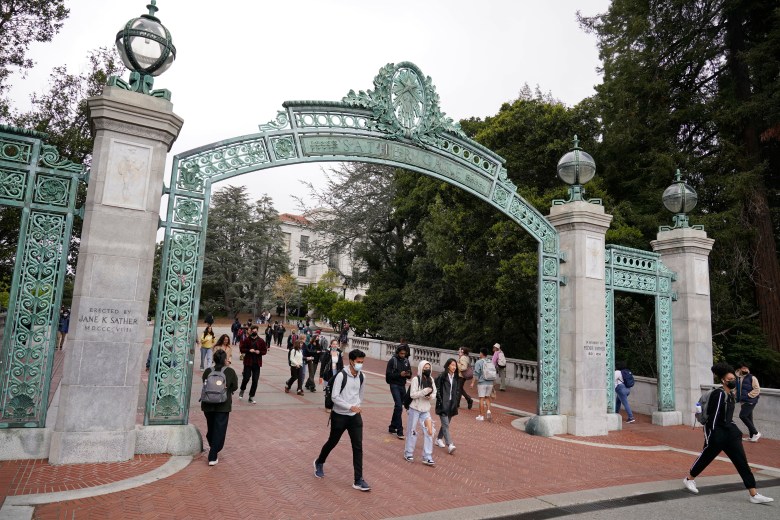
The University of California, Berkeley
BERKELEY, Calif. — Since early April, Rayne Xue, a junior at the University of California, Berkeley, has watched with trepidation as the Trump administration has taken one step after another to limit international students’ access to American higher education.
First came the abrupt cancellation, then reinstatement, of visas for 23 Berkeley students and recent graduates. Then the government cut off Harvard’s ability to enroll international students — a move since blocked by a federal judge — raising fears that something similar could happen at Berkeley. And late last month, as this year’s graduates were celebrating their recent commencements, Secretary of State Marco Rubio paused interviews for all new student visas and announced he would “aggressively revoke” those of Chinese students.
About 16 percent of University of California, Berkeley, students come from outside the United States. Credit: Eric Risberg/AP Photo
Xue, who is from Beijing and won a student senate seat this past spring on a platform of supporting international students, said the administration’s actions strike at a critical part of campus life at Berkeley.
“College is the opportunity of a lifetime to unlearn prejudices and embrace new perspectives, neither of which is possible without a student body that comes from a wide range of geographic and cultural backgrounds,” she said.
About 16 percent of UC Berkeley’s more than 45,000 students come from outside the United States to study at the crown jewel of California’s public research university system, where creeks run through campus beneath cooling redwoods and parking spaces are set aside for Nobel laureates. China, India, South Korea and Canada send the biggest numbers. International students pay higher tuition than California residents, boosting the university’s coffers and subsidizing some of their peers. Many of them conduct cutting-edge research in fields like computer science, engineering and chemistry.
Now the Trump administration’s immigration crackdown, magnified by the yanking of billions in federal research dollars, has international students worried about their future on campus. Many are changing their behavior to avoid scrutiny: Some canceled travel plans and many said they avoid walking near any campus protests in fear of being photographed.
“It’s difficult for international students to feel secure when they cannot anticipate what the administration might charge against them next — or whether they might be unfairly targeted,” said one global studies major who asked not to be identified for fear of attracting retaliation.
Tomba Morreau, a rising junior from the Netherlands studying sociology, said he stopped posting about politics on social media — just in case.
That kind of self-censorship troubles Paul Fine, co-chair of the Berkeley Faculty Association, which represents about a fifth of the university’s tenure-track faculty.
Federal policies are “creating this culture of fear where people start to censor themselves and try to stay under the radar and not show up in their full selves, whether for academic work or activism,” he said.
International students in Fine’s classes told him they wanted to attend a recent protest against federal threats to higher education but were afraid of the consequences, he said. Others told him they were skipping academic conferences outside the United States that they otherwise would have attended.
“Berkeley really prides ourselves on being an intellectual hub that convenes people from all over the world to work on the most important problems,” Fine said. Now that identity is at risk, he said, especially as actual and threatened cuts to grants make it harder for faculty to hire international graduate students and postdocs.
Most poignant, he said, was hearing from demoralized Chinese students who left a repressive government to come to the United States only to see attacks on academic freedom replicated here.
We want to hear from you.
Are you a student, professor, staff or faculty member? Our journalists want to know how the Trump administration is affecting higher education and life on your college campus.
Xue said she hopes the crisis facing universities would draw attention to the challenges international students face, including limited financial aid and the stereotype that all of them are wealthy. With her colleagues in student government, she is lobbying for Berkeley to spend more on the international office, which provides one-on-one advising on visa issues and employment.
For Lily Liu, a Chinese computer scientist, 2025 was shaping up to be a year of milestones. She graduated with a doctorate last month, has a job lined up at a leading artificial intelligence company and is engaged to be married in November.
But the Trump administration’s changing policies toward international scholars have complicated celebrations for Liu, who’s in a federal program that extends her visa for up to a year beyond graduation so she can gain work experience here. She canceled summer travel plans with her family, concerned she might not be let back into the country. And she’s considering moving her wedding to the United States from China, even though many of her relatives wouldn’t be able to attend.
“For international students, every policy affects us a lot,” she said. So Liu is careful. After the publication of her thesis was delayed, she visited Berkeley’s international office to make sure the setback wouldn’t affect her work permit. Her fiancé has a green card, which should theoretically mean his immigration status is more stable. But these days, she said, who knows?
— Felicia Mello
The University of Texas at San Antonio
SAN ANTONIO, Texas — Growing up here, Reina Saldivar had always loved science — all she wanted to watch on TV was “Animal Planet.” Yet until she applied on a whim to a program for aspiring researchers after her first year at the University of Texas at San Antonio, she assumed she would spend her life as a lab technician, running cultures.
The program, Maximizing Access to Research Careers, or MARC, was started by the National Institutes of Health decades ago at colleges around the country to prepare students, especially those from historically underrepresented backgrounds, for livelihoods in the biomedical sciences.
Saldivar got in. And through the program, she spent much of her time on campus in a university lab, helping develop a carrier molecule for a new Lyme disease vaccine. Now Saldivar, who graduated this spring, plans to eventually return to academia for a doctorate.
“What MARC taught me was that my dreams aren’t out of reach,” she said.
Saldivar is among hundreds who’ve participated in the MARC program since its 1980 founding at the University of Texas at San Antonio. She may also be among the last. In April, the university’s MARC program director, Edwin Barea-Rodriguez, opened his email inbox to find a form letter terminating the initiative and advising against recruiting more cohorts.
The letter cited “changes in NIH/HHS [Health and Human Services] priorities.” In recent months, the Trump administration has canceled at least half a dozen programs meant to train scholars and diversify the sciences as part of an effort to root out what the president labels illegal DEI.
In a statement to The Hechinger Report, NIH said that it “is committed to restoring the agency to its tradition of upholding gold-standard, evidence-based science” and is reviewing grants to make sure the agency is “addressing the United States chronic disease epidemic.”
With MARC ending, Barea-Rodriguez is searching for a way to continue supporting current participants until they graduate next academic year. Without access to federal money, however, the young scientists are anxious about their futures — and that of public health in general.
“It took years to be where we are now,” said Barea-Rodriguez, who said he was not speaking on behalf of his university, “and in a hundred days everything was destroyed.”
UTSA’s sprawling campus sits on the northwest edge of San Antonio, far from tourist sites like the Alamo and the River Walk. Forty-four percent of the nearly 31,000 undergraduate students are the first in their families to attend college; more than 61 percent identify as Hispanic or Latino. The university was one of the first nationwide to earn Department of Education recognition as a Hispanic-serving institution, a designation for colleges where at least a quarter of full-time undergraduates are Hispanic.
When Barea-Rodriguez arrived to teach at the school in 1995, many locals considered it a glorified community college, he said. But in the three decades since, the investments NIH made through MARC and other federal programs have helped it become a top-tier research university. That provided students like Saldivar with access to world-class opportunities close to home and fostered talent that propelled the economy in San Antonio and beyond.
The Trump administration has quickly upended much of that infrastructure, not only by terminating career pipeline programs for scholars, but also by pulling more than $8.2 million in National Science Foundation money from UTSA.
One of those canceled grants paid for student researchers and the development of new technologies to improve equity in math education and better serve elementary school kids from underrepresented backgrounds in a city that is about 64 percent Hispanic. Another aimed to provide science, technology, engineering and math programming to bilingual and low-income communities.
UTSA administrators did not respond to requests for comment about how federal funding freezes and cuts are affecting the university. Nationwide, more than 1,600 NSF grants have been axed since January.
In San Antonio, undergraduates said MARC and other now-dead programs helped prepare them for academic and professional careers that might have otherwise been elusive. Speaking in a lab remodeled and furnished with NIH money, where leftover notes and diagrams on glass erase boards showed the research questions students had been noodling, they described how the programs taught them about drafting an abstract, honing public speaking and writing skills, networking, putting together a résumé and applying for summer research positions, travel scholarships and graduate opportunities.
“All of the achievements that I’ve collected have pretty much been, like, a direct result of the program,” said Seth Fremin, a senior biochemistry major who transferred to UTSA from community college and has co-authored five articles in major journals, with more in the pipeline. After graduation, he will start a fully funded doctoral program at the University of Pittsburgh to continue his research on better understanding chemical reactions.
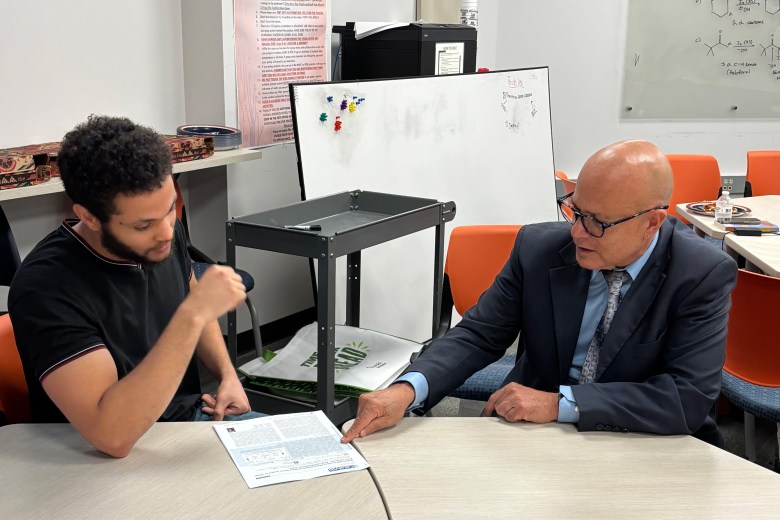
Seth Fremin, a senior biochemistry major at the University of Texas at San Antonio, with Edwin Barea-Rodriguez. Credit: Alexandra Villareal for The Hechinger Report
Similarly, Elizabeth Negron, a rising senior, is spending this summer at the Massachusetts Institute of Technology, researching skin microbiomes to see if certain bacteria predispose some people to cancers.
“It’s weird when you meet students who didn’t get into these programs,” Negron said, referring to MARC. “They haven’t gone to conferences. They haven’t done research. They haven’t been able to mentor students. … It’s very strange to acknowledge what life would have been without it. I don’t know if I could say I’d be as successful as I am now.”
With money for MARC erased, Negron said she will probably need a job once she returns to campus in the fall so she can afford day-to-day expenses. Before, research was her job.
“Without MARC,” she said, “it becomes a question of can I at least cover my tuition and my very basic needs.”
— Alexandra Villarreal
The University of Illinois Urbana-Champaign
CHAMPAIGN, Ill. — When Peter Goldsmith received notice in late January that his Soybean Innovation Lab at the University of Illinois would soon lose all of its funding, he had no idea it was coming. Suddenly Goldsmith, the lab’s director, had to tell his 30 employees they would soon be out of a job and tell research partners across Africa that operations would come to a halt. The lab didn’t even have money to water its soybean fields in Africa.
One employee, Julia Paniago, was in Malawi when she got the news. “We came back the next day,” she said of her team, “and it was a lot of uncertainty. And a lot of people cried.”
The University of Illinois’ Soybean Innovation Lab (SIL) was part of a network of 17 labs at universities across the country, all working on research related to food production and reducing global hunger, and all funded through the U.S. Agency for International Development — until the Trump administration shut down USAID.
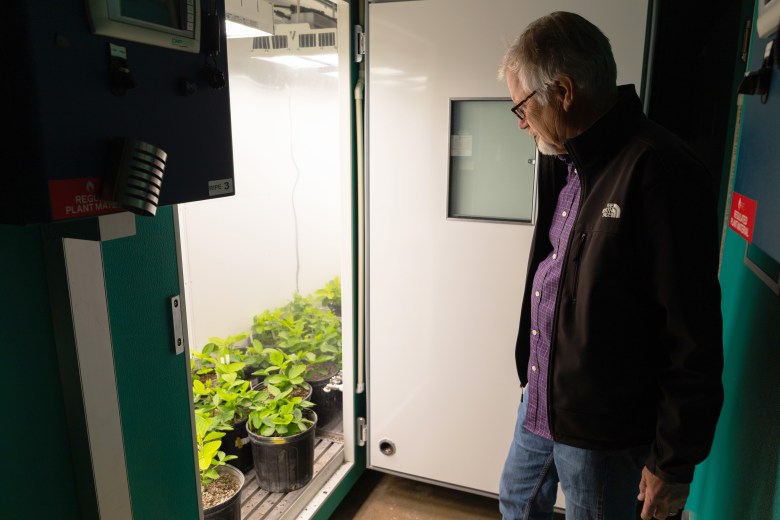
Brian Diers is former deputy director of the University of Illinois’ Soybean Innovation Lab. The lab lost its funding because of cuts to the U.S. Agency for International Development. Credit: Miles MacClure for The Hechinger Report
Soybeans — which provide both oil and high-protein food — aren’t yet commonly grown in Malawi. SIL researchers have been working toward two related goals: helping local farmers increase soybean production and ameliorate malnutrition and generating enough interest in the crop there that a new export market will open for American farmers.
The lab’s researchers work in soybean breeding, economics and mechanical research as well as education. They hope to show that soybean production in Africa is worth further investment so that eventually the private sector will come in after them.
“The people who work at SIL, they like being right at the frontier of change,” Goldsmith said. “It’s high-risk work — that’s what the universities do, that’s what scientific research is about.”
UI, the state’s flagship with a sprawling campus spread between the cities of Urbana and Champaign, is noted for its research work, especially agricultural research.
Labs and researchers across the university lost funding in cuts made by the Trump administration; more than $25 million from agencies including NIH, NSF and the National Endowment for the Humanities was cut, Melissa Edwards, associate vice chancellor for research and innovation, said, a total of 59 grants amounting to 3.6 percent of their overall federal grant portfolio.
Annette Donnelly, who just received her doctorate in education, is among those affected. Her research focuses on educating malnourished children in Africa and developing courses to help Africans learn how to process soybeans into oil.
In April, SIL was handed a lifeline — an anonymous $1 million gift that will keep the lab running through April 2026. The donation wasn’t enough for Goldsmith to rehire all of his employees; SIL’s annual operating budget before the USAID cuts was $3.3 million (and would have kept things running through 2027). But, he said, the money will allow SIL to continue its research in the Lower Shire Valley in Malawi, a project he hopes will attract future donors to fund the lab’s work.
The April donation saved Donnelly’s job, but her priorities shifted. “We’re doing research,” she said, “but we’re also doing a lot of proposal writing. It has taken on a much greater priority.”
Donnelly hopes to attract more funding so she can resume research she had started in western Kenya, demonstrating that introducing soy into children’s diets increased their protein intake by up to 65 percent, she said.
The impact that funding cuts will have on researchers at the soybean lab pales in comparison to the impact on their partners in Africa, Donnelly emphasized. There, she said, the cuts mean processors will likely slow production, limiting their ability to deliver soy products. “The consequences there are much bigger,” she said.
The Soybean Innovation Lab was funded through the Feed the Future initiative, a program to help partner countries develop better agricultural practices that began under the Obama administration in 2010. All 17 Feed the Future innovation labs funded through USAID lost funding, except for the one at Kansas State University, which studies heat-tolerant wheat.
The soybean lab’s office is housed on a quiet edge of the Illinois campus in a building once occupied by the university’s veterinary medicine program. Across the street, rows of greenhouses are home to the Crop Science Department’s experiments.
There, Brian Diers is breeding soybean varieties that resist soybean rust, a disease that’s been an obstacle to ramping up soybean production across sub-Saharan Africa. A professor emeritus who is retired, Diers works part-time at SIL to assist with soybean breeding. The April donation wasn’t enough to cover his work. Now he volunteers his time.
“ If we can help African agriculture take off and become more productive, that’s eventually going to help their economies and then provide more opportunities for American farmers to export to Africa,” he said.
Goldsmith drew an analogy between his lab’s work and the state of American agriculture in the 1930s. As the Dust Bowl swept through the Great Plains, Monsanto or another company could have stepped in to help combat it, but didn’t. Public land-grant universities did.
“That’s where the innovation comes from, from the public land grants in the U.S.,” Goldsmith said. “And now the public land grants still work in U.S. agriculture but also in the developing world.”
Commercial soybean producers hesitate to dip their toes into unproven markets, he said, so it’s SIL’s job to demonstrate that a viable market exists. “That was our secret sauce, in that lots of commercial players liked the products, the technologies we had, and wanted to move into the soybean space, but it wasn’t a profitable market,” Goldsmith said of the African soybean market.
Diers said federal funding cuts imperil not just the development of commerce and global food production but the next generation of scientists as well.
“We could potentially lose a generation of scientists who won’t go into science because there’s no funding right now,” he said.
— Miles MacClure
Contact editor Lawrie Mifflin at [email protected] or 212-678-4078. Contact editor Caroline Preston at 212-870-8965, via Signal at CarolineP.83 or on email at [email protected].
The Hechinger Report provides in-depth, fact-based, unbiased reporting on education that is free to all readers. But that doesn’t mean it’s free to produce. Our work keeps educators and the public informed about pressing issues at schools and on campuses throughout the country. We tell the whole story, even when the details are inconvenient. Help us keep doing that.
DAVENPORT, Iowa — The Catholic prayer for the faithful echoed off the limestone walls and marble floor of the high-ceilinged chapel.
It implored God to comfort the poor and the hungry. The sick and the suffering. The anxious and the afraid.
Then it took an unexpected turn.
“Lord, hear our prayer for St. Ambrose and Mount Mercy University,” the young voice said, “that the grace of the Holy Spirit may help us to follow God’s plan for our new partnership.”
The speaker was talking about ongoing efforts to unite St. Ambrose University, where this weeknight Mass was being held, with fellow Catholic university Mount Mercy. Small religious schools in rural states are shutting down at an accelerating rate, a fate these two are attempting to avoid.
Credit: Mike Rundle for The Hechinger Report
“Lord, hear our prayer,” responded the congregation of students in St. Ambrose-branded T-shirts and hoodies.
The heads of both St. Ambrose and Mount Mercy, which is in Cedar Rapids, said they’ve watched as nearby religiously affiliated colleges, athletic rivals and institutions that employed their friends and former colleagues closed.
With falling numbers of applicants to college — especially in the Midwest — “we just don’t have the demographics anymore,” said St. Ambrose President Amy Novak. Now, as fewer graduates emerge from high schools, combining forces is a way to forestall “the reality that we might all see in five or seven years,” Novak said.
For many other small religiously affiliated institutions, time has already run out.
More than half of the 77 nonprofit colleges and universities that have closed or merged since 2020, or announced that they will close or merge, were religiously affiliated, according to a Hechinger Report analysis of news coverage and federal data. More than 30 that are still in business are on a U.S. Department of Education list of institutions considered “not financially responsible” because of comparatively low cash reserves and net income and high levels of debt.
Related: Interested in innovations in higher education? Subscribe to our free biweekly higher education newsletter.
Some small, religiously affiliated institutions that are not on these lists are also showing signs of strain. Saint Augustine’s University in North Carolina, which is Episcopal, has 200 students, down from 1,100 two years ago, and has lost its accreditation. The 166-year-old St. Francis College in New York, which is Catholic, has sacked a quarter of its staff. Catholic Saint Louis University in Missouri laid off 20 employees, eliminated 130 unfilled faculty and staff positions and sold off its medical practice after running a deficit.
Bluffton University in Ohio, which is Mennonite, is looking for a new partner after a planned merger fell through in February and the president resigned. Catholic St. Norbert College in Wisconsin is eliminating 11 majors and minors and 21 faculty positions. And Georgetown College in Kentucky averted closing only after an alumnus gave it $16 million, which, along with another $12 million in donations, was enough to pay off crippling debt that was costing the small Baptist institution $3 million a year just in interest.
Other religiously affiliated schools are also taking steps to buttress themselves against demographic and financial challenges. Ursuline College in Ohio, for instance, which has fewer than 1,000 students, has agreed to merge with larger Gannon University, 95 miles away. Both are Catholic. Spring Hill College in Alabama and Rockhurst University in Missouri, both also Catholic, are teaming up so they can jointly offer more academic programs, though they will remain independent.
More than a fifth of colleges and universities in the United States, or 849 out of 3,893, are religiously affiliated, according to the most recent figures from the National Center for Education Statistics.
The threats to them are getting new attention. Presidents of 20 Catholic universities and colleges met in November in Chicago at a conference sponsored by DePaul University and held at the offices of the Deloitte consulting firm, which collected data to help them figure out solutions to the challenges they face.
“The intent was to think about a blueprint for the future of Catholic higher education,” including more partnerships, shared services and other kinds of alliances, said Donna Carroll, president of the Association of Catholic Colleges and Universities. “Survival of the fittest is not the strategy that will advance the common good of Catholic higher education. We have to work together.”
The American Council on Education last year launched a Commission on Faith-Based Colleges and Universities, with leaders of what has since grown to 17 institutions including Pepperdine, Brigham Young and Yeshiva universities and the University of Notre Dame.
The idea of the commission, which is scheduled to meet in Washington in June, is “to increase visibility for the important contributions of religious and faith-based colleges and universities and to foster collaboration” among them.
Some religious colleges and universities are doing fine, and even posting enrollment gains — at least in part because of growing political divisions, campus protests and ideological attacks on secular institutions, said David Hoag, president of the Council for Christian Colleges and Universities.
Credit: Mike Rundle for The Hechinger Report
Parents are “wanting to put their son or daughter at a safe place that’s going to have a biblical worldview or a way to look at challenges that’s not polarized,” Hoag said. “At our institutions, you’re not going to be seeing protests or things that are happening at many of these [other] universities and colleges. You’re going to see them rallying together, whether it’s for a sporting event or for a revival or baptisms.”
Other trends also offer some hope to religiously affiliated colleges and universities. A long decline in the proportion of adults who consider themselves affiliated with a religion appears to have leveled off, the Pew Research Center finds. And while enrollment at parochial schools that feed graduates to Catholic universities fell more than 10 percent from 2017 to 2021, the most recent year for which the figure is available, the number of students at other kinds of religious primary and secondary schools is up.
Even religiously affiliated institutions confronting the realities of falling enrollment and financial woes fill a critically important role, their advocates say. They often serve low-income students who are the first in their families to go to college and are reluctant to enroll at large public universities.
Many are in rural areas where access to higher education is more limited than in urban and suburban places and is becoming less available still as public universities in rural states have merged or closed or cut dozens of majors.
Attending a small rural, religiously affiliated institution “is, I think — especially for rural students — a great opportunity,” said Todd Olson, president of Mount Mercy, above the sound of trains crossing Cedar Rapids outside his window. “I know kids from very small towns around Iowa,” like the one where he grew up, Olson said. “This campus is a much more comfortable place for them.”
Credit: Mike Rundle for The Hechinger Report
When Jacob Lange arrived at St. Ambrose from East Dubuque, Illinois, and attended a Mass on campus, “all of a sudden all these new people I had never met were kind of chatting with me and it was really kind of nice. It felt like I was kind of included and I didn’t really think I would be originally,” he said. “You figure, ‘I’m probably going to sit in the back and probably not talk to anyone all night,’ and then I showed up, and I walked out here and all of a sudden they’re, like, ‘Here, come join our group.’ ”
His parents also liked that he decided to go to a Catholic university, Lange said. “You know, you go to one of these big schools with 25,000 kids, and you’re kind of worried about your kid — like, what kind of dumb things is he going to get up to?”
Catholic universities in particular have a slightly higher four-year graduation rate than the national average, according to the Center for Catholic Studies at St. Mary’s University in Texas. Graduates have a stronger sense of community purpose, the center found in a survey. Alumni are 9 percentage points more likely to say they participate in civic activities.
More students at religiously affiliated than at secular institutions receive financial aid, the American Council on Education says. Three out of five get scholarships from the colleges themselves, compared to fewer than one in four at other kinds of schools. At both Mount Mercy and St. Ambrose, which have about 1,450 and 2,700 students, respectively, 100 percent get financial aid.
But these benefits for students can be vulnerabilities for budgets, said Novak, at St. Ambrose.
“We serve the poor. We educate the poor,” she said. “That is a risky financial proposition at the moment for small, regional institutions that are largely tuition-driven.”
The threats to smaller religiously affiliated institutions in rural areas stem largely from the downturn in the already short supply of high school graduates choosing to enroll. The proportion of such students going straight to college has fallen even more sharply in many largely rural states.
While they’re generous with their financial aid, religiously affiliated colleges are also generally more expensive than many other higher education institutions, at a time when many families are questioning the return on their investments in tuition. Median tuition and fees average $25,416 a year, according to the American Council on Education.
St. Ambrose and Mount Mercy, about 90 minutes away,are teaming up from positions of relative strength. Publicly available financial documents suggest that neither faces the immediate enrollment or financial crises that threaten many similar institutions. But their leaders say that they’re trying to fend off problems that could arise later. By joining forces, each can increase its number of programs while lowering administrative costs.
Reaction among students and alumni has been mixed.
Combining with St. Ambrose “was kind of nerve-racking at the beginning because it’s, like, ‘Oh, this is a lot of change,’ ” said Alaina Bina, a junior nursing major at Mount Mercy.
She picked the university in the first place because she liked the small, hilly campus.
“I came from a small town, so I didn’t really want to go bigger,” she said. “Even when I came here on a tour, people would say ‘Hi’ to each other. You just know everyone, and that’s kind of how it is in a small town, too.”
Students were worried about what name would appear on their degrees (the degrees will still say “Mount Mercy”) and whether sports teams that once competed against each other would be merged. Novak and Olson promised to keep their athletics programs separate and even add a sport at Mount Mercy: football, beginning in 2026.
Combining sports teams “would not be wise at all from a business perspective,” Olson said the two agreed, because they are “a powerful enrollment driver” for both schools.
Credit: Mike Rundle for The Hechinger Report
“Honestly, this was probably the biggest student concern,” said Nasharia Patterson, student government president at Mount Mercy, who was wearing a brace on her wrist from an awkward back tuck basket catch during cheer practice. Keeping the athletics teams “gives us a piece of Mount Mercy specifically to just hold on to.”
Among alumni, meanwhile, “there’s mixed feelings” about what’s happening to their alma mater, said Sarah Watson, a leadership development consultant who graduated from Mount Mercy in 2008.
Still, she said, “I know the great challenges that higher ed is facing right now. It’s not just Mount Mercy. It’s not just St. Ambrose. It’s the bigger schools, too. Enrollment numbers have dropped. The desire to go to a traditional four-year college is just not quite what it used to be.”
For Mount Mercy, which was founded by an order of nuns in 1928, Watson said, “If we don’t do this, what’s the alternative? We want to be around for another hundred years.”
After all, said Novak, the St. Ambrose president, “to watch universities close across the heartland because we can’t make it work will leave our communities fallow.”
Carroll, of the Catholic colleges and university association, said that many other religiously affiliated institutions are closely watching what’s happening at St. Ambrose and Mount Mercy.
“It’s a leap of faith,” she said. “And who better to take a leap of faith than a Catholic institution?”
Religiously affiliated colleges that have closed or merged, or announced that they will merge, since 2020
Alderson Broaddus University, West Virginia, Baptist
Alliance University, New York, Christian
Ancilla College, Indiana, Catholic
B. H. Carroll Theological Institute, Texas, Baptist
Birmingham-Southern College, Alabama, Methodist
Bloomfield College, New Jersey, Presbyterian
Cabrini University, Pennsylvania, Catholic
Cardinal Stritch University, Wisconsin, Catholic
Chatfield College, Ohio, Catholic
Clarks Summit University, Pennsylvania, Baptist
College of Saint Rose, New York, Catholic
Compass College of Film & Media, Michigan, Christian
Concordia College New York, Lutheran
Concordia University, Oregon, Lutheran
Eastern Nazarene College, Massachusetts, Christian
Finlandia University, Michigan, Lutheran
Fontbonne University, Missouri, Catholic
Holy Family College, Wisconsin, Catholic
Holy Names University, California, Catholic
Iowa Wesleyan University, Iowa, Methodist
Judson College, Alabama, Baptist
Limestone University, South Carolina, Christian
Lincoln Christian University, Illinois, Christian
MacMurray College, Illinois, Methodist
Magdalen College, New Hampshire, Catholic
Martin Methodist College, Tennessee, Methodist
Marymount California University, California, Catholic
Mount Mercy University, Iowa, Catholic
Multnomah University, Oregon, Christian
Nebraska Christian College, Nebraska, Christian
Notre Dame College of Ohio, Catholic
Ohio Valley University, West Virginia, Christian
Presentation College, South Dakota, Catholic
Rosemont College, Pennsylvania, Catholic
St. Louis Christian College, Missouri, Christian
St. Augustine College, Illinois, Episcopal
St. John’s University Staten Island campus, New York, Catholic
University of Saint Katherine, California, Orthodox Christian
Ursuline College, Ohio, Catholic
Wave Leadership College, Virginia, Christian
Wesley College, Delaware, Methodist
SOURCE: Hechinger Report analysis of news coverage and federal data.
The Hechinger Report provides in-depth, fact-based, unbiased reporting on education that is free to all readers. But that doesn’t mean it’s free to produce. Our work keeps educators and the public informed about pressing issues at schools and on campuses throughout the country. We tell the whole story, even when the details are inconvenient. Help us keep doing that.
Establishing branch campuses abroad—often used as a crisis mitigation strategy—could become more important for U.S. universities facing increasing threats at home, but scholars are divided on their likelihood of success.
Research-intensive colleges and universities in the U.S. are faced with “new and profound uncertainties” over future funding and the strength of their endowments under the Trump administration, said Geoff Harkness, formerly postdoctoral teaching fellow at Northwestern and Carnegie Mellon Universities’ Education City campuses.
“This means that R-1 institutions will have to seek alternative sources of revenue, including partnering with nations in the Middle East. For Georgetown, which has a long-established branch campus at Education City, the renewal was a no-brainer in 2025.”
Harkness, now associate professor of sociology at Rhode Island College, said the Israel-Palestine conflict put Qatar in a difficult position but warned that Texas A&M could regret its decision to leave from a fiscal perspective.
“The nation’s vast resources and relative political moderation make it an appealing partner for U.S. colleges and universities, particularly in light of current economic uncertainties.”
“Branch campuses are often used as a crisis mitigation strategy by universities,” she said.
“In this sense, it is no surprise to me that in situations of financial and geopolitical turbulence, branch campuses become more attractive to decision-makers at universities.”
University leaders hope that overseas campuses can contribute financially to the well-being of the overall institution, either through direct transfers from these sites to the main institutions or through accessing a broader pool of students, said Kleibert.
Recent figures show that U.S.-Chinese collaborative campuses have experienced record-breaking application numbers from both domestic and international students over the past few years.
Illinois Tech began planning its Indian outpost long before President Trump’s unprecedented assault on the U.S. higher education system. But Nigel Healey, professor of international higher education at the University of Limerick, said Trump’s culture wars could increase the “push factors” toward overseas expansion in the future.
“In the medium to long term, branch campuses may offer elite U.S. institutions an alternative way of maintaining their internationalization, accessing international talent and maintaining a global profile at a time when Trump is fostering a new national culture of xenophobia and isolationism,” he said.
However, he warned that the risks of being pushed into a strategy by suddenly changing political winds is that poor, reactive decisions might be made.
“The winds may change in the opposite direction, leaving the institution with a branch campus that is suddenly a white elephant.”
Philip Altbach, professor emeritus at Boston College, agreed that there are significant risks in establishing branches overseas and that they are not a high priority for elite universities right now.
“In the current situation of total instability in U.S. higher education due to the Trump administration, U.S. universities will not be thinking much about branch campuses but about their own survival.”
Although partnering with many countries may be politically safe, he said universities are unlikely to want to risk making “controversial political moves in the current environment.”
“Top U.S. universities are more interested in establishing research centers and joint programs overseas that can help their research and be a kind of embassy for recruiting students and researchers for the home campuses.”
And Kevin Kinser, professor of education and head of the department of education policy studies at Pennsylvania State University, said overseas partners are not free from scrutiny from the White House.
“The turmoil in the U.S. also includes scrutinizing foreign donations, contributions, collaborations and investments. Looking overseas does not create a safe haven for current federal attention.”
As a result, he said, Texas A&M may have gotten ahead of the narrative on foreign activities by universities by quitting Education City when it did.