Personal well-being—particularly related to mental health—is one of the greatest threats to persistence among college students.
Forty percent of students say mental health has “a great deal” of impact on their ability to focus, learn and perform academically, according to a May 2024 Student Voice survey by Inside Higher Ed and Generation Lab. Additionally, 19 percent of respondents believe their physical health impacts their academic success a great deal.
Colleges and universities are responding to this growing need for support; a 2024 Inside Higher Ed survey of college presidents found that 70 percent of respondents had invested in wellness facilities or services to promote overall well-being among students in the past year.
But students aren’t entirely satisfied with the offerings on their campuses; only 46 percent of Student Voice respondents rated the quality of campus health and wellness services as good or excellent.
Inside Higher Ed compiled five examples of new support resources universities are offering to improve student well-being and, in turn, their retention and graduation. Many focus on students’ self-regulation through meditation and reflection, tools that can help them manage physical and socio-emotional health.
In a small room located in the Eugene McDermott Library and Center for Brain Health, students are encouraged to take “brain breaks,” or short, intentional pauses to prime themselves for more focused, deeper thinking.
The room can only be used by one person at a time, and visitors are encouraged to turn off devices and set aside reading materials during this break.
The SDSU, Imperial Valley, administration cut the ribbon on a new wellness and success center in March, creating dedicated space for counseling and health services—as well as career, veterans’, student success and retention services. The goal is to offer holistic support in a one-stop shop. Imperial Valley is a commuter campus, with student housing under construction, making these resources particularly helpful for those living and studying in the area.
Counseling center services include crisis intervention, assessment and short-term therapy. The health center provides low- or no-cost medical services including preventive care, immunizations and psychiatric treatments.
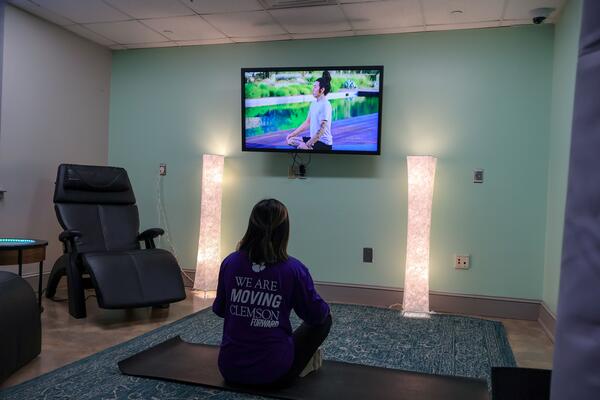
Clemson’s Fike Recreation Center is home to the Wellness Zone, a private room that an individual or group of students can reserve to engage in various activities. Created as a virtual fitness space, the room includes a touch-screen TV and zero-gravity chairs. Students can participate in self-paced yoga, stretching, mindfulness, breath work and meditation, as well as traditional exercises guided by an instructor on the TV.
IU repurposed an old sorority house on campus to centralize mental and physical health service offices, combining Student Wellness, Substance Use Intervention Services and the Collegiate Recovery Community offices under one roof.
In addition to staff offices, the new Wellness House also features reservable spaces for campus groups and four rooms where students can relax and meditate. Each room has a different theme and features; for example, the Fireplace Room is focused on studying and unwinding, whereas the Quiet Room has flexible seating such as beanbags and pillows for greater relaxation.
The goal is to provide an entry point for students who may be overwhelmed, potentially connecting them with relevant offices located in the Wellness House while they engage in other activities.
In 2021, Yale opened the doors to its Good Life Center, a space for unwinding and destressing; this year the university doubled the size of the space to accommodate more students.
The expansion includes five more themed rooms: the tree house, music room, game room, sensory room and balance room. Each offers wellness activities and features related to its theme, such as musical instruments, mini basketball hoops and sound-absorbing chairs.
The sensory room was designed in collaboration with Student Accessibility Services to provide specialized furniture and resources for students of all needs and abilities.
Do you have a wellness intervention that might help others promote student success? Tell us about it.
The Department of Justice launched investigations into admissions practices at four California universities on Thursday night, accusing them of flouting the Supreme Court’s ruling banning affirmative action in Students for Fair Admissions v. Harvard and University of North Carolina at Chapel Hill.
The “compliance reviews,” as the department called them, will target Stanford University and three University of California campuses: Berkeley, Los Angeles and Irvine.
In a statement announcing the investigations, the Justice Department wrote that the investigations are “just the beginning” of their efforts to “eliminate DEI” in college admissions.
“President Trump and I are dedicated to ending illegal discrimination and restoring merit-based opportunity across the country,” U.S. attorney general Pam Bondi wrote in the statement.
It’s unclear what prompted the investigations or what evidence the department has to support its suspicions of illegal racial preferences in admissions at the targeted institutions. Some affirmative action opponents have suggested that institutions that enrolled higher numbers of minority students last fall, the first class admitted after the Supreme Court decision, may have done so illegally.
Berkeley, UCLA and Irvine all reported upticks in the number of Black and Hispanic students enrolled in the Class of 2028 last fall: 45 percent of students who enrolled at a UC system campus this fall were underrepresented students of color, a 1.2 percent increase from 2023 and a record for the system.
Just hours before the DOJ announced its probe, the Department of Health and Human Services launched its own investigation into admissions practices at UCLA’s medical school, accusing it of illegally considering applicants’ race.
The UC system has been banned from considering race in admissions since 1996, when the state passed a referendum making the practice illegal at public institutions. That hasn’t stopped anti–affirmative action watchdogs from accusing the system of doing so secretly.
Last month, the newly formed public interest group Students Against Racial Discrimination filed a lawsuit accusing the system of practicing affirmative action behind closed doors, citing increases in Black and Hispanic enrollment at its most selective campuses, namely UCLA and Berkeley, and labeling recent admissions policies—like the decision in 2020 not to consider standardized test scores—proxies for affirmative action.
“Since Proposition 209 banned California’s public institutions from considering race in admissions, UC has implemented admissions practices to comply with it,” a UC spokesperson wrote in an email to Inside Higher Ed. “The UC undergraduate admissions application collects students’ race and ethnicity for statistical purposes only. This information is not shared with application reviewers and is not used for admissions.”
Stanford, unlike the UC schools, reported a marked decline in first-year underrepresented students last year, according to the university’s Common Data Set, released last month. Black enrollment at the university fell by nearly 50 percent, and Hispanic enrollment by 14.4 percent; meanwhile, white and Asian enrollment rose by 14.5 percent and 10 percent, respectively.
Luisa Rapport, Stanford’s director of media relations, said the university has not flouted the affirmative action ban, and that following the SFFA ruling, it “immediately engaged in a comprehensive and rigorous review to ensure compliance in our admissions processes.”
“We continue to be committed to fulfilling our obligations under the law, and we will respond to the department’s questions as it conducts this process,” she wrote in an email to Inside Higher Ed.
‘Just the Beginning’
Angel Pérez, president of the National Association for College Admission Counseling, said he’s heard “extraordinary concern” from admissions officers and deans in recent weeks that investigations could spread to their institutions. They don’t know how to prepare because “we have no idea what these compliance reviews even entail.”
What they do know, he said, is that investigations could throw their offices into chaos during the height of admissions season.
“These kinds of reviews are extremely disruptive. They’re also extremely expensive,” Pérez said. “There are some institutions that, you know, may not survive a compliance review given the legal costs.”
In an interview with Inside Higher Ed last month, Edward Blum, president of SFFA and the architect of the nationwide affirmative action ban, said he expected schools that reported higher enrollment of racial minorities in the fall to invoke legal scrutiny, both from the courts and the Trump administration. He said he believed a number of institutions could be “cheating” the SFFA ruling, including some that were not included in this first round of investigations: Yale, Duke and Princeton.
“So many of us are befuddled and concerned that in the first admissions cycle post-SFFA, schools that said getting rid of affirmative action would cause their minority admissions to plummet didn’t see that happen,” he said.
Some colleges are withholding demographic information about their incoming classes altogether. On Thursday, hours after the Justice Department probes were launched, Harvard admitted its Class of 2029 but did not release any information—including demographics, acceptance and yield rates, and geographic data—for the first time in more than 70 years.
In response to multiple questions from Inside Higher Ed about what the compliance reviews would entail or how the department plans to pursue its investigations into admissions offices, a Justice Department spokesperson referred to the initial statement announcing the investigations.
“No further comment,” he wrote via email.
There are some hints, though, as to what form a federal admissions investigation could take. In a December op-ed in The Washington Examiner outlining a plan that has reflected the Trump administration’s higher education agenda so far with uncanny accuracy, American Enterprise Institute fellow Max Eden suggested Bondi initiate “a never-ending compliance review” targeting Harvard University and others to enforce the SFFA ruling.
“She should assign Office of Civil Rights employees to the Harvard admissions office and direct the university to hold no admissions meeting without their physical presence,” Eden wrote. “The Office of Civil Rights should be copied on every email correspondence, and Harvard should be forced to provide a written rationale for every admissions decision to ensure nondiscrimination.”
For the four universities at the center of the investigations, this disruption could be especially pronounced right now, as colleges begin sending out acceptance letters and enter the busiest season for building their incoming classes.
“This could not come at a worse time. It is April; this is enrollment management season,” Pérez said. “For institutions to take the time, energy and resources to [respond to compliance reviews] means that they’re going to have a harder time enrolling their classes.”
‘Absurd’ Accusations
The Department of Justice is alleging that in the year and a half since the SFFA ruling, colleges have skirted the law by continuing to consider race in the admissions process. Those grounds make its targets particularly confusing, given that the University of California system hasn’t used affirmative action in admissions for nearly three decades.
In 1996, California voters passed Proposition 209, banning the practice at public colleges. In the application cycles immediately after, Black and Hispanic enrollment fell precipitously. Pérez said it took many years of experimenting with race-neutral admissions, financial aid and recruitment policies for UC campuses to bring Black and Hispanic enrollment back to their prior rates.
In the months following the SFFA decision, Pérez said college admissions professionals turned to California for lessons in how to maintain diversity without running afoul of the new law.
“Officials and admission professionals [at UC] have been helping other institutions across the United States comply with the Supreme Court decision,” he said. “They have actually served as leaders in this space. To accuse them of violating any law is absurd.”
A close friend who works at a nearby college asked me why, in 2025, there haven’t been student protests of the kind that we saw during the Vietnam War and after the killing of George Floyd.
She questioned why campuses seem eerily quiescent as events in Washington, D.C., threaten values essential to the health of higher education, values like diversity, freedom of speech and a commitment to the greater good. We also wondered why most higher education leaders are choosing silence over speech.
Deans and presidents seem more invested in strategizing about how to respond to executive orders and developing contingency plans to cope with funding cuts than in exerting moral leadership and mounting public criticism of attacks on democratic norms and higher education.
I do not mean to judge the goodwill or integrity of anyone in our colleges and universities. There, as elsewhere, people are trying their best to figure out how to live and work under suddenly changed circumstances.
No choice will be right for everyone, and we need empathy for those who decide to stay out of the fray. But if all of us stay on the sidelines, the collective silence of higher education at a time when democracy is in crisis will not be judged kindly when the history of our era is written.
Let’s start by considering the role of college and university presidents in times of national crisis. In the past, some have seen themselves as leaders not just of their institutions but, like the clergy and presidents of philanthropic foundations, of civil society.
Channeling Alexis de Tocqueville, Yale’s Jeffrey Sonnenfeld explains that “the voice of leaders in civil society help[s] certify truth,” creating “priceless ‘social capital’ or community trust.” He asks, “If college presidents get a pass, then why shouldn’t all institutional leaders in democratic society shirk their duties?”
In the 1960s and ’70s, some prominent college presidents refused to take a pass. The University of Notre Dame’s Theodore Hesburgh became a leading voice in the Black civil rights struggle. Amherst College president John William Ward not only spoke out publicly against the Vietnam War, he even undertook an act of civil disobedience to protest it.
A half century earlier, another Amherst president, Alexander Meiklejohn, embraced the opportunity afforded by his position to speak to a nation trying to recover from World War I and figure out how to deal with mass immigration and the arrival of new ethnic groups.
At a time of national turmoil, he asked Americans some hard questions: “Are we determined to exalt our culture, to make it sovereign over others, to keep them down, to have them in control? Or will we let our culture take its chance on equal terms … Which shall it be—an Anglo-Saxon aristocracy of culture or a Democracy?”
Those questions have special resonance in the present moment.
Yet institutional neutrality does not mean they need to be silent “on the issues of the day when they are relevant to the core mission of our institutions,” to quote Wesleyan University president Michael S. Roth. And, as Sonnenfeld notes, even the University of Chicago’s justly famous 1967 Kalven report, which first urged institutional neutrality, “actually encouraged institutional voice to address situations which ‘threaten the very mission of the university and its values of free inquiry.’”
As Wesleyan’s Roth reminds his colleagues, “College presidents are not just neutral bureaucrats or referees among competing protesters, faculty and donors.” Roth urges them to speak out.
But, so far, few others have done so, preferring to keep a low profile.
The silence of college leaders is matched by the absence of student protests on most of their campuses. Recall that in 2016, when President Trump was first elected, “On many campuses, protests exploded late into election night and lasted several days.”
Nothing like that is occurring now, even as the Trump administration is carrying out mass deportations, threatening people who protest on college campuses, attacking DEI, calling for ethnic cleansing in Gaza, ending life-saving foreign aid programs and trampling the norms of constitutional democracy.
Mass protests on campuses can be traced back to 1936, when, as Patricia Smith explains, “college students from coast to coast refused to attend classes to express their opposition to the rise of fascism in Europe and to advocate against the U.S. involvement in foreign wars.”
Students may not be following events in the nation’s capital or grasping the significance of those events and what they mean for them and their futures.
It is the job of those of us who teach at colleges and universities to help them see what is happening. This is no time for business as usual. Our students need to understand why democracy matters and how their lives and the lives of their families will be changed if American democracy dies.
Ultimately, we should remember that the costs of silence may be as great as the costs of speaking out.
M. Gessen gets it right when they say, “A couple of weeks into Trump’s second term, it can feel as if we are already living in an irreversibly changed country.” Perhaps we are, but Gessen warns that there is worse to come: “Once an autocracy gains power, it will come for many of the people who quite rationally tried to safeguard themselves.”
Gessen asks us to remember that “The autocracies of the 20th century relied on mass terror. Those of the 21st often don’t need to; their subjects comply willingly.”
At present, college and university presidents, students and faculty must care about more than protecting ourselves and our institutions. We must speak out and bear witness to what Gessen describes and warn our fellow citizens against compliance.
This will not be easy at a time when higher education has lost some luster in the public’s eyes. But we have no choice. We have to try.
Austin Sarat is the William Nelson Cromwell Professor of Jurisprudence and Political Science at Amherst College.
Introduction: How Educational Technology Promotes Green Campuses
Sustainability is now a requirement, not a slogan, especially concerning educational institutions given the tremendous environmental impact of paper-based systems! Textbooks and administrative paperwork from colleges and institutions contribute to worldwide paper consumption. Panic not, the good news is that technology and smart campus energy management is making a difference.
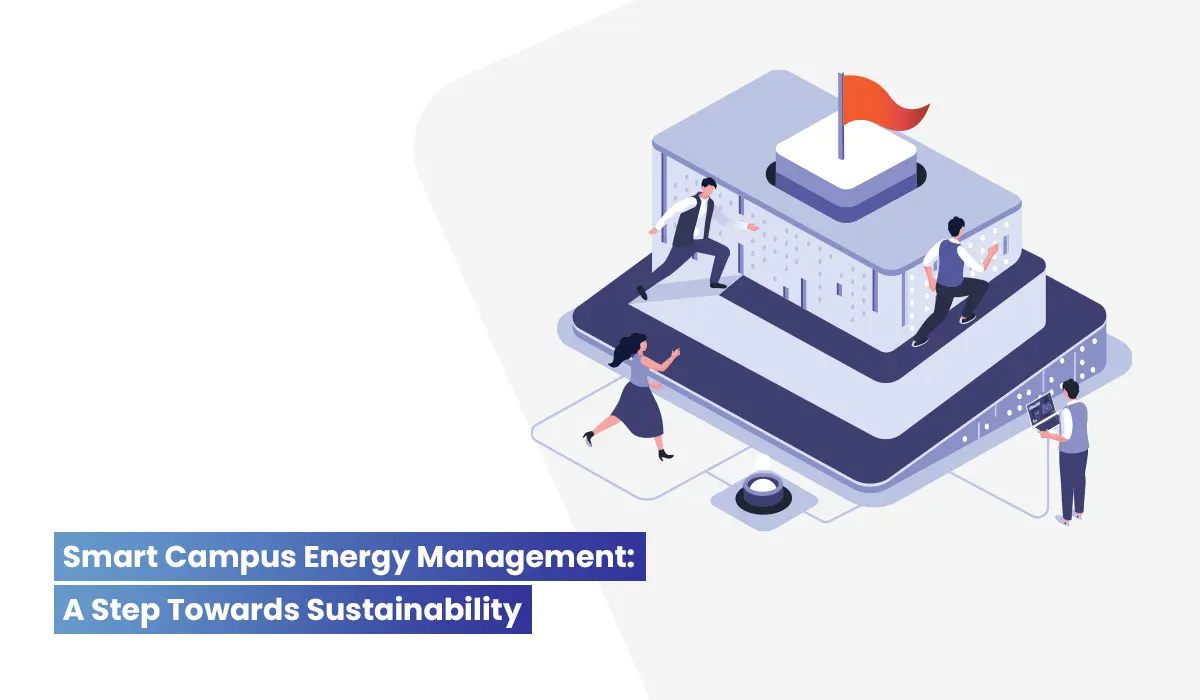
Universities may encourage sustainability by using innovation that eliminates waste, conserves energy, and optimizes resources. With the correct tools, becoming green may become the norm. Creatrix Campus’s educational innovations in the form of smart campus energy management are turning campuses into eco-friendly centers while improving efficiency.
Benefits of Educational Technologies for Eco-friendly Campus Management
Paperless Classrooms and Administration
Reducing paper waste is a simple but effective way for institutions to become green. Paperwork is massive in conventional classrooms and administrative systems due to the proliferation of various forms of paper-based documentation. However, campuses may reduce paper use, simplify operations, and save time by moving digital!
Paperwork is a thing of the past with cloud-based tools for resource optimization that manage student work, grades, and attendance. With a few clicks, students may turn in their work online, instructors can digitally grade and comment, and attendance can be kept tabs. In addition to enhancing efficiency, all of this helps save environment. On top of that, everything is well-organized and simple to find, which simplifies administrative duties.
Controlling Energy Consumption Using Intelligent Devices
Energy regulation is crucial to a sustainable campus. Smart campus energy management have increased university energy efficiency. Smart meters, IoT devices, and cloud-based energy management software can analyze energy usage, identify inefficiencies, and reduce carbon footprint on campuses.
According to a new study out of the National Renewable Energy Laboratory, campuses can save 30% on their energy bills by implementing smart campus energy management solutions. Colleges can significantly reduce their energy use by installing smart lighting, HVAC systems, and energy-efficient equipment.
Additionally, facilities staff may reduce waste and promote eco-friendly practices across the board by making smarter decisions on energy usage based on data-driven insights. It’s about more than just cutting costs; it’s about making a better, more sustainable future for generations to come.
Learn to Reduce Carbon Footprint Online
More than just a convenient way to attend classes, online learning changes the atmosphere. Universities may substantially reduce travel by going digital, reducing traffic, carbon emissions, and cars on the road. Online education reduces carbon footprints by up to 90% compared to on-campus instruction, according to The Global e-Sustainability Initiative.
But it’s not just about travel cuts! Online learning minimizes the need for environmentally harmful paper books, handouts, and other materials! Students get to access course materials instantaneously from anywhere, saving resources and giving the planet a respite.
Students can get degrees from home while protecting the environment—a win-win!
Sustainable Resource Management
Building a green campus requires efficient resource management. AI and IoT-powered smart campus energy management systems are changing how universities measure and optimize resource use. Educational institutions may now make smarter judgments about water, electricity, paper, and plastic to reduce waste and save money.
Real-time data and predictive analytics helped institutions employing smart campus energy management systems cut energy use by 15% reports The International Energy Agency. It’s not just about turning off lights in empty classrooms—it’s about using energy-hungry equipment sparingly and conserving water in dorms and cafeterias.
Cloud-based technologies and AI-powered analytics help colleges improve their sustainability initiatives and achieve lasting impact! Understanding how and when resources are used helps institutions reduce waste, save money, and promote sustainability.
Environment Awareness
Environmental knowledge is crucial to creating tomorrow’s leaders on campuses. Sustainability in the curriculum and green campus projects can teach students to be eco-friendly. This approach may even help students become environmental activists.
According to a National Environmental Education Foundation research, 79% of students think their institutions should address sustainability, and 67% prefer to work for green companies. University environmental awareness programs teach lifelong habits and educate students to take responsibility for their ecological footprint.
Remote Collaboration Encouragement
Carbon footprint reduction doesn’t require face-to-face interaction. Virtual classrooms and cloud-based technology let students and teachers communicate anytime, anywhere, minimizing travel and meetings. Trust us, remote collaboration for group tasks or faculty discussions saves time, cuts travel emissions, and makes their workspace more flexible and sustainable.
Remote work and collaboration tools reduce travel and their organization’s environmental effect, according to 60% of McKinsey respondents.
Data-driven Sustainability Planning
Sustainability requires educated decisions, not just good intentions. Data helps higher eds design better, more customised sustainability plans. Leveraging AI and IoT for green campus operations aids to analyze real-time energy, waste, and resource allocation data to improve.
According to a Gartner report, 70% of organizations utilizing data analytics have improved their sustainability initiatives, from waste reduction to energy optimization. Same with universities. Educational technologies let institutions track success, identify areas for development, and make long-term environmental decisions. Data-driven sustainability is a game-changer, not a buzzword.
Conclusion
University greening can jump forward with technology. Sustainable, eco-friendly education is possible through paperless classrooms in universities, smart campus energy management, and online learning. By using cloud-based tools for resource optimization, institutions lower their environmental footprint and inspire future leaders.
Is your organization ready to impact? Greening your campus is easy with Creatrix Campus and its creative solutions. Connect with us.
RANDOLPH, Vt. — The thermostat was turned low in the admissions office at Vermont State University on a cold winter morning.
It’s “one of our efficiencies,” quipped David Bergh, the institution’s president, who works in the same building.
Bergh was joking. But he was referring to something decidedly serious: the public university system’s struggle to reduce a deficit so deep, it threatened to permanently shutter several campuses after dramatic drop-offs in enrollment and revenue.
While much attention has been focused on how enrollment declines are putting private, nonprofit colleges out of business at an accelerating rate — at least 17 of them in 2024 — public universities and colleges are facing their own existential crises.
State institutions nationwide are being merged and campuses shut down, many of them in places where there is already comparatively little access to higher education.
David Bergh, president of the newly consolidated Vermont State University, in the building where he works at the VTSU campus in Randolph. “Public institutions are not exempt from the challenges” facing higher education, Bergh says. Credit: Oliver Parini for The Hechinger Report
“Public institutions are not exempt from the challenges” facing higher education, Bergh said. “We are already seeing it, and we’re going to see more of it, and it’s particularly acute in some more rural states, where there’s a real need to balance limited resources but maintain access for students.”
Vermont is a case study for this, and an example of how political and other realities make it so hard for public universities and colleges to adapt to the problems confronting them.
“The demographics of fewer traditional-age college students, the over-building of these campuses, the change in the demand for what we need for our workforce in terms of programs — this is something that’s happening everywhere,” said Vermont State Rep. Lynn Dickinson, who chairs the Vermont State Colleges System Board of Trustees.
Related: Interested in innovations in higher education? Subscribe to our free biweekly higher education newsletter.
Public university and college mergers have already happened in Pennsylvania, Georgia, California and Minnesota, and public campuses have closed in Ohio and Wisconsin. A merger of public universities and community colleges in New Hampshire is under study.
When state university and college campuses close, the repercussions for communities around them can be dire.
Until this month, local students had a college “in their backyard,” said Thomas Nelson, county executive in Outagamie County, Wisconsin, where the two-year Fox Cities outpost of the University of Wisconsin Oshkosh this spring will become the sixth public campus in that state to be shuttered since 2023, after a long enrollment slide. “We’ve had this institution for 60 years in our community, and now it’s gone.”
Not only students are affected. In many rural counties, “there really isn’t a lot beyond the university,” Nelson said. “So that’s going to be devastating for the economy. It’s going to kill jobs. It’s going to be one more strike against them when they are competing with other communities with more amenities.”
Attempts to close these campuses attract the intervention of politicians, who have more control over whether public than private nonprofit colleges in their districts close. After all, “they own the place,” said Dan Greenstein, former chancellor of Pennsylvania’s State System of Higher Education, who — after that state’s enrollment fell by nearly one-fifth — led a reconfiguration that resulted in six previously separate public universities there being merged into two systems.
Even trying to rename a public university can have political consequences. When Augusta State University in Georgia was combined with Georgia Health Sciences University to become Georgia Regents University, there was a local outcry over the fact that “Augusta” was no longer in the name. Within two years, the merged school had yet another new name: Augusta University.
“Public institutions are complex structures,” said Ricardo Azziz, who led that consolidation, served as president of the resulting institution and now heads the Center for Higher Education Mergers and Acquisitions at the Foundation for Research and Education Excellence. “They’re influenced by politics. They’re influenced by elected officials.”
When the proposal to close campuses in Vermont was met with public and political resistance, state planners backed down and decided instead to merge them, laying off staff and cutting programs. That did not go well, either, and resulted in raucous public meetings, votes of “no confidence,” plans that were announced and then rescinded and a revolving door of presidents and chancellors. Only now, in its second year, has the process gotten smoother.
Alarm bells started sounding about problems in Vermont’s state universities before the Covid-19 pandemic. With the nation’s third-oldest median age, after Maine and New Hampshire, according to the Census Bureau, the state had already seen its number of young people graduating from high school fall by 25 percent over the previous decade.
Enrollment at the public four-year and community college campuses — not including the flagship University of Vermont, which is separate — was down by more than 11 percent. A fifth of the rooms in the dorms were empty. And with the birthrate in the state lower than it was before the Civil War, there was no rebound in sight.
These trends have contributed to the closings of six of Vermont’s in-person undergraduate private, nonprofit colleges and universities since 2016.
“We’d be keeping our head in the sand if we didn’t think that those same forces were going to affect our public higher education system,” said Jeb Spaulding, who, as chancellor at the time, merged two of Vermont’s five state colleges, in Johnson and Lyndon, in 2018.
The red ink continued to flow. Two years later, just after Covid hit, Spaulding recommended that three of the five public campuses be shut down altogether — Johnson and Lyndon, plus Vermont Technical College in Randolph.
“What we needed to do was save the Vermont State Colleges System as a whole,” which has 145 buildings for fewer than 5,000 students, Spaulding recalled. That same problem of excess capacity is affecting higher education nationwide.
“It was well known that we had too much bricks and mortar for the number of traditional-type students that were going to be available in Vermont,” Spaulding said. “We saw all that coming, and we had started a process of educating people and working on what would be a realistic public-sector consolidation plan so that we could actually put our resources into having a smaller constellation, but well financed and up to date.”
The reaction to the plan was explosive, even in the midst of a pandemic. At socially distanced drive-by protests, critics brandished signs that said: “Start Saving: Fire Jeb.” Within four days, the proposal to close campuses was withdrawn. A week after that, Spaulding resigned.
“I guess I didn’t realize that in the public realm, you can’t make the kind of difficult decisions that if you were at a private institution you would have to make,” he recounted. “When the politics got involved, then it became clear to me that there was no way that I was going to be able to get that through.”
Instead of closing the campuses, the state decided to combine them with the other two, in Castleton and Williston, all under one umbrella renamed Vermont State University, or VTSU. In exchange, the blended institutions would be required to cut spending to help reduce a deficit estimated at the time to be about $22 million.
That decision was almost as contentious. As in Georgia, even the name was controversial. Alumni petitioned in vain for the new system to be called Castleton University instead of Vermont State, to preserve the legacy of the state’s oldest and the nation’s 18th-longest-operating higher education institution, founded in 1787, instead of demoting it to “Castleton Campus.”
Beth Mauch, who as chancellor has overseen VTSU and Vermont’s community college campuses since January, said she gets this kind of sentiment. “There are community members who have had these institutions in their community. There are folks who are alumni of these institutions who remember them in a certain way,” said Mauch. “Really, they are in the fabric of a community.”
Beth Mauch, chancellor of the Vermont State University system and the state’s community college campuses. “Really, they are in the fabric of a community,” Mauch says. Credit: Oliver Parini for The Hechinger Report
That close relationship between the universities and their communities only resulted in additional friction when 23 full-time faculty positions were cut, out of the then-existing 208. So were an equal number of administrators and staff. Not only were there more beds and buildings than were needed for the number of students, there were too many faculty compared to other comparably sized universities, a planning document said.
Neighbors of the campuses, and their elected representatives, didn’t see it that way.
“The people that work at the colleges are local. Everyone knows people that work at these colleges,” said Billie Neathawk, a librarian at what was formerly Castleton University for more than 25 years, and a union officer. “They’re related to people. Especially in a small state like Vermont, everybody knows everybody.”
The layoffs went through anyway. There were also cuts to majors. Ten academic programs were eliminated, 10 others changed locations and still others were consolidated. That meant students at any campus could take the remaining courses in a format combining in-person and online instruction that the system dubbed “In-Person Plus.”
Lilly Hudson is a junior at Vermont State University, whose consolidation means some programs are being offered online. Hudson prefers learning in a classroom but liked being able to take a class online from another campus that wasn’t available on hers. Credit: Oliver Parini for The Hechinger Report
Lilly Hudson, a junior at Castleton, said she prefers learning in a classroom. “It’s just such a difference to be able to see people and meet your professors and go in person,” said Hudson, who is majoring in early education. But she was also able to take a class online from another campus that wasn’t available on hers.
That can be an underappreciated upside to mergers, said Greenstein, now managing director of higher education practice at the consulting firm Baker Tilly. “You can only run as many programs, majors and minors as you can enroll students into,” he said. But by merging institutions and letting students take courses from other campuses online, “now they can go from 20 programs to 80 or 90.”
While that seemed a step forward, the consolidated university’s inaugural president, Parwinder Grewal, next announced that, to cut costs, its libraries would go all-digital and give away their books, the Randolph campus would no longer field intercollegiate sports teams, and athletics on the Johnson campus would move from the NCAA to the less prestigious U.S. Collegiate Athletic Association.
This proved another blunder in a state so fond of its libraries that it has the nation’s highest per-capita number of library visits, and where rural communities rally around even Division 3 athletics. Faculty and staff unions and student government associations on every campus voted “no confidence” in the university’s administration. Athletes transferred away. Grewal was loudly booed when he met with students.
“There was a hot streak there where, every email, we were, like, now what’s going on?” said Raymonda Parchment, a student who was halfway toward her bachelor’s degree at the time.
Raymonda Parchment, who just graduated from Vermont State University, is grateful that a plan to close some public campuses was reversed. “If you can’t afford to go out of state for college, and you can’t afford to pay for maybe a dorm for a couple of years, where does that leave you if there’s no school within commuting distance?” she asks. Credit: Oliver Parini for The Hechinger Report
The library and athletics decisions were eventually reversed, too, and Grewal was out before he’d served a full year. But the damage was done. When the new university finally debuted, at the start of the 2023-24 school year, freshman enrollment was down by about 14 percent from what it had been at the separate campuses the year before.
“I know a lot of friends whose programs were consolidated and shuffled around,” said Parchment, in an otherwise empty study room on the snow-covered Johnson campus. “That was probably the biggest change for students that had direct impact on them. Some people’s programs don’t exist anymore. Some people’s programs have been moved to a different campus.”
Vermont is still working out the kinks, said Bergh, the system’s current president, who was the president of private, nonprofit Cazenovia College in New York when it closed in 2023.
Although first-year enrollment went up about 14 percent this fall, he said, “We’re still surfacing places where our systems aren’t talking to each other as well as they should be, and that we need to correct.”
Parchment likes that it’s easier now to move from one campus in the system to another, without having to go through the red tape of the transfer process. She graduated at the end of the fall semester after moving from Castleton to Johnson to be closer to an internship.
And no campuses were ultimately closed, as had been proposed — a relief to students, prospective students and community members, Parchment said. “Because if you can’t afford to go out of state for college, and you can’t afford to pay for maybe a dorm for a couple of years, where does that leave you if there’s no school within commuting distance?”
Hudson, the Castleton student, whose father is a sixth-generation farrier — a specialist in trimming, cleaning and shoeing horses’ hooves — agreed.
The campuses are “in the middle of an area where there’s a lot of rural towns,” she said. Keeping them in operation means that students nearby who want to go to college “don’t have to pick up their lives and move.”
But Spaulding, the former chancellor, warned that public higher education budget and enrollment problems aren’t likely to subside, in Vermont or many other states.
“I don’t think the storm is over by any stretch of the imagination.”
The Hechinger Report provides in-depth, fact-based, unbiased reporting on education that is free to all readers. But that doesn't mean it's free to produce. Our work keeps educators and the public informed about pressing issues at schools and on campuses throughout the country. We tell the whole story, even when the details are inconvenient. Help us keep doing that.
What is the state of free speech on college campuses? More students now support shouting down speakers. Several institutions faced externalpressure from government entities to punish constitutionally protected speech. And the number of “red light” institutions — those with policies that significantly restrict free speech — rose for the second year in a row, reversing a 15-year trend of decreasing percentages of red light schools, according to FIRE research.
These are just a few of the concerns shared by FIRE’s Lead Counsel for Government Affairs Tyler Coward, who joined lawmakers, alumni groups, students, and stakeholders last week in a discussion on the importance of improving freedom of expression on campus.
Rep. Greg Murphy led the roundtable, along with Rep. Virginia Foxx, Chairwoman of the House Committee on Education and the Workforce, and Rep. Burgess Owens.
But the picture on campus isn’t all bad news. Tyler highlighted some positive developments, including: an increase in “green light” institutions — schools with written policies that do not seriously threaten student expression — along with commitments to institutional neutrality, and “more and more institutions are voluntarily abandoning their requirements that faculty and students submit so-called DEI statements for admission, application, promotion, and tenure review.”
Tyler noted the passage of the Respecting the First Amendment on Campus Act in the House. The bill requires public institutions of higher education to “ensure their free speech policies align with Supreme Court precedent that protects students’ rights — regardless of their ideology or viewpoint.” Furthermore, crucial Title IX litigation has resulted in the Biden rules being enjoined in 26 states due to concerns over due process and free speech.
Lastly, Tyler highlighted areas of concern drawn from FIRE’s surveys of students and faculty on campus, including the impact of student encampment protests on free expression on college campuses.
WATCH VIDEO: FIRE Lead Counsel for Government Affairs Tyler Coward delivers remarks at Rep. Greg Murphy’s 4th Annual Campus Free Speech Roundtable on Dec. 11, 2024.
Students across the political spectrum are facing backlash or threats of censorship for voicing their opinions. Jasmyn Jordan, an undergraduate student at University of Iowa and the National Chairwoman of Young Americans for Freedom, shared personal experiences of censorship YAF members have faced on campus due to their political beliefs. Gabby Dankanich, also from YAF, provided additional examples, including the Clovis Community College case. At Clovis, the administration ordered the removal of flyers YAF students posted citing a policy against “inappropriate or offensive language or themes.” (FIRE helped secure a permanent injunction on behalf of the students. Additionally, Clovis’s community college district will have to pay the students a total of $330,000 in damages and attorney’s fees.)
VICTORY: California college that censored conservative students must pay $330,000, adopt new speech-protective policy, and train staff
Press Release
Federal court orders Clovis and three other community colleges to stop discriminating against student-group speech based on viewpoint.
Conservative students aren’t the only ones facing challenges in expressing their ideas on campus. Kenny Xu, executive director of Davidsonians for Free Speech and Discourse, emphasized that free speech is not a partisan issue. Citing FIRE data, he noted that 70% of students feel at least somewhat uncomfortable publicly disagreeing with a professor in class. “I can assure you that 70% of students are not conservatives,” he remarked. Kyle Beltramini from the American Council of Trustees and Alumni, reinforced this point. Sharing findings from ACTA’s own research, he emphasized that “this is not a problem faced by a single group of students but rather an experience shared across the ideological spectrum.”
The roundtable identified faculty as a critical part of the solution, though they acknowledged faculty members often fear speaking up. FIRE’s recent survey of over 6,000 faculty across 55 U.S. colleges and universities supports this claim. According to the results, “35% of faculty say they recently toned down their writing for fear of controversy, compared to 9% who said the same during the McCarthy era.”
While this data underscores the challenges faculty face, it also points to a broader issue within higher education. Institutions, Tyler said, have a dual obligation to “ensure that speech rights are protected” and that “students remain free from harassment based on a protected characteristic.” Institutions did not get this balance right this year. But, ACTA’s Kyle Beltramini noted the positive development that these longstanding issues have finally migrated into the public consciousness: “By and large, policy makers and the public have been unaware of the vast censorial machines that colleges and universities have been building up to police free speech, enforce censorship, and maintain ideological hegemony in the name of protecting and supporting their students,” he stated. This moment presents an opportunity to provide constructive feedback to institutions to hopefully address these shortcomings.
FIRE thanks Rep. Murphy for the opportunity to contribute to this vital conversation. We remain committed to working with legislators who share our dedication to fostering a society that values free inquiry and expression.
Alumni are also speaking up, and at the roundtable they shared their perspectives on promoting free speech and intellectual diversity in higher education. Among them was Tom Neale, UVA alumnus and president of The Jefferson Council and the Alumni Free Speech Alliance, who highlighted the importance of connecting with alumni from institutions like Cornell, Davidson, and Princeton, since they’re “all united by their common goal to restore true intellectual diversity and civil discourse in American higher-ed.”
Other participants at the roundtable included members of Speech First, and Princetonians for Free Speech.
So what can be done? Participants proposed several solutions, including passing legislation that prohibits the use of political litmus tests in college admissions, hiring, and promotion decisions. They also suggested integrating First Amendment education into student orientation programs to ensure incoming undergraduates understand their rights and responsibilities on campus. Additionally, they emphasized the importance of developing programs that teach students how to engage constructively in disagreements — rather than resorting to censorship — and to promote curiosity, dissent, talking across lines of difference, and an overall culture of free expression on campus.
FIRE thanks Rep. Murphy for the opportunity to contribute to this vital conversation. We remain committed to working with legislators who share our dedication to fostering a society that values free inquiry and expression.
You can watch the roundtable on Rep. Murphy’s YouTube channel.