Tag: Canada

  • Has Canada reached a “turning point” in study permit approvals?

    Has Canada reached a “turning point” in study permit approvals?

    • After months of high study permit refusal rates, stakeholders welcome a more successful second quarter of 2025.
    • But concerns remain about the overall volume of approvals – especially as students from key market India continue to struggle to secure study permits.
    • Meanwhile, approvals from Ghana surge over 200% compared to Q1 of 2025.

    The IRCC data, compiled by BorderPass, showed that while Canadian study permit applications dipped in Q2 2025, the number of approvals increased by 4,450 – leading to a 10% increase in the overall approval rating. 

    “The encouraging sign is that June saw the highest approval rate of the year at 39%, which could point to a modest improvement in the second half of the year,” Jonathan Sherman, vice-president of sales & partnerships at BorderPass told The PIE News. 

    After record low approval ratings in Q1, stakeholders have welcomed the rise in approvals, though serious concerns remain about overall volumes.  

    “Just 31,580 permits were approved in the first half of 2025. IRCC’s published target for the year is about 300,000, which means at the current pace we will only reach around 20% of the goal unless there is a dramatic shift,” warned Sherman.  

    After Canada’s implementation of the study permit cap in 2024, the approval rate dropped from 67% in 2023 to 45% in 2024. So far in 2025, approvals for new study permits (excluding extensions) are tracking at 31%.  

    One of the most striking trends is India’s continued decline, with data showing study permit approvals falling another 7% in Q2 to just 20%, reflecting a “fundamental shift in how IRCC is assessing these applications”, said Sherman.  

    This stands in sharp contrast to the more than 80% approval rates for Indian students just a few years ago, “reflecting a fundamental shift in how IRCC is assessing these applications”, said Sherman.  

    The widening gap between universities and colleges also stood out in the data, a difference that Sherman said was “reshaping the international education market in Canada”.  

    Among the top 20 institutions by volume, university approvals have dropped from 63% in 2024 to 53% so far in 2025, but colleges have seen a steeper fall from 60% to 28%.  

    Colleges have felt the heaviest impact of federal policy changes, including the study permit cap and the new field of study restrictions for post-graduation work permits.  

    Despite a major win for the college sector in March this year when PGWP eligibility was expanded for degree students at colleges, these institutions have still been the hardest hit by the changes, with many of their programs no longer eligible for a work permit.  

    “That said, colleges that are focusing on programs with clear labour market outcomes such as health, technology, and skilled trades are showing better results,” noted Sherman.  

    “The institutions that carefully vet applicants for immigration quality and program alignment are also proving more resilient,” he advised.  

    At the current pace we will only reach around 20% of IRCC’s published target unless there is a dramatic shift

    Jonathan Sherman, BorderPass

    Alongside students from India, Iranian students also experienced volatility, with the country’s approval rating falling by more than 50% from Q1. In contrast, Ghana saw its approval rating surge by 225% on the previous quarter. 

    The approval rating for Chinese students – who make up Canada’s second largest international student cohort – saw stable growth, surpassing 65% approval, and South Korea remained a consistent top performer with approvals at more than 85%.  

    “Smaller markets like Vietnam, Nepal and Nigeria are also moving – some positively, some unpredictably – creating both new opportunities and risk. For many DLIs, this means rethinking region-based strategies in real time,” advised the BorderPass report

    As well as seeing variations across institution type and source market, a large number of IRCC officers were hired and trained in the first half of 2025, which Sherman said had “introduced some inconsistency in decision making as new processing are applied”. 

    “On this note, we are hearing that processing backlogs may get worse before they get better,” he warned.

    Overall: “It is clear that IRCC is applying far greater scrutiny to new applications,” said Sherman, with the gap between high- and low-performing institutions becoming ever wider.  

    Specifically, by investing in application intelligence, thoroughly reviewing documents, confirming travel readiness and working with legally backed partners, some institutions have seen approval rates more than double the national average, according to Sherman.  

    Source link

  • BPP Education Group expands portfolio with acquisition of Sprott Shaw College

    BPP Education Group expands portfolio with acquisition of Sprott Shaw College

    BPP Education Group’s growth plan has been backed by the private equity firm TDR Capital, with a view to expand geographically into various sites around the world.

    The group, which provides education and training in various fields of work like Law and Finance, hopes to increase the variety of ITS portfolio of courses through the acquisition of dynamic education businesses like Sprott Shaw College.

    Sprott Shaw College (SSC), founded in 1903, is one of the largest regulated career colleges IN Canada and offers students connections with real-word opportunities to ready them for work in positions such as nursing and business.

    Prior to the deal, it was a subsidiary of Global Education Communities Corporation (GECC), which is one of the largest education and student housing investment companies in Canada.

    The college also places a large focus on cultural awareness and inclusivity – and its courses are designed with these in mind.

    According to Graham Gaddes, CEO of BPP, the acquisition marks an “important milestone into BPP’s internationalisation”.

    “The acquisition will support SSC’s plans to continue to be agile in meeting the needs of the domestic and international community, with programmes developed with cultural awareness and inclusivity in mind,” he added. “We admire what Sprott Shaw College has achieved to date and look forward to welcoming the team to the BPP Education Group.”

    The college has grown substantially in size with integrity and has gained respect from the global education community
    Toby Chu, GECC

    This purchase opens doorways for BPP to offer a vast range of professional education programs due to an alignment with other institutions in its portfolio, such as Ascenda School of Management and Arbutus College.

    The programs would range from certificates to degree levels, which would aid both domestic and international students.

    Toby Chu, president and CEO of GECC, said that he is “confident that Sprott Shaw College will continue to flourish under BPP’s ownership”.

    The college had weathered many difficulties in recent years, he said, including the Covid-19 pandemic and more recent study permit caps in Canada.

    “Despite these challenges, the college has grown substantially in size with integrity and has gained respect from the global education community. I am confident that Sprott Shaw College will continue to flourish under BPP’s ownership,” he said.

    Source link

  • Priyanka Roy, York University

    Priyanka Roy, York University

    Introduce yourself in three words or phrases. 

    Borderless thinker, story collector, quietly fierce.

    What do you like most about your job?

    Connecting people to possibilities. It blends everything I’ve studied and lived through, connection, culture, and human behavior.

    With a background in clinical psychology, I lean into the why behind choices, but I also love thinking big: What changes access? What drives outcomes? What makes strategy stick? Helping students dream bigger is what I do daily, but assisting institutions to see differently is what I’m growing toward.

    Best work trip/Worst work trip?

    Best: Nepal. A place where spirituality meets ambition, and every conversation felt like a masterclass in purpose. I met students who challenged assumptions,
    asked global questions, and reminded me why this work isn’t just recruitment, it’s relationship-building across borders.

    Worst: One of those everything-goes-wrong kind of trips – delayed flights, tech glitches, and a schedule that changed by the hour. I remember the panic, but
    more than that, I remember pivoting fast, staying present, and making it work. It showed me how adaptability and clarity under pressure aren’t just nice-to-haves;
    They’re the bones that build leaders.

    If you could learn a language instantly, which would you pick and why?

    Arabic. I was born in Saudi, so it’s always felt like the soundtrack of my early life. Learning it would be more than linguistic. It’d be a way of reconnecting with
    something I’ve always found myself drawn to.

    A close second would be Japanese. With how they’re innovating in education and global engagement, it feels like a language that’s about to take centre stage.

    What makes you get up in the morning?

    The fact that someone out there is making a life-changing decision, and I might get to play a small part in it. That, and the promise of good coffee.

    Champion/cheerleader which we should all follow and why?

    Tunde Oyeneyin. Peloton coach turned powerhouse. She speaks about purpose, identity, and growth like she’s been reading your journal. I was never athletic or sporty and exercise never felt like it belonged to me.

    But something shifted when I found her. She made movement feel like a celebration, not a punishment. Her energy is magnetic, her story is powerful, and her voice makes you believe you can rewrite your narrative, and when used intentionally, can move people.

    Best international ed conference and why

    APAIE in India earlier this year. My first global panel! Sitting among leaders I Googled in awe and quietly learn from, now contributing to the conversation at the same table as them was surreal. It was one of those “you’re not in the audience anymore” moments.

    Worst conference food/beverage experience

    One conference served “fusion” snacks. I tried something that was somewhere between dessert and deep regret. Coffee didn’t salvage it either. It’s fine.
    Character was built.

    Book or podcast recommendation for others in the sector?

    The One Thing by Gary Keller. This sector moves fast. There’s always something to do, someone to help, somewhere to be. This book forces you to pause and ask: “What’s the one thing I can do right now that actually makes a difference?” Game changer for anyone juggling a million priorities.

    Describe a project or initiative you’re currently working on that excites you.

    I’m working on a storytelling series that spotlights international students who’ve carved out unexpected paths. It’s about humanising the data and reminding
    institutions that behind every stat is a story worth telling. Still in early stages, but it’s one of those ideas that just won’t leave me alone.

    The post Priyanka Roy, York University appeared first on The PIE News.

    Source link

  • Top govt figure in the dock for role in Kenyan scholarship scandal

    Top govt figure in the dock for role in Kenyan scholarship scandal

    Jonathan Bii, governor of Uasin Gishu, one of Kenya’s prominent counties, is now facing legal scrutiny over his alleged involvement in the controversial Uasin Gishu Finland/Canada Scholarship Program. 

    Bii, a member of the United Democratic Alliance, an affiliate of Kenya’s ruling coalition, is accused of supporting the scholarship scheme and requesting additional payments from students.

    As per media reports, he later distanced himself from the initiative amid allegations of misappropriation of over KSh 1.1 billion meant for scholarships.

    Individual accounts by parents of the students revealed that payments ranged from KSh 650,000 to over KSh 1.2 million (approximately USD$5,000–$9,230), with some families reportedly paying up to KSh 3 million (around USD$23,100). 

    These amounts covered expenses such as tuition, visa and insurance fees, and accommodation deposits.

    Kenyan news outlet Daily Nation reported that a key witness, Mitchelle Jeptanui, testified before senior principal magistrate Peter Ndege that in June 2023, Bii held a meeting with parents to assure them that the overseas trip would receive approval shortly.

    The parents, already anxious as their children had received admission letters from universities in Canada and Finland, were allegedly asked to pay an additional KSh 200,000 to KSh 300,000 (approximately USD$1,540 to $2,310) for accommodation fees. 

    However, despite the payments, none of the students were able to travel abroad.

    My son never travelled. I am still hoping either for a refund or support for him to go
    Benjamin Kibet, parent

    When parents once again demanded answers, Bii allegedly shifted the blame to his predecessor, Jackson Mandago, who initiated the program.  

    However, testimony from seven out of eight witnesses last week confirmed they made their payments after Bii assumed office.

    Benjamin Kibet, a parent of one of the affected student, told the court that he took out a loan of KSh 650,000 (around USD$5,000) to fund his son’s education at Stenberg College in Canada, after being introduced to the programme by Mandago and Bii.

    “My son never travelled. I am still hoping either for a refund or support for him to go,” Kibet told reporters. 

    As the case unfolds, Mandago, along with former county officials Meshack Rono and Joshua Lelei, is expected to face criminal charges related to the alleged misappropriation of the scholarship funds.

    Over the past two years, the scandal has shaken Kenya’s growing middle class, who have aspirations for overseas education.

     A 2020 survey had found that more than half of Kenyan students preferred studying at international universities over local institutions.

    Moreover, Kenya has been identified as a “high-growth potential” source market for international education.

    It ranked as the leading East African market for US universities, with enrolments rising by 45% in 2022 compared to 2019.

    Canadian institutions, a key draw for many of the students who ultimately became entangled in the scholarship scandal, also recorded a 12% rise in Kenyan student enrolments during the same period. 

    Kenyan parents have taken to the streets across Uasin Gishu County over the past few years, demanding answers, as the scandal has left over 300 students stranded at home.

    Many of them have reportedly been expelled from Finnish universities or deported, as previously reported by The PIE News. 

    Source link

  • Over 5k HE job cuts in Canada since study permit caps

    Over 5k HE job cuts in Canada since study permit caps

    • Over 5,000 higher education jobs in Canada have been cut since the government clamped down on study permit numbers – with Ontario, British Columbia and Quebec the hardest hit.
    • The thousands of job cuts tracked by a higher education expert are just those that have been made public, with the possibility that there have been many more.
    • Institutions are also having to consolidate the programs they offer, as billions of dollars worth of budget cuts make their mark.

    More than 5,000 jobs have been lost in the post-secondary education sector in Canada since the federal government first imposed a study permit cap in January 2024, according to research from higher education consultant Ken Steele. Further restrictions – capping study permits at a scant 473,000 – were introduced in September.

    But the cuts collated by Steele are just the ones that have been made public. A number of institutions are not disclosing their drops in employment in teaching and administration.

    With Liberal Mark Carney triumphing in last month’s election, his new government must address worries about jobs disappearing, such as in the auto manufacturing sector, due to US President Donald Trump’s punishing tariffs.

    Slashing jobs in education – due to the government’s own actions – is a huge mistake, Steele said.

    “The unilateral imposition of extreme, abrupt, student visa caps have thrown Canadian higher education into crisis, decimated our reputation abroad and precipitously destroyed one of our major ‘export’ industries,” he told The PIE News.

    For the past year, Steele has been tracking reported job losses at universities and colleges across the country. As expected, programs that relied heavily on international students were forced to make the biggest cuts.

    According to Steele’s data, Mohawk College in Hamilton, Ontario, has eliminated almost 450 positions. The University of Windsor, also in Ontario, has reduced employment by 157 spots.

    The total of 5,267 cuts across the country almost certainly underreports the actual job losses. “Many institutions are keeping quiet about their cuts, including the Ontario private colleges that were partnering with public colleges,” he noted.

    It’s not just jobs that are being slashed. Post-secondary institutions have been forced to eliminate programs and reduce spending.

    Fanshawe College in London, Ontario, appears to lead the way in getting rid of programs. It has suspended 50 fields of study, including advanced live digital media, construction project management and retirement residence management. In all of Canada, Ontario colleges are the top eight for suspending programs, accounting for two-thirds of the 453 cuts.

    The financial hit is significant. “So far, I have tracked CAD$2.2 billion in budget hits at post-secondary schools across the country,” Steele said. This includes last year’s cuts as well as planned reductions for next year.

    If Canada reopened its doors tomorrow, it would likely take until at least 2030 to recover the international enrolment momentum we had just two years ago
    Ken Steele, education consultant

    Ontario was most reliant on international revenues and has been hardest hit by the study permit cap. Steele’s figures suggest that 70% of the cuts have struck that province, with British Columbia and Quebec also suffering. The remaining seven provinces faced more modest losses.

    In Vancouver last month, dozens of staff and faculty at several post-secondary institutions staged a protest of the study permit cap. Taryn Thompson, vice-president of the Vancouver Community College Faculty Association, said there have been 60 layoffs at her school alone, with more expected in the coming months.

    The big question is: Will the new federal government ease the cap? The issue of post-secondary funding was hardly raised at all during the election campaign, overshadowed by concerns about Trump’s threats to annex Canada.

    There’s also the concern about restoring Canada’s reputation following the study permit debacle.

    “If Canada reopened its doors tomorrow, it would likely take until at least 2030 to recover the international enrolment momentum we had just two years ago,” warned Steele.

    Source link

  • Adapting to the ever-changing world of international education as a public institution in Quebec, Canada

    Adapting to the ever-changing world of international education as a public institution in Quebec, Canada

    As a bilingual territory, Quebec offers students the chance to learn both English and French, which can be daunting for some. However, this bilingualism also provides a distinctive advantage in the global education market. This article explores how institutions like the Lester B. Pearson School Board are adapting to these changes and highlights key strategies for success.

    Challenges and opportunities in Quebec

    Quebec’s bilingual nature often makes it a secondary choice for international students who may prefer English-only environments. However, the opportunity to learn both languages can be a significant draw for students seeking to enhance their global competencies. Over the past two years, the field of international education has undergone significant changes, requiring institutions to adapt swiftly. Here are some of the changes:

    New IRCC requirements since July 2023:

    • Revised funds requirement for study permit applicants, increasing the financial threshold to ensure students are adequately prepared for the cost of living in Canada.
    • End of the Student Direct Stream (SDS), affecting the expedited processing of study permits for certain countries.
    • Revision of programs eligible for post-graduation work permits (PGWP), limiting eligibility to specific fields of study and designated learning institutions.
    • Introduction of Provincial Attestation Letters (PALs), requiring students to obtain a PAL as part of their study permit application.

    Adapting to new requirements: a strategic advantage

    The introduction of PALs and the revised financial requirements had a minimal impact on the Lester B. Pearson School Board (LBPSB) due to Quebec’s existing Certificat d’acceptation du Québec (CAQ) process. The CAQ process already required higher financial proof than the new federal standards, positioning LBPSB at an advantage. This continuity ensured that our processes and requirements remained stable, providing a smoother transition for international students.

    Shifting the message: beyond PGWP

    Previously, programs eligible for post-graduation work permits (PGWP) were a major selling point, maintaining healthy student intake levels with minimal marketing effort. However, the focus has now shifted. The message is no longer solely about the PGWP; it is about acquiring a skillset that can be exercised globally. Montreal, an amazing student city, continues to be a prime study destination due to its quality of education, accessibility to higher education, cost of living, quality of life, and availability of a wide range of outdoor activities and hobbies. Montreal was always part of our marketing plan, but now it has become the marketing plan.

    Maintaining stability and messaging

    In the face of these changes, it is crucial to keep our messaging and name intact. As a public institution, the Lester B. Pearson School Board emphasizes stability and a long-term commitment to international education. Quebec offers an exceptional option for students to benefit from its established quality education system. Students study in state-of-the-art facilities, interact with local students, and immerse themselves in a new culture. This experience is not only about receiving a quality education but also about personal growth. The education and personal development gained here are invaluable and transferable anywhere in the world.

    Addressing the housing crisis

    While the housing crisis in Quebec is not as severe as in other parts of Canada, it remains a concern. The lack of housing has been cited as a key reason for limiting the number of international students in Canada, yet this approach overlooks a crucial fact: many international students, especially those in vocational programs like Lester B. Pearson’s, are essential to addressing the very housing shortage they’re being blamed for. These students are training to become carpenters, electricians, plumbers, and other skilled tradespeople—professions desperately needed to build more homes across the country.

    To ensure accessibility to safe, secure, and affordable housing for international vocational students, the Lester B. Pearson School Board has partnered with 4Stay to offer a dormitory experience on campus for adult vocational students. This is a one-of-a-kind offering in Canada, with students enjoying turn-key housing, meal plans, and student life programming to ease their transition to life in Montreal.

    About 4Stay

    4Stay was founded by international students who experienced firsthand the challenges of finding student housing when they arrived in the United States for their education. Launched in 2016, 4Stay is driven by the mission to create a world where everyone has a “home away from home.” The company connects students and interns with local hosts, room providers, and roommates near their destinations, offering both short-term and long-term housing solutions.

    4Stay works with educators and administrators to craft bespoke housing programs, tailored to the institution’s unique needs. Recognizing that every institution has their own set of unique interests, challenges, and strategic priorities, 4stay has a suite of services and strategies to source student housing options and manage them.

    By providing affordable homes, 4Stay helps students find a supportive community that eases their transition to life in a foreign country. The company’s vision and values resonate deeply with the Lester B. Pearson School Board, making it an ideal partner to manage our student residence and enhance the student experience.

    Building a supportive community

    The partnership between LBPSB and 4Stay allows students to access residence options either as a short-term landing pad (up to three months) or as a long-term accommodation solution throughout their entire program. This initiative helps build a community of students who can support each other through the challenges of settling in a new country. By offering these housing solutions, the Lester B. Pearson School Board ensures that international students have a safe and welcoming environment, contributing to their overall success and well-being. 

    Conclusion

    Adapting to the ever-changing world of international education requires innovative strategies and a commitment to providing comprehensive support for students. By leveraging Quebec’s bilingual advantage, shifting the focus of marketing messages, and addressing housing needs through partnerships like 4Stay, public institutions in Quebec can continue to thrive in the global education market. These efforts not only attract international students but also ensure they have the resources and community support needed to succeed in their academic and personal endeavors.

    About the author:

    Martine St-Pierre, MBA, is the director of international programs at the Lester B. Pearson School Board (LBPSB). With over two decades of experience in education, she oversees the recruitment and support of international students, ensuring they receive high-quality education and a welcoming environment. Her strategic vision and expertise have positioned LBPSB as a top choice for students worldwide.

    Source link

  • Fascism Scholars, Trump Critics Leave Yale for Canada

    Fascism Scholars, Trump Critics Leave Yale for Canada

    As the Trump administration escalates its attack on universities, three fascism scholars and vocal Trump critics are leaving Yale University for the University of Toronto. But their given reasons for crossing the border vary.

    Jason Stanley, Jacob Urowsky Professor of Philosophy at Yale and author of multiple books—including How Fascism Works: The Politics of Us and Them—said he finally accepted Toronto’s long-standing offer for a position on Friday after seeing Columbia University “completely collapse and give in to an authoritarian regime.”

    In a move that has unnerved faculty across the country, Columbia’s administration largely conceded to demands from the Trump administration, which had cut $400 million of the university’s federal grants and contracts for what it said was Columbia’s failure to address campus antisemitism. Among other moves, the Ivy League institution gave campus officers arrest authority and appointed a new senior vice provost to oversee academic programs focused on the Middle East.

    “I was genuinely undecided before that,” Stanley said. Now he’s leaving Yale to be the named chair in American studies at Toronto’s Munk School of Global Affairs and Public Policy. According to the university, the intent is for Stanley also to be cross-appointed to the philosophy department. Two popular philosophy blogs previously reported the move.

    “What I worry about is that Yale and other Ivy League institutions do not understand what they face,” Stanley said. He loves Yale and expected to spend the rest of his career there, he said; while he still hopes for the opportunity to return some day, he’s nervous Yale “will do what Columbia did.”

    Stanley said Toronto’s Munk School “raided Yale” for some of its prominent professors of democracy and authoritarianism to establish a project on defending democracy internationally—an effort that began long before the election.

    Also leaving Yale for the Munk School is Timothy Snyder, author of books including The Road to Unfreedom: Russia, Europe, America, and Marci Shore, author of The Ukrainian Night: An Intimate History of Revolution and other works. Snyder and Shore are married.

    Stanley said Toronto reached out to him back in April 2023, during the Biden administration, and he restarted conversations after the election. He finally took the job Friday. The university told Inside Higher Ed it had been trying to recruit Snyder and Shore for years, saying, “We’re always looking for the best and brightest.”

    Snyder, the Richard C. Levin Professor of History at Yale, will become the Munk School’s inaugural Chair in Modern European History, supported by the Temerty Endowment for Ukrainian Studies. A spokesperson for Snyder said he made his decision for personal reasons, and he made it before the election.

    In an emailed statement Wednesday, Snyder said, “The opportunity came at a time when my spouse and I had to address some difficult family matters.” He said he had “no grievance with Yale, no desire to leave the U.S. I am very happy with the idea of a move personally but, aside from a strong appreciation of what U of T has to offer, the motivations are largely that—personal.”

    But when asked for her reasoning, Shore told Inside Higher Ed in an email that “the personal and political were, as often is the case, intertwined. We might well have made the move in any case, but we didn’t make our final decision until after the November elections,” she wrote.

    Shore, a Yale history professor, will become the Munk School Chair in European Intellectual History, supported by the same endowment as her husband.

    “I sensed that this time, this second Trump election, would be still much worse than the first—the checks and balances have been dismantled,” she wrote. “I can feel that the country is going into free fall. I fear there’s going to be a civil war. And I don’t want to bring my kids back into that. I also don’t feel confident that Yale or other American universities will manage to protect either their students or their faculty.”

    She also said it didn’t escape her that Yale failed to publicly defend Snyder when Vice President JD Vance criticized him on X in January. After Trump nominated Pete Hegseth as defense secretary, Snyder—who has repeatedly excoriated the Trump administration in the media—posted that “a Christian Reconstructionist war on Americans led from the Department of Defense is likely to break the United States.”

    Vance reposted that with the caption “That this person is a professor at Yale is actually an embarrassment.” Elon Musk, X’s owner, responded in agreement.

    ‘They Need to Band Together’

    Leaving for Canada might sound like a futile move, given that Trump has threatened to annex it.

    “That’s why I’m definitely not thinking of it as fleeing fascism; I’m thinking of it as defending Canada,” Stanley said. “Freedom of inquiry does not seem to be under threat in Canada,” he said, and moving there will allow him to be engaged in “an international fight against fascism.”

    Nonetheless, he said it’s heartbreaking to leave the Yale philosophy department. He would consider returning to Yale “if there’s evidence that universities are standing up more boldly to the threats,” he said. “They need to band together.”

    Yale spokesperson Karen Peart told Inside Higher Ed in an email that Yale “continues to be home to world-class faculty members who are dedicated to excellence in scholarship and teaching.” She added, “Yale is proud of its global faculty community which includes faculty who may no longer work at the institution, or whose contributions to academia may continue at a different home institution. Faculty members make decisions about their careers for a variety of reasons and the university respects all such decisions.”

    To be sure, the Yale professors are not the first or only U.S. faculty to accept academic appointments outside the country. European universities, at least, have been trying to recruit American researchers. But before Trump’s re-election, there was a dearth of data on the previously rumored academic exodus from red states to blue, supposedly spurred by conservative policy changes.

    Isaac Kamola, director of the American Association of University Professors’ Center for the Defense of Academic Freedom, said he’s now had conversations with multiple faculty members who are naturalized citizens “and still think that the administration might be coming after them.”

    And while star professors at Ivy League institutions are more likely than other faculty to have the opportunity to leave, Yale law professor Keith Whittington, founding chair of the Academic Freedom Alliance, said he thinks such professors are more likely to take those opportunities now.

    “I’ve seen efforts by high-quality academic institutions in other countries to start making the pitch to American academics,” Whittington said. He noted that even faculty at prestigious and well-endowed universities have concerns that their institution and higher ed as a whole are “not as stable as one might once have thought.”

    He said the Trump administration has targeted specific universities with “quite serious efforts to threaten those institutions with crippling financial consequences if they don’t adopt policies that the administration would prefer that they adopt.” And such a playbook could easily be repeated “at practically any institution in the country,” he said.

    Source link

  • Immigration policies in focus as Mark Carney sworn in as Canadian PM

    Immigration policies in focus as Mark Carney sworn in as Canadian PM

    Succeeding Justin Trudeau as Canada’s 24th Prime Minister, Carney’s swearing-in ceremony was conducted by governor general Mary Simon at Rideau Hall in Ottawa.

    Carney’s appointment as Canada’s leader comes at a time when the country is navigating through an increasingly tumultuous relationship with its closest neighbour and ally, the United States.

    Canada’s ties with the US have worsened after President Donald Trump imposed steep tariffs on Canadian goods and floated the idea of integrating Canada into the US, sparking strong backlash.

    Considered a political newcomer, who played significant roles as the governor of the Bank of Canada and the Bank of England between 2008 to 2020, Carney is known for having a tough stance on immigration. 

    Calling Canada’s immigration policy “failures of executions”, Carney stated that Canada has taken in more people than its economy has been able to handle. 

    “I think what happened in the last few years is we didn’t live up to our values on immigration,” he said at a Cardus event – a Christian non-partisan think tank – in November last year, according to Canadian media reports.

    “We had much higher levels of foreign workers, students and new Canadians coming in than we could absorb, that we have housing for, that we have health care for, that we have social services for, that we have opportunities for. And so we’re letting down the people that we let in, quite frankly.”

    Carney’s statement suggests that he will uphold the Canadian federal government’s plan to reduce immigration targets over the next three years.

    Recently, the federal government announced a shift in its immigration strategy, cutting the number of newcomers by 21% – from approximately 500,000 in 2024 to 395,000 in 2025 and 380,000 in 2026.

    In its race to reduce temporary residency numbers and overall inflow of immigrants, international students in Canada have faced the brunt of policy changes in the country.

    Canada has imposed more caps on study permits, eliminated fast-track study permit processing, increased PGWP eligibility and English proficiency requirements, in an effort to “align its immigration planning with capacity”.  

    Over the past year, policy restrictions have already had a significant impact in Canada, with the total number of study permits processed by the IRCC expected to be 39% lower than in 2023.

    A former international student himself, Carney is expected to continue with restrictive policies on the cohort, as he previously blamed Canadian provinces for “underfunding higher education”, which pushed institutions to rely on international students. 

    “Do we value higher education in this country or not? Well, if we value higher education, maybe we should start funding our universities,” stated Carney. 

    “On the foreign student side, it’s more on provincial policy, on squeezing universities, in a sense.”

    Daljit Nirman, an immigration lawyer based in Ottawa and founder, Nirman’s Law, believes aggressive student recruitment has contributed to housing shortages, an oversaturated job market, and increased strain on health care, making effective newcomer integration in Canada more difficult.

    “Given Carney’s stance and these recent policy changes, it is likely that Canada will continue implementing stricter controls on international student admissions during his tenure,” Nirman told The PIE News.

    “This measured approach aims to preserve the benefits of international education while ensuring that Canada’s infrastructure can effectively support those who choose to study and settle in the country.”

    According to Priyanka Roy, senior recruitment advisor at York University, while Carney’s stance on immigration may appear stricter, it will ultimately result in a more “balanced approach.”

    “While it may seem like a tougher stance on immigration, we believe that Prime Minister Carney’s stance is to create a balanced approach to immigration, ensuring that international student enrolment aligns with Canada’s economic capacity and does not place undue pressure on local infrastructure,” Roy told The PIE News.

    “York is proactively adapting by offering sustainable solutions, such as a four-year housing guarantee, on-campus job opportunities, and co-op programs; provisions that help our international students integrate into Canadian life while maintaining a balanced and healthy relationship with the local community.”

    Prime Minister Carney’s leadership presents a valuable opportunity to rebuild stronger ties between India and Canada, fostering an environment of trust and collaboration
    Priyanka Roy, York University

    The former banker, who won the Liberal Party race by 86% of the votes, also acknowledged immigration’s role in contributing to Canada’s economic future. 

    Emphasising the need for productivity and a growing labour force, Carney has previously highlighted that Canada’s growing labour force is “going to largely come through new young Canadians”.

    With immigration poised to be a key issue, rebuilding ties with India – one of Canada’s largest sources of migrants – will be crucial for the prime minister-designate.

    Having already expressed a willingness to mend relations following a major diplomatic crisis, Carney’s efforts to indulge in discussions with India could spell good news for Indian students eyeing Canada as a study destination.

    “Prime Minister Carney’s leadership presents a valuable opportunity to rebuild stronger ties between India and Canada, fostering an environment of trust and collaboration,” stated Roy.

    “As diplomatic relations improve, we are confident that more Indian students will continue to view Canada as an attractive destination for higher education and realign their preference for higher education in Canada.”

    Source link

  • Parents turn to international education as path to residency

    Parents turn to international education as path to residency

    If families looking to relocate to “top destinations” such as the US and Canada choose the right program for their children, they may be granted permanent residency as domestic students or even graduate from their chosen institution as residents or citizens, according to Tess Wilkinson, director of education services at Henley & Partners Education in the UK.

    “We’re now seeing a real uptick in the types of families who are now becoming aware that there is an option for them,” she told The PIE News.

    “For families looking at relocating, there can be real gains in the amount of fees they spend on education in places like Canada,” she explained. “They can they can save [up to] $150,000 on fees.”

    The sheer number of clients asking for assistance in this area signals that education is swiftly becoming “one of the key drivers for people looking at second residences to citizenships”, she added.

    Henley & Partners refers to itself as a “global leader in residence and citizenship by investment”. Its education arm, Wilkinson explained, helps to “advise transnational families who are looking for global education solutions”.

    Working with families all over the world with children and adults of all ages – from K-12 to those seeking master’s degrees or MBAs – it “assists them to find the right match”, taking into account children’s individual needs and the types of residency or citizenship that may become available to its clients through educational opportunities.

    “We can advise on all the top-tier destinations. So we have a family, for instance, who are considering the UK, the US and Australia and they’re putting in applications for all three countries,” Wilkinson shared.

    We’re now seeing a real uptick in the types of families who are now becoming aware that there is an option for them
    Tess Wilkinson, Henley & Partners Education

    With immigration policies in key markets such as the UK, the US, Canada and Australia shifting all the time, Wilkinson acknowledged that it “is not something that is simple”.

    But she said that, with expertise across a number of key markets, Henley & Partners can provide families with education counsellors to help match children to institutions that suit them best, as well as help with applying to universities or summer programs.

    The ‘big four’ international education destination countries are all seeing turbulence in their respective markets. Some of these restrictive policies are having an impact on students’ ability to study in the countries, hindering them from securing post-graduate residency in their chosen destination.

    Australia and Canada are both subject restrictions on international students, while UK universities’ international departments have been blighted by a crackdown on overseas students’ ability to bring their families into the country with them.

    Meanwhile, Donald Trump’s second term as US President continues to present challenges to the sector, as he freezes study abroad funding, battles against DEI legislation and moves to arrest or even deport international student protestors.

    Tess Wilkinson will be speaking at The PIE Live Europe at the PIEx Power Up Expanding horizons: accessing global education & opportunity via investment migration on March 11 at 16:00. Tickets are available online here.

    Source link

  • Student Aid in Canada: The Long View

    Student Aid in Canada: The Long View

    Note: this is a short version of a paper which has just appeared in issue 72:4 the Canadian Tax Journal. How short? I’m trying for under 1000 words. Let’s see how I do.

    Canadian student aid programs existed in scattered forms since just after World War I but became a “national program” when the Dominion-Canadian Student Aid Program (DCSAP) was created in 1939. Under this program, the Government of Canada provided block cash grants to provinces who administered their own scholarship programs which provided aid based on some combination of need and merit. The actual details of the program varied significantly from one province to another; at the time, the government of Canada did not place much importance on “national programs” with common elements.

    In 1964, this DCSAP was replaced by the Canada Student Loans Program (CSLP)—recently re-named the Canada Student Financial Assistance Program (CSFAP). This has always been a joint federal-provincial enterprise. But where the earlier program was a block grant, this program would be a single national entity run more or less consistently across all provinces, albeit with provincial governments still in place as responsible administrative agencies able to supplement the plan as they wished. Some provinces would opt out of this program and received compensation to run their own solo programs (Quebec at the program’s birth, the Northwest Territories in 1984 and Nunavut in 1999). The others, for the most part, built grant programs that kicked in once a student had exhausted their Canada Student Loan eligibility.

    Meanwhile, a complimentary student aid program grew up in the tax system, mainly because it was a way to give money to students that didn’t involve negotiations with provinces. Tuition fees plus a monthly education amount were made into a tax deduction in 1961 and then converted to a tax credit in 1987. Registered Education Savings Plans (RESPs), which are basically tax-free growth savings accounts, showed up in 1971.

    Although the CSLP was made somewhat more generous over time in order to keep up with rising student costs, program rules went largely unchanged between 1964 and 1993. Then, during the extremely short Kim Campbell government, a new system came into being. The federal government decided to make loans much larger, but also to force provinces in participating provinces to start cost-sharing in a different manner—basically, they had to step up from a student’s first dollar of need instead of just taking students with high need. Since this was the era of stupidly high deficits, provinces responded to these additional responsibilities by cutting the generosity of their programs, transforming from pure grants to forgivable loans. For the rest of the decade, student debt rose—in some cases quite quickly: in total loans issued doubled between 1993 and 1997.

    And then, everything went into reverse.

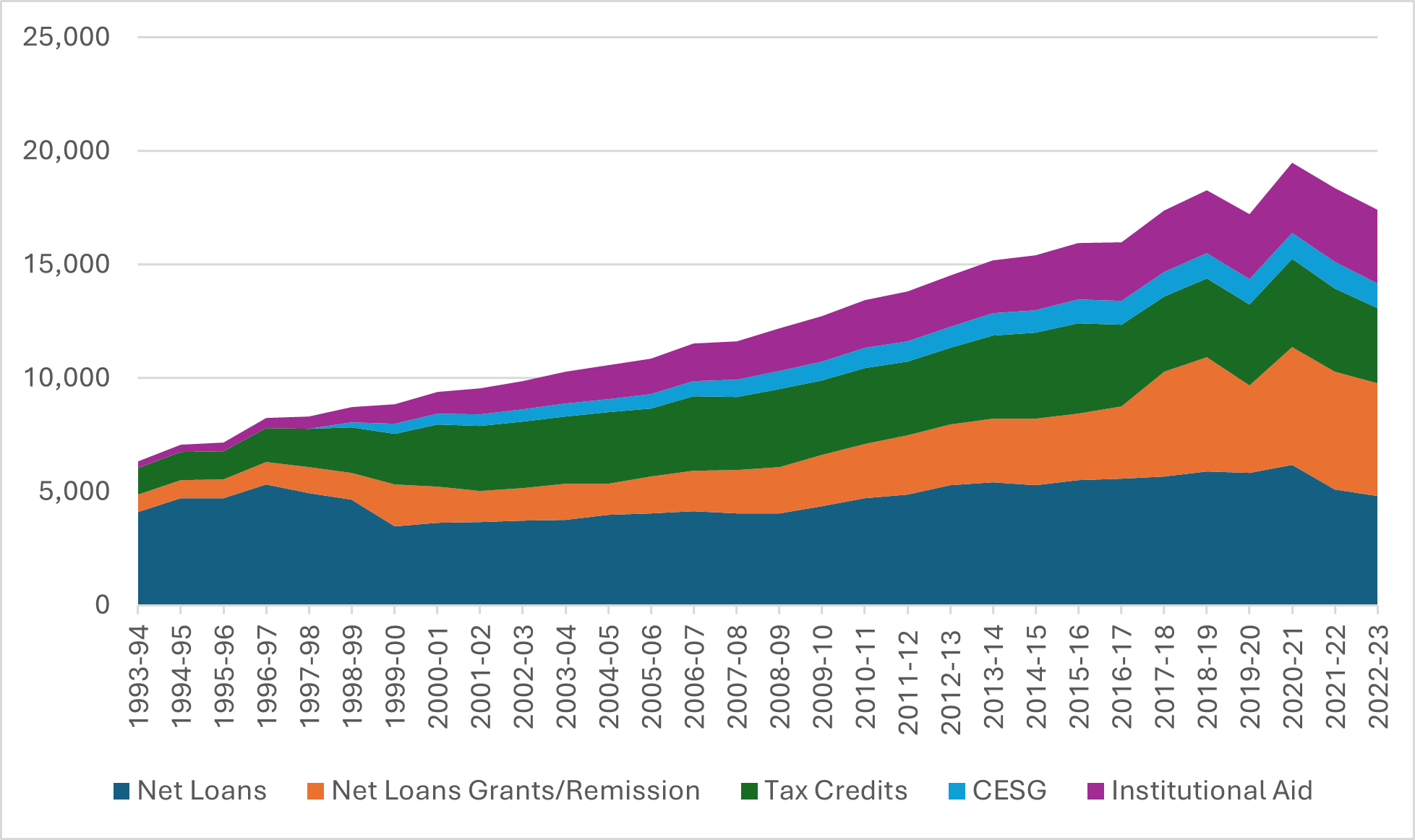
    In a series of federal budgets between 1996 and 2000, billions of dollars were thrown into grants, tax credits and a new program called “Canada Education Savings Grants,” which were a form of matching grant for contributions to RESPs. Grants and total aid rose; loans issued fell by a third, mainly between 1997 and 2001 (a recovering economy helped quite a bit). Tax expenditures soared, which due to a rule change allowing tax credits to be carried forward meant either students got to keep more of their work income or got to reduce their taxes once they started working.

    Since this period of rapid change at the turn of the century, student aid has doubled in real terms. And nearly all of that has been an increase in non-repayable aid. Institutional scholarships? Tripled. Education scholarships? Quadrupled. Loans? They are up, too, but there the story is a bit more complicated.

    Figure 1: Student Aid by Source, Canada, 1993-94 to 2022-23, in thousands of constant $2022

    For the period from about 2000 to 2015, all forms of aid were increasing at about inflation plus 3%. Then, in 2016, we entered another period of rapid change. The Governments of Canada and Ontario eliminated a bunch of tax credits and re-invested the money into grants. Briefly, this led to targeted free tuition in Ontario, before the Ford government took an axe to the system. Then, COVID hit and the CSFAP doubled grants. Briefly, in 2020-21, total student aid exceeded $23 billion/year (the figure above does not include the $4 billion per year paid out through the Canada Emergency Student Benefit), with less than 30% of it made up of loans.

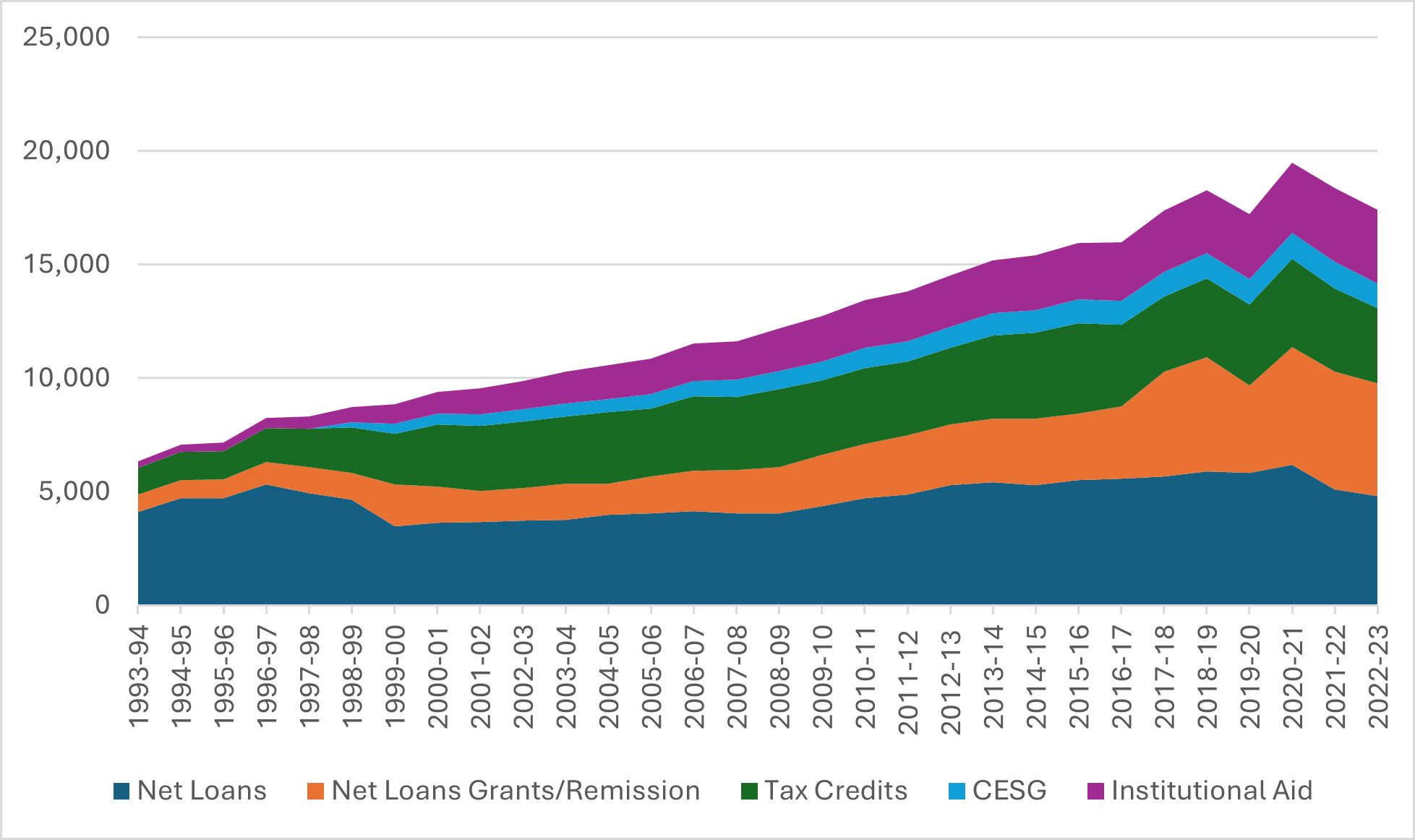
    One important thing to understand about all this is that while the system became much larger and much less loan-based, something else was going on, too. It was becoming much more federal. Over the past three decades, provincial outlays have risen about 30% in real terms; meanwhile, federal ones have quadrupled. In the early 1990s, the system was about 45-55 federal-provincial; now, it’s about 70-30 federal. It’s a stunning example of “uploading” of responsibilities in an area of shared-jurisdiction.

    Figure 2: Government Student Aid by Source, Figure 1: Student Aid by Source, Canada, 1993-94 to 2022-23, in thousands of constant $2022

    So there you go: a century of Canadian student aid in less than 850 words. Hope you enjoyed it.

    Source link