
Tag: Cancer

  • Free College Admissions Counseling for Cancer Survivors

    Free College Admissions Counseling for Cancer Survivors

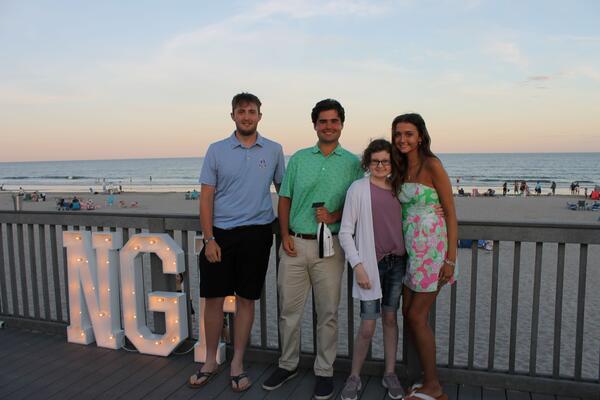
    Anthony Gallonio has spent most of his career working in higher education admissions and financial aid, watching young people select, apply to and enroll in colleges. But when his daughter Grace received a cancer diagnosis 14 years ago, when she was a year old, he realized there was an underserved group of teens who needed support in college exploration: cancer patients.

    “I remember looking at these kids coming in [to the hospital] thinking, ‘How are they doing it?’” Gallonio said. “Their lives are still going on, high school is taking place, college is still in the future. We know one missed application or one missed form or one missed deadline could mean the difference between getting into a school or not or getting tens of thousands of dollars in scholarships or not.”

    In 2011, Gallonio established the National GRACE Foundation, a nonprofit that offers free information and advice on higher education for families of young people who survived childhood cancer. The group is supported by volunteers across the country who work in higher ed, illuminating the hidden curriculum to encourage student success.

    The background: GRACE, named after Gallonio’s daughter and short for Growing, Recovering and Achieving a College Education, is designed to break down barriers to enrollment for childhood cancer survivors and support parents and caregivers navigating college applications and beyond.

    “The whole goal has been to take the stress out of the college admissions and financial aid process for families who have a lot of stress going on and try to help them avoid the mistakes that I have seen over the years,” Gallonio said.

    A 2019 study of 16,700 childhood cancer survivors found that about half graduated from college; those reporting chronic conditions were even less likely to complete a degree by age 25.

    Many pediatric cancer survivors Gallonio works with aspire to careers in helping roles, including in health care, social services or research, he said. Getting into and through college is just the first step in that journey.

    How it works: GRACE provides a range of services, including offering advice on financial aid, tracking upcoming deadlines, explaining confusing terminology or jargon, and highlighting various colleges and programs that might be a good fit for the student. A majority of the students and parents come from low- or middle-income families, and they often find the foundation through word of mouth or through partnerships with hospitals.

    “I think about our services in the way that a family might hire college consultants, but we do it all for free,” Gallonio said. “That’s the group that we’re seeing—those folks who need help but also don’t have necessarily the resources to pay for [a consultant].”

    GRACE volunteers also provide in-person and webinar events for parents and caregivers on topics like college costs and scholarships.

    Once students are enrolled, GRACE supports their persistence by working as a liaison between institutions and families. They might appeal for more financial aid, for instance, or advocate for student supports through disability services offices. “We know what [families] are going through, we know what these school are going through, we kind of speak their language,” Gallonio said.

    The organization has up to 30 volunteers at any point in the academic year, but “we are always looking for volunteers in the higher ed landscape—anywhere in the country, at any type of institution,” to provide counseling to pediatric cancer survivors, Gallonio said.

    Building better: Since launching in 2011, GRACE has assisted over 300 young people in their pursuit of a college degree, and Grace, the foundation’s namesake, is “a happy and healthy 15-year-old,” Gallonio said. Families have also secured over $3 million in scholarships through the foundation’s advocacy work.

    Olivia Falzone, a rising first-year student at the College of Charleston and cancer survivor, receives the Isabel Helen Farnum Scholarship from the National Grace Foundation.

    Anthony Gallonio/National GRACE Foundation

    Over the years, GRACE has expanded services beyond the Northeastern U.S., where Gallonio is located, to support prospective students from coast to coast. As the foundation’s reach has grown, so has its perspective on postsecondary education.

    Initially, the focus was to help cancer patients have a good shot at a competitive institution. It has since expanded to highlight the value of higher education in any capacity and offer vocational or alternative pathway support as well.

    “A lot of it has to do with breaking down that [college] can be done, that it can be affordable,” Gallonio said. “The stories that we hear about debt, about the $90,000 colleges—that’s not every college, and there are colleges in every state that a family can afford to go to.”

    Gallonio is considering changing GRACE’s acronym to “Growing, Recovering and Continuing Education,” to reflect the wider range of pathways available to young people.

    This fall, GRACE will launch a mobile application and webpage so prospective students and parents can explore colleges and universities’ disability services, careers and trades, financial aid information, and selectivity rates. The app also includes a personalized scholarship search service, allowing individuals to put in their information and receive tailored suggestions for scholarships to apply for.

    “We try to make it a one stop,” Gallonio said. “We’re not charging them for usage or anything like that. Hopefully it saves our volunteers and us time.”

    We bet your colleague would like this article, too. Send them this link to subscribe to our newsletter on Student Success.


    Source link

  • Nike Co-Founder Gives $2B to Oregon Cancer Institute

    Nike Co-Founder Gives $2B to Oregon Cancer Institute

    The Oregon Health & Science University will receive a $2 billion gift from Nike co-founder Phil Knight and his wife, Penny, to support the eponymous Knight Cancer Institute, OHSU announced last week.

    It is the largest single donation ever made to a U.S. university-affiliated health center and is intended to promote the integration of cancer diagnostics, treatment and patient care.

    The gift will allow the cancer institute to become self-governed within OHSU. It will have its own board of directors under the leadership of Brian Druker, a leukemia researcher who has worked closely with the Knights and who helped develop a drug that vastly improved the life span of patients with chronic myeloid leukemia.

    “This gift is an unprecedented investment in the millions of lives burdened with cancer, especially patients and families here in Oregon,” said OHSU president Shereef Elnahal. “It is also a signal of trust in the superlative work that our clinicians, researchers and teammates at the Knight Cancer Institute do every day. Dr. Druker’s vision around a multidisciplinary system of care—focused squarely on making the patient’s experience seamless from the moment they receive a diagnosis—will now become reality. And thanks to the extraordinary generosity of Mr. and Mrs. Knight, Oregon will be the place to do it.” 

    The Knights have been key benefactors of the cancer institute. In 2013 they vowed to donate $500 million if the university could match the funds within two years—which it did, thanks to $200 million in bonds from the Oregon Legislature, $100 million from Columbia Sportswear chair Gert Boyle and assorted donations from some 10,000 individuals from all 50 states and 15 countries. 

    Source link

  • Shaping the Future of Cancer Treatment and Advocating for Women in STEM

    Shaping the Future of Cancer Treatment and Advocating for Women in STEM

    Megan O’Meara, M.D., head of early-stage development at Pfizer Oncology, is deeply committed to scientific innovation, mentorship, and breaking barriers for the next generation of women in science, technology, engineering, and mathematics (STEM) industries. In this conversation, Megan shares her journey in oncology, leadership philosophy, and vision of a world where people with cancer live better and longer lives.

    Megan O’Meara, M.D.

    Head of Early-Stage Development, Pfizer Oncology

    What drew you to pursue a career in oncology and what is it that inspires you most about working in this field?

    I’ve always been curious about science. My grandfather was a pediatrician, and as a child he read books to me about the history of medicine. In high school, I worked in cancer research labs, and that gave me exposure to the field from an early age. By the time I was in college, there were exciting advancements happening, including broader use of tumor profiling and targeted therapies. I felt there was a huge opportunity to transform cancer treatment, and I knew I wanted to be part of it. I pursued my medical degree and later went into academic research before transitioning to industry, where I felt I might have the broadest impact on the greatest number of people.

    Women make up less than 30% of the global STEM workforce. What has your experience been as a woman in research?

    Being a woman in a historically male-dominated field can come with unique challenges and opportunities. There were times when I was the only woman in the room. On occasion, I felt like the only one leaving the office on time to make dinner for my family and worried about missing opportunities or important conversations that were happening when I wasn’t there.

    Over time, I learned to accept the situation and be confident in setting personal boundaries. I inserted myself in different ways and advanced my career without losing who I am. I developed the confidence to be me — bringing my most authentic and whole self to work. Now, I encourage and empower other women to do the same.

    As an industry, there’s still a long way to go. At a recent oncology conference, research showed that men presenting were introduced as “Dr.” while women were introduced by their first names. It seems nuanced, but it reflects a larger issue. Even in a field like oncology, where we pride ourselves on progress, bias still exists in subtle but pervasive ways. Things are improving, but they’re not where they should be yet. That’s why I feel so strongly about uplifting other women and creating opportunities for women in science.


    Learn more about Pfizer Oncology at Let’s Outdo Cancer.


    How are you working to change the research field to be more inclusive and supportive of women?

    There were many people, particularly female leaders, throughout my career who saw my potential and championed my advancement. I try to do the same for all my team at Pfizer, including the talented women that work with me. I mention their names when I’m in a room with other leaders; I look for opportunities that will showcase their potential.

    Outside of work, I volunteer at my daughter’s elementary school to organize events that engage students with science, such as bringing in Pfizer scientists to demonstrate lab techniques like DNA isolation and talk about how science can be applied to areas they are interested in. Studies show that girls start losing interest in science around age 12, so, if we can work to address that early, it can make a difference in improving female representation in STEM fields.

    I’m also active in the Society for Immunotherapy in Cancer (SITC) Women in Cancer Immunotherapy Network. I’ve spoken about my journey in research at their events, which are often attended by many women in both academia and industry who are at a crossroads in their career. They’re wondering, “Can I do this?” Hearing people’s stories about how they made it work can be incredibly inspiring.

    As head of the division at Pfizer Oncology responsible for developing innovative cancer treatments, what excites you most about the work your team is currently doing?

    Right now, I’m particularly excited about our work in antibody-drug conjugates (ADCs). ADCs are innovative cancer medicines that specifically target cancer cells and deliver cancer-killing drugs ​directly to tumors, while sparing more of the healthy cells in the body. ​

    ADCs have been the foundation of my career, having worked in the space for almost 15 years. This depth of experience, knowledge, and history is being applied now to what we’re doing at Pfizer to advance the field. And we’ve had a huge impact already — bringing treatments to people with blood cancer for the first time in decades and significantly changing the standard of care across tumor types.

    Now, as a company, we’re asking, “How do we make ADCs even safer and more effective?” We’re exploring new drug linkers, different payloads, and novel combinations, all with the goal of giving patients better options. This kind of innovation is why I pursued a career in STEM — it’s tremendously fulfilling to be bringing us closer to a world where people with cancer live better and longer lives.

    How is Pfizer uniquely positioned to make progress in cancer treatment?

    I like to say Pfizer embodies a spirit of innovation and we have some of the most brilliant and dedicated scientists I’ve ever worked with. It’s rare to work at a company, even in big pharma, that has demonstrated leadership across multiple modalities of science the way Pfizer has. We’re constantly learning, adapting, and investing in what’s next across a wide pipeline of products. It’s an amazing powerhouse to be a part of.

    For me, our success is also due to a culture — set by our executives — where each person has the opportunity to thrive. Chris Boshoff, chief scientific officer and president, R&D, is passionate about showcasing the team and giving people opportunities. I’ve experienced the same from other leaders. When I first joined Pfizer, Sally Susman, executive vice president and chief corporate affairs officer, introduced herself and said, “Next time you’re in New York, come meet my team.” She brought me into her leadership meeting and helped me build connections. These are just two of many people that have gone out of their way to create an environment where I am able to bring my best self to work, and I am doing the same to ensure my team of scientists has everything they need to succeed.

    What do you hope for the future of women in STEM?

    I hope that in 20 years, women don’t have to navigate as many barriers. I hope everyone can bring their whole self to the table without feeling like they need to sacrifice a piece of their personal life to succeed. Instead of feeling impostor syndrome around big opportunities, I hope women ask themselves, “Why not me?”

    We still have work to do, but I truly believe we’re making progress. By supporting women, we’re supporting a better industry and better science.


    Learn more about Pfizer Oncology at Let’s Outdo Cancer.


    Source link