Tag: capital

  • Moral Capital and Locus of Control

    Moral Capital and Locus of Control

    Moral capital has become a contested currency in American public life. It is deployed by political elites to justify austerity, by campus executives to rationalize managerial authority, and by think tanks to discipline the working class. Yet moral capital also rises from below—from students building mutual-aid networks, from adjuncts organizing for fair wages, from communities confronting the harms universities have helped produce. In an era defined by climate peril, surveillance capitalism, and proliferating wars, the stakes of who controls moral capital—and who gets to exercise real agency—have never been higher.

    At the center of this struggle lies a fraught psychological and sociological concept: locus of control. Higher education constantly toggles between narratives of internal control (grit, resilience, personal responsibility) and external control (the market, political pressures, funding cycles). Powerful actors encourage an internal locus of control when it shifts blame downward, and an external locus of control when it shields institutional failure. Students, staff, and faculty live suspended in this contradiction, expected to absorb the consequences of decisions made far above them.

    Quality of Life as Moral Imperative

    Quality of Life—once peripheral to higher education policy—is now a defining moral issue. Students and workers contend with unstable housing, food insecurity, unsafe campuses, inaccessible mental health care, and relentless economic pressures. For many, these burdens are compounded by existential crises: climate anxiety, global conflicts, democratic backsliding, and precarity amplified by technological surveillance.

    Institutions often portray these crises as personal challenges requiring self-management. But Quality of Life is not an individual moral failure; it is a metric of collective conditions. When a university community’s quality of life declines, it signals a profound imbalance between agency and structure—a distorted locus of control.

    The Industry’s Manufactured Moral Capital

    Universities have long crafted narratives that elevate their own moral standing while displacing responsibility onto individuals. The “grateful striver” student, the “self-sacrificing” adjunct, the “visionary” president—these tropes protect managerial systems from scrutiny and allow elites to accumulate moral capital even as Quality of Life deteriorates for everyone else.

    This manufactured moral authority collapses under existential pressures. As campuses confront heatwaves, flooding, militarized policing, housing crises, widening wars, and state-sanctioned surveillance, it becomes impossible to sustain the fiction that individuals can simply “grit” their way to stability.

    Reclaiming Moral Capital 

    Moral capital is not owned by institutions. It can be reimagined, reclaimed, and reoriented. Four longstanding modes of internal discipline—temperance, celibacy, critical thinking, and solidarity—take on new urgency when placed in the context of planetary and political crisis.

    Temperance

    Temperance, stripped of its historical misuse, becomes a strategy of mindful refusal in the face of consumption-based exploitation. It includes rejecting burnout culture, resisting technological tools that monitor student behavior, and refusing to internalize blame for systemic failures. In an era of climate breakdown, temperance also signifies ecological responsibility—a modest but meaningful form of internal control aligned with global survival rather than institutional convenience.

    Celibacy

    Broadly interpreted, celibacy represents intentional self-limitation that protects one’s emotional and cognitive bandwidth. Amid surveillance-driven social media, algorithmic manipulation, and institutions that increasingly commodify student identity, celibacy can be a form of psychological sovereignty. It creates space for reflection in a world designed to keep people reactive, distracted, and easily governed.

    Critical Thinking

    Critical thinking remains the academy’s most subversive tradition—especially when deployed against the university itself. It helps students analyze the interplay between personal agency and systemic constraint. It equips them to understand climate injustice, militarism, and the geopolitics of knowledge production. And it exposes the ways mass surveillance—from learning analytics to campus police technologies—erodes autonomy and shifts the locus of control away from individuals and communities toward powerful institutions.

    Solidarity

    Solidarity transforms private moral commitments into collective action. It breaks the isolation manufactured by surveillance systems, precarity, and competitive academic cultures. Solidarity has historically been the source of the most effective nonviolent strategies—from civil rights sit-ins to anti-war mobilizations to student debt strikes. Today, as geopolitical conflicts escalate and authoritarian tendencies rise, the power of organized nonviolence becomes an existential necessity. It is one of the few tools capable of confronting militarized policing, resisting state repression, and challenging the corporate infrastructures that profit from crisis.

    Nonviolent Strategies in an Era of Global Threat

    Nonviolent action remains a potent form of moral capital—and one of the most effective forms of collective agency. Research across conflicts shows that sustained, mass-based nonviolent movements often outperform violent struggles, especially against highly resourced opponents. For universities, which increasingly collaborate with defense contractors, data brokers, and state surveillance agencies, nonviolent resistance has become both a safeguard and a moral compass.

    Sit-ins, teach-ins, encampments, divestment campaigns, and labor actions reassert external locus of control as something communities can influence—not by force, but by moral clarity, strategic discipline, and the refusal to comply with harmful systems.

    Mass Surveillance as a Threat to Moral Agency

    Mass surveillance is now woven into the fabric of academic life. Learning management systems track student behavior down to the minute. Proctoring software uses biometrics to police exams. Campus police drones and public-private security networks feed data into law enforcement databases. Administrative dashboards quantify student “risk” and worker “efficiency” in ways that reshape institutional priorities.

    This surveillance apparatus corrodes moral capital by reducing human judgment to automated metrics. It also distorts locus of control: individuals are told to take responsibility while being monitored and managed by opaque systems far beyond their influence.

    Reclaiming agency requires dismantling or limiting these systems, demanding transparency, and reasserting human dignity in spaces now governed by algorithms.

    Toward a More Honest Locus of Control

    Moral capital and locus of control are not academic abstractions. They are lived realities shaped by climate disruption, war, inequality, and surveillance. Higher education must stop using moral narratives to deflect responsibility and instead cultivate practices that reinforce real agency: temperance, celibacy, critical thinking, solidarity, and the disciplined power of nonviolent resistance.

    In a world marked by existential threats, reclaiming moral capital from below is not simply an intellectual exercise—it is a condition for survival, and a pathway to collective liberation.

    Sources

    Frantz Fanon, The Wretched of the Earth

    Erica Chenoweth & Maria Stephan, Why Civil Resistance Works

    Shoshana Zuboff, The Age of Surveillance Capitalism

    Naomi Klein, This Changes Everything

    Paulo Freire, Pedagogy of the Oppressed

    Astra Taylor, Democracy May Not Exist, but We’ll Miss It When It’s Gone

    Source link

  • Private New York colleges get $50M in state financing for capital projects

    Private New York colleges get $50M in state financing for capital projects

    This audio is auto-generated. Please let us know if you have feedback.

    Dive Brief:

    • New York is contributing $49 million in capital grants to 35 of the state’s private nonprofit colleges to help fund upgrades to facilities, build new labs and research spaces, and invest in new technology and equipment. 
    • The state’s Higher Education Capital Matching Grant Program — led by a three-person board composed of political appointees — last week awarded grants ranging from tens of thousands of dollars to $5 million, New York Gov. Kathy Hochul announced on Friday.
    • Under the 20-year-old program, eligible colleges must invest $3 of their own money for every $1 of public funds. The next round of applications for projects is set to open in mid-December.

    Dive Insight:

    Since 2005, HECap has directed $369.8 million in state funding toward over 300 projects at private nonprofit colleges in New York, the governor’s office said. 

    The program makes the state a financial partner for private colleges, many of which were established well before the 1948 creation of the State University of New York system. 

    After a more than yearlong application process, the state’s HECap Board approved the latest round of projects at an Oct. 20 meeting. Colleges can use the funds to design, acquire, build, rebuild, renovate or equip buildings. Selected projects are meant to support a college’s academic offerings or student life, as well as to drive economic development in the state.

    These projects stand for our ongoing commitment to keeping New York at the forefront of education and economic opportunity,” Hochul said in a Friday statement

    The current round of combined public and institutional funds represents a $195 million capital investment in independent higher education facilities, according to Hochul’s office. 

    The grants cover a wide range of amounts to nearly three dozen institutions, including:

    • $1.8 million to Albert Einstein College of Medicine for renovations to a commons area and recreation center. 
    • $5 million to Clarkson University for the first phase of renovations to an engineering and science complex.
    • $69,800 to Maria College to purchase and install technological equipment. 
    • $1.8 million to Cornell University to build a large classroom space in a library.
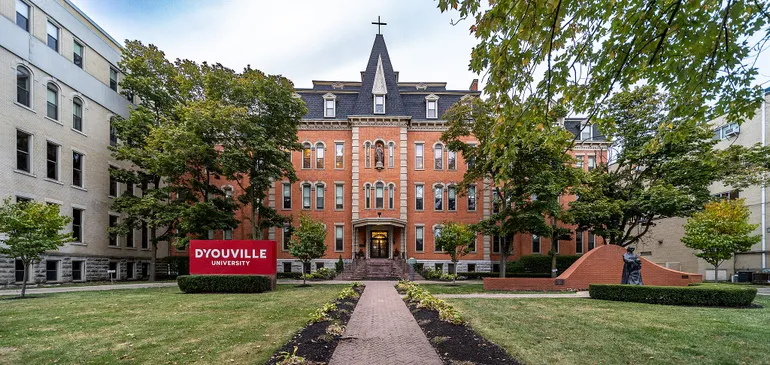
    • $5 million to D’Youville University for renovations to a facility supporting its osteopathic medicine college. 
    • $5 million to Hobart and William Smith Colleges for construction of a new science building and renovation of three adjacent facilities.
    • $1.8 million to the Rochester Institute of Technology to upgrade its electrical infrastructure. 
    • $1.6 million to Sarah Lawrence College to create an experiential learning center.

    New York’s continued public financing of capital projects comes while colleges across the country wrestle with sizable backlogs of deferred maintenance and facilities needs, many left over from the pandemic era as institutions put off those investments.

    Last year, analysts with Moody’s Investor Service estimated a “hidden liability” of deferred maintenance needs at colleges potentially amounting to nearly $1 trillion — and just among the roughly 500 institutions Moody’s rated at the time. 

    Rising costs, high interest rates and financial pressures can make those needs all the more difficult to meet.

    Few have the necessary resources and credit strength to sustain the higher amounts needed to tackle the full extent of their infrastructure needs,” Moody’s analysts said in their report. Colleges that can’t afford upgrades face recruitment risks in enrollment and staff talent as buildings continue to deteriorate. 

    The backlog of projects is so large that capital spending increases on existing facilities have served only to slow the growth of unmet need, according to a report earlier this year from the building intelligence firm Gordian.

    Source link

  • Higher Education’s Complicity in War and Fossil Capital

    Higher Education’s Complicity in War and Fossil Capital

    In a time of global climate catastrophe, endless war, and mounting social unrest, the American higher education system—ostensibly a sanctuary of ethics and enlightenment—has shown its allegiance not to peace or justice, but to power. The presidents of elite universities, their boards of trustees, and their wealthiest donors now stand exposed as key cogs in a machinery that profits from genocide, fossil fuel destruction, and war profiteering. They are not simply bystanders to global injustice; they are its enablers and its beneficiaries.

    The Role of University Presidents

    University presidents, many with backgrounds in business or law rather than academia, have become institutional CEOs rather than moral stewards. Their silence—or worse, their euphemistic statements—in the face of war crimes and environmental devastation reveals not neutrality but complicity. As students protest U.S.-backed wars and apartheid policies abroad, these leaders respond not with dialogue, but with surveillance, mass arrests, and the suppression of speech.

    The university president today is less a defender of academic freedom and more a manager of reputational risk. In the face of genocide in Gaza or mass civilian deaths in Yemen, many presidents remain silent or offer carefully crafted non-statements that betray the moral bankruptcy at the heart of neoliberal academia. Their true constituents are not students or faculty—but the donors and trustees who demand institutional alignment with corporate and political interests.

    Trustees as Enforcers of the Status Quo

    University trustees are often drawn from the ruling class: hedge fund managers, defense contractors, fossil fuel executives, and venture capitalists. These are not individuals selected for their commitment to education or the common good. They are chosen precisely because of their wealth and their proximity to power.

    Their presence on governing boards ensures that universities continue to invest in private equity, fossil fuels, and weapons manufacturers. They help enforce austerity for faculty and students while protecting multi-million-dollar endowments from divestment campaigns. When students call for cutting ties with Israeli defense contractors or fossil fuel companies, it is trustees who push back the hardest.

    Donors as Puppeteers

    Donors exert a quiet but overwhelming influence on policy, curriculum, and campus climate. Mega-donors like Stephen Schwarzman, Kenneth Griffin, and Leonard Lauder have given hundreds of millions to name buildings, shape public discourse, and suppress dissent. Often, these donations come with invisible strings—ideological conditions that shift the priorities of entire departments or shut down lines of critical inquiry.

    In the case of fossil fuels, large gifts from oil and gas interests help sustain “energy centers” at top institutions, which in turn push pro-industry research and obstruct climate activism. In terms of war, donations from defense industry executives or foreign governments with poor human rights records ensure a steady normalization of militarism on campus.

    Even genocide, once a line that no institution dared cross, is now rendered a matter of “complex geopolitics” by the same donors who pour money into think tanks and academic centers that sanitize ethnic cleansing and apartheid.

    Genocide and the Academy

    It is no longer possible to ignore the role of elite institutions in justifying or supporting genocidal policies. When universities accept grants and partnerships with governments or corporations involved in mass displacement, ethnic cleansing, or indiscriminate bombing, they become accomplices in atrocity.

    During the ongoing Israeli siege of Gaza, for example, several major U.S. universities have contracts or investments tied to Israeli defense firms or U.S. arms manufacturers whose weapons are used against civilians. Students calling for divestment face violent repression, police brutality, and academic retaliation. The pursuit of justice is punished. The preservation of power is prioritized.

    Fossil Fuels and the Death Economy

    Despite decades of research proving the existential threat of fossil fuels, many university endowments remain deeply invested in oil, gas, and coal. The divestment movement, led primarily by students, has scored some victories—but these are often cosmetic. Institutions may pull direct holdings while maintaining exposure through private equity or index funds.

    Fossil fuel interests also shape research agendas, sponsor misleading “carbon capture” or “clean energy” projects, and silence environmental whistleblowers. Professors who speak out risk losing funding. Departments that challenge fossil capital are marginalized. The truth, as always, is inconvenient.

    War as a University Business Model

    Finally, the war economy permeates American higher education at every level. Defense contracts support engineering departments. ROTC programs and military recruiting are embedded in campus life. Universities run weapons labs, receive funding from DARPA, and participate in Department of Defense research initiatives. The “military-academic-industrial complex” is not an abstraction—it is the everyday reality of higher ed.

    Many of these contracts directly support weapons development used in current conflicts. And as with fossil fuels, the system is built to insulate the university from moral scrutiny. War is framed as “security research.” Genocide is called “a contested political issue.” Exploitation is rendered invisible through language.

    Toward a Reckoning

    The American university must decide: Will it continue to serve as a laundering machine for violence, fossil capital, and authoritarian control? Or can it reimagine itself as a truly democratic institution—answerable not to trustees and donors, but to the communities it serves?

    That transformation will not come from the top. It will come from students occupying campus lawns, adjuncts organizing for fair wages, and the public demanding transparency and divestment. The reckoning is long overdue.

    Until then, university presidents, trustees, and donors will remain what they have become: polished stewards of empire, cloaked in Ivy and moral evasion.

    The Higher Education Inquirer continues to investigate the political economy of higher ed, exposing how institutions prioritize power and profit over people and planet.

    Source link

  • Banking on Human Capital: How RBC Sees the Future of Talent, Innovation, and the Role of Post-Secondary Institutions

    Banking on Human Capital: How RBC Sees the Future of Talent, Innovation, and the Role of Post-Secondary Institutions

    Canada’s heading into some pretty choppy waters in 2025. For a century or so, we’ve had a one track economic strategy, closer integration with the United States. Now, the Trump administration with its faith in tariffs as an instrument of both power and corruption, has essentially nuked that strategy, at least as far as the trading goods is concerned. There’s a lot of change coming to Canada, and it’ll be costly. In much the same way that diplomatic evolution and defense needs are forcing European countries to look at higher education in a different light, Canadian universities are looking around at their new situation very nervously too.

    In Canada right now, a few people are making the case for change as strongly as John Stackhouse. John’s the ex editor-in-chief of the Global Mail. He’s now a Senior Vice President at the Royal Bank of Canada, leading that organization’s economics and thought leadership group. He’s the lead author of a recent report called “A Smarter Path, the Case for Post-Secondary Reform.” This report makes a number of, shall we say, uncomfortable observations about the relationship between Canadian higher education and the Canadian knowledge economy, in particular, between high spending and high graduate numbers on the one hand, and low productivity and significant levels of graduate underemployment on the other.

    Though the report does not directly address the issue of Trump or tariffs — it was released 48 hours before Liberation Day — it has added to the sense in Canada that the higher education sector is headed for and indeed needs a shakeup. And just to come clean for a moment, we here at Higher Education Strategy Associates are in a partnership with John and RBC and the Business Higher Education Roundtable, putting together a series of events culminating in a policy summit on post-secondary education in late September of this year.

    In the interview today, I talked to John about what the Canadian system’s biggest challenges are, how universities and businesses can more effectively partner with one another, and why Canadian political parties are increasingly shy about betting on the knowledge economy. But enough for me. Let’s turn it over to John.


    The World of Higher Education Podcast
    Episode 3.30 | Banking on Human Capital: How RBC Sees the Future of Talent, Innovation, and the Role of Post-Secondary Institutions

    Transcript

    Alex Usher (AU): Okay, John, why does a bank care so much about post-secondary education?

    John Stackhouse (JS): That’s a fair question, Alex—and thank you for including us in the podcast. If I can put it in terms of capital, maybe that’s what people would expect from a bank. Our economy, and the society that depends on it, relies on different kinds of capital. We have natural capital, technology capital, and of course, financial capital—which you’d expect from a bank. But just as critical is human capital. That’s core to the economy.

    There’s nothing new in saying that, except to emphasize that from RBC’s perspective, when we look at Canada’s prospects through the 2030s and the prosperity we hope to achieve, we need to think seriously about how we harness all these forms of capital: natural, financial, technological—and critically—human capital.

    We need to develop a more prosperous economy and society, but also the kind of vibrant communities that companies want to be part of, and that we as individuals want to contribute to. As a bank, that matters to us. Our purpose is to help clients thrive and communities prosper—and both of those depend on human capital. We hear that from our clients, our community partners, and our employees. So those are just some of the reasons why RBC is leaning into the post-secondary conversation.

    AU: In the paper you co-wrote, you describe Canada’s post-secondary education system as being slow, costly, and often out of sync with the economy. I think those are fairly common criticisms of higher education around the world. Do you think there’s something specific to Canada in that critique? Or is this more of a general observation about modern higher ed?

    JS: There’s probably some parchment from a thousand years ago where an education critic wrote, “You’re too slow, too costly, and out of touch with the economy.” -Signed, the monks of higher education. But yes, it’s fair to say that Canada isn’t alone in facing these challenges. That said, there are a few things that may be more pronounced here. One is that we’ve been a bit of a victim of our own success. We have a lot of post-secondary education in this country, but we haven’t differentiated enough within the system.

    Continental Europe, for example, continues to differentiate in ways we haven’t. So we end up producing graduates with degrees and diplomas that are too similar—and not always aligned with specific needs.

    We also haven’t allowed the business model to evolve at the pace of the economy or society, or even the expectations of students and educators. Many of them know the world is moving faster than our institutions are.

    And then on the research side—which I’m sure we’ll get to—we really lag behind. As an advanced economy, a G7 country, we’re not where we should be in post-secondary research. Part of the issue lies with the private sector—we haven’t integrated research and business to the degree that an advanced economy will need to in the 2030s.

    AU: RBC has been a really strong voice on the education–work connection. What are employers still not getting from the current system? And what responsibility do you think they have in helping to improve it?

    JS: There’s definitely a shared responsibility—and thanks for mentioning RBC’s commitment to work-integrated learning. One of the reasons we’re so invested in this is because our CEO, Dave McKay, is a product of the co-op system at Waterloo. He has a deep belief that work-integrated learning not only improves the student experience, but also strengthens the education system itself.

    When students return to the classroom after applying their knowledge in the real world, it deepens their learning. And it also improves the organizations they work with. At RBC, we hire a couple thousand co-op students every year—not just programmers from Waterloo, but fantastic interns from TMU and a wide range of colleges and universities across the country.

    We benefit from that. It improves how we work. Yes, it creates a talent pipeline—but we’ve also seen something more transformative. Over the past decade, we’ve started giving our co-op students real challenges to solve. We form teams, provide some management support, and tell them: here are some of our biggest problems—see you in August. Then they present their ideas to senior leadership in what’s essentially a competitive showcase. We’ve had around a hundred patents come out of that system.

    Students bring critical thinking, fresh perspectives, and a collaborative mindset that they develop in post-secondary. They often arrive with stronger teamwork skills than we could teach them from scratch, and they’re able to apply those skills to real problems.

    So what do employers need to do? They need to treat this as a serious investment in their own businesses. It’s a way to drive change, but it requires resources. You have to hire people who are good at managing these programs. Students don’t just walk in and figure it out on their own—it’s not Lord of the Flies. It takes organizational effort.

    AU: Let’s talk about what educational institutions are doing. I got the impression from the report that you think they still need to do more to align educational outputs with labor market needs. That said, there’s been a lot of progress over the last decade: growth in work-integrated learning, the rise of microcredentials, experiments with competency-based learning. But it sounds like you don’t think that’s enough. What more needs to happen?

    JS: Sadly—or depending on your perspective, maybe excitingly—none of us are doing enough. That’s partly because of technology, but also because of broader global forces. The world around us is changing faster than most of us are able to keep up with—including large organizations, small businesses, and educational institutions.

    The pace of change is accelerating, and it will only continue to do so. Institutions need to become much more change-minded in how they operate. That’s hard in education, for all the reasons your listeners will understand.

    One major challenge is the business model. It’s becoming a crisis. Post-secondary institutions aren’t getting the funding they need. Everyone knows that—but they’re losing the argument in the public square when it comes to making the case for new funding. And given the pressures society is under, I don’t see that changing in a meaningful way anytime soon.

    So institutions need more freedom to change—to evolve their business models, including how they generate revenue. And that means becoming more connected to, and responsive to, the broader economy around them. That’s where many of the new opportunities lie.

    AU: John, we’ve been talking mostly about human capital, which you’ve said is a key concern for RBC. But what about research and the co-production of knowledge? What are the respective roles of post-secondary institutions and businesses? Why don’t we see the kind of close connection between enterprises and universities that exists in parts of Europe or the U.S.? What’s the missing link?

    JS: That’s a tough nut to crack—and one that people far smarter than me have studied and debated for decades. But part of the challenge lies in the private sector itself. In many ways, we’ve become too much of a “branch plant” and “hinterland” economy—living off the wealth of the land, our access to the U.S. market, and the dividends of an innovation economy.

    I wouldn’t say that’s coming to an end—because that would be overly dramatic—but we’re clearly experiencing a sharp shift. In an odd way, the Trump challenge to Canada is a bit of a gift. It’s forcing us to acknowledge that we can’t be so dependent on the U.S. market. That’s become a broadly shared Canadian view. We need to build stronger connections with other parts of the world—and that’s going to require more serious investment in R&D from our businesses.

    If we want to transform branch plants into independent, globally competitive facilities, especially ones that can succeed in European and Asian markets—despite the distance—we need to invest in research and development in a way we haven’t for a generation.

    New governments—federal and provincial—need to act with urgency. They should bring business leaders together and ask, “What do we need to build?” And not just through one-off tax incentives. We need to foster a culture of collaboration and dynamism between universities, colleges, polytechnics, and businesses to shape what I’d call a post-Trump Canadian economy.

    That’s not going to happen by copying Germany’s Fraunhofer model or Japan’s approach—those are deeply rooted in specific cultural contexts. We need to develop something uniquely Canadian.

    And we can’t afford to spend years on a Royal Commission or slow-moving studies. This needs to happen quickly. A new federal government could seize this moment to bring together the provinces and private sector with a sense of urgency—and maybe even a crisis mindset.

    AU: I’ll come back to the Trump issue in a moment, but going back to the report—you lay out a number of challenges in the sector: outdated budget models, over-credentialed but under-skilled graduates, and so on. What do you think is the most pressing reform Canadian post-secondary needs right now? What’s the weakest link in the system?

    JS: That’s a great question—and a hard one to answer. But I’d go back to the funding model. Post-secondary institutions need more flexibility to innovate with how they’re funded. They need to move beyond the constraints of provincial funding and develop new approaches to tuition and fees—ones that are more closely tied to performance, outputs, and outcomes.

    There also needs to be more competition within the sector. Most people I know in post-secondary are pretty enthusiastic about that idea—though, understandably, they’d like the model to be structured so they have a good shot at succeeding.

    I think provinces need to be nudged—and maybe not even that much—to open the door to more innovation, more competition, and a bit more daring on the institutional side.

    AU: I think the words you used in the report were “reasonable deregulation.” Tell me more about increased competition—are there things we could do to incentivize more new players in the system who might be more disruptive?

    JS: There’s nothing quite like new players. I’ve studied enough sectors over the years to see that when it comes to innovation, nothing works quite as well as a vibrant, well-funded new entrant. Encouraging that kind of disruption would move us forward significantly—and it would give creative people across the sector permission to come up with ideas they’re not even thinking about yet. That’s the power of competition.

    So one key step is reducing the regulatory barriers that prevent those new players from entering the space.

    I also think employers can play a bigger role by sending clearer market signals. That could be as simple as hiring differently. We tend to recruit from the same institutions over and over—often for good reasons—but “like hires like.” If we want to encourage new entrants, we have to show that their graduates will have good job prospects. That kind of signal travels fast—even down to the high school level, where students are making decisions about their future.

    AU: Outside the scope of the report, you’ve been very outspoken in recent months about the gravity of the threat Canada faces from the U.S. under Trump. You spoke at the Business + Higher Education Roundtable event, and I know people who heard your remarks were quite sobered by them.

    There are clearly big changes coming to the country as a whole. What are the implications for universities? What changes do you think are now baked into the systems of government subsidy and regulation because of the shifting geopolitical situation?

    JS: It’s unfortunate that colleges and universities aren’t more central to the Trump-related conversation. We’re hearing a lot about pipelines, export infrastructure, and ports—which are all important. We’re also hearing a lot about trade-exposed sectors: autos, steel, aluminum, even pharmaceuticals. Guess what? All of those sectors depend on post-secondary institutions.

    So how are we thinking about the steel plant of the future that might be exporting more to Europe or Asia? It’s going to need incentives to retool. The same goes for auto plants that may need to shift into different kinds of manufacturing—including, potentially, defense production as we scale up defense spending. What kind of talent will be needed for that? How are schools in those regions adapting? And to your point about research—how can we better integrate the research side of those institutions into this transformation?

    They’ll need to develop new models—and we need to incentivize that shift. The good news is, I think there will be more money on the table. But it will be different kinds of research and institutional funding than what we’ve seen in the past. And that could be a good thing.

    So how do colleges and universities rise to that challenge? There could be tens of billions of dollars available to support economic transition. They’ll need to step up and play a leading role—and if they do, they’ll be rewarded for it.

    Interestingly, there’s already growing enthusiasm to attract academic talent from the U.S.—what some are calling “Trump intellectual refugees.”

    I’ve seen similar cycles before. After 9/11, during the Bush years, there was a similar kind of excitement. Star academics moved here as a sort of cultural vote for Canada. But that kind of movement doesn’t tend to be sustainable—or even all that interesting—from a long-term perspective.

    So how do we make it sustainable and interesting? One idea, from someone else, is to create a kind of Canada Research Chairs 2.0 for the late 2020s.

    Not a play to say “Come escape Trump,” but rather to say: if you’re an entrepreneurial, ambitious academic working in areas that matter to Canada, there’s no better place in the world to be right now than here.

    AU: One of the points you touched on earlier is that political parties seem to be responding to aggressive tariffs on exports by doubling down on producing goods. I find that kind of strange—surely one of the answers is to pivot more toward services. We’re not especially strong in that area, and in theory, that’s where universities should have an advantage. Why do you think we’re pushing so hard on goods while letting the services side drift?

    JS: That’s a great observation. We’ve become more of a services—or maybe better put, an intangibles—economy. A knowledge economy. That was a popular thing to say a decade ago, though it’s become a bit derided since.

    But we need both. You can have intangibles on their own, but the best ones tend to emerge from tangible activities.

    We need to play to our strengths, and that includes our resource economy. One of the things we noted in our study is that post-secondary doesn’t align with the resource economy as well as it should. That doesn’t mean just producing miners and rig operators—though those roles will still matter for years to come. There’s a whole spectrum of science and discovery we’ve long excelled at, and we need to scale that up if we want to lead in critical minerals, for example.

    It’s not just about having critical mineral mines or processing plants. We’ve shut down many of our best mining schools in this country, while China has established far more than we have—far more than you’d expect based on population size alone.

    So yes, we need to invest in the intangible—knowledge—side of that tangible sector. It’s not just manufacturing, as you said. It’s also processing and resource extraction, which are highly sophisticated fields. Those have earned Canada substantial academic recognition over the decades.

    We need to ensure that the intangible capacity we’re building in our universities and colleges remains closely tied to the real economy—especially to manufacturing and resource development.

    AU: Best case scenario—ten years from now—what does the Canadian post-secondary system look like? How is it different from today?

    JS: It would have much more variation. In fact, we might see something entirely new emerge—something that’s not quite a college, university, or polytechnic, but a distinct Canadian model.

    Just as Canada pioneered community colleges in the 1950s and ’60s, we have a chance to create a new tier. And this wouldn’t be at the expense of the existing systems—but something more suited to evolving needs.

    We’d have institutions that reflect and respond to the economy across all regions, including the far North. We don’t need to be physically present everywhere—we can do a lot of this remotely—but we do need our institutions to better reflect the realities of the country and the economy. And they need to be more connected to the world.

    You and I have talked a lot about the situation with international students. The real tragedy of what’s happened over the last decade would be if we abandoned the whole model. We had something that was largely good—it got mucked up—but that doesn’t mean we throw it out.

    We need to fix what went wrong. And we need to remain a destination for the best and most ambitious students from around the world. Ideally, we want them to stay—but even if they go back home, they can help connect us to the world.

    Because if we’re being honest with ourselves, what we’re really saying as Canadians—though maybe not quite this explicitly—is that we want to be a more global country. And our post-secondary system is one of the best tools we have to make that happen. But it will take a deliberate effort to reach out to the world—and there’s no sector better positioned to do that than post-secondary.

    AU: John, thanks so much for being with us today.

    JS: Thanks, Alex. I’ve really enjoyed it.

    Alex Usher: And it just remains for me to thank our excellent producers, Tiffany MacLennan, Sam Pufek, and you, our viewers, listeners, and readers for following us. If you have any questions or concerns about today’s episode or suggestions for future ones, please don’t hesitate to get in touch with us at [email protected]. Run, don’t walk to our YouTube page and hit subscribe. That way you’ll never miss an episode of the World of Higher Education Podcast.

    Join us next week when our guest will be Rómulo Pinheiro. He’s a professor at the University of Agder in Norway, and we’ll be talking about university’s role in the economic development strategies of rural and remote regions. Bye for now.

    *This podcast transcript was generated using an AI transcription service with limited editing. Please forgive any errors made through this service. Please note, the views and opinions expressed in each episode are those of the individual contributors, and do not necessarily reflect those of the podcast host and team, or our sponsors.

    This episode is sponsored by KnowMeQ. ArchieCPL is the first AI-enabled tool that massively streamlines credit for prior learning evaluation. Toronto based KnowMeQ makes ethical AI tools that boost and bottom line, achieving new efficiencies in higher ed and workforce upskilling. 

    Source link

  • Social capital and the degree awarding gap: spaces, places and relationships

    Social capital and the degree awarding gap: spaces, places and relationships

    • Amira Asantewa is Director of Programmes, Grit Breakthrough Programmes
    • Reuel Blair is Lead Diversity Programmes Coordinator at the Centre for Student and Community Engagement, Nottingham Trent University

    Progress on the Black-white degree awarding gap has gone into reverse.  Figures published by Higher Education Student Data (HESA) in autumn 2024 show that in 2022/23 the difference in the percentage of Black students and white students getting a first- or upper-second-class degree went up to 21.4 percentage points (pps) – from 19pps in 2021/22 and 17.6pps in 2020/21.

    Across the sector, institutions are responding. Access and Participation Plans have been signed off.  Work towards achieving Race Equality Charter marks is underway. Faculties and departments are decolonising curricula, diversifying assessment modes, tackling the lack of Black representation in the staff body and the postgraduate community.

    While there are debates about the way the sector analyses and addresses the awarding gap, what we do know is there is, as yet, little to say about what works in UK universities. However, evidence from our work with students of Black Heritage that suggests social capital is key.

    Black leaders

    It was back in 2019 that Nottingham Trent University and Grit Breakthrough Programmes co-designed with students the Black Leadership Programme (BLP) – a mix of community-building activities, mentoring, inspirational speakers and work with both employers and global institutions. Centrepiece workshops are delivered by Grit: breakthrough programmes.

    Six years on and an independent TASO-funded evaluation found strong statistical evidence of impact on final year grades and that these higher grades were likely to have been caused, not by increased academic engagement, but instead by increased motivation, social capital and sense of belonging. 

    This reinforced the findings of the independent evaluation of Grit’s Black Leaders and Students of Colour programme across seven universities, which suggested that students were able to apply skills and confidence from having expanded networks and engagement in new experiences, to their academic lives. And the students tell us what this looks like.

    Spaces for Black students

    Students talk about the importance of access to Black spaces. This space, this community, is a place where Black students are not, as Anike from Liverpool John Moores University puts it, ‘self-censoring to make myself palatable to white people.’ Instead, it is where ‘I can get into the conversations I always wanted to have, feel free to talk about what’s important to me.’

    Research describes how Black-affirming campus spaces are vital for Black student academic success and supporting Black student inclusion and well-being. Kwaku from Nottingham Trent University describes the value of ‘a space where there isn’t the weight of always being different. I want a space to connect with people, people who I can talk to about how I am feeling, what I am going though, and who I know would understand.’

    So social capital is also about belonging. Zelena from Bath Spa University describes wanting ‘to belong to a community of people we can all turn to, to draw strength from, to look up to and connect with.’

    Identity and representation

    It is about identity. Students tell us about the importance of ‘realising the value of my own upbringing, my heritage, my culture… that it is not something to be left behind or discarded… I want to explore and appreciate who I am and what I am.’ As Gemma from the University of Greenwich says, it’s about ‘finally claiming my identity. Becoming proud of being Black.’ University is a time for building a new independent life, figuring out who you really are and how your evolving identity fits in this new space. And there is a strong correlation between identities and deeper approaches to learning.

    It is about representation, both in the messaging about opportunities and in the ability of those delivering them to relate to the racial identity and cultural backgrounds of the students. Or, as Kane from Nottingham Trent University says, ‘it’s about how we have the right to be noticed, feel heard, to see that my voice, my opinion matters.’

    And social capital is also about wanting to make a difference, making a contribution. Afreya from the University of Manchester describes ‘helping other people who are feeling the same as I was. Going out of my way to be visible, showing how anyone just like me, can be successful.’

    Students are very clear about social capital: ‘I made friends from the programme. I’ve joined societies… I’ve been a course rep and a Student Ambassador… I’ve been part of a project supporting young Black learners in schools in the city…’

    They are very clear about its value: ‘It gave me strength… I’ve been relentless in seizing every opportunity available… I work more efficiently… harder and smarter… I feel that the university has an interest in nurturing Black talent and my growth and development.’

    So, alongside all the institutional plans, strategies and initiatives, there also have to be the spaces, places and relationships for Black students to be their full, authentic, very best selves and, just like their white peers, grow the social capital to thrive and succeed in their time at university and beyond.

    On 5th June at Nottingham Trent University, Grit Unleashed will take a deep dive into the university experience for Black students and Students of Colour across the UK in a day co-designed and co-delivered by student participants. For more details email [email protected]

    Source link