by Sarah Butrymowicz, The Hechinger Report
December 18, 2025
About 1.5 million people teach on college campuses in the United States, and nearly 4 million teachers work in its public elementary and secondary schools. More than 15 million undergraduates attend U.S. colleges and universities. There are more than 50 million school-age children across the country.
They all have one thing in common: Federal education policy affects their lives.
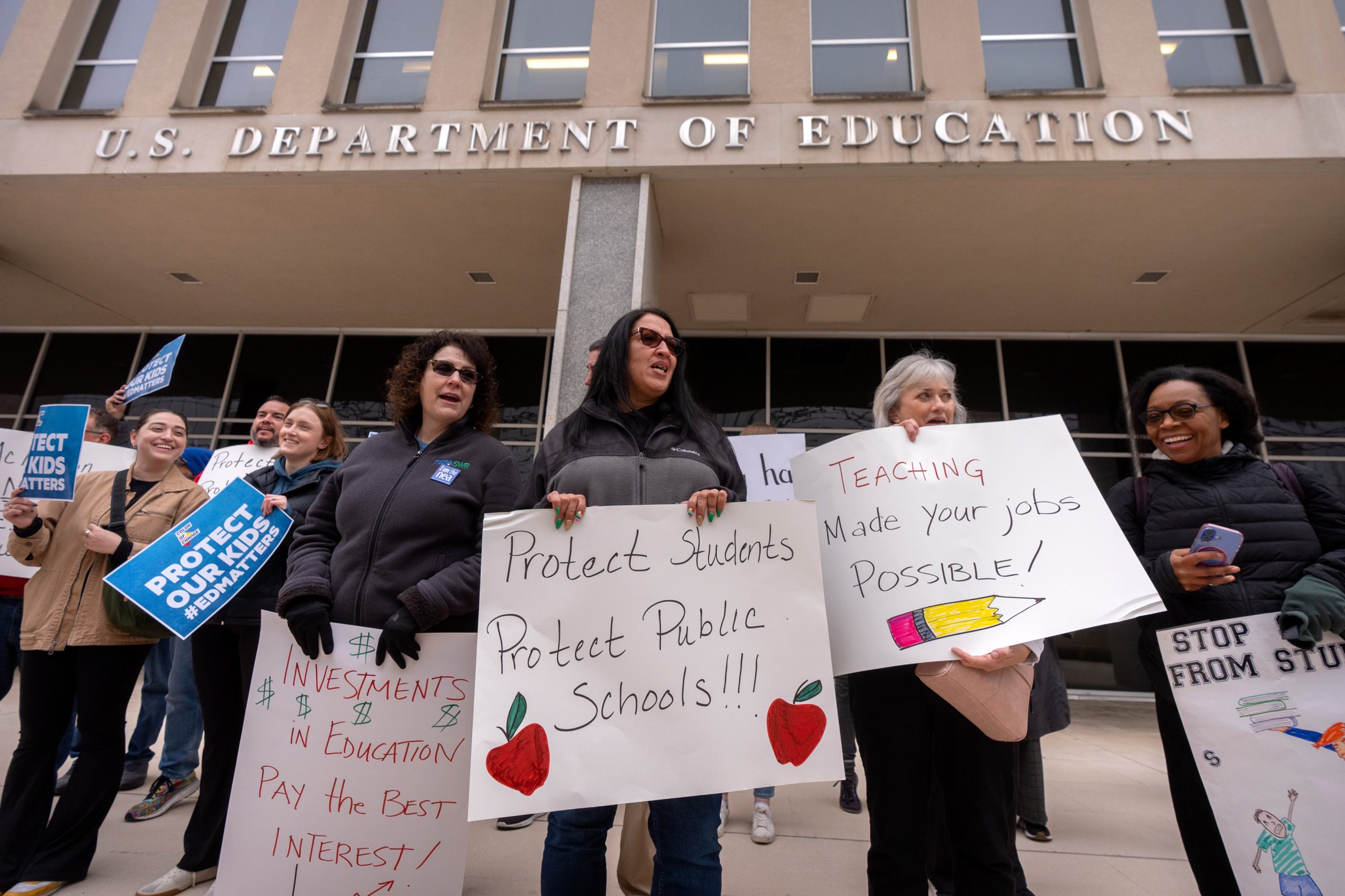
President Donald Trump and Education Secretary Linda McMahon say they want to close the Department of Education and return control of education to the states. At the same time, however, they have aggressively, and rapidly, wielded federal power over schools.
Related: Become a lifelong learner. Subscribe to our free weekly newsletter featuring the most important stories in education.
Here’s a look at some key data points from the first year of Trump’s second term that represent the outsized effect this presidency has had on the nation’s educational institutions and the people within them.
— 15 —
Number of executive orders Trump signed that exclusively address colleges or schools
In 2017, the first year of his first term, Trump signed two executive orders related to education. This year, he signed three times that number on just a single day in April.
Among his most notable executive orders was one early in his term requiring the Department of Education to begin dismantling itself. He also established an Artificial Intelligence Education Task Force and asked cabinet members to provide him with a plan to end “radical indoctrination” in schools. Other executive orders have addressed school discipline, transgender athletes, registered apprenticeships and foreign influence on college campuses.
Another set of executive orders indirectly affected schools. For instance, the Department of Education interpreted an order about undocumented immigrants to require limiting access to some adult and career and technical education programs. And separately, in a presidential memorandum, Trump ordered universities to begin reporting the race of their applicants and admitted students, not just those who enroll in the fall.
— 26 —
Number of investigations into K-12 transgender policies announced by the Education Department
At the K-12 level, the administration has given no issue more attention than policies that govern which bathrooms, locker rooms and sports teams transgender students can access. In all, the department has announced at least 26 such investigations, including into six state education agencies and three statewide athletic associations.
By comparison, the Trump administration announced eight investigations into antisemitism at elementary and secondary schools and four cases of alleged racial discrimination that hurts white teachers or students.
In higher education, it’s the inverse: Just five investigations into transgender issues have been announced, while dozens of cases of antisemitism and racial discrimination are being investigated.
— 50+ —
Number of education-specific lawsuits filed against the Trump administration
It’s not unusual for presidential administrations to be sued: Texas Attorney General Ken Paxton brags about suing the Biden administration 100 times. But the first year of Trump’s second term has been marked by unprecedented legal activity related to his administration’s education actions, according to a review of court documents and other lawsuit trackers. Trump, McMahon and the Department of Education have been sued over efforts to fire employees and dismantle the department, freeze funding and cancel grants, and end diversity, equity and inclusion efforts.
The administration’s track record defending itself in court has been mixed, but it scored a major victory when the Supreme Court allowed its March layoffs of hundreds of Education Department staffers. However, courts have blocked some efforts to ban diversity, equity and inclusion initiatives, forced the federal government to pay out some once-frozen grants and allowed Harvard to continue enrolling foreign students.
— 1,950 —
Number of employees who left the Department of Education in the spring
When Trump took office, the Education Department had more than 4,100 employees. Soon after, those numbers started dropping. In the first seven weeks of the new administration, 572 staffers voluntarily resigned. In March, 1,378 more employees were let go. Many offices were decimated without a clear plan for how or if their work would continue.
The National Center for Education Statistics, for example, went from about 100 staffers to three. That office is responsible for collecting data on the nation’s schools and colleges and administering the National Assessment of Educational Progress. Or take the Office for Civil Rights, which is in charge of investigating complaints about civil rights violations, including sexual harassment, racial discrimination and failure to provide an adequate education to students with disabilities. Seven of its 11 regional offices were shuttered and, in all, it lost nearly half its staff. (In December, some of those staffers were temporarily called back to help reduce a backlog of cases.)
The administration notified another 466 employees they were being let go during the government shutdown in October. Those positions were reinstated, however, as part of a congressional deal to reopen the government. The department also launched a plan to move large swathes of its work to other agencies, including the departments of Labor, State and Health and Human Services.
The Education Department did not respond to several requests for information about how many people are working at the agency now.
— 5 —
Number of regional Head Start offices closed
As part of the administration’s sweeping reductions in force, five out of 10 regional Head Start offices were abruptly closed and all employees fired in April. The offices, all in blue states, help oversee the free child care services provided by local early education programs for low-income children. In all, the five offices had been responsible for oversight of 318,000 — or 44 percent — of Head Start slots.
That wasn’t the only upheaval Head Start programs faced this year. At the end of January, the Trump administration directed agencies to temporarily freeze federal funding for thousands of financial assistance programs, including Head Start. Soon after, the White House said the program was exempt, and later it withdrew the order altogether. (A federal judge eventually ruled the entire directive was illegal.) But dozens of centers serving more than 20,000 children reported weeks-long delays in accessing federal money, with some forced to close temporarily. Then, during the government shutdown in the fall, centers serving 9,000 kids had to close their doors, some for several weeks, according to tracking by the First Five Years Fund.
— 17% —
Decline in new international student enrollment in fall 2025
The Trump administration’s attacks on foreign students with political views it disliked made international headlines this spring, as it targeted students protesting the Israel-Hamas war for deportation and announced plans to scour the social media accounts of new visa applicants. It also imposed travel restrictions and delayed some processing of student visas. The result is a slower pipeline of new foreign students coming to the United States, according to data from the Institute of International Education.
The decrease in new international students was driven by graduate students, whose enrollment declined most sharply. But because most returning students stuck with their U.S. education plans, the overall number of foreign students (including those engaged in jobs related to future or past higher education enrollment) ticked down just 1 percent. Still, that’s a big deal for colleges and universities: Graduate students make up the lionʼs share of international enrollment and are a major source of revenue for many colleges. International students typically do not get financial aid, paying full price to attend.
— $1,700 —
Maximum tax break an individual can get for donating to school choice scholarships
Trump’s signature legislation, the One Big Beautiful Bill Act, was a major win for school choice advocates: It created a new federal school voucher program. The law sets up tax credit scholarships — vouchers — families can use to pay for private school tuition, tutoring or other educational expenses. Parents will also be able to use the money to cover homeschooling costs. Starting in 2027, individuals can get a tax credit of up to $1,700 for donations to nonprofits that provide the scholarships. Those nonprofits, in turn, will be in charge of handing out the money.
States must opt in if they want schools within their respective borders to be able to participate. At least three states so far have said they will decline, but more than 20 others have already established their own tax credit scholarship programs and are expected to sign up when the federal option becomes available.
— 6,353 —
Number of complaints the Education Department’s Office for Civil Rights dismissed between mid-March and mid-September
In one six-month stretch, the Department of Education’s Office for Civil Rights dismissed more than 6,000 complaints without an investigation, according to a September court filing. By contrast, the Biden administration did the same with 2,527 cases in its final three months.
The Trump administration has said in court filings it is following longstanding policies for dismissing cases. Former employees and advocates counter that the jump in dismissals suggests student and parent complaints are not being adequately probed, and that layoffs are affecting an agency that has long struggled to keep up with its caseload.
The rate at which the Trump administration reaches a final resolution in the cases it does investigate has significantly slowed. Between mid-March and mid-September, OCR resolved 581 complaints through mediated settlements, voluntary agreements or technical assistance. Another 138 were resolved after an investigation did not find evidence of violations. Those numbers are roughly the same as the last three months of the Biden administration (595 and 119 respectively).
— $153 million —
Amount of grant money the administration is spending to promote civics education
The Education Department said in September it gave more than $153 million to 85 grantees to work on civics education. That’s a major increase: Since this grant program launched in 2017, just 38 grants worth about $75 million had been awarded in all.
Promoting patriotic education is one of McMahon’s goals. “Patriotic education presents American history in a way that is accurate, honest, and inspiring,” her agency said in a September announcement prioritizing discretionary spending on this issue. “It emphasizes a unifying and uplifting portrayal of the nation’s founding ideals.”
McMahon also started the America 250 Civics Education Coalition, in preparation for next year’s anniversary of the signing of the Declaration of Independence. The coalition is made up largely of conservative organizations including Turning Point USA, Moms for Liberty, Hillsdale College and Priests for Life.
— $5.8 billion —
Minimum amount of federal research funding cut or frozen
Federal research dollars, many of which flow to colleges and universities, were cut way back this year. It’s difficult to calculate exactly how much was lost; this money comes from many agencies and some remains mired in legal battles. The website Grant Witness, run by a group of researchers, tracks canceled or frozen grants. Its data shows that more than $5.1 billion in National Institutes of Health money that had yet to be spent was earmarked for colleges or universities, as was nearly $700 million from the National Science Foundation. (Some of that funding may have been restored.)
Those agencies were two of the largest sources of federal grants to higher education, but not the only ones. More than $425 million in National Endowment for the Humanities grants, many of which are awarded to colleges, were canceled. (Those cuts were later found to be unlawful.) The Department of Agriculture canceled tens of millions of dollars in higher education research funding, and the Environmental Protection Agency also terminated such grants.
The picture doesn’t look better for year two of Trump’s term: The White House has proposed cutting all federal research funding by a third — a decrease of more than $33 billion from 2025.
— 0 —
Number of colleges that have signed the Trump ‘Compact for Academic Excellence in Higher Education’
The Trump administration has been aggressive in trying to bend higher education to its will. In October, officials reached out to nine universities, including some of the country’s most selective institutions, with a deal. The schools could be first in line for federal money if they agreed to a litany of demands including:
- Publishing standardized test scores for admitted students by race, sex and ethnicity
- Capping foreign student enrollment at 15 percent
- Prohibiting transgender females from using women’s locker rooms and bathrooms
- Freezing tuition for five years
So far, none have accepted the offer, with seven universities rejecting it outright. The University of Texas at Austin and Vanderbilt University did not publicly rebuke the compact, but did not sign it. New College of Florida, which was not one of the nine, said it would sign if given the chance. Other universities signed separate agreements with the administration to unfreeze federal money. Columbia University, for example, paid $221 million and accepted a host of conditions to regain access to billions of federal dollars.
Contact investigations editor Sarah Butrymowicz at [email protected] or on Signal: @sbutry.04.
This story about Trump’s effect on education was produced by The Hechinger Report, a nonprofit, independent news organization focused on inequality and innovation in education. Sign up for the Hechinger newsletter.
This <a target=”_blank” href=”https://hechingerreport.org/11-numbers-that-capture-the-trump-effect-on-education/”>article</a> first appeared on <a target=”_blank” href=”https://hechingerreport.org”>The Hechinger Report</a> and is republished here under a <a target=”_blank” href=”https://creativecommons.org/licenses/by-nc-nd/4.0/”>Creative Commons Attribution-NonCommercial-NoDerivatives 4.0 International License</a>.<img src=”https://i0.wp.com/hechingerreport.org/wp-content/uploads/2018/06/cropped-favicon.jpg?fit=150%2C150&ssl=1″ style=”width:1em;height:1em;margin-left:10px;”>
<img id=”republication-tracker-tool-source” src=”https://hechingerreport.org/?republication-pixel=true&post=113911&ga4=G-03KPHXDF3H” style=”width:1px;height:1px;”><script> PARSELY = { autotrack: false, onload: function() { PARSELY.beacon.trackPageView({ url: “https://hechingerreport.org/11-numbers-that-capture-the-trump-effect-on-education/”, urlref: window.location.href }); } } </script> <script id=”parsely-cfg” src=”//cdn.parsely.com/keys/hechingerreport.org/p.js”></script>