
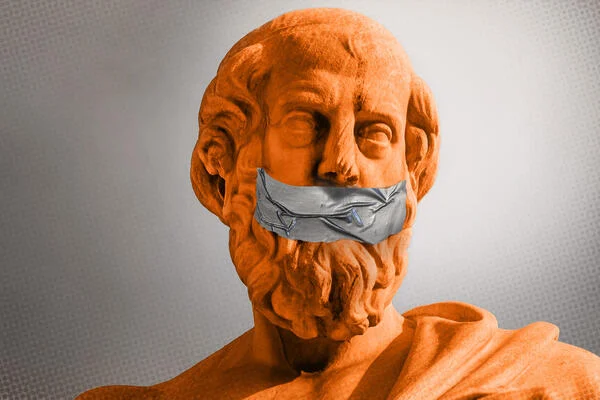
The censored Plato texts include passages from his Socratic dialogue Symposium that discuss patriarchy, masculinity, gender identity and the human condition.
Photo illustration by Justin Morrison/Inside Higher Ed | Nice_Media_PRO/iStock/Getty Images | rawpixel
At least 200 courses in the Texas A&M University College of Arts and Sciences have been flagged or canceled by university leaders for gender- or race-related content as the university undertakes its review of all course syllabi, faculty members told Inside Higher Ed.
This is just the beginning of the system board–mandated course-review process. Faculty were required to submit core-curriculum syllabi for review in December, and some faculty members have yet to receive feedback on their spring courses, scheduled to begin Monday.
So far, queer filmmakers, feminist writers and even ancient Western philosophers are on the chopping block. One faculty member—philosophy professor Martin Peterson, who is supposed to teach Contemporary Moral Problems this spring—was asked by university leadership to remove several passages by Plato from his syllabus.
In an email from department chair Kristi Sweet, Peterson was given two options: either remove “modules on race and gender ideology, and the Plato readings that may include these,” or be reassigned to teach a different philosophy course.
“Your decision to bar a philosophy professor from teaching Plato is unprecedented … You are making Texas A&M famous—but not for the right reasons,” Peterson said in his response to Sweet, which he shared with Inside Higher Ed. The Plato texts include passages from his Socratic dialogue Symposium that discuss patriarchy, masculinity, gender identity and the human condition. In one excerpt, the “Myth of the Androgyne,” the Greek playwright Aristophanes says, “First, you should learn the nature of humanity … for in the first place there were three kinds of human being and not two as nowadays, male and female. No, there was also a third kind, a combination of both genders.”
Peterson ultimately chose to revise his syllabus and replace the censored material with lectures on free speech and academic freedom. “I’m thinking of using this as a case study and [to] assign some of the texts written by journalists covering the story to discuss,” Peterson told Inside Higher Ed via text. “I want [students] to know what is being censored.”
Another censored class is Introduction to Race and Ethnicity. Students enrolled in the sociology course this spring were told via email Tuesday that the class was canceled because there was no way to bring it into compliance with the system policy. One professor, who wished to remain anonymous, was asked in the fall to remove content related to feminism and queer cinema from their History of Film class. The professor refused, and the dean resubmitted the syllabus as a noncore “special topics” class, which enrolled students were notified of Wednesday.
“I’m seeing the enrollment drops as we speak,” the professor said.
The enrollment declines could have the same result as the course review.
“The expectation is that a lot of those classes will ultimately be canceled, not because of content but because of underenrollment,” said another professor in the College of Arts and Sciences who wished to remain anonymous.
English faculty members received an email Tuesday from senior executive associate dean of the college Cynthia Werner telling them that literature with major plot lines that concern gay, lesbian or transgender identities should not be taught in core-curriculum classes.
In a follow-up email Wednesday, Werner said, “If a course includes eight books and only one has a main character who has an LGBTQ identity and the plot lines are not overly focused on sexual orientation (i.e. that is THE main plot line), I personally think it would be OK to keep the book in the course.” She also clarified that faculty may assign textbooks with chapters that cover transgender identity, so long as they do not talk about the material or include it on assignments or exam questions.
In November, the Texas A&M University System Board of Regents decided that courses that “advocate race or gender ideology, sexual orientation, or gender identity” would be subject to presidential approval and launched a systemwide, artificial intelligence–driven course-review process across all five campuses. Faculty members are still confused about who exactly is reviewing their syllabi.
“The university is doing different things in different departments and colleges. They’re interpreting these policies differently,” said Leonard Bright, a professor of government and public service at Texas A&M and president of the university’s American Association of University Professors chapter. “I’ve heard some say they were told that there are some committees [carrying out the review]. I’ve heard some say that it’s just the provost and his close affiliates. We really don’t have a real clear answer as to how these decisions are being made.”
It’s also unclear whether Texas A&M is violating a rule from the Texas Higher Education Coordinating Board that requires institutions to seek its approval before revising its core curriculum and “deleting courses.” A spokesperson for the university did not respond to Inside Higher Ed’s questions about the review Wednesday, including a question about how many total courses have been canceled so far.
The Texas A&M AAUP condemned the university’s decision to censor Plato in a statement Wednesday.
“At a public university, this action raises serious legal concerns, including viewpoint discrimination and violations of constitutionally protected academic freedom,” the AAUP chapter wrote. “Beyond the legal implications, the moral stakes are profound. Silencing 2,500-year-old ideas from one of the world’s most influential thinkers betrays the mission of higher education and denies students the opportunity to engage critically with the foundations of Western thought. A research university that censors Plato abandons its obligation to truth, inquiry, and the public trust—and should not be regarded as a serious institution of higher learning. We are deeply saddened to witness the decline of one of Texas’s great universities.”
The Foundation for Individual Rights and Expression also slammed the move.
“Texas A&M now believes Plato doesn’t belong in an introductory philosophy course,” Lindsie Rank, director of campus rights advocacy at FIRE, said in a statement. “This is what happens when the board of regents gives university bureaucrats veto power over academic content. The board didn’t just invite censorship, they unleashed it with immediate and predictable consequences. You don’t protect students by banning 2,400-year-old philosophy.”

