
Tag: Carrs

  • Carr’s threats to ABC are jawboning any way you slice it

    Carr’s threats to ABC are jawboning any way you slice it

    In 1867, the Supreme Court ruled in Cummings v. Missouri that the state could not use loyalty oaths to bar ex-Confederates from teaching, preaching, or practicing law. The oaths themselves were (at the time) lawful, but Missouri was using them to unlawfully punish past conduct — and that was the problem.

    “What cannot be done directly cannot be done indirectly,” Justice Stephen Johnson Field wrote for the majority. “The Constitution deals with substance, not shadows.”

    Over 150 years later, ABC suspended Jimmy Kimmel hours after FCC Chair Brendan Carr suggested they could face consequences for remarks Kimmel made in the aftermath of Charlie Kirk’s murder.

    Unlike the formal government pressure in Cummings, this was informal government pressure to influence private action, otherwise known as jawboning. But the age-old principle is the same. It was echoed in last year’s landmark jawboning case NRA v. Vullo “a government official cannot do indirectly what she is barred from doing directly.”

    Carr’s defenders try to deny any connection between Carr’s threats and Kimmel’s ouster.

    This has one big problem. Courts have said it doesn’t matter whether a threat produces results. In Backpage.com v. Dart, the Seventh Circuit held that the constitutionality of government conduct turns on what the threat tries to accomplish, not whether it accomplishes it.

    Given that, Carr’s threat still runs headlong into the First Amendment. 

    The bar was laid out clearly in last year’s Vullo: “to state a claim that the government violated the First Amendment through coercion of a third party, a plaintiff must plausibly allege conduct that, viewed in context, could be reasonably understood to convey a threat of adverse government action in order to punish or suppress the plaintiff ’s speech.”

    Let’s see how that squares with the timeline. 


    July 22 – Days after CBS cancels the Late Show with Stephen Colbert, with the question of FCC approval for parent Paramount Global’s merger with Skydance looming large over it, Trump posts:

    August 6 – Trump tells the press pool regarding Kimmel and Late Night host Jimmy Fallon, “They’re next, they’re going to be going — I hear they’re going to be going.” 

    August 11 – Sinclair Broadcast Group shares surge 27% after it announces efforts to explore merger-and-acquisition opportunities in broadcast TV. Any transfer of broadcast licenses requires FCC approval, which FIRE has written extensively about regarding Carr using the government as a “point of leverage.”

    August 19 – Nexstar Media Group, the nation’s largest TV station owner, announces plans to buy rival media giant Tegna in a deal that will require FCC approval and FCC willingness to lift their 39% cap on how many households one company can reach through TV station ownership. Nexstar now has 38.9% of stations covered by the FCC.

    September 4 – The Center for American Rights files a complaint with the FCC over Jimmy Kimmel’s alleged bias and conflict of interest towards Democrats. CAR’s 60 Minutes complaint launched the now infamous FCC probe into CBS, which informed Trump lawsuit, and their complaints against ABC and NBC were revived by Carr early this year. 

    September 10 – Charlie Kirk is murdered while giving a talk at Utah Valley University.

    September 15 – Kimmel says in his opening monologue:

    We hit some new lows over the weekend with the MAGA gang desperately trying to characterize this kid who murdered Charlie Kirk as anything other than one of them and doing everything they can to score political points from it.

    It’s worth noting the accuracy of his statement hinges on whether the “MAGA gang” was trying to avoid association with Kirk’s killer, not on whether the killer was part of the “MAGA gang.” It’s an important distinction when official actions are being considered.

    September 17 – Carr appears on The Benny Johnson Show, with Johnson posting a summary at 1:01 pm, Carr addressing ABC parent Disney says:

    This is a very, very serious issue right now for Disney. We can do this the easy way or the hard way. These companies can find ways to take action on Kimmel or there is going to be additional work for the FCC ahead.

    Carr also addresses the station owners: 

    Disney needs to see some change here, but the individual licensed stations that are taking their content, it’s time for them to step up and say this, you know, garbage, to the extent that that’s what comes down the pipe in the future, isn’t something that we think serves the needs of our local communities.
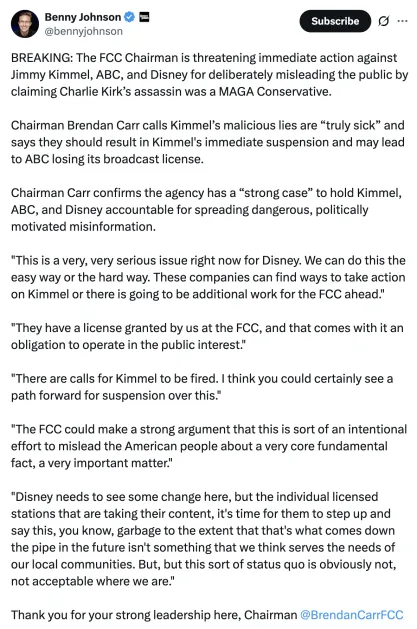
    Benny Johnson post on X describing interview with FCC Chair Brendan Carr

    6:18 pm – Later that day, it’s reported that Nexstar has said it will suspend Kimmel’s show “indefinitely beginning tonight.”

    6:24 pm – Minutes later, it’s reported that Disney’s ABC says it is pulling the show.

    6:49 pm – Sinclair joins Nexstar in indefinitely suspending Kimmel’s show.

    6:59 pm – CNN reporter Brian Stelter says when asked about ABC pulling Kimmel’s show, Carr sent him a celebratory GIF:
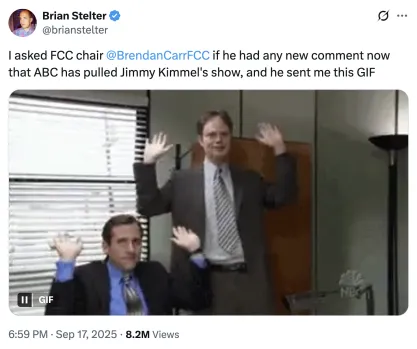
    Brian Stelter post on X.com: "I asked FCC chair @BrendanCarrFCC if he had any new comment now that ABC has pulled Jimmy Kimmel's show, and he sent me this GIF"

    7:00 pm – Carr writes on X, “I want to thank Nexstar for doing the right thing … I hope that other broadcasters follow Nexstar’s lead.”

    8:04 pm – Trump celebrates:
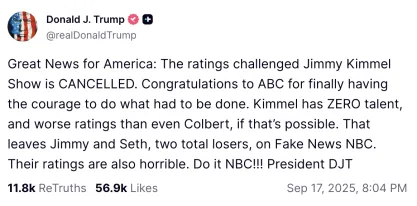
    Donald Trump post on Truth Social celebrating the cancellation of Jimmy Kimmel's show

    8:38 pm – Sinclair says its ABC stations will air a special remembrance of Charlie Kirk this Friday during Jimmy Kimmel Live’s timeslot, adding: “Sinclair also calls upon Mr. Kimmel to issue a direct apology to the Kirk family. Furthermore, we ask Mr. Kimmel to make a meaningful personal donation to the Kirk Family and Turning Point USA.”

    11:43 pm – Carr responds to a post on X saying, “This was all in Project 2025, btw”:
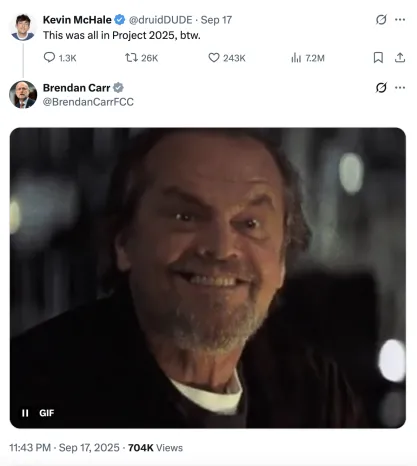
    Brendan Carr GIF response to post on X.com claiming that Project 2025 called for cancelling late night hosts

    September 18 – Carr replies to a post from British commentator Piers Morgan, attributing Kimmel’s suspension to “outrage all across America.” It’s difficult to find evidence of “outrage all across America” before September 17. 
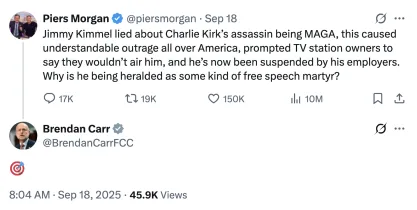
    Brendan Carr responds to a Piers Morgan post on X claiming Jimmy Kimmel lied about Charlie Kirk with a dart hitting a bullseye

    That’s the timeline, so let’s break it down.

    Carr tells ABC that “we can do this the easy way or the hard way” and that “there’s going to be additional work ahead for the FCC” if they don’t “take action.” There’s the threat and the adverse action — possibly in the form of an FCC probe into Carr’s complaint — if they don’t accede to the threat. 

    We also see Carr prompt affiliate station owners like Nexstar and Sinclair — seeking regulatory favor in pressing business before the government — to dial up the pressure on Disney in the lead up to Kimmel’s ouster. The specter of disfavorable treatment from the government poisons the chain from top to bottom. Finally, Trump and Carr celebrate after ABC suspends Kimmel indefinitely. 

    Asked to respond to those condemning him for “bullying ABC” on The Scott Jennings Show, Carr says “we’re reinvigorating the public interest standard for broadcasters. If people don’t like that … If  you’re a broadcaster and you don’t like being held accountable for the first time, in a long time, to your public interest standard, you can turn your broadcast license in to the FCC.”

    The public-interest standard is the nearly century-old mandate that broadcasters use the spectrum medium in service of the public. But the FCC’s public-interest standard has never made it okay to censor people. Even the FCC clearly states in no uncertain terms that “the public interest is best served by permitting free expression of views.”

    That’s because the public interest standard is a creature of statute, subordinate to the Constitution and the First Amendment. The FCC’s governing rules accordingly deny the FCC “the power of censorship” as well as the ability to promulgate any “regulation or condition” that interferes with freedom of speech.

    And Carr has long understood this. As he wrote in 2019, “The FCC does not have a roving mandate to police speech in the name of the ‘public interest.’”

    He’s not alone either. 

    Republican members of Congress leading telecommunications regulation share his familiarity with the limits on the FCC’s power to regulate speech, as demonstrated by their cold reception to his recent threats. Brett Guthrie, chair of the House Committee on Energy and Commerce, said: “We have to be extremely cautious to try to use the government to influence what people say.” 

    Senator Ted Cruz, chair of the Senate Committee on Commerce, Science, and Transportation, was more explicit. “That’s right out of Goodfellas. That’s right out of a mafioso coming into a bar going, ‘Nice bar you have here. It’d be a shame if something happened to it’” he said, referring to Carr’s threats.

    He went on to make an important point, recognizing that Carr’s “dangerous as hell” action was setting a troubling precedent because his Republican Party won’t always hold the keys to the FCC. 

    Three years ago, Carr wrote: “The government does not evade the First Amendment’s restraints on censoring political speech by jawboning a company into suppressing it—rather, that conduct runs headlong into those constitutional restrictions, as Supreme Court law makes clear.” 

    That’s exactly right, and if anyone knows what Brendan Carr is doing right now is unconstitutional jawboning — it’s Brendan Carr, as the record clearly shows.
    Source link

  • Brendan Carr’s Bizarro World FCC

    Brendan Carr’s Bizarro World FCC

    This essay was originally published by The Dispatch on April 30, 2025.


    Fans of the old Superman comics no doubt remember Bizarro World, the cuboid planet where everything is backward. Denizens of this parallel world are distorted replicas of their Earth-based counterparts, and they live by a Bizarro Code which dictates that being good or doing the right thing is a crime.

    Apparently, the phenomenon is not confined to fiction. Ever since Donald Trump’s Inauguration Day appointment of Brendan Carr to chair the Federal Communications Commission, the agency that licenses broadcast stations has become a Bizarro World version of its former incarnation. And there is some reason to suspect Carr himself has somehow been replaced by his Bizarro doppelganger.

    Carr, who has been an FCC commissioner since 2017, used to say things that reflected an understanding that the government’s authority to regulate the media is sharply constrained by the First Amendment. When Democratic congressmen tried to exert political pressure on broadcasters over their coverage of COVID-19 and the 2020 election, for example, Carr called it “a chilling transgression of the free speech rights that every media outlet in this country enjoys,” adding in no uncertain terms, “a newsroom’s decision about what stories to cover and how to frame them should be beyond the reach of any government official.” Or when members of Congress urged the FCC to reject a Miami radio station transfer based on the political viewpoints of the proposed new owner, he rebuffed this effort “to inject partisan politics into our licensing process,” correctly calling it “a deeply troubling transgression of free speech and the FCC’s status as an independent agency.” 

    Since the November election, “Bizarro Brendan” has taken over in earnest, aggressively asserting the kind of government power over speech and the press that normie Brendan professed to abhor.

    Less than a year ago, Carr proclaimed the United States does not need “the FCC to operate as the nation’s speech police,” adding, “if there ever were a time for a federal agency to show restraint when it comes to the regulation of political speech and to ensure that it is operating within the statutorily defined bounds of its authority, now would be that time.” Back then, Carr wore an American flag lapel pin, suggesting a commitment to the Constitution he swore to uphold. He’s since traded that for a Donald Trump lapel pin that looks like a prize fished out of a cereal box, and it suggests an allegiance to . . . something else. 

    Commissioner, regulate thyself: The incoming FCC chair is threatening to censor views he doesn’t like

    News

    President-elect Donald Trump announced he would appoint FCC Commissioner Brendan Carr to chair the agency, calling him a “warrior for Free Speech.”


    Read More

    Since the November election, “Bizarro Brendan” has taken over in earnest, aggressively asserting the kind of government power over speech and the press that normie Brendan professed to abhor. In interviews, social media posts, and by his official acts, Carr has said that the broadcast networks (except Fox) should be investigated for “news distortion,” that media mergers should be held up because of network news decisions, that public broadcasters should be investigated for their private sponsorships (but really for their editorial policies), and that Big Tech companies should be brought to heel because of their moderation practices. This last example is even more bizarro than the others since the FCC lacks jurisdiction over social media and computer companies, and because it came from the same guy who not long ago insisted “the American people want more freedom on the Internet — not freewheeling micromanagement by government bureaucrats.” 

    Right before President Trump was inaugurated for his second term, the FCC took the kind of action the old Brendan would have applauded. Or so his former rhetoric might suggest. The commission’s enforcement bureau dismissed an effort to deny license renewal to the Fox Philadelphia affiliate for its news reporting on the 2020 presidential election; a complaint seeking to penalize WCBS for the way “60 Minutes” edited its Kamala Harris interview; another seeking sanctions against an ABC station because a newsman fact-checked Donald Trump during the presidential debate;  and a complaint alleging NBC violated the FCC’s “equal opportunities” rule when Kamala Harris appeared on Saturday Night Live shortly before the November election (even though the network provided candidate Trump equal time). Outgoing Chairwoman Jessica Rosenworcel said at the time the dismissals were necessary because the FCC “should not be the president’s speech police” and cannot act as “journalism’s censor-in-chief,” which sounded a lot like Carr before he was body-snatched.

    But Bizarro Brendan was fully in charge by the inauguration, and one of his first official acts as chairman was to reinstate the investigations of CBS, ABC, and NBC (but, curiously, not the proceeding against Fox). He doubled down on CBS, seeking public comments on whether the network should be punished for “news distortion” and holding up FCC approval of a proposed merger between Skydance Media and Paramount Global (which includes transfer of 28 owned and operated CBS stations) while the complaint is being reviewed. And this pressure is being exerted on CBS in support of a private lawsuit then-President-elect Trump filed against CBS in Texas frivolously alleging the Harris interview on “60 Minutes” was consumer fraud.

    The news distortion policy has proven to be too useful a tool for bludgeoning the media in a politicized FCC.

    Since then, Carr has worked out a weird call-and-response routine, where he will post on social media his latest beef with particular networks, which then — miraculously — become the subject of complaints. On April 16, for example, Carr hinted in a social media post that NBC committed “news distortion” over its coverage of Kilmar Abrego Garcia — the man the Trump administration mistakenly deported to El Salvador but refuses to return to the U.S. — for, among other things, referring to him as a “Maryland man.” Less than a week later, the Center for American Rights, the partisan group behind the “60 Minutes” complaint, filed a news distortion complaint against not just NBC, but ABC and CBS as well. Carr’s post on X was cited as a principal source for the complaint.

    Carr well knows that such complaints are an abuse of process and a violation of the First Amendment. The FCC’s authority to rule on “news distortion” has always been extremely limited because the agency recognized from the beginning that it cannot act as the “national arbiter of the truth” and that doing so would involve the Commission deeply and improperly in the journalistic functions of broadcasters.”  The news distortion policy is a leftover corollary of the long-defunct Fairness Doctrine under which the FCC purported to evaluate news coverage of controversial issues to ensure “balance.” The agency ended that policy nearly 40 years ago during the Reagan administration under a principled FCC chairman, Mark Fowler, who foresaw that such regulatory authority could not be reconciled with the First Amendment and inevitably would be misused as a political weapon. Since then, the “news distortion” policy has been a dead rule walking, just waiting to be overturned in the right case.

    It is highly doubtful the current FCC will terminate the moribund policy on its own, even though it has opened a proceeding to delete outdated and unconstitutional rules. The news distortion policy has proven to be too useful a tool for bludgeoning the media in a politicized FCC.

    Indeed, the only way this administration makes sense is to understand it as operating under the Bizarro Code. On Day 1, the president issued an executive order purporting to bar any federal officer from conduct that would unconstitutionally abridge free speech, yet Carr’s FCC has been actively involved in threatening media companies — including those beyond its jurisdiction — and reinstituting bogus investigations of broadcast news judgments. Another executive order prohibited weaponizing federal agencies against political opponents, yet that has been Brendan Carr’s primary occupation since becoming FCC chair.

    In the Bizarro FCC, it makes no difference that, just last year, the Supreme Court held the First Amendment does not permit government officials to threaten legal sanctions in order to alter the speech of a private business; that the government cannot interfere with editorial judgments, including the private moderation decisions of social media companies; and that federal agencies like the FCC cannot override statutory commands, such as the Communications Act prohibition against any “regulation or condition” that interferes with freedom of speech. That’s because under the Bizarro Code, doing the wrong thing is the point.

    Source link