Over the past few years, calls for the boycott of Israeli universities have grown louder. This discourse generally entwines two different sets of arguments. The first is an argument about the effectiveness or validity of academic boycotts. The second, because it’s Israel, is about whether Israeli universities are being unfairly targeted due to anti-Semitism. Curiously, what Israeli universities themselves might have specifically done to deserve is often relegated to an afterthought.
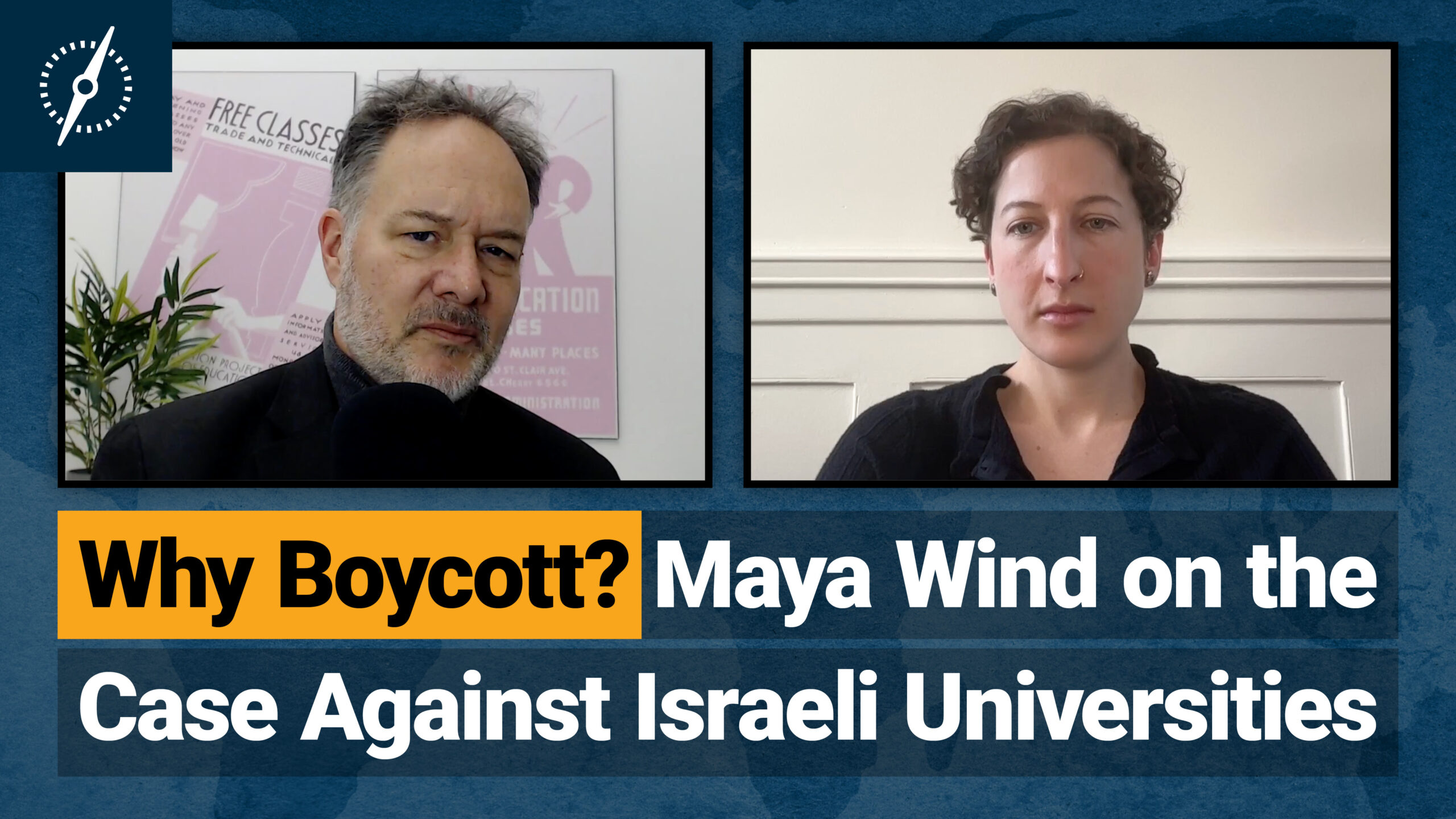
My guest today is Maya Wind. She is an Israeli citizen, and a postdoctoral scholar at the University of California Riverside. She is also the author of Towers of Ivory and Steel, How Israeli Universities Deny Palestinian Freedom, published last year by Verso press. Her book is a direct answer to that last question. The charge sheet that she brings against Israeli universities is a long one. And it should give people pause before thinking that Israeli universities are unproblematic.
Some of you are not going to like this interview. I suspect some will not enjoy the platform given to these opinions. But given the tenor of the times, I very much think it is worth a listen. I think there are two points in particular that are worth thinking about. The first is whether the boycott is about the universities themselves, or about Israel in general. The second is the standard for boycott. Wind makes it clear that she doesn’t see an absolute standard here other than that some oppressed group requests. So, for her, the relative level of complicity of Israeli universities in the dispossession of Palestinians and, say, that of Chinese universities in the repression of Uyghurs is irrelevant because the key factor is that one group asked for the boycott and the other didn’t. It’s about consistent allyship rather than relative guilt. That wasn’t something I had understood beforehand, and I’m guessing it might be new for many of you as well. But maybe it’s best if I let my guest explain things on her own. Over to Maya.
The World of Higher Education Podcast
Episode 3.22 | Why Boycott? Maya Wind on the Case Against Israeli Universities
Transcript
Alex Usher (AU): Maya, your book lays out the case for sanctions against Israeli universities and for boycotting them. But before we get to that, I want to ask about something you don’t really cover in the book: What’s the evidence that boycotts or academic sanctions are an effective strategy for forcing political change?
Maya Wind (MW): That’s a really crucial question. First, for listeners who may not be as familiar with the context, the movement for boycott, divestment, and sanctions (BDS) was first called for by Palestinian civil society organizations in 2005—so, 20 years ago now. The BDS movement, including the call for an academic boycott of Israeli universities, was heavily inspired by the movement against apartheid in South Africa. In that case, the isolation of many apartheid institutions, including universities, played a key role in bringing an end to the apartheid system.
Of course, as academics and students, we are all students of history. If we take seriously the idea that Israel is a settler state and that Israelis are colonizers, then history tells us that colonizers have never initiated the process of decolonization on their own. In every case of settler colonialism, external pressure has been necessary to compel colonizers to participate in that process. The BDS movement is specifically seeking to create that external pressure by building a grassroots international movement to hold the Israeli state—and its universities—accountable.
PACBI, the Palestinian Campaign for the Academic and Cultural Boycott of Israel, actually predates the broader BDS call by a year. It was formed in 2004 and, even then—21 years ago now—identified Israeli universities as pillars of the system of racial rule and apartheid. As academics, particularly those in the West, we have an obligation to respond to this call by severing our ties to Israeli universities. Otherwise, we remain directly complicit.
AU: Your charge sheet, if I can put it that way, against Israeli institutions is really threefold. The first major charge—using your words from the epilogue—is that they need to stop denying that their campuses stand on expropriated Palestinian lands and cease to serve as engines of Judaization, colonization, and Palestinian dispossession. What exactly do Israeli institutions do in this regard, and why does it matter so much?
MW: Right. Here, I’m following not only Palestinian civil society and Palestinian scholars but also Indigenous scholars around the world—particularly in settler states—who have long examined the role of the settler university. These scholars have highlighted how universities have often functioned as pillars of ongoing Indigenous dispossession, built on stolen lands that were cleared through genocide. This is part of a broader, global movement, and there is extensive critical scholarship on this issue in other settler states as well.
In the context of the Israeli settler state, “Judaization” is actually the official terminology used by the Israeli government. It refers to a process seen in many settler states: the twin projects of continual removal and ethnic cleansing of Palestinians, the transfer of Palestinian land ownership to Jewish Israelis, and the ongoing expansion of Israeli frontiers—redistributing the Jewish population across what was historic Palestine.
If we trace the history of Israeli universities, this pattern becomes clear. It starts with Hebrew University, the first university of the Zionist movement, and continues with all the universities established by the Israeli state since then. For example, the University of Haifa is in the Galilee, the region with the highest Palestinian population. Ben-Gurion University is in the Negev, an arid southern region where Jewish Israelis were historically less likely to settle. The most recent university to be accredited, Ariel University, is located in the illegal settlement of Ariel, deep in the occupied West Bank.
For over a century, Israeli universities have been physically designed, built, and strategically located to support the state’s project of Palestinian dispossession, particularly in regions of strategic concern to the Israeli government. Any reckoning with Israeli universities—or settler universities more broadly—must begin with the question of land itself. This is one of the central issues I explore in the book.
AU: Before I go into the other elements of the charge sheet, you’ve used the term “settler” and “settler colonialism” a couple of times. What distinction, if any, do you draw between the need to boycott Israeli universities, as you argue, and the historical case that could be made for boycotting institutions in Canada or the United States? Why sanction one and not the other?
MW: That’s a really important question. The first and primary answer is that the Indigenous population most directly impacted by the violence of these settler universities—in this case, Palestinians—have explicitly called for a boycott. A boycott is not a value; it is a tactic. Indigenous movements around the world have used different tactics to advance decolonization, and these tactics change over time and depend on the specific context.
In this case, more than 20 years ago, the overwhelming majority of Palestinian civil society came together to advance their liberation struggle and issued a call for boycott. They outlined a theory of change, arguing that Western governments—particularly those heavily invested in the Israeli settler state—not only provide arms but also offer diplomatic and legal immunity that allows Israel to continue committing war crimes, including, most recently, the crime of genocide. Given this, they have made it clear that those of us in the international community have an obligation to rise up and pressure our own governments to sever ties and isolate the Israeli regime until the process of decolonization begins and the system of apartheid is dismantled.
This is a grassroots movement, and we do not need to wait for our governments to act.
AU: That’s a useful clarification. The second area where you’re most critical is the cooperation between universities on one hand and the military, Shin Bet, and other security services on the other. You write about how the connection between university research and the military in Israel is somewhat different from how it operates in the United States or other countries, partly because research institutes in Israel cooperate so directly with the security sector. What does this military cooperation look like in practice? And is it just about research, or is there also an academic programming element?
MW: Right. This is a very important question because the collaboration between Israeli universities, the security state, and the military industry is incredibly deep and comprehensive. We see this in several ways.
First, Israeli universities function as military bases by designing and operating specialized, degree-granting programs tailored for security state personnel, including the Israeli Security Agency (Shin Bet), Israeli police forces, and soldiers. These are the same forces that have engaged in decades of daily violations of Palestinian rights and international law. This is well documented, and these academic programs actively train soldiers and security personnel to refine their operations.
One example is Hebrew University, where the Department of Islamic and Middle East Studies trains soldiers in the Intelligence Corps, providing them with linguistic and regional expertise to improve their surveillance of the Palestinian population. This training directly contributes to the creation of target banks for airstrikes in Gaza, as we have seen over the past 16 months. That is just one of many examples.
Another form of cooperation is research and institutional collaborations. The Institute for Criminology at Hebrew University and the Dayan Center at Tel Aviv University work closely with military and security state experts to produce scholarship that advances security operations. Their research informs policy recommendations for the Israeli security establishment.
A third example is the close ties between universities and military industries. It is not widely known that major arms manufacturers like Rafael Advanced Defense Systems, Israel Aerospace Industries, and Elbit Systems—the largest suppliers to the Israeli military and major global exporters of weapons—were actually founded on Israeli university campuses. These companies develop and refine their technologies by testing them in occupied Palestinian territories, violating international and human rights law daily. They then market these products globally as “battle-proven.” To this day, Israeli universities serve as critical laboratories for these industries.
In all of these ways, it is impossible to understand the Israeli security state and military-industrial complex without examining the role of the Israeli university system.
AU: The third charge you discuss is that Israeli universities are not academically neutral—that they do not provide all staff and students with equal opportunities to be protected from outside influence or to thrive academically. We often hear that Israeli universities do not discriminate, but you have a different perspective.
MW: Yes. One of the things that really struck me while researching and writing this book was the extensive scholarly work that already exists on this issue. I conducted an ethnography of Israeli universities, spending significant time across Israel’s eight major public universities. I spoke with and accompanied Palestinian student organizers, and I interviewed both Palestinian and Jewish Israeli faculty and staff.
What stood out to me—both in my fieldwork and in my background research—was just how much has already been written about this. There is a rich body of scholarship, not only in Hebrew and Arabic but also in English, often published in leading peer-reviewed journals in Europe and North America. Palestinian scholars, both in Palestinian and Israeli universities, have extensively documented the constraints on knowledge production, the marginalization of Palestinian critical epistemology, and the challenges of producing anti-colonial scholarship within the confines of the Zionist university system. They have also written in detail about the systematic discrimination Palestinian students face and their experiences within these institutions.
Yet, despite this extensive scholarship, I find that it is largely unread in Western academic communities. This raises important questions about why we, in the West, have failed to engage with this work and why we have instead accepted the narratives presented by Jewish Israeli university administrators and scholars, who often portray Israeli universities as beacons of democracy. In reality, this has never been the case, and Palestinians have been documenting and writing about these inequalities for a very long time. I cite much of this work in my book, and I also corroborated it through my own interviews.
What I found was not only that Israeli universities are embedded within and implicated in a broader system of apartheid, but also that Palestinian student organizing and political activism on campuses are violently suppressed. This suppression has intensified over the past 16 months, as Palestinian scholars and students speak out against the genocide and mobilize for Palestinian liberation on Israeli campuses.
Advertisement: Student success, at scale, with a proven ROI of 4.4 times return for universities and colleges. Studiosity’s AI-for-Learning is designed specifically for post-secondary students to develop real skills, critical thinking, agency, belonging, and retention; to empower educators with reporting and insight into learning progress; and to build human connection – made possible with Studiosity’s strictly help-not-answers formative feedback and integrated Humans in the Loop design. In partnership with post-secondary institutions in Canada and around the world, Studiosity is for future-ready graduates and future-ready institutions. With over 200 post-secondary partners and more than 2 million student users, Studiosity is grounded in an academically-driven evidence base, leading the way to increasing life chances for students everywhere. Learn more about the world’s leading, ethical, AI student support at studiosity.com.
AU: Maya, you’ve discussed issues at several institutions across Israel. You’ve specifically singled out Ariel University for its role in normalizing the occupation and Hebrew University for its failure to protect academic freedom. Are there any institutions that stand out to you as having a better record than others? Is there one that you might say should not be subject to a boycott?
MW: The call for an academic boycott was laid out by Palestinian civil society and Palestinian scholars. Just last year, in 2023, this call was reiterated by not only the Union of Palestinian Faculty and Employees but also by every single Palestinian student union at every Palestinian university. They reaffirmed their call for us to enact the academic boycott.
This is a call coming from Palestinian civil society, and as it is worded, it applies to all complicit Israeli universities. In the course of my research, I found that every single Israeli university is deeply implicated in the structures of occupation and apartheid. Not one is exempt.
At this time, the call remains for a boycott of all Israeli universities, and I hope my book helps to substantiate why that is necessary.
AU: It sounds to me like the Palestinian call is really about Israel as a whole, rather than specifically about Israeli universities, right? And I have to say, when I read the chapter on the relationship between universities and the military, I thought to myself: I can’t imagine a university in any country—let alone one as highly militarized as Israel—saying no to providing academic training for military officers.
Universities are instrumental to the state, right? So when we talk about disapproving of university policies, aren’t we really talking about disapproving of Israeli state priorities? Is there any way an individual Israeli institution could change this if it wanted to?
MW: I think that’s a really critical question. We have to understand—and take seriously—that settler states, systems of violence, and even genocide do not reproduce themselves automatically. These are systems of violence that are upheld by a vast network of institutions, including many in civil society. It is not just the military, not just the security state, and not just military industries. A whole host of public institutions—what we often think of as civil society institutions—lend themselves to this violence of elimination. This case is no different.
But what we also have to recognize is that it is not just the institutions—it is the people within them who sustain and reproduce these structures. There is the active labor of thousands of Israelis, across hundreds of institutions, including universities, who are making this violence possible.
What I want to emphasize here is that Israeli academics have tried very hard to have it both ways. The call for an academic boycott has been underway for more than two decades, and one of the main arguments used by Israeli university administrators and academics who oppose it is that they cannot possibly be held accountable for the crimes of the Israeli state—if such crimes even exist, as is still debated within Israeli universities. They claim that it is unjust to hold them responsible for what the state is doing.
But at the same time, when they are confronted—particularly over the last year—by thousands of students, faculty, and staff participating in the boycott, pointing out that they are directly complicit in apartheid and now genocide, these same university administrators and Israeli academics respond in exactly the opposite way. They say precisely what you just said: Of course, we are embedded in the state. Many of our students are soldiers. Why wouldn’t we cooperate with the state we are a part of?
They often go even further, offering justifications for genocide and apartheid. So they cannot have it both ways. Either they defend themselves by claiming they are not at all accountable and cannot be implicated in what the state is doing, or they admit that they are, in fact, part of the state—at which point they must also take responsibility for their role in sustaining its system of oppression.
AU: One argument that emerged in Canada over the last few months—particularly around the end of the encampment at the University of Windsor, if I’m not mistaken—was that the university agreed to boycott Israeli universities as part of a resolution. In response, some argued—I can’t remember if it was Michael Geist or Anthony Housefather in the House of Commons—that if you boycott Israeli institutions but not universities in other countries guilty of similar actions, then that is antisemitic.
For instance, many of the same criticisms you make about Israeli universities—such as failing to uphold free debate and cooperating with the military—could likely be made about Chinese universities in relation to the government’s policies in Xinjiang or Tibet. What do you make of that argument? Should we also be boycotting Chinese universities? And if not, why not?
MW: Boycotts—whether organized by unions or any other group—are always made in response to a call. It is not up to us to unilaterally decide to boycott a university system. That decision belongs to the communities directly impacted by the violence of that university system. When such a call is made, it is then up to the international community to assess whether the institutions in question are, in fact, complicit—and to decide whether to participate in the boycott.
To my knowledge, there has been no such call from other Indigenous communities in similar contexts. There could be, and if there were, I think many of us would absolutely consider participating. But this argument is ultimately a distraction—one that is often pushed by Israel and its Zionist supporters to divert attention from the central issue at hand. The reality is that Palestinians have called for a boycott. Now, it is up to us to assess whether that call is justified and whether we will comply
AU: You wrote this book prior to October 7, 2023. What has changed since then, both in terms of how Israeli universities behave and in terms of the boycott movement?
MW: Over the past 16 months, we have seen a devastating acceleration of a project that has spanned over a hundred years. Genocide is structural to the Israeli state, just as it is to settler states elsewhere. For two decades, Palestinian civil society has been telling us that various institutions in Israeli society have long served as part of the infrastructure laying the groundwork for the genocide we have witnessed unfold over the last 16 months—part of the Israeli state’s long-term project to ethnically cleanse Palestine of the Palestinian people.
My book, which I submitted to the press shortly before this latest acceleration of the genocide began, details many of the ways in which universities are implicated. But it should come as no surprise that this is a structural problem. Israeli universities have continuously worked in service of the state, uninterrupted and ongoing, from before the state’s founding to the present moment—including this phase of the genocide.
Over the last 16 months, Israeli universities have continued to develop weapons and technologies used against Palestinians in Gaza and the occupied West Bank. They have continued training soldiers and producing Hasbara—Israeli state propaganda—to shield Israel from international criticism. In fact, Israeli universities have actively intervened to prevent academic boycotts from being implemented on Western campuses, smearing student, faculty, and staff organizers, and in some cases, calling for them to be forcibly dispersed. They have also played a direct role in producing legal scholarship to aid the Israeli state in resisting the genocide case brought by South Africa at the International Court of Justice.
Beyond this, universities have provided tangible benefits to soldiers, offering course credit, scholarships, and special privileges for those returning from Gaza. In countless ways, Israeli universities remain embedded in the infrastructure of violence that sustains the Israeli state, even as that state now stands on trial in the highest courts in the world for genocide.
If you’re asking what has changed, I think the biggest shift is that more people have now come to recognize what Palestinians have been calling for over the past 20 years: the urgency of intervention. There is an increasing recognition that international civil society must take action and stand with the Palestinian people in their struggle for liberation—and participate in the broader project of decolonization. That is a significant development in the global movement for Palestinian liberation, and we will continue to build on it.
There is no going back.
AU: Maya, thanks so much for joining us today.
MW: Thank you.
AU: And that just leaves me to thank our excellent producers, Tiffany MacLennan and Sam Pufek, as well as you—our viewers, listeners, and readers—for tuning in. If you have any questions, comments, or concerns, please don’t hesitate to contact us at [email protected]. Folks, please subscribe to our YouTube channel so you never miss an episode of The World of Higher Education.
Join us again next week when I’ll be joined by Hilligje van’t Land. She’s the Secretary General of the International Association of Universities, located in Paris, and she’ll be talking about the joys of running the world’s oldest transnational university organization. Bye for now.
*This podcast transcript was generated using an AI transcription service with limited editing. Please forgive any errors made through this service. Please note, the views and opinions expressed in each episode are those of the individual contributors, and do not necessarily reflect those of the podcast host and team, or our sponsors.
This episode is sponsored by Studiosity. Student success, at scale – with an evidence-based ROI of 4.4x return for universities and colleges. Because Studiosity is AI for Learning — not corrections – to develop critical thinking, agency, and retention — empowering educators with learning insight. For future-ready graduates — and for future-ready institutions. Learn more at studiosity.com.