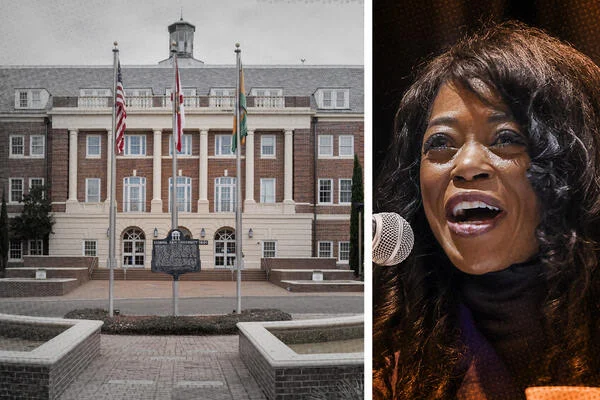
FAMU president Marva Johnson said using the word “Black” doesn’t violate an anti-DEI state law.
Photo illustration by Justin Morrison/Inside Higher Ed | Jemal Countess/Getty Images for NOBCO | JHVEPhoto/iStock/Getty Images
Florida Agricultural and Mechanical University, a historically Black institution, said it mistakenly objected to its Black Law Students Association using the word “Black” in Black History Month fliers.
Law student Aaliyah Steward told Orlando’s News 6 she heard “we couldn’t use the word ‘Black’ in Black History Month; we needed to abbreviate it.” The news broadcast then showed a flier that conformed to this, abbreviating it as “BHM.”
After News 6 broke the story Friday, it reported that the artist SZA and others denounced the censorship on social media. This week, FAMU College of Law interim dean Cecil Howard emailed the college’s community that “the word ‘Black’ is not prohibited” and no such restriction “has been directed by university leadership,” according to a copy of the message that FAMU sent Inside Higher Ed.
Howard wrote that the university “quickly engaged a Florida higher education law expert,” who confirmed the word doesn’t violate Florida’s Senate Bill 266. That 2023 law banned public colleges and universities from spending state or federal money on activities that “advocate for diversity, equity and inclusion, or promote or engage in political or social activism.”
“What occurred was a staff-level error—an overly cautious interpretation that went beyond what the law requires,” Howard wrote.
University president and law professor Marva Johnson—who has long-standing ties to Republican governor Ron DeSantis, an anti-DEI crusader—also released a statement saying FAMU “unequivocally confirms that the use of the word ‘Black,’ or the phrase ‘Black History Month,’ does not violate the letter, spirit, or intent of Florida Senate Bill 266, Board of Governors Regulation 9.016 [titled ‘Prohibited Expenditures’], or any relevant federal guidance.”
We discuss the Supreme Court backing Maine lawmaker Laurel Libby, NPR filing suit against Trump, a years-long dispute over a student wearing a “there are only two genders” shirt, the Secret Service investigation into James Comey, the latest on…
The University of Texas at Dallas has a troubling history of trying to silence students. Now those students are fighting back.
Today, the editors of The Retrograde published their first print edition, marking a triumphant return for journalism on campus in the face of administrative efforts to quash student press.
Headlines above the fold of the first issue of The Retrograde, a new independent student newspaper at UT Dallas.
Why call the newspaper The Retrograde? Because it’s replacing the former student newspaper, The Mercury, which ran into trouble when it covered the pro-Palestinian encampments on campus and shed light on UT Dallas’s use of state troopers (the same force that broke up UT Austin’s encampment just one week prior) and other efforts to quash even peaceful protest. As student journalists reported, their relationship with the administration subsequently deteriorated. University officials demoted the newspaper’s advisor and even removed copies of the paper from newsstands. At the center of this interference were Lydia Lum, director of student media, and Jenni Huffenberger, senior director of marketing and student media, whose titles reflect the university’s resistance to editorial freedom.
The conflict between the paper and the administration came to a head when Lum called for a meeting of the Student Media Oversight Board, a university body which has the power to remove student leaders, accusing The Mercury’s editor-in-chief, Gregorio Olivares Gutierrez, of violating student media bylaws by having another form of employment, exceeding printing costs, and “bypassing advisor involvement.” Yet rather than follow those same bylaws, which offer detailed instructions for removing a student editor, Lum told board members from other student media outlets not to attend the meeting. A short-handed board then voted to oust Gutierrez. Adding insult to injury, Huffenberger unilaterally denied Gutierrez’s appeal, again ignoring the bylaws, which require the full board to consider any termination appeals.
The student journalists of The Retrograde have shown incredible spirit. With your help, we can ensure their efforts — and the rights of all student journalists — are respected.
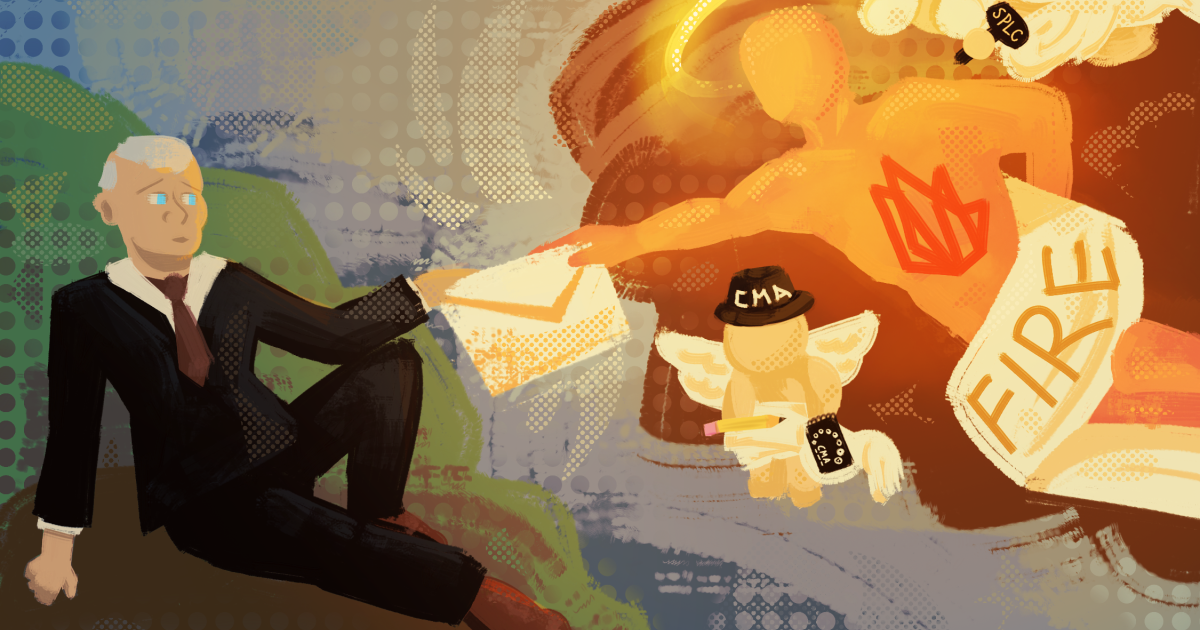
In response, The Mercury’s staff went on strike, demanding Gutierrez’s reinstatement. To help in that effort, FIRE and the Student Press Law Center joined forces to pen a Nov. 12, 2024 letter calling for UT Dallas to honor the rights of the student journalists. We also asked them to pay the students the money they earned for the time they worked prior to the strike.
UT Dallas refused to listen. Instead of embracing freedom of the press, the administration doubled down on censorship, ignoring both the students’ and our calls for justice.
FIRE took out a full page ad in support of The Retrograde at UT Dallas.
In our letter, we argued that the university’s firing of Gutierrez was in retaliation for The Mercury’s unflattering coverage of the way administrators had handled the encampments. This is not even the first time UT Dallas has chosen censorship as the “best solution;” look no further than in late 2023 when they removed the “Spirit Rocks” students used to express themselves. Unfortunately, the university ignored both the students’ exhortations and FIRE’s demands, leaving UT Dallas without its newspaper.
But FIRE’s Student Press Freedom Initiative is here to make sure censorship never gets the last word.
Students established The Retrograde, a fully independent newspaper. Without university resources, they have had to crowdfund and source their own equipment, working spaces, a new website, and everything else necessary to provide quality student-led journalism to the UT Dallas community. They succeeded, and FIRE is proud to support their efforts, placing a full-page ad in this week’s inaugural issue of The Retrograde.
The fight for press freedom at UT Dallas is far from over — but we need your help to make a difference.
Demand accountability from UT Dallas. The student journalists of The Retrograde have shown incredible spirit. With your help, we can ensure their efforts — and the rights of all student journalists — are respected.