Tag: Challenge

  • FIRE and civil liberties groups challenge ‘unconstitutional retaliation’ against Mahmoud Khalil

    FIRE and civil liberties groups challenge ‘unconstitutional retaliation’ against Mahmoud Khalil

    FIRE along with the National Coalition Against Censorship, The Rutherford Institute, PEN America, and First Amendment Lawyers Association today filed a “friend of the court” brief arguing that the jailing of Mahmoud Khalil violates the First Amendment. What follows is the brief’s summary of argument.


    America’s founding principle, core to who and what we are as a Nation, is that liberty comes not from the benevolent hand of a king, but is an inherent right of every man, woman, and child. That includes “the opportunity for free political discussion” as “a basic tenet of our constitutional democracy.” (Cox v. Louisiana). And “a function of free speech under our system of government is to invite dispute. It may indeed best serve its high purpose when it induces a condition of unrest, creates dissatisfaction with conditions as they are, or even stirs people to anger.” (Terminiello v. City of Chicago). For these reasons, along with all citizens, “freedom of speech and of press is accorded aliens residing in this country.” (Bridges v. Wixon).

    Secretary of State Marco Rubio, however, is attempting to deport a permanent resident, Mahmoud Khalil, not because the government claims he committed a crime or other deportable offense, but for the seemingly sole reason that his expression stirred the Trump administration to anger. The Secretary claims he can deport Mr. Khalil under a Cold War–era statute giving the secretary of state the power to deport anyone he “personally determines” is contrary to America’s “foreign policy interest.” And he argues this power extends even to deporting permanent residents for protected speech. It does not.

    The First Amendment’s protection for free speech trumps a federal statute. (United States v. Robel). Accepting Secretary Rubio’s position would irreparably damage free expression in the United States, particularly on college campuses. Foreign students would (with good reason) fear criticizing the American government during classroom debates, in term papers, and on social media, lest they risk deportation. That result is utterly incompatible with the longstanding recognition that “[t]he essentiality of freedom in the community of American universities is almost self-evident,” and that “students must always remain free to inquire, to study and to evaluate, to gain new maturity and understanding.” (Sweezy v. New Hampshire).

    Secretary Rubio claims (as do all censors) that this time is different, that the supposed repulsiveness of Mr. Khalil’s pro-Palestine (and, as Secretary Rubio alleges, pro-Hamas) views cannot be tolerated. But “if there is a bedrock principle underlying the First Amendment, it is that the government may not prohibit the expression of an idea simply because society finds the idea itself offensive.” (Texas v. Johnson) (holding the First Amendment protects burning the American flag in protest); see also (Snyder v. Phelps) (holding the First Amendment protects displaying “God Hates Fags” and “Thank God for Dead Soldiers” posters outside a military funeral).

    Allowing the Secretary of State to deport any non-citizen whose views, in his subjective judgment, are against America’s foreign policy interests places free expression in mortal peril. China’s Constitution, for example, provides that “when exercising their freedoms and rights, citizens . . . shall not undermine the interests of the state.” As China’s experience shows, allowing the government to step in as censor when it believes speech threatens the government’s interests is a loophole with infinite diameter. It has no place in America’s tradition of individual liberty.

    The only court to address the deportation provision Secretary Rubio relies upon to deport Mr. Khalil reached a similar conclusion, holding the law unconstitutional. As that court explained, “If the Constitution was adopted to protect individuals against anything, it was the abuses made possible through just this type of unbounded executive authority.” (Massieu v. Reno).

    The “First Amendment does not speak equivocally. It prohibits any law ‘abridging the freedom of speech, or of the press.’ It must be taken as a command of the broadest scope that explicit language, read in the context of a liberty-loving society, will allow.” (Bridges v. California) (invalidating criminal convictions, including of a non-citizen, based on protected speech). Our “liberty-loving society” does not permit deportation as a punishment solely based on expression the government disfavors. The Court should grant Mr. Khalil’s motion.

    Source link

  • DOL Files Appeal in Overtime Legal Challenge

    DOL Files Appeal in Overtime Legal Challenge

    by CUPA-HR | March 12, 2025

    On February 28, the Department of Labor (DOL) filed an appeal in Flint Avenue, LLC v. U.S. Department of Labor, which previously led a district court to strike down the agency’s overtime final rule set forth under the Biden administration. The action is the second pending appeal from DOL with respect to cases involving the Biden administration’s overtime rule and may be acting as a placeholder to provide time for the Trump administration to determine how they want to move forward with the Biden administration’s overtime rule.

    Background

    As a reminder, the Biden administration’s final rule implemented a phase-in approach to increasing the minimum salary threshold under the Fair Labor Standards Act (FLSA) overtime regulations. Specifically, the rule increased the minimum salary threshold, effective July 1, 2024, from the previous level of $684 per week ($35,568 per year) to a new level at $844 per week ($43,888 per year). This first increase used the same methodology set by the first Trump administration’s 2019 overtime rule to determine the new salary threshold level. The rule also aimed to increase the threshold a second time effective January 1, 2025; however, the Biden overtime rule was struck down in federal court before the second increase could take effect. This increase would have changed the minimum salary threshold again to $1,128 per week ($58,656 per year). Finally, the rule adopted automatic updates to the minimum salary threshold that would occur every three years.

    Shortly after the Biden overtime rule was published, lawsuits were filed challenging the final rule. These lawsuits resulted in two district court orders to vacate the final rule. On November 15, 2024, a federal judge in the Eastern District Court of Texas ruled to vacate the Biden administration’s FLSA overtime final rule in State of Texas v. U.S. Department of Labor. Similarly, on December 30, 2024, another federal judge in the Northern District Court of Texas ruled to vacate the Biden administration’s overtime rule in Flint Avenue, LLC. Both rulings vacated all components of the rule, meaning both the July and January salary thresholds set under the final rule were no longer in effect and automatic updates to the minimum salary threshold would not take place.

    DOL’s Appeals

    Soon after the federal judge ruled in the State of Texas case, the Biden administration’s DOL filed an appeal. The appeal was filed in the 5th U.S. Circuit Court of Appeals, where it remained through the presidential transition. On February 24, the Department of Labor under the Trump administration requested an extension to file its opening brief in the State of Texas appeal. The 5th Circuit Court agreed to the extension, allowing for opening briefs to be filed by May 6, 2025.

    Soon after, on February 28, DOL filed its second appeal to the 5th Circuit Court in the Flint Avenue case. Both actions may be intended to give time to newly confirmed Labor Secretary Lori Chavez-DeRemer to settle into her new role and determine how the Trump administration will move forward with litigation and the Biden administration’s rulemaking.

    CUPA-HR will continue to keep members apprised of legal updates regarding the overtime regulations.


    Source link

  • Solving the continuation challenge with engagement analytics

    Solving the continuation challenge with engagement analytics

    • By Rachel Maxwell, Principal Advisor at Kortext.

    Since the adjustments to the Office for Students’ (OfS) Condition B3: Student outcomes, published continuation rates have dropped from 91.1% in 2022 to 89.5% in 2024 for full-time students on their first degree.

    This drop is most evident for students in four key areas: (1) foundation year courses; (2) sub-contracted and franchised courses; (3) those with lower or unknown qualifications on entry; and (4) those studying particular subjects including Business and Management, and Computing.

    Universities utilising student engagement analytics are bucking this downward trend. Yet, surprisingly, engagement analytics are not mentioned in either the evaluation report or the accompanying Theory of Change document.

    Ignoring the impact of analytics is a mistake: universities with real-time actionable information on student engagement can effectively target those areas where risks to continuation are evident – whether at the programme or cohort level, or defined by protected characteristics or risks to equality of opportunity.

    The [engagement analytics] data you see today is next year’s continuation data.

    Dr Caroline Reid, former Associate Dean at the University of Bedfordshire

    A more complete view of student learning

    The digital footprints generated by students offer deep insights into their learning behaviours, enabling early interventions that maximise the opportunity for students to access the right support before any issues escalate. While data can never explain why a student is disengaging from their learning, it provides the starting point for a supportive outreach conversation. What happens thereafter would depend on what the conversation revealed – what kind of intervention would be most appropriate for the student? Examples include academic skills development, health and wellbeing support or financial help. The precise nature of the intervention would depend on the ecosystem of (typically) the professional services success and support expertise available within each institution.

    Analysing engagement activity at the cohort level, alongside the consequent demand on student services teams, further enables universities to design cohort or institution-wide interventions to target increasingly stretched resources where and when they are needed most.

    [With engagement analytics we have] a holistic view of student engagement … We have moved away from attendance at teaching as the sole measure of engagement and now take a broader view to enable us to target support and interventions.

    Richard Stock, Academic Registrar, University of Essex

    In 2018–19, 88% of students at the University of Essex identified as having low engagement at week six went on to withdraw by the end of the academic year. By 2021–22, this had reduced to approximately 20%. Staff reported more streamlined referral processes and effective targeted support thanks to engagement data.

    Bucking the trend at Keele

    The OfS continuation dashboard shows that the Integrated Foundation Year at Keele University sits 8% above the 80% threshold. Director of the Keele Foundation Year, Simon Rimmington, puts this down to how they are using student engagement data to support student success through early identification of risk.

    The enhanced data analysis undertaken by Simon and colleagues demonstrates the importance of working with students to build the right kind of academically purposeful behaviours in those first few weeks at university.

    • Withdrawal rates decreased from 21% to 9% for new students in 2023–24.
    • The success rate of students repeating a year has improved by nearly 10%.
    • Empowering staff and students with better engagement insights has fostered a more supportive and proactive learning environment.

    Moreover, by identifying students at risk of non-continuation, Keele has protected over £100K in fee income in their foundation year alone, which has been reinvested in student support services.

    Teesside University, Nottingham Trent University (NTU) and the University of the West of England (UWE) all referred explicitly to engagement analytics in their successful provider statements for TEF 2023.

    The Panel Statements for all three institutions identified the ‘very high rates of continuation’ as a ‘very high quality’ feature of their submissions.

    • Teesside’s learning environment was rated ‘outstanding’, based on their use of ‘a learner analytics system to make informed improvements’.
    • NTU cited learning analytics as the enabler for providing targeted support to students, with reduced withdrawals due to the resulting interventions.
    • UWE included ‘taking actions … to improve continuation and completion rates by proactively using learning analytics’ to evidence their approach.

    The OfS continuation dashboard backs up these claims. Table 1 highlights data for areas of concern identified by the OfS. Other areas flagged as key drivers for HEIs are also included. There is no data on entry qualifications. All figures where data is available, apart from one[1], are significantly above the 80% threshold.

    Table 1: Selected continuation figures (%) for OfS-identified areas of concern (taught, full-time first degree 2018–19 to 2021–22 entrants)

    The Tees Valley is the second most deprived of 38 English Local Enterprise Partnership areas, with a high proportion of localities among the 10% most deprived nationally. The need to support student success within this context has strongly informed Teesside University’s Access and Participation Plan.

    Engagement analytics, central to their data-led approach, ‘increases the visibility of students who need additional support with key staff members and facilitates seamless referrals and monitoring of individual student cases.’ Engagement data insights are integral to supporting students ‘on the cusp of academic failure or those with additional barriers to learning’.

    The NTU student caller team reaches out to students identified by its engagement dashboard as being at risk. They acknowledge that the intervention isn’t a panacea, but the check-in calls are appreciated by most students.

    Despite everything happening in the world, I wasn’t forgotten about or abandoned by the University.
    NTU student

    By starting with the highest risk categories, NTU has been able to focus on those most likely to benefit from additional support. And even false positives are no bad thing – better to have contact and not need it, than need it and not have it.

    What can we learn from these examples?

    Continuation rates are under threat across the sector resulting from a combination of missed or disrupted learning through Covid, followed by a cost-of-living crisis necessitating the prioritisation of work over study.

    In this messy world, data helps universities – equally challenged by rising costs and a fall in fee income – build good practice around student success activity that supports retention and continuation. These universities can take targeted action, whether individually, at cohort level or in terms of resource allocation, because they know what their real-time engagement data is showing.

    All universities cited in this blog are users of the StREAM student engagement analytics platform available from Kortext. Find out more about how your university can use StREAM to support improvements in continuation.


    [1] The Teesside University Integrated Foundation Year performs above the OfS-defined institutional benchmark value of 78.9%.

    Source link

  • Rethinking the Financial Challenge of English Universities

    Rethinking the Financial Challenge of English Universities

    By Adam Habib, Vice-Chancellor at SOAS University of London, and Lord Dr. Michael Hastings of Scarisbrick CBE, Chair of the Board of Trustees at SOAS.

    The business model of English higher education is broken. We are not sure that this simple fact is sufficiently understood by all stakeholders in higher education. Do not mistake us: we all recognise the serious financial crises that most English universities are confronting. But this is not the same as understanding its causal features and what to do about it. The latest financial report from the Office for Students (OfS), released in mid-November, suggests 72% of English universities will be in deficit by the end of the academic year if they continue as is. It does not suggest much about how to address it. In fact, it does not even ask why the other 28% of universities are not in deficit. Is this because of their historical endowments or their specific student profile, or are they doing something the others are not?

    But the OfS is not the only stakeholder reluctant to ask the hard questions: how we got here and what to do about it. This malady afflicts almost all other stakeholders. Let’s begin with the basics. Almost three decades ago, the British government committed to massifying education and ensuring that at least 50% of their school-leaving population had the privilege of going to university. The challenge was how to pay for it. They introduced fees, first as a small proportion of the actual cost in 2006, and then to cover the entire cost in 2012 (at least for Business degrees, Humanities and the Social Sciences). The popular backlash this generated, especially since almost all universities rushed to implement the maximum permitted fee, led the politicians to subsequently avoid increasing fees in line with inflation. The net effect was that within a few years, the actual cost of university education outstripped the fees.

    The solution followed by most universities was to increase international fees and their intakes of foreign students. To attract more of these students, universities borrowed heavily, built shiny new facilities, expanded their pastoral services and grew their student numbers. This was assisted in part by the removal of student number caps on home students. Costs increased, and to cover these, more income was required, which led to even higher international fees and more foreign students.

    All higher education stakeholders were complicit in this. The Government initially supported this solution because it obviated the need for more government subsidies and enabled foreign currency earnings. Vice-chancellors and higher education executives deluded themselves in thinking that the international postgraduate masters students came to the UK universities because of their institutions’ research reputations, even though survey after survey demonstrated that these students were increasingly attracted by the prospect of employment prospects and the post-study visa. Unions, both academic and professional service ones, acquiesced given that these international fees enabled higher salaries and subsidised greater research time for academics. There was even broader public support as it contained the fees for domestic students.

    Until of course, a new breed of ethnically oriented right-wing politicians mobilised on the chauvinistic instinct of there being too many foreigners in Britain. This first manifested in Brexit, then China and subsequently all foreigner-bashing, and finally visa restrictions on dependents. The net effect was a dramatic fall in applications and enrolment of international students, with the ensuing financial crisis of universities in the UK. A positive spin-off of this state of affairs is that almost all stakeholders now recognise the flimsy fiscal foundation of universities. The negative feature is that it still has not generated an honest reflection and behaviour on the part of all stakeholders or a sufficiently deep deliberation on the business model of higher education in the UK and what to do about it.

    Take, for instance, the stance of government. The Secretary of State for Education announced in the House of Commons on 4 November 2024 the first university fee increase for undergraduate students in eight years. Yet the Chancellor had increased the Employer National insurance a few days before from 13.8 to 15 percent. The net effect is a further loss of £59 million for universities in the UK from the 2025/26 academic year.

    Neither is the debate in universities more imaginative on what to do about the financial crisis and the business model of higher education. University vice-chancellors and Universities UK have recognised the need to revert to greater public funding for higher education, although there is a broad recognition that this is an unlikely solution in the near future given the fiscal crisis of the state. They have suggested through individual vice-chancellor advocacies that universities would require the financial equivalence of £12,000 fees, but again, almost all recognise the political challenge of achieving this during a cost-of-living crisis. The reluctant fallback back? A retreat to international student fees by retracting or reforming the visa restrictions, thereby allowing for further increases in income from foreign students.

    But this is just not a feasible solution for the long term. Higher education in the UK has priced itself out for ordinary international students looking solely for a higher education qualification. The only rationales for postgraduate master’s students accessing UK universities, given their high-cost structure, are either post-study employment or the learning of a specific qualification not available in alternative higher education settings. The former is increasingly becoming politically unfeasible, and the latter is not a sufficiently large market to financially sustain British universities.

    This is in addition to the moral and commercial challenges of this business model. As we have suggested elsewhere, there should be serious objections to this model, which is effectively directed towards sucking out resources from countries far more impoverished than the UK, to essentially cross-subsidise domestic citizens. Moreover, it accelerates the brain drain, weakening institutional capacities and human capabilities in the majoritarian world at precisely the moment when such societies require an enhancement of capabilities to address the local manifestations of transnational challenges like climate change, pandemics, food insecurity and war.

    Where to go from here, then? First, there is an urgent need for an honest conversation led by government without any smoke and mirrors on the fiscal latitude available to it and the consequences thereof for the financing of higher education. Second, there is a need for a thorough reflection on what has fiscally worked, and what has not in the recent past on the management and executive stewardship of universities in the UK. Third, there is a need for an honest discussion in universities on the fiscal viability of excessively small classes and unduly low staff-student ratios, 40% research time for all teaching and research contracts, and the importance of institutional differentiation in mandates and how these should speak to the former two elements. Finally, we need to think through the limits of cross-subsidising from international student fees and what new opportunities are opening up globally for fulfilling our institutional mandates.

    One opportunity, that has not been sufficiently explored by British universities, is how to assist in the education and training of hundreds of millions of young people in the majoritarian world. This is an urgent necessity not only for the economic development of these societies but also for enabling societies across the world to manage the transnational challenges of our time, without which we may not survive as a human species. Obviously, this will not be possible on the existing cost structures or business models of higher education. But partnering with universities in the Global South, involving the joint development of curricula, co-teaching and co-assessment, could bring down cost structures of higher education. This could then feed into more reasonable fees being charged, thereby opening up new higher education markets for British universities. Cost structures could also be reconsidered in relation to scale. The more students there are within a program, limited to pedagogical requirements, the more cost per student is reduced, and the more competitive fees can become. New technologies involving online teaching and global classrooms, many of which were pioneered for our own students during the Covid-19 Pandemic, can make this equitable transnational teaching even more feasible.

    Some forms of transnational teaching are already underway in UK universities. But these often take the form of online learning, overseas campuses and franchise models of higher education, all of which are only directed at obviating the financial challenges of British universities. While we would be reluctant to take rigid positions against these models – they may indeed be relevant in certain contextual circumstances – we do hold that the equitable partnership model identified above holds the pedagogical benefit of enabling learning that is both globally grounded and locally relevant. It also does not pit the financial security of British universities against that of universities of the majoritarian world. Essentially, these equitable teaching partnerships can pioneer one element of a new business model that enhances collaboration and mutual benefit for universities in the UK and the majoritarian world.

    Such a model of higher education could also become part of the soft power arsenal of the UK. Increasingly, government has broached the idea of a global Britain. This would be a Britain recognised as a collaborative partner of other nations, enabling them to achieve their national objectives, while enabling itself to be economically competitive and socially responsive to both its own citizens and its international obligations. An equitable orientation to its higher education system would assist this strategic national agenda.

    We are by no means suggesting that equitable transnational learning should replace all other forms of teaching in UK higher education. This would be unrealistic and, frankly, would violate the responsibility of British universities to be nationally responsive. Instead, we recommend that in the pursuit of a financially sustainable higher education system, a diverse set of income strategies – subsidy, domestic fees, international fees, ODL, executive education and equitable transnational educational partnerships – is required. This final strategy not only opens up a new higher education student market at a different price point but also enables us to square our imperative to be financially sustainable with our commitment to be socially and globally responsive.

    The strategic challenge of managing higher education institutions in the contemporary era is the management of tensions between competing imperatives. It also requires thinking outside the box, innovating and finding new markets, and servicing these at new price points, while continuing to meet the social obligations implicit in the mandate of universities. This is what we believe is sometimes missing from the deliberations on making British universities financially sustainable. The debate can only be enriched and the recommendations made more robust if we are prepared to think beyond what we are comfortable with.

    Source link

  • Take Part In Our Self Paced October Challenge – Student Blogging Challenge

    Take Part In Our Self Paced October Challenge – Student Blogging Challenge

    Since 2008, the Student Blogging Challenge has run twice yearly, beginning every March and October.

    The 25th Student Blogging Challenge was scheduled to begin in October, however, 2020 has proved to be a year like no other.

    Due to the pandemic and subsequent changes happening in education throughout the world, the Student Blogging Challenge is on pause for now.

    But don’t despair! If you’re interested in ending the year with a challenge, we’ve got ideas for you.

    We’ve taken 10 of the best Student Blogging Challenge prompts from recent years for you to work on at your own pace. Perhaps you could aim to do one a week over 10 weeks, or pick and choose the challenges that suit you.

    You’ll also have the opportunity to have an authentic audience by sharing your work with our volunteer commenters.

    👉🏽 Click here to read the full post on The Edublogger where you can learn more and check out the prompts

    Source link

  • Let’s Reflect! – Student Blogging Challenge

    Let’s Reflect! – Student Blogging Challenge

    This is the final Student Blogging Challenge post until we start again in October 2020.

    We know many of you have been working on the challenge during very unsettled times. Well done!

    It’s time to reflect and celebrate.

    Week Seven Recap

    Trophy image -- great work

    Many students are enjoying sharing posts about emojis.

    You can find all the submitted tasks here (or click on the week 7 box on the sidebar).

    Here’s just a handful of excellent work we spotted recently:

    • Tushil from New Zealand made a unique basketball emoji and has a guessing game.
    • Lainie from Australia invites you to guess the movies from the emoji clues.
    • Olivia shared some interesting details about break time in New Zealand.
    • Eleanor from the USA made an emoji story using the prompts from Byrdseed.
    • Liv wrote an amazing poem about her school in New Zealand.
    • Ervins from Latvia came up with some emoji maths. Can you guess the answers?
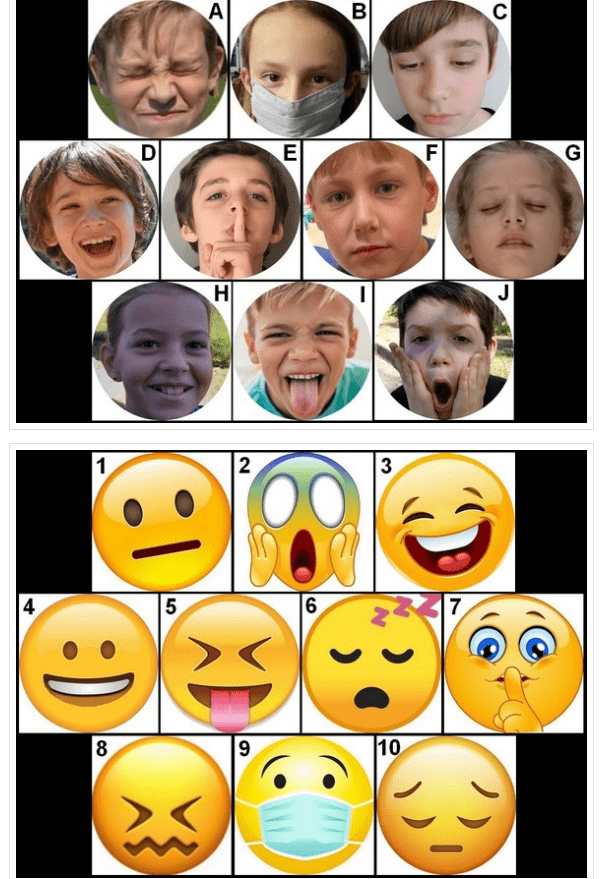
    • Serge Galligani’s class in France came up with a fun idea. The students turned their faces into emojis. Can you guess the answers?

    Reminders

    • The forms for weeks 1-6 are closed. If you’re catching up you can submit your tasks from weeks 1-6 in the week eight Google Form in this post. All Google Forms will close May 24th.
    • If you’d like to join us again for the next challenge in October 2020, make sure you’re on our mailing list. You’ll get an email in September when registrations are open. Otherwise, check this blog in September for all the news.
    • Follow The Edublogger — If you’re not already receiving the email newsletter from Edublogs, maybe you’d like to sign up? I send out an email regularly sharing the latest blog post.

    Thank You

    Thank you floral wreathThe Student Blogging Challenge is a real team effort. We couldn’t do it without the support of our wonderful volunteers.

    Many of our volunteers and participants have worked on the challenge during difficult circumstances. We admire your efforts immensely.

    To Sue Wyatt…

    Miss W/Tasteach/Sue Wyatt works tirelessly behind the scenes to help our commenting team, support participants, and keep our spreadsheets up to date. We appreciate you, Sue!

    To Marg Grosfield…

    Marg is a special commenter who does a wonderful job behind the scenes helping with the spreadsheets. Marg generously volunteers her time to ensure everyone is looked after. Thank you, Marg!

    To our commenters…

    Another big thank you goes to our team of commenters who provided an authentic audience for our students and classes each week. Your comments really helped our students with their confidence and motivation. We hope you’ll return again as a commenter in October.

    To our participants…

    It has been fantastic to see such enthusiastic participation from our students and teachers despite difficult circumstances! I hope you’ve all learned a lot and made some connections.

    Spread the word about the next Student Blogging Challenge!

    Summary Of The Student Blogging Challenge

    We had a good number of registrations for this Student Blogging Challenger, however, participation was naturally down due to over 90% of the world’s student population being affected by school closures.

    Let’s look at STUBC by the numbers…

    • Number of registered individual students: 1043
    • Number of registered classes: 111
    • Number of countries represented: 24

    Number of tasks submitted

    These are the edited numbers after incorrect and duplicate URLs were removed.

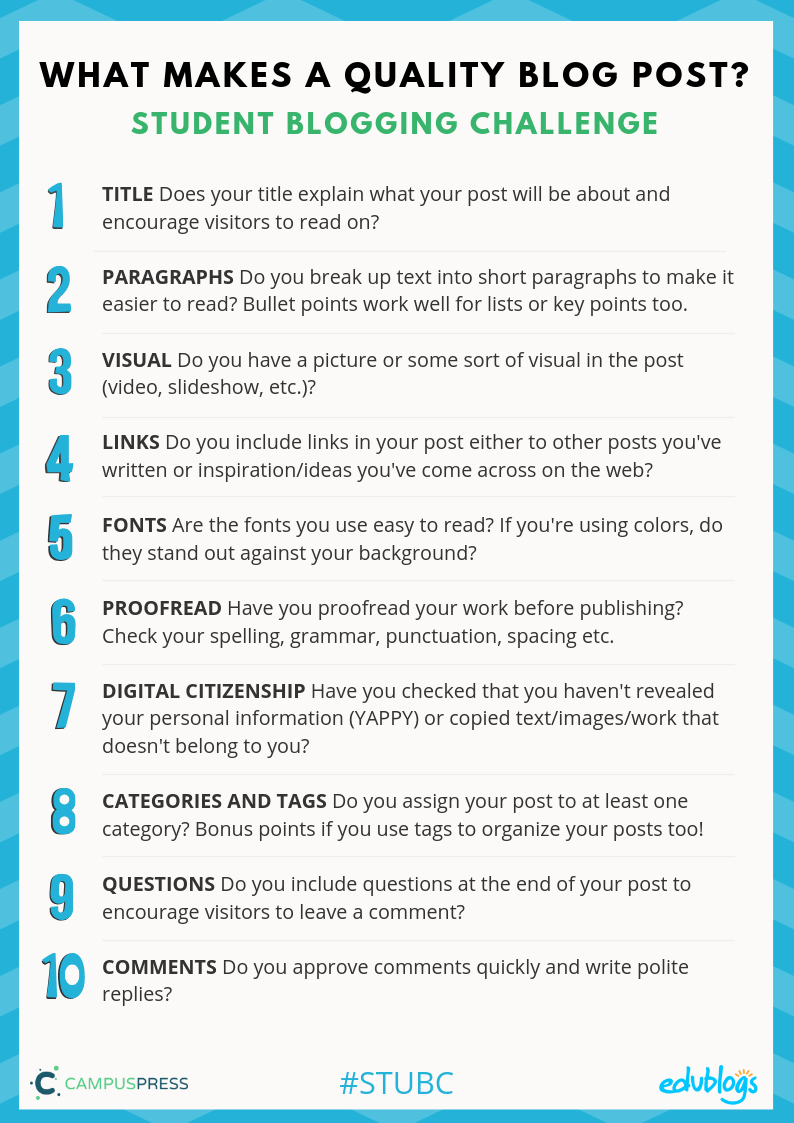
    What Makes A Quality Blog Post?

    I hope you’ve learned a lot throughout the Student Blogging Challenge! Perhaps if you look back to your posts from a few weeks ago you can see that you’ve improved.

    To wrap all our learning up, I invite you to take a look at this poster. It goes over some of the essential ingredients of a quality blog post. You might have your own ideas too!

    You’re welcome to add this poster to your blog.

    >> Download a PDF copy of the poster

    10 point checklist showing what makes a quality blog post STUBC

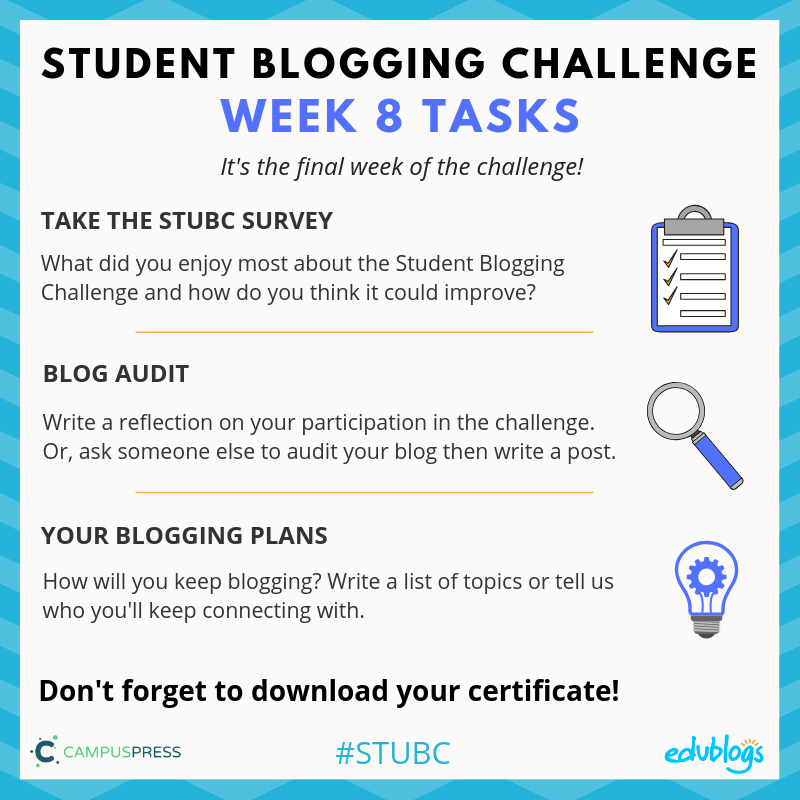
    Week Eight Tasks

    This week there are 3 tasks to complete. If you don’t have time to write a post, please just spend 5 minutes completing our survey. We’d really appreciate it!

    There is a separate survey for teachers and students.

    Teachers, please help us in making sure your students fill in the correct survey (for students)

    Week 8 Tasks STUBC Let's Reflect -- as described in post

    Task 1: Evaluate The Challenge

    Please complete our short survey so we know what you enjoyed most about the challenge and what we could do to improve things in the future.

    There is a separate survey for teachers and students.

    Student survey

    👉🏽 Click here to open the student survey

    Teachers, add this URL to your class blog or LMS if you like https://forms.gle/XVcj8gutKWa4ENgJ7

    Teacher survey

    👉🏽 Click here to open the teacher survey

    Remember, the teacher survey is not for students.

    Thank you!

    Task 2: Audit Your Blog 

    Option One: Write a post on your blog reflecting on your participation in the challenge.

    These are the sorts of prompts you could answer in your post:

    • How many weeks of the challenge did you participate in?
    • How many posts did you write in the 8 week period?
    • How many comments did you receive from classmates, teachers, or other visitors?
    • Which post did you enjoy writing the most and why?
    • Which web tools did you use to show creativity on your blog?
    • What are your plans for your blog now? Will you keep posting?

    Option Two: Ask a friend or family member who might not have read your blog to do an audit.

    Send them your blog URL and ask them some questions.
    For example:

    1. What were your first impressions of my blog?
    2. What captured your attention?
    3. What distracted you on the blog?
    4. What suggestions can you give me to improve my blog?

    Task 3: Your Blogging Plans

    While the Student Blogging Challenge is coming to an end, we hope this is not the end of your blogging journey. We encourage you to keep blogging and connecting. To do this well, you might need a plan.

    Write a post about how you plan to keep blogging:

    • Perhaps you’d like to publish a list of ideas you have for future blog post topics.
    • Or, you could ask your readers for suggestions on what they’d like you to write about on your blog. You could even run a poll.
    • Write about anyone you have connected with throughout the challenge that you’d like to stay in touch with. Are there any blogs you’ll keep reading and commenting on?

    Blog post ideas for students:

    More advanced bloggers and teachers might enjoy these two posts on The Edublogger:

    If you’re working as a class on this activity, perhaps students could contribute post ideas which the teacher compiles. Readers could be invited to comment or vote. 

    Student Certificates

    Congratulations on completing the Student Blogging Challenge!

    Download a certificate to celebrate your achievement.

    Note for commenters: I’ll email you about accessing your certificate during the week. 

    >>Click here for a PDF copy of the student certificate

    Student Blogging Challenge Certificate Participants 2020


    Submit Your Post URL ⬇

    If you want a commenter and other participants to visit your final task on your blog, remember to fill in the Google Form below.

    Examples of post URLS for STUBCThe Google Form

    Teachers, you’re welcome to put the Google Form URL on your own blog or LMS if it makes it easier to share with students.

    https://forms.gle/XQyGmTtyBFrfdgQm6


    If you have any additional comments about the Student Blogging Challenge, feel free to leave a comment below!

    Thank you!

    Source link