Artificial intelligence (AI) platforms, especially chatbots like ChatGPT and Gemini, are influencing many areas of higher education. Students and instructors can interact with these tools to get real-time, personalized help with nearly any academic task at hand, including helping students study or revamping course content for instructors. There is no question that the educational potential is significant, but so too are the concerns about academic integrity and the consequences of students relying too heavily on these tools. While it’s important to weigh the pros and cons of chatbots, using the right strategies and technologies can help avoid those issues and still allow faculty and students to benefit from this burgeoning technology.
Use Cases for Chatbots in Higher Education Teaching
First, let’s consider uses among faculty. They can use chatbots to help improve most areas of teaching and learning while still saving time.
Chatbots can assist with different phases of course design, including writing learning objectives and developing and repurposing content. Chatbots can also be used in evaluating student performance data if your institution offers a secure chatbot (just be sure to anonymize the data). Instructors can also use chatbots to review the rules and instructions for their assignments and tests to identify vague or subjective text and suggest clearer, more objective wording.
But one of the most impactful uses is adapting course content into formats that support students with different learning needs. Chatbots can adapt, simplify and organize text for students with learning or cognitive disabilities, generate alternative text for multimedia content, and they can even adjust their responses based on student emotions (for example, offering words of encouragement when a student is frustrated or discouraged).
Instructors may be tempted to use chatbots to grade written coursework as well, but for now, it is important to note that the technology still struggles with the nuances of grading and feedback. However, chatbots can still help by pulling out the main ideas and revealing whether a student’s essay meets basic criteria, which gives instructors a clearer starting point before reading.
You’ll see a lot of jargon and articles that make prompt writing seem complicated, but you don’t need to be an expert to write effective prompts. It’s a skill you can pick up quickly after a few tries, especially once you find what works for you and start creating your own templates to use in your courses.
Students and Chatbots: Finding a Balance
There are many ways that students can use chatbots to support learning while steering clear of misusing them for tests and assignments. Ensuring ethical and beneficial adoption of AI requires clear strategies and guidelines along with the right technology.
Improving Academic Performance
Recent research indicates that chatbots can improve learning and academic outcomes, but balance is key. When students rely on them too heavily, any benefits, like increased engagement, motivation and reflection are reduced or eliminated. When used appropriately, AI chatbots can tutor students to help them better understand and comprehend the information, which also increases engagement. Chatbots give students instant, personalized help with tasks such as summarizing content and checking grammar, and they also create a nonjudgmental space where students feel more comfortable asking questions.
Cognitive Load Reduction and Stress Management
Chatbots are ideal for offloading tasks such as summarizing a lecture transcript or highlighting key points in an assignment. With students under pressure to complete assignments, leaning on AI can also reduce stress and anxiety by giving them more time to focus on the important elements of an assignment.
Similarly, chatbots can help students visualize information by generating charts, graphs or images to support their ideas. They can also provide adaptive support for students with disabilities or language barriers by reading, translating, simplifying or reformatting content to meet their needs. This reduces cognitive load, allows students to focus on the assignment itself and builds confidence in their ability to complete the work.
Strategies for Reducing Chatbot Misuse
Because of the speed and ease of use for chatbots, students may begin to use them as a shortcut to get work done instead of a supplemental learning tool. That’s a big issue. It bypasses critical thinking, contextual understanding and collaboration. This not only cheats the student out of learning but creates academic integrity issues for higher education institutions to address and stay ahead of.
Cheating is common in higher education, and with recent surveys indicating that more than 85% of students use AI daily to help with schoolwork, there’s a good chance of overlap. Students have mixed opinions when it comes to using AI for homework, with around 40% of students acknowledging that using AI for research and writing assistance should be acceptable, but there should also be limitations and ethical use.
Communicating with students about academic integrity codes of conduct, AI use, and cheating policies and ramifications are the first steps in setting expectations. But delivering assignments in ways that reduce opportunities for the use of chatbots or that lay out specific guardrails for chatbot use can also be helpful.
Reducing Chatbot Cheating
Cheating in higher education will never completely go away, and efforts to maintain and manage tools and channels used for cheating must be ongoing. As more students leverage chatbots for both approved and unapproved use, educational institutions can work to help students understand the appropriate way to leverage technology within the learning environment.
While educators struggle to detect AI use reliably, AI detection tools can identify unedited chatbot-generated content with reasonable accuracy. But their effectiveness drops when students edit or modify responses or use AI paraphrasing tools to rewrite the content. They’re more useful as a gut check, not definitive proof that the text was AI-generated.
Remote proctoring during assessments and written assignments adds another barrier to cheating. Ideally, the proctoring solution should leverage AI test monitoring together with live human proctors, which gives faculty the control to prevent AI use and the flexibility to allow approved resources. For example, instructors can proctor exams or essays by restricting access to all unauthorized websites and software, including chatbots, while still providing access to specific materials like case studies or tools like Word, Excel and Google Docs.
Another option is to use scaffolded, realistic assignments and assessments that focus on real-world application and requiring students to connect course content to their personal experiences or context. This makes it more difficult for chatbots to generate accurate or meaningful responses. For example, assessments could ask students to develop a scenario based on a local community issue, work on collaborative projects that include peer reviews or create video responses that reference specific class lectures or materials. This approach helps evaluate students’ true understanding of materials and that they are developing practical skills.
Set the Stage Now for an AI-Inclusive Future
AI chatbots are powerful tools that can make education more personalized, accessible and engaging. However, their misuse can undermine academic integrity and dilute learning. The solution, in most cases, isn’t to ban them outright, but to integrate them responsibly throughout teaching and learning processes. Striking this balance isn’t always easy, but it’s necessary to preserve the value of learning while preparing students for a future where AI will almost certainly be a part of their work.
Tyler Stike is the Director of Content at Honorlock and a doctoral student in educational technology at the University of Florida. In his role at Honorlock, he develops a wide range of content on online education, assessment, and accessibility. He is interested in how affective states influence learning and performance, and plans to research how AI can support adaptive learning experiences that help students manage those states.
References
W. Dai et al., “Can Large Language Models Provide Feedback to Students? A Case Study on ChatGPT,” 2023 IEEE International Conference on Advanced Learning Technologies (ICALT), Orem, UT, USA, 2023, pp. 323-325, doi: 10.1109/ICALT58122.2023.00100.
Sánchez-Vera, Fulgencio. 2025. “Subject-Specialized Chatbot in Higher Education as a Tutor for Autonomous Exam Preparation: Analysis of the Impact on Academic Performance and Students’ Perception of Its Usefulness” Education Sciences 15, no. 1: 26. https://doi.org/10.3390/educsci15010026
Kofinas, A. K., Tsay, C.-H., & Pike, D. (2025). The impact of generative AI on academic integrity of authentic assessments within a higher education context. British Journal of Educational Technology, 00, 1–28. https://doi.org/10.1111/bjet
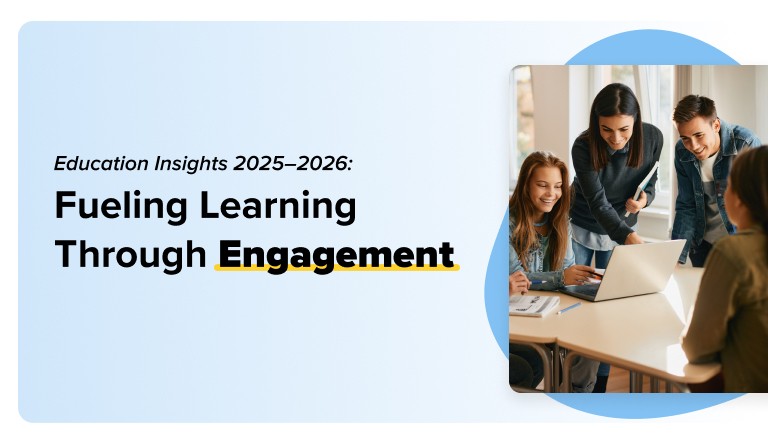
While there is wide agreement that student engagement plays a vital role in learning, educators continue to face uncertainty about what engagement looks like, how best to measure it, and how to sustain it, according to a new study from Discovery Education.
“Discovery Education conducted the EducationInsights report to gain a deeper understanding of how engagement is defined, observed, and nurtured in K-12 classrooms nationwide, and we are thankful to the participants who shared their perspectives and insights with us,” said Brian Shaw, Discovery Education’s Chief Executive Officer. “One of the most important findings of this report is that engagement is seen as essential to learning, but is inconsistently defined, observed, and supported in K-12 classrooms. I believe this highlights the need for a more standardized approach to measuring student engagement and connecting it to academic achievement. Discovery Education has embarked on an effort to address those challenges, and we look forward to sharing more as our work progresses.”
Key findings of the Education Insights 2025–2026: Fueling Learning Through Engagementreport include:
Engagement is broadly recognized as a key driver of learning and success. Ninety-three percent of educators surveyed agreed that student engagement is a critical metric for understanding overall achievement, and 99 percent of superintendents polled believe student engagement is one of the top predictors of success at school. Finally, 92 percent of students said that engaging lessons make school more enjoyable.
But educators disagree on the top indicators of engagement. Seventy-two percent of teachers rated asking thoughtful questions as the strongest indicator of student engagement. However, 54 percent of superintendents identified performing well on assessments as a top engagement indicator. This is nearly twice as high as teachers, who rank assessments among the lowest indicators of engagement.
School leaders and teachers disagree on if their schools have systems for measuring engagement. While 99 percent of superintendents and 88 percent of principals said their district has an intentional approach for measuring engagement, only 60 percent of teachers agreed. Further, nearly one-third of teachers said that a lack of clear, shared definitions of student engagement is a top challenge to measuring engagement effectively.
Educators and students differ on their perceptions of engagement levels. While 63 percent of students agreed with the statement “Students are highly engaged in school,” only 45 percent of teachers and 51 percent of principals surveyed agreed with the same statement.
Students rate their own engagement much higher than their peers. Seventy percent of elementary students perceived themselves as engaged, but only 42 percent perceived their peers as engaged. Fifty-nine percent of middle school students perceived themselves engaged in learning, but only 36 percent perceived their peers as engaged. Finally, 61 percent of high school students perceived themselves as engaged, but only 39 percent described their peers as engaged.
Proximity to learning changes impressions of AI. Two-thirds of students believe AI could help them learn faster, yet fewer than half of teachers report using AI themselves to complete tasks. Only 57 percent of teachers agreed with the statement “I frequently learn about positive ways students are using AI,” while 87 percent of principals and 98 percent of superintendents agree. Likewise, only 53 percent of teachers agreed with the statement “I am excited about the potential for AI to support teaching and learning,” while 83 percent of principals and 94 percent of superintendents agreed.
Yesterday, HEPI and Cambridge University Press and Assessment jointly hosted the UK launch of the OECD’s Education at a Glance. You can see the OECD’s slides here.
Here we publish a response to the OECD from Professor Sir Chris Husbands, who is a former Vice-Chancellor of Sheffield Hallam University and also former Chair of the Teaching Excellence Framework (TEF) Panel. Chris is a Trustee of HEPI and spoke at the launch.
There is one line in the 2025 OECD Education at a Glance report which should be in bright flashing lights for this and all governments. The supporting data is on page 112 of the main report. It is this: Individuals with greater educational attainment generally face a lower risk of unemployment and earn higher wages. Race, gender, deprivation, place, subjects studied all impact outcomes in different ways, but the overall conclusion is clear, and in his HEPI briefing on the report, the OECD’s chief analyst Andreas Schleicher got the summary down to just two words: education pays.
The 2025 OECD Education at a Glance report comes in at 541 pages, and the annual appearance of the report has made it the definitive guide to education system performance and policy dynamics all around the world: in the now familiar graphs of compelling clarity, and crisp text judgements, the OECD team have made themselves indispensable to institutional leaders, policy analysts and decision makers.
This year’s report has a specific focus on tertiary education, which in OECD terms includes, but stretches a bit further than, higher education. There are some familiar and unsurprising themes in the 2025 report, but they are nonetheless important for being set out so clearly. A few key findings stood out for me, all of them speaking clearly to the English and UK policy agendas.
First, advantages are inherited: those who have at least one tertiary-educated parent are more than twice as likely to attain a tertiary qualification than those whose parents have below upper secondary attainment, though the gap is smaller in the UK than elsewhere (p.56).
Secondly, life is getting tougher for those without qualifications: the employment rate for young adults without upper secondary qualifications fell by 6 points since 2019, and by 9 points for men (pp.82-3).
Thirdly, at the same it’s getting better for the better qualified: the nearly one-in-six with a Master’s degree have higher employment rates and earnings than those with an undergraduate degree (p48).
Fourthly, education is losing the battle for public funding as the costs of health, pensions and defence rise: between 2015 and 2022, government spending on education declined from nearly 11% of budgets to just over 10% (p.278).
And fifthly, despite that decline, R&D is strengthening to drive growth and competitiveness. Where it is highest, government drives it: in the UK, Israel and Switzerland, government R&D expenditure is more than twice private expenditure (p.329).
There is more fine-grained analysis about English higher education. England, on the OECD data, is an outlier in important respects.
First: English HE is well-funded by comparison with the OECD, whatever it feels like in the sector just now. The finding is important: total tertiary expenditure per student, including R&D, is $35,000, among the highest in the OECD and 65% above the average (p.327).
Secondly, however, in the UK government tertiary expenditure is $8,000, 48% below the OECD average (p.331). This is a result of high tuition fees: undergraduate fees are three times the OECD average.
The third way in which England is an outlier is that access to higher education and completion rates within it are high – fourteen percentage points above the OECD average (p.246): access to higher education is far more a consequence of maintenance support than fee levels, but high fee levels almost certainly disincentivise non-completion. Finally, while there is a gap between economic returns to science and technology disciplines on the one hand and arts and humanities on the other in all OECD countries, the gap is much higher in the UK than in almost all other countries (p.111).
Putting all this together poses some knotty challenges. England has a successful, relatively accessible higher education system, but one which is very expensive when budgets for education are getting tighter. And this is happening when the economic returns to high levels of qualification are strengthening: masters and doctoral graduates enjoy higher returns than those with undergraduate degrees, while the least qualified face more intense difficulties. These challenges go beyond the voluminous data in Education at a Glance.
First, and painful for English higher education, the challenge is not simply the level of current funding, but funding in relation to what is a high-cost operating and delivery model. That model secures strong results in terms of access for disadvantaged students and high completion rates, but it is relatively inflexible. It’s unclear whether a lower-cost and potentially more flexible operating model would put some of the successes of the English system at risk.
Secondly, it is the economic, social and increasingly political costs of the plight of the lowest attaining young people, and especially young males without qualifications, which is attracting political attention. If money is tight, it’s more likely to go towards that problem, and the London government’s decision to move skills funding into the Department of Work and Pensions appears to be a signal of intent.
These are the leadership challenges which emerge from this year’s report: how to reshape our successful HE system so that its strengths remain, but it can be more responsive and flexible. It needs to adapt to a changing labour market and to a society in which division and inequality are being reinforced with greater ferocity.
Welcome back to our fourth season. Time Flies. We’ve gone back to an audio only format ’cause apparently y’all are audio and bibliophiles and not videophiles, so we decided to chuck the extra editing burden. Other than that, though, it’s the same show. Bring you stories on higher education from all around the world. So, let’s get to it.
Today’s guest is Pedro Teixeira. He’s a higher education scholar from the University of Porto in Portugal, focusing to a large extent on the economics of education, but he also just finished a term as that country’s Secretary of State for higher education. That’s a position closer to a junior minister rather than a deputy minister, but it has elements of both.
I first met Pedro about 20 years ago, and I ran into him again this summer in Boston at the Center for International Higher Education’s biannual shindig, where he was giving the Philip Altbach lecture. And let me tell you, this was the best lecture I have listened to in a long time.
Two reasons for this. First, Pedro spoke about his experiences as a Secretary of State trying to negotiate a new funding formula with universities in that country. I won’t spoil the details, but one big highlight for me was that he was in the rare position of being a politician, trying to convince universities not to have a performance-based element in their funding formula. And second, he talked about the future of higher education in the face of possible falling returns to education due to wider adoption of artificial intelligence.
It was such a good talk, I knew my World of Higher Education podcast listeners would think it was great too. And while I couldn’t record it, I did do the next best thing. I invited Pedro to be our lead off guest for this season’s podcast. Let’s listen to what he has to say.
The World of Higher Education Podcast Episode 4.1 | From Funding Formulas to AI: Pedro Teixeira on Higher Education’s Next Challenges
Transcript
Alex Usher: Okay, so Pedro, you were an academic at CIPES (Centre of Research on Higher Education Policy) at the University of Porto, and you went from that to being a minister of state. That’s not an unfamiliar path in Portuguese higher education—Alberto Amal, I think, did something similar. But that move from academia to government, how big a shift was that? What did you learn, and what were you not expecting when becoming a minister of state?
Pedro Teixeira: I think you’re right in the sense that there are quite a few people who have done this, not only in Portugal but also in other parts of Europe, in different areas. And I think it’s always a bit of a challenge, because there’s this expectation that, since you’re an academic—and especially if you’re an expert on the topic—people expect you to have a solution for all the problems. And it’s not exactly like that.
At the same time, I think one is worried that what you do in office will be coherent with what you had advocated as an academic and with what you had written about specific topics. That’s challenging.
In some respects, I wasn’t very surprised by what I faced, because I had been involved in advisory roles and I knew people who had been in that kind of policy role. So I think I wasn’t—I mean, there were the things you expect, like the amount of work and the long days. But I never felt that was really the most difficult part. Of course, going through these things and living them is a little different than knowing them in the abstract.
But I think the main concern for me was the permanent pressures. You are always concerned with something, always worried either about the problems you have to deal with or the problems that will emerge.
What I was not so happy with was the lack of a sense of urgency in some of the actors, both on the government side and on the side of stakeholders in the sector. Because if you feel the problems are significant, you need to move forward—of course not rushing, but you do need to move forward.
On the positive side, I think the quality and dedication of staff was very important. Civil service is often criticized, but I found that very important. And the other thing that was also very important was the role of data and evidence, while at the same time you also need to develop arguments and persuade people about the points you’re trying to make.
Alex Usher: So what were those urgent issues? I know one of the big things you dealt with was a funding formula—and we’ll come to that later—but what, to your mind, were the other big urgent issues in Portuguese higher education at that time?
Pedro Teixeira: As we know, most people in their higher education system always think their system is very specific, very different from everyone else. But in fact, we know there are a lot of commonalities across education sectors.
In many ways, the challenges were the same ones that people describe as belonging to mass systems, or what others might call mature systems. One significant issue, of course, was the adverse demographic trends.
Another was the tension between, on the one hand, wanting to broaden access and enhance equity in the system, and on the other, facing enormous pressures toward stratification and elitism, with the system tending to reproduce socioeconomic inequalities.
There were also issues related to diversity versus isomorphism. On the one hand, people agree that in order for a mass system to function, it needs to be diverse. But there are pressures in the system that tend to push institutions toward mimicking or emulating the more prestigious ones.
The balance between missions is another challenge. This relates to that issue of isomorphism, because research has become so dominant in defining what higher education institutions do and how they see their mission.
And, of course, there were issues of cost and relevance: who should pay for higher education, and how can we persuade society to put more resources into a sector that, because it is a mass system, is already absorbing a significant amount of public funding?
Alex Usher: All right. On that point about demographics, I saw a story in one of the Portuguese newspapers this week saying that applications were down 15% this year. Is that a rapidly evolving situation? That seems like a lot.
Pedro Teixeira: No. There’s been a downward trend over the last three or four years, but because the number of applicants was bigger than the number of places, it didn’t disturb things much. Most of what we’re seeing now is actually due to the fact that in 2020, with the pandemic, exams for the conclusion of secondary education were suspended.
They were only reintroduced this year. That decision was taken at the end—actually by the government I was part of—at the beginning of 2023. But in order to give students and schools time to adjust, the change only applied to the students who were starting secondary education then. Those are the students who applied this year for higher education.
Basically, when you look at the data—we don’t yet have the numbers on how many graduated from secondary education—but the number of applicants is very much in line with what we had in 2019, which was the last year we had exams for the conclusion of secondary education.
And in fact, if you take into account the declining trend of the last three or four years, I would say it’s not a bad result. It actually means the system managed to compensate for those losses.
Alex Usher: Managed to absorb.
Pedro Teixeira: Yeah, yeah. But it’s also a signal for the sector in that respect.
Alex Usher: So let’s go back to the funding formula issue, because I know that was a big part of your tenure as Secretary of State for Higher Education. What was wrong with the old formula, and what did you hope to achieve with a new one?
Pedro Teixeira: There are two things. I think there were some issues with the old formula. It was designed in 2006, so 15 years had passed. The sector was very different by then—the situation, the challenges, everything had changed.
Also, like many formulas of that time, it was quite complicated, with many indicators and many categories for fields of study. That didn’t make the system very transparent. If you introduce too many indicators and variables, in many ways the message you want to convey is lost. A funding formula is supposed to be an instrument to steer the system.
But the larger problem was that this old formula hadn’t been applied for the last 12 years. When the Great Recession started around 2005–2010, the government suspended its application. Since then, the budgets of all institutions have evolved in the same way—same amount, same direction—regardless of their number of students or their performance.
So when we came into government in 2022, the situation was, in many cases, very unbalanced. Some institutions that had grown significantly didn’t have funding to match that growth. Others that had declined hadn’t seen any adjustments either.
The idea of having a new formula was preceded by an OECD review commissioned by the previous government, which we took over. Our idea was to design a simpler and more transparent formula that would form part of the funding system. In addition to the formula, we introduced funding contracts, focused mainly on institutions located in more peripheral regions of the country.
The idea was also to have a four-year period of gradual implementation of the new model and funding system. At the same time, this would correct some of the imbalances caused by not having applied any formula for 12 years.
Alex Usher: And how did institutions respond to those proposals? Were they on your side? Were there things they liked, and things they didn’t like? Universities don’t like change, after all.
Pedro Teixeira: On the other hand, I think a significant part of the sector was very keen to finally have some kind of formula—some set of rules that would be applied to the whole sector. Of course, some institutions were afraid that by reintroducing a formula, given their recent evolution, they might end up on the losing side.
But one of the key aspects of the process was that this was always seen as a formula, or a new system, that would be introduced within a pattern of growth in funding for the sector—not as a way of redistributing funds from some institutions to others. That made the process easier. It would have been much more difficult if we had been taking money from some institutions to give to others.
This required political commitment from the government, and it was very important to have the backing of the Prime Minister and the Minister of Finance. That meant we could correct imbalances without creating disruption for institutions.
I would say the main critical points were, first, the differentiation between sectors. We have a diverse education system with universities and vocational institutions. Then there was the question of whether to differentiate between regions. Our decision was to have a formula that applied in the same way to all regions, and then use funding contracts as additional resources targeted for strategic purposes—mainly for institutions located in more deprived or less populated regions.
Another point raised in discussions was fields of study. Everyone wants their own fields—or the ones in which they are strongest—to be better funded. But we really wanted to simplify the mechanism, and I think that helped.
Finally, there was the issue of performance indicators. We didn’t propose to introduce them from the start. Because we had gone so many years without a formula, we didn’t have consistent data, and moreover we wanted performance indicators to be developed collaboratively with institutions. The idea was that institutions themselves would decide which areas they wanted to focus on, which areas they wanted to contribute to, and therefore which indicators they wanted to be assessed by.
Because we decided that performance indicators would come in a second step, some institutions wanted them introduced earlier. That was also a point of discussion.
Alex Usher: I find that fascinating, because I don’t think I’ve ever heard of universities—maybe “demanding” is the wrong word—but being disappointed that there wasn’t enough performance-based funding in a system. Why do you think that was?
Pedro Teixeira: I’m not sure I was surprised, but it was significant that some institutions were pressing for it. In some ways, it could have been a strategic approach by certain institutions because they thought they would be on the winning side.
But I think it also has to do with the fact that this competitive, performance ethos has so deeply permeated higher education. At some point, I even said to some institutions: be careful what you wish for. Because in some cases, this could curtail your autonomy and increase the possibility of government interference in your ability to devise your own strategy.
Actually, I think that was, in many ways, the only real public criticism that came up. And that was quite interesting, to say the least.
Alex Usher: I want to shift the ground a little bit from Portugal to Boston. Two months ago, you gave the Philip B. Altbach Lecture at Boston College’s Center for International Higher Education. You devoted a lot of your talk to artificial intelligence and how it’s likely to change higher education. Could you tell us a little bit about your views on this?
Pedro Teixeira: That’s a fascinating topic. Of course, it’s an important issue for many people around the world and for many education institutions.
It’s fascinating because, to a certain extent, we’ve been nurtured by a view that has dominated over the last decades—that progress has been skill-biased. In previous waves of technological progress, the labor market tended to favor those with higher skills. Education was often seen as contributing to that, helping people be on the winning side, and the returns to more education and more skills seemed to confirm it.
My concern is that this wave may be slightly different. I’m not saying it will destroy a lot of jobs, but I am concerned that it may affect skilled and experienced workers in ways that previous waves did not.
We’ve already seen, and many of us have already experienced in our own jobs, that AI is performing certain tasks we no longer have to do. It’s also changing the way we perform other tasks, because it works as a collaborative tool.
So I think there is a serious possibility that AI—especially generative AI—will change the tasks associated with many jobs that today require a higher education degree. We need to pay attention to that and respond to it.
I worry that because education has been such a success story over the last half-century in many countries, there is a degree of complacency. People take a relaxed attitude, saying: “We’ve seen previous changes, and we didn’t experience so many problems, so we’ll be fine this time as well.”
I think there are quite a few aspects we need to change in our approach.
Alex Usher: And what might those areas be? Because I have to say, whenever I hear people discussing AI and radical change in the labor market, I think: that’s the stuff that’s actually hardest for higher education to deal with—or for any kind of education to deal with.
Education is often about teaching a corpus of knowledge, and there is no corpus of knowledge about AI. We’re all flailing blindly here—it’s totally new.
I think a lot about James Bessen and his book Learning by Doing. He was talking about how education worked during the Industrial Revolution in Manchester, and in other parts of England that were industrializing. Basically, when there’s a totally new technology, who are you going to get to teach new people? There’s no settled corpus of knowledge about it.
What do you think higher education institutions should be doing in that context?
Pedro Teixeira: One of the major concerns I have is that we tend to focus so much on the impact of digitalization and technology on science and technology fields. But we should be much more attentive to how it’s changing non-technical fields—health professions, the humanities, and the social sciences. These make up a very large part of higher education, and a very large part of the qualified workforce in many of our countries.
I think there are several things we need to do. The first is to rethink the balance between the different missions of higher education. At the moment, so much of the pressure and so many of the rewards are focused on missions other than education, teaching, and learning. We need to rebalance that. If institutions don’t commit themselves to education, it will be much more difficult for anything significant to happen at the basic level—among professors, programs, and so on.
If AI does affect more experienced workers, that means many people will need more support in terms of lifelong learning. They will need support in reskilling, and in some cases, in changing their professional trajectories. This is an area where many higher education institutions preach much more than they practice.
So I think we need to rethink how we allocate our efforts in education portfolios, moving more attention toward lifelong learning. So far, the focus has been overwhelmingly on initial training, which has been the core of the sector in many systems.
Finally, we would need to rethink—or at least introduce—changes at the level of initial training: the way we teach, the way we assess students, the way we train and retrain academic staff. None of this will be obvious. But in the end, it will all come down to how much institutions are committed to education as the prime mission of higher education.
Alex Usher: So even if AI is not a mass job killer—either now or in the future—we are seeing declining rates of return on higher education around the world. There’s massive graduate unemployment in China, quite a bit in India, and in the United States, for the first time, young graduates are less likely to be employed than non-graduates of the same age.
What does it mean for the higher education sector globally if rates of return decline? Are we heading for a smaller global higher education sector?
Pedro Teixeira: I tend to be cautious with some of these conclusions. We may be extracting too much from what could be transitional situations. We’ve seen in the past moments where there were problems adjusting supply and demand for graduates, and those didn’t necessarily lead to a permanent or structural situation where education became less relevant.
In countries like China and India, higher education systems have expanded tremendously in recent years. In some ways, what we’re seeing now is similar to what other countries experienced when they went through massive expansions and the economy couldn’t absorb the rising number of graduates as quickly as the education system was producing them.
It’s also not surprising that in many countries we’re seeing lower relevance of initial training—bachelor’s or first-cycle degrees. That’s a supply-and-demand issue. As systems move from elite to mass, that’s normal. But in many cases, we’ve seen a growing premium for postgraduate degrees and for continuing education. So I’d be cautious about concluding that education will become less and less relevant.
That said, I would repeat my concern about complacency. I don’t necessarily expect a decline in the sector, but perhaps a slower pattern of growth. That will be a challenge, because we’re coming out of decades of relentless growth in many education systems.
I also think we’ll see a broader scope in how we approach education and differences in higher education portfolios. It’s not that there aren’t many things we can do, but it will probably require us to rethink what we expect from professors and where institutions should focus their attention.
Alex Usher: Right. Pedro, thank you so much for being with us today.
Pedro Teixeira: My pleasure.
Alex Usher: And it just remains for me to thank our excellent producers, Sam Pufek and Tiffany MacLennan, and you, our listeners and readers, for joining us. If you have any questions or comments about today’s episode, or suggestions for future episodes, don’t hesitate to get in touch with us at [email protected].
Join us next week when our guest will be the University of Melbourne’s Andrew Norton. He’ll be talking about what lies ahead for Australian higher education under a second Labor government. Bye for now.
*This podcast transcript was generated using an AI transcription service with limited editing. Please forgive any errors made through this service.Please note, the views and opinions expressed in each episode are those of the individual contributors, and do not necessarily reflect those of the podcast host and team, or our sponsors.
A new study reveals that while there is wide agreement that student engagement plays a vital role in learning, educators continue to face uncertainty about what engagement looks like, how best to measure it, and how to sustain it. Education Insights 2025–2026: Fueling Learning Through Engagementcaptures prevailing attitudes and beliefs on the topic of engagement from 1,398 superintendents, teachers, parents, and students from across the United States. Survey data was collected in May 2025 by Hanover Research on behalf of Discovery Education, the creators of essential PreK-12 learning solutions used in classrooms around the world.
“Discovery Education conducted the EducationInsights report to gain a deeper understanding of how engagement is defined, observed, and nurtured in K-12 classrooms nationwide, and we are thankful to the participants who shared their perspectives and insights with us,” said Brian Shaw, Discovery Education’s Chief Executive Officer. “One of the most important findings of this report is that engagement is seen as essential to learning, but is inconsistently defined, observed, and supported in K-12 classrooms. I believe this highlights the need for a more standardized approach to measuring student engagement and connecting it to academic achievement. Discovery Education has embarked on an effort to address those challenges, and we look forward to sharing more as our work progresses.”
Key findings of the Education Insights 2025–2026: Fueling Learning Through Engagementreport include:
Engagement is broadly recognized as a key driver of learning and success. 93% of educators surveyed agreed that student engagement is a critical metric for understanding overall achievement, and 99% of superintendents polled believe student engagement is one of the top predictors of success at school. Finally, 92% of students said that engaging lessons make school more enjoyable.
But educators disagree on the top indicators of engagement. 72% of teachers rated asking thoughtful questions as the strongest indicator of student engagement. However, 54% of superintendents identified performing well on assessments as a top engagement indicator. This is nearly twice as high as teachers, who rank assessments among the lowest indicators of engagement.
School leaders and teachers disagree on if their schools have systems for measuring engagement. While 99% of superintendents and 88% of principals said their district has an intentional approach for measuring engagement, only 60% of teachers agreed. Further, nearly 1/3 of teachers said that a lack of clear, shared definitions of student engagement is a top challenge to measuring engagement effectively.
Educators and students differ on their perceptions of engagement levels. While 63% of students agreed with the statement “Students are highly engaged in school,” only 45% of teachers and 51% of principals surveyed agreed with the same statement.
Students rate their own engagement much higher than their peers. 70% of elementary students perceived themselves as engaged, but only 42% perceived their peers as engaged. 59% of middle school students perceived themselves engaged in learning, but only 36% perceived their peers as engaged. Finally, 61% of high school students perceived themselves as engaged, but only 39% described their peers as engaged.
Proximity to learning changes impressions of AI. Two-thirds of students believe AI could help them learn faster, yet fewer than half of teachers report using AI themselves to complete tasks. Only 57% of teachers agreed with the statement “I frequently learn about positive ways students are using AI,” while 87% of principals and 98% of superintendents agree. Likewise, only 53% of teachers agreed with the statement “I am excited about the potential for AI to support teaching and learning,” while 83% of principals and 94% of superintendents agreed.
A complete copy of Education Insights 2025–2026: Fueling Learning Through Engagementcan be downloaded here.
On Wednesday, October 8 at 2:00 PM ET, Discovery Education is hosting a special, town hall-style webinar during which education leaders from across the nation will share their thoughts and insights on this report and its findings. Find more details and register for this event here.
About Discovery Education Discovery Education is the worldwide edtech leader whose state-of-the-art, PreK-12, digital solutions help educators engage all students and support higher academic achievement. Through award-winning multimedia content, instructional supports, and innovative classroom tools that are effective, engaging, and easy to use, Discovery Education helps educators deliver powerful learning experiences. Discovery Education serves approximately 4.5 million educators and 45 million students worldwide, and its resources are accessed in over 100 countries and territories. Through partnerships with districts, states, and trusted organizations, Discovery Education empowers teachers with essential edtech solutions that inspire curiosity, build confidence, and accelerate learning. Learn more at www.discoveryeducation.com.
Most undergraduates today are juggling academics with paid work, many logging 40 or more hours a week. That load leaves little margin: more non-academic responsibilities, less time for coursework, and fewer opportunities to engage on campus mean these students often feel the effects of federal policy changes first.
The budget reconciliation bill signed into law on July 4 threatens to make those challenges worse, reshaping student loans and public benefit programs like the Supplemental Nutrition Assistance Program (SNAP) and Medicaid in ways that risk cutting off critical financial lifelines. On Pell Grants, the news is mixed: the bill restores a revised Workforce Pell program that could open doors to short-term training, but makes other changes that may reduce access for some students.
For working students already balancing jobs, school, and basic needs, these changes could tip the balance toward longer time to degree, greater debt, or leaving school altogether. Using recent data, we explore how these students are making ends meet now, and what colleges, universities, and policymakers can do to protect and strengthen the supports that help them stay enrolled and graduate.
Profile of student workers
According to the 2020 National Postsecondary Student Aid Study (NPSAS:20), nearly three-quarters of undergraduate students work while enrolled, with around a third of those students working full time. Results from Trellis Strategies’ 2024 Student Financial Wellness Survey (SFWS) identified similar rates of employment, allowing the ability to cross-reference specific questions about overall financial wellness. In this post, we compare SFWS respondents who answered “yes” to the question “Do you work for pay?” with those who answered “no.”
About half of all SFWS respondents reported using income from their employment to pay for school. However, many working students have additional financial commitments beyond their education. For example, 19 percent of working respondents indicated they provide financial support to a child, and 18 percent provide the same support to their parents or guardians. Overall, about half of working SFWS respondents (47 percent) shared that it was important for them to support their family financially while in college, compared to 38 percent of their non-working peers.
This heightened familial commitment is reflected in the fact that many working students—36 percent of those responding to the 2024 SFWS—identify primarily as workers who go to school, rather than students who work. Furthermore, working students attend part-time at higher rates (38 percent) compared to their non-working peers (28 percent).
How working students pay for college
Most students who were working at the time the 2024 SFWS was administered self-reported using their employment to pay for college (see Figure 2). Many used personal savings as well, but only seven percent were able to “work their way through college” using employment and/or personal savings alone. Instead, working students, similar to their peers who don’t work, depend upon aid such as grants and loans to be able to access higher education.
Nationally representative data from NPSAS:20 show that almost 40 percent of working students receive Pell Grants and more than a third borrow federal student loans (non-working students receive federal aid at similar rates).
For these students, losing part of their federal aid could mean they can no longer afford higher education. This is especially true for those students with limited financial flexibility to fall back on. Working students in the SFWS were more likely to report using credit cards to pay for college and were less likely to receive financial support from parents or family, as compared to their non-working peers.
Implications of policy changes
The reconciliation bill passed by Congress in July 2025 (the One Big Beautiful Bill Act) includes many changes that impact students, with particularly significant consequences for those who work.
On Pell Grants, the bill offers both opportunities and new concerns. It restores a revised Workforce Pell Grant program, starting July 2026, that expands the traditional Pell Grant to include eligible short-term non-degree programs at accredited institutions, an option that could help working students earn credentials more quickly and move into higher-paying jobs.
At the same time, the bill restricts Pell eligibility when other scholarships, grants, or non-federal aid fully cover a student’s cost of attendance. Under this system, a working student who receives a private scholarship that might otherwise allow them to decrease their working hours could instead see their Pell Grant decrease. While intended to prevent Pell from being awarded in “full-ride” situations, the change could also affect working students who have substantial financial responsibilities beyond the calculated cost of attendance.
The bill also includes significant changes to federal student loan programs and repayment options, with most of the changes effective as of July 1, 2026. Parents borrowing Parent PLUS loans will now have annual and aggregate borrowing caps. About one in 10 undergraduate students, including among working students, reported that their parents borrowed loans for their education. Limits on this borrowing may constrain the financial resources of some students, with possible negative consequences for their academic momentum.
Changes to SNAP and Medicaid will affect state budgets, putting higher education at risk and making it harder for people to enroll in and complete a credential while meeting their basic needs. Many students, despite also working, already face significant barriers such as food and housing insecurity, as found in the 2024 SFWS.
While no changes were made to student-specific eligibility criteria in SNAP, new work requirements in SNAP and Medicaid prioritize work over education, making it harder for people to complete a credential while maintaining access to food and health assistance. These work requirements will also create new administrative hurdles, which research shows result in people being kicked off of Medicaid despite being eligible.
The net effect of these changes will relegate more people to low-wage work by delaying or denying their ability to complete credentials that would provide higher wages, lower unemployment and poverty rates, and less use of public benefits. While the Medicaid work requirement changes don’t begin until January 2028, the SNAP changes were effective upon signing of the bill. However, states are awaiting further guidance from the U.S. Department of Agriculture on how to administer those changes.
Any reduction in financial aid or public assistance resources for students may mean that more students will need to work longer hours while enrolled to make ends meet. Besides reducing the number of hours available to study, work schedules can also directly conflict with class schedules and other campus activities.One-quarter of working respondents in the 2024 SFWS reported missing at least one day of classes due to conflicts with their job, and 56 percent of students with jobs agreed or strongly agreed that their job interfered with their ability to engage in extracurricular activities or social events at their school. Students with a weaker sense of connection and belonging at their institution have been shown to have worse academic performance and retention rates than their peers.
Supporting working students
While changes to federal student aid programs are still being debated, colleges and universities can ensure they have programs and processes in place to support working students at their campuses. Institutional leaders can:
Develop or enhance robust support systems, such as emergency grants, connection to public services, and adequate financial aid, to help students weather financial challenges, develop a stronger connection to their institution, and remain enrolled.
Implement strategic course scheduling that can help students more effectively plan employment, child care, transportation, and other needs so they can enroll in and complete more classes in a timely way.
Leverage regular data collection to respond to the needs of their specific student body. Participating in the annual Student Financial Wellness Survey is free and provides institutions with a customized report, benchmarking insights, and de-identified student data.
Policymakers should consider how programs can best serve students juggling multiple time commitments and financial priorities. Robust social services, such as child care and access to public assistance programs, can allow more working students the opportunity to thrive. Adequate financial aid can help students work less and complete their credentials sooner, opening the door to higher wages.
If you have any questions or comments about this blog post, please contact us.
Autistic college students are experiencing anxiety and depression at significantly higher rates than their non-autistic peers, according to new research from Binghamton University that analyzed data from nearly 150,000 undergraduate students across 342 institutions nationwide.
The study, published in the Journal of Autism and Developmental Disorders, represents one of the most comprehensive examinations to date of mental health challenges facing autistic students in higher education—a population that researchers say has been historically underrepresented in academic research despite growing enrollment numbers.
“What we found is really staggering—autistic individuals endorse much higher rates of anxiety and depression compared to their non-autistic peers,” said Diego Aragon-Guevara, the study’s lead author and a PhD student in psychology at Binghamton University.
The research team analyzed data from the National Survey of Student Engagement (NSSE), which in 2021 became the first year that autism was included as an endorsable category in the survey. This milestone allowed researchers to conduct the first large-scale comparison of mental health outcomes between autistic and non-autistic college students.
“We were really excited to see what the data would tell us. It was a big opportunity to be able to do this,” said Dr. Jennifer Gillis Mattson, professor of psychology and co-director of the Institute for Child Development at Binghamton University, who co-authored the study.
The findings come at a critical time for higher education institutions as autism diagnoses continue to rise nationwide and more autistic students pursue college degrees. The research highlights a significant gap in support services that could impact student success and retention.
“We know the number of autistic college students continues to increase every single year,” Gillis-Mattson noted. “We really do have an obligation to support these students, and to know how best to support these students, we need to look beyond just autism.”
The study reveals that campus support systems may be inadvertently overlooking mental health needs while focusing primarily on autism-specific accommodations. Aragon-Guevara, whose research focuses on improving quality of life for autistic adults, said this represents a critical oversight in student services.
“Support personnel might address an individual’s autism and, in the process, overlook their mental health issues,” he explained. “More care needs to be put into addressing that nuance.”
The research underscores the need for institutions to develop more comprehensive support frameworks that address both autism-related needs and concurrent mental health challenges. The findings suggest that traditional disability services approaches may need significant enhancement to serve this population effectively.
“We want to provide the best support for them and to make sure that they have a college experience where they get a lot out of it, but also feel comfortable,” Aragon-Guevara said.
Dr. Hyejung Kim, an assistant professor in Binghamton’s Department of Teaching, Learning and Educational Leadership, noted that the complexity of factors affecting autistic students requires deeper investigation.
“This population often skews male, and interactions between personal factors and conditions such as anxiety and depression may shape overall well-being in college,” she said.
Kim also pointed to additional considerations that institutions should examine.
“Autistic students are also more likely to pursue STEM fields, and many report different experiences with faculty and staff across institutional settings,” she said. “We still have much to learn about how these and other contextual factors relate to mental well-being.”
The Binghamton team views this study as foundational research that confirms the scope of mental health challenges among autistic college students. Their next phase will investigate specific contributing factors, including social dynamics, faculty support, campus accessibility, and other environmental elements that influence student well-being.
“There are so many elements that go into being comfortable in the new environment that is college,” Aragon-Guevara explained. “We want to look into that and see if there are any deficits in those areas that autistic college students are experiencing, so that we know where we can help support them, or create institutional things to help improve quality of life as a whole.”
The research is part of a broader effort at Binghamton to better understand and support autistic students in higher education, with plans to collaborate with campus partners to develop targeted interventions based on their findings.
Principals from K-12 schools across the country traveled to Seattle to attend UNITED, the National Conference on School Leadership, July 11-13, where they discussed and shared solutions for the many challenges facing the education sector.
From concerns over school safety to the dilemma of chronic absenteeism, school leaders heard about innovative ways to tackle these issues by embracing local partnerships or looking into resources from national organizations.
Principals also learned about creative approaches emerging in the classroom. At one Indiana high school, for example, a public relations class is helping both to boost the school’s messaging to its community and to build students’ media skills. District administrators at Portland Public Schools, meanwhile, discussed how they’ve navigated and sustained a high-impact tutoring program in the state’s largest school district.
Read on for K-12 Dive’s coverage of the 2025 annual combined meeting of the National Association of Elementary School Principals and the National Association of Secondary School Principals.
The First Amendment trumps the statutes that the government is abusing to deport people for speech alone
This lawsuit seeks a landmark ruling that the First Amendment forbids the government from deporting lawfully present noncitizens for constitutionally protected speech
FIRE attorney: ‘In a free country, you shouldn’t have to show your papers to voice your opinion’
SAN JOSE, Calif., Aug. 6, 2025 — Today, the Foundation for Individual Rights and Expression sued Secretary of State Marco Rubio, challenging two federal immigration law provisions that give him unchecked power to revoke legal immigrants’ visas and deport them for protected speech.
“In the United States of America, no one should fear a midnight knock on the door for voicing the wrong opinion,” said FIRE attorney Conor Fitzpatrick. “Free speech isn’t a privilege the government hands out. Under our Constitution it is the inalienable right of every man, woman, and child.”
But since March, Rubio and the Trump administration have waged an assault on free speech, targeting foreign university students for deportation based on bedrock protected speech like writing op-eds and attending protests. Their attack is casting a pall of fear over millions of noncitizens, who now worry that voicing the “wrong” opinion about America or Israel will result in deportation.
Noncitizens in the United States have First Amendment rights. Despite that, Rubio is wielding two provisions of the Immigration and Nationality Act to target lawfully present noncitizens for their opinions.
The first allows the secretary of state to initiate deportation proceedings against any noncitizen for protected speech if the secretary “personally determines” the speech “compromises a compelling foreign policy interest.”
The second enables the secretary of state to revoke the visa of any noncitizen “at any time” for any reason.
As FIRE’s lawsuit explains, the provisions are unconstitutional when used to revoke a visa or deport someone for speech the First Amendment protects.
The Trump administration is proudly using the provisions to revoke the visas of and deport lawfully present noncitizens for their speech if the government deems it anti-American or anti-Israel. Rubio used the first provision to target Columbia University student Mahmoud Khalil for protected pro-Palestinian speech and the second to target Tufts University student Rümeysa Öztürk for coauthoring an op-ed.
Rubio and the Trump administration claim — as all censors do — that this time is different. They claim that this political speech comes from noncitizens, which therefore warrants setting aside America’s protection of free speech.
That’s wrong. America’s founding principle is that liberty comes not from the government, but is an inherent right of every individual. Every person — whether they’re a U.S. citizen, are visiting for the week, or are here on a student visa — has free speech rights in this country.
“Two lawful residents of the United States holding the same sign at the same protest shouldn’t be treated differently just because one’s here on a visa,” said FIRE Legal Director Will Creeley. “The First Amendment bars the government from punishing protected speech — period. In our free country, you shouldn’t have to show your papers to speak your mind.”
Plaintiffs in FIRE’s lawsuit represent the wide range of groups and individuals whose speech is threatened by the continued assault on noncitizens’ protected speech:
The Stanford Daily, the independent, student-run newspaper at Stanford University, where writers with student visas are declining assignments related to the conflict in the Middle East, worried that even reporting on the war will endanger their immigration status
Jane Doe and John Doe, two legal noncitizens with no criminal record who engaged in pro-Palestinian speech and now fear deportation and visa revocation because of their expression
“There’s real fear on campus and it reaches into the newsroom,” said Greta Reich, editor-in-chief of The Stanford Daily. “I’ve had reporters turn down assignments, request the removal of some of their articles, and even quit the paper because they fear deportation for being associated with speaking on political topics, even in a journalistic capacity. The Daily is losing the voices of a significant portion of our student population.”
There’s also historical context that should give the government pause. Congress passed the Alien and Sedition Acts 225 years ago. One of those acts allowed President John Adams to deport noncitizens if he thought they posed a “danger” to the country. It was one of the most unconstitutional laws in our nation’s history and died a quick death two years later, after the acts contributed to Adams’ resounding loss in the 1800 presidential election to Thomas Jefferson.
FIRE aims to stop the government’s use of the two provisions that stand counter to our ideals as a nation: Provisions that — in their expansive scope and unchecked authority — are more at home in countries like China and Russia than in a free America. By defeating these provisions, no administration of any party will be able to weaponize them against individuals for expression disfavored by the government.
FIRE moved for a preliminary injunction to stop the government from abusing the visa provision while the case is ongoing.
Marc Van Der Hout, Johnny Sinodis, and Oona Cahill at Van Der Hout LLP are serving as local and advisory counsel on the case.
From today’s lawsuit: “Our First Amendment stands as a bulwark against the government infringing the inalienable human rights to think and speak for yourself.”
The Foundation for Individual Rights and Expression (FIRE) is a nonpartisan, nonprofit organization dedicated to defending and sustaining the individual rights of all Americans to free speech and free thought — the most essential qualities of liberty.
CONTACT:
Daniel Burnett, Senior Director of Communications, FIRE: 215-717-3473; [email protected]
There are a couple of typical ways to “read” Pamela Gillies’ investigation report into financial oversight and decision making at the University of Dundee.
One is to imagine that the issues in it are fairly unique to that university – that a particular set of people and circumstances were somehow not picked up properly by a governing body apparently oblivious to what was happening below the surface.
Another is to wonder whether, even with a clean bill of “good governance” health, it could happen elsewhere.
One of the things that is fascinating about organisational failure is the way in which governance tends to be picked up as a problem – because it can lead to the conclusion that because organisational failure is not widespread, the governance issues must be local.
If you position governance exclusively as scrutiny, it could of course be the case that the culture of governance is weak across the board – it’s just that most senior teams in universities don’t make the mistakes that were evidently made at Dundee, and thus we’d never know.
After all, nobody questions governance when things are going well, when funding is flowing and when student numbers are on the up. If anything, in that positioning, the danger is in complacency – because governance needs to come into its own to avoid mistakes and catch issues before they become catastrophes.
When Gillies’ report was published, I couldn’t avoid recalling countless conversations I’ve had over the years with student members of governing bodies about everything from the lateness of papers to the culture of decision making.
So to test the waters, I pulled out 14 governance issues from the investigation and put a brief (anonymous) survey out to students’ union officers who are members of their Board, Council or Court.
I can’t claim that 41 responses (captured in the second half of June and the first half of July) are representative of the whole sector, and nor are they representative of the whole of the governing bodies on which respondents have sat.
But there is enough material in there to cause us concern about how universities around the UK are governed.
A culture of control
One issue that Pam Gillies picked up was leadership dominance, where the vice chancellor and chair were found to have “behaved like they have everything under control” while governing bodies failed to provide adequate challenge.
When we asked whether student governors had experienced leadership that “routinely dominates discussions, controls narratives to present overly positive pictures, or makes it difficult for governors to raise concerns,” 68 per cent said they’d experienced this “a lot”. Another 27 per cent said “a little.”
That’s 95 per cent of respondents experiencing some level of what one might generously call “narrative management” by their senior teams.
The comments flesh out what this looks like in practice. One student governor observed:
You are told at the start that your job is to manage the VC and the SMT but they manage the governors. The Chair and the VC behave like they have everything under control. The room just does not seem interested in education or the student experience, more whether it is running as a business.
Another captured the emotional impact:
Whenever I have asked a question or said something even questioning let alone critical about UEG it’s like I have suggested burning down their office. They are allowed to be both over-defensive and over-reassuring rather than treat contributions from me and some of the other more vocal governors as contributions to thinking. It makes the whole thing quite pointless.
It’s not just about dominance – it’s also about active silencing. Gillies found that dissenting voices were marginalised and that “critical challenge was not welcomed.” Our survey bears this out.
When asked about governors being “shut down, spoken over, dismissed as ‘obstructive,’ or otherwise discouraged when trying to challenge decisions,” 51 per cent reported experiencing this “a lot”. Another 37 per cent said “a little”.
The mechanisms are subtle but effective. One respondent noted being warned at the start of their term that the previous student president had not been “constructive” and that to get things done, they needed to be “constructive” instead. The implied threat was clear – play nice or be frozen out.
It was made very clear to me at the start that the previous President had not been ‘constructive’ and that if I wanted to get things done I needed to be ‘constructive’. All year I have felt torn – other governors would regularly ask me at the meal what was ‘really going on’ but I never felt like I could be critical in the actual meeting because of the ‘partnership’. I feel like the VC was under a lot of pressure to perform for the governors, and that makes it impossible to say anything about what you think is going wrong.
Another described the choreography of exclusion:
The power dynamics are fascinating if you’re into that sort of thing. Watch who the Chair makes eye contact with, whose contributions get minuted vs. ‘noted’, who gets interrupted vs. who can ramble for 10 minutes unchecked. I never got the premium treatment – I feel that the Chair needs some feedback on whose thoughts they obviously value.
That isolation extends beyond meetings. Multiple respondents noted deliberate strategies to separate them from support:
One tendency we picked up on a lot was to isolate me from support, I wasn’t allowed to discuss the papers with my CEO or have my CEO in the room. It’s only student on the board. They say that’s for confidentiality, but everyone else in the room is clearly discussing their issues with people who can put everything into a context. I think it should be the law that two students are on the board.
The theatre of governance
Gillies found that important decisions at Dundee were made outside formal governance structures, with a “small inner circle” controlling key outcomes. Our survey question on decision-making transparency suggests this is far from unique.
When asked whether “important decisions are made by a small inner circle before reaching the governing body,” 51 per cent said this happened “a lot”, with another 44 per cent saying “a little”.
The comments reveal how that manifests. One student governor described discovering a shadow governance structure:
I think there’s a huge element of culture at my institution which prevents effective governance but it’s also the structure. There’s a meeting which isn’t included in the governance structure but everything goes to it before it can go anywhere else and it’s restricted to senior managers at the university. If it isn’t approved there, it won’t happen, even if things like rent negotiations have taken place in the ‘proper’ meetings, they can just scrap it and say ‘no, this is what needs to happen’ and then we’re just told. It feels like secret meeting which secretly governs everything and every other meeting is a rubber stamp for decisions made there.
Another put it more bluntly:
The meetings are very odd places, we don’t have any input at all on anything. Everything that comes to the Court is finished, and our job seems to be to politely probe what is in front of us (always once, follow ups frowned upon). Eye-opening but completely pointless.
Gillies highlighted how late papers and missing documentation hampered effective governance at Dundee – the control of information emerges as a critical tool in maintaining this system across the sector. Over half (54 per cent) of respondents in our survey reported experiencing late papers, missing documentation, or “critical updates given verbally rather than in writing” frequently.
But it goes deeper than administrative incompetence. When asked about financial information quality – an area Gillies found particularly problematic at Dundee – 37 per cent said they’d frequently received reports that “were unclear, seemed to obscure the true position, contained unexplained anomalies, or lacked integrated information.”
One respondent shared a particularly telling anecdote:
Training – our old CFO was a dick. He said that he wouldn’t train student members of Council in the finances because we ‘wouldn’t understand it’ which, in my mind, seems like something to a) find out and b) entirely irrelevant to a governor asking to see financial information.
The systematic exclusion of student perspectives from board papers then compounds it:
Many of the budget requests and department updates did not reflect the student experience accurately whether it was missing data from specific feedback routes or lacking in student perspective entirely, it made approvals difficult for me and difficult for the board as I would then be asked for the data and even though I can share some of the issues I know of I cannot represent the entire student body. With only 48hrs notice.
The message seems to be that knowledge is power – and student governors aren’t meant to have it.
Living in fantasy land
Gillies found that Dundee’s governing body had been presented with “overly positive pictures” that obscured institutional reality. Quite striking in our survey is the disconnect between the institution presented in governance meetings and the one students actually experience.
Multiple respondents described sitting through presentations that bore no resemblance to reality:
The university that gets presented isn’t the university I was at as a student.
Another elaborated:
It feels a lot like a fantasy world in there but they really don’t know how the university actually works, and the questions they ask are so weird, like they are desperate for the university to be as good as they imagine it is when there are really a lot of problems with how it runs especially at school level.
This fantasy is then maintained through what we might call the tyranny of positivity. When asked whether they’d felt “pressure to maintain positive messaging even when you have legitimate worries,” 61 per cent said they’d experienced this “a lot”.
The enforcement mechanisms vary. Some are explicit:
They love talking about ‘student voice’ in the abstract but hate it when we actually speak. I raised concerns about library hours during exams and the DVC literally rolled his eyes. Later the Chair pulled me aside and said I should ‘pick my battles more carefully’ and focus on ‘strategic matters’.
Others are more subtle. Multiple respondents described being praised for contributions that never led to change:
I was often praised in the minutes. ‘Thoughtful contribution from the student member.’ But praise without change feels hollow – a polite pat on the head.
This disconnect between fantasy and reality is exacerbated by what several respondents identified as an unhealthy fixation on rankings:
A lot of the meetings were really interested in what I had to say, but the obsession with league tables is bizarre. We spent easily an hour at the last meeting discussing how to game NSS metrics but when I suggested actually fixing the issues students raise – timetabling chaos, inconsistent feedback, broken IT systems – I got blank stares. One governor literally said ‘can’t we just manage student expectations better?’ What’s the point?
Another observed:
There are about sixteen of us in theory but really there are six people who speak at every meeting, and it is always about whether we are beating other universities. I don’t think the governors have any way to judge how well the university is doing other than by thinking about other universities. It is very weird.
This comparative obsession substitutes for genuine evaluation of institutional health – where things become filtered through the lens of institutional positioning rather than student experience.
The survey responses also reveal how regulatory compliance has become another distorting filter. Several respondents noted how the Office for Students has inadvertently created perverse incentives:
It is very weird to me that whenever I’ve talked about student issues they are responded to with things like ‘that would not be an issue for the OfS’, like we are only supposed to worry about the student experience if OfS are doing a visit.
It suggests that governing bodies are more concerned with regulatory perception than addressing underlying problems – a dangerous conflation of compliance with quality.
The impossible position
A particularly Byzantine aspect of student perceptions of governance emerges in the contradictions around representation. Multiple respondents noted being told explicitly that they were “not a representative” of students, only to have governors constantly ask them about student views:
At the start of the year it is drilled into you that you are not a representative, and then at every meeting someone has asked me what students think, what students are saying, how students would react, and so on. It really is ridiculous.
It creates an impossible position – student governors are simultaneously expected to embody the student voice whilst being forbidden from claiming to represent it, and are consulted when convenient but dismissed when challenging.
The tokenism extends to how “the student experience” is conceptualised:
There is a pressure not to rock the boat too much or the SU funding will be under threat. One other thing is that the other governors see ‘the student experience’ as one homogeneous thing. I represent 30,000 students – disabled students, commuters, mature students, international students, care leavers – but I get 5 minutes at the end of every meeting to cover ‘student matters.’ When I highlight different needs across student groups, eyes glaze over.
One response powerfully captured another dimension of the problem:
Too many decisions are made by white upper-middle class men who have no real understanding of student demographics or experiences and the effects that rushed, ill informed decisions can have on the student body.
This homogeneity problem compounds all the others – if governance doesn’t reflect the communities it serves, how can it possibly understand their needs?
Throughout the responses runs a theme of performative partnership that masks fundamental power imbalances. Student governors describe being valued for their “input” on predetermined decisions whilst being told their contributions are “premature” on anything still under genuine consideration:
Two types of agenda items, ones where student input is ‘valued’ (anything they’ve already decided) and those where student input is ‘premature’ (anything they haven’t decided yet). Its never the right time for meaningful student contribution.
The contrast between public and private behaviour is also revealing:
I feel that the UET are like Jekyll and Hyde, they have listened to me outside of the meetings but when I have asked about things during Board meetings they react very defensively. I’m not supposed to be a rep for students but nobody else ever talks about students unless we count recruiting students.
When push comes to shove
Gillies found that committees at Dundee operated as “rubber stamping exercises” rather than providing genuine oversight. Our survey revealed similar patterns, with 46 per cent reporting committees feeling like “rubber stamping exercises.”
Even when committees try to assert themselves, the resistance is telling:
We had an issue with the auditors and the closest I’ve seen us come to blows as a Council was when the exec tried to treat the issue as annoying but closed and move on but Council had to say ‘actually, no, we’d like an audit of our auditors to work out how [confidential] was missed.’
The fundamental problem, as one respondent observed, may be structural:
I honestly think that the huge number of things the council are expected to know about and make decisions on are beyond them. They don’t meet often enough and they really do not understand their responsibilities.
Gillies documented how Dundee’s governance processes were abandoned during crisis periods. Our survey asked about governance during “difficult periods,” and of those who didn’t say “N/A”, 51 per cent reported seeing “normal governance processes abandoned, informal advisory groups bypass committee structures, or key oversight bodies become inactive when they’re most needed.”
It suggests that whatever thin veneer of good governance exists in normal times rapidly dissolves under pressure – precisely when robust governance is most essential:
Student input in governance is at a real risk of just becoming a box ticking exercise as I have sat in meetings where the student experience is discussed by everyone but the students in the room. Once decisions need to be made at speed all thought for student and staff is ignored and it is often because of their own burdensome governance structures that inhibit the agility needed for such a volatile time in HE.”
The human cost
The emotional toll shouldn’t be underestimated. Multiple respondents described feeling “out of place,” “invalidated,” or like they were “betraying everyone” simply by asking questions.
One particularly poignant comment came from a sabbatical officer who left their role early:
It was a really tough experience as I had students relying on me. I wish that I could’ve stayed in my role for longer but the lack of transparency and wish to subdue the view for students contradicted my individual beliefs and leadership style. I was supportive and I wanted students to know what I was doing. This wasn’t always possible.
And the lack of institutional learning is telling:
It is telling that they spent so much time with me at the start but haven’t spent any time with me to get my feedback at the end. I feel that they should do exit interviews to learn about how intimidating the atmosphere can be.
Perhaps most damning is the response to our final question. When asked whether they “feel confident that your governing body would identify and respond appropriately to serious institutional risks,” only 32 per cent expressed confidence.
That means 68 per cent of student governors – governors who usually have the most intimate knowledge of how their institutions actually operate – doubt their governing body’s ability to spot and address serious problems.
One captured the fundamental dysfunction:
If I compare it to being on my union board I think the governors is a joke. If I ask why or how in the union we have a decent conversation. If I do it at governors the atmosphere is like I’ve betrayed everyone. And if I say something isn’t clear that is turned into something I’ve not done or read. We’re not governors. We’re an audience.
Another summed up the experience with clarity:
I feel that the whole thing is engineered to make the vice chancellor and her team to look good rather than gather our input or ideas, I would have side conversations with some of the community governors who shared my view but there just is not any part of any meeting where ‘input’ is welcome.
We’re not governors. We’re an audience
Some of the most problematic critiques came in respondents’ final reflections on what governance actually means in practice:
What frustrates me most is the wasted potential. These are genuinely smart, accomplished people who could transform this place. But they’re trapped in this weird bubble where everything’s fine and any criticism is disloyalty. I know I’m not the only one.
The sense of governance as performance came through repeatedly:
In the January meeting I was invited to do a presentation before the formal meeting on what student life is like and I got a lot of praise from the Chair about how eye-opening it was. But about half of the governors were not there and the PVC-E went off on one about how the university’s surveys contradicted some of the things we were saying. I feel that the whole body just doesn’t have a clue about students or staff and what it is like to be a student in 2025.
One respondent captured the Kafkaesque nature of their experience:
The whole ‘critical friend’ thing is such a con. We’re meant to be critical but every time I challenge something I get ‘well, Council can only advise, we cannot instruct the executive.’ So we’re legally responsible for decisions we can only ‘advise’ on? The Vice Chancellor keeps saying Council is ‘not a court’ whenever we try to hold them accountable. I’ve started asking ‘what CAN Council actually do?’ because honestly I’m not sure anymore.
The broader implications were spelled out starkly:
The big, big, BIG thing for us as student leaders has been ‘what Council is and is not for’. Often, when we’ve brought issues for discussion or ‘airing’ at Council, I have had every variation of ‘Council is not a court’ ‘Council can only advise the exec, it cannot instruct it’ ‘Council is for critical challenge but cannot dictate’ some of which is absolutely at odds with then being legally responsible for the decisions you have only ‘advised on’ and ‘cannot dictate’.
And perhaps most damningly:
As a new Sabbatical officer, I felt extremely out of place with the culture of Court meetings, as if I wasn’t supposed to be or welcome there. It made my input feel invalidated and overlooked. Structurally, important decisions are already decided upon within committees before reaching court.
What next?
It’s important to set what I’ve gathered in context. Student governors have a particular perspective and a specific set of confidence and cultural capital asymmetries that are bound to make being on a body of the “great and good” a difficult experience.
41 responses is not the whole sector (and may not even be from 41 universities), and it was a self-selecting survey. But we should be worried.
Out of the back of the Dundee episode, both Graeme Day and the Scottish Funding Council have committed to exploring ways to strengthen governance to avoid a repeat.
Universities Scotland has committed to collective reflection on Gilles’ findings and the lessons it shares to give “robust assurance” of financial management and good governance to funders, regulators, supporters and all who depend on universities.
It has also said it will “connect” to Universities UK’s work to consider the leadership and governance skills required in the sector in times of transformation and challenge.
As such, the same issue that students see in governing bodies is playing out nationally – there are questions that suggest a loss of autonomy, and reassurance about “performance” designed to retain it.
There is therefore a real danger that the processes will conclude what these sorts of things always conclude – that with the right “skills” and adherence to a given Code, all will be well.
But the experiences from students suggest that neither “getting the right skills” nor calls for better codes will solve the fundamental problems. The issue isn’t just about getting the “right” people around the table or training them better – it’s about reconsidering what we’re asking governance to do.
Vertical or horizontal?
As I noted here and here, the Dutch experience offers an alternative. Following a series of governance scandals in the early 2000s, the Netherlands rejected both excessive state control and unfettered institutional autonomy. Their 2016 Education Governance Strengthening Act created a “third way” – creating multi-level democratic participation from program to institutional level.
Rather than imposing rigid rules, the framework promoted “horizontal dialogue” where students, staff, management, and supervisors engage in ongoing conversations about their university.
A 2021 evaluation found meaningful channels for student and staff input had been created, with improved dialogue quality between stakeholder groups. If there’s enough of them, staff and students have turned out to be better at scrutiny than skilled lay members or someone from the funding council sat in the corner.
It’s also partly about what is discussed. Most boards operate primarily in fiduciary mode (overseeing budgets, ensuring compliance) or strategic mode (setting priorities, deploying resources). While essential, these modes often crowd out what governance scholars call the “generative mode” – critical thinking, questioning assumptions, and framing problems in insightful ways.
Generative governance asks probing questions: “What is our fundamental purpose?” and “How does this decision align with our core values?” It involves scenario planning, delving into root causes rather than symptoms, and actively considering ethical implications beyond legal compliance. And it allows senior staff to participate, rather than perform – a culture that then improves scrutiny in fiduciary mode.
It is where staff, student, and community governors could add most value – yet it’s often where their contributions are most dismissed as inappropriate or “operational.” The standard line that governors should be “concerned with the university rather than as representatives” misses the point that understanding the lived experience of those working and studying there is essential to good governance, and actually improves fiduciary scrutiny.
Put another way, maybe better fiduciary mode scrutiny could have probed more on the Nigerian students focussed business plan at Dundee. But it’s more likely that better generative mode governance could have explained what was starting to happen to the currency in Nigeria, how tough students were funding it to pay their fees, and what families were going through as the Naira went into collapse.
It’s also partly about what we think “effectiveness” means. Universities facing unprecedented challenges – financial pressures, technological disruption, legitimacy crises – need governance capable of navigating complexity, not just ticking out risk registers. They need what the Dutch reforms sought – genuine accountability to the communities they serve, not just reassuring compliance with regulatory requirements.
Universities at their best are spaces where different forms of knowledge encounter each other, and where democratic values are modeled and sustained. Their governance should reflect this reality.
As such, we need to ensure we’re solving the right problem. The issue isn’t governors who need better training or institutions that need tighter control. It’s a governance model designed for a different era and different types of organisation, struggling to cope with contemporary complexity while excluding the voices that could help navigate it.
What we do next requires courage to move beyond the false choice between corporatisation and collegial nostalgia. A third way is possible – one that takes seriously both institutional sustainability and democratic participation, that values both expertise and lived experience, that reconciles the university interest with the interests of those who study and work there rather than separating them or elevating one of them, and that governs for the public good rather than just institutional survival.
The students sitting in those boardrooms, feeling like audiences rather than governors, deserve better. So do the staff, the communities universities serve, and democracy itself.