Tag: Challenges

  • Humans in an AI world

    Humans in an AI world

    Key points:

    Like it or not, AI is evolving, and it is cementing its place in education. And the CoSN 2025 Conference is preparing attendees to meet the AI challenge head-on, focusing this year’s conference theme on human leadership in an AI world.

    Register here to attend this year’s conference in Seattle.

    Ken Shelton, an independent consultant, speaker, advisor, and strategist, opens the conference on Monday, March 31 with his keynote, Reimagining Learning with AI: A Path to Empowerment. Shelton will explore the promises and perils of leveraging AI in education and will delve into strategies for maximizing AI’s benefits while addressing its risks, ensuring that AI becomes a tool for true empowerment in education.

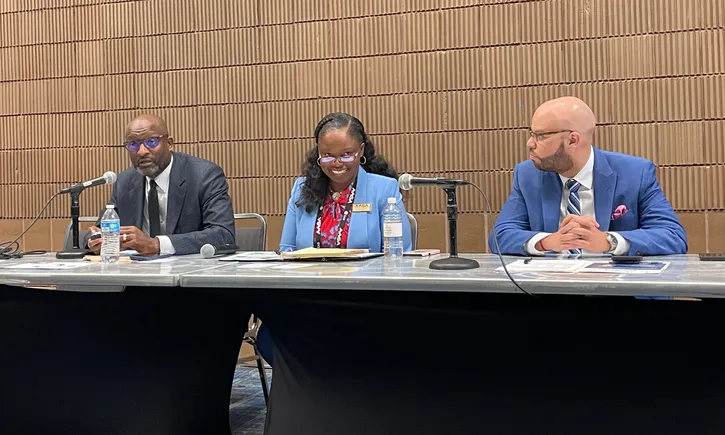
    On Tuesday, April 1, panelists Lindsay E. Jones, CEO of CAST, Lindsay Kruse, CEO of All Means All, and Rachell Johnson, director of assistant technology at SCATP, will participate in a general session, Leadership, Not Bystanders, moderated by Sarah Radcliffe, director of Future Ready Learning in the School District of Altoona. Panelists will discuss how can to ensure that no student is overlooked as AI continues to reshape education.

    The closing keynote on Wednesday, April 2, Beyond the Algorithm–Building Trust, Access, and Purpose in AI-Enhanced Education, features Richard Culatta of ISTE + ASCD, Victor Lee of the Graduate School of Education at Stanford University, Pati Ruiz, EdD, of Digital Promise, and Kris J. Hagel of the Peninsula School District. The discussion will focus on ensuring AI enhances, rather than diminishes, human potential in education.

    Workshops include:

    • Student data privacy
    • Generative AI implementation
    • Education leadership in the digital age
    • AI and leadership
    • Organizational change management for digital transformation

    Spotlight sessions cover cybersecurity and physical security, tackling cell phones in classrooms, top edtech trends in 2025, edtech and AI quality indicators, and FERPA.

    Wondering what the CoSN conference has for you?

    Chief Technology Officers 

    • Learn proven strategies for getting the dollars you need to build the infrastructure for today and tomorrow
    • Connect with your peers and build your community of practice
    • Discover how to stretch scarce resources to make the greatest impact on teaching and learning Instructional Technology Directors

    Instructional Technology Directors 

    • Hear about new tools and models for engaging students and personalizing instruction
    • Strategize about how to bridge the gap between the technical and instructional silos
    • Improve your leadership skills and how to scale technology beyond islands of innovation

    Superintendents, District Teams, and Education Service Agencies 

    • Hear from thought leaders on how to create a vision for digital conversion and continuously improving innovative culture in your district
    • Learn tips for breaking down the silos and leveraging technology to enable a 21stcentury school system
    • Share creative and strategic solutions about how to create robust learning environments at school and at home 

    Industry, Government, and Nonprofit Representatives 

    • Understand what is keeping school system technology leaders up at night 
    • Share information on emerging tools and services for learning
    • Learn about better strategies and models for implementing, maintaining, and evaluating technology for learning
    Laura Ascione
    Latest posts by Laura Ascione (see all)

    Source link

  • How challenges, experiences shape superintendents of color

    How challenges, experiences shape superintendents of color

    This audio is auto-generated. Please let us know if you have feedback.

    NEW ORLEANS — “It doesn’t matter what I brought to the table in terms of preparation. In the eyes of some, I’m just gonna be ill-equipped.”

    That sentiment, expressed by Denver Public Schools Superintendent Alex Marrero, sums up the double standards he says education leaders of color face regularly.

    “Double standards are so, so, so real, and you all need to accept that,” Marrero told a packed session this month at the annual conference of AASA, The School Superintendents Association. 

    “Hopefully during our time, that shifts. But once you realize that’s the reality, you’ll be well-equipped to navigate the turbulent waters that, again, were not designed for us to succeed as scholars, much less leading organizations like ours,” said Marrero, who has led DPS since 2021 and is the district’s third superintendent since 2018.

    Just 200 — or roughly 40% — of the nation’s 500 largest school districts, the superintendencies are held by leaders of color, according to 2024 data from ILO Group’s Superintendent Research Project. Furthermore, only 72 — or 14% — of those school superintendents are women of color.

    During two March 7 AASA conference sessions, Black and Latino leaders from eight districts nationwide shared their challenges and experiences, as well as insights on what helped them reach their position — and what keeps them going. Here are three takeaways.

    Identity matters

    Martha Salazar-Zamora, superintendent of Texas’ Tomball Independent School District, demonstrated how she sometimes changes her speech depending on who she’s speaking with.

    “I learned that, at times, I am Martha Salazar-Zamora, and there are times where I’m Martha Salazar-Zamora,” she said, dropping her accent the second time she spoke her name. “If you understand that, you understand that. And if you don’t, you maybe never will.”

    Known as code-switching, this is the practice of adjusting one’s language, mannerisms or appearance to fit a social context or environment for the comfort of others or to achieve a desired outcome. And it’s something leaders of color might navigate, particularly if they’re the first non-White person to hold a role.

    “I knew when I had to be who I had to be. I knew why I had to be, whether it was an interview, whether it was whatever it might be, an introduction,” said Salazar-Zamora.

    That doesn’t mean, however, that a superintendent’s identity has to be left at the door. Avis Williams, who resigned as superintendent of Louisiana’s NOLA Public Schools in November, shared the benefit that comes with embracing the idea of having students of color see someone who looks like them.

    “When I go to schools, I love it when little girls are like, ‘My hair is like yours.’ Yes, baby, it is,” said Williams. “Some of them will google me, and it’s like, ‘She wore Afro puffs!’”

    These can seem like small details, but seeing a leader who looks like them conveys to students, “Anything you see that I have done, you can do that and more,” said Williams. “We have to make sure that we can bring our whole selves into the role in order to really live out that truth.”

    As a superintendent in Oregon’s Gresham-Barlow School District from 2017 to 2021 , Katrise Perera was the only Black woman district leader in the state, she said. “In my second year, we had another Black superintendent, a male.” 

    One specific memory from that superintendency still resonates for her. Once a week, she would read to elementary school classes, and children could sit where they wanted. Eventually, her communications team pointed out to her that in most photos, students of color were sitting close to her in the front.

    “They were gathering around me. I still get chills to this day,” said Perera, now superintendent of Texas’ Lancaster Independent School District.

    “When it comes to kids, you’re gonna get all of me,” she concluded.

    Relationships — and allies — are key

    Who you know and the relationships you build can make the difference in climbing professional ladders. LaTonya Goffney, superintendent of Texas’ Aldine Independent School District, told another AASA session how support from White and male allies helped her rise to district leadership.

    “It’s about time for men to pave the way for women to be able to do this job,” Goffney said.  

    Among the nation’s 500 largest school districts, just 30% were led by women, and only 14% are women of color, according to data released by ILO last year.

    Goffney attained her first superintendency in 2008 in rural Coldspring, Texas. A middle school principal at the time, Goffney was about nine years into her career as an educator. 

    Source link

  • Top Challenges Inside the Classroom for Drama Teachers

    Top Challenges Inside the Classroom for Drama Teachers

    Investing in Arts Education

    Often a department of one, drama teachers must work proactively to find support networks and community resources that enable them to provide the best education possible.

    In late spring, 2006, I was faced with a quandary: How do you teach drama? I had just been assigned my first drama classes at North Hollywood High School, where I’d been teaching for two years, and although I had many thoughts about shows I might direct that would be a good fit for our student population, I had no idea what to include in day-to-day classroom curriculum. 

    This conundrum was unfortunately not new to me. I had just earned my teacher certification in the state of California as an English teacher through LAUSD’s District Intern Program. Never mind that I had never taken an English class in college — I passed the state exam for English language arts and that was sufficient for entry to the program. As a result, I leaned heavily on the expertise of teachers in the English department at North Hollywood for guidance on what to teach. I asked those colleagues what they were teaching to get insight into what materials and activities were successful with our students. However, when it came to drama, I’d be on my own. Although elements of drama pedagogy were incorporated into various graduate courses I’d taken while a student in NYU Steinhardt’s Program in Educational Theatre, I lacked a scaffolded approach to learning how to create a curriculum and no set community of drama teachers to turn to for support. 

    Just as I had experienced in the English department at North Hollywood, most teachers have the luxury of working with colleagues who teach the same content. Consider the math department, the social studies department, or the science department. But how many schools have a drama department? Some lucky few might find themselves within an arts department, but how similar are visual art teaching, music teaching, dance teaching, and drama teaching? Consequently, it is incumbent upon drama teachers to get out of the isolation of being a department-of-one and find a support network of trusted peers to whom they can turn when faced with the all-too-common question: “What now?” 

    Community support for drama and theater teachers

    Professional organizations like the American Alliance for Theatre and Education (AATE) and the Educational Theatre Association (EDTA) host annual conferences that provide theater educators with needed professional development and networking which are necessary resources for supporting classroom teachers. However, membership in these organizations is not free, and registration and travel to attend these annual conferences requires investment from school and district leadership to support teachers in their professional development.  

    The support drama teachers get from these organizations is essential at this political moment. In the press, a lot of attention is given to book banning across the country, but less so to censorship and restrictions in the arts. For the last five years, Qui Nguyen’s play “She Kills Monsters” regularly appears in EDTA’s annual survey of the top ten plays performed in schools, and yet the work has been met with calls for censorship and cancellation due to the play’s content. Other popular plays have faced a similar fate — be it Lorraine Hansberry’s “A Raisin in the Sun,” Moisés Kaufman and members of Tectonic Theatre Project’s “The Laramie Project,” Bert V. Royal’s “Dog Sees God: Confessions of a Teenage Blockhead,” or even works by William Shakespeare. 

    Through partnership with organizations like AATE and EDTA, teachers learn about initiatives to actively oppose efforts to restrict the arts, such as the No Book Bans Coalition, which advocates against theater bans; Dramatists Guild Legal Defense Fund, which has published “Dramatic Changes: A Toolkit for Producing Stage Works on College Campuses in Turbulent Times,” and provide legal support for producing scripted plays; and the National Coalition Against Censorship, who have published “The Show Must Go On: A Toolkit for Organizing Against Theatre Censorship in Public Schools.”

    Through participation in national organizations like AATE and EDTA, drama teachers are able to develop support networks across the country. In community and solidarity, drama teachers are able to develop skills to meet the needs of an ever-diversifying student population, improve classroom instruction, promote deeper arts learning, and respond to classroom and community challenges in turbulent times.

    Source link

  • From Potholes to Progress: How Higher Education is Driving Solutions to the UK’s Pressing Challenges

    From Potholes to Progress: How Higher Education is Driving Solutions to the UK’s Pressing Challenges

    It’s National Apprenticeship Week. Today on the HEPI blog, you can read about how University Alliance members are using healthcare degree apprenticeships to address workforce shortages: click here to read.

    Or carry on reading to hear from Viggo Stacey at QS about how the researchers at Swansea University are solving contemporary problems like potholes with cutting-edge research.

    • By Viggo Stacey, International Education & Policy Writer at QS Quacquarelli Symonds.

    Drivers in England and Wales encounter an average of six potholes per mile, and damage sustained from them cost drivers an average of £460 in 2024. One estimate put the cost of potholes to the UK economy at £14bn last year.

    Research published last week by Swansea University provides a real solution to this critical problem. Adding plant spores to bitumen will create a self-healing road surface that can extend its lifespan by 30%.

    This speaks directly to the Secretary of State for Education’s five key priorities for reform of the higher education system – that universities should play a great civic role in their communities.

    Local communities and businesses need to benefit fully from the work of higher education institutions, Bridget Phillipson wrote to the sector in November last year and as Debbie McVitty recently covered over at Wonkhe. This research will help individual drivers, councils across the country and UK industry.

    But another thing that is so exciting about this discovery is where it came from. Swansea University, on the south coast of Wales and an institution whose Vice Chancellor in the last week has said higher education in Wales is facing ‘the toughest [financial] position that we’ve been in’, is showing what its academics are capable of, given the right resources.

    And that leads to the second place where this research originated.

    One of those involved is Dr Jose Norambuena-Contreras, a Senior Lecturer in Swansea’s Department of Civil Engineering, originally from Chile, while Dr Francisco Martin-Martinez is a Lecturer at King’s College London’s Chemistry Department who hails from Spain.

    It is also notable that this news came out on the day that Keir Starmer became the first UK prime minister to join a gathering with EU leaders since Brexit.

    While rejoining the EU’s single market is firmly off the cards, a deal on youth mobility is an obvious open goal. Some 57% of voters recently backed a scheme for the under 30s, in addition to polling last year finding 58% thinking a scheme is a good idea.

    The UK Science and Tech Secretary, Peter Kyle, rightly met with EU counterparts in January to push to turbo-charge UK-EU science and technology links in a bid to tackle shared global challenges.

    Potholes in the UK might just be a small part of the UK’s challenge. But as Norambuena-Contreras puts it, it’s a ‘very sexy topic’ that British people like to talk about. If researchers can continue to identify problem areas that resonate with local communities and industry, they’ll be on to a winner.

    International talent is, and will continue to be, key to solving crises across the UK. If only researchers at the country’s top business schools were empowered to find solutions to filling higher education’s financial gaps in the same way as others can for potholes.

    Jessica Turner, CEO at QS Quacquarelli Symonds, commented:

    The UK’s universities are not just centres of learning—they are engines of economic transformation and real-world problem-solving.

    Research from the University of Bristol released this week – showing that it contributed £1.13 billion to the West of England economy in 2022/23 – is just one example of that.

    Swansea University’s ground-fixing research is a perfect example of how higher education drives innovation with tangible benefits for communities, industries, and the economy,” Turner added.

    As the QS World Future Skills Index highlights, the UK is a global leader in academic readiness and future workforce skills. To sustain this momentum, continued investment in universities is essential—not just to address today’s challenges but to shape the solutions of tomorrow.

    Source link

  • The K-12 outlook for 2025: Shifting policy, tech landscapes bring new challenges

    The K-12 outlook for 2025: Shifting policy, tech landscapes bring new challenges

    There’s no shortage of hurdles school leaders must vault over each day. Among them: an ever-evolving influx of new technologies, threats to physical and cybersecurity, spillover from culture wars, and limited budgets. On top of that, this year brings the added challenge of a shifting policy landscape as a new presidential administration takes power.

    To help you map out solutions and best practices for the year ahead, K-12 Dive has gathered our 2025 outlook coverage below as a one-stop resource on the trends impacting schools.

    Source link

  • Online Teaching Challenges Using Virtual Classroom Software

    Online Teaching Challenges Using Virtual Classroom Software

    What is a virtual classroom software?

    A virtual classroom is a digital replica of a traditional classroom, the only difference is that it uses technical tools to interact with students in real-time. The virtual classroom software for teachers helps higher education institutions to manage classes remotely using interactive tools for collaboration, brainstorming, ideation, and discussion. All this is followed by instant assessments and result publications to measure the learning that happened in the session.


    The sudden school closures and the need of Virtual classroom software for teachers

    There can never be a PAUSE mode for Education nor Learning. But what if a situation demands it? Let’s take the example of our current COVID-19 scenario.

    The UNESCO states that globally, over 1.3 billion children are out of the classroom, across 186 countries, as on March 2020.


    There are schools and universities closures everywhere, forcing educational institutions to look for an option to deal with the crisis.

    Thanks to the distinctive rise in the online teaching environment and virtual classroom software, what we could now call the only future of higher education and universities.

    Even the traditional universities and higher eds that were once tabooed to using online teaching are now racing to adapt their programmes and classes to online alternatives. The situation may be pressing, but retorting to any technology wouldn’t help.

    An intuitive, high-end, modern, virtual classroom software for teachers would serve the purpose—a tool that acts as a bridge to offering uninterrupted teaching/learning even during the difficult times.

    Creatrix Campus is end-to-end higher education software that brings campus online on-the-go. You could plan online exams, assignments, execute tasks, conduct online quizzes, group discussions, polling, all virtually.

    Creatrix Campus virtual campus management system has always helped faculty indulge in successful ways of teaching, revolutionizing digital education.

    There’s data analysis, visualization, forecast of assessments that predict learning outcomes, personalized learning pathways for students, and much more. We have figured out 12 successful ways by which Creatrix facilitates successful online teaching and learning, virtually. Here are they;


    How to Create an Engaging Virtual Classroom Environment with Virtual classroom software for teachers


    top-ways-to-teach-online-with-virtual-classroom-software


    1. Get scheduled first

    Now, this is a great feature to start an online classroom—setting up schedules and a set of predefined rules.

    Faculty are allowed to create schedules that most suits their online sessions. Creatrix Scheduling allows schedule creation based on faculty and student preferences.

    Multiple class schedules could be created for different time periods with options to add, edit or cancel schedules, and assign student groups, all this without conflicts.

    There’s enough flexibility here. While any new and complicated topic can be scheduled up in the forenoon, the rest can make up for the afternoon session. Achieving a balanced timetable schedule is also possible with faculty management software that will accommodate all changes instantly and meet your criteria.


    2. Build a course and student community

    The next crucial step in virtual teaching lies in the creation of a course and student community. The faculty is the moderator and the courses she creates are the community. On logging in, the faculty would see the list of batches he handles on her personal dashboard.

    The act of the faculty clicking on a particular batch is alike to the real-life scenario of getting into a classroom, with the bunch of students waiting to be marked attendance, hear their performance reports, and submission of assignments, etc. Before the class commences, the faculty marks attendance of the day.

    Nothing goes lacking in this sort of online teaching. Faculty plans well ahead of the classes with a solid curriculum management system from Creatrix.

    The faculty strategically adapt to the industry trends as well as the unique needs of the students. There’s enough option to track the daily progress of the students in line with the curriculum.


    3. Digitize the course contents

    At Creatrix we know the real purpose of a virtual LMS; we make learning enjoyable, accessible, and meaningful to students, improving their learning outcomes.

    The faculty takes control of the class, adding course materials to suit her course’s plan. Creatrix virtual Learning Management System (LMS) is brings in a lot of tools for applying various learning models in a wide range of digital formats.

    Instructors are allowed to create, upload, the course’s content, back it up with videos and files, deliver them to students, assign tasks and assessments, administer and track their progress, followed by record-keeping. There’s complete transparency on all these processes.

    The topic planned and covered are kept track of and those that need attention are extended for longer hours. The simplified workflows in Creatrix helps to focus students by giving constructive feedback and personalized recommendations.


    4. Adopt collaborative tools to maximize participation

    Virtual teaching is successful only when there’s maximum student participation. Creatrix has many collaborative and communication tools to keep the students glued to the actual teaching process.

    Creatrix virtual LMS allows students to team up on live sessions and video conferencing through external integrated tool.

    Faculty can put forward techniques including quizzes, debates, interactive discussions, etc. There are options to share additional resources for any topic by uploading videos, share relevant PDFs, PPTs, website links, etc. The sessions could be made more fun by bringing in polling, surveys, and map each topic with learning outcomes.


    benefits-of-digitizing-course-contents-using-virtual-LMS


    Creatrix Campus’s Virtual LMS comes with adaptive teaching models like blended learning, self-paced learning, collaborative learning, and flipped learning to arouse student participation. The lesson planner option in Creatrix helps users to plan and execute both physical and virtual classes for the same course.


    5. Focus on keeping the students engaged

    Online remote classes at any cost should be made interesting, mainly because the faculty-student is not in direct interaction. Classes hence have to be delivered in such a way that it builds engagement for learning.

    Creatrix has the Digital Whiteboard tools which come with a virtual pointer to facilitate brainstorming activities. In addition, there are discussion forums and messaging, which is another way of keeping students engaged. 

    Just like how Quora, Yahoo Answers, and Reddit act as amazing discussion forums, Creatrix LMS does the same. 

    The activity wall acts as a message board for further collaboration; students get to post doubtful questions, create polls, and share documents with faculty and his peers.

    There are enough ways a faculty could add advantage to online teaching by sharing learning videos, texts, podcasts to students.


    6. Introduce self-learning techniques

    Not all courses in the syllabus would call for a synchronous way of teaching. Some subject’s objectives maybe just research and self-learning. Creatrix virtual LMS creates a self-learning environment that gives enough room for real-time student engagement and self-reflection.

    On completion of topics, student take up auto-assigned, online assessments and quizzes that are used to track their understanding level on the current topic. Uploading videos related to the topic expands the learners to self-learn.

    The progress the student makes can be seen in their personalized dashboards on their real-time status bar reports displaying current, past, and future course progresses, along with the tasks due.

    The faculty’s journey is similar to a facilitator who provides relevant resources and course materials, create tutorials, short lessons, all made possible through online course repositories.

    Students could take part in live streaming and self-paced learning (video upload), conveniently accessible from a single point.


    7. Centralize the communication efforts

    There should be an organized way of communication keeping both the students and their parents/guardians informed about the teaching happening.

    This allows the stakeholders to stay informed with auto-notified alerts and reminders about deadlines on assignment submission, feedback, as well as missed topics. They get real-time status via email, SMS, and push notifications.


    8. Customize the testing and assessments for personalized learning outcome

    This is an unmissable feature in any online teaching. Assessments help to gauge the learner’s proficiency. Customizing them is incidentally what most software systems lack.

    With customized assessments, faculty have the option to personalize tests for students with different attainment levels. This gives the option to focus on weaker students in a much better way.

    Creatrix has options to conduct both online and offline Assessments/assignments in the form of quizzes, MCQs, long papers, articles, followed by instant onscreen evaluation. Based on the learning outcomes mapping, the system would then intimate the students attainment levels, individually.


    9. Get gamified

    A good online teaching platform should work on making things simple for the learners. They won’t really enjoy teaching that’s monotonous, after all, their eyes are starring the digital devices all day long.

    Pick out elements of game playing to add spice to your teaching. Students look for such a twist in their learning experience.

    Assign tasks and projects online, track the submission rates, and provide them badges or scores.

    Integrate with the course schedule and bring forth activity-based learning in line with the Curriculum. This will help instructors and students track topics better. Students, on the other hand, will have access to course information times during absenteeism. Wouldn’t that be great?


    10. Link to Incidents Tracking

    There are also options to deal with tardy behavior. Online teaching doesn’t mean you have to compromise on bad behavior incidents, students cheating during online exams by conducting online proctoring etc. A university management software with conduct management system make sense here.


    link-to-incidents-tracking


    Instantly parents get notified in real-time via email, SMS alerts, and push notifications.
    Besides capturing incidents, rules could be configured, discipline letters created, referrals initiated, analyze trends, and generate reports for faster decision-making to resolve behavior problems.


    11. Reporting

    With real-time reporting, instructors should be able to generate real-time reports, right in their hand. They get to know the stand of their students and work on their continuous improvement gradually.

    The instructor could track those students who are accessing the course content and who isn’t.

    Creatrix classroom management software is capable of generating real-time reports including students’ demographics, assignments, attendance, assignments, fee payments, grades, discipline incidents, coursework, assignments, etc.

    All these reports from the virtual classroom software help at deriving insights into learning for a bigger picture of the institutional reporting.

    The best thing about using Creatrix Online LMS is student’s progress data is right in their hands. They have the ability to track their own progress, their dips and ups with the progress status bar on their personal dashboard.

    They get to view the current, past, and future course progresses, along with the tasks due.


    12. Mobile support, 24*7

    Wrap up all the above-mentioned features into an all-time accessible mobile app!  A mobile tool is a necessity to support students with uninterrupted learning these days.

    Creatrix Online Learning Management System (OLMS) gives any time, anywhere access to learning where students team up for live sessions via mobile devices and tablets.

    They get the feel of in-the-classroom training with options to view the session’s content visually and communicate via text chat and audio; they can submit assignments, view grades & course materials, and interact with each other just the way they would do in the real classroom.


    Conclusion

    It’s high time we try and reset higher education learning to meet the present 2020 demands by giving uninterrupted online learning.

    A virtual classroom software for teachers is the call of the day; a tool like Creatrix Campus is sure to break the shackle that disrupts the flow of higher education by waking up to a better tomorrow.

    Let the higher education institutions get into virtual learning mode and blend with technology for incessant learning even during a crisis like Covid-19 and beyond. Connect with team Creatrix Campus to learn more about virtual classroom software for teachers!

    Source link

  • Transforming Education in the Age of AI: Challenges and Opportunities

    Transforming Education in the Age of AI: Challenges and Opportunities

    Today’s weekend reading was written by Dr Andrew Woon, Senior Lecturer in Strategic Management at Queen Mary, University of London.

    Generative AI is revolutionising industries, with education at the forefront of this transformation. Traditional models of knowledge acquisition are being challenged as AI redefines how we access and process information.

    As AI becomes more accessible and accepted by the public, its potential to reshape the majority of jobs in the market has become increasingly evident. Consequently, AI literacy has emerged as a foundational skill for careers and entrepreneurship. Given that universities are not only institutions of learning and development but also the cornerstone of a nation’s competitive advantage, the impact of AI on education attracts significant attention.

    As an educator, I believe that AI has lowered the barriers to accessing knowledge and education, enabling more students, especially those who previously lacked opportunities to benefit. On the other hand, AI has also raised the bar for teaching, as the accessibility of information and knowledge is transforming traditional teaching and learning paradigms. To excel as a teacher today, one must possess not only subject expertise but also advanced pedagogical skills and the ability to stay current with emerging trends.

    I echo the sentiments of computer scientist Professor Argamon, who views AI as a technology that can make education more human-centred rather than replacing teachers. AI enables educators to focus on the most critical aspect of their work—teaching and mentoring students rather than merely delivering courses. By leveraging AI, teachers can spend more time engaging with students and actively supporting their holistic development.

    AI should not simply be seen as a new complementary skill but as a driving force for educational transformation. Our education system must evolve from a focus on traditional knowledge-based learning outcomes to prioritising skill development, reflective thinking, and innovation-driven learning. This shift will better prepare students to adapt to future challenges and enhance their competitiveness.

    The Latin root of the word ‘curriculum’ is ‘currere’, meaning ‘to run’. In academic contexts, a curriculum is defined as a learning plan consisting of a series of activities and courses. Our education system has overly prioritised credit accumulation, often neglecting the ethos of lifelong learning and the importance of continuous self-improvement. Therefore, I advocate that education should not merely be a three- or four-year programme but rather the starting point of a lifelong journey encompassing both depth and breadth of learning in knowledge and skills.

    The rapid development of AI should serve as a catalyst for everyone to pursue personal growth. As Professors David Lefevre and David Shrier of Imperial College Business School have suggested, we need to refocus curricula on skills and capabilities that are challenging for AI to replicate. This shift aligns with a move toward more personalised, socially focused, and mentorship-driven education models. Such a transformation would fundamentally change traditional teaching and learning methods, equipping students to better face future challenges.

    The greatest value of universities lies in their role as intellectual hubs that foster curiosity, critical questioning and new creation. Universities should teach students to think independently rather than simply follow instructions. Our education system must stop producing “cookie-cutter” graduates who cannot compete with AI.

    With the rise of online education and the prevalent use of AI, traditional higher education models are facing unprecedented challenges. Higher education institutions are caught in a paradox: on one hand, they require significant resources to retrain staff in new pedagogies and upgrade facilities; on the other hand, they are grappling with the pressures of cost-cutting. Therefore, balancing cost-effective solutions with quality education remains one of the greatest dilemmas for higher education institutions.

    I believe fostering deeper collaboration with industry is a viable way forward to mitigate the financial pressures associated with AI investment. By engaging with industry-specific AI tools, students gain valuable exposure and hands-on learning experiences that better prepare them for employment. At the same time, employers benefit from graduates who not only meet their expectations but also possess the skills to excel in their roles.

    In conclusion, the mission of education must focus on cultivating well-rounded individuals equipped with critical thinking, adaptability, curiosity, and a strong sense of social responsibility. By embracing AI as a transformative force and equipping both staff and students with the right mindset and values, universities can empower their graduates to thrive in an ever-evolving world. This approach will ensure that education remains relevant, impactful, and aligned with the demands of the future.

    Source link

  • Law professor challenges university after campus ‘shooting’ hypothetical changed in lesson plan

    Law professor challenges university after campus ‘shooting’ hypothetical changed in lesson plan

    Those concerned that law schools are shying away from teaching some areas of law to avoid controversy just got more reasons to worry, this time courtesy of the University of Hawai’i at Manoa and its absurd treatment of law professor Kenneth Lawson.

    Lawson, an accomplished faculty member at UH, used a simple hypothetical to teach the idea of “transferred intent,” a legal concept invoked when a defendant intends to harm one person, but ends up harming a second person instead. As is common in law school, Lawson offered a hypothetical to convey this idea: Imagine if a dean at his institution tried to shoot another dean, missed, and hit Lawson instead.

    Here’s a screenshot from part of his lesson:

    Those who have been to law school will understand that using campus figures to illustrate hypotheticals is not at all unusual, and is intended to add a bit of levity and grounding to what can be pretty esoteric topics.

    But when an anonymous student filed a complaint, calling the hypothetical “extremely disturbing” and citing the context of some shootings near the university’s campus, administrators summoned Lawson to a meeting near the end of last semester. Though they acknowledged he had not violated any university policy, they nevertheless mandated that he remove the thought experiment from a posted video of the class — or they would change it for him

    The ability of administrators to forcibly alter course materials is positively ripe for abuse.

    Lawson hadn’t thought twice about including the example, and had been using the example for years, not simply because it wasn’t unusual but because the protections of academic freedom give faculty wide latitude in determining how to approach controversial or potentially difficult material. When Lawson refused to alter the video of his presentation, given that he had not violated any policy, and using the hypothetical was well within his academic freedom rights, administrators just went on the school’s online curriculum system, where faculty submit presentations, to make the changes themselves.

    Remember: these changes were being made because, supposedly, some found a hypothetical of campus figures being shot to be disturbing. So this is what the administration came up with.

    Slide with an image of law professor Ken Lawson alongside generic man/woman icons

    You will note that there is still a campus figure on that slide, and it’s the person who was (hypothetically) shot: Professor Lawson. Only the deans have been removed. It seems that at UH, some hypothetical victims are more equal than others.

    There’s no denying that this is silly, and many will be tempted to chalk it up as just more campus craziness. But there’s a disturbing wrinkle here, which is that the ability of administrators to forcibly alter course materials is positively ripe for abuse. The university’s administrators have granted themselves unilateral authority to interfere with faculty teaching decisions, despite the fact that UH is a public institution bound by the First Amendment, which views academic freedom, which protects that right, as a “special concern.” If administrators can “memory hole” bits and pieces of curricula they don’t like, even when it violates no rule, where does it stop?

    UH still has an opportunity to do the right thing. It’s easy, too — all it has to do is step back and let faculty teach, and save the video editing for film class.

    FIRE wrote the university on Dec. 13, urging it to reverse course and restore Lawson’s original hypothetical. The university responded in early January, declining to substantively engage with our concerns or detail specific issues with our argument. Lawson, and all UH students, deserve better. As our second letter states: 

    FIRE’s concerns are only amplified by the fact that this alleged capitulation to sensitivity is occurring in a law school. To receive a proper education in the law, students will inevitably encounter difficult topics like sexual assault, homicide, physical assault, domestic violence, and may be faced in school and in their careers with descriptions of personal injuries far more graphic than those in Lawson’s hypothetical. Where do UH administrators draw the line regarding their interference in faculty instruction if they feel free to operate under a nebulous standard of protecting students from “disturbing and harmful” material? 

    Lawson has submitted a grievance about the situation, so UH still has an opportunity to do the right thing. It’s easy, too — all it has to do is step back and let faculty teach, and save the video editing for film class.

    Source link

  • Asking students about the challenges they face

    Asking students about the challenges they face

    Increasing numbers of undergraduate students are either neurodivergent or living with a mental health condition, and in some cases both – but their voices aren’t being heard.

    Departments know that these students face particular challenges in their academic studies, but struggle with how to best support them, especially given pressures to do more with fewer resources. University lecturers are also growing more familiar with these conditions, either because of their own personal experience, or because of greater cultural awareness and openness around neurodivergence and mental illness. All of us in the MINOTAUR team have lived experience ourselves or loved ones living with neurodivergence and mental illness, which has informed our approach to this work.

    One way universities have tried to adapt to this change in their student populations has been by issuing support agreements through their disability services team, but these are often very general and don’t always address the actual challenges individual students are facing. We know that this lack of support is having a negative impact on student experiences and academic outcomes.

    Student voice

    The MINOTAUR project (Mental Illness and NeurOdiversiTy Academic sUppoRt), run out of the classics department at Royal Holloway, University of London, grew out of an EDI survey which identified a significant population of students in the department who were neurodivergent and/or living with mental illness. We then ran a series of student focus groups in summer 2023 to identify issues facing these students and solutions the department could implement in order to improve their experience as learners.

    As far as we know, it is the first time that focus groups have been used to ask this diverse community of students about their experiences during their degrees – within Royal Holloway, within our discipline, and quite possibly within HE. Certainly there are no easily visible parallel initiatives in the sector. The recommendations we made following these discussions have been simple and easy to implement, and we know they’ve made a great deal of difference to our student cohort.

    So, in an age where the student voice has become a critical part of university life, why do these students often go unheard?

    A literature review carried out this summer with the support of the RHUL School of Humanities Scholarship and Innovation Fund confirmed our suspicion that interventions for students with neurodivergence and mental illness are typically being done to students rather than shaped by them. This review sampled a wide range of work and resources aimed at supporting university and school students with ADHD, autism, other forms of neurodivergence and mental illness. These studies largely took the form of designing an intervention, implementing it, and considering its effectiveness. There seemed to be few attempts at co-creation, co-design, or co-production.

    However, our experience with the first stage of MINOTAUR suggests that not asking students to identify the challenges they are facing and how these might be addressed means we are missing some simple, low-effort, high-effect interventions that can offer immediate support. In the longer term, it also means that those who design interventions address the problems that they can see, not the problems that students are experiencing.

    Simplicity is a virtue

    Studies indicate that increasing self-knowledge and self-advocacy skills among neurodivergent students can contribute to positive academic outcomes. Through applying principles of co-design, we can empower students to take ownership of their learning while ensuring that any interventions address their real needs. This may be particularly impactful for students without a formal diagnosis, who may not be eligible for support within existing university systems. Co-design can also increase community buy-in to projects and interventions, which is essential as part of supporting a cohort of students who are more likely to become disengaged and isolated when facing challenges.

    One great example of this for MINOTAUR has been an intervention so simple that we wouldn’t have thought of it without talking to our students. As a department, we have a reputation for being supportive and understanding for students living with neurodivergence and mental illness, but as staff we had taken it as a given that our new students would automatically realise this. Last year, we introduced a simple slide titled “Neurodiversity in Classics”, to be shown at the start of each new module.

    It emphasises that we want students to be able to learn, and uses three bullet points designed to lower the barriers to our students’ learning. “Better late than absent” reduces the anxiety of being five or ten minutes late to a class session, which can throw off attendance for a whole term. “Tell us about the room” gives students permission to tell us about sensory disruptors; having to concentrate on processing an overwhelming physical stimulus, like a flickering light, that can distract focus from teaching. “We understand about stimming,” referring to repetitive physical actions often made by people with autism, makes it explicit that students can fidget and move in ways which help them concentrate rather than struggling to repress those habits for an hour.

    We simply hadn’t realised how much work our students were putting in to trying to meet expectations we didn’t have of them. Without consultation, we wouldn’t have known how effective this simple intervention could be – and it has made a huge difference to our students, especially first years joining the department.

    It’s all about participation

    Low-impact adjustments designed for neurodivergent students and students living with mental health issues can often be valuable in supporting the learning of neurotypical students too. Following the focus groups’ recommendations, many of us more systematically introduced a break in lectures to avoid students’ cognitive overload, and to allow them to refresh their minds around halfway through the lecture. Even if the evidence is only anecdotal at this stage, this small change seems to have positive effects on the entire cohort, fostering a more collaborative and open teaching environment, and reinforcing the class as a space of collective learning and teaching.

    Recognising that neurodivergent students, disabled students, and those with mental health conditions are experts because of their experience is critical to work against assumptions which, however unintentionally, disempower these groups. In line with trends around developing ethical practice as part of community-based participatory research, recent movements within disability studies seek to redress the imbalance within scholarship which has cast disabled people as subjects of research, rather than active participants with agency to engage in discussion and innovation: no research about us without us.

    Through proactively working with students, MINOTAUR recognises that higher education cannot meet the needs of this cohort without working with them collaboratively to produce interventions that are grounded in their student experience.

    Source link

  • Harnessing AI in Education: Opportunities and Challenges

    Harnessing AI in Education: Opportunities and Challenges

    The integration of artificial intelligence (AI) into the nation’s classrooms presents both remarkable benefits and significant challenges. 


    In school districts around the country, school board members are working with key education stakeholders, including superintendents, principals, teachers, parents, and students to determine how to harness AI’s benefits while protecting student and teacher agency, ensuring student privacy, and safeguarding data.

    One of the most exciting benefits of AI in education is its potential to personalize learning experiences. Imagine a student who struggles with a particular math concept receiving additional practice and resources tailored to their needs, while advanced learners receive more challenging problems. Or, a student who enjoys fantasy stories could read those, while another who prefers nonfiction gets recommendations in history or science. With lessons tailored to each student’s needs and interests, the result is a more engaging and effective learning experience for the student that improves grades and fosters a love of learning.

    AI-based applications can also help teachers with administrative tasks like scheduling, giving them more time for instruction and one-on-one interactions with their students. Additionally, AI tools can facilitate communication between teachers, students, and parents, helping everyone stay informed about a student’s progress.

    Equitable and fair learning

    Despite its benefits, the incorporation of AI in schools poses several challenges. Equal access to the technology is paramount. If some students have inequitable access, learning gaps could widen further. This divide is a crucial concern for school board members who must ensure that each student benefits from AI educational innovations, regardless of their socioeconomic status, ZIP Code, or background. 

    Another critical concern is student privacy. While school districts have established student privacy policies in the wake of the rapidly evolving technological landscape, educational leaders must ensure that their guidance is stringent enough to continue to protect student information as AI continues to evolve. 

    Concerns have been raised about possible cheating, plagiarism, and misinformation. As with any new technology, students must be taught how to use AI responsibly and ethically. Twenty-five years ago, teachers thought graphing calculators, which could store sophisticated formulas and programs, would lead to rampant cheating. The same concerns were raised about smartphones, which could answer any question with a simple internet search.

    Additionally, while AI can enhance the learning experience, it cannot replace the invaluable role of teachers. Effective teaching involves emotional intelligence, empathy, and personal connections — qualities that artificial intelligence cannot replicate. School board members and other educational leaders must emphasize the importance of a balanced approach, integrating AI resources as a complementary tool rather than a replacement for traditional teaching methods. They must also ensure that educators receive appropriate professional development and other support to know how to effectively incorporate AI into their teaching practices and help students leverage AI to enhance their learning. 

    Equipping teachers and students for success

    Ensuring each student’s access to artificial intelligence tools, as well as the appropriate safeguards, technology, and training needed to accompany these innovations, will require additional funding from federal and state sources for school districts with already limited resources.

    In the end, each community must decide its own approach toward the use of AI. When implemented correctly, it can be used ethically and effectively to enhance the educational experience for each student by empowering teachers, bridging educational gaps, and maximizing student potential. 

    As we look toward a future where jobs increasingly rely on AI, it is imperative that we equip our students today with the skills they need not just to adapt to this evolving landscape, but to lead in a world transformed by artificial intelligence.

    Source link