What is a virtual classroom software?
A virtual classroom is a digital replica of a traditional classroom, the only difference is that it uses technical tools to interact with students in real-time. The virtual classroom software for teachers helps higher education institutions to manage classes remotely using interactive tools for collaboration, brainstorming, ideation, and discussion. All this is followed by instant assessments and result publications to measure the learning that happened in the session.
The sudden school closures and the need of Virtual classroom software for teachers
There can never be a PAUSE mode for Education nor Learning. But what if a situation demands it? Let’s take the example of our current COVID-19 scenario.
The UNESCO states that globally, over 1.3 billion children are out of the classroom, across 186 countries, as on March 2020.
There are schools and universities closures everywhere, forcing educational institutions to look for an option to deal with the crisis.
Thanks to the distinctive rise in the online teaching environment and virtual classroom software, what we could now call the only future of higher education and universities.
Even the traditional universities and higher eds that were once tabooed to using online teaching are now racing to adapt their programmes and classes to online alternatives. The situation may be pressing, but retorting to any technology wouldn’t help.
An intuitive, high-end, modern, virtual classroom software for teachers would serve the purpose—a tool that acts as a bridge to offering uninterrupted teaching/learning even during the difficult times.
Creatrix Campus is end-to-end higher education software that brings campus online on-the-go. You could plan online exams, assignments, execute tasks, conduct online quizzes, group discussions, polling, all virtually.
Creatrix Campus virtual campus management system has always helped faculty indulge in successful ways of teaching, revolutionizing digital education.
There’s data analysis, visualization, forecast of assessments that predict learning outcomes, personalized learning pathways for students, and much more. We have figured out 12 successful ways by which Creatrix facilitates successful online teaching and learning, virtually. Here are they;
How to Create an Engaging Virtual Classroom Environment with Virtual classroom software for teachers
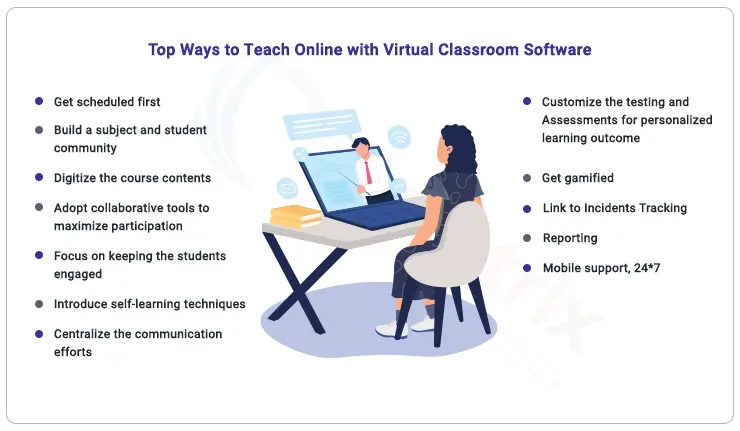
1. Get scheduled first
Now, this is a great feature to start an online classroom—setting up schedules and a set of predefined rules.
Faculty are allowed to create schedules that most suits their online sessions. Creatrix Scheduling allows schedule creation based on faculty and student preferences.
Multiple class schedules could be created for different time periods with options to add, edit or cancel schedules, and assign student groups, all this without conflicts.
There’s enough flexibility here. While any new and complicated topic can be scheduled up in the forenoon, the rest can make up for the afternoon session. Achieving a balanced timetable schedule is also possible with faculty management software that will accommodate all changes instantly and meet your criteria.
2. Build a course and student community
The next crucial step in virtual teaching lies in the creation of a course and student community. The faculty is the moderator and the courses she creates are the community. On logging in, the faculty would see the list of batches he handles on her personal dashboard.
The act of the faculty clicking on a particular batch is alike to the real-life scenario of getting into a classroom, with the bunch of students waiting to be marked attendance, hear their performance reports, and submission of assignments, etc. Before the class commences, the faculty marks attendance of the day.
Nothing goes lacking in this sort of online teaching. Faculty plans well ahead of the classes with a solid curriculum management system from Creatrix.
The faculty strategically adapt to the industry trends as well as the unique needs of the students. There’s enough option to track the daily progress of the students in line with the curriculum.
3. Digitize the course contents
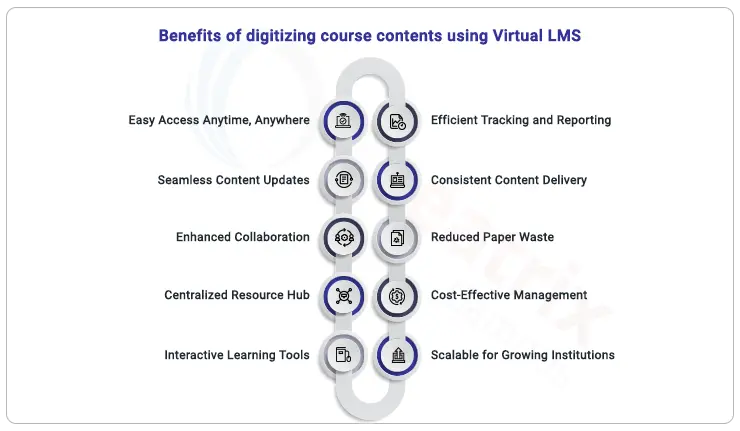
At Creatrix we know the real purpose of a virtual LMS; we make learning enjoyable, accessible, and meaningful to students, improving their learning outcomes.
The faculty takes control of the class, adding course materials to suit her course’s plan. Creatrix virtual Learning Management System (LMS) is brings in a lot of tools for applying various learning models in a wide range of digital formats.
Instructors are allowed to create, upload, the course’s content, back it up with videos and files, deliver them to students, assign tasks and assessments, administer and track their progress, followed by record-keeping. There’s complete transparency on all these processes.
The topic planned and covered are kept track of and those that need attention are extended for longer hours. The simplified workflows in Creatrix helps to focus students by giving constructive feedback and personalized recommendations.
4. Adopt collaborative tools to maximize participation
Virtual teaching is successful only when there’s maximum student participation. Creatrix has many collaborative and communication tools to keep the students glued to the actual teaching process.
Creatrix virtual LMS allows students to team up on live sessions and video conferencing through external integrated tool.
Faculty can put forward techniques including quizzes, debates, interactive discussions, etc. There are options to share additional resources for any topic by uploading videos, share relevant PDFs, PPTs, website links, etc. The sessions could be made more fun by bringing in polling, surveys, and map each topic with learning outcomes.
Creatrix Campus’s Virtual LMS comes with adaptive teaching models like blended learning, self-paced learning, collaborative learning, and flipped learning to arouse student participation. The lesson planner option in Creatrix helps users to plan and execute both physical and virtual classes for the same course.
5. Focus on keeping the students engaged
Online remote classes at any cost should be made interesting, mainly because the faculty-student is not in direct interaction. Classes hence have to be delivered in such a way that it builds engagement for learning.
Creatrix has the Digital Whiteboard tools which come with a virtual pointer to facilitate brainstorming activities. In addition, there are discussion forums and messaging, which is another way of keeping students engaged.
Just like how Quora, Yahoo Answers, and Reddit act as amazing discussion forums, Creatrix LMS does the same.
The activity wall acts as a message board for further collaboration; students get to post doubtful questions, create polls, and share documents with faculty and his peers.
There are enough ways a faculty could add advantage to online teaching by sharing learning videos, texts, podcasts to students.
6. Introduce self-learning techniques
Not all courses in the syllabus would call for a synchronous way of teaching. Some subject’s objectives maybe just research and self-learning. Creatrix virtual LMS creates a self-learning environment that gives enough room for real-time student engagement and self-reflection.
On completion of topics, student take up auto-assigned, online assessments and quizzes that are used to track their understanding level on the current topic. Uploading videos related to the topic expands the learners to self-learn.
The progress the student makes can be seen in their personalized dashboards on their real-time status bar reports displaying current, past, and future course progresses, along with the tasks due.
The faculty’s journey is similar to a facilitator who provides relevant resources and course materials, create tutorials, short lessons, all made possible through online course repositories.
Students could take part in live streaming and self-paced learning (video upload), conveniently accessible from a single point.
7. Centralize the communication efforts
There should be an organized way of communication keeping both the students and their parents/guardians informed about the teaching happening.
This allows the stakeholders to stay informed with auto-notified alerts and reminders about deadlines on assignment submission, feedback, as well as missed topics. They get real-time status via email, SMS, and push notifications.
8. Customize the testing and assessments for personalized learning outcome
This is an unmissable feature in any online teaching. Assessments help to gauge the learner’s proficiency. Customizing them is incidentally what most software systems lack.
With customized assessments, faculty have the option to personalize tests for students with different attainment levels. This gives the option to focus on weaker students in a much better way.
Creatrix has options to conduct both online and offline Assessments/assignments in the form of quizzes, MCQs, long papers, articles, followed by instant onscreen evaluation. Based on the learning outcomes mapping, the system would then intimate the students attainment levels, individually.
9. Get gamified
A good online teaching platform should work on making things simple for the learners. They won’t really enjoy teaching that’s monotonous, after all, their eyes are starring the digital devices all day long.
Pick out elements of game playing to add spice to your teaching. Students look for such a twist in their learning experience.
Assign tasks and projects online, track the submission rates, and provide them badges or scores.
Integrate with the course schedule and bring forth activity-based learning in line with the Curriculum. This will help instructors and students track topics better. Students, on the other hand, will have access to course information times during absenteeism. Wouldn’t that be great?
10. Link to Incidents Tracking
There are also options to deal with tardy behavior. Online teaching doesn’t mean you have to compromise on bad behavior incidents, students cheating during online exams by conducting online proctoring etc. A university management software with conduct management system make sense here.
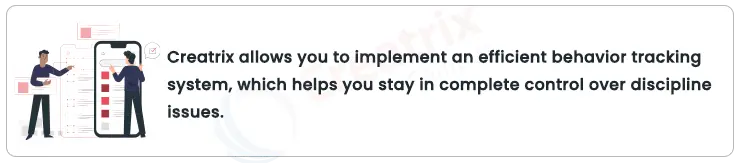
Instantly parents get notified in real-time via email, SMS alerts, and push notifications.
Besides capturing incidents, rules could be configured, discipline letters created, referrals initiated, analyze trends, and generate reports for faster decision-making to resolve behavior problems.
11. Reporting
With real-time reporting, instructors should be able to generate real-time reports, right in their hand. They get to know the stand of their students and work on their continuous improvement gradually.
The instructor could track those students who are accessing the course content and who isn’t.
Creatrix classroom management software is capable of generating real-time reports including students’ demographics, assignments, attendance, assignments, fee payments, grades, discipline incidents, coursework, assignments, etc.
All these reports from the virtual classroom software help at deriving insights into learning for a bigger picture of the institutional reporting.
The best thing about using Creatrix Online LMS is student’s progress data is right in their hands. They have the ability to track their own progress, their dips and ups with the progress status bar on their personal dashboard.
They get to view the current, past, and future course progresses, along with the tasks due.
12. Mobile support, 24*7
Wrap up all the above-mentioned features into an all-time accessible mobile app! A mobile tool is a necessity to support students with uninterrupted learning these days.
Creatrix Online Learning Management System (OLMS) gives any time, anywhere access to learning where students team up for live sessions via mobile devices and tablets.
They get the feel of in-the-classroom training with options to view the session’s content visually and communicate via text chat and audio; they can submit assignments, view grades & course materials, and interact with each other just the way they would do in the real classroom.
Conclusion
It’s high time we try and reset higher education learning to meet the present 2020 demands by giving uninterrupted online learning.
A virtual classroom software for teachers is the call of the day; a tool like Creatrix Campus is sure to break the shackle that disrupts the flow of higher education by waking up to a better tomorrow.
Let the higher education institutions get into virtual learning mode and blend with technology for incessant learning even during a crisis like Covid-19 and beyond. Connect with team Creatrix Campus to learn more about virtual classroom software for teachers!









 You can take CUPA-HR with you wherever you go — especially if you have a Roamin’ Robyn to keep you company. Think “