Mnookin will be the fourth leader in three years at Columbia.
DNY59/iStock/Getty Images
Columbia University has selected Jennifer Mnookin, a legal scholar and current chancellor at the University of Wisconsin at Madison, as its next president.
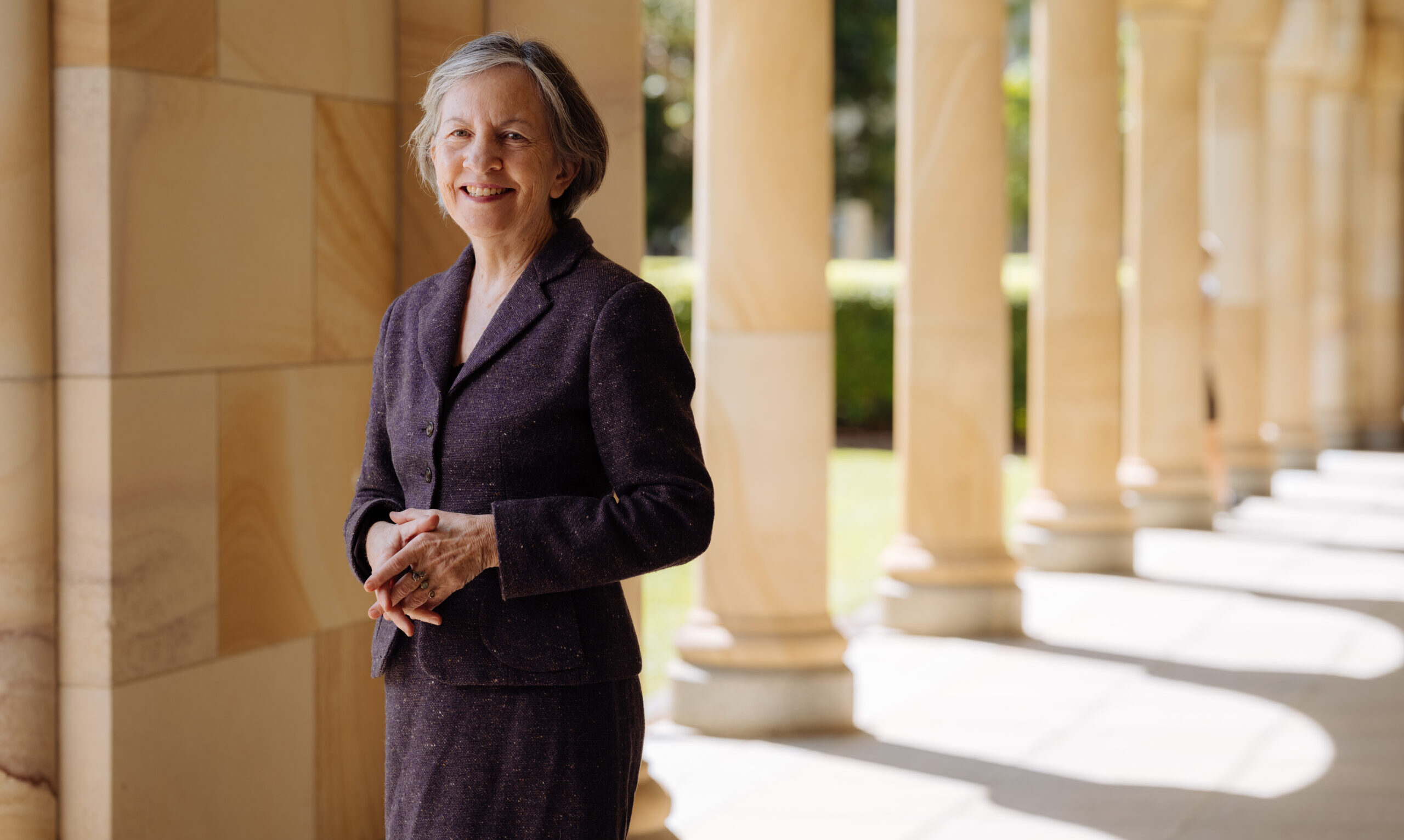
Jennifer L. Mnookin
University of Wisconsin–Madison
Mnookin has led the Wisconsin flagship since 2022 and will remain in her role through the spring commencement. Before taking the top spot at UW-Madison, she served as dean of the UCLA School of Law.
Mnookin will be the fourth leader in three years at Columbia. Since 2023 the institution has been disrupted by student protests, faced $400 million in cuts to federal research funding and agreed to a multimillion-dollar settlement with the Trump administration.
Mnookin will replace Claire Shipman, the former co-chairperson of the Board of Trustees, who has been acting president since March 2025, when interim president Katrina Armstrong resigned. Armstrong took over for Minouche Shafik, who was the university’s last permanent president and resigned in August 2024.
According to The Wall Street Journal, Columbia chose Mnookin because of her success navigating polarized politics in Wisconsin and dealing with the federal government.
During her tenure, Mnookin launched programs guaranteeing full financial support for Pell-eligible in-state students and for undergraduates who are members of federally recognized Wisconsin American Indian tribes and pursuing their first degree. She also increased the institution’s research spending to $1.93 billion, making it the fifth-highest-ranked institution in the country for research expenditures.
Her term has not been without controversy, though. Last July, the institution closed its diversity, equity and inclusion office amid scrutiny into its funding from Republican state lawmakers. In October, the university announced cost-cutting measures after it had federal grants terminated and received stop-work orders on some projects.
In a statement, Mnookin said her time at UW-Madison has been “life-changing.”
“It has been a true honor to be a part of the Wisconsin family. I am proud of what we have accomplished together, even in a challenging period for higher education, and I know great possibilities lie ahead for the UW-Madison campus community.”
Jay Rothman, president of the Universities of Wisconsin, extended “substantial gratitude” to Mnookin.
“During her tenure, Chancellor Jennifer Mnookin brought unbounded energy, resilience and deeply thoughtful leadership to this great university,” Rothman said.
This audio is auto-generated. Please let us know if you have feedback.
Dive Brief:
University of Nebraska-Lincoln’s faculty senate on Tuesdaypassed a no-confidence resolution in the public institution’s chancellor, Rodney Bennett, in part over allegations of poor leadership and financial management.
In a 60-14 vote, faculty approved a measure calling for Bennett’s removal and formally stating no-confidence over allegations of “failures in strategic leadership, fiscal stewardship, governance integrity, external relations, and personnel management.”
The no-confidence vote — UNL’s first — follows fierce debate at the university over Bennett’s plan to cut a handful of academic programs as part of a broader effort toslash $27.5 million from UNL’s budget.
Dive Insight:
The no-confidence resolution reflects faculty pushback against Bennett since September, when the chancellor unveiled a proposal to slash six programs — which he later reduced to four — as part of a budget-reduction plan.
Criticisms have focused largely on what faculty say is a lack of transparency about how, precisely, programs were judged worthy of keeping or cutting. They also allege that Bennett, who joined UNL as chancellor in 2023, has largely failed to include faculty in the decision-making process.
The budget process and timeline precluded “meaningful faculty and departmental leadership consultation” and “undermines the possibility of completing a thorough review of evidence, consequences, and public comments,” according to a Nov. 3 memo the faculty senate circulated ahead of the no-confidence resolution.
As to the timeline, Bennett announced his initial proposal on Sept. 12, and roughly two months later issued his final recommendation, which the University of Nebraska System’s regents plan to vote on at a Dec. 5 meeting.
The memo also questioned Bennett’s approach to reducing UNL’s deficit, saying that his plan relies on “immediate cost-reductions and across-the-board cuts rather than multi-year fiscal modeling or revenue diversification.”
“This system is a $3.5 to $4 billion enterprise, and we are damaging it for $27.5 million,” Faculty Senate President John Shrader said in prepared remarks at a Nov. 4 meeting.“These cuts are going to be devastating to this campus. So damaging to be irreparable.”
The memo further said Bennett had been “noticeably absent” from several faculty senate meetings and accused him of having periods of sparse contact with thesenate’s executive committee, despite UNL bylaws calling for him to meet twice a month with the panel.
“Faculty shared governance represents one of many voices of institutions of higher education,” University of Nebraska System President Jeffrey Gold said in a statement emailed Wednesday. “We value the voice of UNL’s faculty; however, ultimate decisions rest with the Board of Regents.
A UNL spokesperson said Wednesday that Bennett does not plan to comment on the no-confidence vote.
In October, an academic advisory body of faculty, staff, students and administrators tasked with reviewing Bennett’s plan called for more time to consider alternatives to ending programs and voted against winding down four of the original six programs Bennett originally put forward for closure.
Bennett’s final plan spares two programs that were on the chopping block but still included two others that the Academic Planning Committee voted against eliminating.
“None of us want to be in this space, where the decisions we must make will inevitably impact the lives of individuals and change how we do some things on campus,”Bennettsaid in November when announcing his final proposal. “However, our reality is that UNL’s expenses have been greater than its revenue for many years.”
The proposal would slash UNL’s statistics, educational administration, Earth and atmospheric sciences, and textile, merchandising and fashion design programs.
UNL’s chapter of the American Association of University Professors, which has actively opposed the cuts, lauded Tuesday’s no-confidence vote by the faculty senate.
“The faculty has made clear that this chancellor does not have what it takes to lead our flagship institution,”UNL AAUP President Sarah Zuckerman, who is an educational administration professor at the university, said in a statement Tuesday. “We will not accept a lack of transparency, the exclusion of faculty from decision-making, or the erosion of our university’s 156-year-old mission to educate Nebraska’s students.
The second line band’s brass instruments gleamed in the morning sun as they led nearly a thousand first-year students out of the Vadalabene Center arena. The festive New Orleans style procession wound its way across Southern Illinois University Edwardsville’s campus, past the towering Cougar statue where students would soon gather for their traditional class photo. Parents lined the walkway, some having extended their stay just to witness this moment—their children’s ceremonial entry into college life.
Among the crowd, one mother approached Dr. James T. Minor with tears in her eyes.
“That’s my son,” she said, pointing to a young man adjusting his position for the photo. “This is so great. I can’t believe what you’re doing. I’m so proud of him.”
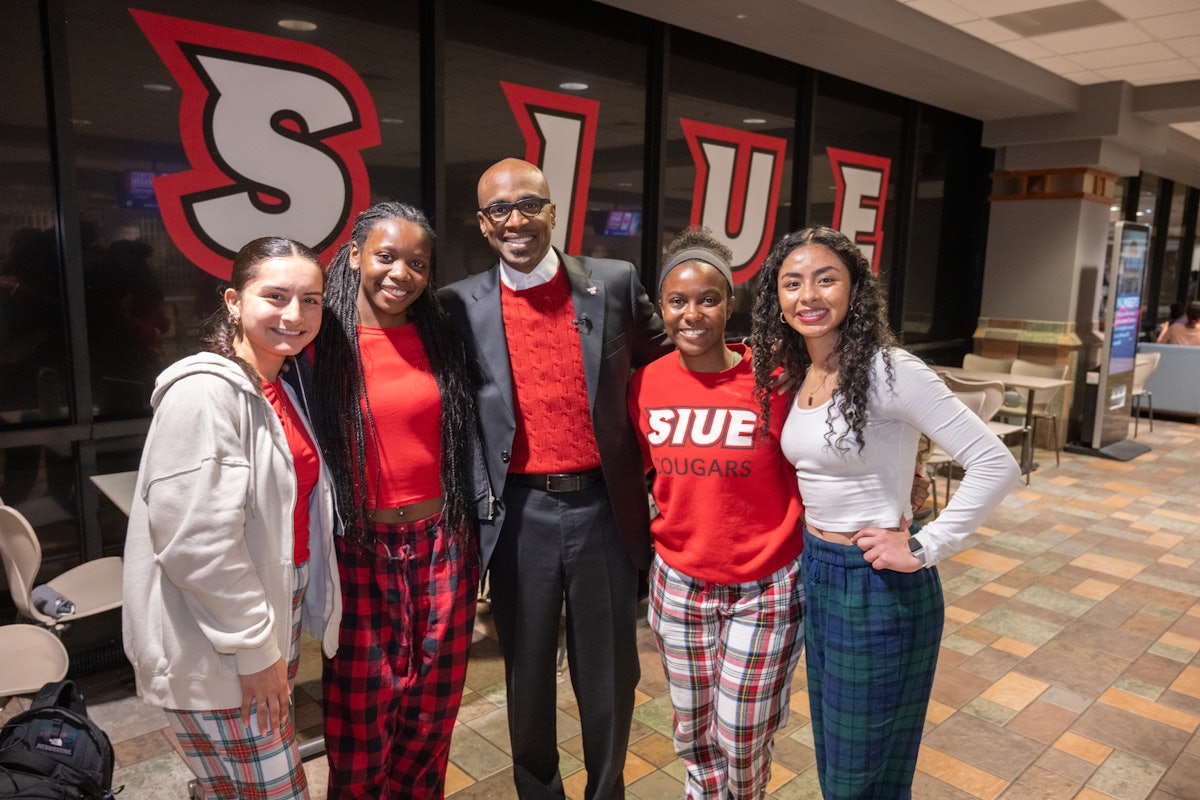
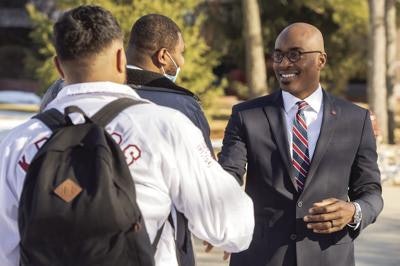
Dr. James Minor talking to a SIUE student. For Minor, SIUE’s first African American chancellor, this moment embodied everything he hopes to achieve at the institution he has led since March 2022. A Detroit native with a Ph.D. from the University of Wisconsin-Madison and a distinguished career spanning federal government, the California State University system, and scholarship in educational policy, Minor brings both academic rigor and practical experience to his transformational vision.
“This is as close as I get to what’s truly special about university communities,” he reflects on the school’s most recent convocation. “You’ve got thousands of young people who have made a decision about their life—that they’re going to pursue a college degree—and the university has a responsibility to facilitate that.”
But behind this celebratory scene lies a story of dramatic transformation, one that has seen SIUE emerge from serious fiscal challenges to become a model for how regional public universities can thrive in challenging times.
A $18 Million Wake-Up Call When Minor arrived on campus in March 2022, he brought credentials that positioned him uniquely for the challenges ahead. As the 10th chancellor in SIUE’s history, his appointment followed distinguished service as deputy assistant secretary at the Department of Education, where he administered more than $7 billion in federal higher education programming. His most recent role as assistant vice chancellor and senior strategist at California State University—where he helped achieve the system’s highest graduation rates in history and secured hundreds of millions of dollars for graduation initiatives—prepared him for the complex work of institutional transformation.
But even this impressive background couldn’t ready him for what he discovered within his first 45 days: an $18 million structural deficit that had been masked by years of poor budget practices.
“I was giving a university budget presentation that was not particularly pleasant,” Minor recalls of those early days in his tenure. “That was not on my list of things to do in the first 100 days—to organize and understand this structural deficit, communicate it to the university community, and then lay out a plan for managing it.”
Dr. James T. Minor at commencement.The distinction between a structural deficit and a spending deficit became crucial to Minor’s communication strategy. Unlike a simple overspend that could be corrected immediately, SIUE faced a fundamental mismatch between fixed expenses and revenue. The number of people, buildings, and courses— the structural components of the budget—exceeded revenue by roughly $18 million.
“We had available cash sources and other things that we could manipulate to cover it,” Minor explains. “We operated that way for a number of years before I arrived, but we all know that’s not sustainable.”
The solution required what Minor calls “environmental responsiveness”— the ability of institutions to expand and contract according to changing conditions. This meant making hard choices about class sizes, graduate assistantships, and operational efficiencies that some within the university community initially resisted.
Fast forward to September 2025, and Minor will soon announce to the campus community that SIUE has effectively resolved its structural deficit, maintains one of the best cash positions among Illinois universities, and accomplished this transformation without spending a single dollar from its cash reserves.
Building a Culture of Student-Centered Data Perhaps even more significant than the financial turnaround has been Minor’s campaign to make SIUE fluent in its own student success metrics. When he arrived, he was stunned by what he discovered during informal surveys of faculty and staff.
“I would walk into a room and ask, ‘Who here can tell me our four-year and six-year graduation rates?’” Minor recalls. “These are people who presumably should have an idea— people who work here, not people shopping at Target or in the grocery store. I would ask about our first-to-second-year retention rate, and it wasn’t meant to embarrass people. It was to underscore the lack of awareness we had as a university community about the most important thing we do.”
Today, when Minor walks into any room on campus, hands shoot up when he asks those same questions. “People expect the question,” he says with satisfaction. “I have promised them, I don’t care if we’re talking about the paint in the stairwell, I will start every conversation here at the university about our student outcome data.”
Dr. James Minor meeting students on campus.This data-driven approach has yielded measurable results for the institution that boasts more than 12,000 students. First-to-second-year retention rates have increased, graduation rates have ticked up, and the university is expecting growth—a major accomplishment in today’s challenging enrollment environment.
Dr. Robin Hughes, dean of the School of Education, Health and Human Behavior, sees Minor’s unique combination of scholarship and leadership as precisely what SIUE needed.
“Chancellor Minor is by far what most institutions look for and want in an organizational leader,” Hughes observes. “He is a distinguished scholar whose work focuses on the study of higher education organizations. He is also an experienced organizational leader who brings both academic insight and institutional expertise to his work. A strong advocate for students, he makes organizational decisions that positively impact their success both during their studies and beyond.”
Dr. Jessica Harris, acting chief of staff and vice chancellor for Anti-racism, Diversity, Equity and Inclusion, chaired the search committee that brought Minor to SIUE.
“I remember reading his cover letter and saying to my mom, ‘I think this is our next chancellor,’” Harris recalls. “Every accomplishment he talked about in his career was about how it positively impacted or transformed the experience for students. That was a consistent thread throughout his cover letter.”
Nearly four years into his tenure, Harris sees that student-centered focus as the driving force behind institutional change.
“One of the major shifts I’ve seen is a very clearly articulated and collective focus on student success,” she explains. “Not that it wasn’t a commitment before, but there’s a level of intentionality I didn’t see across all areas before he started. Every presentation starts with mission—this is why we’re here, these are our enrollment numbers, retention and graduation numbers. He keeps it front of mind for us.”
Dr. Earleen Patterson, associate vice chancellor for Student Opportunities, Equity, Diversity and Inclusion, has witnessed this transformation firsthand.
“There’s a reason I’m still here,” she says of her longevity at the university that began in 1990. “Over the course of time, I’ve seen a lot of evolution of this journey of progress toward being inclusive, toward offering opportunities to every sector of our population.”
The results are visible in SIUE’s incoming class, which Patterson describes as having “the highest African American enrollment in the history of the university.” This fall’s freshman class includes nearly 600 Black students in the Boundless Scholars Experience alone—a comprehensive academic program designed to promote belonging, academic achievement and degree completion. At a time when voices opposing diversity, equity and inclusion efforts grow louder across the higher education landscape, SIUE has chosen to double down on its mission, letting results speak louder than rhetoric.
The focus on student success extends far beyond enrollment numbers. Patterson describes a comprehensive approach to retention that begins before students even attend their first class. The Boundless Scholars Experience moved students in early, gathering them with their families in the campus ballroom for what Patterson calls “real talk” about college expectations.
“What they saw was a room that reflected who they are,” Patterson explains. “But we let them know, come Monday, as you walk out into the university community, you may be the only one in your biology course, in your chemistry course, in your economics course. But you have a community, you have a village.”
This village includes strategic course placement with faculty who are particularly effective with first-year students, early warning systems that track attendance and performance, and support staff who can call students by name when they miss class.
“It marvels them when they come into my office, and I already know you missed chemistry on Tuesday,” Patterson says with a chuckle. “They’re like, ‘How do you know?’ I care enough to know about that—about all of these students.”
For Dominic Dorsey, president of the Black Faculty and Staff Association and director of the Access (Disability Services) Department, representation at the leadership level makes a tangible difference for students.
“We’ve been blessed not just to have Dr. Minor as our first Black chancellor, but to have a chancellor that’s an actual thought leader and transformational in the truest sense of the word,” he says.
Dorsey’s own department has seen dramatic growth, with registered students with disabilities increasing from about 650 when he arrived in 2018 to nearly 1,400 today. This growth reflects SIUE’s broader commitment to inclusive excellence that extends beyond traditional diversity metrics.
Town-Gown Collaboration The transformation at SIUE also stretches beyond campus borders through an unprecedented partnership with the city of Edwardsville. Mayor Art Risavy, a small business owner who has served as mayor for five years after a decade as an alderman, describes an intentional effort to strengthen university- city relations.
“Early on, when I became mayor, one of the first things we decided collectively was we wanted to work on our relations with the university,” Risavy explains. “We reached out to the chancellor, and it didn’t take long—Chancellor Minor wants to do stuff pretty quickly—before we had a meeting set up.”
These conversations led to concrete initiatives: improved website integration between city and university, the Hashbrown Huddle breakfast meetings that bring students directly into downtown Edwardsville, and shared committee appointments that give the university voice in city governance.
“We want to see students in our businesses, involved in our organizations,” Risavy says. “We want them to feel comfortable downtown, going through our shops and participating in our events. This is their home for four years or five or six years.”
The collaboration extends to shared programming, with Minor and Risavy regularly attending each other’s events, from the city’s state of the city address to SIUE’s ice cream social that draws over a thousand participants.
Navigating Challenges with Bold Leadership The success story at SIUE is unfolding against a backdrop of national political tensions around higher education, particularly concerning diversity, equity, and inclusion efforts. For leaders like Dorsey and Patterson, this context requires strategic adaptation without abandoning core values.
“The way that we approach the work has not changed,” Dorsey explains. “We just don’t publicize the way the work is done. Our ancestors created an underground railroad for a reason—it’s a reason why it wasn’t an above ground railroad.”
This approach allows SIUE to continue providing scholarships, celebration opportunities, and support systems for underrepresented students while focusing public attention on broader institutional success metrics that benefit all students.
Patterson emphasizes the importance of drowning out external noise.
“If we were to play into that distraction, we wouldn’t be able to focus on the charge that is in front of us. And these students are in front of us,” she said.
Doug James, immediate past president of the Staff Senate, describes an administration focused on “majoring on the major things” while maintaining awareness of smaller concerns.
“I think there was an appetite for honest conversation,” he says. “Let’s get in a room and talk about what are our challenges, where are we winning, what are the things we get to celebrate, and what needs our attention.”
Yet Harris points to concrete evidence of this collective effort.
“You don’t see 10 percentage point increases in Black student retention without people doing work inside and outside of the classroom. We’ve hit historic fundraising goals since Chancellor Minor’s been here. He’s helping to shift our culture. He often talks about us being first and best in class.”
Looking ahead, Harris envisions SIUE becoming “a model regional public institution with a national reputation” within the next three to five years. The university is already approaching 80% retention for domestic students and has set an ambitious goal of 90% first-to-second-year retention—a benchmark that would distinguish SIUE among institutions of its type.
“In the midst of all the challenges facing higher education, all the anti-DEI efforts, all the darts being thrown at us,” Harris reflects, “we are keeping on. We’re not deterred. In fact, we are making really great progress.”
The Price of Progress Minor’s transformation of SIUE hasn’t come without resistance. As the first African American chancellor in the institution’s history, he acknowledges the complexity of his position with remarkable candor.
“Some people think about it individually. I haven’t,” he tells me. “I’ve thought about what it means for other people and what it means for this university community with respect to our ability to move forward.”
Quite frankly, the university community has had to adjust to new leadership and some members have experienced dissonance with the very idea that a Black man is in charge.
“Sometimes it’s passive resistance, sometimes it’s active resistance, sometimes it’s a level of questioning and verifying before we can participate or agree to move in the right direction, and quite honestly, sometimes it’s blatant sabotage,” the chancellor admits.
Yet Minor approaches these challenges with the same organizational theory perspective he brings to budget management and student success metrics. For him, institutional transformation requires acknowledging and managing all forms of resistance while maintaining a clear focus on the core mission.
Still, the significance of this representation isn’t lost on the broader SIUE community, particularly among Black alumni who lived through earlier eras of the institution. Minor recalls one particularly poignant encounter with an alumna from the mid-1960s: “She came up to me, grabbed my hand and started patting my hand as any good grandmother would do, and said, ‘Baby, I’m so proud of you. It’s so wonderful to see you in this role.’ And as she was patting my hand, she leaned in and said, ‘Now, don’t you mess this up.’”
The exchange captures the weight of expectation that comes with being a first—representing not just personal achievement, but the hopes and dreams of those who paved the way.
“For individuals from that era, that generation, I represent their hopes and dreams for equity and equality and opportunity,” Minor reflects.
A Model for Regional Public Universities
The SIUE story offers lessons for similar institutions nationwide. Minor’s approach demonstrates that even universities without massive endowments can achieve significant transformation through strategic focus, data-driven decision- making, and commitment to operational efficiency.
“Regional public institutions don’t have the margin to be inefficient,” Minor argues. “We’ve got 1960s infrastructures and boilers and aging infrastructure that we have to manage. You can’t manage that and be grossly inefficient at the same time.”
As SIUE prepares for its next chapter, the metrics tell a story of remarkable progress. The university maintains a strong financial position, has achieved record fundraising including the largest single gift in institutional history, and expects continued enrollment growth in a challenging market.
But for Minor, the real measure of success remains that moment during convocation when a parent’s pride reflects the transformative power of higher education.
“The idea that I get to help facilitate the environment in which young people have an opportunity to transform their life—it’s a dream job,” he says. “It’s not the title, it’s not the status, it’s not the position. It is having the opportunity to facilitate the environment in which young people have an opportunity to transform their life.
“I love university communities. I love the power of institutions,” he adds. “I love the idea that they could be beacons of social and economic opportunity. I love the idea that the teaching and learning environment can transform the mind, prepare people professionally in a way that changes the trajectory of their life and their children’s lives. That, to me, is powerful in its own right.”
That transformation happens every day, every semester, every academic year at SIUE. And as the second line band plays on, leading another class of students toward their futures, the sound carries a promise—that this institution, this community, this partnership between town and gown will continue rising above the noise to focus on what matters most: changing lives through education.
In 2023, Texas became one of the first red states to institute a sweeping ban on diversity, equity and inclusion in public colleges and universities.
Following pro-Palestinian protests and a police crackdown on an encampment at the University of Texas at Austin in 2024, the Texas Legislature this year passed another law restricting free speech on public campuses, including banning all expressive activities from 10 p.m. to 8 a.m.
The Legislature also this year passed a wide-ranging bill that allows public college and university presidents to take over faculty senates and councils, prohibits faculty elected to those bodies from serving more than two years in a row, and creates an “ombudsman” position that can threaten universities’ funding if they don’t follow that law or the DEI ban.
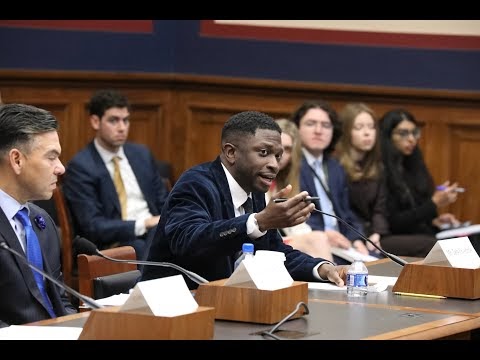
The lead author listed on all three laws is Sen. Brandon Creighton, chair of the Texas Senate education committee. Having overhauled higher ed statewide, he’s about to get the chance to further his vision at one large university system: On Thursday, the Texas Tech University System plans to name Creighton the “sole finalist” for the system chancellor and chief executive officer job.
His hiring by the system’s Board of Regents—whose members are appointed by the governor with confirmation from the Senate—marks another example of a Republican politician in a large red state, namely Texas and Florida, being installed as a higher ed leader. The trend reflects an evolution in how Republicans are influencing public universities, from passing laws to directly leading institutions and systems. For universities, having a former member of the Legislature in the presidency can help with lobbying lawmakers, but it could also threaten academic freedom and risk alienating faculty.
Creighton wasn’t the only, or even the highest-ranking, politician considered for the position, which historically pays more than $1 million a year. As The Texas Tribuneearlier reported, Rep. Jodey Arrington, chair of the U.S. House Budget Committee and shepherd of the One Big Beautiful Bill Act, which affected higher ed nationwide, was also in the running. Unlike Creighton, Arrington has worked in higher ed—specifically as a vice chancellor and chancellor’s chief of staff in the Texas Tech system. Arrington, who didn’t provide Inside Higher Ed an interview, issued a statement Sunday congratulating Creighton.
Faculty leaders offered a muted response to Creighton’s impending appointment. Neither the president of the Faculty Senate at the main Texas Tech campus, the president of the university’s chapter of the American Association of University Professors nor the state AAUP conference publicly denounced Creighton. In an emailed statement, the state conference said, “We have concerns about the future of academic freedom and shared governance in the Texas Tech University System given the positions Sen. Creighton has taken in the legislature.”
“We hope that Texas Tech’s strong tradition of shared governance and academic freedom continues so that Texas Tech can thrive,” the statement said.
Cody Campbell, the system board chair, said Creighton is “a fantastic fit with our culture and is clearly the best person for the job.” He added that he likes the higher ed legislation Creighton has passed. (Creighton was also lead author of a new law that lets universities pay athletes directly.)
“He shares the values of the Texas Tech University System,” Campbell said. Both the system and the wider community of Lubbock, where the main Texas Tech campus is located, are “conservative,” he said.
“We do not subscribe to the ideas around DEI and are supportive of a merit-based culture,” Campbell said, adding that Creighton is well positioned to continue the system’s growth in research, enrollment and academic standing.
For Creighton, the job could come with a big payout. Retiring Texas Tech system chancellor Tedd L. Mitchell made $1.3 million in 2023, ranking him the 12th-highest-paid public university leader in the country, according to The Chronicle of Higher Education’s database. The system didn’t respond to Inside Higher Ed’s open records request for Mitchell’s current contract in time for this article’s publication, and Campbell told Inside Higher Ed Creighton’s pay is “yet to be determined.”
“The contract or the compensation were never part of the discussion with any of the candidates,” Campbell said.
Creighton didn’t provide Inside Higher Ed an interview or answer written questions. But he appeared to accept the position in a post on X.
“Over the past six years, no university system in Texas has taken more bold steps forward,” he wrote. “Serving as Chairman of the Senate Education Committee and the Budget Subcommittee has been the honor of a lifetime—especially to help deliver that success for Texas Tech and its regional universities. I feel very blessed to have been considered for the role of Chancellor. There is no greater purpose I would consider than working to make generational changes that transform the lives of young Texans for decades to come.”
Cowing Faculty Senates
Campbell said he doesn’t recall whether Creighton and Arrington initially expressed interest in the position to the board or whether the board reached out to them. Dustin Womble, the board’s vice chair, declined to comment. Campbell said the board “actively recruited” some candidates.
“There wasn’t really a formal application process, necessarily,” he said. But dozens of candidates across the country expressed interest in the “high-paying position” leading a large system, he said.
The system says it has more than 60,000 students across five institutions and 20 locations, including one in San José, Costa Rica. The five institutions are Texas Tech (which has multiple campuses), Texas Tech Health Sciences Center (which also has multiple campuses), the separate Texas Tech Health Sciences Center El Paso, Angelo State University and Midwestern State University.
Asked about Creighton’s lack of higher ed work experience, Campbell said that wasn’t unusual for system chancellors, contrasting the position with those of the presidents who lead individual institutions on a day-to-day basis.
“Our past chancellor was a medical doctor, the chancellor before him was a state senator, the chancellor before him was a former U.S. congressman and a state politician; we’ve had businessmen in that position, we’ve had all different types of people,” Campbell said.
Aside from serving in the Senate for a decade and the state House for seven years before that, Creighton is an attorney.
Andrew Martin, the tenured art professor who leads the Texas Tech University main campus’s AAUP chapter, noted that “our chapter has actively opposed some of the legislation that Sen. Creighton has authored.”
“Our hope now is that Sen. Creighton, in apparently assuming the role of chancellor, will spend time learning more about the campuses in the TTU System and will meet as many students, faculty [and] administrators on our campuses as possible to see how these institutions actually operate day in and day out,” Martin said. “I’m not sure how clear that’s been from his perspective as a lawyer and legislator.”
Martin—who stressed that he was speaking for himself and colleagues he’s spoken to, but not on behalf of his university—said the AAUP is concerned with maintaining academic freedom for faculty and students, upholding tenure protections, and preserving the faculty’s role in determining curriculum, conducting research and exercising shared governance.
When the Legislature passed Senate Bill 37—the Creighton legislation that, among other things, upended faculty senates—Creighton issued a news release saying, “Faculty Senates will no longer control our campuses.” He said his legislation “takes on politically charged academic programs and ensures students graduate with degrees of value, not degrees rooted in activism and political indoctrination.”
Among other things, SB 37 requires university presidents to choose who leads faculty senates. Ryan Cassidy, a tenured associate librarian, was elected to lead the Texas Tech University main campus’s Faculty Senate before SB 37 took effect, and the institution’s president has allowed him to stay in that role.
Asked about Creighton being named chancellor, Cassidy said, “I haven’t really had time to reflect on it.”
Creighton’s bio on the Legislature’s website touts his conservative values outside of higher ed, too. “He has relentlessly hammered excessive taxation, pursued ‘loser pays’ tort reform, passed drug testing for unemployment benefits, stood up for Texas’ 10th Amendment rights and effectively blocked Obamacare’s Medicaid expansion,” the bio says.
Martin said Texas Tech aspires to become a member of the Association of American Universities, a prestigious group of top research universities, of which UT Austin and Texas A&M University are already members. That would be hard if faculty are “marginalized,” he said.
“You can’t get there without the huge investment of faculty,” he said.
The Southern University System hired Democratic lawmaker Joe Bouie as chancellor of its New Orleans campus on Friday, a position he was removed from in 2002, the Louisiana Illuminator reported.
Bouie, 78, is currently a member of the Louisiana Senate and served in the Louisiana House from 2014 to 2020. Bouie told the news outlet he intends to resign from the Senate “at the appropriate time.”
From 2000 to 2002, Bouie was chancellor of Southern University New Orleans, where he earned his undergraduate degree and worked as a social work professor, even serving a stint as Faculty Senate president.
However, his contract was terminated in 2002, which he argued at the time was because he “refused to participate in political nepotism.” He alleged he was “fired” because he removed the wife of then-U.S. Representative William Jefferson, Andrea Jefferson, from her role as vice chancellor of academic affairs. Prior to becoming an administrator, Andrea Jefferson had also served on Southern University’s Board of Supervisors. She resigned from that role to take the administrative job, which prompted protests from faculty members who complained she lacked adequate experience.
System officials pointed instead to concerns raised by the legislative auditor’s office over insufficient financial controls at SUNO. Bouie argued that he had inherited those problems from his predecessor.
Bouie’s return to SUNO came as a surprise; the Louisiana Illuminator reported that faculty members only learned Chancellor James Ammons was leaving about a week ago, and that there was no formal search for his successor.
Bouie will reportedly earn a $275,000 annual salary with a contract that runs through July 2028. He will formally step into the job on Aug. 1.
City College of San Francisco announced last week that it had hired a new chancellor—but never voted to approve the candidate and later deleted the news release, leaving the process in limbo.
The San Francisco Chronicle reported that City College posted a news release on Tuesday announcing that it had selected Carlos O. Cortez as its next chancellor, pending approval at a Board of Trustees meeting on Thursday. However, the board spent several hours in a closed executive session before ultimately deciding not to make a decision on the candidate.
Trustees did not explain their inaction on the search, according to a review of the meeting. The board agenda shows trustees were also set to consider approval of a contract for Cortez, with an annual base salary of $350,000, but removed that action item after punting on the search.
Multiple speakers at the meeting expressed support for Cortez.
In the Tuesday news release that was later deleted, Anita Martinez, the Board of Trustees president, lauded the candidate for his “proven track record of success in academic innovation, fundraising, student success, and community engagement.”
Cortez was previously chancellor of the San Diego Community College District from July 2021 to May 2023 before he stepped down suddenly, a move he attributed to the need to take care of his ailing parents in Florida. Since then he has emerged as a finalist for six jobs at the chancellor or president level, including SFCC. Five of those jobs were in California and one was in Wisconsin.
The San Francisco Chronicle also reported that Cortez was arrested in Florida on suspicion of driving under the influence in January 2024 and later pleaded no contest to reckless driving. Cortez told the newspaper the charge was “due to a mixture of prescription medicine.”
Cortez told the San Francisco Chronicle last week that he didn’t know where his candidacy stands. He did not respond to a request for comment from Inside Higher Ed sent via LinkedIn on Monday.
City College officials also did not respond to a request for comment from Inside Higher Ed.
Dr. Tonya Smith-JacksonNorth Carolina Agricultural and Technical State University Provost Dr. Tonya Smith-Jackson has been appointed chancellor of Rutgers University–Newark, marking a significant leadership transition for the public research university.
Smith-Jackson, a human factors engineer who has served as provost and executive vice chancellor for Academic Affairs at NC A&T since 2013, will assume her new role on August 1. Her appointment was approved unanimously by the Rutgers Board of Governors and announced jointly by current President Dr. Jonathan Holloway and President-designate Dr. William F. Tate IV.
“Tonya Smith-Jackson is a person of principles and values who has dedicated her professional life to making transformative changes in higher education,” Holloway said in announcing the appointment.
At NC A&T, the nation’s largest historically Black college and university, Smith-Jackson has overseen remarkable growth and innovation. Under her leadership, the university has launched three new doctoral programs and created the state’s first bachelor’s degree program in artificial intelligence. She has also presided over dramatic increases in both research staff and graduate assistants.
Her tenure at NC A&T has been marked by the establishment of three new Centers of Excellence focused on cybersecurity, product design and manufacturing, and entrepreneurship and innovation. Smith-Jackson also led the university’s successful recognition as an anchor institution by the Association of Public and Land-grant Universities.
Prior to her current role, Smith-Jackson chaired NC A&T’s Department of Industrial and Systems Engineering and directed multiple research initiatives, including a cybersecurity center, the Human Factors Analytics Lab, and the laboratory for Cyber-Human Analytics Research for the Internet of Things.
Smith-Jackson brings a unique blend of academic, corporate, and government experience to her new role. She holds a doctorate in psychology/ergonomics and an interdisciplinary Master of Science degree in psychology and industrial engineering.
Before joining NC A&T, she spent 14 years at Virginia Tech, advancing from assistant professor to full professor of industrial and systems engineering. Her professional experience also includes engineering roles at IBM and Ericsson Mobile Communications, as well as a year-long appointment as program director in the National Science Foundation’s Cyber-Human Systems Program from 2018-2019.
Smith-Jackson said that her approach to higher education leadership is deeply rooted in personal experience and family values.
“Inspired by my parents’ belief in education as a pathway to liberation, meaning and purpose, I’ve dedicated my life to helping others obtain college degrees and upward mobility,” she said.
President-designate Tate said that Smith-Jackson’s background positions her well for the role.
“As an engineer with contributions to human factors research, she brings a systems-oriented, people-centered approach well suited to leading an urban university,” Tate said. “I look forward to partnering with her to expand opportunity pathways, advance impactful research and promote economic development for the region and the state.”
Julie Bishop has been under fire for hiring a former staffer to be her speechwriter. Picture: Josh Woning
Nearly all Australian National University (ANU) union members on Thursday supported a vote of no confidence in vice-chancellor Genevieve Bell and chancellor Julie Bishop.
Please login below to view content or subscribe now.