Tag: charge

  • Texas A&M Professor Arrested on Indecent Exposure Charge

    Texas A&M Professor Arrested on Indecent Exposure Charge

    Texas A&M University professor Russell Taylor Johns was arrested by university police last Wednesday following an allegation that he exposed himself at the University of Texas at Austin earlier this year, KBTX reported

    Johns, who hadn’t yet begun teaching but was hired to join Texas A&M’s Harold Vance Department of Petroleum Engineering this fall, worked at UT Austin from 1995 to 2010 and was invited back to campus in April by its department of petroleum and geosciences. Court documents obtained by KBTX allege that Johns exposed his genitals and touched himself inappropriately at the UT Austin student center on April 29. A staff member told police that she saw Johns masturbate while looking at two female students sitting across from him.

    Johns previously taught in the Department of Energy and Mineral Engineering at Pennsylvania State University.

    Johns was booked at the Brazos County Detention Center and released on a $7,000 bond. His bond conditions require that he not contact the alleged victims or their families, refrain from committing additional offenses, and submit to random drug testing. In Texas, indecent exposure is a Class B misdemeanor and punishable by up to 180 days in jail and a $2,000 fine.

    Texas A&M did not return Inside Higher Ed’s request for comment Tuesday. A university spokesperson told KSAT that the university was not aware of the allegation when Johns was hired and that he is currently suspended.

    Source link

  • Trump Political Appointees in Charge of Grant Decisions

    Trump Political Appointees in Charge of Grant Decisions

    Wesley Lapointe/The Washington Post via Getty Images

    President Donald Trump is now requiring grant-making agencies to appoint senior officials who will review new funding opportunity announcements and grants to ensure that “they are consistent with agency priorities and the national interest,” according to an executive order issued Thursday. And until those political appointees are in place, agencies won’t be able to make announcements about new funding opportunities.

    The changes are aimed at both improving the process of federal grant making and “ending offensive waste of tax dollars,” according to the order, which detailed multiple perceived issues with how grant-making bodies operate. 

    The Trump administration said some of those offenses have included agencies granting funding for the development of “transgender-sexual-education” programs and “free services to illegal immigrants” that it claims worsened the “border crisis.” The order also claimed that the government has “paid insufficient attention” to the efficacy of research projects—noting instances of data falsification—and that a “substantial portion” of grants that fund university-led research “goes not to scientific project applicants or groundbreaking research, but to university facilities and administrative costs,” which are commonly referred to as indirect costs.  

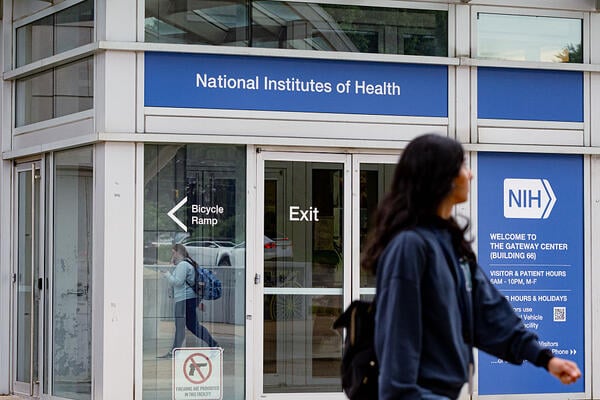
    It’s the latest move by the Trump administration to take control of federally funded research supported by agencies such as the National Science Foundation, the National Institutes of Health and the Department of Energy. Since taking office in January, those and other agencies have terminated thousands of grants that no longer align with their priorities, including projects focused on vaccine hesitancy, combating misinformation, LGBTQ+ health and promoting diversity, equity and inclusion. 

    Federal judges have since ruled some of those terminations unlawful. Despite those rulings, Thursday’s executive order forbids new funding for some of the same research topics the administration has already targeted.  

    It instructs the new political appointees of grant-making agencies to “use their independent judgment” when deciding which projects get funded so long as they “demonstrably advance the president’s policy priorities.” 

    Those priorities include not awarding grants to “fund, promote, encourage, subsidize, or facilitate” the following:

    • “Racial preferences or other forms of racial discrimination by the grant recipient, including activities where race or intentional proxies for race will be used as a selection criterion for employment or program participation;
    • “Denial by the grant recipient of the sex binary in humans or the notion that sex is a chosen or mutable characteristic;
    • “Illegal immigration; or
    • “Any other initiatives that compromise public safety or promote anti-American values.”

    The order also instructs senior appointees to give preference to applications from institutions with lower indirect cost rates. (Numerous agencies have also moved to cap indirect research cost rates for universities at 15 percent, but federal courts have blocked those efforts for now.)

    Source link

  • Harvard Medical Researcher Detained by ICE Faces Charge

    Harvard Medical Researcher Detained by ICE Faces Charge

    The Harvard Medical School research associate and Russian native detained by Immigration and Customs Enforcement three months ago and sent to Louisiana now faces a criminal charge—for allegedly trying to smuggle frog embryos into the U.S.

    The Massachusetts U.S. Attorney’s Office announced the charge in a news release Wednesday, saying it could mean “a sentence of up to 20 years in prison, a term of up to five years of supervised release and a fine of up to $250,000.”

    Prosecutors allege that after the researcher, Kseniia Petrova, arrived from Paris at Boston’s Logan International Airport, a law enforcement canine “alerted its handler to the defendant’s checked duffel bag on the baggage carousel.” The release said Petrova “initially denied carrying any biological material in her checked baggage.”

    Petrova’s lawyer, Gregory Romanovsky, said in a statement Thursday that “less than two hours after the Vermont judge set a hearing on Kseniia’s release, she was suddenly transferred from ICE to criminal custody. This is not a coincidence. It is an attempt by the government to justify its outrageous and legally indefensible position that this scientist working for the U.S. on cures for cancer and aging research has somehow become a danger.”

    The government said in court Wednesday that it intends “to deport Kseniia to Russia,” Romanovsky said, “where it knows she will face grave danger for opposing the Putin regime.”

    He said he expects Petrova will be transferred to Massachusetts in the next few weeks. Romanovsky has previously said Petrova was transporting “a non-hazardous scientific sample,” for which authorities could’ve merely fined her instead of detaining her and revoking her visa.

    Source link