Tag: Charlie Kirk

  • Iowa Teacher Committed Misconduct With His Anti-Kirk Facebook Posts – The 74

    Iowa Teacher Committed Misconduct With His Anti-Kirk Facebook Posts – The 74


    Get stories like this delivered straight to your inbox. Sign up for The 74 Newsletter

    An administrative law judge has ruled that an Iowa school teacher committed job-related misconduct when he posted negative Facebook comments about conservative activist Charlie Kirk.

    Matthew Kargol worked for the Oskaloosa Community School District as an art teacher and coach until he was fired in September 2025. Kargol then filed for unemployment benefits and the district resisted, which led to a recent hearing before Administrative Law Judge David Steen.

    In his written factual findings of the case, Steen reported that on Sept. 10, 2025, Kargol had posted a comment to Facebook stating, “1 Nazi down.” That comment was posted within hours of authorities confirming Kirk had been shot and killed that day while speaking at Utah Valley University in Orem, Utah.

    When another Facebook user commented, “What a s—-y thing to say,” Kargol allegedly replied, “Yep, he was part of the problem, a Nazi.”

    Steen reported that Kargol posted his comments around 5 p.m. and then deleted them within an hour. By 6 p.m., the district began fielding a number of telephone calls and text messages from members of the public, Steen found.

    According to Steen’s findings, the district’s leadership team met that evening and included Kargol via telephone conference call. District leaders asked Kargol to resign, and he declined, after which the district officials said they were concerned for his safety due to the public’s reaction to his comments.

    The district placed Kargol on administrative leave that evening, Steen found. The next day, district officials fielded roughly 1,500 telephone calls and received 280 voicemail messages regarding Kargol’s posts.

    “These calls required the employer to redirect staff and other resources from their normal duties,” Steen stated in his ruling. “The employer also requested additional law enforcement presence at school facilities due to the possibility of physical threats, which some of the messages alluded to. The employer continued to receive numerous communications from the public for days after the post was removed.”

    On Sept. 16, 2025, Superintendent Mike Fisher submitted a written recommendation to the school board to fire Kargol, with the two primary reasons cited as a disruption to the learning environment and a violation of the district’s code of ethics. Upon Fisher’s recommendation, the board fired Kargol on Sept. 17, 2025.

    According to Steen’s findings, the district calculated the cost of its response to the situation was $14,332.10 – and amount that includes the wages of the regular staff who handled the phone calls and other communications.

    As for the ethics-policy violation, Steen noted that the policy states that employees “are representatives of the district at all times and must model appropriate character, both on and off the worksite. This applies to material posted with personal devices and on personal websites and/or social media accounts.”

    The policy goes on to say that social media posts “which diminish the professionalism” of the district may result in disciplinary action, including termination, if it is found to be disruptive to the educational environment.

    The district, Steen noted, also has a policy on “employee expression” that states “the First Amendment protects a public employee’s speech when the employee is speaking as an individual citizen on a matter of public concern,” but that “even so, employee expression that has an adverse impact on district operations and/or negatively impacts an employee’s ability to perform their job for the district may still result in disciplinary action up to and including termination.”

    Based on the policies and Kargol’s conduct, Steen concluded the district fired Kargol for job-related misconduct that disqualified him from collecting unemployment benefits.

    The issue before him, Steen observed, wasn’t whether the district made a correct decision in firing Kargol, but whether Kargol is entitled to unemployment insurance benefits under Iowa law.

    In ruling against Kargol on that issue, Steen noted Kargol was aware of district policies regarding social media use as well as work rules that specifically state employees are considered representatives of the school district at all times.

    Kargol’s posts, Steen ruled, “reflected negatively on the employer and were against the employer’s interests.” The posts also “caused substantial disruption to the learning environment, causing staff at all levels to need to redirect focus and resources on the public’s response for days after the incident,” Steen stated.

    Kargol’s federal lawsuit against the school district, alleging retaliation for exercising his First Amendment right to expression, is still working its way through the courts.

    In that lawsuit, Kargol argues that in comments made last fall, Fisher made clear that his condemnation of Kargol’s Facebook posts “was rooted in his personal beliefs, not in evidence of disruption. Speaking as ‘a man of faith,’ Fisher expressed disappointment in the state of society and disapproval of Mr. Kargol’s expression. By invoking his personal religious identity in condemning Mr. Kargol’s speech, Fisher confirmed that his reaction was based on his own values and ideology, not on legitimate pedagogical concerns.”

    The district has denied any wrongdoing in that case. A trial date has yet to be scheduled.

    Several other lawsuits have been filed against their former employers by Iowa educators, a public defender and a paramedic, all of whom allege they were fired or sanctioned for online comments posted in the immediate aftermath of Kirk’s death.

    Earlier this week, two Iowa teachers sued the state’s teacher-licensing board and its executive director, alleging they improperly solicited complaints related to anti-Kirk social media posts.

    Iowa Capital Dispatch is part of States Newsroom, a nonprofit news network supported by grants and a coalition of donors as a 501c(3) public charity. Iowa Capital Dispatch maintains editorial independence. Contact Editor Kathie Obradovich for questions: [email protected].


    Did you use this article in your work?

    We’d love to hear how The 74’s reporting is helping educators, researchers, and policymakers. Tell us how
    Source link

  • Tenn. Law Aimed at Students Who Make School Shooting Threats Ensnares a Retiree – The 74

    Tenn. Law Aimed at Students Who Make School Shooting Threats Ensnares a Retiree – The 74

    School (in)Security is our biweekly briefing on the latest school safety news, vetted by Mark KeierleberSubscribe here.

    Larry Bushart Jr. was just freed from a Tennessee jail cell after spending more than a month behind bars — for a Facebook post.

    The high-profile arrest of the 61-year-old retiree and former cop — which made waves in free speech circles — has all the hallmarks of a bingeworthy culture war clash in 2025: 

    • A chronically online progressive turns to Facebook to troll his MAGA neighbors about President Donald Trump’s seemingly lopsided response to school shootings compared to the murder of right-wing pundit Charlie Kirk
    • An elected, overzealous county sheriff intent on shutting him up
    • A debate over the limits of the First Amendment — and the president’s broader efforts to silence his critics
    Eamonn Fitzmaurice / T74

    The controversy, I report this morning, also calls attention to a series of recent Tennessee laws that carry harsh punishments for making school shooting threats and place police officers on campus threat assessment teams working to ferret out students with violent plans before anyone gets hurt. 

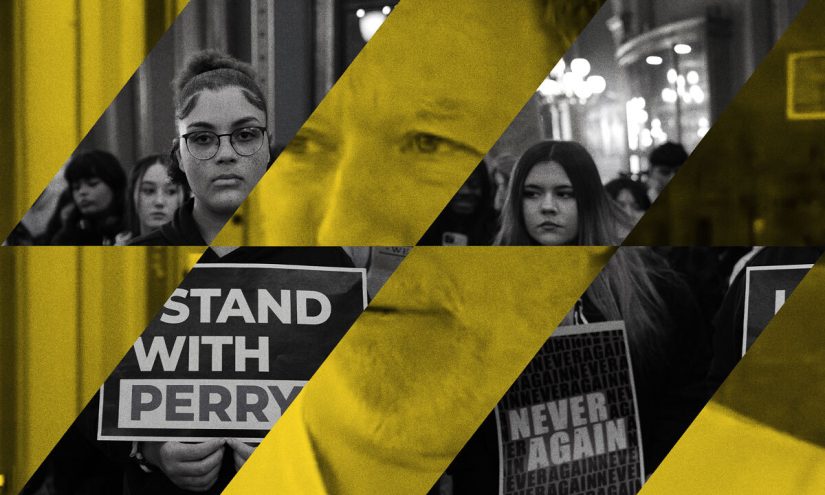
    In Bushart’s case, the sheriff maintained that his post referring to the president’s reaction to a 2024 school shooting in Perry, Iowa, constituted a threat “of mass violence at a school,” apparently the local Perry County High School. The rules that ensnared Bushart have also led to a wave of student arrests and several free speech lawsuits. His is likely to be next, Bushart’s lawyer told The Washington Post.


    In the news

    Updates in Trump’s immigration crackdown: Federal immigration officers chased a Chicago teacher into the lobby of a private preschool Wednesday and dragged her out as parents watched her cry “tengo papeles!” or “I have papers.” The incident is perhaps the most significant immigration enforcement act in a school to date. | The 74

    • Proposed federal rules would allow Immigration and Customs Enforcement to collect iris scans, fingerprints and other biometric data on all immigrants — including, for the first time, children under 14 years old — and store it for the duration of each individual person’s “lifecycle.” |  Ars Technica
    • On the same day Cornell University notified an international student that his immigration status had been revoked, Google alerted him that federal authorities had subpoenaed his personal emails. Now, the institution won’t say whether federal authorities had tapped into university “emails to track [students] as well.” | The Cornell Daily Sun
    • In California, federal immigration officers shot a U.S. citizen from behind as he warned the agents that students would soon gather in the area to catch a school bus. The government says the shots were “defensive.” | Los Angeles Times
    • ‘Deportation isn’t a costume’: A Maine middle school principal is facing pushback for a federal immigration officer Halloween costume, complete with a bulletproof vest that read “ICE.” | Boston.com
    • In Chicago communities that have seen the most significant increase in immigration enforcement, school enrollment has plunged. | Chalkbeat
    • Also in Chicago, a federal judge ordered the Trump administration to hand over use-of-force records and body camera footage after trick-or-treaters were “tear-gassed on their way to celebrate Halloween.” | USA Today

    A bipartisan bill seeks to bar minors from using AI chatbots as petrified parents testified their children used the tools with dire consequences — including suicide. Some warn the change could stifle the potential of chatbots for career or mental health counseling services. | Education Week

    • A Kentucky mom filed a federal lawsuit against online gaming communities Discord and Roblox alleging the companies jeopardized children’s safety in the name of profit. After her 13-year-old daughter died by suicide last year, the mom said, she found the girl had a second life online that idolized school shooters. | 404 Media
    • Character.AI announced it will bar minors from its chatbots, acknowledging safety concerns about how “teens do, and should, interact with this new technology.” | BBC
    Getty Images

    A jury awarded $10 million to former Virginia teacher Abby Zwerner on Thursday, two years after she was shot by her 6-year-old student. Zwerner accused her former assistant principal of ignoring repeated warnings that the first grader had a gun. The student’s mother was sentenced to nearly four years in prison for felony child neglect and federal weapons charges. | The New York Times

    ‘Creepy, unsettling’: This family spent a week with Grem, a stuffed animal with artificial intelligence designed to “learn” children’ s personalities and hold educational conversations. | The Guardian

    A judge ordered the Trump administration to release federal funds to California school districts after it sought to revoke nearly $165 million in mental health grants as part of a broader crackdown on diversity, equity and inclusion.  The grants funded hundreds of school social workers and counselors. | EdSource

    In 95% of schools, active-shooter drills are now a routine part of campus life. Here’s how states are trying to make them less traumatic. | The Trace

    Sign-up for the School (in)Security newsletter.

    Get the most critical news and information about students’ rights, safety and well-being delivered straight to your inbox.

    A lawsuit against a Pennsylvania school district alleges educators failed to keep students safe after a 12-year-old girl was attacked by a classmate with a metal Stanley drinking cup. | NBC10

    ‘Inviting government overreach and abuse’: The Education Department was slapped with two lawsuits over new Public Service Loan Forgiveness rules that could bar student borrowers from the program who end up working for the president’s political opponents, including organizations that serve immigrant students and LGBTQ+ youth. | The Washington Post


    ICYMI @The74

    1939 redlined maps of Los Angeles showing neighborhoods deemed eligible and ineligible for economic aid

    How LAUSD School Zones Perpetuate Educational Inequality, Ignoring ‘Redlining’ Past

    Students Want Schools to Incorporate AI in Learning But Express Some Fears

    LifeWise’s Big Red Bus Is Driving Thorny Questions about Church and State


    Emotional Support

    Matilda plots her escape.


    Did you use this article in your work?

    We’d love to hear how The 74’s reporting is helping educators, researchers, and policymakers. Tell us how
    Source link

  • How Charlie Kirk Changed Gen Z’s Politics – The 74

    How Charlie Kirk Changed Gen Z’s Politics – The 74


    Get stories like this delivered straight to your inbox. Sign up for The 74 Newsletter

    This analysis originally appeared at The Up and Up, a newsletter focused on youth culture and politics. 

    There’s been a massive effort to understand why Gen Z shifted right in the 2024 election. Part of that movement was thanks to Charlie Kirk and his work to engage young people — on and offline.

    Whether it was his college tours or the campus debate videos he brought to the forefront of social media, he changed the way young people think about, consume and engage in political discourse.

    Over the past few years, as I’ve conducted Gen Z listening sessions across the country, I’ve watched as freedom of speech has become a priority issue for young people, particularly on the right. The emphasis on that issue alone helped President Donald Trump make inroads with young voters in 2024, with Kirk as its biggest cheerleader. Just a few years ago, being a conservative was not welcomed on many liberal college campuses. That has changed.

    Even on campuses he never visited, Kirk, via his massive social media profile and the resonance of his videos online, was at the center of bringing MAGA to the mainstream. Scroll TikTok or Instagram with a right-leaning college student for five minutes, and you’re likely to see one of those debate-style videos pop into their feed. Since the news broke of the attack on his life last week, I’ve heard from many young leaders — both liberal and conservative — who are distraught and shook up. The reality is that Kirk changed the game for Gen Z political involvement. Even for those who disagreed with his politics, his focus on young voters inevitably shifted how young people were considered and included in the conversation.

    Like many of you, I’ve followed Kirk for years. Whether you aligned with his policy viewpoints or not, his influence on the conversation is undeniable. And, for young people, he was the face of the next generation for leadership in the conservative party.

    Kirk’s assassination was the latest in a string of political violence, including the political assassination in Minnesota that took the life of former House Speaker Melissa Hortman and her husband, and left state Sen. John Hoffman wounded. One of the most common fears I hear from young people across the country and the political spectrum is that political division has gone too far. Last week’s shooting also coincided with a tragic school shooting in Colorado. The grave irony of all these forces coinciding — gun violence, political violence and campus violence — cannot be ignored.

    In all my conversations with young people, one thing is clear: they are scared.

    Gen Z perspectives 

    After Wednesday’s tragedy, I reached out to students and young people I’ve met through listening sessions with The Up and Up, as well as leaders of youth organizations that veer right of center. Others reached out via social media to comment. Here’s some of what they shared.

    California college student Lucy Cox: “He was the leader of the Republican Party and the conservative movement right now especially for young people. He’s probably more famous than Trump for college students. He had divisive politics, but he never went about it in a divisive way. He’s been a part of my college experience for as long as I’ve been here. He felt like somebody I knew. His personality was so pervasive. It feels very odd that I’m never going to watch a new Charlie Kirk video again.”

    Jesse Wilson, a 30-year-old in Missouri: “From the first time I saw him, it was on the ‘Whatever’ podcast, I’ve watched that for a long long long time. Just immediately, the way he carried himself and respected the people he was talking to regardless of who they were, their walk of life, how they treated him. Immediately I just thought, ‘Man, there’s just something different about him.’ He was willing to engage. It was the care, he didn’t want to just shut somebody down. He was like, ‘These are my points, and this is what I’m about,’ and it seemed like there was a willingness to engage and meet people where they’re at. I found it really heartwarming. And we need it. That’s what’s going to make a difference.”

    Ebo Entsuah, a 31-year-old from Florida: “Charlie had a reach most political influencers couldn’t even imagine. I didn’t agree with him on a number of things, but there’s no mistaking that he held the ear of an entire generation. When someone like that is taken from the world, the impact multiplies.”

    Danielle Butcher Franz, CEO of The American Conservation Coalition: “Charlie changed my life. The first time I ever went to D.C. was because of him. He invited me to join TPUSA at CPAC so I bought a flight and skipped class. When we finally met in person he grinned and said, ‘Are you Republican Sass?’ (My Twitter at the time) and gave me a big thumbs-up. I owe so much of my career to him. Most of my closest friends came into my life through him or at his events. Because of Charlie, I met my husband. We worked with him back when TPUSA was still run out of a garage. Charlie’s early support helped ACC grow when no one else took us seriously. He welcomed me with open arms to speak at one of his conferences to 300+ young people when ACC was barely weeks old. I keep looking around me and thinking about how none of it would be here if I hadn’t met Charlie.”

    A 26-year-old woman who asked to remain anonymous: “I would be naive to not admit that my career trajectory and path would not have been possible without Charlie Kirk. He forged a path in making a career with steadfast opinions, engaging with a generation that had never been so open-minded and free, slanting their politics the exact opposite of his own. He made politics accessible. He made conservatism accessible. But damn, he made CIVICS accessible. He dared us to engage. To take the bait. To react. He was controversial because he was good at what he was doing. Good at articulating his beliefs with such conviction to dare the other side to express. He died engaging with the other side. In good or bad faith is one’s own to decide, but he was engaging. In a time where the polarization is never more clear. So I will continue to dare to engage with those I agree and those I disagree with. But it’s heartbreaking. It feels like we’ve lost any common belonging. There has not been an event in modern political history that has impacted me this much. Maybe it hits too close to home.”

    Disillusioned by a divided America 

    Over the summer, I wrote about Gen Z’s sinking American pride. Of all generations, according to Gallup data, Gen Z’s American pride is the lowest, at just 41%. At the time, I wrote that this is not just about the constant chaos which has become so normalized for our generation. It’s more than that. It’s a complete disillusionment with U.S. politics for a generation that has grown up amid hyperpolarization and a scathing political climate. What happened last week adds a whole layer.

    Beyond the shooting, there is the way in which this unfolded online. There’s a legitimate conversation to be had about people’s reactions to Kirk’s death and an unwillingness to condemn violence.

    As a 19-year-old college student told me: “This reveals a big problem that I see with a lot of members in Gen Z — that they tend to see things in black and white and fail to realize that several things can be true at once.”

    There’s also the need for a discussion about the speed at which the incredibly graphic video of violence circulated — and the fact that it is now seared into the minds of the many, many young people who watched it.

    We live in a country where gun violence is pervasive. When we zoom out and look toward the future, there are inevitable consequences of this carnage.

    Since The Up and Up started holding listening sessions in fall 2022, young people have shared that civil discourse and political violence are two of their primary concerns. One of the most telling trends are the responses to two of our most frequently asked questions: “What is your biggest fear for the country, and what is your biggest hope for the country?” 

    Consistently, the fear has something to do with violence and division, while the hope is unity.

    I think we all could learn from the shared statement issued by the Young Democrats and Young Republicans of Connecticut before Trump announced Kirk’s death, in which they came together to “reject all forms of political violence” in a way we rarely, if ever, see elected officials do.


    Get stories like these delivered straight to your inbox. Sign up for The 74 Newsletter

    Source link