FCC Chairman Brendan Carr is once again abusing his position to try to assert government control over public discourse, spuriously invoking the “public interest” standard to selectively target speech the government dislikes.
President Trump has recently called for the FCC to revoke ABC’s broadcast license because he does not like the way the network — and Jimmy Kimmel in particular — speaks about him. Just yesterday, Trump suggested to a reporter that Attorney General Pam Bondi’s statement about prosecuting “hate speech” might mean she will “go after” ABC “because you treat me so unfairly. It’s hate.”
Now, Carr is threatening ABC for comments about Charlie Kirk’s shooter that Kimmel made during his opening monologue on Monday, insinuating that the shooter was part of “the MAGA gang.”
The FCC has no authority to control what a late night TV host can say, and the First Amendment protects Americans’ right to speculate on current events even if those speculations later turn out to be incorrect. Subjecting broadcasters to regulatory liability when anyone on their network gets something wrong would turn the FCC into an arbiter of truth and cast an intolerable chill over the airwaves.
With national attention already focused on campus free speech, the assassination of Charlie Kirk at Utah Valley University has intensified a fractious moment for higher education. Voices on the right have blamed colleges for Kirk’s death, calling them “indoctrination camps” and comparing them to “madrassas that radicalize jihadis.”
Though the suspect is not a student, Kirk’s killing has intersected with concerns that students are increasingly unable or unwilling to engage with dissenting views. Critics have cited the most recent FIRE College Free Speech Rankings survey, which shows that one in three students thinks it’s acceptable to use violence to stop a speaker.
Colleges did not cause Kirk’s death, but leaders cannot ignore the finding that a third of students support using violence against a speaker. Though most students will never resort to violence, the possibility forces colleges to reassess campus security. UVU’s police chief admitted more than half his force of 15 officers wasn’t able to secure the crowd of 3,000 people at the Kirk event. Security experts noted that stopping a shooting from the top of a building hundreds of feet away requires Secret Service–style sweeps. The incident raises questions about bringing outside speakers to campuses. With so many budget problems in higher ed, who will cover the costs of keeping them safe?
Yet on the ground at UVU, life on campus looked far different from critics’ portrayals. In the hours after the shooting, the student newspaper, The UVU Review, reported that professors reached out to students to offer resources and reprieves from coursework. Students called everyone in their phone to tell them they were safe. Strangers hugged each other and students offered a ride home to anyone who needed it. They put aside their differences to grieve together. “It feels like life stopped for us,” said one student. “But it kept going for everyone else. I’m ready for life to start again, no matter how changed it’ll be.”
Given Kirk’s prominence, students across the country will feel like this incident has changed their lives, too. With more than 850 campus chapters, Turning Point USA is an organization where conservative students have found community. And even for students who disagreed with Kirk he inspired them to engage with political issues and debate their ideas.
But the reactions to Kirk’s death reveal that the ideological fissures on campus have only deepened. At least 15 faculty and staff members have been fired for appearing to condone the shooting on social media, many after online campaigns called for their dismissal. Meanwhile, at a candlelit vigil at the University of North Carolina at Chapel Hill—a campus that has faced its own tragedy—student Walt Wilson told The Daily Tarheel he was mourning Kirk even though he disagreed with him. “Getting killed over debate and fostering free speech, especially in a place like a university where that is supposed to prosper, is a real tragedy and shows an issue of communication and reconciliation,” he said.
Free speech survives only if protected in practice. This moment will test higher education’s resolve: Will political pressure drive colleges to retreat, or will they recommit to free expression as a path through turmoil?
Far from diminishing conservative student mobilization, Kirk’s death appears to have amplified it—at least in the short term. Randall Collins’ sociology of interaction ritual chains and Eric Hoffer’s classic analysis of mass movements provide a useful lens for understanding both the surge and the likely limits of this moment.
Collins’ Emotional Energy Framework Applied to Kirk’s Death
Collins identifies four outcomes of successful ritual gatherings: group solidarity, emotional energy, sacred symbols, and moral righteousness. In the wake of Kirk’s assassination, conservative students and evangelical leaders have experienced all four in compressed, amplified form.
Pastors quickly declared Kirk a “Christian martyr.” Rob McCoy invoked biblical precedent, while Jackson Lahmeyer described the murder as “spiritual in nature and an attack on the very institution of the church.” This religious framing elevates Kirk from activist to sacred symbol.
The immediate response has been extraordinary. Turning Point USA claims more than 32,000 requests for new chapters in the 48 hours following his death. Collins would interpret this as emotional energy seeking new ritual outlets. In this sense, Kirk’s martyrdom has become not just a grievance but a generator of collective action.
The memorial scheduled for September 21 at State Farm Stadium—with capacity for more than 60,000 and featuring Donald Trump—is set to be the largest ritual gathering in the history of conservative student politics. Collins would predict this to be a high-intensity moment of “collective effervescence,” the kind of event that extends emotional energy for months if not years.
Hoffer’s Mass Movement Dynamics and Conservative Student Mobilization
Hoffer’s The True Believer provides a complementary angle. He argued that mass movements thrive on frustration, doctrine, and the presence of either a leader or a transcendent cause. Kirk’s assassination intensified frustration while transforming him into a more powerful symbolic figure than he was in life.
Student conservatives now have all three: grievance (left-wing violence), a sacred cause (free speech framed as religious duty), and a heroic narrative (following a martyred leader). In Hoffer’s words, martyrdom provides both “grievance and transcendent meaning.”
The shift from Kirk as a living leader to Kirk as martyr reflects Hoffer’s principle of substitutability. Loyalty has already migrated from the man himself to the mythology of his sacrifice. College Republicans chairman William Donahue compared the killing to Martin Luther King Jr.’s assassination, framing it as a watershed for the movement.
Sustainability and the Ritual Problem
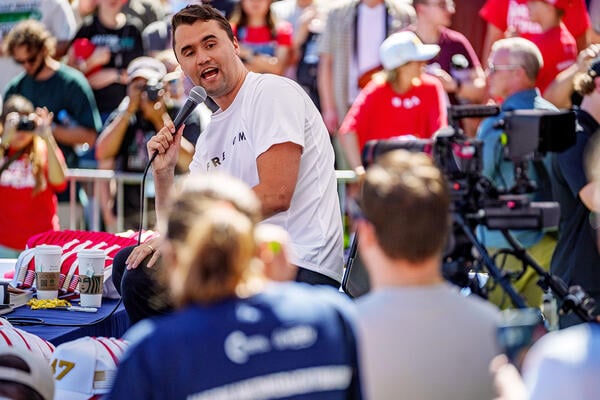
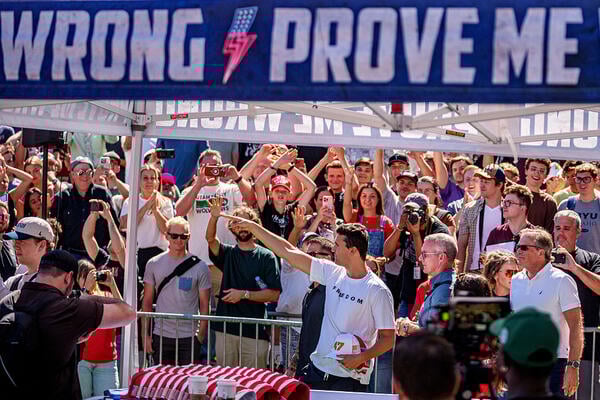
The paradox is that Kirk’s most important contribution—the high-energy confrontational rituals of his “Prove Me Wrong” campus debates—cannot be replicated without him. These events generated viral spectacle, solidified conservative identity, and created sacred moments of confrontation. They were, in Collins’ terms, engines of emotional energy.
The September 21 memorial may provide a one-time boost, but Collins emphasizes that emotional energy must be renewed through repeated rituals. Without Kirk’s charisma and willingness to create confrontational spaces, conservative students risk energy dissipation. Already some students report greater enthusiasm for activism, while others express fear of being targeted themselves.
The dilemma is clear: the rituals that generated the most energy (public confrontations) are the very ones most likely to invite violence. This tension may limit the sustainability of the movement’s current surge.
The Profit Motive: Martyrdom as Marketplace
Beyond the sociology of solidarity lies a material reality: martyrdom is also a business model. Conservative organizations are already converting Kirk’s death into a revenue stream. Within hours of the assassination, Turning Point USA launched fundraising appeals invoking Kirk’s “sacrifice,” while conservative merchandisers began selling commemorative t-shirts, hats, and wristbands emblazoned with slogans like “Martyr for Freedom” and “Charlie Lives.”
Publishing houses are reportedly fast-tracking hagiographic biographies, while streaming platforms are negotiating for documentaries. Memorial events, livestreams, and “Martyrdom Tours” are being packaged as both spiritual rituals and ticketed spectacles. Kirk’s death, in other words, is generating not only emotional energy but also financial capital.
This profit motive raises questions about the sincerity of the rhetoric surrounding Kirk’s martyrdom. While Collins and Hoffer help explain the emotional pull, the commodification of grief ensures that the “sacred symbol” is also a lucrative brand. Conservative student organizing may thus be sustained less by spontaneous devotion than by a well-financed industry of grievance, merchandise, and media spectacle.
Indicators to Watch
Several markers will reveal whether Kirk’s martyrdom produces lasting transformation or burns out in ritual dissipation:
Memorial impact: Attendance and intensity at the September 21 gathering will test whether Kirk’s death can generate lasting solidarity.
Chapter formation: The real test of Turning Point USA’s 32,000 claims will be functioning chapters in six months.
Leadership succession: Hoffer reminds us that movements need charismatic leaders. At present, Trump appears to be monopolizing the emotional energy, raising doubts about the rise of new student leaders.
Counter-mobilization: Collins’ conflict theory suggests left-wing backlash could shape whether conservative students double down or retreat.
The Probable Trajectory
For the next 6–18 months, conservative student mobilization is likely to grow. The movement now has the grievance, sacred symbolism, and transcendent narrative that both Collins and Hoffer identify as powerful motivators.
But sustaining this surge will be difficult without Kirk’s unique talent for generating high-energy campus rituals. Unless new leaders emerge who can replicate or reimagine those ritual forms, the emotional energy of martyrdom may eventually dissipate.
At the same time, the financial infrastructure now growing around Kirk’s death suggests the movement has a fallback strategy: keep the martyrdom alive as long as it remains profitable. In this way, Kirk’s assassination may prove to be not just a sociological event but also a business opportunity—one that reveals the convergence of politics, religion, and profit in contemporary conservative student life.
Appropriately, we can expect colleges and universities to place even greater emphasis on safety and security ahead of outside speakers arriving on campus moving forward. They have a moral and legal obligation to redouble their efforts to protect free speech as well as their campus community. However, administrators must not pass those security costs along to speakers or use security concerns as pretext to cancel a speaker’s appearance. Rewarding threats of violence by taxing speech or silencing speakers will only invite more threats and more violence.
Just as there is undeniable risk in hosting controversial speakers, there is infinite risk in surrendering the marketplace of ideas to the heckler’s veto.
In Forsyth County v. Nationalist Movement (1992), the Supreme Court determined that government actors — like public college or university administrators — may not lawfully impose security fees based on their own subjective judgments about “the amount of hostility likely to be created by the speech based on its content.” Such fees amount to a tax on speech an administrator subjectively dislikes, or subjectively believes is likely to cause disruption or violence.
“Speech cannot be financially burdened, any more than it can be punished or banned, simply because it might offend a hostile mob,” the Forsyth Court wrote, noting that “[t]hose wishing to express views unpopular with bottle throwers, for example, may have to pay more for their permit.”
America must be an open society where we feel safe to share our ideas in the public square, not just from behind bulletproof glass and bulletproof vests.
Imposing exorbitant security fees due to the controversial nature of an event effectuates a heckler’s veto, as it allows an audience’s reaction to dictate the price a student group must pay to hold an event. This means that a student group could be priced out of holding a controversial event if the audience reaction is anticipated to be too disruptive. Just as there is undeniable risk in hosting controversial speakers, there is infinite risk in surrendering the marketplace of ideas to the heckler’s veto.
So what should colleges do in the face of this challenge?
First, they need to adopt and publish viewpoint- and content-neutral regulations on events. As we wrote in a 2022 letter to Pennsylvania State University, “Any administrative imposition of security fees on a student group must be guided by narrowly drawn, viewpoint- and content-neutral, reasonable, definite, and clearly communicated standards in order to comply with [the university’s]…obligations under the First Amendment.” FIRE’s Model Speech Policies for College Campuses include a security fee policy that other colleges can emulate to set themselves up for success.
When universities silence controversy they silence opportunity — the opportunity to test ideas, sharpen arguments, and confront uncomfortable topics.
Second, colleges must apply those regulations to make decisions about security measures on the basis of verified, specific safety concerns, rather than speculative assumptions on the basis of the speaker’s message or experiences at past events. And every effort should be made to ensure events that do present concerns are able to continue. Such strategies as increasing security, using metal detectors, and moving events online should be applied before cancellation.
Third, colleges need to train staff to apply these standards properly to meet their dual obligations to ensure safety of attendees and the speaker during the event, and to uphold the ability of attendees to hear the speaker’s message. FIRE’s First Amendment Lessons for College Administrators can be a useful starting point for this work.
Student acceptance of violence in response to speech hits a record high
In 2020, just 1 in 5 students said it was acceptable to use violence to stop a speaker. Now it’s 1 in 3 — a nearly 80% jump in five years.
At the same time, colleges should educate students on freedom of speech: both its limits and its importance in our democracy. FIRE encourages colleges to begin this education on day one at orientation, guided by our Free Speech at Freshman Orientation programming. These lessons should provide students with better options for responding to disfavored speech than shoutdowns or violence. They should also reinforce why we’ve chosen in America to meet speech with which we disagree with more speech.
When universities silence controversy they silence opportunity — the opportunity to test ideas, sharpen arguments, and confront uncomfortable topics. They must meet this challenging moment not with censorship but with empowerment of free expression.
This analysis originally appeared at The Up and Up, a newsletter focused on youth culture and politics.
There’s been a massive effort to understand why Gen Z shifted right in the 2024 election. Part of that movement was thanks to Charlie Kirk and his work to engage young people — on and offline.
Whether it was his college tours or the campus debate videos he brought to the forefront of social media, he changed the way young people think about, consume and engage in political discourse.
Over the past few years, as I’ve conducted Gen Z listening sessions across the country, I’ve watched as freedom of speech has become a priority issue for young people, particularly on the right. The emphasis on that issue alone helped President Donald Trump make inroads with young voters in 2024, with Kirk as its biggest cheerleader. Just a few years ago, being a conservative was not welcomed on many liberal college campuses. That has changed.
Even on campuses he never visited, Kirk, via his massive social media profile and the resonance of his videos online, was at the center of bringing MAGA to the mainstream. Scroll TikTok or Instagram with a right-leaning college student for five minutes, and you’re likely to see one of those debate-style videos pop into their feed. Since the news broke of the attack on his life last week, I’ve heard from many young leaders — both liberal and conservative — who are distraught and shook up. The reality is that Kirk changed the game for Gen Z political involvement. Even for those who disagreed with his politics, his focus on young voters inevitably shifted how young people were considered and included in the conversation.
Like many of you, I’ve followed Kirk for years. Whether you aligned with his policy viewpoints or not, his influence on the conversation is undeniable. And, for young people, he was the face of the next generation for leadership in the conservative party.
Kirk’s assassination was the latest in a string of political violence, including the political assassination in Minnesota that took the life of former House Speaker Melissa Hortman and her husband, and left state Sen. John Hoffman wounded. One of the most common fears I hear from young people across the country and the political spectrum is that political division has gone too far. Last week’s shooting also coincided with a tragic school shooting in Colorado. The grave irony of all these forces coinciding — gun violence, political violence and campus violence — cannot be ignored.
In all my conversations with young people, one thing is clear: they are scared.
Gen Z perspectives
After Wednesday’s tragedy, I reached out to students and young people I’ve met through listening sessions with The Up and Up, as well as leaders of youth organizations that veer right of center. Others reached out via social media to comment. Here’s some of what they shared.
California college student Lucy Cox: “He was the leader of the Republican Party and the conservative movement right now especially for young people. He’s probably more famous than Trump for college students. He had divisive politics, but he never went about it in a divisive way. He’s been a part of my college experience for as long as I’ve been here. He felt like somebody I knew. His personality was so pervasive. It feels very odd that I’m never going to watch a new Charlie Kirk video again.”
Jesse Wilson, a 30-year-old in Missouri: “From the first time I saw him, it was on the ‘Whatever’ podcast, I’ve watched that for a long long long time. Just immediately, the way he carried himself and respected the people he was talking to regardless of who they were, their walk of life, how they treated him. Immediately I just thought, ‘Man, there’s just something different about him.’ He was willing to engage. It was the care, he didn’t want to just shut somebody down. He was like, ‘These are my points, and this is what I’m about,’ and it seemed like there was a willingness to engage and meet people where they’re at. I found it really heartwarming. And we need it. That’s what’s going to make a difference.”
Ebo Entsuah, a 31-year-old from Florida: “Charlie had a reach most political influencers couldn’t even imagine. I didn’t agree with him on a number of things, but there’s no mistaking that he held the ear of an entire generation. When someone like that is taken from the world, the impact multiplies.”
Danielle Butcher Franz, CEO of The American Conservation Coalition: “Charlie changed my life. The first time I ever went to D.C. was because of him. He invited me to join TPUSA at CPAC so I bought a flight and skipped class. When we finally met in person he grinned and said, ‘Are you Republican Sass?’ (My Twitter at the time) and gave me a big thumbs-up. I owe so much of my career to him. Most of my closest friends came into my life through him or at his events. Because of Charlie, I met my husband. We worked with him back when TPUSA was still run out of a garage. Charlie’s early support helped ACC grow when no one else took us seriously. He welcomed me with open arms to speak at one of his conferences to 300+ young people when ACC was barely weeks old. I keep looking around me and thinking about how none of it would be here if I hadn’t met Charlie.”
A 26-year-old woman who asked to remain anonymous: “I would be naive to not admit that my career trajectory and path would not have been possible without Charlie Kirk. He forged a path in making a career with steadfast opinions, engaging with a generation that had never been so open-minded and free, slanting their politics the exact opposite of his own. He made politics accessible. He made conservatism accessible. But damn, he made CIVICS accessible. He dared us to engage. To take the bait. To react. He was controversial because he was good at what he was doing. Good at articulating his beliefs with such conviction to dare the other side to express. He died engaging with the other side. In good or bad faith is one’s own to decide, but he was engaging. In a time where the polarization is never more clear. So I will continue to dare to engage with those I agree and those I disagree with. But it’s heartbreaking. It feels like we’ve lost any common belonging. There has not been an event in modern political history that has impacted me this much. Maybe it hits too close to home.”
Disillusioned by a divided America
Over the summer, I wrote about Gen Z’s sinking American pride. Of all generations, according to Gallup data, Gen Z’s American pride is the lowest, at just 41%. At the time, I wrote that this is not just about the constant chaos which has become so normalized for our generation. It’s more than that. It’s a complete disillusionment with U.S. politics for a generation that has grown up amid hyperpolarization and a scathing political climate. What happened last week adds a whole layer.
Beyond the shooting, there is the way in which this unfolded online. There’s a legitimate conversation to be had about people’s reactions to Kirk’s death and an unwillingness to condemn violence.
As a 19-year-old college student told me: “This reveals a big problem that I see with a lot of members in Gen Z — that they tend to see things in black and white and fail to realize that several things can be true at once.”
There’s also the need for a discussion about the speed at which the incredibly graphic video of violence circulated — and the fact that it is now seared into the minds of the many, many young people who watched it.
We live in a country where gun violence is pervasive. When we zoom out and look toward the future, there are inevitable consequences of this carnage.
Since The Up and Up started holding listening sessions in fall 2022, young people have shared that civil discourse and political violence are two of their primary concerns. One of the most telling trends are the responses to two of our most frequently asked questions: “What is your biggest fear for the country, and what is your biggest hope for the country?”
Consistently, the fear has something to do with violence and division, while the hope is unity.
I think we all could learn from the shared statement issued by the Young Democrats and Young Republicans of Connecticut before Trump announced Kirk’s death, in which they came together to “reject all forms of political violence” in a way we rarely, if ever, see elected officials do.
For almost a decade, the Higher Education Inquirer investigated right wing influencer Charlie Kirk and his Turning Point Empire. Kirk was groomed by Bill Montgomery (a surrogate for Richard Nixon in Florida for Nixon’s Reelection Campaign) and Steve Bannon when Bannon was at Breitbart. Kirk quickly learned the dirty tricks of the Nixon-Reagan era and the dog whistles of white supremacy and misogyny. He also quickly gained funding from right wing billionaire Foster Freiss.
In mid-2016, we communicated our concerns with Michael Vasquez at Politico, who later moved on to the Chronicle of Higher Education (CHE). CHE later reported that Kirk created a plan to win student elections using outside (illegal) money. We also contacted the Southern Poverty Law Center and the Anti-Defamation League who both listed TPUSA as a hate group.
Right-wing social media accounts have embarked on a widespread name-and-shame campaign to out any college employees who have celebrated or spoken insensitively about Kirk’s death.
Photo illustration by Justin Morrison/Inside Higher Ed | skynesher/E+/Getty Images
Two administrators are now out of a job and a graduate student lost an internship after making comments online that downplayed or celebrated the death of Charlie Kirk, the influential conservative founder of the campus-focused Turning Point USA.
In the 36 hours since Kirk was shot and killed during an event at Utah Valley University, right-wing social media accounts have screenshotted and circulated several social media posts, likes and reposts from college faculty and staff members related to Kirk’s death. In addition to the firings, the campaign to name and shame these individuals has led to death threats, Wired reported.
Late Wednesday, a student affairs administrator at Middle Tennessee State University was fired after posting “insensitive” remarks on Facebook in response to Kirk’s death. “We take great pride in the professionalism of our staff; in my long tenure with this university I’ve never before had to dismiss someone for so carelessly undermining the work and mission of this fine institution,” Middle Tennessee State president Sidney McPhee wrote in a statement Thursday. A university spokesperson confirmed the employee was Laura Sosh-Lightsy, an associate dean of student care and conduct who had worked at the university since 2005.
“Looks like ol’ Charlie spoke his fate into existence. Hate begets hate. ZERO sympathy,” Sosh-Lightsy wrote in a Facebook post that has been circulated widely by right-wing accounts on social media. A university spokesperson did not confirm whether or not that specific post led to her firing but noted that “her termination was related to her insensitive social media posts related to the horrific death of Mr. Kirk.” Tennessee senator Marsha Blackburn, a Republican, called for Sosh-Lightsy’s firing on X, writing that she “should be ashamed of her post.” Sosh-Lightsy did not respond to Inside Higher Ed’s request for comment.
On Thursday afternoon, University of Mississippi chancellor Glenn Boyce confirmed the firing of an unnamed staff member who he said “re-shared hurtful, insensitive comments on social media regarding the tragic murder of Charlie Kirk.”
Boyce didn’t provide specifics but noted that “these comments run completely counter to our institutional values of civility, fairness and respecting the dignity of each person.”
At Baylor University, officials distanced the university from a graduate student who wrote “this made me giggle” in response to a social media post sharing the news of Kirk’s death.
“We are aware and greatly disappointed by a social media comment from a Baylor graduate student regarding the fatal shooting of Charlie Kirk. To make light of the death of a fellow human being is completely inappropriate and completely counter to Baylor’s Christian mission. Baylor strives to be a community in which every individual is treated with respect—in life and in death,” a university statement said.
The graduate student—whose online username includes “coach”—is not a member of the faculty nor a part of the athletics program, the statement clarified. Midway Middle School, where the graduate student was student teaching, also removed him from teaching there, KWTX reported.
The Foundation for Individual Rights and Expression is monitoring which universities are censoring employee speech, said Lindsie Rank, director of campus rights advocacy at FIRE. “It may not be moral to speak ill of the dead, but it is protected by the First Amendment so we’re going to be keeping our eyes open for those situations,” she said.
Wednesday saw a moment without precedent in recent history: A college speaker shot to death on a campus during an event. That fact alone would’ve escalated growing concerns about the future of free speech and civil discourse at colleges and universities.
But this speaker was Charlie Kirk, a prominent ally of a U.S. president who was already crusading against higher ed. Kirk, a national political figure in his own right, was one of the foremost conservative critics of intolerance for right-wing views in higher ed and the founder and leader of Turning Point USA, a nationwide organization of conservative campus groups that aided the president’s re-election. Kirk even spoke at Trump’s January inauguration.
He was known for goading students on campuses to “prove me wrong,” posting the resulting clips online, appearing in conservative media to denounce higher ed, spreading his views further on his own podcast and using his organization’s online presence and on-the-ground staff to target left-leaning faculty.
“College is a scam,” Kirk, who dropped out of Harper College in Illinois, wrote in a 2022 Fox News op-ed, in which he urged most students not to go.
“Universities are indoctrination zones where free speech is crushed,” he wrote. “Radical students and faculty coerce and persecute their nonconforming peers through ‘cancel culture’ and threats … I firmly believe that most—if not all—the destructive ideas that are now eating away at the foundation of American society originated on college campuses.”
His death at Utah Valley University could put more pressure on higher ed at a time when colleges and universities have already been excoriated and targeted by the right. Faculty and those who criticize higher ed as being insufficiently open to civil debate between different viewpoints are worried that free expression will further erode.
“This is an epic moment for the future of higher ed,” said John Tomasi, president of Heterodox Academy. “For the issue of free speech, there’s been nothing quite like this ever before.”
Tomasi, whose organization promotes “viewpoint diversity” and “constructive disagreement” on campuses, noted both Kirk’s national stature and his association with campus free expression. He was the kind of person that conservatives had long argued wasn’t welcome on campuses.
“This is an attack on a magnitude that we have not previously seen,” he said. He said national attention on campus cultures intensified when Congress in late 2023 started calling university presidents into televised hearings regarding alleged campus antisemitism. Now, that “white-hot spotlight” is even hotter.
“This is a killing of a person who exemplifies the struggles of viewpoint diversity on college campuses … in the act of speaking on a college campus,” Tomasi said.
Multiple college presidents have issued statements condemning the shooting. Michael Roth of Wesleyan University, a vocal critic of Trump’s targeting of higher ed, wrote that “those who choose violence destroy the possibility of learning and meaning. Mr. Kirk’s murder on a college campus is an assault on all of us in education.” University of California system president James B. Milliken wrote, “This wasn’t just an attack on an individual; it was an attack on the very freedoms we as a nation hold dear.”
Some universities have also acted swiftly to punish employees who appeared to celebrate or make light of Kirk’s death in online comments.
I think it marks a breakdown of the culture of free speech.”
—Lindsie Rank, director of campus rights advocacy at FIRE
The killer has yet to be apprehended, their motive is unknown and the FBI is offering up to $100,000 for information. But in a video from the Oval Office Wednesday evening, President Trump called Kirk’s killing a “heinous assassination” of a “martyr for truth and freedom” and a “dark moment for America.” He said, “There’s never been anyone who was so respected by youth,” whom Kirk brought into the political process “better than anybody ever.”
“Charlie was a patriot, who devoted his life to the cause of open debate and the country that he loved so much,” Trump said, adding that Kirk “traveled the nation, joyfully engaging with everyone interested in good-faith debate.”
Kirk in the Oval Office
Andrew Harnik/Getty Images
But the president—who has demanded an undefined viewpoint diversity from universities while threatening them with sweeping federal funding cuts—didn’t go on to defend all free speech, which includes even hate speech. He denounced the “radical left,” saying that “violence and murder are the tragic consequence of demonizing those with whom you disagree day after day, year after year.”
“Those on the radical left have compared wonderful Americans like Charlie to Nazis and the world’s worst mass murderers and criminals,” Trump said. “This kind of rhetoric is directly responsible for the terrorism that we’re seeing in our country today, and it must stop right now.” (His speech didn’t mention the 2022 attack on former House speaker Nancy Pelosi’s husband, Paul, or the killings earlier this year of Democratic former Minnesota House speaker Melissa Hortman and her husband, Mark.)
Trump isn’t the only person calling it an assassination. Free speech advocates have called past shoutdowns of campus speakers the “heckler’s veto.” Lindsie Rank, director of campus rights advocacy at the Foundation for Individual Rights and Expression, called this an “assassin’s veto.”
“Regardless of how one feels about Charlie Kirk’s viewpoints, his tactics, his background, assassination cannot be a response to disagreement in a civilized society,” Rank said. “That’s the whole purpose of free speech: that we have a better way to engage in discourse across differences to settle disagreements.”
“I think there’s a lot of faculty thinking, ‘Is it going to be me, and maybe instead of a video, it’s a rifle?’”
—Isaac Kamola, director of the AAUP Center for the Defense of Academic Freedom
Rank said free speech allows people “to exchange words instead of bullets.” She said what happens on campus is never isolated to campus and raised concern about a feedback loop.
“Our society has started to accept violence as an appropriate response to viewpoints that folks disagree with,” Rank said. “I think it marks a breakdown of the culture of free speech.”
Isaac Kamola, director of the American Association of University Professors’ Center for the Defense of Academic Freedom and an associate political science professor at Trinity College in Connecticut, is among the fierce critics of Kirk’s tactics. While Trump called the “radical left’s” rhetoric dangerous, Kamola said Kirk’s was.
“He literally wrote the book titled Campus Battlefield,” Kamola noted. “He built a career out of treating higher education as a war zone … and treating professors and students that he disagreed with as enemies that posed an existential threat to America … That being said, when actual violence—physical violence and murder—come to college campuses, that ratchets things up to an even more dangerous degree.”
Kamola added that, “without knowing who the gunman is,” Trump is already saying “he’s going to use this as an opportunity to punish the left, and I think that’s really scary.” (Kirk’s final post on X to his over 5.4 million followers said it was “100% necessary to politicize the senseless murder” of a Ukrainian woman in Charlotte, N.C., last month.)
Kamola pointed to Turning Point USA’s own Professor Watchlist and Texas A&M University’s firing of a professor earlier this week after a student filmed herself challenging the legality of teaching about gender identity in a children’s literature class. He said the killing could now leave faculty to think, “Is there going to be retaliation for this assassination?”
“I think there’s a lot of faculty thinking, ‘Is it going to be me, and maybe instead of a video, it’s a rifle?’” he said.
Another Turning Point
Trump redefined conservatism, attracting new adherents. Kirk appeared to do the same for conservative students across the nation, adding them to the MAGA movement.
Amy Binder, SNF Agora Professor of Sociology at Johns Hopkins University, said she’s studied conservative campus activism for decades. She said Kirk “kind of burst on the scene right around the time” Trump won his first term in office.
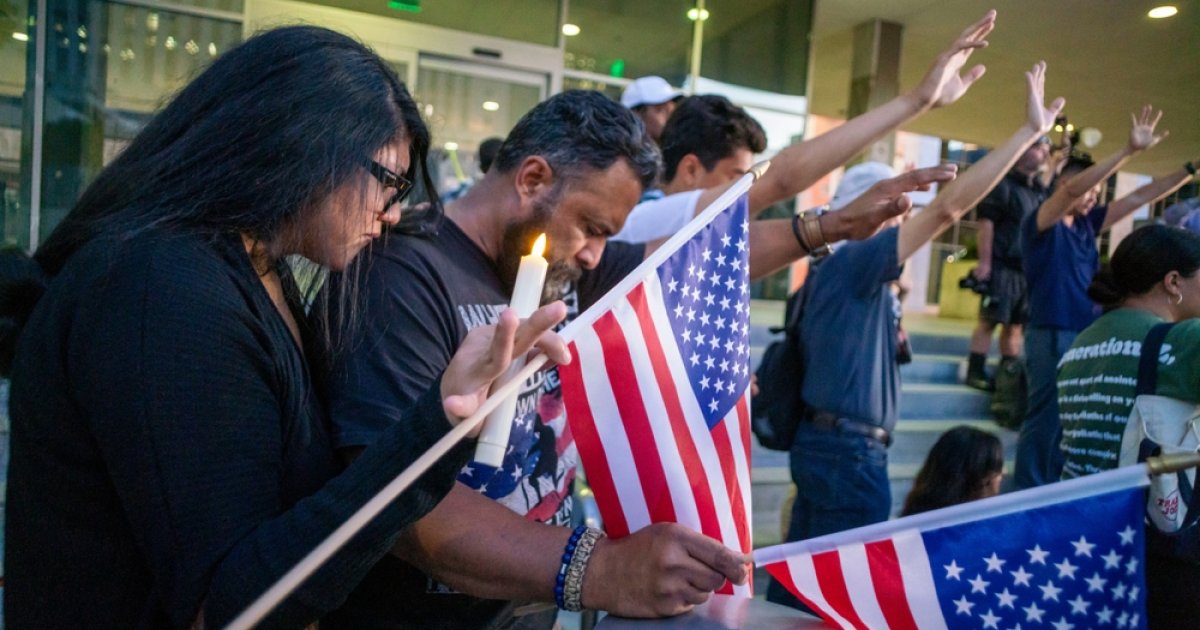
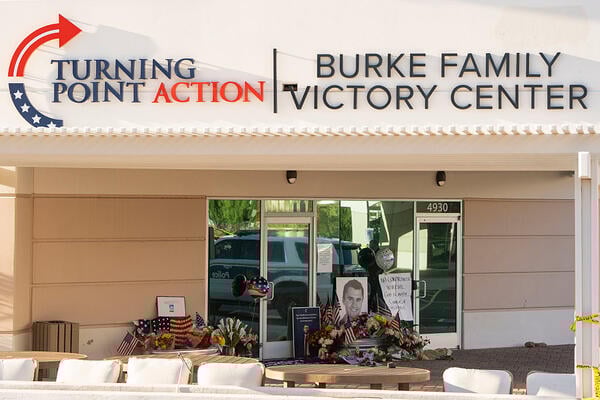
Vigils to remember Kirk have popped up at college campuses and at the Turning Point USA headquarters in Arizona.
Rebecca Noble/Getty Images
Binder, co-author of Becoming Right: How Campuses Shape Young Conservatives and The Channels of Student Activism, said Kirk’s Turning Point group attracted students who initially weren’t sure they were Republicans and weren’t attracted to the College Republicans chapters that traditionally mobilized students.
“Their complaint about College Republicans was that it was too establishment, it was kind of fusty, stale, too focused on getting people elected,” Binder said of these students. She said Turning Point told them that “you are part of a liberal, left campus and you are mistreated here and you need to come out of the closet and declare that you’re conservative in a big, broad way—and we’ll help you do that with really splashy events and really splashy speakers.”
“All of the incentive structure there was to go big, go confrontational,” she said. Kirk exemplified that in his sparring matches with left-leaning students on campuses.
Binder said, “Kirk was really excellent at cross-branding,” frequently appearing on Fox News, recording videos for the conservative education video website PragerU and more.
“Over time, Kirk was really involved with the Trump family, and with MAGA under Trump,” Binder said. “And he really became an ambassador for that—not only to young people, but to others as well … He was really crossing over into other age brackets and he just kind of became a face—or the face—of energized, youthful conservatism.”
Turning Point sought to elect conservatives to student governments by providing funding. It broadcast online the names of faculty it considered too left-leaning or intolerant of conservative views and marshaled voters for Trump during his re-election campaigns.
“He became the face of young Republicans and probably helped Trump win Arizona, maybe Wisconsin, maybe Michigan, with his get-out-the-vote” in 2024, Binder said. She said he “might have been predicted to have a political career in the future. He’s charismatic, he’s good-looking, he has a perfect family, he’s obviously had success.”
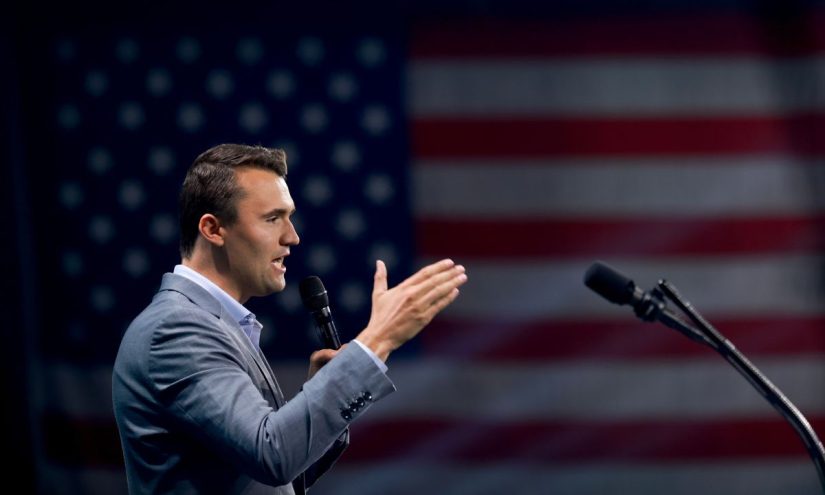
Charlie Kirk was speaking at Utah Valley University on Sept. 10 to kick off his American Comeback Tour when he was shot and killed.
Trent Nelson/The Salt Lake Tribune/Getty Images
But now, Kirk is dead. While Binder said there will continue to be a “very robust right ecosystem of organizations that seek mobilized students on campus,” it’s unclear what Turning Point’s future will be.
“Is there a power vacuum, is there a succession plan, what does that look like? I certainly don’t know,” she said. Turning Point didn’t respond to Inside Higher Ed’s request for an interview Thursday.
As for how his death could impact campus free expression, Binder said, “It’s really, really horrible on just all of the fronts, and in the wrong hands, something like this could shut down speech.”
Rank, from FIRE, said that while the shooter’s motive is unknown, the effect that violence can have on free expression isn’t. She said it can not only create a chilling effect within people, but it also can cause higher ed institutions to clamp down on speech to prevent violence.
“If an administration comes in and prevents controversial speaking engagements, then you’re creating a situation where the violence wins and that just causes free speech to deteriorate even further,” Rank said. She said that would not only be wrong, but “it would be a strange way to honor his legacy.”
Charlie Kirk was shot and killed at Utah Valley University today. The killer was not immediately caught. The Higher Education Inquirer has been covering Kirk and his organization, Turning Point USA, since 2016. Kirk has been a polarizing force in the United States, particularly on US college campuses. HEI hopes this event will not lead to further violence. Since its inception, we have urged for peace and nonviolence.
Charlie Kirk was shot during an event at Utah Valley University today. Details of the incident are still unfolding.
Political violence is never an acceptable response to speech. Free speech allows us to settle our differences peacefully and is essential to a free and democratic society.
Our thoughts are with Charlie Kirk and his family.