Tag: Child Care

  • Homeless kids get special treatment at Boston-area child care center

    Homeless kids get special treatment at Boston-area child care center

    by Jackie Mader, The Hechinger Report
    January 21, 2026

    To an untrained eye, the “gross motor room” at the Edgerley Family Horizons Center in Boston looks like any other indoor gym for preschoolers. There are mats on the floor, large foam blocks, shapes and stairs to play with and climb on, fabric swings hanging from the ceiling and sensory boards attached to the walls, covered with various materials that provide touch-based activities. 

    But this room was thoughtfully designed to be much more than a play space: It includes features meant to support emotional development and provide a calming place for children experiencing big feelings. For example, the cocoon swings provide a “hug” feeling that helps children relax. The blue lights above promote a sense of peace. And the soft foam tunnel gives children a place to hide when they need a break. The teachers are also specifically trained to foster feelings of safety and trust, and to reduce child stress. 

    At Edgerley, which is run by the nonprofit Horizons for Homeless Children and serves more than 250 children ages 2 months to 5 years old, there’s a need for this resource. All the children who are enrolled have experienced or are experiencing homelessness, which for kids, can lead to difficulty regulating emotions, ongoing health issues and developmental delays.

    Over the past few years, infant and toddler homelessness has increased in nearly every state. Nearly half a million of the country’s youngest children are living in shelters, in overcrowded homes with other families, or sleeping in temporary spaces, like cars or hotels. At the same time, fewer of these children are enrolled in early learning programs like the one at Edgerley. Such programs, with their enriching environments and stable teachers, can help buffer the effects of homelessness on young children and their growing brains. I recently traveled to Boston to learn more about the early learning program run by Horizons. My story, which also looks at what other cities and states are doing to help these families, was published last weekend with The Boston Globe. 

    This story about homeless kids was produced by The Hechinger Report, a nonprofit, independent news organization focused on inequality and innovation in education. Sign up for the Hechinger newsletter.

    This <a target=”_blank” href=”https://hechingerreport.org/homeless-kids-get-special-treatment-at-boston-area-child-care-center/”>article</a> first appeared on <a target=”_blank” href=”https://hechingerreport.org”>The Hechinger Report</a> and is republished here under a <a target=”_blank” href=”https://creativecommons.org/licenses/by-nc-nd/4.0/”>Creative Commons Attribution-NonCommercial-NoDerivatives 4.0 International License</a>.<img src=”https://i0.wp.com/hechingerreport.org/wp-content/uploads/2018/06/cropped-favicon.jpg?fit=150%2C150&amp;ssl=1″ style=”width:1em;height:1em;margin-left:10px;”>

    <img id=”republication-tracker-tool-source” src=”https://hechingerreport.org/?republication-pixel=true&post=114434&amp;ga4=G-03KPHXDF3H” style=”width:1px;height:1px;”><script> PARSELY = { autotrack: false, onload: function() { PARSELY.beacon.trackPageView({ url: “https://hechingerreport.org/homeless-kids-get-special-treatment-at-boston-area-child-care-center/”, urlref: window.location.href }); } } </script> <script id=”parsely-cfg” src=”//cdn.parsely.com/keys/hechingerreport.org/p.js”></script>


    Source link

  • Infants and toddlers are a growing group among homeless children

    Infants and toddlers are a growing group among homeless children

    by Jackie Mader, The Hechinger Report
    January 17, 2026

    BOSTON, Mass. — For months, Karian had tried to make it on her own in New York.

    After the birth of her second daughter, she was diagnosed with postpartum depression, major depressive disorder and anxiety. A single mother who had moved from Boston to New York about 13 years ago, she often spent days at a time on the couch, unable to do more than handle the basics for her daughters.

    “I wasn’t taking care of myself,” she said softly on a recent afternoon. “I was not really present.” The Hechinger Report is not publishing her last name to protect her privacy.

    Karian’s mother urged her to move back home to the Boston area and offered to house her and her daughters temporarily. She started working the night shift at a fast food restaurant to save up for her own place while her mother and sister watched her children. 

    But in a city where fast food wages aren’t enough to pay the rent, her efforts felt futile. And then, a month after moving in with her family, her mother’s landlord told her the apartment was overcrowded and she had to leave. Karian and her girls, then 7 years old and 8 months old, moved into a homeless shelter, where her depression and anxiety worsened. 

    “I tried my best, but it’s not their home,” said Karian, now 31.

    Karian’s children had joined the growing ranks of very young children experiencing homelessness. Between 2021 and 2023, the number of homeless infants and toddlers increased in 48 states and the District of Columbia. The most recent estimates found that in 2023 nearly 450,000 infants and toddlers in the United States were in families that lacked a stable place to live. That was a 23 percent increase compared to 2021, according to a report released last year by the nonprofit SchoolHouse Connection in partnership with Poverty Solutions at the University of Michigan.  

    The numbers could be even higher, experts worry, because “hidden homeless” children — those who are doubled up in homes with family or friends or living in a hotel — may not be captured in tallies until they start school.

    High prices for diapers and formula, the exorbitant cost of child care, the rising cost of living, and rising maternal mental health challenges all contribute to the growing rate of homelessness among very young children, experts say. In 2024, one-third of infants and toddlers were in families that struggled to make ends meet, according to the nonprofit infant and toddler advocacy organization Zero to Three. 

    “We’re talking about families who have generationally been disadvantaged by circumstance,” said Kate Barrand, president and CEO of Horizons for Homeless Children, a nonprofit that supports homeless families with young children in Massachusetts. “The cost of housing has escalated dramatically. The cost of any kind of program to put a child in, should you have a job, is escalating,” she added. “There are a lot of things that make it really hard for families.”

    Related: Young children have unique needs and providing the right care can be a challenge. Our free early childhood education newsletter tracks the issues.

    Housing instability is dire for anyone, but particularly for young children, whose brains are rapidly growing and developing. Studies show that young children who are homeless often lag behind their peers in language development and literacy and struggle to learn self-regulation skills, like being able to calm themselves when feeling angry or sad or transition calmly to new activities. They also may experience long-term health and learning challenges.

    Early childhood programs could provide a critical source of stability and developmental support for these children. But SchoolHouse Connection found only a fraction of homeless children are enrolled in early learning programs, and the percentage who are has decreased over the past few years.

    “It’s not just incredibly tragic and sad that infants and toddlers are experiencing homelessness,” said Rahil Briggs, national director of the nonprofit Zero to Three’s HealthySteps program, which works with pediatricians to support the health of babies and toddlers. The first few years are also a “disproportionately important” time in a child’s life, she added, because of the brain development that’s happening.

    Karian and her daughters faced new difficulties after they moved into a shelter.

    They shared an apartment with another family. If the other family was using the shared common space, Karian tried to give them privacy, which meant keeping her children in the bedroom the three of them shared.

    Her older daughter had to change schools, and left without getting to say goodbye to many of her friends. At her new school, her grades dropped. The baby developed a skin condition and there was a bedbug infestation at the shelter. Karian didn’t want to put her on the floor for tummy time. She was desperate to find a home.

    “We were in a place where we couldn’t really make noise. I couldn’t really let them be kids,” she said.

    The rise in housing insecurity among young children has created more demand for programs created specifically to meet the unique needs of children who are experiencing instability and trauma. Many of these programs offer support to parents as well, through what is called a “two-generation” approach to support and services.

    Related: A school created a homeless shelter in the gym and it paid off in the classroom

    In 2021, in response to ballooning child homelessness rates, Horizons opened the Edgerley Family Horizons Center, an early learning program that serves children from 2 months to 5 years old. While some families find Horizons on their own, many are referred by shelters around the Boston area. The need is great: Edgerley serves more than 250 children, with a waitlist of 200 more. Karian’s younger child was one of those who got a spot soon after the program opened.

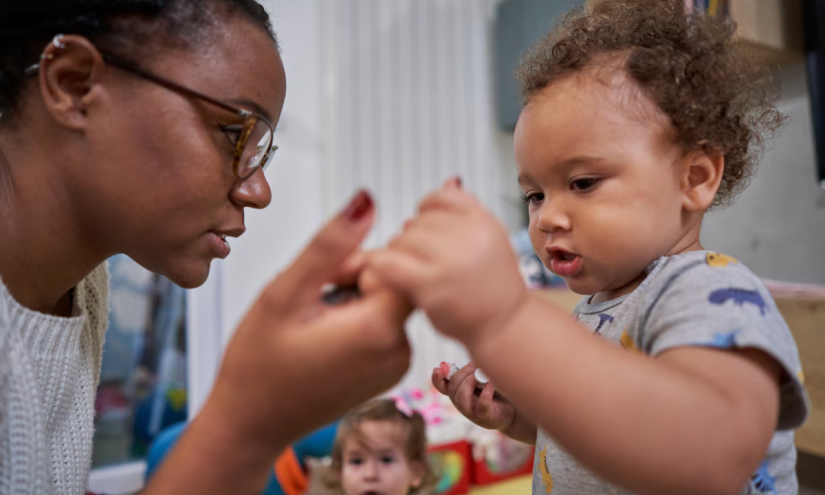
    Inside Horizons’ large, light-filled building on the corner of a busy street in Boston’s Roxbury neighborhood, every detail is tailored to the needs of children who have experienced instability. Walls are painted in soothing blues and greens. Each classroom has three teachers to maintain a low child-to-staff ratio. Many of the teachers are bilingual. All educators are trained in how to build relationships with families and gently support children who have experienced trauma. 

    The starting salary for teachers is $54,200 a year, far more than the national median for childcare workers of $32,050 and the Massachusetts median of about $39,000. That has encouraged more teachers to stay on at the center and provide a sense of security to the children there, said Horizons CEO Barrand.

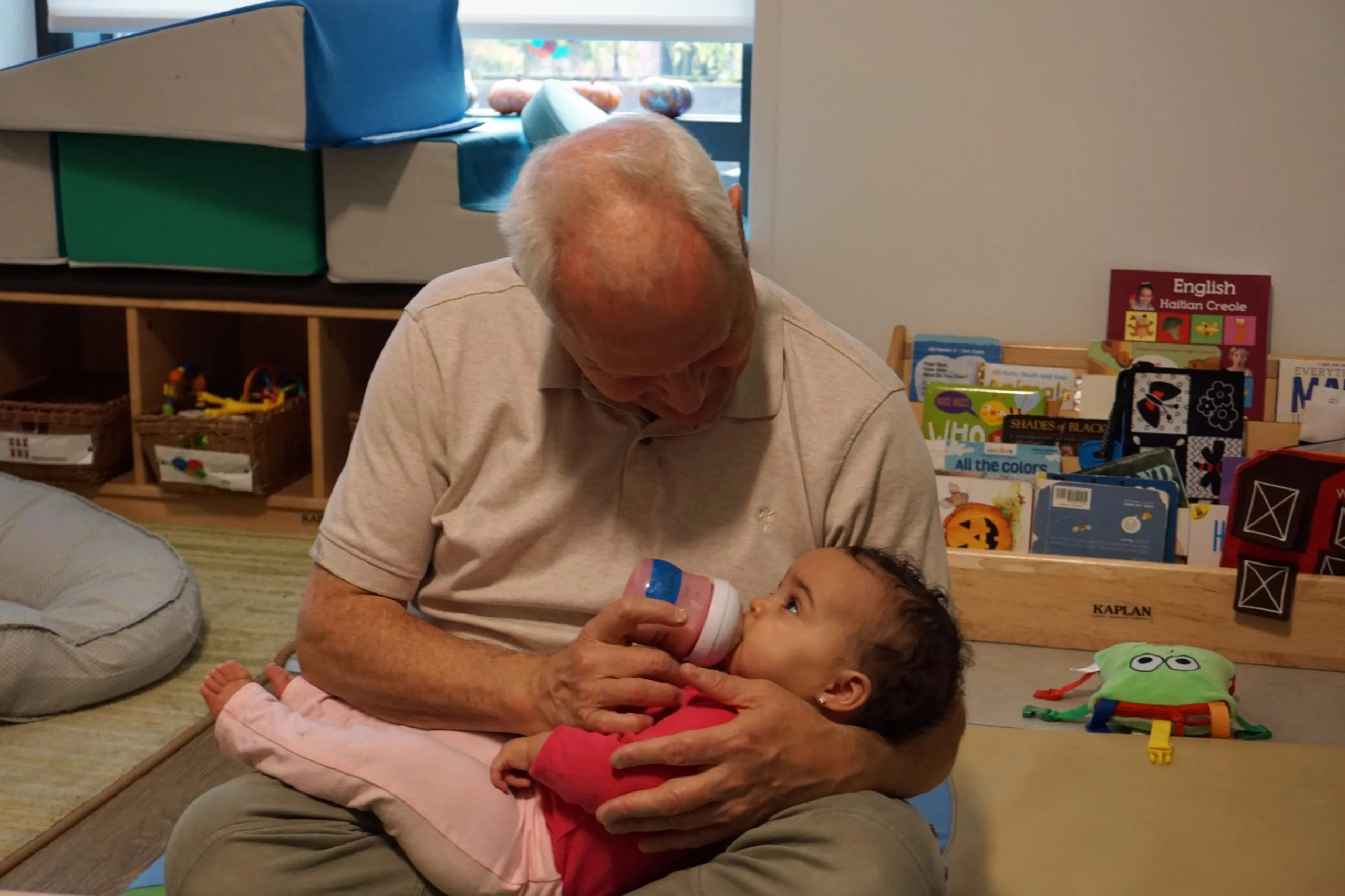
    In the infant room, teacher Herb Hickey, who has worked at Horizons for 13 years, frequently sees infants who are hyperaware, struggle to fall asleep, can’t be soothed easily or cling desperately to whichever adult they attach to first. The goal for the infant teachers, he said, is to be a trusted, responsive adult who can be relied on.

    Every day, the teachers in the infant room sing the same songs to the babies. “When they hear our voices constantly, they know they’re in a safe space,” Hickey said. “This is calm.” 

    Teachers also follow the same familiar routines. The rooms are decorated simply, organized and filled with natural light. Teachers constantly scan the infants for signs of distress.

    “We have to be even more responsive,” Hickey said. “When the child starts crying, we don’t have the convenience to say, ‘I know you’re hungry, I’ll get to you.’” He said teachers want even the tiniest babies to learn that “we’re not going to leave you crying.’”

    Related: A federal definition of ‘homeless’ leaves some kids out in the cold. One state is trying to help

    Other needs arise with Horizons’ youngest children: Infants and toddlers living in homeless shelters often lag in gross motor skills. Many spend time on beds rather than on playmats on the floor, or they are kept in car seats or in strollers to keep them safe or from wandering off. That means they’re missing out on all the skills that come from active movement.  

    Even the arrangement of toys at the center has a purpose. Staff want children to know they can depend on toys being in the same location every day. For many children, those are some of the only items they can play with. Families entering a shelter environment can usually only bring a few bags, with no room for toys or books. A toddler who recently entered a shelter where Horizons runs a playroom came in holding a small empty chip bag, recalled Tara Spalding, Horizons’ chief of advancement and playspace. When a shelter staff member threw it away, the boy was inconsolable. “This is the only toy my child has,” staff recalled the mother saying.

    “This just shows the sheer poverty,” said Spalding. 

    As infant and toddler homelessness has increased, other cities and states have tried to provide more support to affected families and get a better sense of their needs. In Oklahoma, experts say, low wages, a lack of housing and eviction laws that favor landlords have led to rising homelessness rates. State officials are trying to gather better data about homeless families to determine the best use of resources, said Susan Agel, chair of Oklahoma’s Homeless Children and Youth Steering Committee. Their efforts are hampered, however, by the fact that many homeless families fear that their children will be taken away by child protective services because they are homeless. 

    In 2024, to fill that gap in data, the state launched a residency questionnaire given to every K-12 student that includes new questions about homelessness, including if there are younger children in the home who are not students and may not otherwise be counted in homeless populations. Officials say it isn’t a perfect solution, but it’s a start to get a sense of the severity of family homelessness. “We can’t devise a system for dealing with a problem if we don’t know what the problem is,” said Agel.

    In Sioux Falls, South Dakota, city officials have ramped up efforts to coordinate city agencies to respond to an increase in homelessness among infants and toddlers.

    “In general, the families we see more often have younger children. The school offers so much support, and there’s limited daycare access” to get similar support for infants and toddlers, said Tommy Fuston, Community Services and Housing Navigator at Minnehaha County’s Department of Human Services. “If a family has younger children, they’re going to struggle more.” 

    Each week, officials from the city, the Sioux Falls School District, local early childhood programs and shelters hold a “care meeting” to make sure any homeless families, or families at risk of homelessness, are quickly connected to the right resources and receive follow-up. “We don’t have unlimited resources, but I think it maximizes the resources that we do have,” Fuston said. “We’ve tried to create a village of supportive services to wrap around these folks.” The city relies extensively on private and faith-based donations to help. All shelters in town are privately funded, for example. 

    Related: Shelter offers rare support for homeless families: a child care center

    Karian heard about the child care center run by Horizons from a social worker soon after she and her daughters moved into their Boston-area shelter. In the infant room, her youngest daughter quickly settled into a routine, something Karian said didn’t happen when the baby was watched at night by family members. When staff identified speech and developmental delays, they helped connect Karian to an early intervention program where her daughter could receive therapy. Now 4 years old and in pre-K at Horizons, “she’s thriving,” Karian said. “She’s getting that nourishment.” 

    Karian also received support. Each family at Horizons is assigned a coach to help parents set personal goals and connect with resources. The organization offers classes in computing, financial management and English, all within the early learning building.

    Two months after setting goals with a family coach, Karian earned her GED, with the help of  the child care assistance. A few months later, she graduated from a culinary training program. She now works a steady job as a cafeteria manager for a local school district, where she earns a salary with benefits. 

    After a year in the shelter, her family was approved for subsidized housing and moved into their own apartment. Horizons allows families to stay in its programs for at least two years after they secure housing to make sure they are stable. 

    Now, Karian has her sights set on eventually opening a restaurant. She also has big dreams for her daughters, something that once seemed out of reach. She wants them to have ambition to “work towards something big,” she said. “I want them to have a dream and be able to achieve it.” 

    Experts say there are larger policy changes that could help families like Karian’s: increasing the minimum wage, expanding child care options like Head Start, which saves a portion of seats for homeless children, and offering more affordable housing to low-income families, to start.

    Providing more federal money to the programs that help poor families pay for child care could also help. Those programs require states to prioritize homeless children and give them the first opportunity to access that money. 

    While important, experts argue, these solutions shouldn’t need to exist in the first place.

    “We should be able to come to an agreement as a society that we should prioritize keeping families with infants and toddlers in their homes,” said Melissa Boteach, chief policy officer at Zero to Three. “Babies shouldn’t be homeless.”

    Contact staff writer Jackie Mader at 212-678-3562 or [email protected].

    This story about homeless children was produced by The Hechinger Report, a nonprofit, independent news organization focused on inequality and innovation in education. Sign up for the Hechinger newsletter

    This <a target=”_blank” href=”https://hechingerreport.org/homelessness-is-rising-fast-among-a-surprising-group-infants-and-toddlers/”>article</a> first appeared on <a target=”_blank” href=”https://hechingerreport.org”>The Hechinger Report</a> and is republished here under a <a target=”_blank” href=”https://creativecommons.org/licenses/by-nc-nd/4.0/”>Creative Commons Attribution-NonCommercial-NoDerivatives 4.0 International License</a>.<img src=”https://i0.wp.com/hechingerreport.org/wp-content/uploads/2018/06/cropped-favicon.jpg?fit=150%2C150&amp;ssl=1″ style=”width:1em;height:1em;margin-left:10px;”>

    <img id=”republication-tracker-tool-source” src=”https://hechingerreport.org/?republication-pixel=true&post=114264&amp;ga4=G-03KPHXDF3H” style=”width:1px;height:1px;”><script> PARSELY = { autotrack: false, onload: function() { PARSELY.beacon.trackPageView({ url: “https://hechingerreport.org/homelessness-is-rising-fast-among-a-surprising-group-infants-and-toddlers/”, urlref: window.location.href }); } } </script> <script id=”parsely-cfg” src=”//cdn.parsely.com/keys/hechingerreport.org/p.js”></script>
    Source link

  • Trump Administration Plans to Freeze Billions in Childcare Funding to California – The 74

    Trump Administration Plans to Freeze Billions in Childcare Funding to California – The 74


    Get stories like this delivered straight to your inbox. Sign up for The 74 Newsletter

    The Trump administration says it’s planning to freeze about $10 billion in federal support for needy families in California and four other Democrat-run states, as the president announced an investigation into unspecified fraud in California.

    The plans come on the heels of the Trump administration announcing a freeze on all federal payments for child care in Minnesota, citing fraud allegations against daycare centers in the state.

    The state’s Democrat governor, Tim Walz — who ran for vice president against Donald Trump’s ticket in 2024 — announced Monday he was dropping out of running for reelection. He pointed to fraud against the state, saying it’s a real issue while alleging Trump and his allies were “seeking to take advantage of the crisis.”

    On Monday, the New York Post reported that the administration was expanding the funding freeze to include California and three other Democrat-led states, in addition to Minnesota. Unnamed federal officials cited “concerns that the benefits were fraudulently funneled to non-citizens,” The Post reported.

    Early Tuesday, President Trump alleged that corruption in California is worse than Minnesota and announced an investigation.

    “California, under Governor Gavin Newscum, is more corrupt than Minnesota, if that’s possible??? The Fraud Investigation of California has begun. Thank you for your attention to this matter! PRESIDENT DONALD J. TRUMP,” the president wrote on his social media platform Truth Social.

    He did not specify what alleged fraud was being examined in the Golden State.

    LAist has reached out to the White House to ask what the president’s fraud concerns are in California and to request an interview with the president.

    “For too long, Democrat-led states and governors have been complicit in allowing massive amounts of fraud to occur under their watch,” said an emailed statement from Andrew Nixon, a spokesperson for U.S. Department of Health and Human Services, which administers the federal childcare funds.

    “Under the Trump administration, we are ensuring that federal taxpayer dollars are being used for legitimate purposes. We will ensure these states are following the law and protecting hard-earned taxpayer money.”

    Gov. Gavin Newsom’s press office disputed Trump’s claim on social media, arguing that since taking office, the governor has blocked $125 billion in fraud and arrested “criminal parasites leaching off of taxpayers.”

    Criminal fraud cases in CA appear to be rare for this program

    Defrauding federally funded programs is a crime — and one LAist has investigated, leading to one of the largest such criminal cases in recent years against a California elected official, which surrounded meal funds.

    When it comes to the federal childcare funds that are being frozen, the dollar amount of fraud alleged in criminal cases appears to be a tiny fraction of the overall program’s spending in California.

    A search of thousands of news releases by all four federal prosecutor offices in California, going back more than a decade, found a total of one criminal case where the press releases referenced childcare benefits.

    That case, brought in 2023, alleged four men stole $3.7 million in federal childcare benefits through fraudulent requests to a San Diego organization that distributed the funds. All four pleaded guilty, with one defendant sentenced to 27 months in prison and others sentenced to other terms, according to authorities.

    It appears to be equivalent to one one-hundredth of 1% of all the childcare funding California has received over the past decade-plus covered by the prosecution press release search.

    Potential impact on California families

    The plans call for California, Minnesota, New York, Illinois and Colorado to lose about $7 billion in cash assistance for households with children, almost $2.4 billion to care for children of working parents, and about $870 million for social services grants that mostly benefit children at risk, according to unnamed federal officials speaking to the New York Times and New York Post.

    In the largest category of funding, California receives $3.7 billion per year. The program is known as Temporary Assistance for Needy Families, or TANF.

     ”It’s very clear that a freeze of those funds would be very damaging to the children, families, and providers of California,” said Stacy Lee, who oversees early childhood initiatives “at Children Now, an advocacy group for children in California.

     ”It is a significant portion of our funds and will impact families and children and providers across the whole state,” she added. “It would be devastating, in no uncertain terms.”

    About 270,000 people are served by the TANF program in L.A. County — about 200,000 of whom are children, according to the county Department of Public Social Services.

    “Any pause in funding for their cash benefits – which average $1000/month – would be devastating to these families,” said DPSS chief of staff Nick Ippolito.

    Ippolito said the department has a robust fraud prevention and 170-person investigations team, and takes allegations “very seriously.”

    It remains to be seen whether the funding freeze will end up in court. The state, as well as major cities and counties in California, has sued to ask judges to halt funding freezes or new requirements placed by the Trump administration. L.A. city officials say they’ve had success with that, including shielding more than $600 million in federal grant funding to the city last year.

    A union representing California childcare workers said the funding freeze would harm low-income families.

    “These threats need to be called out for what they are: direct threats on working families of all backgrounds who rely on access to quality, affordable child care in their communities to go to work every day supporting, and growing our economy,” said Max Arias, chairperson for the Child Care Providers United, which says it represents more than 70,000 child care workers across the state who care for kids in their homes.

    “Funding freezes, even when intended to be temporary, will be devastating — resulting in families losing access to care and working parents facing the devastating choice of keeping their children safe or paying their bills.”

    Federal officials planned to send letters to the affected states Monday about the planned funding pauses, the New York Post reported. As of 3 p.m. Tuesday, state officials said they haven’t gotten any official notification of the funding freeze plans.

    “The California Department of Social Services administers child care programs that help working families afford safe, reliable care for their children — so parents can go to work, support their families, and contribute to their communities,” said a statement from California Department of Social Services spokesperson Jason Montiel.

    “These funds are critical for working families across California. We take fraud seriously, and CDSS has received no information from the federal government indicating any freeze, pause, or suspension of federal child care funding.”

    This story was originally published on LAist.


    Did you use this article in your work?

    We’d love to hear how The 74’s reporting is helping educators, researchers, and policymakers. Tell us how

    Source link

  • Proposed Changes to Provider Pay Could Lead to Child Care Rate Hikes, Closures – The 74

    Proposed Changes to Provider Pay Could Lead to Child Care Rate Hikes, Closures – The 74


    Join our zero2eight Substack community for more discussion about the latest news in early care and education. Sign up now.

    For months now, Shannon Hampson has had August 1 etched in her mind. 

    That day marks an important shift for her and other early care and education providers in Nebraska who serve low-income families. On that date, the state intended to begin paying providers a consistent rate for families who use government subsidies to pay for child care. 

    Instead of reimbursing providers based on children’s attendance — which can vary wildly, especially this time of year, based on factors like illness and family travel — Nebraska would pay providers the same amount each month based on enrollment. 

    Last year, because of the change expected to come in summer 2026, Hampson, who owns a home-based child care program in Lincoln, Nebraska, felt comfortable filling more of her program slots with children whose families pay with subsidies. Today, she does not have one private-paying family. She made the shift assuming the enrollment-based pay would insulate her from the instability that often accompanies subsidy slots. 

    “I was super excited to know more of these families were going to get that quality, consistent care,” Hampson said, adding that reaching more low-income families is important in the field. “It’s not that providers don’t want to.”

    Now, though, that could all be about to change. 

    Nebraska’s transition to enrollment-based pay was part of an effort to get in compliance with a rule established by the Biden administration in 2024. Enrollment-based payments, that administration believed, would create greater predictability for providers, allowing them to serve more low-income families who need child care and, eventually, could entice more providers to participate in the subsidy program. 

    The rule was one of a handful of changes made by the prior administration related to the Child Care and Development Fund (CCDF), the primary federal program that states use to provide financial assistance to low-income families in need of child care. Other shifts include paying providers up front for child care, rather than reimbursing them the following month, and encouraging the use of grants and contracts with providers. State timelines for implementing these changes have varied. As of September 2025, 24 states were paying based on enrollment, according to an analysis by New America. For the others, the latest deadline granted was Aug. 1, 2026. 

    Just this week, however, the U.S. Department of Health and Human Services, through the Administration for Children and Families (ACF), announced that it would seek to rescind many of the 2024 rules, returning these issues to states. 

    The proposed changes cannot be enforced right away. Under federal law, the agency is required to take public comments, review them, and use that input to make final decisions, noted Alex Adams, who leads ACF. He declined to give a timeline for any changes to take effect.

    If approved, the changes would not “make any net new policy decisions,” he added. “It simply goes back to where we were prior to 2024 regulations.”

    The administration wants to rescind the 2024 rules, he said, because all 50 states had requested waivers related to some or all of these rules due to budget constraints and other implementation challenges. 

    “Any time 50 states are asking for a waiver from something,” Adams said, “it suggests to me that maybe the rule isn’t working as intended.”

    He also noted that “attendance-verified payment,” rather than enrollment-based, “is more of a deterrent to fraud.” Leaders in the Trump administration are concerned about programs with “phantom attendance” — suggesting they receive government payments but don’t actually serve the children they say they do — Adams said, but he declined to share specifics of ongoing investigations. 

    Many early care and education advocates and policy experts have expressed skepticism that rampant fraud and abuse is going unchecked. 

    Casey Peeks, senior director of early childhood policy at the Center for American Progress, a left-leaning think tank, called the allegations “unfounded” and worried that they would undo real progress made in the field in recent years. 

    “It is very unhelpful and destabilizing to the sector, in the immediate- and long-term, to take some of these most foundational levers we have to stabilize the sector and claim that they result in fraud,” Peeks said.

    Upon hearing the news this week, Hampson said she’s had to remind herself to “just breathe.” She knew she was taking a risk by enrolling 100% of families on subsidies.

    Now, she said, she will have to rearrange her budget to continue to serve all of those families. Under an attendance-based pay structure, her income is just that much more volatile.

    In December, for example, between holidays, vacation time and children’s absences, Hampson was only able to bill the state for 18 child care days. If the children in her program were from private-paying families, she would have been paid for 23 days, she said. 

    But Hampson’s operational costs didn’t see a material decrease in December. 

    “Without a provider being at fault at all, they could be at 50% attendance one day just because the flu is going around. That shouldn’t harm their bottom line,” Peeks said. 

    “It’s really unpredictable and unfair for the provider,” she added. “Just because attendance is down doesn’t mean operation costs go down.”

    In West Virginia, where providers have been paid based on enrollment since 2020, Katelyn Vandal emphasized how critical the change has been to keeping her rural, center-based program open. 

    “Our mortgage payment doesn’t cost less because two kids in the classroom have the flu,” noted Vandal, director of A Place to Grow, a child care center in Oak Hill, West Virginia. Nor does her electricity bill and a host of other overhead costs. 

    If her state returns to attendance-based pay, she’s not sure A Place to Grow would be able to continue operating. The center serves about 100 kids, with 60% from families that pay with subsidies. 

    “We run such a fine budget line anyway that if, six months from now, we were going back to attendance, we would be looking at closing,” she said. “We would not survive transitioning back to that.”

    Sheryl Hutzenbiler, owner of Munchkin Land Daycare in Billings, Montana, said she suspects that, under attendance-based pay, providers will either raise tuition rates on families — many of whom are already paying the maximum they can afford without one parent leaving the workforce — or, like Vandal, be forced to close their doors. 

    But that is not a decision Hutzenbiler will have to face, should the Trump administration successfully restore attendance-based pay. Since she lives in Montana, where enrollment-based pay became law in 2023, she and other providers in the state are protected from policy fluctuations at the federal level. 

    That’s true for a handful of states, which have either passed laws protecting enrollment-based pay or have continued paying based on enrollment, on a temporary basis, since the pandemic. (West Virginia is in the latter category.)

    Enrollment-based pay has been pivotal for Hutzenbiler, whose home-based program consists of about 60% of families who pay with subsidies. Back when she was paid based on attendance, she said her first sacrifice during low-attendance months would be her own wages. She would pay her full-time teacher first and make sure program costs were covered, often leaving nothing for herself and relying on her husband’s income instead. With the consistent subsidy income each month, though, she’s not only been able to avoid missed paychecks for herself, she’s been able to add two part-time workers to the payroll. 

    Hampson, in Nebraska, said she was part of a group last year advocating for the state to pass legislation around enrollment-based pay. It was ultimately unsuccessful.

    “We wanted to know our state had already said yes, so we wouldn’t go backwards,” she said. “And here we are going backwards.”

    In an industry where profit margins are estimated at less than 1%, these changes will inevitably leave providers who participate in the subsidy program with less revenue to survive on. The shifts will likely also deter providers who participate in the subsidy program, or who might have considered participating, from doing so in the future, said Peeks. This will likely, in effect, leave low-income families with fewer choices about where to go for child care. 

    “When you’re stabilizing providers overall, you’re often creating more options for families overall,” said Peeks. “I think it could definitely have a chilling effect.”


    Did you use this article in your work?

    We’d love to hear how The 74’s reporting is helping educators, researchers, and policymakers. Tell us how

    Source link

  • Child Care Aid Could Run Out by Jan. 31 Due to Trump Funding Freeze, Colorado Officials Say – The 74

    Child Care Aid Could Run Out by Jan. 31 Due to Trump Funding Freeze, Colorado Officials Say – The 74


    Get stories like this delivered straight to your inbox. Sign up for The 74 Newsletter

    Colorado officials say money that helps 18,000 low-income families pay for child care could run out by Jan. 31 if federal officials don’t lift the freeze they’ve imposed on funding for several safety net programs in five Democrat-led states.

    If that happens, some children could go without care and some parents would have to stay home from work. State lawmakers could cover such a funding gap temporarily, though Colorado is facing a significant budget crunch.

    The Trump administration announced the freeze on $10 billion in child care and social services funding for Colorado, California, Illinois, Minnesota, and New York in a press release Monday.

    In letters sent to the two Colorado agencies that run the affected programs, federal officials said they have “reason to believe that the State of Colorado is illicitly providing” benefits funded with federal dollars to “illegal aliens.”

    The letters didn’t cite evidence for that claim and a spokesperson for the U.S. Department of Health and Human Services didn’t respond to questions from Chalkbeat about why federal officials are concerned about fraud in Colorado.

    Spokespeople from both state departments said by email on Tuesday they’re not aware of any federal fraud investigations focused on the programs affected by the funding freeze.

    The five-state funding freeze follows a federal crackdown in Minnesota after a right-wing YouTuber posted a video in late December alleging that Minneapolis child care centers run by Somali residents get federal funds but serve no children. It’s not clear why the other four states have gotten the same treatment as Minnesota, but all have Democratic governors who have clashed with President Donald Trump.

    In a New Year’s Eve social media post, Trump called Colorado Gov. Jared Polis “the Scumbag Governor” and said Polis and another Colorado official should “rot in hell” for mistreating Tina Peters, a Trump supporter and former Mesa County clerk who’s serving a nine-year prison sentence for orchestrating a plot to breach election systems.

    The federal freeze will affect three main funding streams in Colorado that together bring in about $317 million a year. They include $138 million for the Colorado Department of Early Childhood for child care subsidies for low-income families and a few other programs.

    The subsidy program, known as the Colorado Child Care Assistance program, helps cover the cost of care for more than 27,000 children so parents can work or take classes. It’s mostly funded by the federal government with smaller contributions from states and counties.

    The other two frozen funding streams go to the Colorado Department of Human Services and pay for Temporary Assistance for Needy Families, or TANF, and other programs.

    In the letter to the Colorado Department of Early Childhood, federal officials outlined new fiscal requirements the state will have to follow before the funding freeze is lifted. They include attendance documentation — without names or other personal identifiers — for children in the child care subsidy program.

    A state fact sheet issued in response to the funding freeze said funding for the child care subsidy program would be depleted by Jan. 31. It also outlined several measures already in place to prevent fraud or waste, including state audits, monthly case reviews by county officials, and efforts to recover funds if improper payments are made.

    The state said it is exploring “all options, including legal avenues” to keep the frozen funding flowing.

    Six Democratic state lawmakers, most in leadership positions, released a statement Tuesday afternoon calling the funding freeze a callous move that will make life more expensive for working families.

    “We stand ready to work with Governor Polis and partners in our federal delegation to resist this lawless effort to freeze funding, and we sincerely hope that our Republican colleagues will put politics aside, get serious about making life in Colorado more affordable, and put families first,” the statement said in part.

    The statement was from Speaker of the House Julie McCluskie; Senate President James Coleman; House Majority Leader Monica Duran; Senate Majority Leader Robert Rodriguez; Rep. Emily Sirota; and Sen. Judy Amabile.

    Chalkbeat is a nonprofit news site covering educational change in public schools.


    Did you use this article in your work?

    We’d love to hear how The 74’s reporting is helping educators, researchers, and policymakers. Tell us how

    Source link

  • Early childhood educator apprenticeships offer an answer to child care shortages

    Early childhood educator apprenticeships offer an answer to child care shortages

    by Nirvi Shah, The Hechinger Report
    January 7, 2026

    About six years ago, an apprentice training to be a machinist in Washington state told her supervisor she would probably have to drop out of the training program after having her baby: She couldn’t find child care that accommodated her shift.

    It was one of the first challenges Shana Peschek was tasked with solving when she became executive director of the Machinists Institute, which trains workers for jobs in the aerospace, manufacturing and automotive industries all over the state. 

    Peschek knew it was essential to do something for workers with young children.

    “That worst shift, the new hires are going to get it. The new hires are generally younger people. They have little kids or they are going to want a little kid,” Peschek said.

    “It’s beyond the cost of child care,” she said. “If they can’t find anywhere, we’re going to lose them.” 

    As Peschek worked on a way to address the situation, she also wondered how she could include apprenticeship in the solution. The answer: incorporating early educator apprenticeships into a custom-built child care center tailored to the trade union’s needs. Last month, The Hechinger Report wrote about San Francisco’s child care apprenticeship program

    “Apprenticeship is my jam,” said Peschek, who emphasized that apprenticeship is a mode of education, not limited to any specific profession. While the word apprentice is often associated with roles like machinists, it is just the term for an educational path that includes paid, on-the-job training. Early educator apprenticeships do just that, providing classes and training alongside paid work experience to help hopeful teachers earn required credentials and get full-time jobs. “I want that pathway available for our teachers and assistant teachers,” she said.

    With a combination of institute money, grants and donations, the Machinists Institute bought land and is constructing Little Wings Early Learning Academy in Everett, Washington. Its name is inspired by the local economy, which is powered in part by a nearby Boeing factory. The center will serve workers in the trade union, who will be able to send their young children for care starting as early as 4 a.m. through as late as midnight. Care will also be available on weekends, to accommodate a range of shifts. It is scheduled to open this spring.

    Machinists, maritime industry workers and other local tradespeople and apprentices will pay a discounted rate for child care, which will also be available to area residents to enroll their kids. 

    Peschek’s hopes are high, for all of the apprentices the center will involve. 

    That’s in part because of the experience some early educator apprentices have had. Apprenticeships have been a part of the trades for centuries, but they are relatively novel in education. 

    The option changed the course of Carlota Hernández de Cruz’s life. For years, with only an elementary school education from when she grew up in Mexico, she was the primary caregiver for her three children while her husband was the breadwinner. When her youngest child was still in child care, at a California Head Start program run by an area YMCA, she began working a few hours a day as a parent intern at the center. 

    She eventually encountered Pamm Shaw, who created one of the first early educator apprenticeship programs in the country for the YMCA of the East Bay, in California’s Alameda County. Shaw encouraged Hernández de Cruz to take classes and work toward becoming an early childhood teacher. 

    “I’m originally from Mexico,” Hernández de Cruz said, remembering her apprehension. “I came with zero English.” But Shaw was convincing. 

    Hernández de Cruz took classes, one or two at a time, balancing them with motherhood and homekeeping duties. Then her husband got sick and could no longer work. It took years, but she completed the courses for her associate degree. Just a few months before graduation, her husband died. 

    Hernández de Cruz, now 53, knew that although what she had accomplished was monumental, it wasn’t enough. Thanks to her apprenticeship, however, her bachelor’s degree coursework was paid for, even though it was sometimes a struggle to keep up with the requirements of online courses and lectures in English, while solo parenting and working. 

    In 2019, Hernández de Cruz earned that bachelor’s degree but turned down a job running a child care center. She wasn’t ready. When she was approached again in 2021 about a director role, at the center where she was working, she agreed. There have been ups and downs: That center closed and she was back to teaching for a while. But now she runs the Vera Casey Center, a Head Start site for infants and toddlers in Berkeley that is part of the YMCA of the East Bay.

    “I feel I can say financially I’m stable,” Hernández de Cruz said, and she said she is proud of herself and her children. Her kids grew up watching their mother work and study hard and have had opportunities she didn’t when she was younger, even though she said they all faltered, and flunked a few classes, when their father died. Her younger daughter just graduated from a nursing program and her older daughter completed a bachelor’s degree in child development and is now pursuing a master’s degree. Both daughters live at home with her, as do her parents. (Her son, she said, is still taking classes and finding his way.) “I’m stable but he’s not here with us,” Hernández de Cruz said of her husband, but “being in the classroom with kids, it helped me to heal. That’s what I feel at work. I still feel happy every day.”

    Contact Executive Editor Nirvi Shah at 212-678-3445, on Signal at NirviShah.14 or [email protected]

    Reporting on this story was supported by the Higher Ed Media Fellowship.

    This story about child care apprenticeships was produced by The Hechinger Report, a nonprofit, independent news organization focused on inequality and innovation in education. Sign up for the Hechinger newsletter.

    This <a target=”_blank” href=”https://hechingerreport.org/early-childhood-educator-apprenticeships-offer-an-answer-to-child-care-shortages/”>article</a> first appeared on <a target=”_blank” href=”https://hechingerreport.org”>The Hechinger Report</a> and is republished here under a <a target=”_blank” href=”https://creativecommons.org/licenses/by-nc-nd/4.0/”>Creative Commons Attribution-NonCommercial-NoDerivatives 4.0 International License</a>.<img src=”https://i0.wp.com/hechingerreport.org/wp-content/uploads/2018/06/cropped-favicon.jpg?fit=150%2C150&amp;ssl=1″ style=”width:1em;height:1em;margin-left:10px;”>

    <img id=”republication-tracker-tool-source” src=”https://hechingerreport.org/?republication-pixel=true&post=114241&amp;ga4=G-03KPHXDF3H” style=”width:1px;height:1px;”><script> PARSELY = { autotrack: false, onload: function() { PARSELY.beacon.trackPageView({ url: “https://hechingerreport.org/early-childhood-educator-apprenticeships-offer-an-answer-to-child-care-shortages/”, urlref: window.location.href }); } } </script> <script id=”parsely-cfg” src=”//cdn.parsely.com/keys/hechingerreport.org/p.js”></script>

    Source link

  • 3 Pressing Themes Shaping Early Care and Education – The 74

    3 Pressing Themes Shaping Early Care and Education – The 74


    Join our zero2eight Substack community for more discussion about the latest news in early care and education. Sign up now.

    The early care and education field has experienced an eventful — sometimes tumultuous —  year, placing it repeatedly in the spotlight. While some states such as New Mexico forged bold solutions to child care’s rising unaffordability, others responded to federal budget pressures by cutting or freezing their child care programs, or walking back the very regulations meant to keep kids safe. When Head Start’s federal grant disbursements were slowed or frozen, the 60-year-old early education program for low-income families suffered a severe, existential threat. Meanwhile, as the sector continues to reel from the staffing shortages and high turnover rates that have haunted child care since the pandemic, heightened immigration enforcement activity is sending chills through the field’s workforce, which is nearly 20% foreign born. Through these challenges, some child care providers have found themselves becoming involved with advocacy efforts to bring about change, with some even running for office.

    Amid these developments — some amazing research and resources have emerged for the field. As the year comes to a close, zero2eight asked early care and education experts to share what they consider to be the sector’s must-read research of 2025. What emerged from their responses were a collection of reports, studies and data tools relevant to a number of urgent themes. These include the sector’s ability to respond to current events, new ways of thinking about preschool gains and economic analysis of some of the ongoing challenges facing the early care and education workforce. 

    Here are some of the themes, studies and resources identified by the field’s insiders as essential to moving the sector forward.

    1. Timely Research and Resources for Challenging Times

    Steeply rising costs, dwindling federal child care funds, and an aggressive federal immigration crackdown have all contributed to a challenging, fast-changing landscape for families and early educators, many of whom are immigrants and reliant on public benefits. The following new research and tools offer timely insights into how such pressures are reshaping families’ lives and the early care and education sector, with some offering inspiration for how to respond. 

    Working Paper: Recent Immigration Raids Increased Student Absences 

    Authors: Thomas S. Dee, economist and the Barnett Family Professor at Stanford University’s Graduate School of Education

    Key Takeaway: Immigration raids coincided with a 22% increase in daily student absences, with especially large increases among the youngest students. 

    This study highlights the field’s “ability to innovate and be nimble to understand impacts of policy and policy enforcement,” said nominator Cristi Carman, director of the RAPID Survey Project at Stanford Center on Early Childhood who studies family well-being. It examines the collateral damage of unexpected immigration raids in California’s Central Valley, documenting a clear pattern in children’s school attendance, said second nominator Philip Fisher, director of the Stanford Center on Early Childhood, adding that “ICE raids are associated with increased school absenteeism.” According to the working paper, young children are expected to be the most likely to miss school, with students in kindergarten through fifth grade estimated to be far more likely to miss school as a result of immigration raids than high school students. 


    Report: State Strategies for Sustained Investment in Kids: A Landscape of Dedicated Funding

    Authors: Children’s Funding Project staff, including Bruno Showers, state policy manager; Lisa Christensen Gee, director of tax policy; Olivia Allen, vice president of strategy and advocacy; Josh Weinstock, policy analyst (former); and Marina Mendoza, senior manager of early childhood impact

    Key Takeaway: Facing dwindling federal funds, several states have innovated ways to provide dedicated funding for early care and education and youth programs.

    With pandemic-era relief funds running out, states are in desperate need of models for how to continue supporting early care and education, said Erica Phillips, executive director of the National Association for Family Child Care (NAFCC), who nominated this recent report. The report — from Children’s Funding Project, a nonprofit that helps secure sustainable public funding for children’s services — offers exactly that by providing a crucial, “very comprehensive overview” of how some states are building long-term, dedicated revenue streams for child care, early education and youth programs as federal money runs dry. As the report’s authors explain, stable, dedicated funding is critical to thriving programs, letting states and providers to “budget more than one year at a time, allowing them to make longer-term investments in quality improvement, facilities, staff education, and other key elements of evidence-based programs and services.” 


    Data Tools: Mapping Diaper Need in the U.S. and The American Affordability Tracker

    Authors: The diaper need mapping tool was published as part of a research collaboration between the Urban Institute and the National Diaper Bank Network. The affordability tracker was published by the Urban Institute. 

    Key takeaway: Families are facing mounting economic insecurity 

    The Urban Institute recently released two innovative data tools for policymakers, advocates and researchers that illuminate the increasing economic precariousness facing too many families, said Carman of the RAPID Survey Project. The interactive tool Mapping Diaper Need in the U.S., produced in partnership with the National Diaper Bank Initiative, shows how many diapers each county across the nation needs to address diaper shortages facing homes with young children that are below 300% of the federal poverty level. The American Affordability Tracker illustrates the rising cost pressures facing families across various indicators, including how the price of groceries has changed in counties and congressional districts in recent years. “Being able to see and understand scale and drivers of economic insecurity nationally is very powerful,” wrote Carman. 

    2. New Research Reveals Preschool’s Overlooked Impacts

    The body of early education research about how preschool affects children often measures child outcomes such as kindergarten readiness, standardized test scores or later graduation rates. While those are all important, Christina Weiland, professor at the Marsal School of Education at the University of Michigan and the Ford School of Public Policy, wrote in an email, “we’ve long suspected they aren’t the full picture of preschool’s effects.” Weiland nominated the following working paper as part of what she considers to be a new wave of research that explores a broader set of outcomes than the field has typically examined, such as parent earnings, accelerated coursework and subsequent schooling environments. “Together, these studies suggest benefits of preschool programs that have been largely overlooked,” but that are key to fully understanding the potential benefits of early learning investments for children and families, noted Weiland.

    Working Paper: Parents’ Earnings and the Returns to Universal Pre-Kindergarten

    Authors: John Eric Humphries, faculty research fellow at Yale University’s Department of Economics; Christopher Neilson, research associate at Yale University; Xiaoyang Ye, Brown University; and Seth D. Zimmerman, research associate at Yale School of Management 

    Key Takeaway: New Haven’s universal pre-K (UPK) program raised parents’ earnings by nearly 22% during pre-kindergarten, with gains persisting for at least six years.

    Weiland said that this notable study, published in 2024 and updated in 2025, expands the preschool picture by looking at how UPK might impact parents’ earnings,” and uses that to estimate the program’s returns on investment. It found that New Haven’s UPK program raised parents’ earnings by nearly 22% during pre-kindergarten, with gains persisting for at least six years, concluding that the returns to UPK investment are “high.” As one of the first studies looking at “earnings data in modern-day pre-K studies,” noted Weiland, it offers more evidence that the field is “likely underestimating the return on investment early education programs have.” 

    3. Spotlight on the Early Child Care Workforce

    Back in the spring, child care economist Chris Herbst spoke with zero2eight about how the COVID pandemic demonstrated how the child care workforce is “like a leaf blowing in the wind” — “sensitive to all kinds of changes in the policy and economic environment because it is is inextricably linked to the larger labor market.” Because of this, a new surge of recent research by economists has focused on the workforce, with researchers seeking to understand how early care providers respond to policy and market changes. Nominators pointed toward two such studies. 

    Working Paper: The Effect of the Minimum Wage on Childcare Establishments

    Authors: Katharine C. Sadowski, assistant professor at Stanford’s Graduate School of Education

    Key Takeaway: An increase in minimum wage changes who provides child care

    Combining “rich data with sensible research designs,” this study examines how an increase in the minimum wage could impact child care quality and access, noted nominator Aaron Sojourner, senior economist at W.E. Upjohn Institute for Employment Research. 

    Author Katharine C. Sadowski’s findings suggest that an increase to the minimum wage doesn’t lead to a decrease in the number of child care programs or the number of people working in the sector. However, minimum wage policies can influence who provides child care: larger enterprises, such as child care centers, are more likely to open and remain in operation, while smaller, self-employed providers, such as home-based child care programs, are less likely to open or remain in business. Among the smaller establishments that do stay open, the owners are less likely to have advanced degrees, the study found, potentially impacting the quality of child care provided, according to the author. “Unfortunately, minimum wage policy is binding and too important for a lot of child care employers and employees due to chronic underinvestment in the sector,” wrote Sojourner, adding that this is the first paper he’s seen to leverage “restricted-use data available through the U.S. Census Research Data Center system to generate insights on the sector.”


    Study: The Declining Relative Quality of the Child Care Workforce

    Authors: Chris M. Herbst, foundation professor in Arizona State University’s School of Public Affairs 

    Key Takeaway: The education of the early education workforce has dropped over time, possibly due to the sector’s low wages 

    This study found that the education levels and cognitive test scores of the early education workforce have been declining over time, suggesting lower teacher quality, which could have implications for children’s development. The study links this dip in teacher skills to the proliferation of early education programs which might divert future child care workers away from four-year colleges. It also looks at how low wages — which have remained low even as wages for other jobs for similarly-skilled workers have increased — might lead highly qualified individuals to choose other occupations. 

    “This is analogous to what previous research has found in the K-12 workforce,” wrote Jessica Brown, assistant professor of economics at University of South Carolina, who nominated the study. It “underscores the importance of the discussion of compensation in early childhood education.” Brown notes that it’s a difficult topic for the field to discuss, because “no one wants to imply that the current workforce is not high quality. But the reality is that compensation challenges mean that child care is not a very attractive job, and that has implications for the quality of the workforce.”


    Did you use this article in your work?

    We’d love to hear how The 74’s reporting is helping educators, researchers, and policymakers. Tell us how

    Source link

  • 5 early childhood education highlights of 2025

    5 early childhood education highlights of 2025

    by Jackie Mader, The Hechinger Report
    December 24, 2025

    In the nearly 13 years since I wrote my first early childhood story for The Hechinger Report, I have never experienced a year quite like 2025. From the gutting of federal early childhood offices to threats to Head Start and the deeply felt ramifications of aggressive federal immigration enforcement, news on the early ed beat felt constant — and especially urgent — this year.  

    Amid all this, there were some promising steps taken, especially at the state level, to elevate children’s issues and pay for programs that support the earliest years of life. Here are five highlights, including a few you may have missed: 

    New Mexico introduced universal child care. New Mexico was the first state in the country to roll out universal child care to every family, regardless of income. Experts are cautiously optimistic, and acknowledge the state likely has some kinks to work out. One New Mexico source I spoke to said she’s especially worried that wealthier families will snatch up spots if guardrails aren’t put in place to prioritize certain populations, including children with disabilities. Another advocate told me she is worried that the wages for early childhood educators are still too low. This is a story that will continue to play out over the next few years, and will be watched carefully. Still, in a country that has long underfunded early learning, experts are hopeful that other states will follow suit and invest more in the child care industry in ways that support the child care staff and families.

    New Jersey, which leads the nation in excluding young children with disabilities, committed to investigate how to improve inclusive practices: Earlier this year, a Hechinger Report investigation found New Jersey is the worst in the nation at making sure young students with disabilities are learning alongside their peers for at least 80 percent of the day, which is a federal metric for inclusion. After our series was published, a council that advises New Jersey education officials on special education issues announced it will investigate inclusion rates for young children and look at how state educators and administrators are trained.

    States and municipalities invested in early childhood: Cincinnati, Montana and California’s Alameda County increased their support for early learning this year, said Emmy Liss, a researcher and policy consultant for the think tank New America’s New Practice Lab. In San Antonio, the city’s pre-K program expanded this year to serve infants and toddlers. In Colorado, voters approved new “taxing districts” that will raise sales tax for early childhood programs. “We see this consistent pattern of mayors, would-be mayors, county officials, saying, ‘Our families can’t withstand this anymore, and we have the power and the mandate from our community to invest in early childhood,’” Liss said. “I feel optimistic because of that.”

    Some states expanded family-friendly policies: After reporting by Hechinger contributor Sarah Carr this year found few parents are made aware of their infant’s rights to early intervention services, Illinois passed a law requiring that families with infants who stay in the NICU are connected to those early therapies. In Colorado, state officials added NICU leave to the state’s paid family medical leave program. Minnesota policymakers are on the cusp of launching their state’s paid family leave program.

    Pittsburgh embraced a citywide play-based initiative: After decades of research that shows the importance of play for healthy development, a new initiative in Pittsburgh is putting research into action. After funding several years of play-based projects around the city, the Let’s Play, PGH program, funded by the nonprofit Remake Learning and the Grable and Henry L. Hillman foundations, rolled out permanent play-based experiences this year. Those include a “Clayground,” where families can try hands-on clay sculpting, and a “Discovery Tree,” an indoor structure with various play and learning features. “I think society, especially in education, we’re moving away from valuing play in a way that it’s often spoken of more in a pejorative sense, like there’s more serious things we have to do,” said Tyler Samstag, executive director of Remake Learning. “But there’s this rich research around the importance of play,” he added. And, “there’s a kind of reeling back from the pandemic era of always being in front of a screen.” 

    I also asked a few early childhood experts what they plan to watch for in 2026:

    • I’m watching the dual trends of state momentum for universal child care proposals against the budgetary headwinds states are facing as a result of economic policies and H.R. 1 [the “big, beautiful bill”]. 

    Elliot Haspel, senior fellow at Capita

    • The early care and education community will have the opportunity to stake out bold policy positions, like those we saw in New Mexico, New York, Connecticut, Montana and Vermont this past year, while facing the challenge of protecting children, families and educators from federal policies that will wreak havoc on safety net programs and state budgets. 

    Albert Wat, deputy director of advocacy and impact at the Alliance for Early Success

    • I am paying attention to whether there are signs of even a minor shift away from this dominant narrative — that something close to universal child care is the ‘true goal,’ which we now seem to be accepting without question. My concern is that the needs of young children will once again get blotted out by the needs of grown-ups, the needs of the economy, the needs of business. 

    Katharine B. Stevens, founder and president of the Center on Child and Family Policy

    • Differences between the House and Senate funding bills, which will be settled in January, which could affect funding for various early childhood programs.

    Sarah Gilliland, senior policy manager, New America’s New Practice Lab

    • With New York City’s cost of living driving families away in droves, the time is ripe for universal child care — and it can happen! We look forward to working with Mayor-elect Mamdani and his team as they develop plans that lift up home-based child care as a vital support. 

    Jessica Sager, CEO, All Our Kin

    Thank you so much to all of you for your support and readership this year, and please don’t hesitate to reach out with any story ideas, questions or comments. Happy holidays!

    This story about early childhood education was produced by The Hechinger Report, a nonprofit, independent news organization focused on inequality and innovation in education. Sign up for the Hechinger newsletter.

    This <a target=”_blank” href=”https://hechingerreport.org/5-early-ed-highlights-from-2025/”>article</a> first appeared on <a target=”_blank” href=”https://hechingerreport.org”>The Hechinger Report</a> and is republished here under a <a target=”_blank” href=”https://creativecommons.org/licenses/by-nc-nd/4.0/”>Creative Commons Attribution-NonCommercial-NoDerivatives 4.0 International License</a>.<img src=”https://i0.wp.com/hechingerreport.org/wp-content/uploads/2018/06/cropped-favicon.jpg?fit=150%2C150&amp;ssl=1″ style=”width:1em;height:1em;margin-left:10px;”>

    <img id=”republication-tracker-tool-source” src=”https://hechingerreport.org/?republication-pixel=true&post=114137&amp;ga4=G-03KPHXDF3H” style=”width:1px;height:1px;”><script> PARSELY = { autotrack: false, onload: function() { PARSELY.beacon.trackPageView({ url: “https://hechingerreport.org/5-early-ed-highlights-from-2025/”, urlref: window.location.href }); } } </script> <script id=”parsely-cfg” src=”//cdn.parsely.com/keys/hechingerreport.org/p.js”></script>

    Source link

  • Food Insecurity Is Surging Among Child Care Providers – The 74

    Food Insecurity Is Surging Among Child Care Providers – The 74


    Join our zero2eight Substack community for more discussion about the latest news in early care and education. Sign up now.

    Hunger is on the rise for the early care and education workforce, according to recent research from the Stanford Center on Early Childhood, and signs suggest the challenge is unlikely to improve in the short term. 

    In June, 58% of early care and education providers surveyed by the RAPID Survey Project at Stanford said they were experiencing hunger, which researchers measured using six questions about food insecurity developed by the U.S. Department of Agriculture. These providers, who span a variety of roles and settings, are not just dealing with sticker shock at the grocery store; they are skipping meals, eating smaller portions to stretch food supplies further, and going hungry because they’ve run out of money to purchase food.

    The RAPID Survey Project measured hunger using six food security criteria developed by the U.S. Department of Agriculture:

    1. The food that we bought just didn’t last, and we didn’t have money to get more.
    2. We couldn’t afford to eat balanced meals.
    3. Did you or other adults in your household ever cut the size of your meal or skip meals because there wasn’t enough money for food?
    4. If yes, how often did this happen?
    5. Did you ever eat less than you felt you should because there wasn’t enough money for food?
    6. Were you ever hungry but didn’t eat because there wasn’t enough money for food?

    RAPID has charted provider food insecurity for the past four years. Rates of hunger held steady between 20% and 30% from summer 2021 until early 2024, then began rising precipitously. 

    Phil Fisher, director of the Stanford Center on Early Childhood, said the status quo rates of provider hunger were “unacceptable to begin with,” but that this recent spike is both “alarming” and “concerning.” 

    “The early care and education workforce is incredibly vulnerable to economic trends,” Fisher said, explaining the rise. “Part of it is just how close to abject poverty many [educators] are.”

    Indeed, early educators earn a median wage of $13.07 per hour, making it one of the lowest-paid professions in the United States. An estimated 43% of the workforce relies on public benefits, such as Medicaid and food stamps, to get by. 

    So when prices go up, early educators are among the first to feel the effects, and lately, food prices have done nothing but climb. The cost of groceries has increased almost 30% since February 2020. 

    “Food is very expensive,” said Isabel Blair, a home-based child care provider of almost 20 years who recently decided to close her program in Michigan. “It’s hard for families earning minimum wage to cover their basic needs — housing, child care and food.”

    Blair has noticed price inflation among eggs and produce, in particular. Both are staples in an early education program. 

    “You go to the grocery store, and the fresh vegetables are very expensive. For a tomato, you pay like three bucks. Or a dozen eggs, you play close to $4 now,” she said. “Feeding the children, you have to provide breakfast, a snack and lunch. Some programs offer dinner. Add those up, and it’s very costly.”

    In the RAPID survey, providers shared written responses to open-ended questions, and some highlighted how high grocery prices are affecting their own families. 

    “We’re skipping meals so the kids can eat,” a teacher in Colorado said. “Grocery prices are through the roof.” 

    “Grocery bills continue to rise and we are having to cut back on what we buy and redo our menu at home to be able to afford the same amount of food we were buying just months ago…” wrote a center director in Washington.

    “[My biggest concern right now is that] we don’t go hungry in the street someday,” a teacher at a center-based program in Georgia wrote. 

    A center director in Indiana said the “cost of groceries is going up and I can’t afford enough food … to last the entire month. We have to skimp on meals or bring leftovers from work home for the kids to eat.” 

    “Keeping food in the house and meeting our nutritional needs as a family [are my biggest concerns],” wrote a home-based provider in Ohio.

    Cristi Carman, director of the RAPID Survey Project, said the difficult choices providers must make, between buying more groceries or paying off a bill, is “really, really devastating.” Carman and Fisher separately noted that it becomes harder for caregivers to provide a nurturing, high-quality environment for kids when their stomachs are growling and they’re worried about how to put food on the tables for their own families before their next paycheck hits.

    “That’s not humane circumstances for individuals in any role, especially when they’re caring for the youngest children,” Carman said. “They’re not operating under the best set of circumstances. They’re operating at reduced need.”

    What’s more, Fisher said, is that early care and education providers often aren’t just buying groceries for themselves, but for the kids in their programs as well. (Rising costs have hit unlicensed family, friend and neighbor providers who care for millions of children from birth to age 5 in the U.S. especially hard, because while they are technically eligible, many remain excluded from the federal food program for child care providers.) So when providers are going hungry, it usually means the kids they’re serving are affected too. Maybe fresh fruits and vegetables are replaced with canned items, or proteins are replaced with carbs. Corner-cutting becomes unavoidable. 

    Despite the severity of food insecurity among providers, grocery prices are not expected to stabilize anytime soon, with the Trump administration’s tariffs forcing up the cost of imported foods. Meanwhile, the Supplemental Nutrition Assistance Program, which helps low-income households offset the cost of food, was disrupted during the government shutdown this fall, leaving many recipients without benefits for weeks. RAPID researchers have not yet finished analyzing survey data from that period, but Fisher acknowledged it may only show a worsening situation.

    “We’re not expecting these things to get better in the short term,” Fisher said. “If anything it will either reach a ceiling or continue to spiral.”


    Did you use this article in your work?

    We’d love to hear how The 74’s reporting is helping educators, researchers, and policymakers. Tell us how

    Source link

  • Bill Would Require More Small Businesses to Give Paid Family Leave – The 74

    Bill Would Require More Small Businesses to Give Paid Family Leave – The 74


    Join our zero2eight Substack community for more discussion about the latest news in early care and education. Sign up now.

    A state Senate panel advanced a bill Monday that would expand New Jersey’s family leave law to businesses with at least 15 workers, a change from the current threshold of 30 employees.

    The bill has seen some changes since it passed the Assembly in February. It had initially lowered the worker threshold to five, to widespread criticism from the business community. Business groups remain opposed, saying that encompassing businesses with fewer than 30 employees would deter hiring and potentially force small businesses to close their doors.

    “New Jersey small businesses are already shouldering some of the highest operating costs in the country, including labor, insurance, property taxes, and compliance obligations,” said Amirah Hussain of the New Jersey Chamber of Commerce. “Imposing these mandates introduces a new layer of risk and unpredictability.”

    Yarrow Willman-Cole, with consumer advocacy group New Jersey Citizen Action, testified in favor of the bill, saying 1.7 million workers are not covered by the state’s current family leave law.

    “We passed paid family leave 17 years ago. It took us 10 years to improve it. It should not take another decade to get this right,” Willman-Cole said. “Our laws should reflect our society’s growing caregiving needs. New Jersey is, in fact, not keeping up.”

    The Senate Judiciary Committee’s Republicans and Sen. Paul Sarlo (D-Bergen), the panel’s chair, voted against advancing the bill.

    New Jersey law requires that businesses provide eligible workers with up to 12 weeks of paid leave to bond with a new child or to care for a loved one. Workers pay into the fund that pays out benefits, and the benefits are based on a worker’s earnings. Workers’ jobs are protected until their leave ends.

    The committee amended the bill Monday to include employees who have worked for a company for six months — current law says 12 months — and for 500 hours, down from 1,000 hours. The bill would take two years to phase in.

    Elizabeth Zuckerman of the state chapter of the National Employment Lawyers Association said that whatever “small burden” the bill puts on an employer is justified to keep parents from choosing between bonding with their children or keeping their job.

    “We are a pro-family country. We should support our families by allowing employers or encouraging employers to give employees time off when they need to care for a child or a family member,” Zuckerman said.

    Businesses remain concerned that the bill would put an “unsustainable burden” on small employers, said Frank Jones with Big I New Jersey, which advises independent and locally owned insurance agencies.

    Jones said he supports the goal of the bill to give more workers access to family leave, but when businesses with 15 employees lose one person, it’s difficult for the remaining workers to juggle the work. He also said it would drive up liability insurance costs. He stressed that paid benefits and job-protected reinstatement should be separate issues.

    “The mandatory reinstatement requirement, regardless of business conditions, removes the flexibility small business employers need to survive,” Jones said. “Agencies may be forced to permanently restructure or hire to maintain client service, only to face liability for not reinstating later, even if decisions were made in good faith.”

    New Jersey Monitor is part of States Newsroom, a nonprofit news network supported by grants and a coalition of donors as a 501c(3) public charity. New Jersey Monitor maintains editorial independence. Contact Editor Terrence T. McDonald for questions: [email protected].


    Did you use this article in your work?

    We’d love to hear how The 74’s reporting is helping educators, researchers, and policymakers. Tell us how

    Source link