by Jackie Mader, The Hechinger Report December 17, 2025
Each day, nearly 70 percent of the world’s children are cared for and educated by adults other than their parents in home-based settings, many of which are informal and run by women. (In the United States, it’s about 30 percent.) In many countries, these home-based settings receive little financial or training support from their governments.
This summer, I moderated a panel made up of global child care experts at the National Association for Family Child Care’s (NAFCC) global learning convening. The event marked the first time that the association brought together child care leaders from across the globe to share their expertise in how family child care works in their countries. About 1,000 people attended, including representatives from Bangladesh, Ecuador, South Africa and the United States, to discuss how early learning programs face similar challenges around the world, including low pay and a lack of respect. Attendees also discussed progress securing funding and more awareness and recognition for the sector.
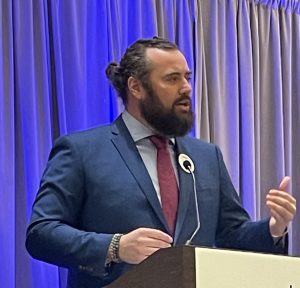
The session I moderated, on home-based child care policy and advocacy, featured Grace Matlhape as one of the panelists.Matlhape is the chief executive director of SmartStart, a nonprofit that supports high-quality home-based early learning programs in South Africa.
The organization’s model, which trains community members to teach a play-based curriculum and run their own early learning programs, has been found to decrease achievement gaps between higher- and lower-income children.
In early 2025, after advocacy from Matlhape and other early childhood organizations, South African President Cyril Ramaphosa announced he would prioritize the early years in his education agenda, acknowledging the country is decades behind in the field. The government also dedicated $500 million to expand early childhood development programs to some of the country’s 1.3 million young children not already enrolled in early care. That number represents about 18 percent of the country’s 0-5 population.
I recently caught up with Matlhape to hear more about progress she is seeing in South Africa, stereotypes of home-based care and which countries she’s looking to for guidance as the sector continues to grow. This interview has been edited for length and clarity.
What is the landscape of early childhood in South Africa?
Up to now, South Africa’s main approach is center-based child care. There’s still a gap in access, it’s not equitably accessible, but the main seen, acknowledged, recognized and regulated mode of child care is center-based care.
SmartStart is the first organization to look at home-based care as a model to build. Having said that, South Africa is very similar to the U.S. in that the early childhood care education is market-driven. The government does not run programs directly. From time to time, they may have a school here and a preschool there, but in the early years, government is not the main provider of programs. SmartStart is the first organization that decided to build [home-based care] into a national model that becomes acceptable even to policy makers.
Why are you focusing on home-based care?
It enables rapid setup, because it avoids all of the lead times in buildings and so on. It lowers the cost when you take away all of the infrastructure investments required. It’s community-based. People have very strong local relationships, for example, a shopkeeper down the road delivers bread every day. It builds on this very strong local culture of looking after children and just investing in their care and their stimulation.
We recruit our providers within close proximity to one another so that they can form into communities of practice to support one another. It’s a very powerful vehicle of building belonging and identity. It creates cultural acceptability very quickly.
Finally, we’ve seen fantastic child outcomes compared to the national average in South Africa. Many of [the programs] are in informal housing in very, very poor environments, but their child outcomes outperform the national average. We think it is a matter of good child ratios. You can’t have a massive class of children at a home. You have children in smaller groups, and we think that’s the answer.
What challenges have you encountered?
It is really hard for people to let go of this overreliance on quality associated with physical structures. People expect to see quality with their eyes, whereas what we are seeing in home-based child care is the experience and the love and attention, and the power of practicing good pedagogy between one loving practitioner and a handful of children. That’s the secret sauce. And so it’s been a challenge just to change mindsets, for people to see child care, home-based child care, in that way.
This summer you came to Dallas and met with other home-based child care experts from around the world. Did anything stick out to you regarding how South Africa’s home-based landscape compares to other countries?
What was very different in the U.S. is just how mature the sector is. It’s significantly more mature. It has matured to a practitioner-led advocacy level, with a platform like NAFCC and people who are leading the organization! [In South Africa], it is very strongly practitioner led. We are still on that journey of the practitioner representing themselves and driving advocacy in their own provinces or states. It gave me a sense of what the future might look like, the power in the practitioner-led alliance or coalition.
What are your goals moving forward?
We’ve actually moved into the zone now of regulation and funding by the government. We co-founded an advocacy organization about three to four years ago with other early childhood development organizations in South Africa. We’ve invested in policy research on what’s going on around the world [in early childhood]. My colleagues really invested in understanding what home-based child care looks like, particularly in Latin America — we drew a lot from that. And we are partnering with the government, with the Department of Education. As insights emerge, we partner with them to say, ‘This is what the research says. These are the trends.’ We are very effectively influencing policy in South Africa by getting the president to announce early childhood as one of the apex priorities for our government. We are trying to make early childhood development in general, and promoting home-based child care as a first tier approach, a societal priority.
This <a target=”_blank” href=”https://hechingerreport.org/what-the-us-can-teach-other-countries-about-home-based-child-care/”>article</a> first appeared on <a target=”_blank” href=”https://hechingerreport.org”>The Hechinger Report</a> and is republished here under a <a target=”_blank” href=”https://creativecommons.org/licenses/by-nc-nd/4.0/”>Creative Commons Attribution-NonCommercial-NoDerivatives 4.0 International License</a>.<img src=”https://i0.wp.com/hechingerreport.org/wp-content/uploads/2018/06/cropped-favicon.jpg?fit=150%2C150&ssl=1″ style=”width:1em;height:1em;margin-left:10px;”>
by Jackie Mader, The Hechinger Report December 10, 2025
Close to 40,000 foreign-born child care workers have been driven out of the profession in the wake of the Trump administration’s aggressive deportation and detainment efforts, according to a new study by the Better Life Lab at the think tank New America. That represents about 12 percent of the foreign-born child care workforce.
Child care workers with at least a two-year college degree are most likely to be leaving the workforce, as well as workers who are from Mexico, a demographic targeted by ICE, or those who work in center-based care, the left-leaning think tank found. The disruption has worsened an already deep shortage of child care staffers, threatening the stability of the industry and in turn is contributing to tens of thousands of U.S.-born mothers dropping out of the labor market because they don’t have reliable child care.
In addition to workers facing detainment or deportation, many people are staying home to avoid situations where they may encounter Immigration and Customs Enforcement (ICE), the report found. Agents are detaining people who have not traditionally been the focus of ICE actions, including those following legal pathways like asylum seekers and green card applicants. Child care centers were once considered “sensitive locations” exempt from ICE enforcement, but the White House rescinded that in January. In at least one example, a child care worker was detained while arriving for work at a child care program.
“What’s different now is the ferocity of the enforcement,” said Chris Herbst, a professor at Arizona State University’s School of Public Affairs and one of the authors of the report, in an interview with The Hechinger Report. “ICE is arresting far more people, the number of deportations has risen dramatically,” he added. “People are scared out of their minds.”
Related: Young children have unique needs and providing the right care can be a challenge. Our free early childhood education newsletter tracks the issues.
America has long relied on immigrants to fill hard-to-staff caregiving positions and enable parents to work. Across the country, around 1 in 5 child care workers is an immigrant. In Florida and New York, immigrants account for nearly 40 percent of the child care workforce. One study that compared native-born and immigrant child care workers found that nearly 64 percent of immigrants had a two- or four-year college degree, compared to 53 percent of native-born workers. The study also noted that immigrant workers are more likely than native-born workers to have child development associate credentials and to invest in professional development activities.
Overall, the child care industry supports more than $152 billion in economic activity.
In Wisconsin, Elaine, the director of a child care center, said her program has benefited greatly from a Ukrainian immigrant who has been teaching there for two years, ever since arriving in the United States as part of a humanitarian parole program. (The Hechinger Report is not using Elaine’s last name or the city where her child care center is located because she fears action by immigration enforcement.) Elaine’s center has experienced a teacher shortage for the past 13 years, and the immigrant, who has a college degree and past experience in social services, has been a steady presence for the children there.
“She’s their consistent person. She spends more time than a lot of the parents do with the children during their waking hours,” Elaine said. “She’s there for them, she’s loving, she provides that support, that connection, that security that young children need.”
In January, the Trump administration suspended the Uniting for Ukraine program, which allowed Ukrainians fleeing the Russian invasion to live and work in the United States for two years. While the program later opened up a process to apply for an extension, Elaine’s employee has encountered delays, like many others.
The teacher’s parole expired this month. Under the law, she is now supposed to return to Ukraine, where her home city in southeast Ukraine is still under attack by Russian forces.
Elaine fears what will happen if the center loses her. “As a business, we need her. We need a teacher we can count on,” Elaine said. “For our teachers’ mental health, to have her leave and knowing where she would go would be really difficult.”
Elaine has decided to allow the employee to keep working, and is appealing to state lawmakers to help extend her stay. Several parents have also joined in the effort, writing letters to Democratic U.S. Sen. Tammy Baldwin telling her how much their children love the teacher — and how important she is to the local economy. One factor in granting an extension is that the person offers a “significant public benefit” to the country.
The authors of the new report found immigrants are not the only caregivers affected by ICE enforcement this year. There has also been a drop in U.S.-born child care workers in the industry, especially among Hispanic and less-educated caregivers. This could be the result of a “climate of fear and confusion” surrounding enforcement activity, according to the report, as well as a “perceived pattern of profiling or discriminatory enforcement practices.”
“These deportations have been sold under the theory that they are going to be a boon for U.S.-born workers once we sort of unclog the labor market by removing large numbers of undocumented immigrants,” Herbst said. “We’re finding at least in the child care industry, and at least in the short run, that appears not to be the case.” Some foreign-born and U.S.-born workers have different skills and do not seem to be competing for the same caregiving jobs, he added.
Not all workers are leaving the caregiving industry altogether. Some immigrants are shifting to work as nannies or au pairs, Herbst said, “finding refuge” in private homes where they are less likely to come into contact with state child care regulators or be part of formal wage systems. (Already, an estimated 142,000 undocumented immigrants work as nannies and personal care or home health aides nationwide.) That contact with regulators and other authorities may be a reason why center-based early childhood educators are leaving the field in greater proportions now, Herbst said.
These findings come at the end of a difficult year for the child care workforce, which has long been in crisis due to dismally low pay and challenging work conditions. More than half of child care providers surveyed this year by the RAPID Survey Project at Stanford University reported experiencing difficulty affording food, the highest rate since the survey started collecting data on provider hunger in 2021. Other recent reports have found child care providers are at a higher risk for clinical depression, and in some cities an increasing number are taking on part-time jobs to make ends meet.
Across the country this year, early childhood providers have seen drops in enrollment as families pull their children out of schools and programs to avoid ICE. Child care centers are losing money and finding that some staff members are too scared to come to work or have lost work authorization after the administration ended certain refugee programs. Many child care workers have taken on additional roles driving children to and from care, collecting emergency numbers and plans for children in their care in case parents are detained and dropping off food for families too scared to leave their homes.
This story about immigration enforcement was produced by The Hechinger Report, a nonprofit, independent news organization focused on inequality and innovation in education. Sign up for the Hechinger newsletter.
This <a target=”_blank” href=”https://hechingerreport.org/immigration-enforcement-is-driving-away-early-childhood-educators/”>article</a> first appeared on <a target=”_blank” href=”https://hechingerreport.org”>The Hechinger Report</a> and is republished here under a <a target=”_blank” href=”https://creativecommons.org/licenses/by-nc-nd/4.0/”>Creative Commons Attribution-NonCommercial-NoDerivatives 4.0 International License</a>.<img src=”https://i0.wp.com/hechingerreport.org/wp-content/uploads/2018/06/cropped-favicon.jpg?fit=150%2C150&ssl=1″ style=”width:1em;height:1em;margin-left:10px;”>
For the first five years of children’s lives, many families are experiencing child care challenges — which have been at the center of discussions among the NC Task Force on Child Care and Early Education since Gov. Josh Stein established the group in March.
But gaps in child care do not disappear once children start kindergarten. Finding affordable, high-quality child care solutions for school-age children should be part of the state’s continuum of care, advocates and providers told the task force Monday.
“The parents I work with don’t experience child care as a 0 to 5 situation,” said Beth Messersmith, task force member and campaign director of MomsRising’s North Carolina chapter. “They experience it as a 0 to 12 situation, or older.”
Many families need care before and after the school day and during the summer months in order to work and keep students safe and engaged. However, four in five students in North Carolina do not have access to the out-of-school care they need, according to a report from the national Afterschool Alliance.
Students, including young children, are instead spending time unsupervised. About 3% of K-5 students, 11% of middle school students, and 34% of high school students spend an average of 5.7 hours without adult supervision per week, according to the same report.
Providers shared their struggles to serve children despite high demand and the benefits children, families, and businesses see when out-of-school care is accessible. After-school programs face many of the same challenges as child care programs. And some child care programs serving children before kindergarten also serve school-age children when school is out of session.
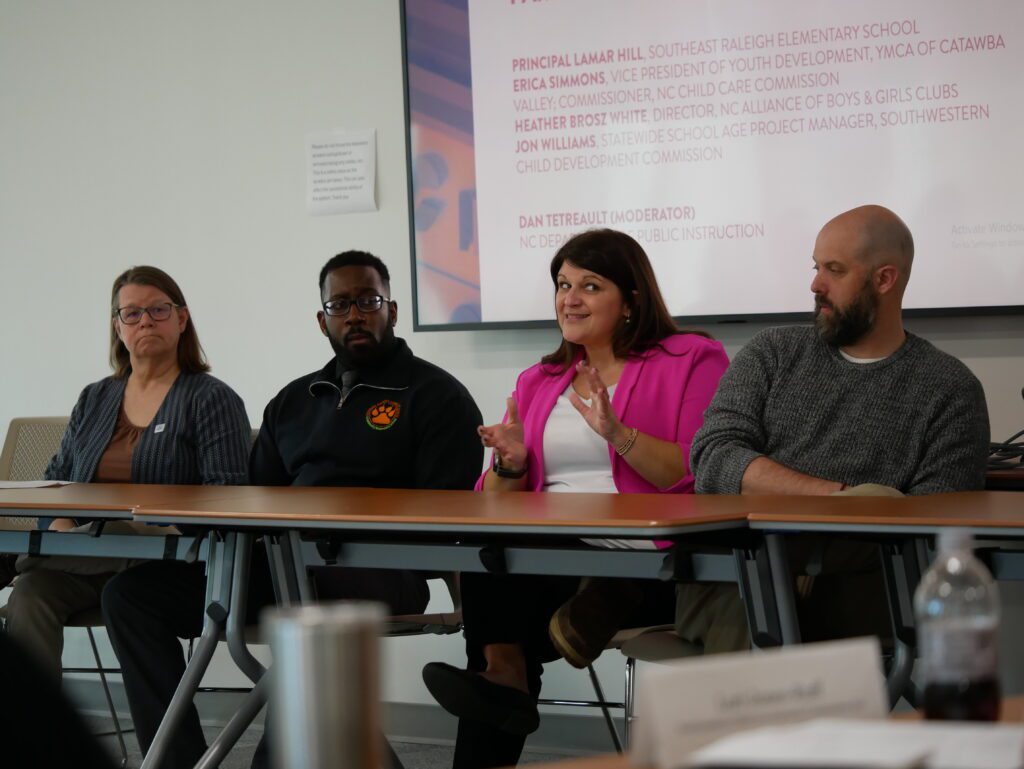
Erica Simmons, vice president of youth development at YMCA of Catawba Valley, shares her programs’ reach and barriers to that reach. (Liz Bell/EdNC)
Families need care that works with their schedules and engages students in activities that support them academically and socially, said Elizabeth Anderson, executive director of the North Carolina Center for Afterschool Programs, a nonprofit under the Public School Forum of North Carolina. That requires funding, workforce supports, transportation, and creative partnerships, Anderson and a panel of providers said.
“The more we can create a spectrum of opportunities for birth through grade 12, the more that children and families in our state are going to recognize the positive economic impacts of those investments,” Anderson said.
Report due in December on child care solutions ahead of short session
The governor’s task force will release a report by the end of December with recommendations on how the state should expand access to high-quality, affordable child care. Stein formed the group earlier this year as pandemic-era child care funding ran out and advocates across the state and country called for consistent public investment to meet families’ needs.
The state legislature did not allocate new funding for child care this year and did not pass a new comprehensive budget. Some new funding, though lower than advocates’ and state officials’ requests, was included in budget proposals from Stein’s office and the House and Senate, but those proposals were not ultimately passed.
The main child care legislation that was passed made regulatory changes to loosen staffing requirements and allow providers to serve more children in classrooms with appropriate space and teacher-to-child ratios.
The task force will meet again in February, though a date is not yet set. Ahead of next year’s short session, members on Monday discussed what role the group should play in moving policy solutions forward, including six recommendations in the group’s interim report released in June:
Set a statewide child care subsidy reimbursement rate floor.
Develop approaches to offer non-salary benefits to child care professionals.
Explore partnerships with the University of North Carolina System, N.C. Community Colleges System, and K-12 public school systems to increase access to child care for public employees and students.
Explore subsidized or free child care for child care teachers.
Link existing workforce compensation and support programs for early childhood professionals into a cohesive set of supports.
Explore the creation of a child care endowment to fund child care needs.
As the state faces many funding requests, federal funding uncertainty, and slim tax revenue, members said more legislators need to be aware of the state’s child care crisis and why it’s relevant to the state’s economy and future.
“Maybe we have some more work to do around actually educating and engaging members of the General Assembly to get this on their radar and build more champions,” said Susan Gale Perry, CEO of Child Care Aware of America and task force member.
Funding to address issues of access, quality, and affordability is needed, members said, and considering existing funding streams rather than new ones might be more politically feasible in the short term.
“Certain proposals about, ‘Let’s just go raise taxes,’ are probably not going to be something that is going to get across the aisle agreement, but it does create the opportunity to looking at areas where tax rates are already set, or certain revenue streams are already existing,” said Mary Elizabeth Wilson, task force member and the Department of Commerce’s chief of staff and general counsel.
Mary Elizabeth Wilson, task force member and the Department of Commerce’s chief of staff and general counsel, shares considerations for 2026. (Liz Bell/EdNC)
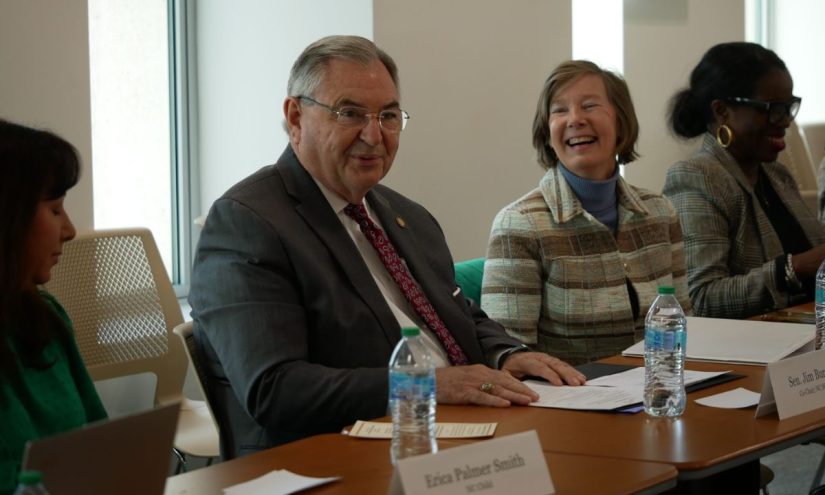
Sen. Jim Burgin, R-Harnett, who chairs the task force along with Lt. Gov. Rachel Hunt, said he and other legislators will be introducing legislation that would double the tax rates on sports gambling.
“If it’s for the children, everybody needs to support it,” Burgin said. “And I don’t believe in gambling … I’m doing it because we need the money.”
Child care fixes would also increase tax revenue, said Erica Palmer-Smith, executive director of nonprofit NC Child and task force member.
“(The generated revenue) would more than cover the overall cost that we would need to put in in the long run to fix the child care system,” Smith said.
‘The gap between 3 and 6 and between May and August’
Many families either do not have an after-school program nearby, do not have transportation to programs, or cannot afford programs, Anderson said in a presentation to the group Monday.
In 2025, 188,295 children participated in after-school programs, but 664,362 additional children would have if they had access, according to the presentation.
Programs are funded through a mix of private grant funding, public funding, and parent tuition. The two biggest funding sources are from the federal government: the Child Care Development Fund, which funds child care subsidies for young children and school-age children up through 12 years old, and 21st Century Community Learning Centers through the Department of Public Instruction.
After-school programs exist in all different types of facilities — community-based organizations, schools, faith-based organizations, and child care centers and home-based programs. Anderson described these programs as “folks stepping in to fill the gap between 3 and 6 and between May and August.”
Students benefit when they access out-of-school programs, she said. In the case of the 21st Century Community Learning Centers, 72% improved their attendance in the 2023-24 school year, 75% of students had decreased suspensions, and 90% improved their overall engagement in school.
Elizabeth Anderson, executive director of the North Carolina Center for Afterschool Programs, provides an overview of the demand for school-age care across the state. (Liz Bell/EdNC)
Anderson said the skills employers are seeking align with those that children are gaining from after-school programs, like problem-solving, teamwork and collaboration, communication, and leadership.
“We know that our after-school programs are an important place where children get to interact with one another and interact with mentors and positive adult figures that help them build these skills, which ultimately help them to become more successful, independent earners in the future,” she said.
Like child care programs in the early years, after-school programs not only help children, but allow parents to work. In a survey from the national report, 91% of parents said these programs help them be able to keep their job.
Families face particular challenges in the summer months. A national survey from LendingTree of more than 600 parents found this year that 66% of parents who seek summer care struggle to afford it, and 62% had taken on debt to pay for summer care.
Anderson said more conversations on child care should extend beyond the early childhood period. She pointed to research from the University of California that found educational and occupational attainment improvements were higher when children had access to both early care and education and out-of-school care once they entered school.
“It is something that parents need and want,” she said. “I think that we talk a lot about what happens for children birth to 5, but a child does not turn 5 years old and suddenly not need opportunity.”
Subsidy funding and reform would help, experts say
North Carolina is one of 23 states that does not have state level funding for after-school care, Anderson said. Anderson and panelists said funding is needed to retain teachers, increase access, provide transportation, and help families afford care.
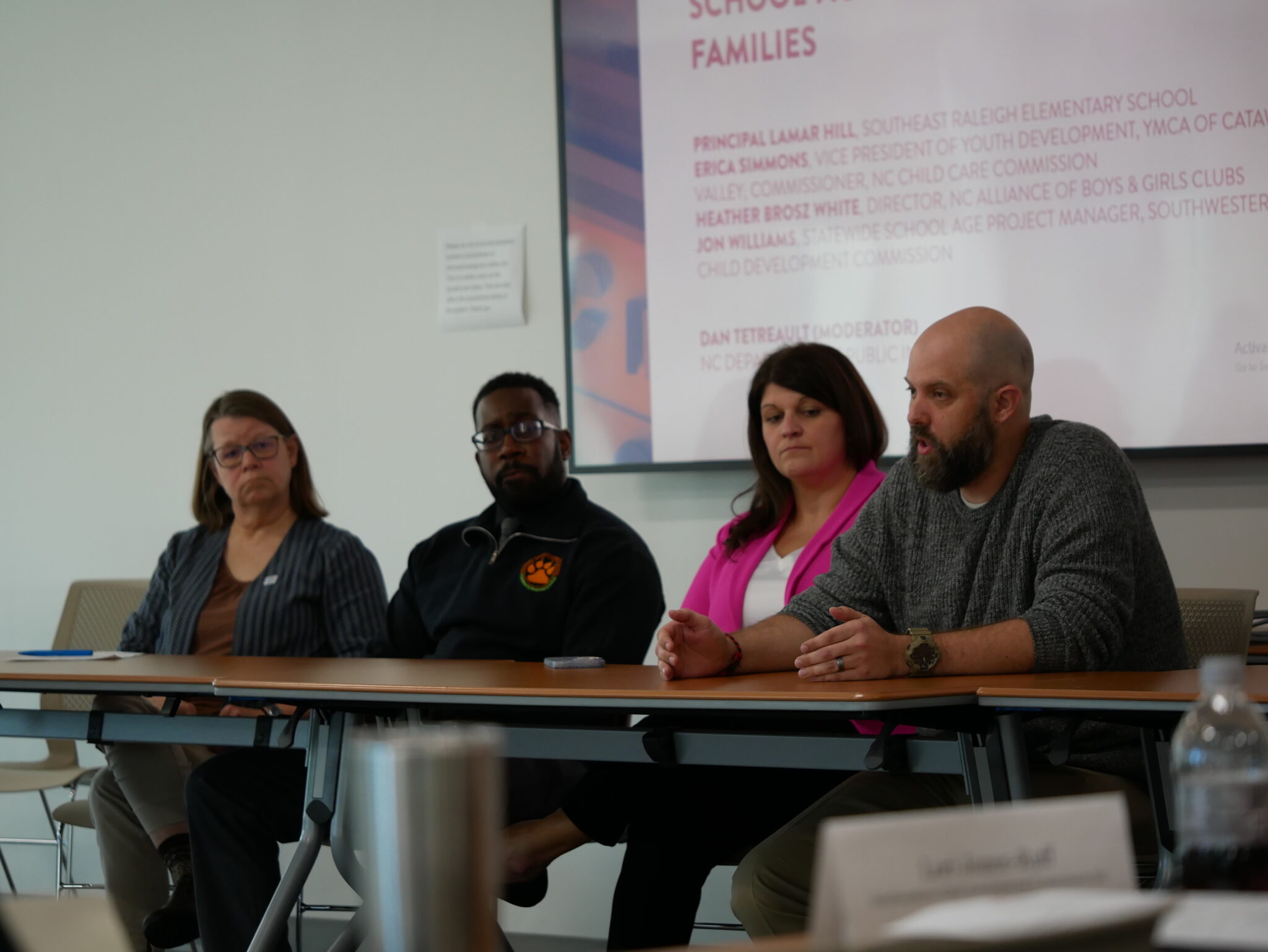
Jon Williams, manager of the statewide School-Age Initiative at the Southwestern Child Development Commission, is focused on increasing the quality of out-of-school care across the state. He said the transient nature of school-age professionals disrupts consistency for children, families, and programs. A burdensome orientation process creates challenges for owners and directors constantly onboarding new people.
Williams said business training for after-school program directors would be helpful. Many have educational backgrounds and lack the business expertise to be successful in a challenging environment.
“They don’t have that financial background that is needed to run a business, and that creates a lot of financial instability,” Williams said. “If they don’t know how to orient or get new staffing in, that creates a huge problem.”
Jon Williams, manager of the NC School Age Initiative at the Southwestern Child Development Commission, says providers need funding and business training to improve the stability and quality of school-age care. (Liz Bell/EdNC)
A policy change that several panelists and task force members raised as a need is to align the eligibility requirements for child care subsidies across age groups. Right now, families who earn less than 200% of the federal poverty line are eligible for child care subsidies when their children are 5 years old or younger. But for school-age children, the threshold lowers: families must make less than 133% of the poverty line.
That disrupts care for families whose children need after-school care going to kindergarten or for families with multiple children of different ages who would prefer to send all of their children to one program.
A statewide subsidy floor, which is one of the policy priorities of the task force, would also help school-age care providers, said Erica Simmons, vice president of youth development at YMCA of Catawba Valley.
The floor would raise the per-child rate that child care programs receive to the state’s average rate. In cases where programs receive more than the average rate, they would continue receiving the same amount.
“(The floor) would make it a little more equitable,” Simmons said.
She said it costs similar amounts to provide care at her licensed programs in rural and urban communities. But the subsidy rates are much lower in rural areas.
“We have the same requirements for staff, we have the same programming requirements,” she said. “There’s no difference in the amount that we spend per program as an organization. However, there is a very big difference in what we are able to capture for subsidy. So there’s a big funding gap.”
Williams said there was a gap of $8,000 for one program just last month between the cost of services and the subsidy reimbursement. Annually, some programs in her network accrue around $100,000 in funding gaps for caring for children through subsidy.
Burgin asks a question of after-school program experts. (Liz Bell/EdNC)
Programs also receive subsidy payments retroactively. Changing the timing of funding could relieve some of the financial burden from programs, Williams said.
“I get paid via subsidy after I provide the services, and that’s a huge problem if I’m already in the red,” he said.
“… When we think about the mental health of our administration and our directors, that just adds fuel to the flame,” Williams said. “And it creates another gap, a 30-day gap, where I can say, ‘I can’t do this anymore,’ and then that care drops off. So we have to rethink how we get that money out in the state. We have to rethink the rates at which they are given.”
Panelists also shared that liability insurance rates have risen drastically. Williams said her program’s rates have increased by 44% over the last year, a trend among child care providers overall. A 2024 survey from the National Association for the Education of Young Children (NAEYC) found 80% of respondents saw their liability insurance costs increase in the last year and 62% reported difficulty finding or affording it.
Updates on care for public employees, workforce supports, and funding models
The task force has been split up into three subgroups which have been studying how to move toward the group’s six recommendations.
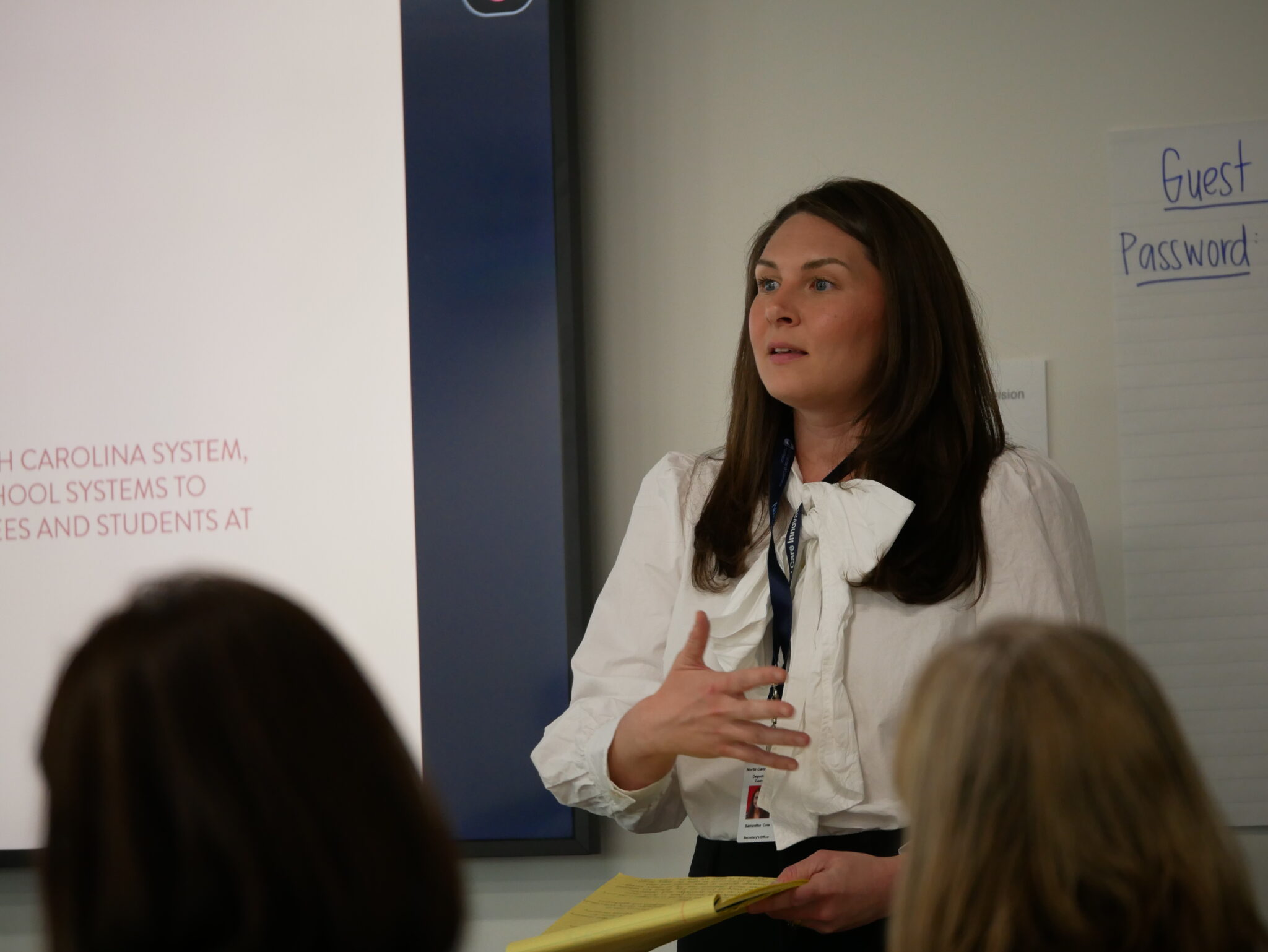
Samantha Cole, child care business liaison at the Department of Commerce, said a subgroup focusing on expanding child care access for public employees has looked at models across K-12, community college, and UNC-system schools to create child care solutions.
“We really see that there have been a lot of successes that have come about in these three examples and others, but they’re hyperlocalized,” Cole said. More external communication is needed for other campuses to understand how and why peer institutions are offering child care.
Madhu Vulimiri, senior advisor for health and families policy for Stein’s office, said the subgroup focused on workforce compensation and supports has been studying strategies to ensure early childhood teachers have access to non-salary benefits like health insurance.
They have studied the possibility of adding early childhood teachers as an eligible population for the State Health Plan, subsidizing ACA marketplace premiums through state dollars, and educating early childhood providers about the recently launched Carolina Health Works, which offers options for groups of small businesses.
The group is also studying how existing workforce supports like TEACH scholarships, child care academies, and apprenticeships could be more seamlessly tied together to strengthen the early childhood profession. They have requested that the Hunt Institute create a map to demonstrate what supports are available in what counties.
Samantha Cole, child care business liaison at the Department of Commerce, says some schools and colleges across the educational continuum have built models to provide child care specific to their local needs and resources. (Liz Bell/EdNC)
“That will help us see more holistically, where do we have resources and where are there gaps, and help us hopefully target future resources that we might have to expand those statewide,” Vulimiri said.
The third group, which is focused on financing, has been studying several states’ approaches to endowments and other funding mechanisms for child care, including Nebraska, Connecticut, Arizona, Montana, and Washington, D.C. They aim to develop a paper that weighs the options for North Carolina and analyses costs and benefits of each.
by Nirvi Shah, The Hechinger Report December 5, 2025
SAN FRANCISCO — In a playground outside a YMCA, Mayra Aguilar rolled purple modeling dough into balls that fit easily into the palms of the toddlers sitting across from her. She helped a little girl named Wynter unclasp a bicycle helmet that she’d put on to zoom around the space on a tricycle.
Aguilar smiled, the sun glinting off her saucer-sized gold hoop earrings. “Say, ‘Thank you, teacher,’” Aguilar prompted Wynter, who was just shy of 3. Other toddlers crowded around Wynter and Aguilar and a big plastic bin of Crayola Dough, and Aguilar took the moment to teach another brief lesson. “Wynter, we share,” Aguilar pressed, scooting the tub between kids. “Say, ‘Can you pass it to me?’”
Aguilar and Wynter are both new at this. Wynter has been in the structured setting of a child care center only since mid-August. Aguilar started teaching preschoolers and toddlers, part-time, in February.
It has been life-changing, in different ways, for them both. Wynter, an only child, is learning to share, count and recognize her letters. Aguilar is being paid to work and earning her first college credits — building the foundation for a new career, all while learning new ways to interact with her own three kids.
Early educators are generally in short supply, and many who attempt this work quickly quit. The pay is on par with wages at fast food restaurants and big box stores, or even less. Yet unlike some other jobs with better pay, working with small children and infants usually requires some kind of education beyond a high school diploma. Moving up the ladder and pay scale often requires a degree.
What’s different for Aguilar compared to so many other people trying out this profession is that she is an apprentice — a training arrangement more commonly associated with welders, machinists and pipefitters. Apprentice programs for early childhood education have been in place in different parts of the country for at least a decade, but San Francisco’s program stands out. It is unusually well, and sustainably, funded by a real estate tax voters approved in 2018. The money raised is meant to cover the cost of programs that train early childhood educators and to boost pay enough so teachers can see themselves doing it for the long term.
Related: Young children have unique needs and providing the right care can be a challenge. Our free early childhood education newslettertracks the issues.
Some policy experts see apprenticeships as a potential game changer for the early educator workforce. The layers of support they provide can keep frazzled newcomers from giving up, and required coursework may cost them nothing. “We want it to be a position people want to go into as opposed to one that puts you in poverty,” said Cheryl Horney, who oversees the Early Learning Program that employs apprentices at Wu Yee Children’s Services in San Francisco, including the site where Aguilar works.
Aguilar, 32, is paid to work 20 hours a week at the Wu Yee Children’s Services’ Bayview Early Learning Center, tucked inside a Y in a residential neighborhood a little under a mile from San Francisco Bay. She works alongside a mentor teacher who supports and coaches her. The apprenticeship covers the online classes, designed just for her and other apprentices and taught live from City College of San Francisco, that Aguilar takes a few nights a week. She was given all the tools needed for her courses, including a laptop, which she also uses for homework and discussions with other apprentices outside of class.
After high school, Aguilar had tried college, a medical assistant program that she quit after a few months. That was more than 10 years ago. She hadn’t touched a computer in all that time. When she was enrolling her youngest daughter at another Wu Yee location, Aguilar saw a flyer about the apprenticeship program and applied. She is finding this work to be a far better fit: “This — I think I can do it. This, I like it.”
The need for more early educators is longstanding, and in recent years there’s been a push for early educators to get postsecondary training, both to support young children’s development and so the roles command higher salaries. For example, a 2007 change in federal law required at least half of teachers working in Head Start to have bachelor’s degrees in early childhood education by 2013, a goal the program met.
Despite efforts to professionalize the workforce, salaries for those who work with young children remain low: 87 percent of U.S. jobs pay more than a preschool teacher earns on average; 98 percent pay more than what early child care workers earn. In 2022, Head Start lead teachers earned $37,685 a year on average.
Apprenticeships are seen as one way to disrupt that stubborn reality: Would-be teachers are paid while being trained for everything from entry-level roles that require a small number of college credits or training to jobs, like running a child care center, that require degrees and come with more responsibility and even higher pay. According to a June 2023 report from the Bipartisan Policy Center, a think tank, 35 states have some kind of early childhood educator apprenticeship program at the city, regional or state level, and more states are developing their own programs. U.S. Department of Labor data shows that more than 1,000 early educator apprentices have completed their programs since the 2021 fiscal year. Early Care & Educator Pathways to Success, which has received Labor Department grants to help set up apprenticeship programs, estimates the numbers are far larger given its work has cultivated hundreds of apprentices in 21 states, including Alaska, California, Connecticut and Nebraska.
These programs can be complicated to launch, however. They sometimes require painstaking work to find colleges that will provide coursework specific to local regulations and at hours that work for apprentices who may be in classrooms much of the workday as well as tending to their own children. They require money to pay the apprentices — on top of whatever it already costs to run child care centers and pay existing staff. The apprentices also typically need other layers of support: coaching, computers, sometimes child care and even meals for apprentices’ own kids as they study and take exams.
In San Francisco, Horney advocated for her employer to set up an apprenticeship program for staffers at its 12 Head Start centers even before the tax money became available. She recalled losing teachers to chain retailers like Costco and Walgreens where they found less stressful jobs with more generous benefits. When she arrived in San Francisco to work in the classroom, with five years of experience and a bachelor’s degree, she was paid $15 an hour. “Now the lowest salary we pay is $28.67 for any sort of educator,” she said, and the wages and apprenticeships are even drawing people from other counties and stabilizing the San Francisco early educator workforce. “It has helped immensely.”
Other parts of the country have seen success with similar initiatives.
The YWCA Metro St. Louis in Missouri, which hasn’t had a single teacher vacancy for the last two years at the child care centers it oversees, credits its apprenticeship program. In Guilford County, North Carolina, vacancies and staff turnover were a plague until recently, but an apprenticeship program for entry-level early educators has kept new teachers on the job.
Elsewhere, there is hope for those kinds of results. In the Oklahoma City area, an apprenticeship program started in 2023 just yielded its first graduate, who worked in a child care center for two years and completed a 288-hour training program. Curtiss Mays, who created the program for teachers at the group of Head Start centers he oversees, was in the midst of trying to hire 11 educators just as the first apprentice earned a credential that allows her to back up other teachers.
“It’s a pretty major project,” Mays said. “We hope it’s the start of something really good.” Mays worked with the Oklahoma Department of Labor to set up the apprenticeship program, which he said has already pulled one person out of homelessness and is helping to lure more aspiring teachers. It will pay for education all the way through a bachelor’s degree if apprentices stick with it.
Apprenticeship programs can be costly to run, but bipartisan federal legislation to support them has never gained traction. (Advocates note that apprenticeships can cost far less than a traditional four-year college degree.) Labor Department money for organizations that help set up and grow early childhood educator apprenticeships helped increase the number of apprentices in so-called registered apprenticeship programs — ones that are proven and validated by the federal agency. But some of those grants were axed by the Trump administration in May.
In San Francisco, while setting up apprenticeships was as labor intensive as in many other places, the 2018 real estate tax provides a new and deep well of money to propel the early educator apprentice effort. The money pays for all of the things that are letting Aguilar and dozens of others in the county earn at least 12 college credits this year. In two semesters, Aguilar will have the credentials to be an associate teacher in any early education program in California. Other apprentices across San Francisco, in Head Start centers, family-owned child care programs, even some religious providers, can work toward associate or bachelor’s degrees using the new tax revenue to pay for it.
Long before the ballot measure across the bay in San Francisco, Pamm Shaw dreamed up the forerunner of an early educator apprenticeship program in a moment of desperation.
It was over a decade ago, and Shaw, who was then working at the YMCA East Bay overseeing a collection of Head Start centers, said her agency was awarded a grant to add spaces for about 100 additional infants. Except her existing staff didn’t want to work with children younger than 3. So Shaw sent notices to the roughly 1,000 families with children enrolled in YMCA East Bay Head Start programs at the time and convinced about 20 people, largely parents of children enrolled in Head Start, to consider the role. She pulled together the training that would qualify the parents to become early educators — 12 college credits in six months.
The education piece, Shaw realized, was a huge draw. Some of the parents had spent 10 years working toward associate degrees on their own without completing them. Giving them the chance to earn those degrees in manageable chunks — while getting paid and receiving raises relatively quickly as their education advanced — proved a powerful recruitment tool. “It changed their lives,” Shaw said. And these new teachers had their eyes opened to how what they would be doing wasn’t just babysitting. They took away lessons they used with their own children — who in turn took notice of their parents studying. “It’s actually child care,” said Shaw. “So much happens in the first year of life that you never get to see again. Never, ever, ever.”
It changed Shaw’s life, too, and inspired many other apprenticeship programs all over. Her role morphed into fundraising to build out the apprenticeship pipeline. The program, now baked into the YMCA of the East Bay system, reflected the overall early educator workforce: It was made up entirely of women, mostly women of color, some of them immigrants and many first-generation college students. By the time Shaw retired a few years ago, more than 500 people in the Berkeley area had completed the early educator apprenticeship program.
Erica Davis, a single mom, is one of its success stories. When she met Shaw, Davis said, she was relying on public assistance and jobs caring for other people’s children, while taking care of a daughter with significant medical needs, as well as her toddler-age son. Davis was at a Head Start dropping off paperwork for the family of a child in her care when an employee told Davis her young son might be eligible for Head Start too. He was, and as Davis enrolled him, she learned about Shaw’s apprenticeship program. Davis missed the first window to apply, but as she put it, “I was blowing their phone up. I needed to get in.”
That was 2020. By this spring, Davis will have earned her bachelor’s degree from Cal State East Bay. She works full-time at a Richmond, California, Head Start center while taking classes and supporting her kids, now in high school and elementary school. She can afford to rent a two-bedroom apartment, owns a car and no longer relies on state or federal assistance to pay bills. She’s on the dean’s list, and, she said proudly, she can squat 205.
“I didn’t take my education seriously,” Davis, 41, said of her younger self. “I feel like I’m playing catch-up now.” She is in her element at the YMCA of the East Bay Richmond Parkway Early Learning Center, reading to children, working on potty training and leading the kids through coloring-and-pasting exercises. She has even become an informal coach for newer apprentices. The network and family feel of these apprenticeships is some of what helps many succeed, she said. “I have a sad story, but it turned into something beautiful.”
While Davis said she prefers the flexibility of taking classes at her own pace, other apprentices thrive in the kind of classes Aguilar attends, with a live instructor who starts off leading students in a mindfulness exercise. That is the same approach to teaching apprentices at EDvance College in San Francisco, which works exclusively with early childhood apprentices, according to its president and CEO, Lygia Stebbing.
The college provides general education classes in reading, math and science for apprentices pursuing degrees, taught through an early childhood lens so it feels approachable and relevant. And every lesson can be applied nearly in real time, unlike other paths to degrees, in which in-person teaching experience comes only after many classes, Stebbing said. Before beginning classes, apprentices get a crash course in using technology, from distinguishing between a tablet and a laptop to using Google Docs and Zoom, “so they can jump right into things,” she said. A writing coach and other student support staff are available in the evenings, when apprentices are taking courses or doing homework. Because many of the apprentices are older than typical college students and may even have used up their federal Pell Grants and other financial aid taking courses without earning a degree, the college works with foundations and local government agencies to offset the cost of courses so graduates don’t end up in debt.
“We’ve really put the student at the center,” Stebbing said.
For Mayra Aguilar, her mentor teacher Jetoria Washington is a lifeline who can help her unstick an issue with any aspect of the apprenticeship — in the classes she takes or the classroom where she works. Taking courses online means she can be home with her own kids in the evenings. Earning money for the hours she spends in the classroom means she is not going into debt to earn the credential she needs to find a full-time job. The constellation of support has helped her shift from feeling in over her head to feeling ready to keep working toward a college degree.
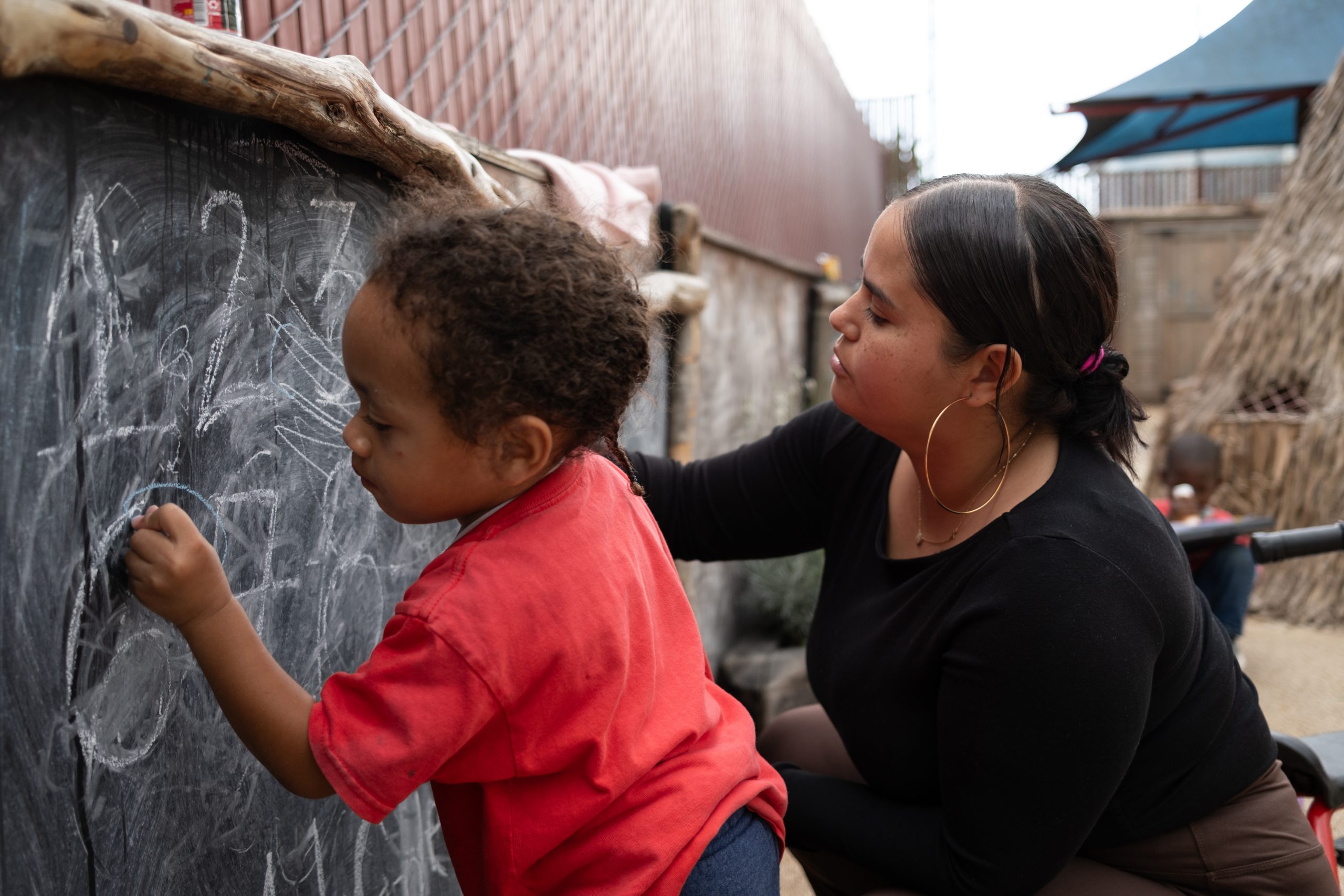
And she is having fun. On the playground, one of the kids had the idea to trace another with sidewalk chalk, working on their pencil grip as much as they were playing. Except it wasn’t just the other kids: They traced Aguilar, too. When it was time to go back inside, powdery green and pink lines crisscrossed the back of her brown pants and black blouse. She wasn’t bothered.
“I love the kids,” she said. “They always make me laugh.”
Aguilar has even picked up skills that she uses with her own children, something many apprentices describe.
Now, she sometimes says to her youngest daughter, “Catch a bubble.” That’s preschool speak for “Be quiet.” When a teacher needs the toddlers’ attention, kids hear this phrase, then fill their cheeks with air.
Most of the time, at home and at work, a brief silence follows. Then the kids look up, ready to hear what comes next.
This story about preschool teachers was produced by The Hechinger Report, a nonprofit, independent news organization focused on inequality and innovation in education. Sign up for the Hechinger newsletter.
This <a target=”_blank” href=”https://hechingerreport.org/one-city-finding-early-educators/”>article</a> first appeared on <a target=”_blank” href=”https://hechingerreport.org”>The Hechinger Report</a> and is republished here under a <a target=”_blank” href=”https://creativecommons.org/licenses/by-nc-nd/4.0/”>Creative Commons Attribution-NonCommercial-NoDerivatives 4.0 International License</a>.<img src=”https://i0.wp.com/hechingerreport.org/wp-content/uploads/2018/06/cropped-favicon.jpg?fit=150%2C150&ssl=1″ style=”width:1em;height:1em;margin-left:10px;”>
This story was produced by The 19th and reprinted with permission.
The mother was just arriving to pick up her girls at their elementary school in Chicago when someone with a bullhorn at the nearby shopping center let everyone know: ICE is here.
The white van screeched to a halt right next to where she was parked, and three Immigration and Customs Enforcement agents piled out. They said something in English that she couldn’t decipher, then arrested her on the spot. Her family later said they never asked about her documentation.
She was only able to get one phone call out before she was taken away. “The girls,” was all she said to her sister. Her daughters, a third grader and a fourth grader, were still waiting for her inside the school.
Luckily, the girls’ child care provider had prepared for this very moment.
Sandra had been taking care of the girls since they were babies, and now watched them after school. She’d been encouraging the family to get American passports for the kids and signed documents detailing their wishes should the mother be detained.
When Sandra got the call that day in September, she headed straight to the school to pick up the girls.
Since President Donald Trump won a second term, Sandra has been prepping the 10 families at her home-based day care, including some who lack permanent legal status, for the possibility that they may be detained. (The 19th is only using Sandra’s first name and not naming the mother to protect their identities.)
She’s worked with families to get temporary guardianship papers sorted and put a plan in place in case they were detained and their kids were left behind. She even had a psychologist come and speak to the families about the events that had been unfolding across the country to help the children understand that there are certain situations their parents can’t control, and give them the opportunity to talk through their fears that, one day, mamá and papá might not be there to pick them up.
Read more
And for two elementary school kids, that day did come. Sandra met them outside the school.
“When they saw me, they knew something wasn’t right,” Sandra said in Spanish. “Are we never going to see our mom again?” they asked.
For all her planning, she was speechless.
“One prepares for these things, but still doesn’t have the words on what to say,” Sandra said.
Related: Young children have unique needs and providing the right care can be a challenge. Our free early childhood education newsletter tracks the issues.
After that day, Sandra worked with the mother’s sister to get the girls situated to fly to Texas, where their mother, who had full custody of them, was being detained, and then eventually to Mexico. She hasn’t heard from them in over a month. The girls were born in the United States and know nothing of Mexico.
“I think about them in a strange country,” Sandra said. “‘Who is going to care for them like I do?’ Now with this situation I get sad because I think they are the ones who are going to suffer.”
In this year of immigration raids, child care providers have stepped up to keep families unified amid incredible uncertainty. Some are agreeing to be temporary guardians for kids should something happen to their parents. The workers themselves are also under threat — 1 in 5 child care workers are immigrant women, most of them Latinas, who are also having to prepare in case they are detained, particularly while children are in their care. Already, child care workers across the country have been detained and deported.
“The immigration and the child care movements, they are one in the same now,” said Anali Alegria, the director of federal advocacy and media relations at the Child Care for Every Family Network, a national child care advocacy group. “Child care is not just something that keeps the economy going, while it does. It’s also really integral to people’s community and family lives. And so when you’re destabilizing it, you’re also destabilizing something much more fundamental and very tender to that child and that family’s life.”
A loose network of resistance has emerged, with detailed protection plans, ICE lookout patrols, and Signal or Whatsapp chats. Home-based providers like Sandra have been especially involved in that effort because their work often means their lives are even more intertwined with the families they care for.
“All the families we have in our program, I consider them family. We arrive in this country and we don’t have family, and when we get support, advice or the simple act of caring for kids, as child care providers we are essential in many of these families — even more in these times,” said Sandra, who has been caring for children in the United States for 25 years. All the families she cares for are Latinx, 70 percent without permanent legal status.
According to advocacy groups, child care providers are increasingly being asked to look after kids in case they are detained, typically because they are the only trusted person the family knows with U.S. citizenship or legal permanent residence. Parents are asking child care workers to be emergency contacts, short-term guardians and, in some cases, even long-term guardians.
“We heard this under the first Trump administration, and we’re hearing it much more now. It’s not so much a matter of if, but when, right now, and it used to be the other way around,” said Wendy Cervantes, the director of immigration and immigrant families at the Center for Law and Social Policy, an anti-poverty nonprofit. “It adds just additional stress and trauma because they deeply care about these kids. Many of them have kids of their own and obviously have modest incomes, so as much as they want to say, ‘yes’, they can’t in some cases.”
The question was posed to Claudia Pellecer a couple weeks ago. A home-based child care provider in Chicago for 17 years, Pellecer cares for numerous Latinx families, at least one of whom doesn’t have permanent legal status.
In October, one of those moms was due to appear before ICE for a regular check-in as part of her ongoing asylum case. But she knew that many have been detained at those appointments this year.
The mother asked Pellecer to be her 1-year-old son’s legal guardian should she be taken away.
“I couldn’t say no because I am human, I am a mother,” Pellecer said.
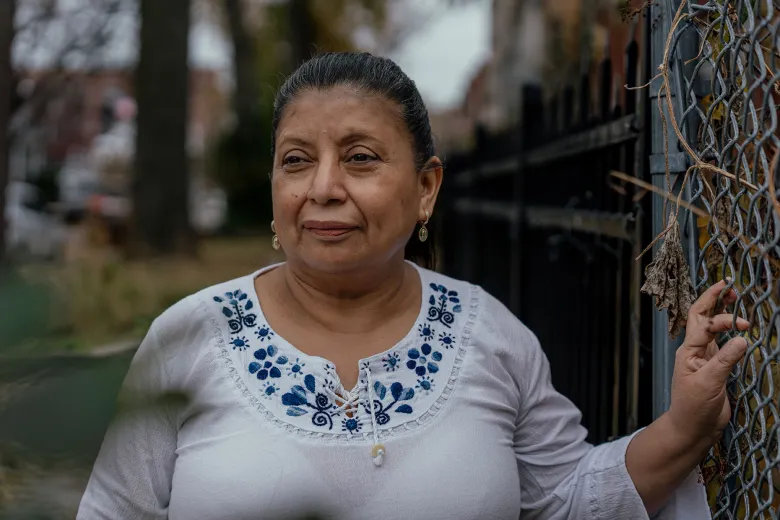
Claudia Pellecer, who runs a small daycare for young children out of her home, stands for a portrait outside her house. Credit: Jamie Kelter Davis for The 19th
They got to work getting the baby a passport and filling out the necessary guardianship paperwork. Pellecer kept the originals and copies. The mother closed her bank account, cleaned out her apartment and prepped two bags, one for her and one for the baby. If the mother was deported, Pellecer would fly with him to meet her in Ecuador, they agreed.
The day of the appointment, she dropped the baby off with Pellecer and set the final plan. Her appointment was at 1 p.m. “If at 6 p.m. you haven’t heard from me, that means I was detained,” she told Pellecer, who cried and wished her luck.
At the appointment, the judge asked her three sets of questions:
“Why are you here?”
“Are you working? Do you have a family?”
“Do you have proof of what happened to you in your country?”
Claudia Pellecer plays games with children in the living room of her home daycare, where she cares for up to eight young children a day. Credit: Jamie Kelter Davis for The 19th
The judge agreed to let her stay and told her to continue working. The mother won’t have a court date again until 2027.
“We learned our lesson,” Pellecer said. “We had to prepare for the worst and hope for the best.”
But their relief was short-lived. Recent events in Chicago have sent child care workers and families into panic, as the people who have tried to keep families together are now being targeted.
Resistance networks have sprung up rapidly in Chicago in recent weeks after a child care worker was followed to Spanish immersion day care Rayito de Sol on the city’s North Side and arrested in front of children and other teachers. The arrest was caught on camera and has sparked demonstrations across the city.
Erin Horetski, whose son, Harrison, was cared for by the worker who was arrested at Rayito de Sol in early November, said parents there had been worried ICE might one day target them because the center specifically hired Spanish-speaking staff.
The morning of the arrest, parents were texting each other once they heard ICE was in the shopping center where the day care is located.
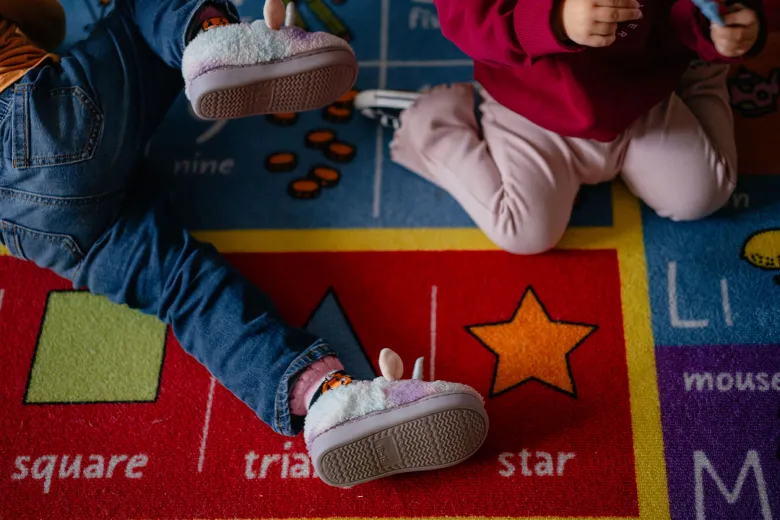
Children crawl on a colorful rug while playing educational games at Claudia Pellecer’s home daycare. Credit: Jamie Kelter Davis for The 19th
Her husband was just arriving to drop off their boys as ICE was leaving. The first thing out of his mouth when he called her: “They took Miss Diana.”
Agents entered the school without a warrant to arrest infant class teacher Diana Patricia Santillana Galeano, an immigrant from Colombia. DHS said part of the reason for her arrest was because she helped bring her two teenage children across the southern U.S. border this year. “Facilitating human smuggling is a crime,” DHS said. Santillana Galeano fled Colombia fearing for her safety in 2023, filed for asylum and was given a work permit through November 2029, according to court documents. She has no known criminal record. After her arrest, a federal judge ruled that her detention without access to a bond hearing was illegal and she was released November 12.
Horetski said the incident, the first known ICE arrest inside a day care, has spurred the community to action. A GoFundMe account set up by Horetski to support Santillana Galeano, has raised more than $150,000.
Horetski said what’s been lost in the story of what happened at Rayito is the humanity of the person at the center of it, someone she said was “like a second mother” to her son.
“At the end of the day, she was a person and a friend and a mother and provider to our kids — I think we need to remember that,” Horetski said.
Now, the parents are the ones coming together to put in place a safety plan for the teachers, most of whom have continued to come to the school and care for their children.
They are working on establishing a safe passage patrol, setting up parents with whistles at the front of the school to stand guard during arrival and dismissal time to ensure teachers can come and go to their cars or to public transit safely. Parents are also establishing escorts for teachers who may need a ride to work or someone to accompany them on the bus or the train. A meal train set up by the parents is helping to send food to the teachers through Thanksgiving, and two local restaurants have pitched in with discounts. Some of the parents are also lawyers who are considering setting up a legal clinic to ensure workers know their rights, Horetski said.
A young child watches an educational TV show in the living room of Claudia Pellecer’s home daycare in Chicago. Credit: Jamie Kelter Davis for The 19th
Figuring out how to come together to support teachers and the children who now have questions about safety is something that “continues to circle in all of our minds and brains,” Horeski said. “It’s hard to not have the answers or know how to best move forward. We’re in such uncharted territory that you’re like, ‘Where do you go from here?’ So we’re kind of paving that because this is the first time that something like this has happened.”
Prep is top of mind now for organizers including at the Service Employees International Union, where Sandra and Pellecer are members,who are convening emergency child care worker trainings to set up procedures, such as posted signs that say ICE cannot enter without a warrant, showing them what the warrants must include to be binding, helping them set a designated person to speak to ICE should they enter and talking to their families to offer support.
Cervantes has been doing this work since Trump’s first term, when it was clear immigration was going to be a key focus for the president. This year has been different, though. Child care centers were previously protected under a “sensitive locations” directive that advised ICE to not conduct enforcement in places like schools and day cares. But Trump removed that protection on his first day in office this year, signaling a more aggressive approach to ICE enforcement was coming.
Cervantes and her team are currently in the midst of a research project about child care workers across the country, conversations that are also illuminating for them just how dire the situation has become for providers.
“We are asking providers to make protocols for what is basically a man-made disaster,” she said. “They shouldn’t have to worry about protecting children and staff from the government.”
Since you made it to the bottom of this article, we have a small favor to ask.
We’re in the midst of our end-of-year campaign, our most important fundraising effort of the year. Thanks to NewsMatch, every dollar you give will be doubled through December 31.
If you believe stories like the one you just finished matter, please consider pitching in what you can. This effort helps ensure our reporting and resources stay free and accessible to everyone—teachers, parents, policymakers—invested in the future of education.
by Jackie Mader, The Hechinger Report November 27, 2025
When my oldest child was a 2-year-old, we relocated to a new state and I found myself back at square one with my search for child care. In my new city, I now had a very good problem: There was an abundance of programs with availability, and I had a choice of where to enroll my son. As I toured a half-dozen of them, however, I worried that even as an early childhood reporter, I wasn’t asking the right questions or paying attention to the right thing.
A few months later, our early childhood team at Hechinger launched a project digging into the elements of a high-quality preschool. That article and the corresponding video became a quick and easy guide as I looked at options for my second child. It’s what I sent to friends who asked me for advice while navigating their own searches.
While I love telling stories from the field, my colleagues and I are also passionate about providing helpful tools and guides for teachers and caregivers. Here are a few of my favorite early ed “cheat sheets” from our decade of reporting on early childhood.
1. The five elements of a good preschool: What should you look for when you step inside a preschool classroom? What clues can you find on the walls or bookshelves? What questions should you ask teachers and school administrators? This video and article break it down. While classrooms and programs will vary by setting, many of these elements, like the way teachers talk to children and an emphasis on play, apply everywhere.
2. Cracking down on unsafe sleep products: As an anxious new parent, nothing scared me more than hearing about infant deaths due to unsafe sleep products. Still, when desperate and exhausted, I tried several items that I heard would help my babies sleep, including some that the American Academy of Pediatrics later discouraged in updated safe sleep guidelines in 2022. While reporting this article, I was stunned by the lack of evidence and oversight of products that many parents like myself believe are tested before they are available to buy.
3. How to boost math skills by talking about math with your kids: Most parents know how important it is to read to children. But did you know that there are easy ways caregivers can develop math skills? Earlier this year, my colleague Jill Barshay looked at a wave of research from the past dozen years on simple things adults can do to lay an early foundation in math.
4. How to answer tough questions about race and racism with your children: Research shows racial stereotypes start early, and that’s why it’s important to talk to young children about different races and read books and offer toys that have diverse characters. Many parents feel ill equipped for these conversations, however. In 2020, I asked three experts how they would respond to real questions from young kids about race and racism so adults feel better prepared for the questions that children inevitably ask.
5. How parents can support their kids with play: With all the challenges of being a parent, it can be hard to hear there’s yet another thing we should be doing. But this 2023 conversation with researcher Charlotte Anne Wright helped me reframe the way I think about play and my role in it with my own children. While it’s important to give children opportunities for free play, Wright’s research shows “guided play,” or play with a learning goal in mind and light support from a parent, can have benefits for children, too. It’s not as heavy of a lift as it sounds, and Wright provides simple ways parents can engage in playful learning with their children on bus rides and trips to the laundromat.
This story about preschoolers was produced by The Hechinger Report, a nonprofit, independent news organization focused on inequality and innovation in education. Sign up for the Hechinger newsletter.
This <a target=”_blank” href=”https://hechingerreport.org/5-cheat-sheets-for-parents-of-preschoolers/”>article</a> first appeared on <a target=”_blank” href=”https://hechingerreport.org”>The Hechinger Report</a> and is republished here under a <a target=”_blank” href=”https://creativecommons.org/licenses/by-nc-nd/4.0/”>Creative Commons Attribution-NonCommercial-NoDerivatives 4.0 International License</a>.<img src=”https://i0.wp.com/hechingerreport.org/wp-content/uploads/2018/06/cropped-favicon.jpg?fit=150%2C150&ssl=1″ style=”width:1em;height:1em;margin-left:10px;”>
Nearly 9,000 children across 16 states and Puerto Rico remained locked out of Head Start programming as of Friday evening, according to the National Head Start Association, despite the federal government’s reopening on Wednesday night.
For some programs, the promise of incoming funding will be enough to restart operations. But many won’t be able to open their doors until they receive their federal dollars, which could take up to two weeks, said Tommy Sheridan, deputy director at the NHSA.
Sheridan said the Trump administration understands the urgency and is “moving as fast as they possibly can.”
That said, this interruption had an opportunity cost, and it’s led to instability for families and providers, he said, adding that the shutdown caused staff to focus on issues they “should not be worried about,” such as fundraising and contingency planning.
“They’re going to be working as hard as they can, but they’re going to be doing it with half the capacity,” said Katie Hamm, former deputy assistant secretary for early childhood development under President Joe Biden.
And even once the funding comes through, closed centers will need to go through a series of logistical hurdles, including reaching out to families who may have found alternative child care arrangements and calling back furloughed staff, some of whom have found employment elsewhere.
“Head Start is not a light switch,” Hamm said. “You can’t just turn it back on.”
This interruption has also further eroded trust between grantees and the federal government that was already shaky, she added.
The Administration for Children and Families did not respond to a request for comment on when programs can anticipate communication from the office or their funding.
Since Nov. 1, approximately 65,000 kids and their families — close to 10% of all of those served by Head Start — have been at risk of losing their seats because their programs had not received their awarded funding during the longest government shutdown in history. The early care and education program delivers a range of resources to low-income families including medical screenings, parenting courses and connections to community resources for job, food and housing assistance.
At the peak of the Head Start closures, roughly 10,000 kids across 22 programs lost access to services, according to Sheridan. A number of the remaining programs were able to stay open through private donations, loans, alternative funding streams and staff’s willingness to go without pay.
Valerie Williams, who runs a Head Start program with two facilities in Appalachian Ohio, was excited to tell parents that classrooms would be reopening soon. Her centers have been closed since Nov. 3, impacting 177 kids and 45 staff, many of whom already live paycheck to paycheck, she said.
Valerie Williams runs two Head Start centers in Appalachian Ohio, serving 177 kids. (Valerie Williams)
A number of families were doubly impacted, losing access to Head Start’s resources as well as the Supplemental Nutrition Assistance Program, also known as SNAP, simultaneously. In the days leading up to the closure, Williams and her staff prepared families as best they could, sharing information about resources for food, assistance for utilities and heating and guidance on child care options.
On Thursday, Williams wrote to parents via an online portal that she hopes to restart the normal school schedule sometime next week. The post was quickly flooded with comments.
“This is super exciting!!” wrote one parent. “Best news in a long time. Carter has been asking every day. Hope to see u guys very soon.”
“Yayyy,” wrote another. “The kids miss you guys so much!”
Valerie Williams, who runs a Head Start program in Appalachian Ohio, was excited to tell parents that classrooms would be reopening soon. (Valerie Williams)
Still, Williams knows reopening won’t be seamless. Along with program leaders across the country, she’ll need to call back furloughed staff, place food orders and handle a number of other operational challenges.
And despite the excitement, the transition back may also prove tricky for some kids.
“I do think that it will feel like starting school again for a lot of our classrooms,” Williams said. “They’ve been out for two weeks … You’re going to work on separation anxiety issues, you’re going to have to get into that routine again and the structure of a classroom environment. So I think that will be a big issue for a lot of our teachers.”
As of Friday afternoon, Williams was still awaiting communication from the federal Office of Head Start with information about the anticipated timeline for next steps.
“As soon as we get that notice of award, [I want to] start our staff and kids back immediately,” she said. “The very next day.”
Now that the shutdown has ended, what’s next for Head Start?
Funding for Head Start is complex. Some 80% comes from federal grants that are released to local providers on a staggered schedule throughout the year. This year, grant recipients with funding deadlines on the first of October and November were left scrambling, as the federal shutdown dragged on.
The government began to resume operations late Wednesday night after President Donald Trump signed a bill, funding most federal agencies through Jan. 30 and allowing programs that didn’t receive their funding on time, including Head Start, to use forthcoming dollars to backpay expenses incurred over the past month and a half.
Here’s what Hamm predicts will happen next: The Office of Head Start will recall all staffto resume, including those who were furloughed during the shutdown. The employees will review grant applications, a process which now requires them to flag any language that might be reflective of diversity, equity and inclusion practices. Next, money will be sent along to the remaining regional offices, and eventually dispersed to individual grantees. The NHSA is hopeful that this process will be completed by Thanksgiving for all grantees.
There are two things the federal government can do to help centers open faster, according to Hamm. First, they could waive a typical protocol that leads to a period of seven days between when a member of Congress is notified that their state will be receiving funding and when the funding actually goes out, Hamm explained.
Officials could also notify grantees, in writing, about how much money they’ll get and when it’s expected to come through, so they can begin planning.
Unlike SNAP, which received guaranteed funding through the budget year, money for Head Start remains uncertain beyond Jan. 30. While the fear of another shutdown has caused “quite a bit of worry” among the Head Start community, Sheridan said it would likely lead to fewer program disruptions, since it wouldn’t fall at the start of the fiscal year.
Tommy Sheridan, deputy director of the National Head Start Association. (Tommy Sheridan)
To prevent similar chaos moving forward, Democratic Sen. Tammy Baldwin of Wisconsin introduced a bill in the final days of the shutdown that would guarantee uninterrupted service for fiscal year 2026.
“The 750,000 children and their families who use Head Start shouldn’t pay the price for Washington dysfunction,” Baldwin, the ranking member of the Senate Appropriations Subcommittee for Labor, Health and Human Services, Education, and Related Agencies, wrote in a statement to The 74.
Multiple funding threats and deep staffing cuts by the Trump administration over the past year have plunged programs across the country into uncertainty. In the wake of that recent upheaval, a leadership change is also underway. The acting director of the Office of Head Start, Tala Hooban, accepted a new role within the Office of Administration for Children and Families and will be replaced by political appointee Laurie Todd-Smith, according to an email statement from ACF. Todd-Smith currently leads the Office of Early Childhood Development, which oversees the Office of Head Start.
Sheridan described this move as anticipated and not particularly concerning, though others were less sure. Joel Ryan, the executive director of the Washington State Association of Head Start, noted that Hooban was a longtime civil servant and strong supporter of the Head Start program. Without her, he fears “there’s nobody internally with any kind of power that will push back,” on future threats to the program.
Another worry plaguing providers: current funding for Head Start has remained stagnant since the end of 2024, meaning that through at least Jan. 30, programs will be operating under the same budget amid rising costs across the board.
In previous years, the program’s grant recipients typically got a cost-of-living adjustment, such as the 2.35% bump ($275 million) for fiscal year 2024. In May, a group of almost 200 members of Congress signed a letter to a House Appropriations subcommittee, requesting an adjustment of 3.2% for 2026. A recent statement from NHSA suggested that instead, the proposed Senate bill for next year includes a jump of just 0.6%, or $77 million.
“If we don’t see a funding increase in line with inflation, that means that Head Start will be facing a cut of that degree,” said Sheridan. “It’s just kind of a quiet cut, or a silent cut.”
“I think what will end up happening,” said Ryan, “is you’ll end up seeing a massive reduction in the number of kids being served.”
Did you use this article in your work?
We’d love to hear how The 74’s reporting is helping educators, researchers, and policymakers. Tell us how
by Sarah Carr, The Hechinger Report November 13, 2025
In New Orleans, a few hundred dollars could once help a family buy a “gifted” designation for their preschooler.
As an education reporter for the city’s Times-Picayune newspaper several years ago, I discovered that there was a two-tiered system for determining whether 3-year-olds met that mark, which, in New Orleans, entitled them to gifted-only prekindergarten programs at a few of the city’s most highly sought-after public schools.
Families could sit on a lengthy waitlist and have their children tested at the district central office for free. Or they could pay the money for the private test. In 2008, the year that I wrote about the issue, only a few of the more than 100 children tested at the central office were deemed gifted; but dozens of privately tested kiddos — nearly all of them tested by the same psychologist for $300 — met the benchmark.
Since working on that story, I’ve been interested in the use of intelligence testing for high-stakes decisions about educational access and opportunity — and the ways that money, insider knowledge and privilege can manipulate that process.
But I knew less about what the research shows about a broader question: Should gifted-only programming for the youngest students exist at all and, if so, what form should it take? When New York City Mayor-elect Zohran Mamdani announced in October that he would end long-standing gifted programming for kindergartners (while preserving it for the older grades), I reached out to some leading researchers in search of answers to those questions. Read the story.
More on gifted education
Hechinger reporter Jill Barshay, who covers education research, has written several stories about different facets of gifted education, which she captured in a column earlier this month.
In 2020, The Hechinger Report and NBC News produced a three-part series on the ways that gifted education has maintained segregation in American schools and efforts to diversify gifted classes.
More early childhood news
Federal immigration agents pulled an infant teacher out of her classroom at a Chicago child care, pinning her arms behind her — and traumatizing the families who witnessed the incident, report Molly DeVore and Mack Liederman for Block Club Chicago.
Growing numbers of child care workers are running for elected office, hoping to work directly on behalf of change and more support for a sector that desperately needs it, writes Rebecca Gale for The 74.
Colorado voters approved two sales tax levies to support child care providers and families with young children, reports Ann Schimke with Chalkbeat Colorado.
Research quick take
Contrary to perception, there’s little evidence that an increased academic focus in the early elementary years disadvantages boys, write researchers in a new working paper published by Brown University’s Annenberg Institute. The researchers, Megan Kuhfeld and Margaret Burchinal, examined growth in reading and math test scores for a sample of 12 million students at 22,000 schools between 2016 and 2025. They found that boys are surpassing girls in math by the end of elementary school, and that girls maintain an advantage in reading through fifth grade.
This story about gifted testing was produced by The Hechinger Report, a nonprofit, independent news organization focused on inequality and innovation in education. Sign up for the Hechinger newsletter.
This <a target=”_blank” href=”https://hechingerreport.org/how-young-is-too-young-for-gifted-testing/”>article</a> first appeared on <a target=”_blank” href=”https://hechingerreport.org”>The Hechinger Report</a> and is republished here under a <a target=”_blank” href=”https://creativecommons.org/licenses/by-nc-nd/4.0/”>Creative Commons Attribution-NonCommercial-NoDerivatives 4.0 International License</a>.<img src=”https://i0.wp.com/hechingerreport.org/wp-content/uploads/2018/06/cropped-favicon.jpg?fit=150%2C150&ssl=1″ style=”width:1em;height:1em;margin-left:10px;”>
Members of Gov. Josh Stein’s bipartisan Task Force on Child Care and Early Education got an update on licensed child care closures during their most recent meeting.
“Just in the month of August, we had more than twice as many programs close as open,” said Candace Witherspoon, director of the Division of Child Development and Early Education (DCDEE).
Based on data provided by the N.C. Child Care Resource and Referral (CCR&R) Council in partnership with DCDEE, EdNC previously found that North Carolina lost 5.8% of licensed child care programs during the five years when stabilization grants were used to supplement teacher wages.
That net loss has increased to 6.1% since the end of stabilization grants. Family child care homes (FCCHs) make up 97% of that net loss.
Trends among licensed centers and homes
Since February 2020, the last month of data before the COVID-19 pandemic, the number of licensed FCCHs has decreased by 23%. The number of licensed child care centers has decreased by 0.3%.
The trend for licensed FCCHs since EdNC began tracking the data in June 2023 has been one of consistent net loss, decreasing each quarter.
Graphic by Katie Dukes/EdNC
There were 1,363 FCCHs in February 2020. That number was down to 1,096 in March 2025, the last data before the end of stabilization grants. Now there are 1,052 FCCHs across the state.
While licensed child care centers have also experienced a net loss since February 2020, the trend has been less linear.
Graphic by Katie Dukes/EdNC
There were 3,879 licensed centers in February 2020. When EdNC began tracking in June 2023, the number was slightly higher at 3,881. From then on it fluctuated, with net gains in some quarters and net losses in others. There are now 3,868 licensed centers statewide.
While the net loss of centers remains small, the effect of a single center closing is huge — especially in rural communities.
Families on Hatteras Island are learning this firsthand. The only licensed child care program on the island is scheduled to close at the end of the year. With no licensed FCCHs and no clear way to save the sole licensed center, families are trying to figure out how to keep their businesses open and remain in their communities without access to child care.
Access to high-quality, affordable early care and learning is crucial to child and family freedom and well-being. It enables parents to participate in the workforce or continue their education without concern for the safety of their children. It also puts North Carolina’s youngest residents on a path to future success.
Graphic by Lanie Sorrow
Trends among subgroups
In addition to monitoring overall licensed child care trends, EdNC zooms in on trends among three subgroups of counties each quarter.
In the counties that make up the area covered by the Dogwood Health Trust (Avery, Buncombe, Burke, Cherokee, Clay, Graham, Haywood, Henderson, Jackson, Macon, Madison, McDowell, Mitchell, Polk, Rutherford, Swain, Transylvania, and Yancey), the number of licensed child care sites is 5% lower than before the pandemic. These counties had a net loss of eight programs from July through September 2025, the largest single-quarter decrease since EdNC began tracking.
In the majority-Black counties (Bertie, Edgecombe, Halifax, Hertford, Northampton, Vance, Warren, and Washington), the number of licensed child care sites remained relatively stable during and after the pandemic. But in the most recent quarter, these counties had a net loss of nine programs, putting them 4% lower than before the pandemic, a sudden and dramatic shift in circumstance. As with the Dogwood counties, this represents the largest single-quarter decrease since EdNC began tracking.
In Robeson and Swain, which both have large Indigenous populations, the number of licensed child care sites had also remained relatively stable during and after the pandemic. In the most recent quarter, for the first time since EdNC began tracking, the number of licensed child care programs in these counties has dipped just below pre-pandemic levels.
Editor’s note: The Dogwood Health Trust supports the work of EdNC.
by Jackie Mader, The Hechinger Report November 1, 2025
The first hint of trouble for McKinley Hess came in August.
Hess, who runs an infant and toddler care program in Conway, Arkansas, heard that the teen moms she serves were having trouble getting their expected child care assistance payments. Funded by a mix of federal and state dollars, those subsidies are the only way many low-income parents nationwide can afford child care, by reimbursing providers for care and lowering the amount parents have to pay themselves.
In Arkansas, teen parents have long been given priority to receive this aid. But now, Hess heard, they and many other families in need were sitting on a growing wait-list.
Hess had just enrolled eight teen moms at her central Arkansas site, Conway Cradle Care, and was counting on state subsidies to pay for their children’s care. As the moms were stuck waiting for financial assistance, Hess had two options: kick them out, or care for their infants for free so their mothers wouldn’t have to drop out of school. She chose the latter.
Just a month later, another hit: Arkansas government officials announced they were going to cut the rates they pay providers on behalf of low-income families. Beginning Nov. 1, Hess will get $36 a day for each infant in her care and $35 a day for toddlers, down from $56 and $51 a day respectively. She’s already lost out on more than $20,000 by providing free care for 8 infants for the past two months.
“Financially, it really is going to hurt our day care,” Hess said. But the stakes are also high for the parents who need child care assistance, she said: “For them to be able to continue school, these vouchers are essential.”
As states face having to cut spending while bracing for fewer federal dollars under the budget bill President Trump signed in July, some, including Arkansas, view early learning programs as a place to slash funding. They’re making these cuts even as experts and providers predict they will be disastrous for children, families and the economy if parents don’t have child care and can’t work.
The same families face other upheaval: The ongoing government shutdown means states may not receive their Nov. 1 shares of federal money for the Supplemental Nutrition Assistance Program, also known as food stamps, meaning families may not get that aid. Across the country, more than 100 Head Start centers, part of a federally funded preschool program that provides free child care, may have to close, at least temporarily, if the shutdown drags on as expected and they do not get expected federal cash by the start of next month.
Related: Young children have unique needs and providing the right care can be a challenge. Our free early childhood education newsletter tracks the issues.
Elsewhere, Colorado, Maryland and New Jersey recently stopped accepting new families into their child care assistance programs. In June, Oregon’s Democratic-led legislature cut $20 million from the state’s preschool program for low-income families. In September, Indiana joined Arkansas in announcing reductions in reimbursement rates for providers who care for low-income children. This summer, the governor of Alaska vetoed part of the state’s budget that would have given more money to child care and early intervention services for young children with developmental disabilities. Washington state legislators cut $60 million last month from a program that provides early learning and family support to preschoolers. Additional cuts or delays in payments have cropped up in Ohio, Nevada and the District of Columbia.
“Almost every state is facing a very, very, very significant pullback of federal dollars,” said Daniel Hains, chief policy officer at the D.C.-based National Association for the Education of Young Children. “It does not help families when you cut provider reimbursement rates, when you cut funds going to providers, because it makes it less likely that those families are going to access the high-quality child care that they need.”
This trend could further devastate America’s fragile child care industry, which has been especially slow to recover since the pandemic due to a lack of funding. Child care programs are expensive to run and, with limited public support, providers rely heavily on tuition from parents to pay their bills.
In many parts of the country, parents already pay the equivalent of college tuition or a second mortgage on child care and have little ability to pay more. Yet child care staff generally make abysmally low wages and have high turnover rates. There’s often little wiggle room in program budgets.
One of the only sources of federal funding for child care centers comes from the federally funded Child Care and Development Fund. Each year, Congress sets the level of block grants to states, which add matching funds. Arkansas officials said recent cuts to their subsidy program are in response to an unexpected $8 million decrease in federal CCDF funding this year after post-pandemic changes to the way state payouts are calculated.
In September, Arkansas Secretary of Education Jacob Oliva told lawmakers that without cutting rates to providers, the state would be unlikely to be able to sustain the program. “The last thing I want to do is set up a reimbursement rate that at Christmas we have to call everybody and say we’re done, we spent all our money,” he said during a hearing.
In addition to cutting payments to providers, the state increased family co-payments, the amount parents must pay toward child care in addition to what their subsidy covers. It’s far from a perfect solution, Oliva told lawmakers. “But we have to do something.”
During the pandemic, child care programs and states received a fresh infusion of public funds from the American Rescue Plan Act and the Child Care and Development Block Grant, helping to stabilize those businesses. Many states used the influx to bolster their subsidy programs, allowing more children to use them and increasing what providers were paid.
As that aid expired over the last two years, some states found money to sustain that expansion, but others did not. Indiana was left with a $225 million gap between the cost of its child care subsidy program and the state money dedicated to filling it. In October, officials cut reimbursement rates by 10 to 35 percent, saying in a statement that “there is only one pot of money — we could either protect providers or kids, and we chose kids.”
Experts and child care directors say, however, that in the child care business it’s impossible to decouple kids from providers. The decision to cut reimbursement rates will ultimately hurt both, they insist, especially as providers find it hard to keep their doors open. Already, some programs have shuttered or announced plans to close by the end of the year. At others, families have left in search of more affordable care.
Cori Kerns, a senior staff consultant at Little Duckling Early Learning Schools in Indianapolis, said that now that schools are receiving less money from the state, parents must make up the difference. Since the changes were announced in September, Little Duckling has lost 26 children — nearly 18 percent of its enrollment — because parents cannot afford that increase.
“That could be a tank of gas to them, that could be some groceries, that could be school supplies or medical needs. Some of them have had to literally stop and stay home with their child in order to survive and also not pay for child care,” Kerns said. “Those kids are suffering” as they stay home with stressed parents who are worrying about lost income, she added.
As families pulled their children, Kerns merged two buildings of her program into one, creating larger class sizes and new teacher assignments. That’s led to challenging behavioral problems for children who must adjust to new environments. Kerns anticipates losing teachers now that the work environment has become more stressful.
Experts warn this trend in some states of scaling back early childhood investments is widening an existing nationwide disparity in the availability of affordable, high-quality child care. While states like Arkansas and Indiana pull back, a handful of others are moving the opposite direction, putting more money toward early learning. In New Mexico, for example, the nation’s first free universal child care program will launch on Nov. 1, paid for by oil and gas revenue that is routed to the state’s Early Childhood Education and Care Fund. In 2023, Vermont passed a payroll tax to increase child care funding in the state, while Connecticut established an endowment this year to route surplus state funds into early learning programs.
States have already been diverging in their approach to the child care industry since the pandemic. Rather than invest in more qualified workers, some states have opted to deregulate child care and bring teenagers in to care for young children. At the same time, places like the District of Columbia have increased qualifications for child care providers.
“This is what happens when you don’t have public federal dollars in the system,” said NAEYC’s Hains. In states that are clawing back child care funds, “it’s going to result in lower quality care for children, or it’s going to result in families pulling back from the workforce and facing greater economic insecurity,” Hains said. “We’re going to see a real harmful impact on children and families as these investments are pulled back.”
In Mooresville, Indiana, Jen Palmer calculated that her program, The Growing Garden Learning Center, will lose about $260,000 from its annual budget because of cuts in state contributions to care for children from low-income families.
“If nothing changes as of today, I can sustain for a year,” Palmer said. “Past that, I’m going to start dipping into my retirement savings.” She’s hesitant to discuss closing the program, one of highest-quality centers in the area. “I believe in this place. What we do is amazing. We just have to make it through this.”
The lower subsidy rate is just the latest of a series of changes that Palmer has endured. Last December, Indiana stopped accepting new applicants into the care aid program and instead launched a waiting list. Palmer stopped getting calls from parents who wanted to enroll their children, as they couldn’t pay for care on their own.
Earlier this year, Indiana also announced cuts to reimbursement rates for its pre-K program, which is run in schools and child care programs throughout the state. Palmer now receives about $148 a week for each pre-K student she serves, down from more than $300 a week last year. Over the past three months, she’s had to lay off seven teachers and has taken over teaching in a pre-K classroom in the mornings. “We’re going to do our darndest that the kids don’t feel the impact,” she said.
She hasn’t been able to completely shield them. One toddler in her program recently shocked and delighted his teachers when he said his first word in English: a bold “no.” Concerned that the child had language delays, they were thrilled that he was starting to make progress.
Then the child’s family pulled him out of the program. His mother, who works as a delivery driver, had previously qualified for free child care paid for by state. With the state now paying less, her tuition jumped to $167 a month.
Instead of interacting with other children and teachers, playing and learning new skills, the toddler is now “sitting in mom’s car in a car seat driving around all over the county while she delivers for Uber,” said Palmer. “That just set that little guy years back. When he enters school, he’s no longer going to be on par with his classmates. That’s not fair. That can’t be the answer.”
Contact staff writer Jackie Mader at 212-678-3562 or [email protected]
This story about child care was produced by The Hechinger Report, a nonprofit, independent news organization focused on inequality and innovation in education. Sign up for the Hechinger newsletter.
This <a target=”_blank” href=”https://hechingerreport.org/child-care-crisis-deepens-as-funding-slashed-for-poor-families/”>article</a> first appeared on <a target=”_blank” href=”https://hechingerreport.org”>The Hechinger Report</a> and is republished here under a <a target=”_blank” href=”https://creativecommons.org/licenses/by-nc-nd/4.0/”>Creative Commons Attribution-NonCommercial-NoDerivatives 4.0 International License</a>.<img src=”https://i0.wp.com/hechingerreport.org/wp-content/uploads/2018/06/cropped-favicon.jpg?fit=150%2C150&ssl=1″ style=”width:1em;height:1em;margin-left:10px;”>