Tag: childhood

  • Most Americans Believe in the Effectiveness of Childhood Vaccines — But There’s a Catch – The 74

    Most Americans Believe in the Effectiveness of Childhood Vaccines — But There’s a Catch – The 74


    Get stories like this delivered straight to your inbox. Sign up for The 74 Newsletter

    This story was originally reported by Barbara Rodriguez of The 19th. Meet Barbara and read more of their reporting on gender, politics and policy.

    Although a majority of Americans are confident that childhood vaccines are highly effective against serious illness, Republicans’ trust in vaccine safety and support of school requirements is dropping, according to new polling from Pew Research Center.

    Sixty-three percent of Americans are extremely or very confident in the effectiveness of childhood vaccines, according to a survey published Tuesday. But Democrats and those who lean Democrat are much more likely than Republicans and Republican-leaners to hold that view — 80 percent versus 48 percent.

    And while the majority of Americans believe in the safety of vaccines — 53 percent believe childhood vaccines have been tested enough for safety and 51 percent agree that the childhood vaccine schedule is safe — there is significantly more uncertainty among Republicans. For Democrats, 74 percent show high confidence in the safety testing of vaccines and 71 percent believe the childhood vaccine schedule is safe. For Republicans, those numbers are 35 percent and 32 percent, respectively.

    “Both things can be true, that people believe in vaccines’ effectiveness overall and the confidence is a little softer on safety,” said Eileen Yam, director of science and society research at Pew who was part of the primary research team. “But writ large, that’s been pretty stable to see confidence in vaccines. But at the same time, when it comes to things like school requirements, or ‘telling me what to do,’ or requiring me to do something — that’s where you see the bristling on the Republican side.”

    Americans have become more skeptical of requiring that children get the measles-mumps-rubella (MMR) vaccine to attend public school. Sixty-nine percent support it, a decline from 82 percent in 2016. Most of the drop can be attributed to Republicans — with just 52 percent believing in the requirement, compared to 79 percent in 2016. For Democrats, that support was 83 percent in 2016 and actually climbed to 86 percent this year.

    This all comes amid a major measles outbreak in the United States that started in Texas and has spread to multiple other states. And while students are required in each state to get the MMR vaccine to attend public school, officials in Florida have indicated a willingness to drop that requirement.

    Pew found broad and consistent support for the MMR vaccine: 84 percent believe its benefits outweigh its risks (of which there are minor side effects). When Pew first started asking about this in 2016, support was at 88 percent. Yam said the findings show some agreement on the benefits of the MMR vaccine. While 92 percent of Democrats believe the benefits of the vaccine outweigh the risks, 78 percent of Republicans do, too.

    Health and Human Services Secretary Robert F. Kennedy, an anti-vaccine activist who has revamped a key panel that helps decide vaccine policy, has questioned the safety of the MMR vaccine without evidence. He has the backing of President Donald Trump, who has perpetuated misinformation this year about childhood vaccines.

    Pew surveyed parents and found a majority with minor children (57 percent) say they are extremely or very confident in childhood vaccines’ effectiveness. Republican parents are far less likely than Democratic parents to have that confidence (45 percent versus 71 percent), belief in safety testing (29 percent versus 63 percent) and the childhood vaccine schedule (27 percent versus 58 percent).

    Democrats are more likely than Republicans to say medical scientists should have a major role in decisions about childhood vaccines (85 percent vs. 62 percent). There are more partisan fissures on the role of parents: 71 percent of Republicans say that parents of young children should have a major role in policy decisions about childhood vaccines. For Democrats, it’s 46 percent.

    “That speaks to just a divergence in trust in science that we’ve been tracking since before the pandemic,” Yam said. “Just Republicans since the pandemic, their confidence in scientists, the way they look at the CDC has just dropped off much more than on the Democrat side. Democrats have had fairly stable views on scientists and on the CDC, in contrast to Republicans.”

    Pew also examined how recent Centers for Disease Control and Prevention recommendations have influenced Americans’ decisions around getting a COVID-19 shot. The agency recently agreed with Kennedy’s new vaccine panel to stop recommending the shot to everyone and to instead leave the choice up to people. Forty-four percent say they have heard nothing at all about the CDC’s changes to recommendations. Among those who have heard at least a little, 63 percent say it has had no influence on whether they got an updated vaccine.

    “The one big takeaway there is that policies really can’t influence behaviors if people haven’t heard about the policies or the recommendations,” Yam said. “And in this case, a lot of people haven’t heard about it, and some when they have, their minds were made up. They’ve already kind of decided, and it really didn’t influence their behavior one way or the other.”

    This story was originally published on The 19th.


    Did you use this article in your work?

    We’d love to hear how The 74’s reporting is helping educators, researchers, and policymakers. Tell us how

    Source link

  • Fired CDC director says RFK Jr. aims to change childhood vaccine schedule

    Fired CDC director says RFK Jr. aims to change childhood vaccine schedule

    This audio is auto-generated. Please let us know if you have feedback.

    Health secretary Robert F. Kennedy Jr. plans to soon make changes to the childhood vaccine schedule, according to former Centers for Disease Control and Prevention Director Susan Monarez, who Kennedy ousted from her role earlier this month.

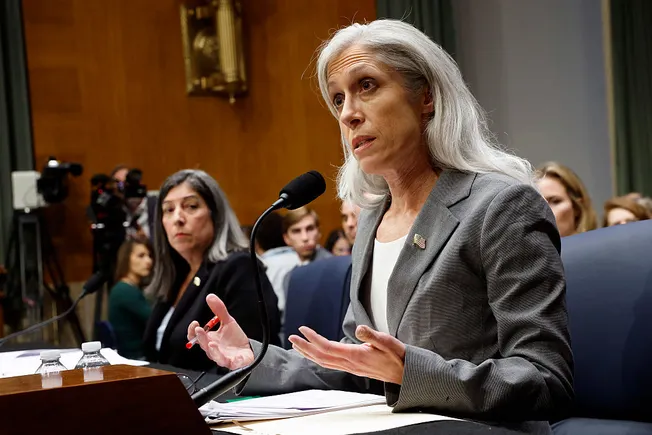
    Monarez informed U.S. lawmakers of Kennedy’s plans Wednesday during a hearing hosted by the Senate Health, Education, Labor and Pensions Committee. The hearing is the first public appearance by Monarez since her firing, which spurred several other high-ranking CDC officials to resign in protest.

    In a Sept. 4 op-ed in The Wall Street Journal and again Wednesday, Monarez said she was removed for refusing to rubber-stamp vaccine guidelines without supportive evidence.

    “He just wanted blanket approval,” Monarez said during the hearing, referring to Kennedy. “If I could not commit to an approval to each of the recommendations, I would need to resign.”

    Monarez said Kennedy plans to change recommendations for childhood vaccinations against COVID-19 and hepatitis B. Both shots will be discussed at a meeting this week of the CDC’s Advisory Committee on Immunization Practices, which is tasked with formulating guidelines.

    “In the first meeting [with Kennedy], he asked me to commit to firing scientists or resign. He asked me to pre-commit to signing off on each one of the forthcoming ACIP recommendations, regardless of whether or not there was scientific evidence.”

    Debra Houry, the CDC’s former chief medical officer who resigned after Monarez’s ouster, also testified at the hearing Wednesday.

    ACIP’s meeting, which will take place Thursday and Friday, will be closely watched. A draft agenda indicates the committee will discuss and vote on guidelines for vaccines against hepatitis B, COVID, and measles, mumps, rubella and varicella.

    Monarez and Houry told senators that they were not aware of any scientific evidence to support changing the age at which children can get those vaccines.

    Sen. Bill Cassidy, R-La, expressed support for the inclusion of the hepatitis B vaccine in the childhood immunization schedule. The shot is recommended for all infants.

    “That is an accomplishment to make America healthy again, and we should stand up and salute the people that made that decision, because there’s people who would otherwise be dead if those mothers were not given that option to have their child vaccinated,” Cassidy said.

    Since becoming head of HHS, Kennedy has remade ACIP, firing its previous 17 members and stacking it with seven advisers he picked. This week, just days ahead of the committee’s meeting, Kennedy added five new members, including individuals whose backgrounds are atypical for the panel. Now among the panel’s members are critics of COVID vaccine policies and skeptics of vaccine technologies like messenger RNA.

    At an earlier meeting in June, the seven advisers first chosen by Kennedy indicated they held doubts about the evidence supporting COVID vaccines and voted to remove a little-used, but controversial preservative that’s been targeted by anti-vaccine groups.

    Typically, CDC working groups prepare data in support of ACIP votes on guidelines. Houry said no working groups besides one for COVID have been convened ahead of this week’s meeting, however.

    Monarez indicated she would be open to changing the childhood vaccine schedules if there was supporting evidence to do so.

    “Kennedy responded that there was no science or evidence associated with the childhood vaccine schedule, and he elaborated that CDC had never collected the science or the data to make it available related to the safety and efficacy,” Monarez said.

    Studies supporting the vaccines included in the childhood immunization schedule are public, and the current schedule has been supported by medical associations.

    “I worry about our medical institutions having to take care of sick kids that could have been prevented by effective and safe vaccines,” Monarez said. “I worry about the future of trust in public health.”

    Source link

  • Harvard: Indoor air quality even more important in early childhood

    Harvard: Indoor air quality even more important in early childhood

    This audio is auto-generated. Please let us know if you have feedback.

    Indoor air pollution has especially powerful effects on babies and young children, not only due to more time spent indoors but because they breathe more rapidly and inhale more air relative to their body size than adults, according to a working paper by the Center on the Developing Child at Harvard University.

    Most spend more than 90% of their time in enclosed buildings, where air pollutants can be two to five times higher than outdoor levels due to poor ventilation, say the researchers, citing estimates from the U.S. Environmental Protection Agency. 

    During early childhood, the amount of time spent inside is also due to the additional time spent in childcare facilities, schools, community centers, summer camp buildings, offices and homes, according to the paper. Elevated levels occur for those during pregnancy as well, the researchers say. 

    One example of volatile organic compounds, or VOCs, commonly found inside children-focused locations stems from the frequent use of cleaning products — particularly scented spray products — that result in a higher risk of wheezing in early childhood and the development of asthma and lower respiratory tract infections in childhood, the researchers say. 

    The paper notes that actionable solutions to improve indoor air quality exist. These range from policy and regulation to pollutant-free cleaners, healthier housing and furniture materials, new building technologies and “simply maintaining and using ventilation systems with high-quality filters.” 

    The EPA defines indoor air quality management as the control of airborne pollutants, introduction and distribution of adequate outdoor air and the maintenance of acceptable temperature and relative humidity. Key pollutants present in children’s environments that can cause serious harm when exposure occurs include VOCs; pesticides, phthalates, forever chemicals and flame retardants; particulate matter; wildfire smoke; germs, viruses, bacteria and allergens; gases; and heat, according to the Harvard research paper. 

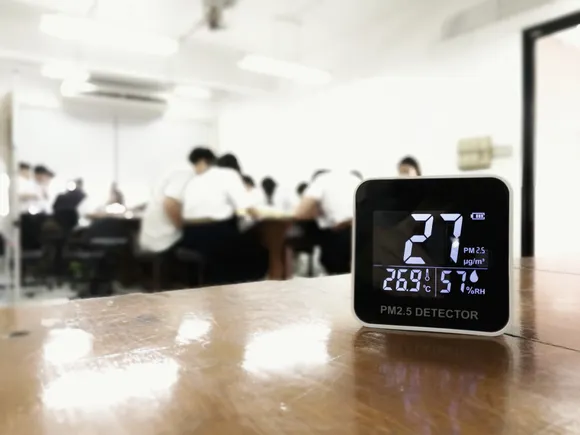
    A balanced approach to cleaner indoor air means three approaches: protection, adaptation and prevention, the paper says. Facility managers can protect occupants by monitoring indoor air quality, switching to safer cleaning products, using hooded kitchen exhaust fans that vent to the outside, and utilizing portable, room-based air purifiers with HEPA filters, according to the paper. 

    Adaptation includes the reduction and absorption of emissions by creating vegetation barriers, transitioning to less polluting appliances and by making buildings healthier. According to the Healthy Buildings Program at the Harvard T.H. Chan School of Public Health, an approach to improving air quality includes the use of ventilation that controls indoor sources of pollutants, providing regulation maintenance of ventilation systems and implementing an integrated pest management plan. This plan should focus on preventative measures, such as sealing entry points, preventing moisture buildup and removing trash, according to the paper. 

    Operators should also install and maintain adequate ventilation and filtration systems in schools located in low-income neighborhoods and verify that building systems are operating as designed. The researchers noted that proper maintenance and use of these systems is “surprisingly rare,” citing a California study of schools with recently retrofitted HVAC systems that found only 5% of classrooms met minimum ventilation rates due to improperly selected equipment, incorrect fan control settings and maintenance issues. 

    Prevention measures include policy interventions and the development of health-based regulatory standards for indoor air quality, researchers say.   

    The EPA’s IAQ Tools for Schools program is one resource that operators can use to implement these strategies, including a framework for effective school IAQ management, guidance documents and an IAQ assessment mobile app that can be used to address critical building-related environmental health issues.

    Source link