Tag: Chinas

  • What does the K visa mean for China’s search for global talent?

    What does the K visa mean for China’s search for global talent?

    Earlier this month, China’s State Council amended the Regulations on the Administration of the Entry and Exit of Foreigners, highlighting the growing importance of its global talent strategy.

    Effective from October 1, the visa, which will be subject to approval by the authorities of the People’s Republic of China, will be open to international youths who have earned undergraduate or STEM degrees from leading domestic and global research institutions. 

    The visa will also be open to young international professionals engaged in education and research in STEM fields.

    As per reports, compared with ordinary visa categories in China, the K visa is designed to provide greater convenience for holders through multiple entries, longer validity, and extended stay durations.

    We see it as a powerful signal that China is not only open for business but is actively and competitively seeking to attract the world’s best and brightest minds
    Charles Sun, China Education International

    It will also create opportunities for exchanges and collaboration across education, science, technology, culture, business, and entrepreneurship with applications no longer needing sponsorship from a local enterprise, relying instead on the applicant’s age, educational background, and work experience.

    “We see it as a powerful signal that China is not only open for business but is actively and competitively seeking to attract the world’s best and brightest minds,” Charles Sun, founder and managing director of China Education International, told The PIE News.

    “A key attractive feature is the inclusion of provisions for spouses and children. Making it easier for families to relocate together is perhaps one of the most important factors in convincing top-tier talent to make a long-term commitment to a new country.”

    According to data from Studyportals, this move comes at a time when interest in pursuing Artificial Intelligence degrees in the US is declining, while interest in studying the same in China is on the rise.

    “When comparing January to July 2025 to the same period in 2024, relative demand for artificial intelligence degrees (on-campus Bachelor’s and Master’s and PhDs) in the US on Studyportals dropped 25% year-over-year, while interest in AI degrees in China rose 88%,” read a report shared by Studyportals.

    “Both Beijing and Washington are racing to secure technological leadership in the  ‘Race on AI’. According to Harvey Nash “Digital Leadership Report 2025” artificial intelligence has created the world’s biggest and fastest-developing tech skills shortage in over 15 years. This shortage has created a race for talent, with companies like Meta reportedly handing out $100m sign-on bonuses to win top talent.”

    While interest in pursuing such degrees in China is growing amid its global talent push, the US remains a powerhouse in the field.

    International students account for 70% of all full-time graduate enrolments in AI-related programs and make up more than half of all international students in the country enrolled in STEM disciplines.

    “Nations that succeed in drawing the brightest minds and in creating an environment for innovative business to thrive, will not just advance their economies, they will command the future of technology, security, and influence,” stated Edwin Rest, CEO of Studyportals.

    “International students do not only bring revenue to local economies and soft power, they also fuel innovation, startups, and job creation.”  
    Source link

  • China’s censorship goes global — from secret police stations to video games

    China’s censorship goes global — from secret police stations to video games

    Last year, FIRE launched the Free Speech Dispatch, a regular series covering new and continuing censorship trends and challenges around the world. Our goal is to help readers better understand the global context of free expression. The previous entry covered Australia’s ban on teen social media, South Korea’s martial law decree, and more. Want to make sure you don’t miss an update? Sign up for our newsletter

    China’s censorship in the news — and in the U.S.

    • Late last month, a New York man pleaded guilty in Brooklyn Federal Court to his role in running a secret Chinese government police station in Manhattan. The Chinese government is accused of setting up over a hundred such stations worldwide and using them to surveil, threaten, and silence dissidents outside its borders. His prosecution is the latest in a series of Department of Justice efforts to combat foreign governments’ targeting their critics within U.S. borders.
    • On a related note, President Joe Biden established a “China Censorship Monitor and Action Group” in December. The group’s mission is to “monitor and address the effects of any efforts by the PRC to censor or intimidate, in the United States or in any of its possessions or territories, any United States person, including a United States company that conducts business in the PRC, exercising its freedom of speech.”
    • If you’re a gamer, you might be excited about the popular new video game “Marvel Rivals.” But you may be disappointed to learn that the game comes with some strings attached — namely, users cannot make political statements that the Chinese Communist Party dislikes. The game, created by Marvel and Chinese developer NetEase, blocks users from typing phrases in the chat function including “Tiananmen Square,” “free Taiwan,” “free Hong Kong,” “free Tibet,” and “Taiwan is a country.” What is allowed? Negative commentary about Taiwan. 

    On a somber anniversary, a glimmer of hope for blasphemers

    Sign reading Je Suis Charlie at a memorial for the victims of the Charlie Hebdo magazine terror attacks in 2015. (conejota / Shutterstock.com)

    Jan. 7 marked the tenth anniversary of the Charlie Hebdo attacks, in which cartoonists and staff from satirical French magazine Charlie Hebdo were killed by gunmen over the magazine’s depictions of the Prophet Muhammad. The magazine commemorated the date with a contest for the “funniest and meanest” depictions of God. 

    As I wrote about the anniversary, we have failed to protect blasphemers since the killings and, in some ways, the legal realities are getting even worse for those accused of transgressing against deities. But there are a couple of bright spots in the wake of the commemoration. 


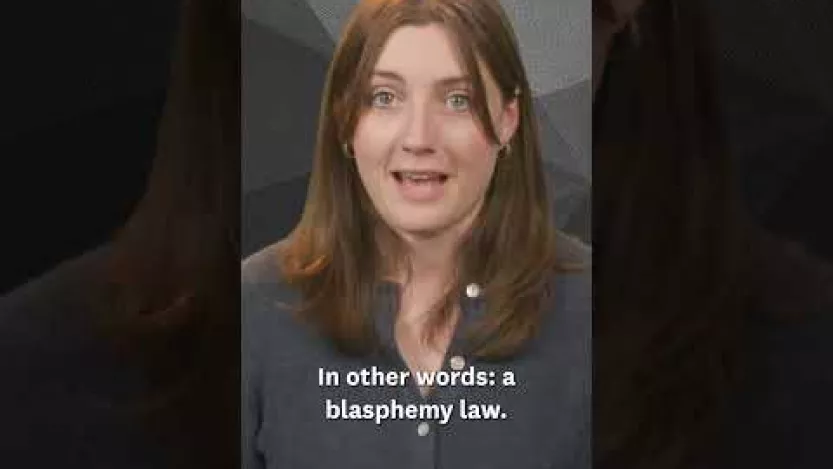
    WATCH: UK to create blasphemy laws?

    A BBC report released on the anniversary itself announced that Nigerian humanist Mubarak Bala was set free from prison after a nearly five year legal battle. Bala was initially sentenced to 24 years in prison for blasphemous Facebook posts. His sentence was reduced last year, and although he has now been released, he is not exactly free. Bala is in hiding in a safe house, due to concerns that he will be attacked by vigilantes or mobs.

    And, now, Spain is looking to set a good example, with the Socialist party’s introduction of a bill that would, among other things, repeal the country’s blasphemy law that hands out fines to offenders. This law “rarely achieves convictions and yet it is constantly used by extremist and fundamentalist organisations to persecute artists, activists (and) elected representatives, subjecting them to costly criminal proceedings,” the party’s spokesperson said. 

    The legislation was prompted by a lawsuit “brought by Abogados Cristianos (Christian Lawyers) against comedienne Lalachus after she, in a state television appearance during New Year’s Eve celebrations, brandished an image of Jesus on which the head of the cow mascot for a popular TV program had been superimposed.”

    The latest in speech rulings and regulations

    From the UK to Germany to Singapore: Police are watching what you post

    Blog

    Police detained a pro-Palestinian activist in London under the UK’s Terrorism Act for, as the arresting officer put it, “making a hate speech.”


    Read More

    • Lithuania’s Constitutional Court ruled as unconstitutional a provision in the country’s Law on the Protection of Minors from Negative Effects of Public Information, which stated that information about non-traditional families was harmful to minors and could be restricted.
    • Irish media regulator Coimisiún na Meán released a decision last month warning Meta to take “specific measures” to reduce the “dissemination of terrorist content” on Facebook and report its progress. The nature of the “terrorist content” remains unclear.
    • The UK’s Investigatory Powers Tribunal issued a ruling finding that an “undercover surveillance operation” by the Police Service of Northern Ireland and Metropolitan Police to identify journalists’ sources was “disproportionate” and “undermined” media protections
    • Albania announced a one-year ban on TikTok, with the country’s prime minister blaming the app for violence among young people, including the recent stabbing death of a 14-year-old. (The Supreme Court is deliberating the TikTok ban here in the United States, a ban FIRE opposes as a First Amendment violation.)
    • On Christmas Day, Vietnam enacted a new decree requiring social media users to verify their identity, a tool that’s ripe for abuse in a country known for its crusade to silence online government critics.

    Maker of infamous Pegasus spyware loses to WhatsApp in California court 

    NSO Group Technologies is an Israeli cyber-intelligence firm known for its proprietary spyware Pegasus

    NSO Group Technologies is a cyber-intelligence firm known for its proprietary spyware Pegasus. (poetra / Shutterstock.com)

    Meta’s WhatsApp won a major victory in the U.S. District Court for the Northern District of California against the NSO Group, an Israel-based spyware company. The NSO Group was accused of exploiting WhatsApp to install its infamous Pegasus spyware program into over a thousand phones. 

    Pegasus, sold to governments around the world by NSO Group, became the center of blockbuster reporting in recent years over its use to target human rights activists and journalists — and the wife of Jamal Khashoggi, the U.S. based journalist who was brutally murdered in the Saudi consulate in 2018.

    Deepening repression continues into 2025

    The new year unfortunately doesn’t mean an end to repressive trends around the world, some of which have been building for years or even decades. 

    • Hong Kong is once again attempting to punish its exiled pro-democracy activists. Late last month, Hong Kong police offered large rewards for information assisting in the arrest of activists now in the UK and Canada who are accused of national security law violations. Then the city’s government canceled the passports of seven activist “absconders,” including some based in the U.S. “You will become a discarded soldier, you will have no identity,” Secretary for Security Chris Tang said at a press conference. “After I cancelled your passport, you cannot go anywhere.” And early this week, police raided a pollster’s home and office over claims he assisted a “wanted person who has absconded overseas.”
    • Meanwhile, critics are still being punished regularly within Hong Kong. A 19-year-old student is battling charges that he insulted China’s national anthem by turning his back while it played at a World Cup qualifier. He pleaded not guilty this month.
    • A teenage girl spent the holidays in pre-trial detention in St. Petersburg, Russia, after being detained on charges of “public calls for committing terrorist activities or public justification of terrorism.” The 16-year-old allegedly put on her school’s bulletin board flyers celebrating “Heroes of Russia” — Russian troops who defected to fight for Ukraine. 
    • It’s difficult to imagine any more ways the Taliban could dream up to suppress the expression and presence of women of Afghanistan, but they found another. A government spokesman announced that existing buildings and new construction would be required to obscure or eliminate windows showing “the courtyard, kitchen, neighbour’s well and other places usually used by women,” as the sight of them could “lead to obscene acts.” 
    • Human rights lawyer Arnon Nampa, whose repeat and unjust prosecutions I’ve discussed in previous Dispatch entries, has once again been sentenced to prison for his commentary about Thailand’s monarchy. This time he’s been sentenced to nearly three years in prison over an anti-monarchy Harry Potter-themed 2020 protest. In total, that puts him at almost 19 years in prison.
    • Apple and Google pulled VPNs from their app stores in India in response to an order from the Indian Ministry of Home Affairs, an act that “marks the first significant implementation of India’s 2022 regulatory framework governing VPN apps.” These regulations require VPN providers to keep for five years records of users’ names and identifying information.
    • A Uyghur woman was sentenced to 17 years in prison for engaging in “illegal underground religious activity” by teaching about Islam to her sons and neighbor.
    • Kenya’s president claimed for months that allegations of forced disappearances of activists connected to a youth protest movement were “fake news” but now appears to admit the government’s responsibility and promises an end to the kidnappings. “What has been said about abductions, we will stop them so Kenyan youth can live in peace, but they should have discipline and be polite so that we can build Kenya together,” president William Ruto said last month.
    • This month, Vietnamese lawyer Tran Dinh Trien went on trial for “infringing upon the interests of the state” in three Facebook posts criticizing the chief justice of the Supreme People’s Court of Vietnam. He’s potentially facing up to seven years in prison.
    • And last week, María Corina Machado, opposition leader against Venezuelan President Nicolás Maduro, was “violently intercepted” and arrested after exiting a protest in Caracas. Machado had previously been in hiding from an arrest warrant issued against her. She’s since been released but her team alleges that she “was forced to record several videos” before being set free.

    Recently unbanned Satanic Verses is popular in India’s bookstores — for now

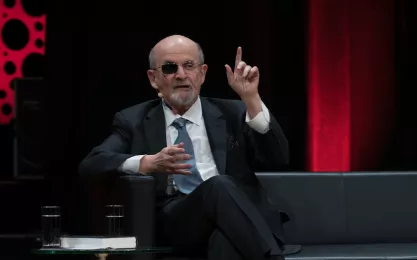
    Salman Rushdie speaks at the 75th Frankfurt Book Fair in October 2023

    Salman Rushdie, author of “The Satanic Verses” speaks at the 75th Frankfurt Book Fair on Oct. 21, 2023.

    In November, I noted that India’s ban on Salman Rushdie’s controversial bestseller “The Satanic Verses” was ending for an absurd reason: No one could find the decades-old order from customs authorities banning its import. 

    The book is now available in the country’s shops and appears to be a hit. One store manager said he was selling out of copies, despite the book’s higher-than-average cost. But not everyone is thrilled by its popularity. Groups calling for a reinstatement of the ban include the Forum Against Blasphemy and the All India Muslim Jamaat, whose president said, “No Muslim can tolerate seeing this hateful book on any bookstore shelf.”

    Source link