Tag: civic

  • The Last Class with Robert Reich (Inequality Media Civic Action)

    The Last Class with Robert Reich (Inequality Media Civic Action)

    Former Secretary of Labor Robert Reich might be famous for his public service, best-selling books, and viral social media posts, but he always considered teaching his true calling. The Last Class captures a master educator wrestling with the dual realities of his own aging and his students inheriting a world out of balance. Reich confronts the impending finality with unflinching candor, humor, introspection, and a rawness of emotion he has never shared publicly before.

    One thousand students fill the biggest lecture hall on campus—the last class to receive Reich’s wisdom and exhortations not to accept that society has to stay the way it is. His final assignment: Who will be the teachers of tomorrow?

    Source link

  • Military education committees and universities’ civic role

    Military education committees and universities’ civic role

    The publication of the Strategic Defence Review (SDR) in early June 2025 emphasised a whole-of-society approach to defence and recognised the importance of societal engagement and resilience-building.

    But there was also an element of missed opportunity – the review should also have been a moment to highlight the role of the network of 19 regional military education committees (MECs) which exist to foster good relations between universities and the armed forces, and their associated university service units (USUs).

    Although universities were prominently featured in the SDR, the focus was narrowly confined to their ability to serve as a talent pipeline and to provide technology to support “warfighting” and “lethality”.

    What’s missing is a more engaged understanding of the broader value universities provide for defence, particularly the role of MECs in fostering this relationship, building on Haldane’s earlier vision of a civic university with strong links to the armed forces.

    We see a need to outline a broad vision for MECs that builds on the SDR but also looks beyond it, offering a future-focused perspective for leaders in the armed forces and academia.

    Universities and civil-military relations

    Universities play a crucial – though often overlooked – role at the interface of civil-military relations. Our graduates are the officers of the future, and with seven per cent of UK households including a veteran, and over 180,000 currently serving, many of our students’ university experiences are inherently shaped by military life, whether as part of service families or as future personnel.

    Established as part of the Haldane Reforms of the armed forces in 1908, MECs were initially created to ensure that officer cadets received a balanced education, combining academic study with military training.

    Today, MECs are a vital bridge between two distinct worlds: academia and the military. They offer a unique forum where these cultures meet, enabling universities to better understand the particular pressures facing students in university service units and students from service families, while helping the military appreciate the academic environment through the eyes of those teaching their officer cadets.

    Military education committees and the student experience

    MECs support students serving in university service units by helping them navigate the dual demands of academic study and armed forces activities. These officer cadets face unique pressures and challenges, but also gain valuable opportunities for skills development, leadership training, and even paid experiences through social and sporting activities including overseas trips and training deployments. For those interested in an armed forces career, scholarships are available which provide a crucial route to higher education, often for those who would otherwise find it financially prohibitive.

    A recent commentary from the Royal United Services Institute underscores the importance of these activities, particularly the role of the University Officer Training Corps (UOTCs) in the British Army’s officer training pipeline. The authors warn against proposals to centralise all training at the Royal Military Academy Sandhurst, which they argue would undermine the historical and practical value of UOTCs as springboards for leadership and national resilience. They argue that UOTCs are vital for building the skills and networks needed for future mobilisations and for sustaining the Army Reserve’s capacity.

    This vital role underscores how the meeting of minds facilitated by MECs is more than just symbolic. In practical terms, MECs bring together universities and university service units for events ranging from Remembrance Sunday commemorations, to officer cadet-led debates on topical issues, to high-profile guest lectures, like Newcastle’s annual defence lecture.

    It has also helped bridge defence and the lecture hall. For example, through the Hacking 4 MoD module, facilitated by the Common Mission Project, where students tackle real-world challenges set by the Ministry of Defence. To date, this is run in over 20 universities across the UK, and is often led by MEC members, whose insights into defence make it easier for academics with no military background to teach and engage confidently in this space to better support students.

    Pluralism, oversight, and civic values

    The relationship between academic and the military is not without its critics. Some argue that engagement with the armed forces risks the militarisation of academic spaces, threatening academic freedom and raising ethical concerns.

    Yet universities have never been entirely “de-militarised” spaces. The concept of the “military-university nexus” is useful here in that it challenges any simplistic binary between civilian and military spheres, requiring us to consider each relationship on its own merits.

    MECs provide essential civilian oversight of USUs, establishing lines of communication that build trust and mutual understanding. As autonomous institutions, universities thrive on debate and competing viewpoints – this pluralism is vital if they are to remain places of innovation and critical thought.

    Challenges and opportunities ahead

    Looking to the future, MECs face the challenge of adapting to a rapidly changing educational and geopolitical landscape – one in which the UK will increasingly rely on societal resilience, whether to counter misinformation or respond to threats against NATO allies. Universities therefore have a crucial role in national security, not as talent pipelines alone, but as civic institutions producing future leaders, both civilian and military.

    The national security landscape outlined in the SDR echoes Haldane’s idea of a “nation in arms”, fostering closer ties between the army and society to mobilise civilian resources during wartime.

    The risk of the SDR, however, is that it frames universities too narrowly, as talent pipelines supporting STEM innovation in service of “lethality”, rather than recognising the wider civic contribution they make. In a democracy, we expect the armed forces to reflect the society they serve, in both composition and leadership values. Tomorrow’s officers are shaped in part by their university experiences – ignoring this reality is a missed opportunity.

    Moreover, the emphasis in the SDR on AI, cyber warfare, and space defence requires a re-evaluation of MECs and their engagement with USUs. This sits alongside a broader shift from civic universities to a more regionally-engaged model – globally connected but rooted in local innovation and committed to addressing societal challenges. Universities and their respective MECs will need to foster adaptability and technological literacy, preparing students and staff for non-conventional challenges, whether in warfare or not.

    Diversity and inclusive leadership

    Taking a whole society approach to defence, MECs will need to redouble their efforts to champion inclusivity and diversity, fostering lesson-sharing between universities and USUs.

    The armed forces struggle to be representative of the society they serve – with a level of ambition set for 30 per cent intake of women by 2030 (currently at 11.6%) and only incremental improvement in ethnic minority representation (currently 15.3 per cent).

    Many USUs in contract already achieve or approach gender balance, though challenges remain in recruiting ethnic minority cadets, and translating the gender balance into those who chose to go through the full officer selection process. That said, MECs need to focus efforts to ensure the offer from USUs is inclusive, addressing barriers to participation and creating welcoming environments for all. At the Northumbrian Universities Military Education Committee, for example, we have a standing agenda item for USUs to report on the status of women within their units. This has led to several collaborations between university colleagues and their military counterparts to tackle the issue head-on.

    The civic role, reimagined

    The civic role of universities in supporting societal resilience – essential for an effective defence, through fostering informed debate, critical thinking, and understanding – is too important to lose. MECs remain central to this mission, ensuring that universities continue to be spaces of pluralism and partnership, bridging military and academic worlds for the benefit of both.

    As universities reimagine their civic role, it is crucial that engagement with the armed forces remains anchored in inclusivity and democratic values, rather than reduced to recruitment pipelines or simply extracting STEM expertise in service of “lethality”. MECs have a key role in this, bringing together academic and military leaders to create spaces for reimagining civil-military partnerships – championing diversity, civic leadership, and mutual understanding in all areas of their work.

    Source link

  • Promoting Civic Action through Service Learning

    Promoting Civic Action through Service Learning

    ***HEPI and the UPP Foundation will host a free webinar tomorrow, Wednesday 4 June at 1pm on embedding employability and civic action into the curriculum. There is still time to register your place: Sign up here***

    • By Dr Ben Lishman, Associate Dean for Students, College of Technology and Environment, London South Bank University.

    London South Bank University (LSBU) launched its Energy Advice Centre (EAC) in January 2023. The concept was a simple one. The energy crisis of the previous year had seen average household gas and electricity bills increase by 54% in the spring and a further 27% that autumn. The University already had well-established legal and small business advice clinics, so why not expand the concept to have students in our College of Technology and Environment provide local residents with energy-saving advice?

    With grant funding from the UPP Foundation, we have created a database of advice and ideas, which we share through a website and a drop-in clinic where local residents can talk directly to our students. The students answer questions, make suggestions for domestic changes which will reduce bills, and remove layers of complexity around domestic energy. 

    One of Bridget Philipson’s five priorities for reform of the higher education system is that universities play a greater civic role in their communities. With 15% of our local borough affected by fuel poverty, the Energy Advice Centre (EAC) is making an active and meaningful contribution to LSBU’s civic mission and our commitment to reducing the university’s carbon use.

    Through the website, our Elephant and Castle drop-in clinic, and winter workshops held in Peckham, Camberwell and Canda water, our student advisors have, to date, provided bespoke and detailed advice to over two hundred and fifty homes, as well as schools and SMEs. By providing information and guidance on issues such as improving energy efficiency, fitting insulation, installing solar panels and applying for home improvement grants, we estimate that the Energy Advice Centre has enabled savings of £75,000 on energy bills so far – and much of the advice we’ve given should provide savings for years to come.

    The impact of our work has been noticed locally, with Southwark Council making the Energy Advice Centre its official Green Homes Service, providing funding that has allowed the centre to continue once the initial grant from the UPP Foundation had been spent.

    It’s not only local residents who benefit from the Centre. In addition to being paid for their time, working at the EAC provides students with the opportunity to engage in civic activities while developing work-ready skills through applying learning from the classroom into the real world. This has enabled a number of the thirty students who have worked for the EAC so far to get jobs in professional energy advice, net-zero buildings research, and jobs in sustainability across their sectors.

    I’m thrilled that the UPP Foundation, having seen evidence of the effectiveness of the model, has provided us with further funding to develop a toolkit, which provides guidance on how other universities can develop their own energy advice centres. We are now working with three initial partner universities – Wrexham University, University of Reading and Kingston University London – to set up their own centres. We think there’s a need for a national network of these centres, sharing good ideas, and we want to share what we’ve learned.

    If you would be interested in exploring how to set up an energy advice centre at your own institution, the toolkit is being made available on the UPP Foundation’s website. At 1pm on 4th June, HEPI is also holding a webinar on how initiatives such as the EAC can be used to embed employability and civic engagement in higher education.

    Source link

  • As universities embrace the civic, they must transcend activist/academic binaries

    As universities embrace the civic, they must transcend activist/academic binaries

    Everyone has their own expertise. For academics, that expertise leads to intellectual authority. Some happily choose to use that authority in the cause of activism. Others cringe at the thought, fearing the overtly political and a loss of actual or perceived objectivity.

    The debate as to whether academics can be or should be activists is alive and well. But, as universities across the UK (re)discover their civic purpose, institutional spaces for overtly activist academic work are emerging.

    One such space is that offered through activist-in-residence (AiR) schemes. Typically hosted by university research centres, these programmes invite activists to work alongside academics and students on projects with a social justice focus. The activists gain access to institutional resources, collaborating with their hosts through a wealth of mutually transformative and enriching encounters that may challenge traditional academic practices. Such schemes are relatively rare in the UK but more common in North American higher education institutions.

    Oppositional or diplomatic activism?

    Ronald Barnett has said that academic activism can lend itself to an array of stances. He suggests that activism in universities may be situated along two sliding axes – diplomatic/oppositional and individual/collective actions. Oppositional to the state, to the status quo, versus a diplomatic willingness to engage with powerful institutions.

    But let’s face it, universities often are powerful institutions perpetuating the status quo. And anyway, can you really be activist within institutional structures? For some, it’s a clear “no”. When our Queer@King’s research centre at King’s College London launched a call for activists to join a pilot AiR scheme, several rejected the invite, concerned to connect their queer activism to oppressive institutional structures.

    However, for those willing to accept such an invite, there’s the potential to become a (diplomatic) institutional irritant. Here, we view the work of AiR schemes as that of “collective diplomacy”. Residencies carve out institutional spaces for academics and activists to unite around a social justice cause, practising theory-informed activism and activism-informed theory.

    Those engaged in AiR schemes might act as tempered radicals, working subtly to forge change, both within and beyond institutions. Quiet acts of rebellion, compared to the vocal stridency of their oppositional cousins.

    Transcending the binary

    Back in 2023, we launched four new AiR schemes in the Faculty of Arts and Humanities at King’s College London. Since then, we’ve followed the journeys of the activists and academics involved as they walk the tightrope between conformity and rebellion.

    The schemes, which involved four discrete research centres, have recently concluded. They spanned diverse areas – from decolonising wellness practices to challenging media narratives on race and migration, from reclaiming language justice to reframing the lived expertise of women with HIV. The communities engaged were equally diverse – French anti-racists, diaspora communities from East and Southeast Asia, movement artists, radical translators, poets, community organisers, a charity supporting women with HIV.

    Despite thematic differences, what united the schemes was a commitment to co-creation, disrupting institutional norms, and centring knowledge that often remains undervalued or excluded from academia.

    Activists have, quite rightly, long been wary of universities’ historical tendencies to extract knowledge without genuine reciprocity. Our AiR schemes attempt to shift this, striving for shared authorship and long-term relationship-building over transactional engagements. Academics, meanwhile, began questioning their own positionality. Several noted how the process helped them to see the activist within. Someone who takes a different approach from big marches or picket lines. Someone who instead, operates in a different sphere, with different tools from conventional protest.

    A core element of the schemes involved deep conversations in which participants explored different ways of “being”, “doing”, and “knowing”, navigating creative tensions that ignited activist potential. Engagement in transformational dialogue demanded a rethinking of traditional academic hierarchies.

    A striking outcome was the impact on identity. Many participants shifted from seeing themselves as strictly ‘academic’ or ‘activist’ to occupying a hybrid space—the activist-academic or the academic-activist. As one participant put it:

    I’ve learned to see myself as an academic-activist, rather than assuming that activism is something distinct from what I do as a researcher.

    Others reflected on how their roles had become more fluid, disrupting rigid institutional scripts about who generates knowledge, and how.

    The schemes were not without tension. Bureaucratic barriers, power imbalances, and institutional inertia were recurrent frustrations. Activists were often faced with institutional red tape, while academics navigated the challenge of validating non-traditional forms of knowledge in spaces structured around rigid frameworks. Yet, the schemes demonstrated that universities could serve as incubators for new forms of activism and collaboration – if they are willing to do the hard work of structural change.

    The future of AiR schemes

    AiR schemes must be more than symbolic gestures. Universities must actively dismantle the barriers that limit their potential: from rethinking funding structures that exclude grassroots activists to challenging rigid research output models that fail to recognise activist knowledge production. And of course, always ensuring that sustained funding is made available.

    As universities embrace their civic role, they should go beyond the activist/academic binary. The most powerful insights from AiR schemes come not from forcing these categories into opposition, but from allowing them to blur, evolve, and co-exist.

    For the academic hesitant to embrace activism, AiR schemes provide a pathway for engaged scholarship. For the activist wary of academia, they offer a chance to disrupt from within. And for the university itself, they provide a critical mirror, one that reveals its complicity, its contradictions – but also, its potential as a site of radical possibility.

    Source link

  • UNC Chapel Hill Provost Stepping Down Amid Civic Life Strife

    UNC Chapel Hill Provost Stepping Down Amid Civic Life Strife

    The University of North Carolina at Chapel Hill’s provost is stepping down next month to return to the faculty there, a development that news articles last week suggested is tied to his disagreement with hiring practices at the School of Civic Life and Leadership, or SCiLL.

    In a statement Friday to Inside Higher Ed, Chris Clemens, the outgoing provost, said, “I made the decision to step down as provost. During my time as provost, I’ve been able to address challenges I care deeply about and make meaningful progress. However, the issues that have arisen in recent days are not ones I can solve, and I don’t feel the same passion for them.”

    His statement didn’t explain what these recent issues are, and Chapel Hill spokespeople didn’t provide further information beyond campus chancellor Lee Roberts’s April 3 announcement that Clemens had decided to step down.

    Clemens will return May 16 to being the Jaroslav Folda Distinguished Professor of Physics and Astronomy, Roberts said in that announcement. Clemens has been provost since early 2022, starting under former chancellor Kevin M. Guskiewicz, who’s now president of Michigan State University. Roberts credited Clemens with, among other things, helping establish the School of Data Science and Society, the Program for Public Discourse, and SCiLL.

    SCiLL was established after Chapel Hill’s Board of Trustees passed a resolution in January 2023 asking the campus administration to “accelerate its development” of this new school. The then–board chair called SCiLL an effort to “remedy” a shortage of “right-of-center views” on campus. Controversy quickly ensued. Faculty said they didn’t know a whole school was in development.

    The Republican-controlled State Legislature then passed a law requiring Chapel Hill to establish the school and hire 10 to 20 faculty from outside the university, plus make them eligible for tenure. It became one of many civics or civil discourse centers—critics have called them conservative centers—that Republican lawmakers and higher education leaders have established at public universities in recent years.

    In January 2025, Clemens canceled the latest SCiLL tenure-track faculty searches before reversing course days later. Articles in The Assembly and the conservative Real Clear Investigations have now implied that Clemens’s departure was connected to his involvement in the disagreements over hiring within SCiLL.

    Clemens, a self-described conservative, had been an advocate for SCiLL. The Real Clear Investigations article was titled, before the headline was changed, “In North Carolina, Academic Conservatives Have Met the Enemy and It Is … Them.”

    In his Friday statement, Clemens said, “I look forward to returning to the faculty to resume work on optical design technology, with a particular focus on applications for the SOAR telescope and astronomy. This will allow me to spend more time in the classroom—an aspect of academic life I have greatly missed.”

    Source link

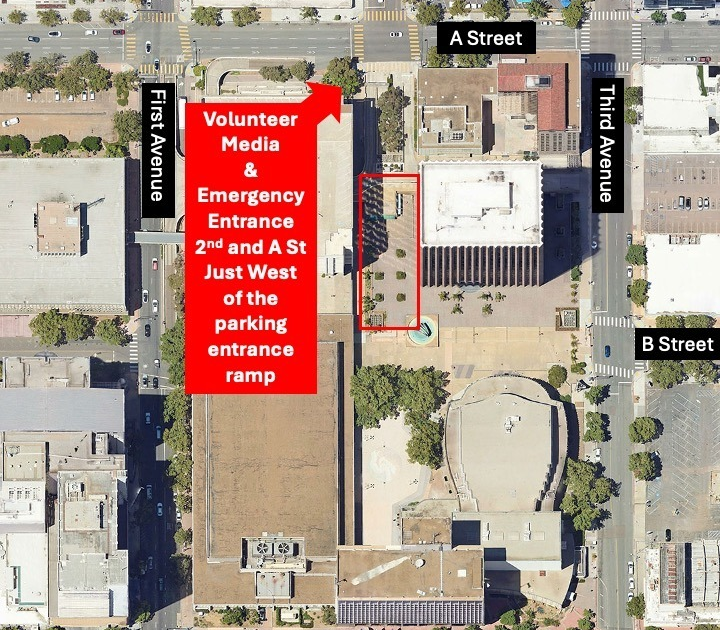
  • Higher Education Inquirer : MEDIA ADVISORY UPDATE: ‘Hands Off!’ March at San Diego Civic Center, April 5 Noon

    Higher Education Inquirer : MEDIA ADVISORY UPDATE: ‘Hands Off!’ March at San Diego Civic Center, April 5 Noon

    SAN DIEGO, CA — Community members will gather at the San Diego Civic Center Plaza for
    a “Hands Off!” march on April 5 to protest DOGE and the Trump
    administration’s attack on programs and services used by San Diego
    residents. The local march will coincide with a nationwide day of
    demonstrations expected to be attended by hundreds of thousands

    Organizers
    describe the event as a collective response to policies impacting our
    community. “San Diegans who are veterans, who are postal workers and
    teachers, who rely on Social Security, Medicaid or Medicare, and who are
    horrified at the Trump-Musk billionaire takeover of our government are
    coming together to protest the Trump Administration’s attacks on the
    rights and services they depend upon, many of them for survival” said
    Angela Benson, a member of the organizing coalition.

    Event Details:

    • What:
      Over 10,000 San Diegans expected to peacefully demand “HANDS OFF!”
      their rights and services in one of over 1,000 HANDS OFF! events
      scheduled nationwide on April 5

    • Who: Coalition of San Diego Pro-Democracy Groups

    • When: Saturday, April 5, noon, 1 mile march to leave approximately 12:15 PM

    • Where: March starts at Civic Center Plaza Fountain by 1200 Third St., ends at Hall of Justice at 330 W Broadway

    • Transportation: Participants are encouraged to take public transit to the event

    Planning group:

    • Change Begins With ME

    • CBFD Indivisible

    • Indivisible49

    • Indivisible North San Diego County

    • Democratic Club of Carlsbad and Oceanside

    • Encinitas and North Coast Democratic Club

    • SanDiego350

    • Swing Left/Take Action San Diego

    • Activist San Diego

    • 50501 San Diego

    Media Opportunities:

    • The following representatives will be available day-of the march for interviews.
      If interested, please coordinate with Richard (770-653-6138) prior to
      the event, and plan to arrive at the location marked below by 11:30 AM
      Pacific

      • Representatives

        • Sara Jacobs – House of Representatives, CA-51 district

        • Scott Peters – House of Representatives, CA-50 district

        • Chris Ward – California State Assemblymember, 78 district

        • Stephen Whitburn – San Diego Councilmember

        • Reverend Madison Shockley II – Pilgrim United Church of Christ

        • Yusef Miller – Executive Director of North County Equity & Justice Coalition

        • Brigette Browning – Executive Secretary San Diego and Imperial Counties Labor Council and President, Unite Here!

        • Crystal Irving – President, Service Employees International Union (SEIU)

        • Andy Kopp – Veteran

        • Patrick Saunders – Veteran

        • Phil Petrie – SanDiego350, Climate Activist

      • Recommended Schedule

        • 11:30 AM – 11:40 AM: Representative introductions – Group/cause they’re representing, why they’re marching

        • 11:40 AM – 12:05 PM: Representatives break off, available for interview by Press

        • 12:05 PM – 12:15 PM: Representatives move to beginning of march

        • 12:15 PM: March begins

        • 12:15 PM – 2:00 PM: March to Hall of Justice

        • 2:00 PM: March ends at Hall of Justice, participants may disperse or continue to federal plaza

    Source link

  • No more civic washing – most universities now pay their staff a living wage

    No more civic washing – most universities now pay their staff a living wage

    Today 88 per cent of UK universities pay a living wage, marking a significant increase from 2022 when I first published an article on Wonkhe that suggested that several universities were engaged in “civic washing” – claiming civic credentials without the concrete action to back up their claims.

    My argument then was that a significant proportion of universities had made public commitments to be “civic” but were not paying the living wage. How, I often asked myself, can you claim to be civic and not treat your lowest paid, and often local, staff with the dignity of a living wage?

    The Living Wage Foundation calculates the living wage to be £12.60 (£13.85 in London) according to the cost of living, based on a basket of household goods and services. This is above the statutory minimum wage, which the government brands as the “national living wage.” Employers – including universities – have used the language of the “voluntary living wage” (VLW) where they claim to pay the level determined by the Living Wage Foundation but are not accredited in doing so. This contrasts with the “real living wage” (RLW) which is when an employer is accredited by the Living Wage Foundation as paying the living wage.

    To be accredited with the Living Wage Foundation an employer must pay all directly employed staff the living wage and have an agreed plan in place for third party contracted staff such as for outsourced catering, cleaning and security. The requirement placed on subcontracted staff is one of the reasons that universities and other employers pay the VLW as opposed to the RLW.

    Real progress

    As reported in a series of Wonkhe articles (here and here), over the past four years there has been an increase in the number of universities paying the real and voluntary living wage. In the context of the acute financial crisis impacting many universities this is a massive achievement that should be celebrated. Indeed, I am aware of only one university that has de-credited from the Living Wage Foundation over the past few years.

    In 2019 (when I first looked into the living wage issue) only 38 of Universities UK members were accredited with the LWF. Today that has increased to 80 with four accrediting in 2024. However, this does not take into account the universities that pay the VLW. The only way to determine this is to check institutional websites and where no information is available to follow up with a freedom of information request. In 2024, we contacted 61 universities and determined that 39 were paying a voluntary living wage.

    This year I decided to update this analysis by focusing on the 22 universities that confirmed they did not pay the RLW or VLW. Two of these were private providers that did not respond to a FOI last year, so I excluded them. The remaining 20 did respond, of which 12 unambiguously acknowledged that they did not pay the living wage, three said they were considering it but currently do not pay the VLW, 2 said no, but added that their pay scales are above the living wage and thus were included in the analysis and three said that they now pay the VLW.

    This means that out of 140 universities in my sample, 123 now pay the real or voluntary living wage (88 per cent), up from 82 per cent last year. Whilst this is undoubtedly cause for celebration, it is important to note that the VLW does not require a commitment for subcontractors to be paid a living wage.

    As some of you know, I am off to pastures new and thus this will be the last time I update the analysis. However, I am delighted that Citizens UK’s community of practice on higher education has agreed to take on the exercise and I have shared with them all the data from previous years. Perhaps when I return to the UK the university sector will have set a precedent by being wholly accredited with the Living Wage Foundation.

    Find out more about the Living Wage Foundation and the process of accreditation as a Living Wage employer here

    Source link

  • The class gap in the civic map

    The class gap in the civic map

    Albert Hill Working Men’s Club and Institute has played an important role in my life.

    It’s the place where my parents had their wedding reception. My christening party was held in its concert room. Friends of mine, uncles, and acquaintances, have had their wakes with luke warm pork-pies and pints of Magent in the bar. The day I got my membership to the club was a milestone into adulthood and at thirty one I suspect I am still the youngest member.

    Temperance and temperament

    The working man’s club emerged through colliding strains of the temperance movement as an alternative to the gin bars of the 1800s, the rise of the industrial working classes and their desire for betterment, and as a hub for leisure, sports, lectures, and other recreational activity. In university parlance we often talk of local catalysts but Albert Hill has maintained a generation of allotments for leek growing competitions, brought money into local economies through the touring domino tournaments, and kept hundreds if not thousands of self-employed singers, caterers, and turns in business.

    And they would not be pretentious enough to call themselves it but it is a civic institution. As the writer Devika Rao has said on the decline of these kinds of third spaces that are neither home nor work “Where do you go if you are not at school, work or home? For some, the answer is, well, nowhere.” The civic agenda does not quite know how to deal with these kinds of third spaces.

    It’s not that universities are not doing things which directly benefit the drinkers of Albert Hill. Universities are providing nursery places, improving school performance, supporting sustainability projects, and much more between. These things are exceptionally valuable, if executed well will change a place, and in an era of constrained university spending are admirable. At the same time, like the temperance campaigners of the 1800s, projects can sometimes feel like telling a general population to know what is good for them. As recent polling by Public First demonstrates a plurality of the public know not much or very little about what their local university does for the local area.

    Further research by Public First shows people see the place where they live as the locus of their identity. Not the United Kingdom, not England, and certainly not Europe, but the actual places they live. The very idea of levelling up (remember that) is tied to both a desire to revitalise a place and an industrial heritage in places that have been left ashore with the tides of globalisation.

    People and their place

    The challenge is that universities are not just local institutions but global ones. Inevitably, this means that they will do things which are unfamiliar to populations that are less internationally mobile. David Goodhart, once darling of the liberal media now feted immigration sceptic, may argue this is the divide between nowheres and somewheres. The somewheres being people rooted in their local places, often not university educated, with small c conservative views. The nowheres being the mobile, less rooted, and highly educated. If the civic agenda is anything it is an attempt to bridge the education faultline through the university.

    This also means that universities do university coded things in their civic agenda. There is not a focussed civic university agenda about revitalising and supporting working men’s clubs, snooker halls, pubs, places of worship, community centres, small music venues, local football teams, or, to a lesser extent, saving the local high street. It’s legitimate to argue that this isn’t the business of universities but this is no more or less true than partnering with the local museum, art gallery, or literature festival.

    And this is perhaps the second challenge. Value, and the things worth spending public money on that aren’t education and teaching, are often middle class coded. This isn’t to say universities aren’t minded of their impacts on working-class communities. From supporting a just transition, to school programmes, free nursery places, and so on, they clearly are. It’s more that the kind of intangible, culturally coded, doing nice things for an area, can feel middle class.

    Again, to be absolutely clear, it’s not that working-class people don’t enjoy literature, art, and culture. This is obviously the case and it’s tedious to suggest otherwise. It’s more about the range of things universities choose to invest in. And, whisper it, it’s because many of these working-class spaces are also full of people who share views that are anathema to universities. They are often less in favour of immigration, less socially liberal, and more opposed to high levels of public spending on the things universities do. To organise in those spaces is to not organise with people that aren’t aware of universities but with people that are aware of universities and simply don’t always like them that much.

    Pot and trench leeks

    This leaves the fundamental challenge of the extent to which universities responsibility extends to areas where they have no direct mission, with individuals that may never join in their activity, and with activities they do not have the cultural cache to do authentically. Even if universities thought maintaining a working-class culture was their role it’s not even that clear what they would actually do.

    Ambiguity doesn’t mean universities can vacate the space. The politics of young white men is flipping the political map. We know there is an increasing pull toward the far right, they are less likely to receive a university education than nearly any other group, and they are more likely to stay in the places they were born. To entirely leave this space is to say universities have no place in their lives which is to tacitly acknowledge that universities’ civic commitments are partial.

    Universities also cannot dictate the civic institutions they have. It’s not their role to tell their populations where to work, live, love, study, enjoy their time, and just hang out. The role of the civic university agenda is not to extend the university into the world but to extend the world into the university. The people who have the most to gain from universities being civically involved are often the least likely to know what the university is or what it does.

    The civic agenda has spurred universities toward a greater consciousness of their places and achieved practical things. The way activities are coded is not to say that these activities are not valuable but it is to say that the authorial intent of civic agendas of economic growth and cultural enrichment hit the reality of communities that feel alienated from institutions generally not just the university.

    If universities are to lead on growth and capture momentum with this new government they have to demonstrate they can support growth everywhere. The success of the civic agenda is not just about days spent in museums, hours of tutoring, or student spending. It is also whether the people that once felt like their university had nothing for them now does.

    Source link