Tag: Civics

  • Trump’s push for ‘patriotic’ education could further chill history instruction

    Trump’s push for ‘patriotic’ education could further chill history instruction

    High school history teacher Antoine Stroman says he wants his students to ask “the hard questions” — about slavery, Jim Crow, the murder of George Floyd and other painful episodes that have shaped the United States. 

    Now, Stroman worries that President Donald Trump’s push for “patriotic education” could complicate the direct, factual way he teaches such events. Last month, the president announced a plan to present American history that emphasizes “a unifying and uplifting portrayal of the nation’s founding ideals,” and inspires “a love of country.” 

    Stroman does not believe students at the magnet high school where he teaches in Philadelphia will buy this version, nor do many of the teachers I’ve spoken with. They say they are committed to honest accounts of the shameful events and painful eras that mark our nation’s history.

    “As a teacher, you have to have some conversations about teaching slavery. It is hard,” Stroman told me. “Teaching the Holocaust is hard. I can’t not teach something because it is hurtful. My students will come in and ask questions, and you really have to make up your mind to say, ‘I can’t rain dance around this.’” 

    Related: Become a lifelong learner. Subscribe to our free weekly newsletter featuring the most important stories in education. 

    These are tense times for educators: In recent weeks, dozens of teachers and college professors have been fired or placed under investigation for social media posts about their views of slain 31-year-old conservative activist Charlie Kirk, ushering in a slew of lawsuits and legal challenges

    In Indiana, a portal called Eyes on Education encourages parents of school children, students and educators to submit “real examples” of objectionable curricula, policies or programs. And nearly 250 state, federal and local entities have introduced bills and other policies that restrict the content of teaching and trainings related to race and sex in public school. Supporters of these laws say discussion of such topics can leave students feeling inferior or superior based on race, gender or ethnicity; they believe parents, not schools, should teach students about political doctrine.

    “It has become very difficult to navigate,” said Jacob Maddaus, who teaches high school and college history in Maine and regularly participates in workshops on civics and the Constitution, including programs funded by the Sandra Day O’Connor Institute. Almost 80 percent of teachers surveyed recently by the institute say they have “self-censored” in class due to fear of pushback or controversy. They also reported feeling underprepared, unsupported and increasingly afraid to teach vital material.

    After Kirk’s death Trump launched a new “civics education coalition,” aimed at “renewing patriotism, strengthening civic knowledge, and advancing a shared understanding of America’s founding principles in schools across the nation.” The coalition is made up made up almost entirely of conservative groups, including Kirk’s Turning Point USA, whose chief education officer, Hutz Hertzberg, said in a statement announcing the effort that he “is more resolved than ever to advance God-centered, virtuous education for students.” 

    So far, no specific guidelines have emerged: Emails to the Department of Education — sent after the government shut down — were not returned. 

    Related: Teaching social studies in a polarized world 

    Some students, concerned about the shifting historical narratives, have taken steps to help preserve and expand their peers’ access to civics instruction. Among them is Mariya Tinch, an 18-year-old high school senior from rural North Carolina. “Trump’s goal of teaching ‘patriotic’ education is actually what made me start developing my app, called Revolve Justice, to help young students who didn’t have access to proper civic education get access to policies and form their own political opinions instead of having them decided for them,” she told me. 

    Growing up in a predominantly white area, Tinch said, “caused civic education to be more polarized in my life than I would like as a young Black girl. A lot of my knowledge in regard to civic education came from outside research after teachers were unable to fully answer my questions about the depth of the issues that we are taught to ignore.”

    Mariya Tinch, a high school senior in North Carolina, at the 2025 Ready, Set, App! competition (second from left). She developed an app to help students get access to policies and form their own political opinions. Credit: Courtesy of Mariya Tinch

    Other students are upset about federal cuts to history education programs, including National History Day, a 50-year-old nonprofit that runs a history competition for some 500,000 students who engage in original historic research and provides teachers with resources and training. Youth groups are now forming as well, including Voters of Tomorrow, which has a goal of building youth political power by “engaging, educating, and empowering our peers.” 

    Related: What National Endowment for the Humanities cuts mean for high schoolers like me

    There will surely be more attention focused on the founders’ original ideals for America as we approach the 250th anniversary of the signing of the Declaration of Independence this July. Some teachers and groups that support civics teachers are creating resources, including the nonprofit iCivics, with its “We can teach hard things — and we should” guidelines.

    How all of these different messages resonate with students remains to be seen. In the meantime, Jessica Ellison, executive director of the nonprofit National Council for History Education is fielding a lot of questions from history teachers and giving them specific advice.

    “They might be anxious about any teaching that could get them on social media or reported by a student or parent,” Ellison told me, noting the strategy she shares with teachers is to focus on “the three S’s –— sources, state standards and student questions.” 

    Ellison also encourages teachers to “lean into the work of historians. Read the original sources, the primary sources, the secession documents from Mississippi and put them in front of students. If it is direct from the source you cannot argue with it.”
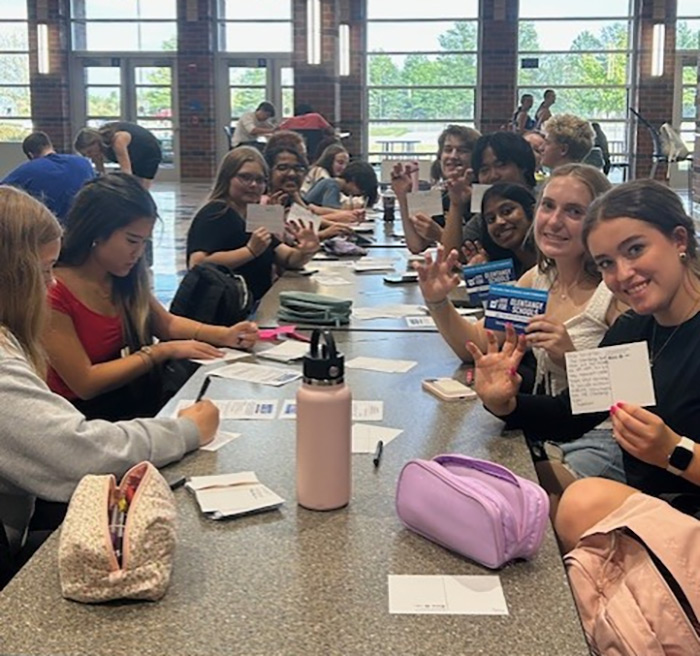
    In September, students at Berlin High School in Delaware, Ohio, participated in a sign creation and postcard campaign for a levy on the ballot. Credit: Courtesy Michael LaFlamme

    Michael LaFlamme has his own methods: He teaches Advanced Placement government and U.S. history at Olentangy Berlin High School outside of Columbus, Ohio, where many of his students work the polls during elections to see up close how voting works. They learn about civics via a participatory political science project that asks students to write a letter to an elected official. He also encourages students to watch debates or political or Sunday morning news shows with a parent or grandparent, and attend a school board meeting.

    “There is so much good learning to be done around current events,” LaFlamme told me, noting that “it becomes more about community and experience. We are looking at all of it as political scientists.”

    For Maddaus, the teacher in Maine, there is yet another obstacle: How his students consume news reinforces the enormous obstacles he and other teachers face to keep them informed and thinking critically. Earlier this fall, he heard some of his students talking about a rumor they’d heard over the weekend. 

    “Mr. Maddaus, is it true? Is President Donald Trump dead?” they asked. 

    Maddaus immediately wanted to know how they got this false news. 

    “We saw it on TikTok,” one of the students replied — not a surprising answer, perhaps, given that 4 out of 10 young adults get their news from the platform.

    Maddaus says he shook his head, corrected the record and then went back to his regularly scheduled history lesson. 

    Contact editor in chief Liz Willen at [email protected].

    This column about patriotism in education was produced by The Hechinger Report, a nonprofit, independent news organization focused on inequality and innovation in education. Sign up for the Hechinger newsletter.
    The Hechinger Report provides in-depth, fact-based, unbiased reporting on education that is free to all readers. But that doesn’t mean it’s free to produce. Our work keeps educators and the public informed about pressing issues at schools and on campuses throughout the country. We tell the whole story, even when the details are inconvenient. Help us keep doing that.

    Join us today.

    Source link

  • Learning to debate is an important facet of education, but too often public school students are left out 

    Learning to debate is an important facet of education, but too often public school students are left out 

    Ever since I first stepped onto the debate stage, I have been passionate about speech and debate. For the last three of my high school years, I have competed and placed nationally at major tournaments in Dallas, Los Angeles, Chicago, Atlanta and Las Vegas, among many others. Debate demands an incredible amount of research, preparation and practice, but those aren’t the biggest challenges for me.  

    I attend a public high school in California that lacks a formal debate program or coach, which has forced me to choose between quitting an activity I love and competing independently without any school support.  

    I chose the latter. And that means I prepare alone in the dark, navigate complex registration processes and, most importantly, pay hefty fees. 

    As many of us know, debate is an effective way to strengthen students’ comprehension, critical thinking and presentation skills. Debate allows students to explore ideas in a myriad of topics, from biotechnology to nuclear proliferation​​​​, and find their unique passions and interests. 

    Yet for many students, a lack of school support is a major entry barrier. It has turned debate into another private-school-dominated space, where private-school students receive access to higher quality research and on-the-spot coaching on argument structure and prose, like a football coach adjusting strategy on the sidelines. Additionally, most prestigious tournaments in the U.S. prohibit non-school-affiliated debaters like me from competing altogether.  

    Related: A lot goes on in classrooms from kindergarten to high school. Keep up with our free weekly newsletter on K-12 education.  

    These circumstances de facto prevent lower-income debaters from becoming successful in the activity. And that is why I believe that all schools should incorporate speech and debate classes into their core curriculums. Existing history and English teachers could act as debate coaches, as they do in many private schools. School districts could even combine programs across high schools to save resources while expanding access (Mountain View High School and Los Altos High School in California have pursued this strategy).  

    Over the past two decades, the debate community has engaged in efforts to democratize access to speech and debate through the creation of new formats (for example, public forum), local debate associations and urban debate leagues, among others.  

    However, many of these initiatives haven’t been successful. These newer formats, initially intended to lessen the research burden on debaters, have shifted toward emphasizing strict evidence standards and complex debate jargon. This shift has made debate less, not more, accessible, and led to more students from private schools — who were quickly able to ​​​​out-prepare those from public​​ schools — entering and dominating the competition.  

    Local debate associations and​​​​ competitive leagues for neighboring schools have provided more students with opportunities to participate. Still, debate via these organizations is limited, as they don’t provide direct coaching to member schools or rigorous opportunities for students, and prohibit certain students and programs from competing.  

    Similarly, urban debate leagues (for example, the Los Angeles Metropolitan ​​​​Debate League) have been incredibly successful in expanding debate access to lower-income and minority students; however, these programs are concentrated in major metropolitan cities, face opposition from some school districts and rely on donor funding, which can be uncertain.  

    In my debate rounds, I have analyzed pressing social problems such as global warming and economic inequality through a policymaking lens; in some rounds I defended increased wealth taxes, and in others I argued against bans on fossil fuels. Without debate, I wouldn’t be so conscious of the issues in my community. Now, as I enter college, I’m looking forward to continuing debate and leveraging my skills to fight for change.  

    Related: High school students find common ground on the debate stage 

    Speaking of college, in the competition for admission to the most selective colleges, extracurricular involvement can be a deciding factor, and debate is an excellent way to stand out, at least for those students with proper support.  

    However, when students from rural and low-income communities lack access to the same opportunities as students from more metropolitan and higher-income communities, we risk exacerbating the educational achievement gap to our collective detriment.  

    In the meantime, debate tournaments should reduce entry barriers for nontraditional debaters and for students from public schools without coaches and extra support.  

    Without these initiatives, too many rural and low-income students will be excluded from an amazing activity, one that is especially important in today’s polarizing and divisive climate.  

    Aayush Gandhi is a student at Dublin High School. He is an avid writer and nationally ranked Lincoln-Douglas debater.  

    Contact the opinion editor at [email protected].  

    This story about debate programs was produced by The Hechinger Report, a nonprofit, independent news organization focused on inequality and innovation in education. Sign up for Hechinger’s weekly newsletter.  

    The Hechinger Report provides in-depth, fact-based, unbiased reporting on education that is free to all readers. But that doesn’t mean it’s free to produce. Our work keeps educators and the public informed about pressing issues at schools and on campuses throughout the country. We tell the whole story, even when the details are inconvenient. Help us keep doing that.

    Join us today.

    Source link

  • What’s So Conservative About Civics, Anyway? (opinion)

    What’s So Conservative About Civics, Anyway? (opinion)

    Amid rising political violence, the need for nonpartisan civic education has never been clearer. Yet saying, “civic thought” or “civic life and leadership” now reads conservative. Should it?

    With the backing of a legislature his party dominated, Republican governor Doug Ducey created Arizona State University’s School of Civic and Economic Thought and Leadership in 2016. Both SCETL and its founding director, Paul Carrese, are now understood as key leaders in a movement for civic schools and centers.

    In a March 2024 special issue on civic engagement in the journal Laws, Caresse outlines a deepening American civic crisis, including as evidence, “the persistent appeal of the demagogic former President Donald Trump.”

    He’s not exactly carrying water for the MAGA movement.

    Whether MAGA should be considered conservative is part of the puzzle. If by “conservative” we mean an effort to honor that which has come before us, to preserve that which is worth preserving and to take care when stepping forward, civic education has an inherently conservative lineage.

    But even if we dig back more than a half century, it can be difficult to disentangle the preservation of ideals from the practices of partisanship. The Institute for Humane Studies was founded in the early 1960s to promote classical liberalism, including commitments to individual freedom and dignity, limited government, and the rule of law. It has been part of George Mason University since 1985, receiving millions from the Charles Koch Foundation.

    Earlier this year, IHS president and CEO Emily Chamlee-Wright asserted that President Trump’s “tariff regime isn’t just economically harmful—it reverses the moral and political logic that made trade a foundation of the American experiment.” Rather than classifying that column through a partisan lens, we might consider a more expansive query: Is it historically accurate and analytically robust? Does it help readers understand intersections among the rule of law, individual freedom and dignity?

    The editors at Persuasion, which ran the column, certainly would seem to think so. But Persuasion also has a bent toward “a free society,” “free speech” and “free inquiry,” and against “authoritarian populism.” The founder, Yascha Mounk, a political scientist at Johns Hopkins University, has been a persistent center-left critic of what he and others deem the excesses of the far left. Some of the challenges they enumerate made it into Steven Pinker’s May opinion piece in The New York Times, in which Pinker defended Harvard’s overwhelming contributions to global humanity while also admitting to instances of political narrowness; Pinker wrote that a poll of his colleagues “turned up many examples in which they felt political narrowness had skewed research in their specialties.” Has political narrowness manifested within the operating assumptions of the civic engagement movement?

    Toward the beginning of this century, award-winning researchers Joel Westheimer and Joseph Kahne pushed for a social change–oriented civic education. Writing in 2004, in the American Educational Research Journal, they described their predispositions as such: “We find the exclusive emphasis on personally responsible citizenship when estranged from analysis of social, political, and economic contexts … inadequate for advancing democracy. There is nothing inherently democratic about the traits of a personally responsible citizen … From our perspective, traits associated with participatory and justice oriented citizens, on the other hand, are essential.”

    Other scholars have also pointed to change as an essential goal of civic education. In 1999, Thomas Deans provided an overview of the field of service learning and civic engagement. He noted dueling influences of John Dewey and Paulo Freire across the field, writing, “They overlap on several key characteristics essential to any philosophy of service-learning,” including “an anti-foundationalist epistemology” and “an abiding hope for social change through education combined with community action.”

    Across significant portions of the fields of education, service learning and community engagement, the penchant toward civic education as social change had become dominant by 2012, when I inhabited an office next to Keith Morton at Providence College. It had been nearly 20 years since Morton completed an empirical study of different modes of community service—charity, project and social change—finding strengths and integrity within each. By the time we spoke, Morton observed that much of the field had come to (mis)interpret his study as suggesting a preference for social change over project or charity work.

    While service learning and community engagement significantly embraced this progressive orientation, these pedagogies were also assumed to fulfill universities’ missional commitments to civic education. Yet the link between community-engaged learning and education for democracy was often left untheorized.

    In 2022, Carol Geary Schneider, president emerita of the American Association of Colleges and Universities, cited real and compounding fractures in U.S. democracy. Shortly thereafter in the same op-ed, Geary Schneider wrote, “two decades of research on the most common civic learning pedagogy—community-based projects completed as part of a ‘service learning’ course—show that student participation in service learning: 1) correlates with increased completion, 2) enhances practical skills valued by employers and 3) builds students’ motivation to help solve public problems.”

    All three of these outcomes are important, but to what end? The first serves university retention goals, the second supports student career prospects and the third contributes broadly to civic learning. Yet civic learning does not necessarily contribute to the knowledge, skills, attitudes and beliefs necessary to sustain American democracy.

    There is nothing inherently democratic about a sea of empowered individuals, acting in pursuit of their separate conceptions of the good. All manner of people do this, sometimes in pursuit of building more inclusive communities, and other times to persecute one another. Democratic culture, norms, laws and policies channel energies toward ends that respect individual rights and liberties.

    Democracy is not unrestrained freedom for all from all. It is institutional and cultural arrangements advancing individual opportunities for empowerment, tempered by an abiding respect for the dignity of other persons, grounded in the rule of law. Commitment to one another’s empowerment starts from that foundational assumption that all people are created equal. All other democratic rights and obligations flow from that well.

    Proponents of civic schools and centers have wanted to see more connections to foundational democratic principles and the responsibilities inherent in stewarding an emergent, intentionally aspirational democratic legacy.

    In a paper published by the American Enterprise Institute, Benjamin Storey and Jenna Silber Storey consider next steps for the movement advancing civic schools and centers, while also emphasizing responsibility-taking as part of democratic citizenship. They write, “By understanding our institutions of constitutional government, our characteristic political philosophy, and the history of American politics in practice as answers to the challenging, even paradoxical questions posed by the effort to govern ourselves, we enter into the perspective of responsibility—the citizen’s proper perspective as one who participates in sovereign oversight of, and takes responsibility for, the American political project. The achievement of such a perspective is the first object of civic education proper to the university.”

    This sounds familiar. During the Obama administration, the Civic Learning and Democratic Engagement National Task Force called for the “cultivation of foundational knowledge about fundamental principles and debates about democracy.” More than a half century before, the Truman Commission’s report on “Higher Education for American Democracy” declared, “In the past our colleges have perhaps taken it for granted that education for democratic living could be left to courses in history and political science. It should become instead a primary aim of all classroom teaching and, more important still, of every phase of campus life.” And in the era of the U.S. founding, expanding access to quality education was understood as central to the national, liberatory project of establishing and sustaining democratic self-government. Where does this leave us today?

    Based on more than 20 years of research, teaching and administration centered around civic education, at institutions ranging from community colleges to the Ivy League, I have six recommendations for democratic analysis, education and action to move beyond this hyperpartisan moment.

    1. Advance analysis rather than allegations. I started this essay with two critiques of President Trump advanced by leaders at centers ostensibly associated with conservativism. More recently I demonstrated alignments between current conservative appeals and civic aspirations under two popular Democratic presidents. We should spend far less time and ink debating whether something emerges from Republican or Democratic roots. Our proper roles as academics and as citizens direct us to consider specific policies and practices, to compare them historically and cross-nationally, and to gather evidence of impacts. We now have a landscape that includes more than a dozen new civic schools and centers. We therefore have opportunities to assess their differences, similarities and impact.
    2. Demonstrate that rights derive from shared governance. Work with students to understand the relationship between good government and everyday functions such as freedom to move, freedom to associate, freedom to contract and freedom to trade. These rights manifest through the promise made in the Declaration of Independence. “Governments are instituted,” it reads, “to effect … Safety and Happiness.” Danielle Allen’s Our Declaration is an indispensable aid in any such effort.
    3. Encourage historic political-economic comparisons of rights. Diving deep into history from all corners of the world clarifies various kinds of colonizing forces and diverse approaches to good government, from imperial China to the Persian Empire and American expansion. Last year’s winners of the Nobel Prize in Economics, Daron Acemoglu, Simon Johnson and James Robinson, received the award for research demonstrating that societies with well-established rule of law and individual rights are more likely to become economically prosperous. Consider this and other, disciplinarily diverse explorations of the structural conditions for human flourishing. Push past dichotomizing narratives that sort history into tidy buckets. Rights as we know them—expanded and protected through state institutions—are tools of liberation with an extended, colonial and global heritage. Mounk’s podcast is an excellent resource for contemporary, comparative interrogation of the structures and cultural commitments that advance rights.
    4. Wrestle with power and violence. Despite national and global history riven with conflict and conquest, many progressives came to imagine that democracy is a given, that having rights in conditions of comparative peace is the natural state. Yet those rights only manifest through the disciplined commitments of state officials doing their jobs. In a recent article in Democracy, William A. Galston, a Brookings Institution senior fellow, professor at the University of Maryland and former Clinton administration official, suggests democracy is on the defensive because citizens too frequently “regard the movement toward tolerance at home and internationalism abroad as irreversible.” Nonsense, argues Galston. History shows us societies descend into evil, governments revoke liberties and armies invade. Democratic liberties are co-created political commitments. They have always depended upon judicious, democratic stewardship of policing power at home and military power abroad. Questioning state structures of enforcement should be part of university-level civic education, but so too should respecting them and understanding the reasons for their persistence. Here and throughout, civic education must balance respect for the past, its traditions and its empirical lessons, with possibilities for the future.
    5. Embrace and interrogate foundational democratic values. Meditate on the intentionally aspirational commitment to American democracy, embodied in the assertion that all people are created equal. Nurture the virtue of respect for others implied by inherent equality. Foster—in yourself and in your students—an embrace of human dignity so strong that you seek bridging opportunities across the American experiment, working to find the best in others, seeking connections with individuals who seem most unlike you. Even if they offer no reciprocity, never forget any person’s basic humanity. Before analyzing or convincing, listen and find ways to listen well beyond your normal circles. My colleague at the University of Pennsylvania Lia Howard is modeling such efforts with systematic approaches to democratic listening across the Commonwealth of Pennsylvania.
    6. Most of all, if principled, rigorous, honest analysis beyond partisan dichotomizing appeals to you, know that you are not alone. Danielle Allen (Harvard University), Kwame Anthony Appiah (New York University) and Eboo Patel (Interfaith America) lead among numerous scholars and organizers refreshing democratic ideals for our era. They demonstrate that democracy does not manifest without attention to our shared heritage, our collective institutions and our willingness to respect one another. They hold a pragmatic space between civic education as unquestioning nation-building on one extreme and as unmoored social justice activism on another. Readers curious about their approaches can begin with Allen presenting “How to Be a Confident Pluralist” at Brigham Young University, Appiah making a cosmopolitan case for human dignity and humility in The New York Times Magazine, and Patel in conversation with American University president Jonathan Alger in AU’s “Perspectives on the Civic Life” series.

    This essay, it must be noted, was almost entirely completed before the political assassination of Charlie Kirk. It now becomes even clearer that we must identify ways to analyze beyond partisan pieties while embracing human dignity. Some leaders are reminding us of our ideals. Utah governor Spencer Cox’s nine minutes on ending political violence deserves a listen. Ezra Klein opened his podcast with a reflection on the meaning of the assassination, followed by his characteristic modeling of principled disagreement with a political opponent (in this case, Ben Shapiro). It is the second feature of that Klein podcast—extended periods of exploration, disagreement and brief periods of consensus regarding critical democratic questions—that we must see more of across campuses and communities. One of the worst possible, and unfortunately plausible, outcomes of this movement for civic schools and centers could be the continuing balkanization of campuses into self-sorted identity-based communities, with very little cross-pollination. That would be bad for learning and for our country.

    Whatever the political disposition of civic centers or other programs across campus, we need more and better cross-campus commitment to democratic knowledge, values and beliefs if we wish to continue and strengthen the American democratic tradition.

    Eric Hartman is a senior fellow and director of the executive doctorate in higher education management at the University of Pennsylvania Graduate School of Education.

    Source link

  • The push to expand school choice should not diminish civic education

    The push to expand school choice should not diminish civic education

    From Texas to Florida to Arizona, school voucher policies are reshaping the landscape of American education. The Trump administration champions federal support for voucher expansion, and many state-level leaders are advancing school choice programs. Billions of public dollars are now flowing to private schools, church networks and microeducation platforms.  

    The push to expand school choice is not just reallocating public funds to private institutions. It is reorganizing the very purpose of schooling. And in that shift, something essential is being lost — the public mission of education as a foundation of democracy. 

    Civic education is becoming fragmented, underfunded and institutionally weak.  

    In this moment of sweeping change, as public dollars shift from common institutions to private and alternative schools, the shared civic entities that once supported democratic learning are being diminished or lost entirely — traditional structures like public schools, libraries and community colleges are no longer guaranteed common spaces. 

    The result is a disjointed system in which students may gain academic content or career preparation but receive little support in learning how to lead with integrity, think across differences or sustain democratic institutions. The very idea of public life is at risk, especially in places where shared experience has been replaced by polarization. We need civic education more than ever. 

    Related: A lot goes on in classrooms from kindergarten to high school. Keep up with our free weekly newsletter on K-12 education.  

    If we want students who can lead a multiracial democracy, we need schools of every type to take civic formation seriously. That includes religious schools, charter schools and homeschooling networks. The responsibility cannot fall on public schools alone. Civic formation is not an ideological project. It is a democratic one, involving the long-term work of building the skills, habits and values that prepare people to work across differences and take responsibility for shared democratic life. 

    What we need now is a civic education strategy that matches the scale of the changes reshaping American schooling. This will mean fostering coordinated investment, institutional partnerships and recognition that the stakes are not just academic, they are also democratic. 

    Americans overwhelmingly support civic instruction. According to a 2020 survey in Texas by the Center of Women in Politics and Public Policy and iCivics, just 49 percent of teachers statewide believed that enough time was being devoted to teaching civics knowledge, and just 23 percent said the same about participatory-democracy skills. This gap is not unique to Texas, but there is little agreement on how civics should be taught, and even less structural support for the schools trying to do it. 

    Without serious investment, civic formation will remain an afterthought — a patchwork effort disconnected from the design of most educational systems. 

    This is not an argument against vouchers in principle. Families should have options. But in the move to decentralize education, we risk hollowing out its civic core. A democratic society cannot survive on academic content alone. It requires citizens — not just in the legal sense, but in the civic one. 

    A democratic society needs people who can deliberate, organize, collaborate and build a shared future with others who do not think or live like they do. 

    And that’s why we are building a framework in Texas that others can adopt and adapt to their own civic mission. 

    The pioneering Democracy Schools model, to which I contribute, supports civic formation across a range of public and private schools, colleges, community organizations and professional networks.  

    Civic infrastructure is the term we use to describe our approach: the design of relationships, institutions and systems that hold democracy together. Just as engineers build physical infrastructure, educators and civic leaders must build civic infrastructure by working with communities, not for or on them. 

    We start from a democratic tradition rooted in the Black freedom struggle. Freedom, in this view, is not just protection from domination. It is the capacity to act, build and see oneself reflected in the world. This view of citizenship demands more than voice. It calls for the ability to shape institutions, policies and public narratives from the ground up. 

    Related: STUDENT VOICE: My generation knows less about civics than my parents’ generation did, yet we need it more than ever 

    The model speaks to a national crisis: the erosion of shared civic space in education. It must be practiced and must be supported by institutions that understand their role in building public life. Historically Black colleges and universities like Huston-Tillotson University offer a powerful example. They are not elite pipelines disconnected from everyday life. They are rooted in community, oriented toward public leadership and shaped by a history of democratic struggle. They show what it looks like to educate for civic capacity — not just for upward mobility. They remind us that education is not only about what students know, but about who they become and what kind of world they are prepared to help shape. 

    Our national future depends on how well we prepare young people to take responsibility for shared institutions and pluralistic public life. This cannot be accomplished through content standards alone. It requires civic ecosystems designed to cultivate public authorship. 

    We have an enormous stake in preparing the next generation for the demands of democratic life. What kind of society are we preparing young people to lead? The answer will not come from any single institution. It will come from partnerships across sectors, aligned in purpose even if diverse in approach. 

    We are eager to collaborate with any organization — public, private or faith-based — committed to building the civic infrastructure that sustains our democracy. Wherever education takes place, civic formation must remain a central concern. 

    Robert Ceresa is the founding director of the Politics Lab of the James L. Farmer House, Huston-Tillotson University. 

    Contact the opinion editor at [email protected].  

    This story about civic education was produced by The Hechinger Report, a nonprofit, independent news organization focused on inequality and innovation in education. Sign up for Hechinger’s weekly newsletter.

    The Hechinger Report provides in-depth, fact-based, unbiased reporting on education that is free to all readers. But that doesn’t mean it’s free to produce. Our work keeps educators and the public informed about pressing issues at schools and on campuses throughout the country. We tell the whole story, even when the details are inconvenient. Help us keep doing that.

    Join us today.

    Source link

  • Scholarship, Not Ideology, Guides Civics Curricula

    Scholarship, Not Ideology, Guides Civics Curricula

    To the editor,

    I write in response to Ryan Quinn’s recent article (“The Battle for ‘Viewpoint Diversity’” Sept. 2, 2025) on the new civic center at Utah State University, which mandates general education courses on Western civilization. In his words: “Utah’s Legislature created a civic center at Utah State University committed to ‘viewpoint diversity and civil discourse’ … Those courses must include three that engage with ‘primary texts predominantly from Western civilization,’ such as ancient Israel, Greece or early Christianity. There’s no mention of Islam.”

    Well, there’s no mention of Shintoism, Confucianism or Buddhism, either, but I fail to see what’s puzzling about excluding Islam from a “Western civilization” curriculum. Islam’s primary texts played no part in the political construction of the West. Quinn’s implied request is analogous to demanding that a curriculum devoted to Aztec or Inca civilization include the Bible simply because Spain invaded, conquered, subjugated and colonized those societies. 

    As a matter of civics, the distinction between the Islamic world and the West is foundational and elementary. It is recognized historically and intellectually by all who have studied the West’s construction.

    Most Americans—and by extension, our education systems—naturally focus on their own historical and cultural heritage. We’re in the United States; courses here typically reflect what shaped this nation: Greco-Roman republicanism, state Christianity and Enlightenment ideals. People are curious how and why our country got to where it is. If we taught in Iran, China or elsewhere, the focus would reflect their heritage—not ours.

    This isn’t a value judgment. It’s just a fact. As odd as it sounds, the United States was conceived as a reactivation of the Roman Republic 1,800 years after it came to an abrupt halt. The Founders live action role played as ancient Romans in their writings. It’s strange, but that’s precisely why it fascinates students. So these texts are not political baggage; they’re intriguing questions of origin and identity.

     The question here isn’t moral judgment or wishful thinking. It’s scholarly clarity. Let’s demand substance, not ideology.

    Mike Fontaine is a professor of classics at Cornell University.

    Source link

  • High school speech and debate allows students to find common ground

    High school speech and debate allows students to find common ground

    This story about high school speech and debate was produced by The Hechinger Report, a nonprofit, independent news organization focused on inequality and innovation in education. Sign up for the Hechinger newsletter.
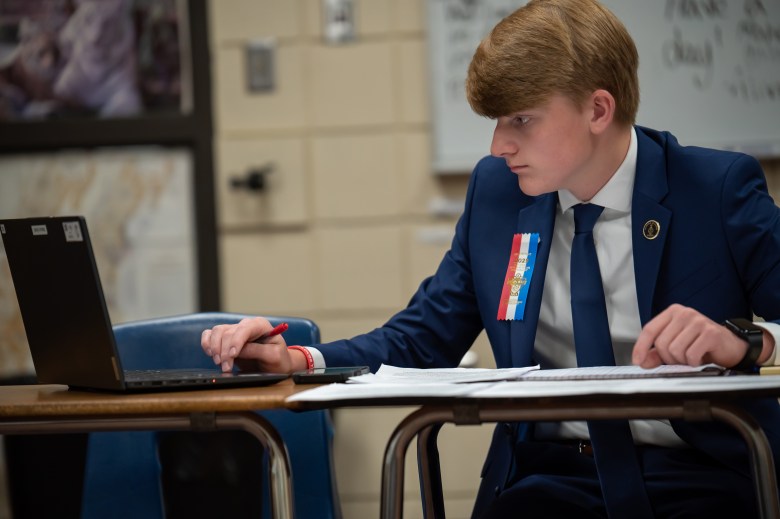
    DES MOINES, Iowa — Macon Smith stood in front of a nearly empty classroom 1,000 miles from home. He asked his opponent and the two judges in the room if they were ready to start, then he set a six-minute timer and took a deep breath.

    “When tyranny becomes law, rebellion becomes duty,” he began. 

    In front of Macon, a 17-year-old high school junior, was a daunting task: to outline and defend the argument that violent revolution is a just response to political oppression.

    In a few hours, Macon would stand in another classroom with new judges and a different opponent. He would break apart his entire argument and undo everything he had just said.

    “An eye for an eye makes the whole world blind,” Macon started.

    It doesn’t really matter what opinion Macon holds on violence or political oppression. In this moment in front of the judges, he believes what he’s saying. His job is to get the judges to believe with him.

    Related: A lot goes on in classrooms from kindergarten to high school. Keep up with our free weekly newsletter on K-12 education.

    Macon was one of more than 7,000 middle and high school students to compete in the National Speech and Debate Tournament this summer in Iowa, run by an organization that is celebrating a century in existence.

    In that time, the National Speech and Debate Association has persevered through economic and social upheaval. It is entering its next era, one in which the very notion of engaging in informed and respectful debate seems impossible. The organizers of this event see the activity as even more important in a fracturing society.

    “I don’t think there’s an activity in the world that develops empathy and listening skills like speech and debate,” said Scott Wunn, the organization’s president. “We’re continuing to create better citizens.” 

    Macon Smith, a rising senior from Bob Jones Academy in South Carolina, competes in the third round of the Lincoln-Douglas Debate at the National Speech and Debate Tournament in Iowa this summer. Credit: Meenakshi Van Zee for The Hechinger Report

    Though the tournament is held in different cities around the country, for the 100th anniversary, the organizers chose to host it in Des Moines, where the association’s headquarters is based.

    Preparing for this competition was a year in the making for Macon, who will be a senior at Bob Jones Academy, a Christian school in Greenville, South Carolina, this fall. Students here compete in more than two dozen categories, such as Original Oratory, in which they write and recite their own 10-minute speeches, or Big Questions, where they attempt to argue broad, philosophical ideas. 

    Macon’s specialty, the Lincoln-Douglas Debate, is modeled after a series of public, three-hour debates between Abraham Lincoln and Sen. Stephen Douglas in 1858. In this event, two students have just 40 minutes to set up their arguments, cross-examine each other and sway the judges.

    “Even if I don’t personally believe it, I can still look at the facts and determine, OK, this is a good fact, or it’s true, and argue for that side,” Macon said.

    Debaters often have to tackle topics that are difficult, controversial and timely: Students in 1927 debated whether there was a need for a federal Department of Education. In 1987, they argued about mandatory AIDS testing. In 2004, they debated whether the United States was losing the war on terror. This year, in the Public Forum division, students debated whether the benefits of presidential executive orders outweigh the harms. 

    Related: Teaching social studies in a polarized world

    While the speech and debate students practiced for their national event, adults running the country screamed over each other during a congressional hearing on state sanctuary policies. A senator was thrown to the floor and handcuffed during a press conference on sending the National Guard to immigration enforcement protests in Los Angeles. Most Americans feel political discourse is moving in the wrong direction — both conservatives and progressives say talking politics with someone they disagree with has become increasingly stressful and frustrating

    Speech and debate club, though, is different.

    “First of all, it gives a kid a place to speak out and have a voice,” said Gail Nicholas, who for 40 years has coached speech and debate at Bob Jones Academy alongside her husband, Chuck Nicholas, who is Macon’s coach. “But then also learn to talk to other people civilly, and I think that’s not what’s being modeled out there in the real world right now.” 

    Macon Smith, a rising senior from Bob Jones Academy in South Carolina, shows off the notes that he took during debates at the National Speech and Debate Tournament in Iowa. Credit: Meenakshi Van Zee for The Hechinger Report

    On the second day of the competition in a school cafeteria in West Des Moines, Macon was anxiously refreshing the webpage that would show the results of his rounds to learn whether he would advance to semifinals.  

    For most of the school year, Macon spent two days a week practicing after school, researching and writing out his arguments. Like many competitors, he has found that it’s easy to make snap judgments when you don’t know much about an issue. Decisively defending that view, to yourself and to others, is much harder.  

    “I tend to go in with an opinion and lose my opinion as the topic goes on,” said Daphne DiFrancesco, a rising senior from Cary Academy in Cary, North Carolina.

    Traveling for regional events throughout the school year means Macon has become friends with students who don’t always share his conservative views. He knows this because in debate, discussing politics and religion is almost unavoidable.

    “It doesn’t make me uncomfortable at all,” Macon said. “You don’t want to burn down a bridge before you make it with other people. If you stop your connection with a person right at their political beliefs, you’re already cutting off half of the country. That’s not a good way to conduct yourself.”

    Macon, and other students in the clubs, said participating has made them think more deeply about their own beliefs. Last year, Macon debated a bill that would defund Immigration and Customs Enforcement, an agency he supports. After listening to other students, he developed a more nuanced view of the organization. 

    “When you look at the principle of enforcing illegal immigration, that can still be upheld, but the agency that does so itself is flawed,” he said.

    Related: ‘I can tell you don’t agree with me’:’ Colleges teach kids how to hear differing opinions

    Henry Dieringer, a senior from L.C. Anderson High School in Austin, Texas, went into one competition thinking he would argue in favor of a bill that would provide work permits for immigrants, which he agrees with. Further research led him to oppose the idea of creating a federal database on immigrants.

    “It made me think more about the way that public policy is so much more nuanced than what we believe,” Henry said. 

    On the afternoon of the second day of the national tournament, Macon learned he didn’t advance to the next round. What’s sad, he said, is he probably won’t have to think this hard about the justness of violent revolution ever again. 

    “There’s always next year,” Macon said.

    Callista Martin, 16, a rising senior from Bainbridge High School in Washington state, also didn’t make the semifinals. Callista and Macon met online this year through speech and debate so they could scrimmage with someone they hadn’t practiced with before. It gave them the chance to debate someone with differing political views and argument styles.

    Macon Smith, a rising senior from Bob Jones Academy in South Carolina, takes notes during a round of the Lincoln-Douglas Debate at the National Speech and Debate Tournament in Iowa. Credit: Meenakshi Van Zee for The Hechinger Report

    “In the rounds, I’m an entirely different person. I’m pretty aggressive, my voice turns kind of mean,” Callista said. “But outside of the rounds, I always make sure to say hi to them before and after and say things I liked about their case, ask them about their school.”

    Talking to her peers outside of rounds is perhaps the most important part of being in the club, Callista said. This summer, she will travel to meet with some of her closest friends, people she met at debate camps and tournaments in Washington.  

    Since Callista fell in love with speech and debate as a freshman, she has devoted herself to keeping it alive at her school. No teacher has volunteered to be a coach for the debate club, so the 16-year-old is coaching both her classmates and herself.

    A lack of coaches is a common problem. Just under 3,800 public and private high schools and middle schools were members of the National Speech and Debate Association at the end of this past school year, just a fraction of the tens of thousands of secondary schools in the country. The organization would like to double its membership in the next five years.

    That would mean recruiting more teachers to lead clubs, but neither educators nor schools are lining up to take on the responsibility, said David Yastremski, an English teacher at Ridge High School in New Jersey who has coached teams for about 30 years.

    It’s a major time commitment for teachers to dedicate their evenings and weekends to the events with little supplemental pay or recognition. Also, it may seem like a risk to some teachers at a time when states such as Virginia and Louisiana have banned teachers from talking about what some call “divisive concepts,” to oversee a school activity where engaging with controversial topics is the point.

    “I primarily teach and coach in a space where kids can still have those conversations,” Yastremski said. “I fear that in other parts of the country, that’s not the case.” 

    Related: A school district singled out by Trump says it teaches ‘whole truth history’ 

    Dennis Philbert, a coach from Central High School in Newark, New Jersey, who had two students become finalists in the tournament’s Dramatic Interpretation category, said he fears for his profession because of the scrutiny educators are under. It takes the fun out of teaching, he said, but this club can reignite that passion.

    “All of my assistant coaches are former members of my team,” Philbert said. “They love this activity [so much] that they came back to help younger students … to show that this is an activity that is needed.”

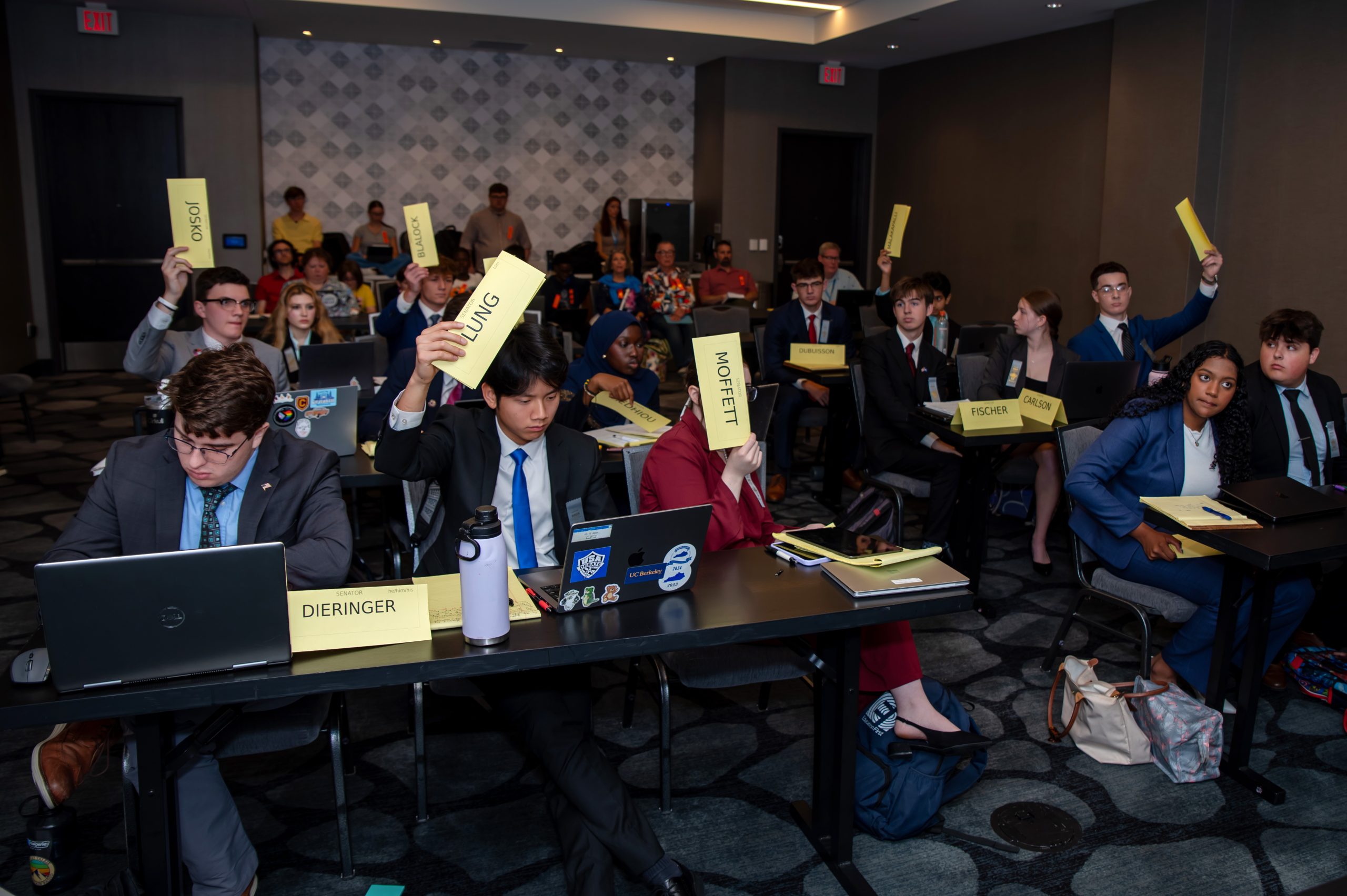
    On the other side of Des Moines, Gagnado Diedhiou was competing in the Congressional Debate, a division of the tournament that mimics Congress and requires students to argue for or against bills modeled after current events. During one round, Gagnado spoke in favor of a bill to shift the country to use more nuclear energy, for a bill that would grant Puerto Rico statehood, and against legislation requiring hospitals to publicly post prices.

    Gagnado Diedhiou, a senior from Eastside High School in South Carolina, competing in the first round of the Congressional Debate at the National Speech and Debate Tournament in Iowa in June. Credit: Meenakshi Van Zee for The Hechinger Report

    Just like in Congress, boys outnumbered girls in this classroom. Gagnado was the only Black teenager and the only student wearing a hijab. The senior, who just graduated from Eastside High School in Greenville, South Carolina, is accustomed to being in rooms where nobody looks like her — it’s part of the reason she joined Equality in Forensics, a national student-led debate organization that provides free resources to schools and students across the country.

    “It kind of makes you have to walk on eggshells a little bit. Especially because when you’re the only person in that room who looks like you, it makes you a lot more obvious to the judges,” said Gagnado, who won regional Student of the Year for speech and debate in her South Carolina district this year. “You stand out, and not always in a good way.”

    Camille Fernandez, a rising junior at West Broward High School in Florida, said the competitions she has participated in have been dominated by male students. One opponent called her a vulgar and sexist slur after their round was over. Camille is a member of a student-led group — called Outreach Debate — trying to bridge inequities in the clubs. 

    “A lot of people think that debate should stay the same way that it’s always been, where it’s kind of just — and this is my personal bias — a lot of white men winning,” Camille said. “A lot of people think that should be changed, me included.” 

    Despite the challenges, Gagnado said her time in debate club has made her realize she could have an influence in the world.

    “With my three-minute speech, I can convince a whole chamber, I can convince a judge to vote for this bill. I can advocate and make a difference with some legislation,” said Gagnado, who is bound for Yale. 

    About 10,000 people attended the National Speech and Debate Tournament in Iowa this June during the organization’s centennial anniversary. Credit: Meenakshi Van Zee for The Hechinger Report

    A day before the national tournament’s concluding ceremony, a 22-year-old attendee rushed the stage at the Iowa Event Center in Des Moines during the final round of the Humorous Interpretation speech competition, scaring everyone in the audience. After he bent down to open his backpack, 3,000 people in the auditorium fled for the exits. The man was later charged with possession of a controlled substance and disorderly conduct. For a brief moment, it seemed like the angry discourse and extreme politics from outside of the competition had become a part of it. 

    In response, the speech and debate organization shifted the time of some events, limited entrances into the building and brought in metal detectors, police officers and counselors. Some students, Gagnado among them, chose not to return to the event. 

    Still, thousands of attendees stayed until the end to celebrate the national champions. During the awards ceremony, where therapy dogs roamed the grounds, Angad Singh, a student from Bellarmine College Preparatory in California competing in Original Oratory, took the national prize for his speech on his Sikh identity and the phrase “thoughts and prayers” commonly repeated by American leaders after a tragedy, titled “Living on a Prayer.”

    “I’ve prayed for change,” Singh told the audience. “Then I joined speech and debate to use my voice and fight for it.”

    This story about high school speech and debate was produced by The Hechinger Report, a nonprofit, independent news organization focused on inequality and innovation in education. Sign up for the Hechinger newsletter.

    The Hechinger Report provides in-depth, fact-based, unbiased reporting on education that is free to all readers. But that doesn’t mean it’s free to produce. Our work keeps educators and the public informed about pressing issues at schools and on campuses throughout the country. We tell the whole story, even when the details are inconvenient. Help us keep doing that.

    Join us today.

    Source link

  • Canceling AmeriCorps grants threatens the future of education and workforce pipelines that power our nation’s progress

    Canceling AmeriCorps grants threatens the future of education and workforce pipelines that power our nation’s progress

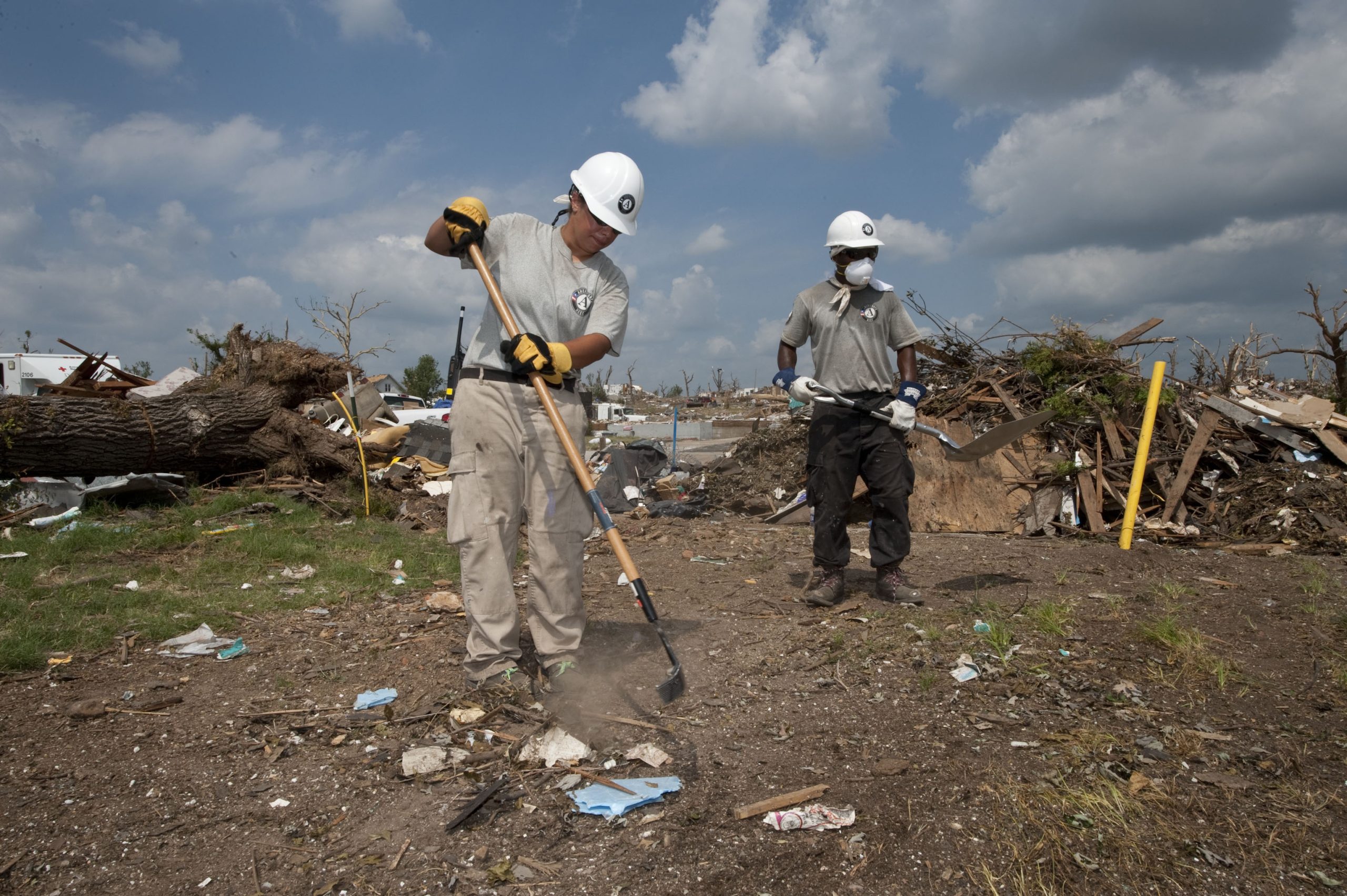
    The recent decision to cancel $400 million in AmeriCorps grants is nothing short of a crisis. With over 1,000 programs affected and 32,000 AmeriCorps and Senior Corps members pulled from their posts, this move will leave communities across the country without critical services.

    The cuts will dismantle disaster recovery efforts, disrupt educational support for vulnerable students and undermine a powerful workforce development strategy that provides AmeriCorps members with in-demand skills across sectors including education.

    AmeriCorps provides a service-to-workforce pipeline that gives young Americans and returning veterans hands-on training in high-demand industries, such as education, public safety, disaster response and health care. Its nominal front-end investment in human capital fosters economic mobility, enabling those who engage in a national service experience to successfully transition to gainful employment.

    As leaders of Teach For America and City Year, two organizations that are part of the AmeriCorps national service network and whose members receive education stipends that go toward certification costs, student loans or future education pursuits, we are alarmed by how this crisis threatens the future of the education and workforce pipelines that power our nation’s progress, and it is deeply personal. We both started our careers as corps members in the programs we now lead.

    Related: A lot goes on in classrooms from kindergarten to high school. Keep up with our free weekly newsletter on K-12 education.

    Aneesh began his journey as a Teach For America corps member teaching high school English in Minnesota. Jim’s path began with City Year, serving at a Head Start program in Boston. We know firsthand that AmeriCorps programs are transformative and empower young people to drive meaningful change — for themselves and their communities.

    At Teach For America, AmeriCorps grants are essential to recruiting thousands of new teachers every year to effectively lead high-need classrooms across the country. These teachers, who have a consistent and significant positive impact on students’ learning, rely on the AmeriCorps education awards they earn through their two years of service to pay for their own education and professional development, including new teacher certification fees, costs that in some communities exceed $20,000.

    Termination of these grants threatens the pipeline of an estimated 2,500 new teachers preparing to enter classrooms over the summer. At a time when rural and urban communities alike are facing critical teacher shortages, cutting AmeriCorps support risks leaving students without the educators they need and deserve.

    City Year, similarly, relies on AmeriCorps to recruit more than 2,200 young adults annually to serve as student success coaches in K-12 schools across 21 states, 29 cities and 60 school districts.

    These AmeriCorps members serving as City Year student success coaches provide tutoring and mentoring that support students’ academic progress and interpersonal skill development and growth; they partner closely with teachers to boost student achievement, improve attendance and help keep kids on track to graduate. Research shows that schools partnering with City Year are two times more likely to improve their scores on English assessments, and two to three times more likely to improve their scores on math assessments.

    Corps members gain critical workforce skills such as leadership, problem-solving and creative thinking, which align directly with the top skills employers seek; the value of their experience has been reaffirmed through third-party research conducted with our alumni. The City Year experience prepares corps members for success in varied careers, with many going into education.

    AmeriCorps-funded programs like Breakthrough Collaborative and Jumpstart further strengthen this national service-to-workforce pathway, expanding the number of trained tutors and teacher trainees while also preparing corps members for careers that make a difference in all of our lives.

    Those programs’ trained educators ensure all students gain access to excellent educational opportunities that put them on the path to learn, lead and thrive in communities across the country. And the leaders of both organizations, like us, are AmeriCorps alumni, proof of the lasting effect of national service.

    Collectively, our four organizations have hundreds of thousands of alumni whose work as AmeriCorps members has impacted millions of children while shaping their own lives’ work, just as it did ours. Our alumni continue to lead classrooms, schools, districts, communities and organizations in neighborhoods across the country.

    Related: Tracking Trump: His actions to dismantle the Education Department, and more

    The termination of AmeriCorps grants is a direct blow to educators, schools and students. And, at a time when Gen Z is seeking work that aligns with their values and desire for impact, AmeriCorps is an essential on-ramp to public service and civic leadership that benefits not just individuals but entire communities and our country at large.

    For every dollar invested in AmeriCorps, $17 in economic value is generated, proving that national service is not only efficient but also a powerhouse for economic growth. Rather than draining resources, AmeriCorps drives real, measurable results that benefit individual communities and the national economy.

    Moreover, two-thirds of AmeriCorps funding is distributed by governor-appointed state service commissions to community- and faith-based organizations that leverage that funding to meet local needs. By working directly with state and local partners, AmeriCorps provides a more effective solution than top-down government intervention.

    On behalf of the more than 6,500 current AmeriCorps members serving with Teach For America and City Year, and the tens of thousands of alumni who have gone on to become educators, civic leaders and changemakers, we call on Congress to protect AmeriCorps and vital national service opportunities.

    Investing in AmeriCorps is an investment in America’s future, empowering communities, strengthening families and revitalizing economies. Let’s preserve the fabric of our national service infrastructure and ensure that the next generation of leaders, educators and community advocates who want to serve our nation have the ability to do so.

    Aneesh Sohoni is Teach For America’s new CEO. Previously, he was CEO of One Million Degrees and executive director of Teach For America Greater Chicago-Northwest Indiana. He is a proud alum of Teach For America.

    Jim Balfanz, a recognized leader and innovator in the field of education and national service, is CEO and a proud alum of City Year.

    Contact the opinion editor at [email protected].

    This story about AmeriCorps, Teach For America and City Year was produced by The Hechinger Report, a nonprofit, independent news organization focused on inequality and innovation in education. Sign up for Hechinger’s weekly newsletter.

    The Hechinger Report provides in-depth, fact-based, unbiased reporting on education that is free to all readers. But that doesn’t mean it’s free to produce. Our work keeps educators and the public informed about pressing issues at schools and on campuses throughout the country. We tell the whole story, even when the details are inconvenient. Help us keep doing that.

    Join us today.

    Source link

  • Book bans draw libraries into damaging culture wars that undermine their purpose

    Book bans draw libraries into damaging culture wars that undermine their purpose

    For the last four years, school and public libraries have been drawn into a culture war that seeks to censor, limit and discredit diverse perspectives.

    Yet time and time again, as librarians have been encouraged or even directed to remove books that include LGBTQ+, Black, Latino and Indigenous characters or themes or history from their collections, they have said no.

    When librarians said no, policy changes were submitted and laws were proposed — all in the name of controlling the library collection.

    Some librarians lost their jobs. Some had their lives threatened. Legislators proposed bills that attempt to remove librarians’ legal protections, strive to prevent them from participating in their national professional associations, seek to limit some materials to “adults only” areas in public libraries and threaten the way library work has been done for decades.

    Here’s why this is wrong. For generations, libraries have been hubs of information and expertise in their communities. Librarians and library workers aid in workforce development, support seniors, provide resources for veterans, aid literacy efforts, buttress homeschool families —among many other community-enriching services. Your public library, the library in your school and at your college, even those in hospitals and law firms, are centers of knowledge. Restrictions such as book bans impede their efforts to provide information.

    Related: Become a lifelong learner. Subscribe to our free weekly newsletter featuring the most important stories in education. 

    Professional librarians study the First Amendment and understand what it means to protect the right to read. We provide opportunities for feedback from our users so that they have a voice in decision-making. We follow a code of ethics and guidelines to make the best selections for our communities.

    It is illegal for a library to purchase pornographic or obscene material; we follow the law established by the Supreme Court (Miller v. California, 1973). That decision has three prongs to determine if material meets the qualifications for obscenity. If the material meets all three, it is considered obscene and does not have First Amendment protection.

    But our procedures have been co-opted, abused and flagrantly ignored by a small and vocal minority attempting to control what type of information can be accessed by all citizens. Their argument, that books are not banned if they are available for purchase, is false.

    When a book or resource is removed from a collection based on a discriminatory point of view, that is a book ban.

    Librarians follow a careful process of criteria to ensure that our personal biases do not intervene in our professional work. Librarians have always been paying attention. In 1939, a group of visionary librarians crafted the Library Bill of Rights to counter “growing intolerance, suppression of free speech and censorship affecting the rights of minorities and individuals.” In 1953, librarians once again came together and created the Freedom to Read Statement, in response to McCarthyism.

    You may see a similar censorship trend today — but with the advent of the internet and social media, the speed at which censorship is occurring is unparalleled.

    Much of the battle has focused on fears that schoolchildren might discover books depicting families with two dads or two moms, or that high school level books are available at elementary schools. (Spoiler alert: they are not.)

    Related: The magic pebble and a lazy bull: The book ban movement has a long timeline

    The strategy of this censorship is similar in many localities: One person comes to the podium at a county or school board meeting and reads a passage out of context. The selection of the passage is deliberate — it is meant to sound salacious. Clips of this reading are then shared and re-shared, with comments that are meant to frighten people.

    After misinformation has been unleashed, it’s a real challenge to control its spread. Is some subject matter that is taught in schools difficult? Yes, that is why it is taught as a whole, and not in passages out of context, because context is everything in education.

    Librarians are trained professionals. Librarians have been entrusted with tax dollars and know how to be excellent stewards of them. They know what meets the criteria for obscenity and what doesn’t. They have a commitment to provide something for everyone in their collections. The old adage “a good library has something in it to offend everyone” is still true.

    Thankfully, there are people across the country using their voices to fight back against censorship. The new documentary “Banned Together,” for example, shows the real-world impact of book banning and curriculum censorship in public schools. The film follows three students and their adult allies as they fight to reinstate 97 books pulled from school libraries.

    Ultimately, an attempt to control information is an attempt to control people. It’s an attempt to control access, and for one group of people to pass a value judgment on others for simply living their lives.

    Libraries focus on the free expression of ideas and access to those ideas. All the people in our communities have a right to read, to learn something new no matter what their age.

    Lisa R. Varga is the associate executive director, public policy and advocacy, at the American Library Association.

    Contact the opinion editor at [email protected].

    This story about book bans was produced by The Hechinger Report, a nonprofit, independent news organization focused on inequality and innovation in education. Sign up for Hechinger’s weekly newsletter.

    The Hechinger Report provides in-depth, fact-based, unbiased reporting on education that is free to all readers. But that doesn’t mean it’s free to produce. Our work keeps educators and the public informed about pressing issues at schools and on campuses throughout the country. We tell the whole story, even when the details are inconvenient. Help us keep doing that.

    Join us today.

    Source link

  • Resignations, Disagreements With Dean Roil UNC Civics School

    Resignations, Disagreements With Dean Roil UNC Civics School

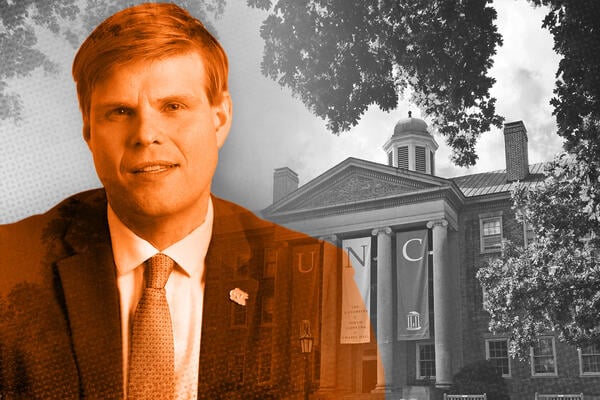
    Multiple faculty members connected with the University of North Carolina at Chapel Hill’s controversial school that had been billed as promoting civil discourse have resigned from leadership roles, citing strong disagreements with the dean who appointed them.

    One such professor went so far as to call the School of Civic Life and Leadership an “unmitigated disaster.” The recent group of resignations adds to past departures by professors who said the school’s earlier focus had shifted and narrowed under Jed Atkins, its first permanent dean. Much of the current controversy centers on Atkins’s handling of searches for new faculty.

    Atkins, who ran Duke University’s Civil Discourse Project and chaired its classical studies department before moving to UNC a year ago, defended the hiring procedures in a statement to Inside Higher Ed. He didn’t provide an interview.

    The school’s birth was mired in controversy. It’s an example of the civil discourse centers—which critics have called conservative centers—that higher education leaders and Republican state lawmakers have been establishing at public universities. For more than two years, debate over the UNC school has been tinged by accusations that its supporters are motivated by conservative politics and its opponents by leftism.

    But the recent resignation letters from the school’s former supporters suggest disagreements that resist characterization as a simple left-right divide. The criticism of the faculty search procedures involves allegations that faculty input, including from the school’s search committee and advisory board members, was disregarded.

    The university’s media relations arm said that Chapel Hill policy requires four full professors to vote in faculty hirings. The advisory board contained such professors, who predated the school’s creation. But the Chapel Hill spokespeople said that in “all faculty appointment matters, the votes of faculty are advisory to the dean,” whose recommendation eventually goes to the universitywide appointments, promotion and tenure committee that advises the provost. The provost has hiring power, though the Chapel Hill Board of Trustees must approve awarding tenure.

    Inger S. B. Brodey, an English and comparative literature professor whom Atkins chose as one of two associate deans, kicked off the recent round of resignations. She wrote to Atkins on Feb. 28 that she still believes strongly in the school’s “original mission, which, as I understand it, includes an emphasis on civil discourse across difference, preparation for citizenship and fruitful lives through studying global great books, promoting scientific literacy and assembling a diverse faculty from many disciplines.”

    However, Brodey wrote, the school “has lost sight of its mission in all these areas and is unlikely to make the lasting positive impact that I and the other inaugural faculty had hoped for. For this and other reasons, I hereby resign as associate dean.”

    Inside Higher Ed obtained the email and other documents mentioned in this story from sources who were either anonymous or whose identities are known but who requested anonymity.

    In January, before that resignation email, Brodey sent Atkins a much longer message on why she was resigning from a faculty search committee. Brodey confirmed the authenticity of both emails to Inside Higher Ed.

    “While it may be within the dean’s power to intervene at every stage of the search and add/remove names, overruling the opinions of the committee, I have never seen this power executed outside of SCiLL,” wrote Brodey, using the school’s acronym. She serves in multiple departments of Chapel Hill.

    “I don’t have any confidence that the search committee will have any actual effect on the final roster of individuals hired,” she wrote. She also said, “I don’t think this list differs in any substantial way from the list of concerns David enumerated in our last meeting, when he resigned from the search.”

    That’s a reference to David Decosimo, SCiLL’s remaining associate dean. Asked for comment, Decosimo replied in an email, “I’m on parental leave this semester, so won’t comment at this time.”

    This faculty search, which began in the fall, wasn’t small. Atkins has said it resulted in eight offers to candidates. Brodey was even more critical of the process in an email to The Daily Tar Heel, which reported earlier on her resignation. She told the student newspaper that there were “improprieties, slander, vindictiveness and manipulation” surrounding the search.

    Dustin Sebell, a SCiLL professor who chaired the search committee (the three members were him, Brodey and Decosimo), disagreed with Brodey in an email. Sebell wrote that Atkins hadn’t overruled the committee.

    “You personally recorded the names of the 20 finalists on behalf of the search committee and emailed them to me,” Sebell wrote. He said, “The committee was fully aware that we had only 16 spots for on campus interviews … it was a mathematical certainty that the dean would exercise some discretion in the selection of finalists from our list.”

    On March 7, Jon Williams, a Chapel Hill economics professor, resigned from SCiLL’s advisory board in an email to Atkins, Chapel Hill chancellor Lee Roberts, provost Chris Clemens and vice provost for faculty affairs Giselle Corbie. Williams alleged that Atkins had ignored all advice and that he felt like he was “nothing more than one of four warm bodies to achieve the dean’s shadowed objectives.”

    “There is no need for an advisory board if the dean ignores any advice that isn’t simply confirmation,” Williams wrote. “More troubling, over the last six weeks, I’ve seen incivility and dysfunction, biased and unfair processes, a complete disregard for governance, and a willingness to deceive and misrepresent that is unlike anything I’ve witnessed in my 15 years in academia.”

    Williams ended with, “I cannot see how SCiLL will emerge from this troubled beginning without new leadership.” He declined an interview with Inside Higher Ed, writing in an email, “I will confirm that I resigned and that my concerns center around” Atkins.

    He wrote in his resignation email that he still appreciates “the need for a place on campus for students to learn how to critically evaluate and debate the most challenging and controversial topics. Simply put, I’m often in a tiny minority among faculty in my views and opinions, so I appreciate how difficult students may find it to engage in open discussion.”

    Three days after Williams’s resignation from the advisory board, Fabian Heitsch, a physics and astronomy professor, followed suit with his own email to Atkins, Roberts, Clemens and Corbie. Heitsch specifically mentioned issues with personnel decisions, but he didn’t provide many specifics or respond to Inside Higher Ed’s requests for comment.

    “In my year of service on the advisory board, I have witnessed its advice on personnel decisions being ignored on three separate occasions,” Heitsch wrote. He said, “It seems as if the advisory board is being used only as a formality instead of as a body of experience and strategy.”

    Heitsch said the advisory board “is to provide formal advice to the dean and director. As I understand it, formal advice is not limited to providing the votes to confirm leadership’s decisions.” He wrote that he still supports the school’s “original mission” and that he “will gladly continue to serve as a curricular fellow.”

    Not the First Resignations

    These weren’t the first Chapel Hill faculty who—having come to the university before the school’s creation—affiliated themselves with it only to then reduce their involvement or fully withdraw after Atkins’s appointment, citing a changed direction for the school. One who stepped back last year was Matthew Kotzen, Chapel Hill’s philosophy department chair.

    But the newer resignations have come alongside stronger denunciations—at least publicly. And Kotzen himself increased his past public criticism in a statement to Inside Higher Ed.

    “The original mission of SCiLL was to model and to teach essential skills related to productive engagement with democratic civic institutions, including respectful dialogue across ideological difference,” Kotzen wrote. “Unfortunately, it has become increasingly clear that Dean Atkins is committed to none of those values.”

    Kotzen said Atkins “has an extremely narrow conception of acceptable viewpoints and approaches and has demonstrated almost no openness to feedback from others on the faculty, including those that he himself selected for their role. Dean Atkins has fostered a dysfunctional anti-intellectual culture at SCiLL that rewards hostility, dishonesty and self-righteousness in the pursuit of his ideological and personal aims. That disqualifies him from holding any leadership position at UNC.”

    Atkins told Inside Higher Ed in an email that “the advisory committee’s function in faculty searches is to help assess the merits of our finalists and to cast an advisory vote on each finalist.” He wrote, “In SCiLL’s most recent national search, our faculty rigorously evaluated our applicants’ strengths and promise.”

    “Finalists traveled to campus from three continents, gave teaching demonstrations to students, presented on their research and engaged with our faculty in more informal settings,” Atkins said. “After these campus interviews, SCiLL’s tenure-line faculty met and voted on our finalists; they recommended a strong slate of candidates for appointment.”

    Danielle Charette James, a SCiLL assistant professor, told Inside Higher Ed in an email that “our process was highly collaborative, and the candidates who received offers earned overwhelming, and in some cases unanimous, support from SCiLL’s core faculty.”

    Chapel Hill’s media relations arm emailed a statement to Inside Higher Ed saying, “SCiLL’s faculty searches honored all university rules and procedures. Applicants were advanced on the basis of merit and fit with the advertised positions. We are looking forward to welcoming an outstanding group of new faculty to campus next fall.”

    ‘Dress Rehearsal’

    Back in January 2023, Chapel Hill’s Board of Trustees passed a resolution asking the campus administration to “accelerate its development of a School of Civic Life and Leadership.” Faculty said they were caught off guard because they didn’t know a whole school was in development. David Boliek, then chair of Chapel Hill’s board, called it an effort to “remedy” a shortage of “right-of-center views” on campus. Clemens, the provost and a self-described conservative, promoted the school.

    In the fall of 2023, the Republican-controlled State Legislature passed a law that required Chapel Hill to establish the school. The campus couldn’t back out even if it desired to. Clemens had the final say in hiring Atkins as dean, at least before the Chapel Hill board signed off.

    And despite the past faculty objections, current Chapel Hill professors, including Brodey, Kotzen and Williams, affiliated with the initiative.

    But faculty aren’t the only ones critiquing the recent faculty search. Clemens, who didn’t return requests for comment for this article, at one point ordered a stop to the faculty searches.

    In a January email to Atkins, Clemens said there were financial limitations. Instead of progressing toward hiring tenure-track faculty, Clemens said, “SCiLL should initially focus on hiring teaching track professors to support large enrollments in the general education curriculum.” So, he said, he was canceling the searches.

    The provost also seemingly referenced issues beyond budgets.

    “Your search committee and voting faculty for these searches is small; smaller even than the number of people you were authorized to hire,” Clemens wrote. “Moreover, some of them have just arrived in Chapel Hill. All new teams must learn to work together, and this ‘dress rehearsal’ has hopefully been a learning experience for all.”

    He then wrote, with original emphasis included, “I want to emphasize how important it is for a School of Civic Life and Leadership to serve as a model of civic life and civil discourse. Given the intense scrutiny and attention on this school, everything you do—including faculty searches—must be exemplary, both to give the candidates confidence in SCiLL and to give the rest of the university confidence in those you hire. I will address how we can fulfill those expectations for future searches in collaboration with SCiLL leadership and with HR.”

    Clemens sent that on a Friday. But by the following Monday, he said the searches were back on after Chancellor Roberts “committed sufficient funds.”

    The criticism of Atkins continues. On Monday, Atkins accepted Williams’s resignation and rebutted his critiques. Williams responded in an email by saying he resigned to protect his reputation, “because SCiLL is currently an unmitigated disaster.”

    He accused Atkins of “hiding behind accusations that wokeness has derailed your efforts,” something Williams called “absolutely ridiculous given that you completely lost the support of folks like myself that have spent a decade battling it on campus.”

    “It’s your failure alone,” Williams wrote. “Time to own it.”

    Source link