Tag: claims

  • FTC Claims the ABA Is a Monopoly

    FTC Claims the ABA Is a Monopoly

    The Federal Trade Commission accused the American Bar Association of having a “monopoly on the accreditation of American law schools” in a letter to the Texas Supreme Court at a time when the state is considering minimizing the ABA’s oversight of legal education.

    In April, the Texas Supreme Court announced it was looking into eliminating ABA requirements for licensure. Justices wrote in a tentative opinion in the fall that the ABA “should no longer have the final say on whether a law school’s graduates are eligible to sit for the Texas bar exam and become licensed to practice law.” It also invited the public to comment on a proposal to potentially undercut the ABA as an accreditor for Texas law schools.

    FTC officials Clarke Edwards and Daniel Guarnera signaled support for potentially moving away from ABA accreditation in a nine-page letter submitted to the Texas Supreme Court on Monday. In addition to claiming the ABA was a monopoly, they argued it had “rigid and costly requirements” and that it mandates “every law school follow an expensive, elitist model of legal education.”

    The two FTC officials also accused the ABA of driving up the costs of law school.

    “The ABA’s standards for accreditation appear to go far beyond what is reasonably necessary to assure adequate preparation for the practice of law in Texas, increasing the cost of a legal education. The current rule therefore likely causes Texas to forgo admitting many potentially qualified lawyers who could provide needed legal services to the Texas public,” they wrote.

    Monday’s letter reflects rhetoric from President Donald Trump and his allies who have taken aim at accreditors in recent years. Trump blasted the ABA in an April executive order, accusing it of discrimination for its diversity, equity and inclusion standards. (The ABA suspended DEI standards for accreditation in February, before the executive order.)

    The ABA did not respond to a request for comment from Inside Higher Ed.

    Source link

  • Education Department outsourcing is unlawful, amended lawsuit claims

    Education Department outsourcing is unlawful, amended lawsuit claims

    This audio is auto-generated. Please let us know if you have feedback.

    The U.S. Department of Education’s plans to move core programming to other agencies is illegal and harmful to K-12 and higher education students, educators and families, according to an amended lawsuit filed Tuesday.

    Brought forth by a broad coalition of school districts, employee unions and a disability rights organization, the amended complaint seeks to halt the outsourcing of Education Department programs. 

    “Taking away the services and supports students rely on will irreparably hurt children, families, educators, schools, and communities, in states across the nation,” said a Tuesday statement by Democracy Forward, which is representing the plaintiffs in the case. “The Department of Education offers important support to educators and communities throughout the nation and the unlawful attempts to shut down the Department are nothing less than an abandonment of the future of our country.”

    In a statement emailed to K-12 Dive on Wednesday, Madi Biedermann, deputy assistant secretary for communications at the Education Department, said, “It’s no surprise that blue states and unions care more about preserving the DC bureaucracy than about giving parents, students, and teachers more control over education and improving the efficient delivery of funds and services.”

    On Nov. 18, the Education Department announced it was developing interagency agreements with other federal agencies to support six programs, including with the U.S. Department of Labor to handle the management of about $28 billion in K-12 funding for low-income school districts, homeless youth, migrant students, academic support, afterschool programs, districts receiving Impact Aid and other activities.

    Another interagency agreement places about $3.1 billion in institution-based grants for postsecondary education programming at the Labor Department.

    The moves add to a partnership the Education Department created with the Labor Department earlier this year to take over the management of federal career and technical assistance programs. Democratic lawmakers, during a Nov. 19 House Education and Workforce subcommittee hearing, said several state CTE programs ran into funding delays due to a new grant management process at the Labor Department.

    While the Education Department does not yet have formal plans to move the management of special education, civil rights enforcement and federal student aid out of the agency, those options are still being explored, a senior department official said during a press call on Nov. 18.

    Even when programming shifts under the interagency agreements, the Education Department would still be the agency responsible for these programs, with the partner agencies taking on much of the daily operations.

    The Trump administration has said the continual downsizing of the Education Department is meant to reduce federal bureaucracy and give states more autonomy over spending allocations.

    During a White House press conference Nov. 20, U.S. Education Secretary Linda McMahon said there’s been a “hard reset” of the country’s educational system. “That reset was a campaign promise from President Trump to send education back to the states and end Washington’s micromanagement of education once and for all,” McMahon said. 

    Critics, however, say the disruptions from shifting agency responsibilities, along with Education Department staff reductions and delays in grant funding, is causing havoc for K-12 and higher education systems. 

    The updated complaint in Somerville v. Trump, which was consolidated with New York v. McMahon, was brought against the Education Department by groups of states, school districts and teacher unions. The Arc of the United States is now an additional plaintiff in the case.

    The cases were heard earlier this year before district and appeals courts, which issued and upheld injunctions blocking the administration’s actions. In July, the U.S. Supreme Court granted the Trump administration’s request for a stay allowing the changes at the Education Department to take place for now.

    Source link

  • When a company’s enviro claims sound convincing …

    When a company’s enviro claims sound convincing …

    Many companies contribute to the climate crisis and make a profit doing so. As consumers and governments pressure them to reduce their carbon emissions, they look for ways to make themselves appear environmentally friendly. This is called green marketing.

    As a journalist, you need to learn to spot what a business really means by its green marketing.

    Greenwashing is when a brand makes itself seem more sustainable than it really is, as a way to get consumers to buy their product. For example, let’s look at fashion, an industry that is responsible for between 2 and 8% of global greenhouse gas emissions.

    In the absence of environmental legislation around the fashion industry a business might get themselves certified under a sustainability certification scheme — these are standards developed by governments or industry groups or NGOs to measure such things as energy efficiency or processes that are low carbon or carbon neutral. There are more than 100 different such certification programs.

    Companies tout these certifications. But a 2022 study by the Changing Markets Foundation (CMF) found that the standards set by the majority of the 10 or more popular certification initiatives for the fashion industry aren’t difficult to meet and lack accountability.

    Artificial claims about sustainability

    Fast fashion relies on cheap synthetic fibers, which are produced from fossil fuels such as oil and gas. And while you might assume that clothing with labels such as “eco” or “sustainable” might have fewer synthetics, you’d unfortunately be wrong.

    Another study by CMF found that H&M’s “conscious” clothing range, for example, contained 72% synthetics — which was higher than the percentage in their main collection (61%). And it’s not just H&M. While the same study found that 39% of products made some kind of green claim, almost 60% of these claims did not match the guidelines set out by the UK Competition and Markets Authority.

    The same is happening in the meat and dairy industry. Companies say they are reducing their environmental footprint by engaging in “regenerative agriculture”, a farming approach that aims to restore and improve ecosystem health. They argue that it reduces greenhouse gas emissions and helps store carbon in the soil.

    But relying on carbon storing in soil is not enough. An article in Nature Communications found that around 135 gigatonnes of stored carbon would be required to offset the emissions that come from the agriculture sector. This is roughly equivalent to the amount of carbon lost due to agriculture over the past 12,000 years, according to CMF.

    But companies grab onto these empty promises, perhaps knowing that the general public might only see regenerative agriculture and other “green narratives” as promising.

    Look for real solutions to climate change.

    For example, Nestlé tells their customers that it is addressing the carbon footprint of the agriculture industry by supporting regenerative agriculture, stating on its website that in 2024, some 21% of the ingredients they source come from farmers adopting regenerative agriculture practices.

    When you understand that regenerative agriculture is not the solution it has been made out to be, only then can you see through Nestlé’s branding.

    So how can you spot greenwashing?

    Let’s say you saw a press release from a company in an industry that has historically relied heavily on fossil fuels. It tells its readers that it plans to be carbon neutral by a certain date, or that it’s using recycled materials for a large portion of its production, or that its future is “green”.

    You might first wonder, is this an example of how companies are moving away from fossil fuels and towards a green future? How can you tell?

    1. Be skeptical.

    When something has to tell you that it is green, it might not be. Start your investigation right there.

    For example, if you were looking at Nestlé’s regenerative agriculture campaign, you would need to find out what regenerative agriculture is and how much it is indeed reducing greenhouse gas emissions. You can do this by starting with a good Google search: e.g “regenerative agriculture and greenhouse gas emissions”.

    Once you click on a number of articles that report on this topic, you’ll be able to read about the different studies and data into the topic. Follow the sources used when an article cites a study or data. The article should hyperlink or list the sources. But those hyperlinks might take you to other secondary sources — other articles that cited the same data.

    For example, an article might cite this statistic: sustainability certifications increase consumer willingness to pay by approximately 7% on average. The article might cite as the source this study published in the journal Nature. But that article isn’t the original source of that data. It came from a 2014 study published in the Journal of Retailing.

    So try to find the primary source and see how credible or reputable it is. Who conducted the research in the first place?

    If you wanted to find out what H&M’s “conscious” range really meant, you would start by looking at H&M’s website and reports to look further into their claims. Then, follow those claims.

    2. Research the wider industry.

    Whether you’re reporting on fashion, agriculture or any other industry, look into where its emissions are coming from, which companies are claiming what and what the evidence says needs to be done in order for these industries to reduce their emissions.

    Providing context is important. What percentage of global greenhouse gas emissions is this industry responsible for? Is it getting better or worse? What legislation is in place to reduce emissions from these industries? In order for you and your audience to understand the greenwashing of any company, this background information is vital.

    3. Go straight to the company.

    Once you’ve conducted some initial research, follow up with the company if you are using it as an example or focus for your article. On Nestlé’s website, for example, you can find contact details for their communications, media or PR department. Send them an email saying something like the following:

    “I am writing an article on regenerative agriculture and I’ve found some studies that show that soil sequestration through these practices are in fact not enough to be a real climate solution. Can you please provide me with a comment on what Nestlé thinks about this?”

    They might not answer, but that also says a lot. If they don’t reply to you after one or two follow-up emails, you might try calling them.

    If you try several times and in different ways to contact them and they failed to respond, you can state that in your article. That way your readers know you made the effort.

    Claims from corporations that they are doing all they can to help the planet are easy to make. But if we really want to slow down climate change, significant efforts have to be made. And it is the role of journalists to hold companies to account for the claims they make.


    Questions to consider:

    1. What is “greenwashing”

    2. What is one example of greenwashing?

    3. What criteria do you use when deciding whether to buy a company’s product?


    Source link

  • Extremist Group Claims Responsibility for “Swatting” Calls

    Extremist Group Claims Responsibility for “Swatting” Calls

    Aaron Ontiveroz/The Denver Post/Getty Images

    A person who goes by the name Gores online claimed responsibility for the flurry of so-called swatting calls made to colleges and universities over the past several days, Wired reported.

    Gores is the self-proclaimed leader of an online group called Purgatory, which is linked to a violent online extremist network called The Com, according to Wired. Alongside another Purgatory member called tor, Gores began placing fake calls to campus and local emergency services about active shooters about noon Aug. 21, the same day the University of Tennessee at Chattanooga and Villanova University received swatting calls. 

    As of Wednesday afternoon, Inside Higher Ed counted 19 confirmed swatting calls since Aug. 19, including at Mercer University, the University of Wisconsin at Madison, the University of Utah and the University of New Hampshire.

    Not all of the calls placed by Purgatory have been successful. In some cases, authorities correctly identified the calls as hoaxes. When the group placed a call to Bucknell University in Lewisburg, Pa., a researcher listening in on the call was able to alert the university. The FBI is investigating the uptick in swatting calls and has not publicly confirmed Purgatory’s involvement. Gores told Wired that the swatting spree will continue for another two months. 

    Purgatory offers to make swatting calls for as little as $20, though the price has increased to $95 since this recent campaign of calls began, according to Wired. Three members of Purgatory were arrested in 2024 and pleaded guilty earlier this year for threats made to a Delaware high school, a trailer park in Alabama, Albany International Airport, an Ohio casino and a private residence in Georgia. 

    Ashley Mowreader contributed to this article.

    Source link

  • US-based TOEFL scorers “shut out” of ETS shifts, petition claims

    US-based TOEFL scorers “shut out” of ETS shifts, petition claims

    • Petition from ETS scorers takes issue with shifts being handed to offshore colleagues, claiming that such decisions are often taken last minute.
    • Concerns raised over new scorers not having English as a first language – which ETS says does not matter so long as the scorer has the correct expertise.
    • ETS defends “strategic decision” to look beyond the US for some of its scorers, saying this reflects the global nature of its business.

    “Over the past several months, ETS has stopped assigning shifts to US-based rates and scoring leaders without any clear or honest explanation,” states the petition

    “There has been a quiet transition to a completely offshore rater pool, with scoring for the TOEFL Speaking section now handled almost entirely out of India. US raters – many of whom have supported this work for over a decade – have been ghosted,” it claims.  

    According to speaking raters and leaders interviewed by The PIE News, shifts for US-based raters and scoring leaders started reducing in December 2024 and have all but dried up, though employees are still asked each month to submit their availability.  

    But according to the testing giant, scoring staff were informed in December 2024 of the expansion of ETS’s scoring capabilities beyond the US, including being told that the shift “could result in a reduction of scoring hours for US-based raters”.  

    “This change reflects our effort to meet international demand more effectively and leverage a broader, global pool of qualified scoring professionals,” an ETS spokesperson told The PIE 

    And yet, employees have complained of a lack of transparency from ETS: “Those who complained to HR or Scheduling receive either silence or vague boilerplate responses citing ‘global strategy’ or ‘volume’”, the petition states.  

    According to Teri Anglim, a scoring leader who has worked for TOEFL since 2006: “The email that came in December was well crafted… they said they were going to be including global raters and that some would see their shifts increase and others would decrease”.  

    “Come February, lots of raters would email me and say they were only scheduled for five days out of the month, some having registered their availability for every day,” said Anglim.  

    “Come March, they might get 10 days for the month, but a day and a half before their shift, they’d get an email saying that half of their shifts were cancelled,” she explained.  

    Several employees have echoed similar frustrations over shifts being cancelled at the eleventh hour.

    Speaking to The PIE anonymously, another scoring leader explained it was their understanding that “ETS still sends out availability requests every month and actually confirms one or two shifts at most, only for them to be cancelled at the last minute”.  

    “Because I work for other programs, I’m getting scheduled for them but not for TOEFL. ETS essentially wants to keep our pool of workers ‘on-call’ to the side, just in case,” they said.  

    By Anglim’s accounts, shifts for US test raters had all but dried up in April, though test scorers training the new global raters continued receiving shifts.  

    In May, the number of raters on each scoring leader’s roster was increased, with experienced leaders finding it difficult to keep up with the increased monitoring.

    “It’s humanly impossible to keep tabs on 24 people who are novices at scoring,” said Anglim, who became concerned that mistakes could slip through the cracks.  

    And yet, by June, Anglim was assigned six shifts for the whole month and saw three of them cancelled: “That was the end of TOEFL for us, the scoring leaders,” she said.  

    It’s not diverse, it’s certainly not equitable, and it’s not inclusive

    Teri Anglim, TOEFL scoring leader

    The petition is demanding that ETS provides a “clear, honest explanation of how shifts are being assigned”, as well as detailed accounts of how many US raters have received shifts since April and the ratio of US raters and the new global pool.  

    The scoring leader speaking to The PIE anonymously said they were “devastated to no longer be a part of a program [they] helped build 20 years ago… ETS used to be a great side income, but it’s mere pittance now.” 

    “[ETS] basically told us last fall that we would be training our replacements – they didn’t word it quite like that, but we all knew our days were numbered at that time.”

    Since many raters work part-time for ETS, they say they have had to rely on other jobs and pick up shifts elsewhere since the reductions.  

    “At this point in my life, I do get social security, and I’m looking for other remote jobs,” said Anglim, who holds a BA from Arizona State University and two MA degrees from the University of Texas Arlington.  

    Beyond the personal impact on employees, Anglim said she was concerned about the standard of the new scorers, with the petition claiming that the scoring of the TOEFL Speaking section is “now handled almost entirely out of India”. 

    Anglim, who trained many of the new scorers, said: “I have nothing against the raters in India – I liked working with them – though I was concerned about non-native English speakers marking the test without other people.” 

    “How can a company like the Educational Testing Service (ETS) promote DEI when having scorers only from one place is not diverse, it’s certainly not equitable, and it’s not inclusive,” she said.  

    For its part, ETS has countered the claims, stressing that new raters are given the same “rigorous” training as existing ones and that it is irrelevant whether or not English is their first language.

    Anglim recalled a case when she was reviewing the scores given to a test-taker from Germany, whose English was “impeccable” – “his vocabulary was better than I use”, she said – though he was scored two out of four for delivery.  

    In that incident, Anglim initiated a score change, but she said she was worried that individuals who have taken the test since January could be “collateral damage” of the new pool of scorers.  

    The TOEFL exam is primarily used to measure the English proficiency of test takers applying to English speaking universities in the UK, Canada, the US, Australia and New Zealand, among a few others.

    Out-of-work US-based raters fear that moving the test scoring offshore will lead to a loss of raters who instinctively know the nuances of the English language that can affect score outcomes.

    What matters is expertise, not where someone was born or what their first language was

    ETS

    Alongside a “commitment to transparency, accountability and professional respect” for its employees, the petition’s signatories want an “acknowledgment that the rater and scoring leader roles are now being filled exclusively from India”.  

    The scoring leader speaking anonymously also said they were “concerned about the integrity of the test”, fearing “it will be compromised due to raters and leaders who aren’t fully proficient in English”.  

    “My interactions with some raters over the years and with these specific ‘global raters’ left me wondering how thoroughly ETS had vetted their language abilities. 

    “I fear that TOEFL will die once US universities get wind of this shift and also if scores end up being inaccurate, leading to difficulties or even failure for international students,” they said.  

    Responding to the claims, an ETS spokesperson said that the integrity of the TOEFL would “always be [its] highest priority”.

    “All of our raters, whether English is their first or learned language, go through the same rigorous training, qualification process, and continuous monitoring to ensure scores are fair, accurate, and consistent.

    “What matters is expertise, not where someone was born or what their first language was and our diverse community of raters reflects exactly that.”

    ETS leadership have not formally responded to the petition or addressed the 342 signatories or their demands.

    Speaking to The PIE, an ETS spokesperson said the company had “a growing global customer base and a business that continues to evolve to meet the needs of learners, institutions, and partners worldwide.  

    “In response to these changing demands, we made the strategic decision in late 2024 to expand our scoring capabilities beyond the US. 

    “This shift allows us to better serve a global testing population, increase operational flexibility, and uphold the quality and efficiency our customers expect.” 

    It told The PIE: “We are grateful to the many raters and scoring leaders in the US who have supported TOEFL over the years and helped establish the standards we maintain today.  

    “ETS remains committed to treating all members of our scoring community with respect and to communicating transparently as we continue to adapt in an increasingly globalised education landscape.”

    Source link

  • Los Angeles Community College District Claims to Be Facing State Takeover Amid Allegations of Fraud and Censorship in LAVC Media Arts Department (LACCD Whistleblower)

    Los Angeles Community College District Claims to Be Facing State Takeover Amid Allegations of Fraud and Censorship in LAVC Media Arts Department (LACCD Whistleblower)

    The Los Angeles Community College District (LACCD) may be facing state takeover within two years due to overextended hiring and budget mismanagement, as discussed during a May 2025 meeting of the Los Angeles Valley College (LAVC) Academic Senate. Faculty warned that the looming financial crisis could result in mass layoffs—including tenured staff—and sweeping program cuts.

    Start Minutes LAVC Academic Senate

    “R. Christian-Brougham: other campuses have brand new presidents doing strange things. If we don’t do things differently as a district, from the mouth of the president in two years we’ll be bankrupt and go into negative.
     Chancellor has responsibility
    C. Sustin  asks for confirmation that it is the Chancellor that can and should step in to curb campus budgets and hirings.
    R. Christian-Brougham: the Chancellor bears responsibility, but in the takeover scenario, the Board of Trustees – all of them – would get fired
    E. Perez: which happened in San Francisco
    C. Sustin: hiring is in the purview of campuses, so they can’t directly determine job positions that move forward?
    R. Christian-Brougham: Chancellor and BoT could step in and fire the Campus Presidents, though.
    E. Perez: in next consultation with Chancellor, bringing this up.
    C. Maddren: Gribbons is not sitting back; he’s acting laterally and going upward
    E. Thornton: looping back to the example of City College of San Francisco: when the takeover happened there the reductions in force extended to multiple long-since-tenured members of a number of disciplines, including English. For this and so many other reasons, it was a reign of terror sort of situation. So we really need to push the Chancellor.”

    End Minutes Academic Senate

    https://go.boarddocs.com/ca/laccd/Board.nsf/vpublic?open#

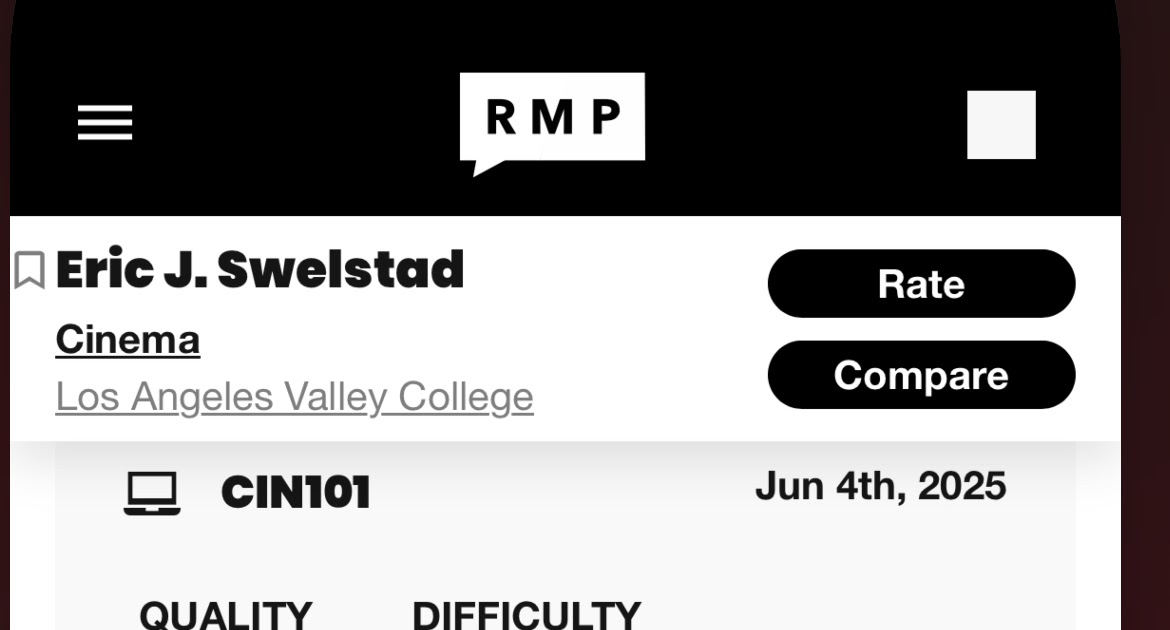
    The dire financial outlook comes as new scrutiny falls on LAVC’s Media Arts Department, already under fire for years of alleged fraud, resume fabrication, and manipulation of public perception. Central to these concerns is the department’s chair, Eric Swelstad, who also oversees a $40,000 Hollywood Foreign Press Association (Golden Globe) grant for LAVC students—a role now drawing sharp criticism in light of mounting questions about his credentials and conduct.

    Over the past two months, a troubling wave of digital censorship has quietly erased years of documented allegations. In May 2025, nearly two years’ worth of investigative reporting—comprising emails, legal filings, and accreditation complaints—were scrubbed from the independent news site IndyBay. The removed content accused Swelstad of deceiving students and the public for over two decades about the quality and viability of the Media Arts program, as well as about his own professional qualifications.

    In June 2025, a negative student review about Swelstad—posted by a disabled student—disappeared from Rate My Professor. These incidents form part of what appears to be a years-long campaign of online reputation management and public deception.

    An AI-driven analysis of Rate My Professor entries for long-serving Media Arts faculty—including Swelstad, Arantxa Rodriguez, Chad Sustin, Dan Watanabe, and Jason Beaton—suggests that the majority of positive reviews were written by a single individual or a small group. The analysis cited “Identical Phrasing Across Profiles,” “Unusually Consistent Tag Patterns,” and a “Homogeneous Tone and Style” as evidence:

    “It is very likely that many (possibly a majority) of the positive reviews across these faculty pages were written by one person or a small group using similar templates, tone, and strategy… The presence of clearly distinct voices, especially in the negative reviews, shows that not all content comes from the same source.”

    A now-deleted IndyBay article also revealed emails dating back to 2016 between LAVC students and Los Angeles Daily News journalist Dana Bartholomew, who reportedly received detailed complaints from at least a dozen students—but failed to publish the story. Instead, Bartholomew later authored two glowing articles featuring Swelstad and celebrating the approval of LAVC’s $78.5 million Valley Academic and Cultural Center:

    * *”L.A. Valley College’s new performing arts center may be put on hold as costs rise,”* Dana Bartholomew, August 28, 2017.

      [https://www.dailynews.com/2016/08/09/la-valley-colleges-new-performing-arts-center-may-be-put-on-hold-as-costs-rise/amp/](https://www.dailynews.com/2016/08/09/la-valley-colleges-new-performing-arts-center-may-be-put-on-hold-as-costs-rise/amp/)

    * *”L.A. Valley College’s $78.5-million arts complex approved in dramatic downtown vote,”* Dana Bartholomew, August 11, 2016.
      [https://www.dailynews.com/2016/08/11/la-valley-colleges-785-million-arts-complex-approved-in-dramatic-downtown-vote/](https://www.dailynews.com/2016/08/11/la-valley-colleges-785-million-arts-complex-approved-in-dramatic-downtown-vote/)

    Among the most explosive allegations is that Swelstad misrepresented himself as a member of the Writer’s Guild of America (WGA), a claim contradicted by official WGA-West membership records, according to another redacted IndyBay report.

    This appears to be the tip of the iceberg according to other also scrubbed IndyBay articles

    Other questionable appointments, payments, and student ‘success stories’ in the Los Angeles Valley College Media Arts Department include:

    * **Jo Ann Rivas**, a YouTube personality and former Building Oversight Committee member, was paid as a trainer and presenter despite reportedly only working as a casting assistant on the LAVC student-produced film *Canaan Land*.

    (https://transparentcalifornia.com/salaries/2018/los-angeles-district/jo-ann-rivas/)

    * **Robert Reber**, a student filmmaker, was paid as a cinematography expert.

    (https://transparentcalifornia.com/salaries/2017/los-angeles-district/robert-reber/)

    * **Diana Deville**, a radio host and LAVC alumna with media credits, served as Unit Production Manager on *Canaan Land*, but her resume claims high-profile studio affiliations including DreamWorks, MGM, and OWN.

    (https://www.tnentertainment.com/directory/view/diana-deville-13338)

    The film *Canaan Land*, made by LAVC Media Arts students, has itself raised eyebrows. Filmmaker Richard Rossi claimed that both it and his earlier student film *Clemente* had received personal endorsements from the late Pope Francis. These assertions were echoed on *Canaan Land*’s GoFundMe page, prompting public denials and clarifications from the Vatican in *The Washington Post* and *New York Post*:

    [https://www.washingtonpost.com/news/early-lead/wp/2017/08/17/after-july-miracle-pope-francis-reportedly-moves-roberto-clemente-closer-to-sainthood/]
    * [https://nypost.com/2017/08/17/the-complicated-battle-over-roberto-clementes-sainthood/]

    Censorship efforts appear to have intensified following the publication of a now-removed article advising students how to apply for student loan discharge based on misleading or fraudulent education at LAVC’s Media Arts Department. If successful, such filings could expose the department—and the district—to financial liability.

    But the highest-profile financial concern is the 2020 establishment of the **Hollywood Foreign Press Association’s $40,000 grant** for LAVC Media Arts students, administered by Swelstad:

    * [HFPA Endowed Scholarship Announcement (PDF)](https://www.lavc.edu/sites/lavc.edu/files/2022-08/lavc_press_release-hfpa-endowed-scholarship-for-lavc-film-tv-students.pdf)
    * [LAVC Grant History Document](https://services.laccd.edu/districtsite/Accreditation/lavc/Standard%20IVA/IVA1-02_Grants_History.pdf)

    As a disreputable academic administrator with a documented history of professional fraud spanning two decades and multiple student success stories that aren’t, future grant donors may reconsider supporting the Department programs – further pushing the Los Angeles Valley College and by extension the district as a whole towards financial insolvency. 

    Source link

  • Jeffrey Sachs EXPOSES Israel–U.S.–Iran War Plot: Shocking Claims Uncovered (Times Now World)

    Jeffrey Sachs EXPOSES Israel–U.S.–Iran War Plot: Shocking Claims Uncovered (Times Now World)

    Renowned economist Jeffrey Sachs has launched a scathing critique of U.S. foreign policy in the Middle East, placing the blame squarely on Washington’s alliance with Israel’s far-right leadership. Speaking at the Antalya Diplomacy Forum, Sachs claimed that American interference—encouraged by Israeli Prime Minister Benjamin Netanyahu—has devastated the region. He cited covert operations like the CIA’s Timber Sycamore as catalysts behind the Syrian civil war and accused Israel of pushing for armed conflict with Iran after having allegedly promoted six previous wars.

    Source link

  • RFK Jr. Falsely Claims New Vax Board Member Works at GWU

    RFK Jr. Falsely Claims New Vax Board Member Works at GWU

    Robert F. Kennedy Jr., secretary of the Department of Health and Human Services, falsely said he named a doctor from George Washington University to a federal vaccine advisory board, reported News 4, the NBC affiliate in Washington, D.C. 

    Last Monday, Kennedy, who denies that vaccines are safe and effective and whose department has previously cited fake studies to support parts of its public health agenda, fired all 17 members of the federal Advisory Committee on Immunization Practices. By Wednesday, he posted on X that he had “repopulated” it with eight new members.

    “The slate includes highly credentialed scientists, leading public-health experts, and some of America’s most accomplished physicians,” he wrote. “All of these individuals are committed to evidence-based medicine, gold-standard science, and common sense.”

    One of them, according to Kennedy, is Michael A. Ross, a clinical professor of obstetrics and gynecology at George Washington University and Virginia Commonwealth University, with a career spanning clinical medicine, research and public health policy.

    But a GWU spokesperson told News 4 that Ross hasn’t taught there in eight years; a VCU spokesperson also said Ross hasn’t taught there for four years. Instead, Ross is listed as an operating partner for the private equity fund Havencrest, and his company bio says he “serves on the boards of multiple private healthcare companies.”

    Kennedy’s post on X made no mention of Ross’s current involvement with the company.


    Source link

  • International students and asylum claims

    International students and asylum claims

    For at least a couple of years there’s been an issue percolating away without much clarity about its extent, causes and consequences – that of international students in the UK applying for asylum either during or following their studies. Staff in universities have at times told us of a noticeable rise in cases, and we also get rumours every now and then of it being on the Home Office radar.

    Over the weekend the government released for the first time some data on asylum claims by student visa holders – previously there have only been figures for successful applications, according to first visa held, which have been buried in the annual “migrant journey” report. These have not painted a particularly clear picture of the real situation.

    So we now learn that, of the 108,000 who claimed asylum in the UK in 2024, 40,000 were from people who had held a visa. Within this group, student visas were the highest share of the total, with 16,000 claims – those on work visas accounted for 11,500, and 9,500 were on visitor visas (all these figures have been rounded to the nearest 500, for some reason). There’s nothing here about the proportion of claims that were successful, or even resolved.

    The stats release with coordinated with an interview with home secretary Yvette Cooper on the front page of The Sunday Times, focusing on the effects of asylum claims on the government’s floundering accommodation system:

    One of the things that became clear as we examined this really rather chaotic system that we inherited is that we have people who are in the asylum accommodation system who arrived in the UK on a student visa, or a work visa, and who then only claimed asylum at the end of their visa. They have then gone into the asylum accommodation system even though when they arrived in the country they said they had the funding to support themselves.

    The Home Office data release highlights that “almost 10,000 people who claimed asylum after having entered on a visa were provided with asylum support in the form of accommodation at some point during 2024” – this figure isn’t broken down by visa type – and that the most common nationalities here were Pakistan, Nigeria and Sri Lanka.

    So what’s going on?

    In the run-up to last year’s MAC review of the Graduate route, there was a rather convenient Home Office leak to the Daily Mail of the numbers of international students who had gone on to claim asylum, covering the 12 months to March 2023 – and broken down by nationality and even institution. These figures, if accurate, showed 6,136 asylum claims made in that year, so the numbers have only increased since.

    The timing and the pick-up in anti-immigration media was sufficient for the Migration Advisory Committee, in its Graduate route review, to feel the need to comment, if only to damp down hopes that they would consider this as a form of “abuse of the visa system”:

    We note recent reports of an increase in asylum applications from those originally coming to the UK through work and study routes. The government may deem this behaviour undesirable and unintended usage of these routes. However, coming to the UK legally on a work or study visa and proceeding to make a legitimate, admissible asylum application does not constitute abuse. If the government is concerned by the rising number of such applications they should address this issue directly – it does not relate substantively to the Graduate route.

    But the issue hasn’t entirely gone away with the change of government and Labour’s relative de-politicisation of international students. In February, the BBC quoted border security and asylum minister Angela Eagle as having her eye on “those coming on work and student visas and then claiming asylum” – she pins the issue on the disorder the Conservatives left in the asylum system.

    This was then followed by Yvette Cooper’s comments at the weekend, along with the new Home Office data. The home secretary was announcing an expansion of right-to-work checks to gig economy and zero-hours roles in sectors like construction, food delivery, beauty salons and courier services.

    Meanwhile in Canada

    There’s an instructive international comparison here – Canada. Last autumn there was controversy in certain corners of the Canadian media when it emerged that almost 12,000 asylum claims had been made by international students in 2023, rising to more than 13,600 in the first nine months of 2024.

    The potential for political fallout was enough for immigration minister Marc Miller to write to the Canadian College of Immigration and Citizenship Consultants over the “important and concerning issue”, saying:

    I am concerned by reports that some of these students are being counselled by third parties to do so and to provide false information… I request that the College look into the possibility that licensed immigration consultants are illegitimately advising international students to claim asylum.

    This took place against a backdrop of the Canadian government instituting a series of caps on international student numbers, and restrictions on post-study work, ahead of a general election this year.

    Policy levers

    The UK government has pledged to substantially cut the number of people in temporary accommodation with claims or appeals pending – it’s a policy objective driven both by Treasury imperatives to cut the ballooning costs and political considerations around being “tough on migration.”

    If international students claiming asylum gains traction as an area for attention – and it’s worth reiterating that the figures show that just shy of 15 per cent of all claims in 2024 were from student visa holders – then probably the easiest policy lever for the government to pull is simply to throttle student and graduate route numbers: avoid overturning any of the restrictive policies introduced by the Conservatives, and harry away at the edges of the system to discourage any kind of return to the totals seen in 2022–23 and 2023–24.

    There’s a question here, though, about whether this is really an HE-related matter. As the statement from one of the universities in the above-mentioned Daily Mail splash said at the time:

    This particular issue is a result of the government’s own asylum policy, which allows visa switching in a way that is outside the direct control of the universities concerned and is not a failing of the higher education sector.

    And the National Audit Office’s recent report on the skilled worker visa found that the number of asylum claims from holders of that visa had risen from 53 in 2022 to 5,300 in the first ten months of 2024. So if it’s not a phenomenon that is restricted to student visa routes, and one that in many cases is about what happens after the period of study, it would appear an over-correction for the government to take any action specifically focused on the higher education system.

    But there are some issues that the government seems to have in its sights. In the Sunday Times interview, there’s a specific mention of the proof of funds that student visa applicants must demonstrate, and how this seemingly conflicts with asylum claims on economic grounds.

    Last September Labour announced an increase in the amount that students must evidence – though it’s still far from being sufficient to live on in most places. But there are plenty of rumours about this system being gamed by agents who assist applicants by parking temporary funds in their accounts, telling them that they will in fact be able to support themselves (and pay off all the debts they’ve accrued) by working while and after studying.

    It’s another example of failure to provide students with clear-cut, realistic information about visa costs leaving them open to exploitation – and an area where the sector should be arguing for more rigour and scrutiny in the proof of funds process, along with a higher sum required, rather than seeing it as a deterrent to prospective students. We’ve also previously covered – anecdotal – reports that students have been advised to apply for asylum when unable to complete degrees within the specified time limits, or potentially for other reasons such as non-payment of fees, though there’s no evidence that this is a widespread phenomenon.

    So there are specific issues here for institutions to get ahead of. Whether that’s enough to move the dial remains to be seen, especially if these latest figures gain prominence and newspapers investigate promises made by agents overseas.

    Protecting students

    Ensuring that vulnerable people are not exploited through misinformation about how they can, supposedly, game the UK’s dysfunctional immigration system should be a priority. If nothing else, there is the pragmatic benefit of heading off further international restrictions and another round of negative HE headlines.

    But more importantly, upholding the right for international students to claim asylum – as well as scientists, researchers and other staff – is of critical importance for preserving academic freedom (among many other things), not just in the UK but around the world. If the growth in claims, and the government’s flailing attempts to address it, ends up tarnishing the need for a humane, well-managed asylum process, everyone suffers. And the higher education sector being on the back foot over asylum, rather than standing up and advocating for its importance, would be a terrible turn of events.

    While the Daily Mail and others might report on growing application numbers from current and former international students as evidence that the UK is not tough enough, too permissive, too generous in the legal protections and recourse it offers to those seeking asylum, the fact remains that it’s an awful system for anyone to get caught up in.

    Just over a year ago in the House of Commons, the now former SNP MP Alison Thewliss reported on a a parliamentary visit to the Bibby Stockholm barge, used by the previous government for asylum accommodation:

    I will take this opportunity to put on record the sadness, confusion and frustration of those on board. Those men felt that they were being punished for some unknown misdemeanour – unable to get any peace and quiet, living in impossibly close proximity to people for months at a time, with no certainty as to when that will end, and their health needs not being properly assessed. The vessel was not intended to be lived on 24/7, and despite the tabloid rhetoric, none of those I met on that boat had come on small boats. Some had been international students, forced to claim asylum when the political situation in their home countries deteriorated. One told me: ‘the longer you are in here, you turn into a person you don’t know.’ How incredibly sad it is that the UK Government see fit to treat people in that way.

    Source link

  • New research questions DOGE claims about ED cut savings

    New research questions DOGE claims about ED cut savings

    New research suggests that the Department of Government Efficiency has been making inaccurate claims about the extent of its savings from cuts to the Department of Education.

    DOGE previously posted on X that it ended 89 contracts from the Education Department’s research arm, the Institute of Education Sciences, worth $881 million. But an analysis released Wednesday by the left-wing think tank New America found that these contracts were worth about $676 million—roughly $200 million less than DOGE claimed. DOGE’s “Wall of Receipts” website, where it tracks its cuts, later suggested the savings from 104 Education Department contracts came out to a more modest $500 million.

    New America also asserted that DOGE is losing money, given that the government had already spent almost $400 million on the now-terminated Institute of Education Sciences contracts, meaning those funds have gone to waste.

    “Research cannot be undone, and statistics cannot be uncollected. Instead, they will likely sit on a computer somewhere untouched,” New America researchers wrote in a blog post about their findings.

    In a separate analysis shared last week, the American Enterprise Institute, a right-leaning think tank, also called into question DOGE’s claims about its Education Department cuts.

    Nat Malkus, senior fellow and deputy director of education policy studies at AEI, compared DOGE’s contract values with the department’s listed values and found they “seldom matched” and DOGE’s values were “always higher,” among other problems with DOGE’s data.

    “DOGE has an unprecedented opportunity to cut waste and bloat,” Malkus said in a post about his research. “However, the sloppy work shown so far should give pause to even its most sympathetic defenders.”

    Source link