Tag: classroom management

  • 4 tips to create an engaging digital syllabus

    4 tips to create an engaging digital syllabus

    Key points:

    Back-to-school season arrives every year with a mixed bag of emotions for most educators, including anticipation and excitement, but also anxiety. The opportunity to catch up with friendly colleagues and the reward of helping students connect with material also comes with concern about how best to present and communicate that material in a way that resonates with a new classroom.

    An annual challenge for K-12 educators is creating a syllabus that engages students and will be used throughout the year to mutual benefit rather than tucked in a folder and forgotten about. Today’s digital transformation can be a means for educators to create a more dynamic and engaging syllabus that meets students’ and parents’ needs.

    While it can be overwhelming to think about learning any new education technology, the good news about a digital syllabi is that anyone who’s sent a digital calendar invite has already done most of the technical-learning legwork. The more prescient task will be learning the best practices that engage students and enable deeper learning throughout the year. 

    Step one: Ditch the PDFs and print-outs

    Creating a syllabus that works begins with educators stepping into the shoes of their students. K-12 classrooms are full of students who are oriented around the digital world. Where textbooks and binders were once the tools of the trade for students, laptops and iPads have largely taken over. This creates an opportunity for teachers to create more dynamic syllabi via digital calendars, rather than printed off or static PDFs with lists of dates, deadlines, and relevant details that will surely change as the year progresses. In fact, many learning management systems (LMS) already have useful calendar features for this reason. Again, teachers need only know the best way to use them. The digital format offers flexibility and connectivity that old-school syllabi simply can’t hold a candle to.

    Tips for creating an effective digital syllabus

    Classroom settings and imperatives can vary wildly, and so can the preferences of individual educators. Optimization in this case is in the eye of the beholder, but consider a few ideas that may wind up on your personal best practices list for building out your digital syllabus every year around this time:

    Make accessing the most up-to-date version of the syllabus as frictionless as possible for students and parents. Don’t attach your syllabus as a static PDF buried in an LMS. Instead, opt-in to the calendar most LMS platforms offer for the mutual benefit of educators, students, and parents. To maximize engagement and efficiency, teachers can create a subscription calendar in addition or as an alternative to the LMS calendar. Subscription calendars create a live link between the course syllabus and students’ and/or parents’ own digital calendar ecosystem, such as Google Calendar or Outlook. Instead of logging into the LMS to check upcoming dates, assignments, or project deadlines, the information becomes more accessible as it integrates into their monthly, weekly, and daily schedules, mitigating the chance of a missed assignment or even parent-teacher conference. Students and parents only have to opt-in to these calendars once at the beginning of the academic year, but any of the inevitable changes and updates to the syllabus throughout the year are reflected immediately in their personal calendar, making it simpler and easier for educators to ensure no important date is ever missed. While few LMS offer this option within the platform, subscription calendar links are like any hyperlink–easy to share in emails, LMS message notifications, and more.

    Leverage the calendar description feature. Virtually every digital calendar provides an option to include a description. This is where educators should include assignment details, such as which textbook pages to read, links to videos or course material, grading rubrics, or more. 

    Color-code calendar invitations for visual information processors. Support different types of information processors in the classroom by taking the time to color-code the syllabus. For example, purple for project deadlines, red for big exams, yellow for homework assignment due dates. Consistency and routine are key, especially for younger students and busy parents. Color-coding, or even the consistent naming and formatting of events and deadlines, can make a large impact on students meeting deadlines.

    Encourage further classroom engagement by integrating digital syllabus “Easter eggs.” Analog syllabi often contain Easter eggs that reward students who read it all the way through. Digital syllabi can include similar engaging surprises, but they’re easy to add throughout the year. Hide extra-credit opportunities in the description of an assignment deadline or add an invitation for last-minute office hours ahead of a big quiz or exam. It could be as simple as a prompt for students to draw their favorite animal at the bottom of an assignment for an extra credit point. If students are aware that these opportunities could creep up in the calendar, it keeps them engaged and perhaps strengthens the habit of checking their classroom syllabus.

    While the start of the new school year is the perfect time to introduce a digital syllabus into the classroom, it’s important for educators to keep their own bandwidth and comfortability in mind. Commit to one semester with a digital syllabus and spend time learning the basic features and note how the classroom responds. From there, layer in more advanced features or functionality that helps students without being cumbersome to manage. Over time, educators will learn what works best for them, their students and parents, and the digital syllabus will be a classroom tool that simplifies classroom management and drives more engagement year-round. 

    Latest posts by eSchool Media Contributors (see all)

    Source link

  • 3 steps to build belonging in the classroom

    3 steps to build belonging in the classroom

    Key points:

    The first few weeks of school are more than a fresh start–they’re a powerful opportunity to lay the foundation for the relationships, habits, and learning that will define the rest of the year. During this time, students begin to decide whether they feel safe, valued, and connected in your classroom.

    The stakes are high. According to the 2023 Youth Risk Behavior Survey, only 55 percent of students reported feeling connected to their school. That gap matters: Research consistently shows that a lack of belonging can harm grades, attendance, and classroom behavior. Conversely, a strong sense of belonging not only boosts academic self-efficacy but also supports physical and mental well-being.

    In my work helping hundreds of districts and schools implement character development and future-ready skills programs, I’ve seen how intentionally fostering belonging from day one sets students–and educators–up for success. Patterns from schools that do this well have emerged, and these practices are worth replicating.

    Here are three proven steps to build belonging right from the start.

    1. Break the ice with purpose

    Icebreakers might sound like old news, but the reality is that they work. Research shows these activities can significantly increase engagement and participation while fostering a greater sense of community. Students often describe improved classroom atmosphere, more willingness to speak up, and deeper peer connections after just a few sessions.

    Some educators may worry that playful activities detract from a serious academic tone. In practice, they do the opposite. By helping students break down communication barriers, icebreakers pave the way for risk-taking, collaboration, and honest reflection–skills essential for deep learning.

    Consider starting with activities that combine movement, play, and social awareness:

    • Quick-think challenges: Build energy and self-awareness by rewarding quick and accurate responses.
    • Collaborative missions: Engage students working toward a shared goal that demands communication and teamwork.
    • Listen + act games: Help students develop adaptability through lighthearted games that involve following changing instructions in real time.

    These activities are more than “fun warm-ups.” They set a tone that learning here will be active, cooperative, and inclusive.

    2. Strengthen executive functioning for individual and collective success

    When we talk about belonging, executive functioning skills–like planning, prioritizing, and self-monitoring–may not be the first thing we think of. Yet they’re deeply connected. Students who can organize their work, set goals, and regulate their emotions are better prepared to contribute positively to the class community.

    Research backs this up. In a study of sixth graders, explicit instruction in executive functioning improved academics, social competence, and self-regulation. For educators, building these skills benefits both the individual and the group.

    Here are a few ways to embed executive functioning into the early weeks:

    • Task prioritization exercise: Help students identify and rank their tasks, building awareness of time and focus.
    • Strengths + goals mapping: Guide students to recognize their strengths and set values-aligned goals, fostering agency.
    • Mindful check-ins: Support holistic well-being by teaching students to name their emotions and practice stress-relief strategies.

    One especially powerful approach is co-creating class norms. When students help define what a supportive, productive classroom looks like, they feel ownership over the space. They’re more invested in maintaining it, more likely to hold each other accountable, and better able to self-regulate toward the group’s shared vision.

    3. Go beyond the first week to build deeper connections

    Icebreakers are a great start, but true belonging comes from sustained, meaningful connection. It’s tempting to think that once names are learned and routines are set, the work is done–but the deeper benefits come from keeping this focus alive alongside academics.

    The payoff is significant. School connectedness has been shown to reduce violence, protect against risky behaviors, and support long-term health and success. In other words, connection is not a “nice to have”–it’s a protective factor with lasting impact.

    Here are some deeper connection strategies:

    • Shared values agreement: Similar to creating class norms, identify the behaviors that promote safety, kindness, and understanding.
    • Story swap: Have students share an experience or interest with a partner, then introduce each other to the class.
    • Promote empathy in action: Teach students to articulate needs, seek clarification, and advocate for themselves and others.

    These activities help students see one another as whole people, capable of compassion and understanding across differences. That human connection creates an environment where everyone can learn more effectively.

    Take it campus-wide

    These strategies aren’t limited to students. Adults on campus benefit from them, too. Professional development can start with icebreakers adapted for adults. Department or PLC meetings can incorporate goal-setting and reflective check-ins. Activities that build empathy and connection among staff help create a healthy, supportive adult culture that models the belonging we want students to experience.

    When teachers feel connected and supported, they are more able to foster the same in their classrooms. That ripple effect–staff to students, students to peers–creates a stronger, more resilient school community.

    Belonging isn’t a single event; it’s a practice. Start the year with purpose, keep connection alive alongside academic goals, and watch how it transforms your classroom and your campus culture. In doing so, you’ll give students more than a positive school year. You’ll give them tools and relationships they can carry for life.

    Latest posts by eSchool Media Contributors (see all)

    Source link

  • How we designed a space where our students connect, collaborate, and flourish

    How we designed a space where our students connect, collaborate, and flourish

    Key points:

    Our charter school, Westbrook Academy, has been serving middle and high school students in the South Los Angeles area for the past six years and stands as a beacon of opportunity for our community. With a student body comprising nearly 99 percent Black and Latinx individuals hailing from historically under-resourced communities, we confront the realities of poverty and the accompanying insecurities head-on.

    Despite the odds, our 400 students consistently demonstrate remarkable resilience and a profound capacity for excellence. Our institution is supported by generous donors and funding sources. Operated and managed by the education nonprofit LA Promise Fund, which provides students with academic and enrichment opportunities that support our mission to spark passion, empower leadership, and prepare them for their chosen college and career paths.

    At one point, our high school students were learning in a church because we didn’t have a traditional classroom set-up. We also lacked the equipment that a traditional high school might have. This changed when we moved into our forever home in South Gate, where an on-campus Empowerment Center serves as a modern, welcoming “student hub.”

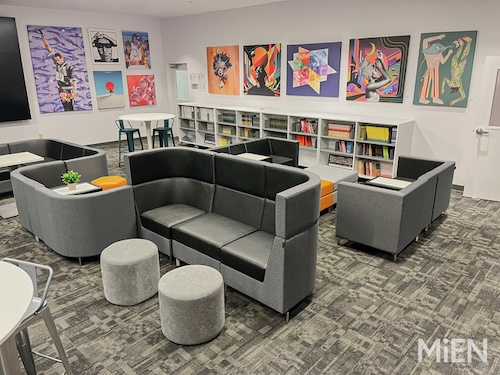
    Designed and outfitted by MiEN and Meteor Education, the Empowerment Center is where kids go to hang out, collaborate, and/or participate in school club activities. The hub is also set up with two wellness rooms where students can go to debrief and disconnect from a long day or just the stresses of being a student. It’s there for the students’ use.

    Here are the steps we took to create a space that consistently makes jaws drop and impresses parents who never thought their children would have access to such a warm, welcoming communal space on campus:

    • Add some flexibility into the process. Our original goal was to open the Empowerment Center’s doors in time for the 2023-24 school year, but getting it done the right way would require a bit more time. Our partners were willing to listen to us in terms of what we wanted to create, but within the realistic timelines. That was really cool.
    • Acknowledge the financial limitations. We largely relied on fundraising for this project and knew that some things just weren’t going to be realistic. To other schools in similar situations, I’d recommend staying flexible enough to hit the timelines and get all of the bases covered while keeping student needs in mind. We can have all the bells and whistles, but at the end of the day, if the car runs, the car runs. We know we can always add a new paint job later.
    • Get the right partners onboard early. As we went through the steps of designing the Empowerment Center, we learned a lot about architecture, planning, and construction. Through it all, having the right partners in its corner helped the school achieve its goals within budget and on time. It was really great to have our design and furniture partners sharing their best practices and other insights with us. We knew what we wanted to do, and a lot of the ideas came from our families and students. We just needed them to show us how we could get those ideas as close to reality as possible.
    • Make it personal. Special features we wanted in our Empowerment Center included a huge, interactive flatscreen TV that students, teachers, and guest speakers use to interact and work together. There’s also a large selection of donated books, the latest technology tools, and artwork that was personally selected by an art curation team. They were able to secure artists from the LA community to create and share visuals that our students are really familiar with. For example, some of the artwork spotlights female empowerment (i.e., with photos of authors like Octavia Butler) and the importance of acknowledging indigenous people. Everything in the hub is meant to spark curiosity. 
    • Brace yourself for some jaw-dropping moments. At our ribbon-cutting ceremony last year, our parents’ jaws were on the floor. They just never thought these resources would be available to their kids. A lot of them grew with us being in the church and a co-located space, and then we asked them to trust us to deliver on our promise, and now we’re able to show that as the reward for supporting us. We feel really proud that our parents were just over the moon about it.

    Hitting it out of the park

    Reflecting on the process we put in place to get our modern student hub designed, built, and open for business, I can say that the end result is an engaging, collaborative space that can be used for hanging out, structured learning, or a little of both. I think we really hit the ball out of the park with this innovative space.

    Student, teacher, and family feedback on the Empowerment Center has been extremely positive. Everyone loves it, and students are always excited to come and spend time in the modern, comfortable space that’s equipped with the technology and tools they need to be able to learn and engage.

    Latest posts by eSchool Media Contributors (see all)

    Source link