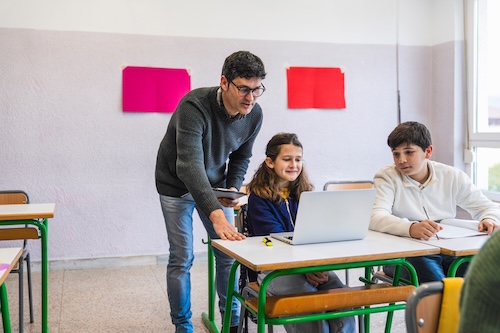
A colleague of ours recently attended an AI training where the opening slide featured a list of all the ways AI can revolutionize our classrooms. Grading was listed at the top. Sure, AI can grade papers in mere seconds, but should it?
As one of our students, Jane, stated: “It has a rubric and can quantify it. It has benchmarks. But that is not what actually goes into writing.” Our students recognize that AI cannot replace the empathy and deep understanding that recognizes the growth, effort, and development of their voice. What concerns us most about grading our students’ written work with AI is the transformation of their audience from human to robot.
If we teach our students throughout their writing lives that what the grading robot says matters most, then we are teaching them that their audience doesn’t matter. As Wyatt, another student, put it: “If you can use AI to grade me, I can use AI to write.” NCTE, in its position statements for Generative AI, reminds us that writing is a human act, not a mechanical one. Reducing it to automated scores undermines its value and teaches students, like Wyatt and Jane, that the only time we write is for a grade. That is a future of teaching writing we hope to never see.
We need to pause when tech companies tout AI as the grader of student writing. This isn’t a question of capability. AI can score essays. It can be calibrated to rubrics. It can, as Jane
said, provide students with encouragement and feedback specific to their developing skills. And we have no doubt it has the potential to make a teacher’s grading life easier. But just because we can outsource some educational functions to technology doesn’t mean we should.
It is bad enough how many students already see their teacher as their only audience. Or worse, when students are writing for teachers who see their written work strictly through the lens of a rubric, their audience is limited to the rubric. Even those options are better than writing for a bot. Instead, let’s question how often our students write to a broader audience of their peers, parents, community, or a panel of judges for a writing contest. We need to reengage with writing as a process and implement AI as a guide or aide rather than a judge with the last word on an essay score.
Our best foot forward is to put AI in its place. The use of AI in the writing process is better served in the developing stages of writing. AI is excellent as a guide for brainstorming. It can help in a variety of ways when a student is struggling and looking for five alternatives to their current ending or an idea for a metaphor. And if you or your students like AI’s grading feature, they can paste their work into a bot for feedback prior to handing it in as a final draft.
We need to recognize that there are grave consequences if we let a bot do all the grading. As teachers, we should recognize bot grading for what it is: automated education. We can and should leave the promises of hundreds of essays graded in an hour for the standardized test providers. Our classrooms are alive with people who have stories to tell, arguments to make, and research to conduct. We see our students beyond the raw data of their work. We recognize that the poem our student has written for their sick grandparent might be a little flawed, but it matters a whole lot to the person writing it and to the person they are writing it for. We see the excitement or determination in our students’ eyes when they’ve chosen a research topic that is important to them. They want their cause to be known and understood by others, not processed and graded by a bot.
The adoption of AI into education should be conducted with caution. Many educators are experimenting with using AI tools in thoughtful and student-centered ways. In a recent article, David Cutler describes his experience using an AI-assisted platform to provide feedback on his students’ essays. While Cutler found the tool surprisingly accurate and helpful, the true value lies in the feedback being used as part of the revision process. As this article reinforces, the role of a teacher is not just to grade, but to support and guide learning. When used intentionally (and we emphasize, as in-process feedback) AI can enhance that learning, but the final word, and the relationship behind it, must still come from a human being.
When we hand over grading to AI, we risk handing over something much bigger–our students’ belief that their words matter and deserve an audience. Our students don’t write to impress a rubric, they write to be heard. And when we replace the reader with a robot, we risk teaching our students that their voices only matter to the machine. We need to let AI support the writing process, not define the product. Let it offer ideas, not deliver grades. When we use it at the right moments and for the right reasons, it can make us better teachers and help our students grow. But let’s never confuse efficiency with empathy. Or algorithms with understanding.
Dennis Magliozzi & Kristina Peterson, University of New Hampshire’s Writers Academy
Kristina Peterson and Dennis Magliozzi have been teaching English since 2008. Kristina has a master’s degree in teaching and over a decade of experience mentoring teachers. Dennis holds an MFA in poetry and a PhD from the University of New Hampshire. Together, they co-teach in the University of New Hampshire’s Writers Academy and Learning Through Teaching program. Their work on generative AI’s impact in the classroom is highlighted on Heinemann’s blog, and in their forthcoming book, AI in the Writing Workshop: Finding the Write Balance.
Latest posts by eSchool Media Contributors (see all)
Two years ago, I bought each of the teachers at Hamilton Elementary in San Diego’s City Heights neighborhood a blue chair. I told them to put it in the back of their classrooms, and that if a parent or caregiver wanted to visit to see how their children are learning — no matter what the reason — that this would be a dedicated space for them.
I may have earned some exaggerated eye-rolls from educators that day. After all, I can appreciate the disruption to learning that classroom visitors can sometimes cause, especially among excitable elementary schoolers.
But school is our home, and it is our responsibility to invite families into our home and welcome them. And this was a necessary olive branch, my way of saying to families: “From here on out, things are going to be different.”
And they were. They also can be different at other schools, because the benefits of family engagement go well beyond student achievement.
Research has long shown that when parents and caregivers are involved and engaged with their children’s education — whether that’s by attending parent-teacher conferences or participating in school events — student achievement, motivation and social-emotional well-being increase.
Parent involvement with reading activities has a positive impact on reading achievement, language comprehension, expressive language skills and level of attention in the classroom, according to the National Literacy Trust.
Research also shows that educators enjoy increased job satisfaction and are more likely to keep teaching at the school, families enjoy stronger relationships with their children and feel less isolated, and even school districts themselves become better places to live and raise children.
None of this was the case when we returned to normalcy following Covid. Just 13 percent of students were reading on grade level, and 37 percent were chronically absent. I knew right away that before we even attempted to tackle academics, we needed to engage families and make them feel deeply connected and committed to the community I envisioned building here.
Today, 45 percent of students are reading at grade-level, and chronic absenteeism, at 12 percent on the most recent official numbers, is down to 10 percent in our own tracking, with a goal of pushing it down to 8 percent in 2025-26.
But it wasn’t easy given the distrust that had boiled over during the pandemic, with families skeptical of our ability to effectively support their children and school staff feeling defensive and exhausted.
It was clear to me that families weren’t excited to send their kids to school, didn’t feel informed about what was happening on our campus and, moreover, didn’t feel comfortable — let alone capable — of communicating their needs to us.
Complicating matters further was the need to share information across many languages other than English, which can make relationship-building and communicating expectations difficult.
Roughly half of our students are English learners, and while the majority of their families are Spanish-speakers, there are growing populations of students whose first languages are Haitian-Creole, Pashto and Vietnamese.
The first thing I did was establish open communication with parents using ClassDojo, a mobile app that gives families an easy, intuitive central access point to our teachers and staff, automatically translates all messages into parents’ native languages and allows us to share stories about what is happening in school.
It became an easy way to build trust and collaboration between families and staff.
Creating that type of visibility was key to breaking down walls between us. And in those early days, we didn’t post about literacy, math or anything related to academics. Instead, we focused solely on attendance and getting families to come inside the school as much as possible.
We focused on relationship-building activities and joyful learning. We hosted after-school art classes and monthly family Fridays, when families could come to school to engage in a fun activity.
We organized a Halloween costume drive with candy and fun games for kids; we hosted a Read Across America event where we passed out Play-Doh; and we organized other low-stakes events at school, rooted in building a partnership between home and school.
Again, our goal wasn’t learning during these meet-ups. It was all in service of building trust and creating meaningful relationships with students and their families.
Once we had the foundation in place, we added a focus on academics — though we rooted that learning in family engagement, too. For example, our schoolwide focus last year was phonics, so we sent activities home for families to complete with their children that were tied specifically to concepts the students needed reinforced, based on their individual assessments, like long vowel patterns and sight words.
These activities were taught by the students and their teachers to family members during conferences.
Beyond helping students, the exercise challenged a false narrative so many families had assumed — that they either didn’t know enough about what was happening in school to help, weren’t confident enough to help or didn’t have enough time.
Today, the atmosphere at Hamilton feels radically different than when I first walked through the doors. When we first started hosting Family Fridays, about 10 family members and their children showed up.
Now, we have roughly 200 caregivers at every meet-up. Families run most of the community-based initiatives at the school — from a boutique where families can shop among donated clothes twice a month, to a food distribution center, to a book club, English classes and a monthly meet-up where families can socialize.
When district leaders visit, they’re always impressed by the participation. I tell them, if you care about family engagement, it has to be so deeply embedded into the system that people don’t have a choice but to do it.
That’s why I’m constantly thinking about how to center family engagement in staff meetings, in attendance meetings, in literacy and math plans, in behavioral and counseling plans and in meetings about school procedures and budgets.
It’s a strategy that not only involves families but also supports academic achievement and student well-being. For me, family engagement is the ultimate strategy for academics.
Sometimes in the K-12 world we keep outreach and academics separate, but in reality, engagement is the key that unlocks our ability to hit academic goals and create a joyful school community.
The Hechinger Report provides in-depth, fact-based, unbiased reporting on education that is free to all readers. But that doesn’t mean it’s free to produce. Our work keeps educators and the public informed about pressing issues at schools and on campuses throughout the country. We tell the whole story, even when the details are inconvenient. Help us keep doing that.
School (in)Security is our biweekly briefing on the latest school safety news, vetted by Mark Keierleber. Subscribe here.
As far-right political operative David Barton leads a Christian nationalist crusade, he’s traveled to state capitols across the country this year to support dozens of bills requiring Ten Commandments displays in classrooms.
My latest story digs into a well-coordinated and deep-pocketed campaign to inject Protestant Christianity into public schools that could carry broader implications for students’ First Amendment rights. Through a data analysis of 28 bills that have cropped up across 18 states this year, I show how Barton’s role runs far deeper than just being their primary pitchman.
The analysis reveals how the language, structure and requirements of these bills nationwide are inherently identical. Time and again, state legislation took language verbatim from a Barton-led lobbying blitz to reshape the nation’s laws around claims — routinely debunked — about Christianity’s role in the country’s founding and its early public education system.
Three new state laws in Louisiana, Arkansas and Texas mandating Ten Commandments posters in public schools are designed to challenge a 1980 Supreme Court ruling against such government-required displays in classrooms. GOP state lawmakers embracing these laws have expressed support for eradicating the separation of church and state — a pursuit critics fear will coerce students and take away their own religious freedom.
In the news
Updates to Trump’s immigration crackdown: Immigration and Customs Enforcement has released from custody a 6-year-old boy with leukemia more than a month after he and his family were sent to a rural Texas detention center. | Slate
As the Department of Homeland Security conducts what it calls wellness checks on unaccompanied minors, the young people who migrated to the U.S. without their parents “are just terrified.” | Bloomberg
‘It looks barbaric’: Video footage purportedly shows some two dozen children in federal immigration custody handcuffed and shackled in a Los Angeles parking garage. | Santa Cruz Sentinel
The Department of Homeland Security is investigating surveillance camera footage purportedly showing federal immigration officers urinating on the grounds of a Pico Rivera, California, high school in broad daylight. | CBS News
California sued the Trump administration after it withheld some $121 million in education funds for a program designed to help the children of migrant farmworkers catch up academically. | EdSource
Undocumented children will be banned from enrolling in federally funded Head Start preschools, the Trump administration announced. | The Washington Post
Legal pushback: Parents, Head Start providers challenge new rule barring undocumented families. | The 74
Getty Images
The executive director of Camp Mystic in Texas didn’t begin evacuations for more than an hour after he received a severe flood warning from the National Weather Service. The ensuing tragedy killed 27 counselors and campers. | The Washington Post
The day after the Supreme Court allowed the Education Department’s dismantling, Secretary Linda McMahon went ahead with plans to move key programs. | The 74
Now, with fewer staff, the Office for Civil Rights is pursuing a smaller caseload. During a three-month period between March and June, the agency dismissed 3,424 civil rights complaints. | Politico
Sign-up for the School (in)Security newsletter.
Get the most critical news and information about students’ rights, safety and well-being delivered straight to your inbox.
Massachusetts legislation seeks to ban anyone under the age of 18 from working in the state’s seafood processing facilities after an investigation exposed the factories routinely employed migrant youth in unsafe conditions. | The Public’s Radio
An end to a deadly trend: School shootings decreased 22% during the 2024-25 school year compared to a year earlier after reaching all-time highs for three years in a row. | K-12 Dive
Florida is the first state to require all high school student athletes to undergo electrocardiograms in a bid to detect heart conditions. | WUSF
The Senate dropped rules from Trump’s “big, beautiful” tax-and-spending bill that would have prevented states from regulating artificial intelligence tools, including those used in schools. | The Verge
Food stamps are another matter: The federal SNAP program will be cut by about a fifth over the next decade, taking away at least some nutrition benefits from at least 800,000 low-income children. | The 74
What if I told you the education system isn’t broken—it’s working exactly the way it was built to? That’s not just a soundbite from my TEDx Talk—it’s my lived experience.
I grew up in a historically underserved neighborhood in Houston, Texas, zoned to one of the lowest-performing elementary schools in the city. But due to a granted academic transfer, I ended up attending a top-performing public school just three miles away. Same city. Different ZIP code. Completely different resources—and trajectory.
That three-mile difference changed everything. And today, as a doctoral student and aspiring professor, I can see how those early disparities still show up in our college classrooms.
Here’s the thing: public school funding in the U.S. depends heavily on local property taxes. That means wealthier neighborhoods get better schools—often with state-of-the-art facilities, robust extracurriculars, and college prep courses—while nearby communities may struggle with crumbling infrastructure and underpaid staff (Owens-Young 2023).
Part of my dissertation, I compared two elementary schools less than three miles apart. One had a PTA raising over $100,000 annually. The other didn’t have working air conditioning. These weren’t just different schools—they were different worlds. And students from those environments bring that context with them when they walk into our lecture halls.
But what we see in higher education—missed assignments, low engagement, quiet classrooms—isn’t always a motivation issue. Often, it’s a preparedness gap. And that gap isn’t the student’s fault.
As faculty, we can’t change where our students come from. But we can shape what they experience once they’re here. Below are four strategies I use in the classroom to help level the playing field:
1. Start by Asking, Not Assuming
Instead of assuming a lack of interest, ask about their background. I use a quick, anonymous prompt on the first day of class: “What’s one thing you overcame to get here today?” One student wrote about taking two buses from the other side of town after getting their younger siblings off to school. That kind of insight changes how we teach.
2. Rethink Participation
Not everyone feels comfortable speaking up in class. Consider using written reflections, discussion boards, or tools like Jamboard and Padlet. For instance, in one of my leadership classes, I use a shared Google Doc where students add thoughts anonymously. The quieter students thrive—and the louder ones gain new perspectives.
3. Normalize Struggle
Students from under-resourced schools often view academic struggle as failure. That’s why I share my own story of nearly failing out during undergrad. I also let students revise one major assignment. One student improved from a 72 to a 90—and more importantly, realized they were capable all along.
4. Offer Flexible Assessment Options
Some students express themselves better visually or verbally. I once had a student create a narrated photo essay instead of a traditional paper—it was powerful, reflective, and demonstrated full mastery. When students see that their strengths are valued, their confidence grows.
None of these ideas require overhauling your entire course. But they do require intentionality. And that’s what makes the difference.
I’ve been the under-resourced student, and now I’m becoming the professor I wish I had—someone who saw potential beyond performance.
We don’t control our students’ ZIP codes. But we do influence how they feel in our classrooms—and whether they believe they belong there.
Lloyd Lindley Jr. is a PhD student in Educational Leadership and Organization at Texas Woman’s University, a TEDx speaker, and author of “From the Hood to Understood”. He is the co-founder of a grassroots nonprofit that advocates for equitable access to education, mentorship, and financial literacy in underserved communities. Lloyd has been featured on Good Morning Houston and KTSU Radio for his impactful community work and continues to champion culturally responsive teaching and student empowerment at all levels of education.
References
Owens-Young, Jessica. 2023. “The ZIP Code Effect.” American University.
What if I told you the education system isn’t broken—it’s working exactly the way it was built to? That’s not just a soundbite from my TEDx Talk—it’s my lived experience.
I grew up in a historically underserved neighborhood in Houston, Texas, zoned to one of the lowest-performing elementary schools in the city. But due to a granted academic transfer, I ended up attending a top-performing public school just three miles away. Same city. Different ZIP code. Completely different resources—and trajectory.
That three-mile difference changed everything. And today, as a doctoral student and aspiring professor, I can see how those early disparities still show up in our college classrooms.
Here’s the thing: public school funding in the U.S. depends heavily on local property taxes. That means wealthier neighborhoods get better schools—often with state-of-the-art facilities, robust extracurriculars, and college prep courses—while nearby communities may struggle with crumbling infrastructure and underpaid staff (Owens-Young 2023).
Part of my dissertation, I compared two elementary schools less than three miles apart. One had a PTA raising over $100,000 annually. The other didn’t have working air conditioning. These weren’t just different schools—they were different worlds. And students from those environments bring that context with them when they walk into our lecture halls.
But what we see in higher education—missed assignments, low engagement, quiet classrooms—isn’t always a motivation issue. Often, it’s a preparedness gap. And that gap isn’t the student’s fault.
As faculty, we can’t change where our students come from. But we can shape what they experience once they’re here. Below are four strategies I use in the classroom to help level the playing field:
1. Start by Asking, Not Assuming
Instead of assuming a lack of interest, ask about their background. I use a quick, anonymous prompt on the first day of class: “What’s one thing you overcame to get here today?” One student wrote about taking two buses from the other side of town after getting their younger siblings off to school. That kind of insight changes how we teach.
2. Rethink Participation
Not everyone feels comfortable speaking up in class. Consider using written reflections, discussion boards, or tools like Jamboard and Padlet. For instance, in one of my leadership classes, I use a shared Google Doc where students add thoughts anonymously. The quieter students thrive—and the louder ones gain new perspectives.
3. Normalize Struggle
Students from under-resourced schools often view academic struggle as failure. That’s why I share my own story of nearly failing out during undergrad. I also let students revise one major assignment. One student improved from a 72 to a 90—and more importantly, realized they were capable all along.
4. Offer Flexible Assessment Options
Some students express themselves better visually or verbally. I once had a student create a narrated photo essay instead of a traditional paper—it was powerful, reflective, and demonstrated full mastery. When students see that their strengths are valued, their confidence grows.
None of these ideas require overhauling your entire course. But they do require intentionality. And that’s what makes the difference.
I’ve been the under-resourced student, and now I’m becoming the professor I wish I had—someone who saw potential beyond performance.
We don’t control our students’ ZIP codes. But we do influence how they feel in our classrooms—and whether they believe they belong there.
Lloyd Lindley Jr. is a PhD student in Educational Leadership and Organization at Texas Woman’s University, a TEDx speaker, and author of “From the Hood to Understood”. He is the co-founder of a grassroots nonprofit that advocates for equitable access to education, mentorship, and financial literacy in underserved communities. Lloyd has been featured on Good Morning Houston and KTSU Radio for his impactful community work and continues to champion culturally responsive teaching and student empowerment at all levels of education.
References
Owens-Young, Jessica. 2023. “The ZIP Code Effect.” American University.
School and other learning environments are often a safe place for students who have difficult home lives.
I know, I was one of those students. I take that knowledge into every classroom that I enter, and my understanding of student engagement and student experience are woven into my pedagogy of care and teaching to transgress.
I cannot, (and do not wish to!) separate my lived experience from my teaching. As someone who dropped out of the university that I now work at, I do have an interesting insight into building community and belonging into the curriculum.
As I wrote here with Lisa Anderson, we require a radical shift in how we consider the needs of students. I want every student in my classroom to experience it as a safe and welcoming space.
These are not buzzwords or trends, it is how I ensure that students are able to learn – I want them to be in the room. Teaching is a relational activity that requires commitment, experience, honing our craft and being willing to adapt.
The university sector is not in a good place, and as committed as I am to my research, it is teaching that brings me joy and new ideas every single time I enter the classroom. When we teach to transgress, it is for us as much as it is for the students.
The classroom reminds me of what is possible. Engaging strongly with the literature of the UK’s leading emergency and disaster planner, Lucy Easthope, I recognise the education will be impacted forever by the pandemic, and I want to play my part in the recovery.
Crime, justice and the sex industry
I lead the largest optional final year module in my department, with 215 registered students, based on my 23 years’ experience of the sex industry. It was a community of care that got me here, with colleagues from around the country (and globe!) sharing material and ideas with me when I launched this module in 2020. Collaboration and teaching go hand-in-hand and we must allow time for this.
The module is underpinned by my nonlinear pedagogy which I write about here. The design empowers students to have control over the direction and pace of their learning. All content is uploaded to our virtual learning environment Canvas in week one. There are weekly recorded lecture summaries, and 2-hour weekly workshops.
The content also includes a comprehensive library reading list, weekly reading folders, watch folder and collaborative tools.
This year the module is celebrating its fifth birthday and the student engagement is better than ever before. Here are some things that I have learned and that I am reflecting on.
A welcoming classroom and learning names
Where possible, I always enter the classroom ten minutes before class begins (this is definitely not always possible in a large and busy campus with extreme demands on estates and our time) to provide a prepared and calm setting for students to arrive. This is also helpful for me as a neurodiverse teacher.
I like to greet students as they arrive, and learn names wherever possible (photo class lists are your friend).This sets the tone for our warm and welcoming teaching community. It demonstrates the way in which we will invite peers to contribute and talk through the content. It may seem a small thing, but it makes a huge difference to teaching and learning.
Front-loaded prep
As a dyslexic I need to be prepared. This is a large module, and a busy teaching load. I spend the weeks before semester begins frontloading my prep so that I am ready to go. This involved re-recording the summary E lectures, updating workshop materials, sheets, reading folders, module guides, etc.
Visitors to my office are surprised to see a row of 12 piles along the floor- with each week’s content printed out, highlighted, and ready to go. I am always very grateful once semester starts that I took the time to do this. It creates a calm tone to classes that students explicitly comment on.
Lesson plans
This year I went old-school in multiple ways, including buying a hardback lesson planner, in which I mapped out the learning objectives for every workshop – mapping against learning outcomes for the module.
Physically mapping these out, with prompts, links to the readings and case studies, was something that students positively picked up on. This also ensured adaptability and that I was reflecting upon and updating my material. Students need calm and expert guidance; experienced teachers are key.
Workbooks
Acting on student feedback from the previous year, I designed a workbook that students can print out or use digitally. Students always make a lot of notes on this module, and the workbook helps them with organising those thoughts. In class, I was very pleased to see rows of pink workbooks looking back at me.
The workbook also includes space for questions, and learners can bring this to my student support hours. I have been learning a lot from school teachers, and recognising how much extra structure students need post-pandemic.
Learning through tempo
I made an active decision this year to experiment with the tempo of each workshop class, with differences even between some workshop groups. This was in response to student feedback who wanted some slower sessions in order to read in class, and more time to talk with their groups/peers.
This was music to my ears (pun absolutely intended) and it made me reflect on the pace and rhythm of my classes. I am a high-energy teacher and I like to pack a lot into classes, but stripping (pun not intended!) some of this back to create quieter time (for class reading) and slower sessions with more time for groups to talk, has been a game-changer. Students actively requesting some slower workshops so they could read together in class, was amazing to witness. Students reacted overwhelmingly positively to my ability to respond and adapt.
Learning through play
It is interesting in this post-disaster period of the pandemic to witness students enjoying, and requesting, playful activities in class. As I argue here, we need to build community into the curriculum to boost attendance.
Poster paper and felt tip pens might have attracted horrified faces a few years ago and a low uptake, but this year, every single “play” activity that I have offered has been taken up by almost every student. I always offer a range of engagement tools, with non-verbal options such as our collaborative google doc, padlet, and other online tools, and I offer the option for sheets, paper, pens etc.
A welcoming, hospitable classroom where students know they are being considered, pays dividends in engagement and mutual respect. Once students feel safe and able to take risks, no matter how low-stakes, they open up, and engage in difficult and complex debates.
One group activity looked at sexual entertainment venue closures using five different pieces of coloured card to map out key findings from two different journal articles, identify and apply concepts from earlier weeks in the module, examples of venue closures, and examples of campaign group discourse.
A “fun” activity that involves deep critical thinking and the ability to successfully weave together multiple forms of evidence to formulate a convincing argument. I then took a photo of the giant map we all created across the module. Every single student wanted to take part; students are actively seeking community and togetherness within the classroom.
The activity with foam stickers, which I thought students would resist, was the most popular activity of the semester (after the guided walk, below). Through the mechanism of light-hearted play, students successfully navigated a tricky and sensitive topic examining the harms, dangers and exploitation associated with online sex work. We ended up with students stickering their laptops, phones, their workbooks, and themselves! We cannot forget that these are all students of the pandemic, they missed out on so many opportunities to interact with peers. They are embracing every opportunity to connect with each other within timetabled sessions.
Guided walk
Another activity on the module (and the one that students most favourably comment on) is our guided walk of sexual entertainment venues in Liverpool city centre. I provide online material for accessibility purposes recognising that not all students can walk around the city, or may not wish to.
For students who attend, we map out the city in terms of gendered harm and risk, and I give a lecture inside of a sexual entertainment venue that opens exclusively for our class. This brings the Policing and Crime Act 2009 to life, and gives students a unique insight into what the key texts are discussing. It is also very much a community building exercise, with a large proportion of our module cohort in attendance. Learning outside of the classroom is very important for student engagement.
Scaffolding learning
I intentionally choose to layer texts: curating texts of various complexity, using tools such as padlet. Students choose what texts to access based on their own areas of interests and confidence, as they progressively build up skill and academic knowledge of the area. This ensures that the module is accessible to all students, with learners challenged at a point which feels appropriate for them.
It also means that students always have supported content to work with. In week ten, we looked at the media, and we returned to a key text from week eight, to apply three media myths from a journal article to three documentary clips. Using worksheets, the students demonstrated a sophisticated ability to apply a criminological concept to media sources.
Responding to ongoing feedback
Building a rapport with students through modelling a pedagogy of care and inclusion, equips students with the ability to provide feedback throughout the semester. Students appreciate the wealth of resources available from the beginning of semester, but others may feel overwhelmed with choice.
In rapid response to student feedback, I started to provide recommended readings in addition to the large selection. Students appreciated this speedy closing of the feedback loop, and being valued co-producers of the module approach. The student feedback for the module was the best yet.
Accessible assessment as the default position
With growing numbers of students experiencing health issues, it is good practice to think of accessibility as the default position, not an additional bolt-on. I am in favour of different modes of assessment that students can choose from, or developing an assessment that can be approached in different ways. I have written here about my letter assessment, inspired by the work of Katie Tonkiss. Students often feel worried about “academic writing”, and this assessment allows students to use the first person, and to use a more colloquial writing tone if desired. The students develop a nuanced, convincing and influential writing style, with the ability to hold conflicting and competing harms in tension.
Ultimately, it is about remembering that teaching is a huge privilege and blessing. We get to have an impact on so many people and play a part in shaping ideas and innovations of the future. I will never lose the gratitude for getting to do this job and remembering where I come from.
CINNAMINSON, N.J. — Terri Joyce believed that her son belonged in a kindergarten classroom that included students with and without disabilities.
The year before, as a 4-year-old, he happily spent afternoons in a child care program filled with typically developing children, without any extra support. Like other kids his age, her son, who has Down syndrome, was learning about shapes and loved sitting on the rug listening to the teacher read books aloud. His speech delay didn’t prevent him from making friends and playing with children of differing abilities and, during the summer, he attended the same program for full days and would greet her with big smiles at pick up time.
But when Joyce met with school district administrators ahead of her son’s kindergarten year, they told her that he would need to spend all day in a classroom that was only for students with significant disabilities.
“They absolutely refused to even consider it,” Joyce said. “They told us, ‘We move so fast in kindergarten, he needs specialized instruction, he’ll get frustrated.’”
It was the separate classroom that left him frustrated.
Terri Joyce said her son, who has Down syndrome, has thrived after she fought for him to be included in a general education classroom. Credit: Yunuen Bonaparte for The Hechinger Report
Under federal law, students with disabilities — who once faced widespread outright exclusion from public schools — have a right to learn alongside peers without disabilities “to the maximum extent” possible. That includes the right to get accommodations and help, like aides, to allow them to stay in the general education classroom. Schools must report crucial benchmarks, including how many students with disabilities are learning in the general education classroom over 80 percent of the time.
More than anywhere else in the country, New Jersey students with disabilities fail to reach this threshold, according to federal data. Instead, they spend significant portions of the school day in separate classrooms where parents say they have little to no access to the general curriculum — a practice that can violate their civil rights under federal law.
Just 49 percent of 6- and 7-year-olds with disabilities in the state spend the vast majority of their day in a general education classroom, compared with nearly three-quarters nationally. In some New Jersey districts, it was as low as 10 percent for young learners. Only 45 percent of students with disabilities of all ages are predominantly in a general education classroom, compared to 68 percent nationwide.
For over three decades, the state has faced lawsuits and federal monitoring for its continued pattern of unnecessarily segregating students with disabilities and regularly fails to meet the targets it sets for improving inclusion.
Surrounded mostly by children who had trouble communicating, Terri Joyce’s son’s speech development stalled. He wasn’t exposed to what his peers in the general education classroom were learning — like science and social studies.
For Terri Joyce, getting her son included in a general education classroom “was a part-time job” and meant staying on top of, and documenting, his academic and social progress. Credit: Yunuen Bonaparte for The Hechinger Report
Joyce tried mediation with the Cinnaminson district but they refused to budge. In the end, she hired a lawyer, filed a due process claim with the state and succeeded in having her son placed in a classroom that included students with and without disabilities the next year, repeating kindergarten to see if he could regain the skills he had lost. The process cost her family thousands of dollars.
Related: Become a lifelong learner. Subscribe to our freeweekly newsletter featuring the most important stories in education.
The Hechinger Report spoke with more than 80 parents, researchers, lawyers, advocates and school officials across the state who described a widespread failure to devote resources to integrating students with disabilities — and a decentralized system that gives enormous power to district leaders, who have long been able to refuse to prioritize inclusion without facing consequences from the state or federal government.
New Jersey is known nationally as a leader in public education, but the state’s governance system has led to inclusion rates that vary dramatically between districts. As a result, a child who is placed in a separate classroom for the entire day in one district could be included all day in a general education classroom in a neighboring one.
“Mindset is the biggest barrier,” said Michele Gardner, executive director of All In for Inclusive Education and previously an administrator for 15 years in the Berkeley Heights district. “There are educators, parents, administrators and physicians who truly believe that separate is better for children with and without disabilities. With more than 600 districts, local control makes change harder.”
Experts say integrating students with disabilities in general education should be easiest, and can be the most beneficial, in the early years. Researchers have found students with and without disabilities — particularly the youngest learners — can benefit when inclusion is done with enough staffing and commitment. Young children also learn from watching each other, and parents worry denying students with disabilities this chance can have lasting damage on them academically and emotionally. Worldwide, inclusion is considered a human right helping all children develop empathy and prepare for society after graduation.
Too often, New Jersey parents say, young learners are placed right away in separate classrooms based on a diagnosis — as Joyce’s son was — rather than an assessment of what support they actually need.
Just over a decade ago, New Jersey settled a class-action lawsuit filed by parents and advocacy groups over student placement, which required years of state monitoring, a new stakeholder committee, and training and technical assistance for districts with the lowest rates of inclusion.
But since then, the proportion of young students in the general education classroom the vast majority of the day actually decreased by about 5 percentage points, from 54 percent in the 2013-14 school year. Nationwide, there was no such drop.
“We are certainly seeing a trend that, even at younger ages, students are being shuttled into segregated schooling and never really starting in inclusive experiences,” Syracuse University inclusive special education professor Christine Ashby said of New Jersey and other states.
Ashby, who also runs the university’s Center on Disability and Inclusion, said students then tend to stay in separate — commonly called self-contained — classrooms, where they may receive individualized instruction alongside peers with disabilities but may be less prepared for life after high school.
For Terri Joyce, the opportunity she fought for her son to have proved worth it. It took him time to adjust, but with the help of an aide, he settled in and, now in first grade, is thriving alongside his general education peers once again.
“It was like night and day,” said Joyce. “His speech improved. He loves school. He has friends. He gets invited to birthday parties.”
Terri Joyce is happy with how her son’s writing skills have developed in first grade while learning in a general education classroom. Credit: Yunuen Bonaparte for The Hechinger Report
New Jersey Department of Education officials declined a request for an interview, but said in a statement that the agency is working with schools statewide to improve how often students with disabilities are placed in general education classrooms through training, technical assistance and programs promoting inclusion. A new website provides a detailed look at each district’s data, broken down by grade and type of disability.
“All placement decisions must be made on an individual basis and there is no one-size-fits all standard or outcome that should be applied to every district, school or student,” Laura Fredrick, the department’s communication director, said in the emailed statement.
Fredrick said districts that fail to meet state goals for increasing inclusion may face more intensive monitoring, but there are no direct financial penalties or automatic consequences for failing to improve. She also noted that the state pays for voluntary trainingto increase inclusion in K-12 schools.
That program has helped in some districts, but a limited number of schools have participated so far and space is limited — some that have applied for the training have been turned away.
In Cinnaminson, district officials said they could not comment on specific students but that school officials and parents work together on placement decisions.
“To the fullest extent possible, we strive to place students in general education classrooms for the most inclusive educational experience,” Superintendent Stephen Cappello said in a statement.
Some experts said the data suggests that, unlike other states, New Jersey districts do a good job providing individualized services that students need. Autism New Jersey clinical director Joe Novak said in contrast, “There are certain districts, or states, where the default may simply be to place the child in general education and say, ‘Well, best of luck.’”
Indeed a frequent complaint from some parents is the lack of specialized services in general education classrooms, especially because of staffing shortages or lack of expertise. In those cases a student may be counted as included in a general education classroom but without the support they need, which advocates on both sides of the debate say can be harmful.
“New Jersey is probably doing a lot of things right, because it means we’re probably really customizing what makes sense for the individual,” Novak said
Yet others say the state can improve inclusion rates that are sharply lower than the nation’s.
The federal government doesn’t say how many students should be included or for how much of the school day. States set targets for inclusion rates but typically don’t fine or sanction districts for not meeting them. States can also take other steps like requiring training or administrative changes for districts. Advocates say New Jersey districts have little to lose for repeatedly falling below the state’s own targets for including children with disabilities.
Left out
New Jersey has the nation’s lowest inclusion rates for students with disabilities. The Hechinger Report investigated why — and visited places that show how it doesn’t need to be that way.
Do you have experiences with special education you’d like to share with our journalists?
Oversight from the federal government could also diminish going forward. Although the Trump administration pledges to continue funding special education, advocates warn the planned dismantling of the Department of Education, including its civil rights enforcement arm, will harm students with disabilities.
“It’s sort of petrifying, from my end, for these families,” said Jessica Weinberg, a former New Jersey school district attorney who now runs a special education law firm.
“It could be completely disbanded,” she said of the Education Department. “The uncertainty is really unsettling.”
Federal law says students should be placed in separate classrooms “only if” they can’t learn in the general education classroom with services detailed in IEPs, or individualized education programs — the document that outlines a student’s needs, the services they should receive and where they’ll receive them. Teachers, school officials and parents sit on their child’s IEP team, which is supposed to review placement decisions each year.
And parents across New Jersey say it takes time and money to fight for access to general education classrooms — which means whether a child is included can reflect existing racial disparities and whether families can afford lawyers and advocates. Parents say when a school argues their child must be taught separately, their best way of fighting that decision is lawyers and experts — if they can afford it.
Districts with less poverty and a larger share of white students tend to have higher inclusion rates and test scores, according to The Hechinger Report’s analysis of state data. Overall, just 37 percent of Black students in kindergarten, first or second grade in New Jersey are included in the general education classroom for the vast majority of the school day, compared to half of white students.
It’s challenging to get special education services in urban and lower-income districts in the first place, said Nicole Whitfield, a mother of a child with a disability who founded an advocacy group in Trenton for families fighting for special education services.
Urban “districts are so overloaded with so many kids, they don’t do a good job in managing it,” she said.
In all districts, arguments against including more students often hinge on money. Administrators may say they can’t afford all the services every child needs, like an aide assigned to work with one child, and some parents worry providing comprehensive services could strain budgets or cut services for students without disabilities. As special education costs rise, the federal government has long failed to provide as much special education funding as it pledged.
The way New Jersey funds schools doesn’t consider how many students have disabilities. The governor’s proposed budget for the upcoming school year would take that into account and increase overall special education spending by about $400 million — though some districts will lose money. Lawmakers are debating the governor’s proposal, which has some support from the chair of the state Senate Education Committee, Sen. Vin Gopal.
Yet districts spend hundreds of millions of dollars a year to pay tuition at private schools ($784 million last year statewide) and fight legal battles — money advocates say could boost public special education.
It cost Washington Township school district about $90,000 to send Nicole Lannutti’s daughter, who is non-verbal and has a developmental delay, to a private preschool for a year rather than educate her in one of its schools.
“If you can come up with the money for lawsuits, why can’t you put it into the district right now?” Lannutti said. “That makes no sense.”
Washington Township school district did not respond requests for comment.
Whittier Elementary School in Teaneck, New Jersey, rearranged its classrooms to improve how many students with disabilities are included in classes with their peers. Credit: Meredith Kolodner/The Hechinger Report
In some districts, officials say inclusion doesn’t cost more in the long run, even if there are upfront costs. Administrators in Sparta Township, for example, said improving inclusion rates didn’t require more spending. Its schools got help from the New Jersey Inclusion Project — the state-funded training program that helps districts provide students with the least restrictive learning environment appropriate for them.
“[It] has really changed the way we educate our students,” said Adrienne Castorina, Sparta’s director of special services. Teachers found that they were able to provide specialized instruction in reading inside a general education classroom, for example, instead of pulling children out and teaching them in separate rooms.
In 2024, a special education parent advisory committee in Bernards Township School District asked administrators to apply to the New Jersey Inclusion Project. Parents thought the program would be a no-cost, collaborative path forward.
District officials refused.
Many parents in the wealthy district say Bernards’ classroom staff are committed and skilled, but they also say there’s an unwritten policy of separating children based on their diagnosis — close to three-quarters of children with autism, for example, spend the vast majority of their day without contact with their general education peers.
For years, Trish Sumida pleaded with staff at her daughter’s elementary school in Bernards to allow her to have contact with her non-disabled peers. But every day, starting in kindergarten, she learned only alongside other children with autism. Most years, she was the only girl in the room, and she longed for someone to play with who shared her interests.
“Those early years are so important,” said Sumida, whose daughter is now in fifth grade and still spends most of her time in a separate classroom. “I feel like we’ve missed our window.”
Many Bernards parents are particularly frustrated by the refusal to set up co-taught classrooms, a nationally used approach where a general education and special education teacher work together to educate students with and without disabilities.
Jean O’Connell, Bernards’ director of special services, rejected the idea of co-taught classes in elementary school, saying they made it harder to support individual students, particularly in reading. “We had this model in place for many years and found it ineffective,” she said in an email.
Research suggests even students with significant disabilities can learn alongside general education peers with help from co-teachers or paraprofessionals. And a large body of evidence suggests inclusion doesn’t harm learners with or without disabilities.
Some scholars say inclusion research is flawed because students who appear to benefit may need less support and have fewer academic struggles. Such experts point out that a separate classroom may be the appropriate setting for some children, who could languish without intensive support in a general education classroom. And schools with high inclusion rates on paper may place students with disabilities in general education without needed aides and accommodations — which federal data does not capture.
Even a prominent researcher who has questioned the benefits of inclusion, however, said most children don’t need to be taught separately all day.
“Most students with disabilities do not need very intensive forms of instruction,” said Vanderbilt University special education professor Douglas Fuchs.
O’Connell did not respond to questions about why Bernards refused to participate in the New Jersey Inclusion Project and said only that the district has participated in inclusion workshops. She added that the district has no “blanket district-wide policy on inclusion” and involves parents in all placement decisions.
Yet several Bernards parents said they met intense resistance from administrators. One mom said her child who has autism that requires limited support was in an inclusion classroom for pre-K without any problems, but Bernards administrators insisted he be placed in a self-contained classroom for kindergarten.
“He would cry to me every morning and say he didn’t want to go to school,” said the mom, who asked not to be named, afraid her child could experience discrimination because of his disability if identified. “I just felt heartbroken every day.”
She tried repeatedly to have him moved, eventually turning to mediation and filing a complaint with the state. Ultimately, she felt her child couldn’t wait for a resolution. She moved to another district last fall, where he learns alongside his general education peers all day. She said her child is now happy and doing well academically and socially.
Other districts that have struggled with low levels of inclusion have embraced outside help — including from the Inclusion Project. The program helped Whittier Elementary School in Teaneck create its first co-taught classrooms two years ago. Teachers there said the shift requires a lot of planning and they wish they had more staff to provide support, but they’ve seen their students develop academically and socially.
“When you think about the conversations that kids have — turn to your partner, talk to your table, those opportunities aren’t there in self-contained,” said Janine Lawler, who has been a special education teacher for 18 years, mostly in self-contained classrooms, and is now co-teaching in a first-grade class.
Janine Lawler teaches math to a group of first graders in Teaneck, New Jersey. Her classroom includes students with and without disabilities. Credit: Meredith Kolodner/The Hechinger Report
Educators say they can provide intensive instruction without having to separate children for large portions of the day.
“Do we have to isolate young people to give them a service, or can we include them and provide the same service or greater service?” said André Spencer, superintendent of Teaneck Public Schools. “We believe we can include them.”
For decades, New Jersey education officials have failed to support or pressure districts to improve their inclusion rates. A 2004 report found a lack of consequences — such as financial penalties — for New Jersey districts who repeatedly failed to increase inclusion of students with disabilities despite years of promises to improve.
“There’s a culture in New Jersey, which is that you teach kids with impairments in segregated classes,” said Carol Fleres, a long-time special education administrator in New Jersey who is now a special education professor and department co-chair at New Jersey City University.
A 2018 report by the National Council on Disability, an independent federal agency, found “serious contradictions” in New Jersey’s regulations that lay out how schools have to provide special education services. For example: The state categorizes students as having mild, moderate or severe disabilities and says that students with similar behavioral or academic needs should be grouped together.
Those issues make it easy for New Jersey schools to lump students with disabilities together in violation of federal requirements, according to the report.
A spokesman for New Jersey’s education department defended the regulations as doing the opposite. “This arrangement helps ensure that students who require more individualized instruction, especially those whose needs cannot be met in a general education setting, even with supplementary aids and services, are educated in smaller, more supportive environments,” Michael Yaple said in an email.
Despite settlements and scrutiny, advocates want more accountability: New Jersey’s State Special Education Advisory Council, which advises the state Education Department on special education issues, recommended required training for districts with low inclusion rates.
Special education parent and advocate Amanda Villamar, who works with families throughout New Jersey, said education officials try to educate the state’s over 600 school districts — but those efforts only go so far.
“We have a lot of districts that just say: ‘Well, it’s guidance. We don’t have to do it,’” Villamar said. “They literally just don’t even give it the time of day. Then you have other districts that put a lot of work and thought and effort into it.”
Lawyers representing families said young children with behavioral challenges or intellectual disabilities often wind up in separate classrooms for years, even if behaviors improve. Promises of inclusion in gym class or at lunch don’t always happen, they said.
Many parents said they felt forced to agree to separate classrooms, with the promise of inclusion, eventually. That day never came.
“Once you start restricting them, how are you going to get them back and get them increasingly more time within the classroom?” said Elizabeth Alves, a member of the State Special Education Advisory Council.
For Terri Joyce’s son, learning in the co-taught classroom meant accessing the general education curriculum, including social studies. The lessons on civil rights inspired him.
“He became obsessed with Martin Luther King,” she said. “He still will sit for hours and watch YouTube videos of his speeches.”
Like other students with disabilities, her son’s IEP is subject to an annual review, which means that inclusion in the general education classroom isn’t guaranteed in the years to come. Joyce says that means constant vigilance in a process that feels like a part-time job.
But her efforts to have her son included are about more than academics. He’s on the flag football team. He rides the school bus. Other kids recognize him and say hello in the grocery store.
“It’s much bigger than just his education and being included in the classroom,” she said. “Being included in school means he’s more included in life, and he’s more included in our community, and he’s more valued.”
The Hechinger Report provides in-depth, fact-based, unbiased reporting on education that is free to all readers. But that doesn’t mean it’s free to produce. Our work keeps educators and the public informed about pressing issues at schools and on campuses throughout the country. We tell the whole story, even when the details are inconvenient. Help us keep doing that.
Microsoft Corp. and the National FFA Organization on Tuesday announced the national expansion of FarmBeats for Students, a cutting-edge educational program integrating smart sensors, data science and artificial intelligence (AI) to teach precision agriculture in classrooms. Starting today, FFA teachers and students throughout the United States, including FFA chapters in 185 middle and high schools, will receive a classroom set of FarmBeats for Students kits free of charge. The kits include ready-to-use sensor systems along with curriculum for teachers and are designed for classrooms of all kinds; no prior technical experience is required.
More and more farmers are adopting advanced technology, including automating systems such as tractors and harvesters and using drones and data analysis to intervene early against pests and disease, to maximize crop yield, optimize resource usage, and adjust to changing weather patterns. Gaining hands-on experience with machine automation, data science and AI will help American agricultural students remain competitive in the global market.
Using the FarmBeats for Students kits and free curriculum, students build environmental sensor systems and use AI to monitor soil moisture and detect nutrient deficiencies — allowing them to understand what is happening with their plants and make data-driven decisions in real time. Students can adapt the kit to challenges unique to their region — such as drought, frost and pests — providing them with practical experience in tackling real-world issues in their hometowns.
“Microsoft is committed to ensuring students and teachers have the tools they need to succeed in today’s tech-driven world, and that includes giving students hands-on experience with precision farming, data science and AI,” said Mary Snapp, Microsoft vice president, Strategic Initiatives. “By teaming up with FFA to bring FarmBeats for Students to students across the country, we hope to inspire the next generation of agriculture leaders and equip them with the skills to tackle any and all challenges as they guide us into the future.”
“Our partnership with Microsoft exemplifies the power of collaboration in addressing industry needs while fostering personal and professional growth among students,” said Christine White, chief program officer, National FFA Organization. “Supporting agricultural education and leadership development is crucial for shaping the next generation of innovators and problem solvers. Programs like this equip students with technical knowledge, confidence and adaptability to thrive in diverse and evolving industries. Investing in these young minds today sets the stage for a more sustainable, innovative and resilient agricultural future.”
In addition, teachers, students or parents interested in FarmBeats for Students can purchase a kit for $35 at this link and receive free training at Microsoft Learn.
Any educator interested in implementing the FarmBeats for Students program can now access a new, free comprehensive course on the Microsoft Educator Learn Center, providing training on precision agriculture, data science and AI, allowing teachers to earn professional development hours and badges.
FarmBeats for Students was co-developed by Microsoft, FFA and agriculture educators. The program aligns with the AI for K-12 initiative guidelines; Agriculture, Food and Natural Resources career standards; Computer Science Teachers Association standards; and Common Core math standards.
For more information about FarmBeats for Students, visit aka.ms/FBFS.
Kevin is a forward-thinking media executive with more than 25 years of experience building brands and audiences online, in print, and face to face. He is an acclaimed writer, editor, and commentator covering the intersection of society and technology, especially education technology. You can reach Kevin at [email protected]
Virtual field trips have emerged as an engaging resource, offering students immersive experiences and allowing them to explore global landmarks, museums, and natural wonders without leaving their classrooms.
Virtual field trips connect students to places that, due to funding, geography, or other logistical challenges, they may not otherwise have a chance to visit or experience.
These trips promote active engagement, critical thinking, and cater to diverse learning styles. For instance, students can virtually visit the Great Wall of China or delve into the depths of the ocean, fostering a deeper understanding of subjects ranging from history to science.
If you’re looking for a new virtual field trip to bring to your classroom, here are a few to investigate:
Giant Panda Cam at the Smithsonian National Zoo: Watch Bao Li and Qing Bao–the two new Giant Pandas at Smithsonian’s National Zoo–as they explore their indoor and outdoor habitats at the David M. Rubenstein Family Giant Panda Habitat. The Giant Panda Cam is live from 7 a.m. to 7 p.m. ET daily. After 7 p.m., the cam feed will switch to a pre-recorded view of the last 12 hours.
The Superpower of Story: A Virtual Field Trip to Warner Bros. Studios: Students will go behind the scenes on an exclusive virtual field trip to DC Comics headquarters at Warner Bros. Studios in Burbank, California!.They’ll step into the world of legendary superheroes and blockbuster films, uncovering the secrets of how stories evolve from bold ideas to iconic comics to jaw-dropping live-action spectacles on the big screen. Along the way, they’ll hear from the creative minds who shape the DC Universe and get an insider’s look at the magic that brings their favorite characters to life.
Mount Vernon: Students can enter different buildings and click on highlighted items or areas for explanations about their significance or what they were used for.
Arctic Adventures: Polar Bears at Play Virtual Field Trip: Do polar bears play? The LEGO Group’s sustainability team, Polar Bears International, and Discovery Education travel to Churchill Manitoba and the Polar Frontier habitat at the Columbus Zoo and Aquarium in search of polar bears at play. Students will meet polar bears and play experts and uncover how arctic animals use play to learn just like humans, while inspiring students to use their voice to change their planet for the better.
The Manhattan Project: Join The National WWII Museum for a cross-country virtual expedition to discover the science, sites, and stories of the creation of the atomic bomb. Student reporters examine the revolutionary science of nuclear energy in the Museum’s exhibits and the race to produce an atomic weapon in complete secrecy.
The Anne Frank House in VR: Explore the hiding place of Anne Frank and her family in virtual reality using the Anne Frank House VR app. The app provides a very special view into the Secret Annex where Anne Frank and the seven other people hid during WWII. In the VR app, all of the rooms in the Secret Annex are furnished according to how it was when occupied by the group in hiding, between 1942 and 1944.
Night Navigators: Build for Bats Virtual Field Trip: Join Discovery Education, the LEGO Group’s Social Responsibility Team, and Bat Conservation International as we travel across Texas and Florida in search of bat habitats. Students will meet play experts as they explore how these nighttime pollinators use play to learn and discover the critical role of bats in protecting farmers’ crops from pests and what we can do to help bats thrive.
Laura Ascione is the Editorial Director at eSchool Media. She is a graduate of the University of Maryland’s prestigious Philip Merrill College of Journalism.
There I was, standing in front of my face-to-face Introduction to Psychology class on a sunny Monday afternoon in spring 2024. I was watching as a few of my students took notes while the remaining students sat passively, perhaps hoping my animated gestures and pacing would somehow osmotically transfer my explanation of classical conditioning into their brains. Meanwhile, in my online section of the same course, students worked through carefully crafted modules at their own pace, their participation in discussion boards ebbing and flowing unpredictably. That’s when it hit me—despite years of teaching experience, I’m still searching for ways to spark the same level of engagement whether I’m interacting with students face-to-face or through carefully designed asynchronous activities. These parallel yet distinct teaching environments demand intentional strategies that can adapt while maintaining their power to actively engage students in the learning process.
Rethinking Active Learning for Asynchronous Spaces
Traditional active learning techniques that work beautifully in my face-to-face classes often fall flat in the asynchronous online environment. Take the classic “turn to your neighbor and discuss” prompt that energizes my traditional classes—there’s no direct equivalent when students are logging in at different times throughout the week. Yet simply abandoning these proven engagement strategies isn’t the answer. Instead, we need to reimagine active learning for both spaces, maintaining the core principles while adapting the execution. The key is finding techniques that preserve what makes active learning so powerful—student engagement, peer interaction, and immediate application of concepts—while acknowledging the unique constraints and opportunities of each learning environment.
One of the most powerful techniques in my traditional classroom is the think-pair-share discussion format. Students have those precious moments to gather their thoughts before turning to a classmate to discuss concepts like confirmation bias or the impact of classical conditioning on everyday behavior. The students are energized as pairs merge into small groups, building on each other’s insights before sharing with the whole class. But how do we capture that same collaborative energy in an asynchronous environment?
I’ve found success by structuring online discussions in three distinct phases that mirror the in-person experience. First, students post their initial response to a thought-provoking prompt (the “think” phase). Then, they must meaningfully respond to two classmates’ posts, building on their ideas rather than simply agreeing (the “pair” phase). Finally, students return to their original post and reflect on how their understanding has evolved after engaging with their peers’ perspectives (the “share” phase). The key is crafting prompts that demand critical thinking—instead of asking “What is classical conditioning?” I might ask “How would you use classical conditioning principles to help someone overcome their fear of public speaking?”
Timing matters, too. In my face-to-face class, I allow two to three minutes for individual reflection, five minutes for pair discussions, and 10 minutes for group sharing. Online, I’ve found success with a similar proportional structure: two days for initial posts, three days for peer responses, and two days for final reflections. This creates a rhythm that keeps the discussion moving while accommodating varied schedules.
Designing Collaborative Learning Experiences
Interactive content creation transforms how students engage with course material in both environments. In my traditional classes, I divide students into small groups to create concept maps exploring the relationships between different psychological disorders. Armed with markers and paper, they work collaboratively to connect concepts like anxiety, depression, and trauma responses, discovering links they might have missed studying alone. The energy is palpable as groups share their maps, debating connections and building on each other’s insights.
For my online students, I’ve adapted this activity using collaborative digital tools. Students work in small groups throughout the week to build their concept maps using shared online workspaces. Each student must add at least three concepts and make meaningful connections to their groupmates’ contributions. The asynchronous format actually offers an advantage here – students have time to think deeply about their contributions and can watch their group’s map evolve over several days. I provide specific deadlines for initial contributions and peer feedback to maintain momentum.
I have found that the key to success in either environment lies in providing clear examples of strong concept maps at the outset, establishing specific criteria for meaningful connections, and requiring students to explain their reasoning for each link they create. Deadlines for each phase keep the momentum going, while incorporating peer evaluation into the final grade ensures consistent participation. The resulting maps often reveal insights that surprise both me and my students, demonstrating how collaborative learning can deepen understanding regardless of the teaching modality.
Measuring Engagement and Refining Strategy
One-minute papers serve as powerful self-assessment tools in my traditional classes. For example, at the end of our discussion on memory formation, I ask students to quickly write down the most important concept they learned and one question they still have. This simple exercise reveals gaps in understanding and helps students consolidate their learning. In our next class, I address the most common questions, creating a feedback loop that keeps everyone engaged.
For my online students, I’ve transformed this into structured reflection journals. After completing each module, students must identify their key takeaway and pose one substantive question about the material. The asynchronous format allows for deeper reflection, and I’ve noticed online students often make fascinating connections to their personal experiences. Each week, I compile the most thought-provoking questions into a FAQ document, creating a collaborative resource that benefits the entire class.
Success in both formats require clear guidelines about what constitutes a meaningful reflection versus surface-level observations. Students stating that “the limbic system processes emotions” won’t suffice—they need to explain how this knowledge changes their understanding of human behavior. This approach not only reinforces learning but also develops critical thinking skills that serve students well beyond our course.
Measuring engagement across different learning environments requires that I use a systematic approach. In my traditional classroom, I track participation through observation and collect quick feedback via index cards. For my online students, I monitor not just the frequency but the quality of their discussion posts and collaborative work. The key metrics that I use remain consistent across both spaces: depth of analysis, peer interaction quality, and concept application.
I use a simple framework that examines three elements: initial engagement (participation in discussions or activities), sustained interaction (meaningful responses to peers), and learning application (connecting concepts to real-world scenarios). For each component, I look for evidence of critical thinking rather than mere completion. This approach helps identify which strategies are working and which need adjustment.
Beyond quantitative measures, I pay attention to qualitative indicators like the sophistication of student questions and the complexity of peer-to-peer discussions. These insights guide my refinement of teaching strategies in both environments, ensuring that active learning remains effective regardless of delivery method.
As the spring semester progressed, I saw the impact of the adapted strategies in both my traditional and online psychology classes. Those initially passive students in my traditional class began to engage in our active learning exercises, while my online students built an active learning community through their thoughtful asynchronous interactions. In my experience, the key isn’t choosing between traditional and online teaching methods—it’s understanding how to preserve active learning while adapting strategies to fit each unique environment. By reimagining rather than simply transplanting these strategies, we can create engaging learning experiences that work effectively across both spaces.
Dr. Dunja “Dee” Trunk, a professor of psychology at Bloomfield College of Montclair State University, has a passion for teaching and a genuine belief in the transformative power of education.