For over two decades, the National Institute for the Study of Transfer Students has bridged two worlds—the researchers who study transfer students and the campus staff who work with them. Located at the University of North Georgia, NISTS has gathered these groups for annual conferences, disseminated resources and research, and doled out awards for groundbreaking work.
Now, university leaders say they can no longer afford to fund NISTS. At the end of October, NISTS, at least in its current form, will shutter.
The institute “has made a lasting impact in improving transfer policy and practice nationwide,” and “its research has informed how colleges and universities support transfer student success,” university officials said in a statement.
But “unfortunately, due to ongoing budget constraints and a realignment of institutional priorities, the university is no longer able to financially support the Institute,” the statement read. “We are proud of the Institute’s legacy and the many partnerships it has built, and we remain committed to serving transfer students through our academic programs and student success initiatives.”
Janet Marling, NISTS’s executive director, said that over the past year, institute staff tried but ultimately couldn’t find a new permanent home for their work—at least for now. She hopes that other organizations will carry on parts of the institute’s work, including its conferences and programs, and house its research and resources so transfer professionals can continue to benefit from them.
“We have heard, time and time again, there just isn’t anyone else providing the resources, the community, the networking, the translation of research to practice in the transfer sphere in the way that NISTS is doing it,” Marling said.
‘A Terrible Loss’
NISTS prides itself on taking a unique approach, connecting staff who span the transfer student experience—from admissions professionals to advisers to faculty members—in an effort to holistically improve transfer student success. Transfer practitioners and researchers worry NISTS’s closure will have ripple effects across the field.
Alexandra Logue, professor emerita at the CUNY Graduate Center, said the transfer process inherently involves multiple institutions working together, including, in some cases, across state lines; about a quarter of transfer students choose to go to a four-year college or university in another state.
Logue appreciated that NISTS conferences offered a rare “chance for people from all the different states in the country to come together” to coordinate and swap best practices. Such programs also allowed transfer researchers like her to share their findings with staff working directly with transfer students on campuses.
“The research that we do is pointless if it isn’t put into practice,” Logue said.
While other organizations are doing powerful work to improve transfer student outcomes, NISTS played a major role in bringing new visibility to transfer students’ needs by making them a singular focus, said Stephen Handel, a NISTS advisory board member.
The institute “added a legitimacy to a constituency of students that often got forgotten,” Handel said. “NISTS was completely focused on that constituency alone, and that’s what made it unique.”
Eileen Strempel, also on the advisory board, said she got involved with NISTS when she served as an administrator at Syracuse University and sought to create a strategic plan to improve transfer outcomes—an area she hadn’t done much work in before.
“I felt like, oh, wow, there’s a brain trust already for me, the neophyte, the learner who doesn’t know very much about transfer at all,” she said. She called the closure “a terrible loss.”
She said NISTS leaders often asked conference participants how many of them had never attended a convention focused on transfer students before; Each year, most hands went up.
“To me, what that moment always crystallized was the important role that NISTS had” in helping practitioners figure out “how they could learn from other colleagues, that they didn’t need to recreate the wheel,” Strempel said.
Those lessons have had downstream effects on students.
Each practitioner came out better equipped “to help hundreds, if not thousands of students,” Strempel said.
Marling said one of the most exciting parts of the work was seeing its impact on students across the country. For example, she watched graduates of NISTS’s post-master’s certificate program in transfer leadership and practice go on to make meaningful changes on their campuses, such as establishing new transfer partnerships with other institutions or revamping training for advisers to improve transfer students’ experiences.
She said she feels “profoundly sad” about NISTS shuttering at University of North Georgia, but she also believes NISTS will live on in some form because of the “tremendous outpouring of support and concern” that followed the announcement of its closure.
“I’m very hopeful that the spirit of NISTS will continue,” whether that’s as an institute elsewhere or “within the many, many transfer champions that are working in higher education across the country. I’m really excited to see how individuals and institutions take what they’ve learned from NISTS and continue to grow their focus on transfer students and continue to provide equitable opportunities for these students.”
In a statement, Bell Educational Services Ltd confirmed that the group has served notice to put its three schools in Cambridge, London and St Albans into administration due to financial difficulties, with the schools set to close on October 31.
“It is with deep regret that we announce Bell Educational Services Ltd has made the difficult decision to wind down its operations and will cease to trade shortly,” the group said in a statement.
“Regrettably, the closure of the schools will also mean that staff members will face redundancy in the coming weeks,” it said, adding: “This is a deeply sad outcome for all involved”.
English UK is finding replacement courses for some 125 students affected by the news under the student Emergency Support Scheme (SES), which obliges British Council-accredited centres to offer places to those whose schools have closed suddenly. The affected students are currently studying at Bell’s Cambridge and London locations, while the St Albans site will have no students by the closure date at the end of this month.
English UK’s acting joint chief executive, Huan Japes, said he was “very sorry” for all those caught up in the closure. “[We] wish to pay our respects to the contribution that Bell has made to shaping the English language teaching industry over the last 70 years,” he added.
“The English UK team is working with Bell management and nearby centres to ensure the students can continue their courses as quickly as possible. We have visited the school to answer the students’ questions in person, and we hope staff who have lost jobs find new employment quickly. We are very grateful to Bell staff and the administrators for managing the closure responsibly and with sensitivity.”
Bell highlighted its “proud heritage spanning over 70 years” that has been “widely recognised as a pioneer in the teaching of English as a foreign language”.
But it said it faced “significant cashflow challenges” and was unable to recover financially from the prolonged impact of the pandemic. Nor could it secure a buyer for the business.
This is a very sad closure, but we don’t see it as part of a wider trend
Huan Japes, English UK
Bell school was founded by Frank Bell in 1955, having been inspired to start a language school after teaching languages in a prisoner of war camp.
English UK noted that many bastions of the ELT sector had worked for Bell at some point in their careers. “We extend our sympathies to all of Bell’s staff, students and partners affected by this closure,” it said.
Despite the news, Japes asserted that English UK data monitoring showed the UK remained a resilient market for the ELT sector. In spite of “tough trading conditions”, English UK student numbers dipped just 0.6% between 2023 and 2024, he said.
“Unexpected closures do happen, but they are rare. Bell English’s financial set up was very unusual for our industry as it was run by a charitable foundation. This is a very sad closure, but we don’t see it as part of a wider trend,” he continued.
“We understand how shocking closures are to affected staff and students, and our student emergency scheme is here to help anyone affected complete their studies as planned. We encourage students and agents to continue booking English courses in the UK with confidence.”
The company noted that Bell Switzerland SA – of which Bell is the sole shareholder – would be unaffected by the closure and would continue operating as usual.
Nick Hillman, HEPI Director, bottles his thoughts about this year’s Labour Party Conference.
As multiple fringe events showed, when it comes to higher education the Labour Conference was very busy, with notably more vice-chancellors in attendance than in days of yore.
My Conference sojourn started on Saturday with a trip to Liverpool’s famous Cavern Club to watch the brilliant in-house Beatles tribute band. At the time, I mused about which fab-four song might best sum up the next few days. ‘Taxman’ perhaps?
(If you drive a car) I’ll tax the street
(If you try to sit) I’ll tax your seat
(If you get too cold) I’ll tax the heat
(If you take a walk) I’ll tax your feet
In fact, when it came to higher education, the big news was a giveaway rather than a new tax. I’ll always remember where I was when Margaret Thatcher resigned as Prime Minister (in the Manchester University Students’ Union shop). Perhaps education policy wonks will similarly always remember where they were when they heard maintenance grants were on their way back (albeit for a second time – they were last reintroduced in the mid-2000s before being abolished a decade later).
In my case, I was with dozens of others in a fascinating HEPI fringe event on students’ cost of living, chaired by my colleague Rose Stephenson and featuring Alex Stanley (NUS), Gavan Conlon (London Economics) and Nic Beech (University of Salford). This came hot on the heels of two other HEPI fringe events – one on public opinion and higher education featuring a bevy of vice-chancellors and another with Cambridge University Press and Assessment on ‘Quality Matters’.
It was no surprise the news about maintenance grants won a spontaneous round of applause. It reminded me of the cheer I got during a speech to the University of Derby in 2016, when I read out the breaking news that UKIP’s Leader had just stood down (‘Nigel Farage resigns’, the Guardian reported, ‘after “achieving political ambition”’).
In both instances, the initial reaction was premature. Brexit was not the end of Faragism and it quickly became clear in Liverpool that the return of maintenance grants is not quite what it first seemed either.
Access to our colleges and universities shouldn’t just be for a wealthy few.
That’s why I’m bringing back maintenance grants for those who need them most.
Labour is ambitious for all our young people, no matter their background. I’m putting our values into action.
Most people who have calculated the cost of reintroducing grants have assumed it would cost something in the region of £2 billion a year. However, Ministers plan to fund the new grants via the proposed levy on international students’ fees, which is expected to raise around £600 million. So entitlement to the new means-tested grants will, it turns out, be limited by students’ course choice. You will be quids in only if you are studying what the politicians want you to study.
As I noted at the King’s College London Policy Institute fringe meeting on Wednesday afternoon, funding the new grants from the new levy may seem like clever politics, at least inside Number 10 and the Treasury and also perhaps by anyone seeking election as the Labour Party’s Deputy Leader.
Students and vice-chancellors have been desperate for grants to return and rightly so – for the reasons why, see our recent report on a Minimum Income Standard for Students with TechnologyOne and Loughborough University. But the levy / tariff / tax on international students is hated by those same students and vice-chancellors, putting them in something of a bind when it comes to responding to the Government’s announcement.
Not only do international students typically come from countries that are poorer than the UK, but they are already subsidising UK research and the teaching of domestic students. Now they are expected to contribute towards the day-to-day living costs of poorer home students too (just so long as those UK students are studying courses deemed to be of most economic value). Just how broad do Ministers think international students’ shoulders are?
Many of them come from wealthy backgrounds but some do not have very deep pockets and none is obliged to study in the UK rather than elsewhere. So our higher education institutions are unlikely to be able to pass on the full 6% without seeing a drop in demand.
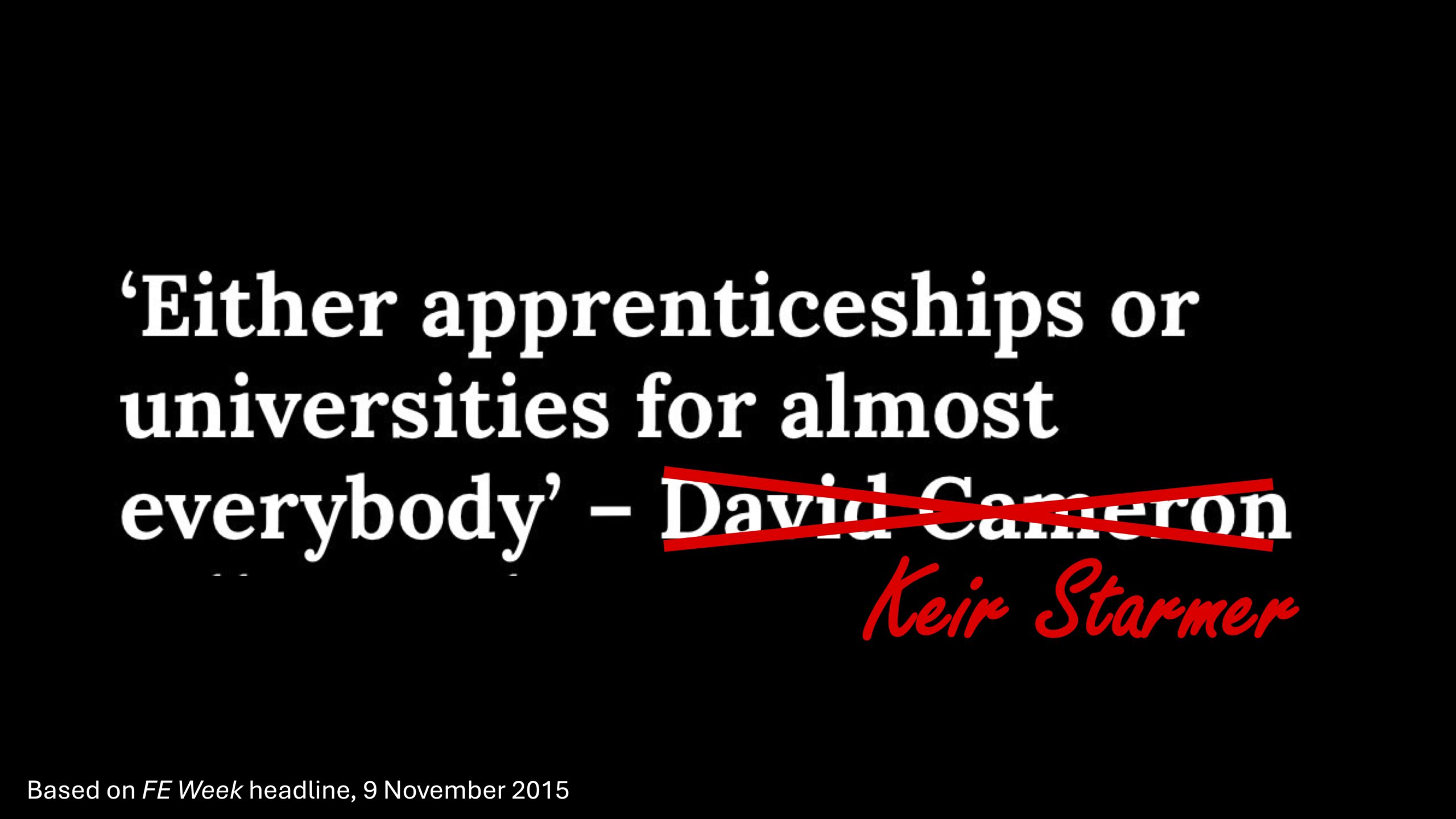
It was great to witness so many backbench Labour MPs, like Alex Sobel, Daniel Zeichner, Abtisam Mohamed and Dr Lauren Sullivan, advocating for UK universities across the conference fringe programme. But more generally, there were parts of the Conference that felt flat as well as parts that were presumably in line with what the organisers wanted – including the Leader’s big set-piece speech. Starmer’s big reveal was the rejection of the ancient 50% target for young people’s participation in higher education in preference for a new target ‘That two-thirds of our children should go either to university… Or take a gold standard apprenticeship.’
The Prime Minister would be unlikely to welcome the comparison but this reminded me of nothing so much as David Cameron’s pledges as Prime Minister. In 2013, for example, Cameron said: ‘I want us to have as a new norm the idea that in school, everybody, everyone who can, either takes that path on to university, or takes that path on to an apprenticeship. You should be doing one or the other.’
The challenge is not coming up with such commitments; it is delivering them. Fewer adults are doing apprenticeships now than when David Cameron spoke, despite the introduction of an Apprenticeship Levy. Perhaps Starmer can succeed where Cameron and his successors failed…
At the end of the Conference, I was left feeling the biggest omission compared to past Labour Conferences was a clear and broad narrative about His Majesty’s Official Opposition: the Conservative Party. If the choice facing the country really is between ‘division’ and ‘decency’, as Keir Starmer says, then might not the best way to defeat division be, as with Le Pen in France or the AfD in Germany, for centre-right and centre-left parties to act together?
If Tony Blair and William Hague can work together, surely this is not impossible? But – and this is a personal opinion only – I left Liverpool wondering if the main problem for today’s Labour leadership is that they have spent the last 15 years making such strong criticisms of their bedfellows in the mainstream centre of British politics that they are unable to admit they may now need to work with the centre-right to stave off their worst fears.
Then again, perhaps today’s Tory Party also cannot see that the opposite of division is not so much ‘decency’ (however much we might want that) as collaboration. We’ll find out for certain next week as the policy caravan moves across the north-west to Manchester for the Conservative Party Conference. Do come to HEPI’s event there if you can – it is outside the secure zone so no expensive pass is needed.
Carole Cox, HEPI’s Events and Communications Administrator (and HEPI’s biggest Beatles’s fan) explains why Liverpool is the perfect place for day-trippers and long-stayers.
The City of Liverpool has the biggest single collection of Grade One listed buildings than any other English city outside London and it was named the European Capital of Culture in 2008. A football mecca, it also boasts a plethora of museums, including the World Museum, the International Slavery Museum, the Museum of Liverpool, Tate Liverpool and the Merseyside Maritime Museum.
It is also an interestingly quirky place, which harbours some amazing public toilets (you read that right). For example, if you ever happen to drop into the Philharmonic Dining Rooms in the Georgian Quarter, feel free to admire the famous Grade I-listed urinals in their pink marble splendour.
And then, there is the deservedly famous Mersey Beat. Liverpool and The Beatles, these are words that go together well.* The Liverpudlian group are considered the best-selling band in music history, hailed as pioneers who revolutionised the music industry and popular culture.
In summary, Liverpool is a ‘blast’ in more ways than one: a city which does not shy away from its heritage, a city with so much to offer culturally, but also a windy city open to the strong maritime winds gusting from the docks. Which may be why the French translation of the 1964 Beatles film A Hard Day’s Night is Les Quatre Garçons Dans Le Vent, a French colloquial idiom for their growing popularity – which, when translated word-for-word, awkwardly reads as ‘the four boys in the wind’.
* ‘these are words that go together well’ are lyrics from the 1965 Beatles song Michelle (Lennon/McCartney).
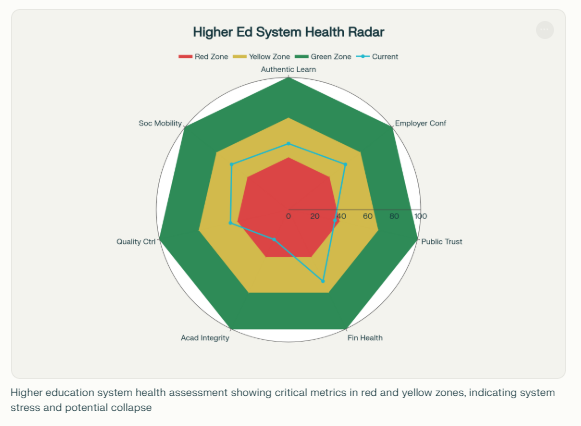
For years, higher education leaders have avoided one of the most uncomfortable questions in the field: What is the minimum threshold of authentic learning required to keep the system operational? That threshold exists — and recent data suggest we may have already crossed it. The warning signs are visible in eroding public trust, declining employer confidence, and a growing inability to authenticate credentials. What we are watching now is not a temporary disruption, but the managed decline of mass higher education as we have known it.
A truly viable education system has to deliver four essential functions. It must transmit knowledge — not only basic literacy, numeracy, and critical thinking, but also the domain-specific skills employers recognize, along with the ability to evaluate information in a democratic society. It must authenticate credentials by verifying learner identity, ensuring assessments are legitimate, maintaining tamper-proof records, and clearly differentiating between levels of competence. It must serve as a pathway for social mobility, providing economic opportunities that justify the investment, generating real wage premiums, and fostering professional networks and cultural capital. And it must have reliable quality assurance, with competent faculty, relevant curriculum, trustworthy measurement of learning outcomes, and external accountability strong enough to maintain standards.
Research into institutional collapse and critical mass theory shows that each of these functions has a minimum operational threshold. The authentic learning rate must exceed 70 percent for degrees to retain their signaling value. Below that point, employers begin to see the credential itself as unreliable. Estimates today range from 30 to 70 percent, depending on the institution and delivery method. Employer confidence must stay above 80 percent for degrees to remain the default hiring credential. When fewer than eight in ten employers trust the degree signal, alternative credentialing accelerates — something already underway as skills-based hiring spreads across industries. Public trust must also remain high, but Gallup’s 2023 data put confidence in higher education at just 36 percent, far below the survival threshold. On the financial side, stability is eroding, with roughly 15 percent of U.S. institutions at risk of closure and more failing each year.
Despite these trends, parts of the system still function effectively. Elite institutions with rigorous admissions, strong alumni networks, and powerful employer relationships continue to maintain credibility. Professional programs such as medicine, engineering, and law retain integrity through external licensing and oversight. Technical programs tied closely to industry needs still provide authenticated learning with direct employment pathways. Research universities at the graduate level preserve rigor through peer review, publication requirements, and close faculty mentorship. These pockets of quality create the illusion that the overall system remains sound, even as large portions hollow out.
But the cracks are widening. Public trust is at 36 percent. Fraud rates are climbing beyond detection capacity, with California’s rate estimated at 31 percent. Grade inflation is erasing distinctions between levels of achievement. Authentic learning appears to be hovering somewhere between 30 and 70 percent, putting the system in a yellow warning zone. Financially, the sector remains unstable, with 15 percent of institutions on the brink.
Higher education is also becoming sharply stratified. At one end are the high-integrity institutions that still maintain meaningful standards, a group that may represent just 20 to 30 percent of the market. In the middle are the credential mills — low-integrity schools operating on volume with minimal quality control, perhaps 40 to 50 percent of the market. On the other end, alternative providers such as bootcamps, apprenticeships, and corporate academies are rapidly filling the skills gap. This stratification allows the system to stagger forward while its core mission erodes.
Collapse becomes irreversible when several failure points converge. Employer confidence dropping below 50 percent would trigger mass abandonment of degree requirements. Public funding cuts, fueled by political backlash, would intensify. Alternative credentials would reach critical mass, making traditional degrees redundant in many sectors. A faculty exodus would leave too few qualified instructors to maintain quality. Rising student debt defaults could force the federal government to restrict lending.
The available evidence suggests the tipping point likely occurred sometime between 2020 and 2024. That was when public trust cratered, employer skepticism intensified, financial fragility spread, and the post-pandemic environment made fraud and grade inflation harder to contain. We may already be living in a post-viable higher education system, one where authentic learning and meaningful credentialing are concentrated in a shrinking group of elite institutions, while the majority of the sector operates as a credentialing fiction.
The question now is whether the surviving components can reorganize into something sustainable before the entire system’s legitimacy evaporates. Without deliberate restructuring, higher education’s role as a public good will vanish, replaced by a marketplace of unreliable credentials and narrowing opportunities. The longer we avoid defining the collapse threshold, the harder it will be to stop the slide.
Sources: Gallup, Inside Higher Ed, BestColleges, Cato Institute, PMC (National Center for Biotechnology Information), Council on Foreign Relations
I believe it to be very important for disciplinary bodies to issue statements/guidance on the use of generative AI when it comes to the production of scholarship and the work of teaching and learning.
First, we should acknowledge the limits of these kinds of documents, something the AHA committee that prepared the principles acknowledges up front at the closing of the preamble:
Given the speed at which technologies are changing, and the many local considerations to be taken into account, the AHA will not attempt to provide comprehensive or concrete directives for all instances of AI use in the classroom. Instead, we offer a set of guiding principles that have emerged from ongoing conversations within the committee, and input from AHA members via a survey and conference sessions.”
—AHA Guiding Principles for Artificial Intelligence in Education
I think this is obviously correct because teaching and learning are inherently, inevitably context-dependent, sometimes down to the smallest variables. I’ve used this example many times, but as someone who frequently taught the same course three or even four times a day, I could detect variances based on what seems like the smallest differences, including the time of day a particular section met. There is a weird (but also wonderful) human chemistry at play when we treat learning as a communal act—as I believe we should—but this means it is incredibly difficult to systematize teaching, as we have seen from generations of failed attempts to do so.
Caution over offering prescriptions is more than warranted. As someone who now spends a lot of time trying to help others think through the challenges in their particular teaching contexts, I’m up front about the fact that I have very few if any universal answers and instead offer some ways of thinking about and breaking down a problem that may pave the road to progress.
I cringe at some folks who seem to be positioning themselves as AI gurus, eager to tell us the future and, in so doing, know what we should be doing in the present. This is going to be a problem that must be continually worked.
The AHA principles start with a declaration that seeks to unify the group around a shared principle, declaring, “Historical thinking matters.”
My field is writing and English, not history, but here I think this is a misstep, one that I think is common and one that must be addressed if we’re going to have the most productive conversations possible about where generative AI has a place (or not) in our disciplines.
What is meant by “historical thinking”? From what I can tell, the document makes no specific claims as to what this entails, though it has many implied activities that presumably are component parts of historical thinking: research, analysis, synthesis, etc. …
To my mind, what is missing is the underlying values that historical thinking is meant to embody. Perhaps these are agreed upon and go without saying, but my experience in the field of writing suggests that this is unlikely. What one values about historical thinking and, perhaps most importantly, the evidence they privilege in detecting and measuring historical thinking is likely complicated and contested.
This is definitely true when it comes to writing.
One of my core beliefs about how we’ve been teaching writing is that the artifacts we ask students to produce and the way we assess them often actually prevents students from engaging in the kinds of experiences that help them learn to write.
Because of this, I put more stock in evidence of a developing writing practice than I do in judging the written artifact at the end of a writing experience. Even my use of the word “experience” signals what I think is most valuable when it comes to writing: the process over the product.
Others who put more stock in the artifacts themselves see great potential for LLM use to help students produce “better” versions of those artifacts by offering assistance in various parts of the process. This is an obviously reasonable point of view. If we have a world that judges students on outputs and these tools help them produce better outputs (and more quickly), why would we wall them off from these tools?
In contrast, I say that there is something essentially human—as I argue at book length in More Than Words—about reading and writing, so I am much more cautious about embracing this technology. I’m concerned that we may lose experiences that are actually essential not for getting through school, but for getting through life.
But this is a debate! And the answers to what the “right” approach is depend on those root values.
The AHA principles are all fair enough and generally agreeable, arguing for AI literacy, policy transparency and a valuing of historical expertise over LLM outputs. But without unpacking what we mean by “historical thinking,” and how we determine when this thinking is present, we’re stuck in cul-de-sac of uncertainty.
This is apparent in an appendix that attempts to show what an AI policy might look like, listing a task, whether AI use could be acceptable and then the conditions of acceptance. But again, the devil is in the details.
For example, “Ask generative AI to identify or summarize key points in an article before you read it” is potentially acceptable, without explicit citation.
But when? Why? What if the most important thing about a reading, as an aspect of developing their historical thinking practice, is for students to experience the disorientation of tackling a difficult text, and we desire maximum friction in the process?
Context is everything, and we can’t talk context if we don’t know what we truly value, not just at the level of a discipline, or even a course, but at the level of the experience itself. For every course-related activities, we have to ask:
What do we want students to know?
and
What do we want students to be able to do?
My answers to these questions, particularly as they pertain to writing courses, involve very little large language model use until a solid foundation in a writing practice is established. Essentially, we want students to be able to use these tools in the way we likely perceive our own abilities to use them productively without compromising our values or the quality of our work.
I’m guessing most faculty reading this trust themselves to make these judgments about when use is acceptable and under what conditions. That’s the big-picture target. What do we need to know and what do we need to be able to do to arrive at that state?
Without getting at the deepest values, we don’t really even know where to aim.
This audio is auto-generated. Please let us know if you have feedback.
Dive Brief:
The New York Conservatory for Dramatic Arts plans to close at the end of its current academic year, with operations and classes set to end Aug. 31, it announced Tuesday.
The for-profit arts college is currently coordinating with other institutions to help find spots for students who have not completed their programs by then. So far, it has established teach-out agreements with Five Towns College and American Academy of Dramatic Arts, both in New York.
NYCDA trustees decided to close after a “thorough evaluation of our enrollment and financial forecasts,” the two-year college said in an FAQ page. In explaining the closure, it cited national college enrollment trends and demographic projections.
Dive Insight:
The 45-year-old NYCDA said that the decision to close “has not been made lightly, and it comes after exhaustive efforts to explore every possible alternative.”
On the FAQ page about the wind-down, the college noted that “the landscape of higher education has meaningfully changed since the pandemic.” Its own fall enrollment fell by 8.6% to 286 students between the pre-pandemic year of 2019 and 2023, according to federal data.
Founded in 1980 by Joan See, a successful commercial actor, the New York City institution started with a single private acting class.
From there, it was built into a “nationally accredited college that to this day empowers actors to follow their dreams, prove the doubters wrong, and make a living doing what they love,” as the institution described itself in Tuesday’s announcement.
Before the closure decision, NYCDA offered two-year acting programs in theater, musical theater, and film and television, and a two-year program in media production geared toward actors. It also offers shorter-term programs, including certificates. Its alumni include film and television actors, including Miles Teller, Jacob Batalon and Ashleigh Murray.
NYCDA joins a growing list of private arts colleges to fail recently. Last year saw the sudden closure of University of the Arts in Philadelphia along with the Delaware College of Art and Design. Pennsylvania Academy of the Fine Arts, meanwhile, announced it would stop offering two- and four-year degrees at the end of the 2024-25 academic year.
Those closures left holes not just in the higher education world of those regions but also in the local arts scenes, where the institutions employed working artists, hosted events and created hubs of artistic activity.
A federal judge in Massachusetts has issued a preliminary injunction halting President Donald Trump’s executive order to dismantle the U.S. Department of Education, dealing a significant blow to the administration’s efforts to eliminate the federal agency.
District Court Judge Myong J. Joun on last Thursday blocked Trump and Education Secretary Linda McMahon from carrying out the executive order and ordered the administration to reinstate approximately 1,300 Education Department employees who were terminated in March as part of a sweeping reduction-in-force.
The ruling comes in response to consolidated lawsuits filed by a coalition of 20 states, the District of Columbia, educator unions, and school districts challenging the administration’s moves to shrink and eventually close the department.
When Trump took office in January, the Education Department employed 4,133 workers. The reduction-in-force announced March 11 terminated more than 1,300 positions, while nearly 600 additional employees chose to resign or retire, leaving roughly 2,180 remaining staff—approximately half the department’s original size.
In his ruling, Judge Joun wrote that “a department without enough employees to perform statutorily mandated functions is not a department at all,” adding that the court “cannot be asked to cover its eyes while the Department’s employees are continuously fired and units are transferred out until the Department becomes a shell of itself.”
The judge also prohibited Trump from transferring management of the federal student loan portfolio and special needs programs to other federal agencies, as the president had pledged to do from the Oval Office.
Judge Joun determined that the Trump administration likely violated the separation of powers by taking actions that conflicted with congressional mandates. He noted the administration had failed to demonstrate that the staff reductions actually improved efficiency, writing that “the record is replete with evidence of the opposite.”
The plaintiffs argued that the department could no longer fulfill critical duties, including managing the $1.6 trillion federal student loan portfolio serving roughly 43 million borrowers and ensuring colleges comply with federal funding requirements.
The American Association of University Professors (AAUP), which joined the legal challenge alongside other educator groups, praised the ruling as a crucial victory for higher education access.
“The AAUP is thrilled that District Judge Joun has blocked Trump’s illegal attempt to gut the Department of Education and lay off half of its workforce,” said AAUP President Dr. Todd Wolfson. “Eliminating the ED would hurt everyday Americans, severely limit access to education, eviscerate funding for HBCUs and TCUs while benefiting partisan politicians and private corporations looking to extract profit from our nation’s higher education system.”
American Federation of Teachers President Randi Weingarten called the decision “a first step to reverse this war on knowledge and the undermining of broad-based opportunity.”
The Education Department’s deputy assistant secretary for communications, Madi Biedermann, criticized the ruling in a statement, calling Judge Joun a “far-left Judge” who “dramatically overstepped his authority” and vowed to “immediately challenge this on an emergency basis.”
The case, Somerville Public Schools v. Trump, represents the consolidation of two separate lawsuits filed in March. Democracy Forward is representing the coalition of plaintiffs, which includes the AAUP, Somerville Public School Committee, Easthampton School District, Massachusetts AFT, AFSCME Council 93, and the Service Employees International Union.
The ruling temporarily halts one of the Trump administration’s most ambitious efforts to reshape federal education policy, though the legal battle is expected to continue as the administration pursues its appeal.
DAVENPORT, Iowa — The Catholic prayer for the faithful echoed off the limestone walls and marble floor of the high-ceilinged chapel.
It implored God to comfort the poor and the hungry. The sick and the suffering. The anxious and the afraid.
Then it took an unexpected turn.
“Lord, hear our prayer for St. Ambrose and Mount Mercy University,” the young voice said, “that the grace of the Holy Spirit may help us to follow God’s plan for our new partnership.”
The speaker was talking about ongoing efforts to unite St. Ambrose University, where this weeknight Mass was being held, with fellow Catholic university Mount Mercy. Small religious schools in rural states are shutting down at an accelerating rate, a fate these two are attempting to avoid.
Credit: Mike Rundle for The Hechinger Report
“Lord, hear our prayer,” responded the congregation of students in St. Ambrose-branded T-shirts and hoodies.
The heads of both St. Ambrose and Mount Mercy, which is in Cedar Rapids, said they’ve watched as nearby religiously affiliated colleges, athletic rivals and institutions that employed their friends and former colleagues closed.
With falling numbers of applicants to college — especially in the Midwest — “we just don’t have the demographics anymore,” said St. Ambrose President Amy Novak. Now, as fewer graduates emerge from high schools, combining forces is a way to forestall “the reality that we might all see in five or seven years,” Novak said.
For many other small religiously affiliated institutions, time has already run out.
More than half of the 77 nonprofit colleges and universities that have closed or merged since 2020, or announced that they will close or merge, were religiously affiliated, according to a Hechinger Report analysis of news coverage and federal data. More than 30 that are still in business are on a U.S. Department of Education list of institutions considered “not financially responsible” because of comparatively low cash reserves and net income and high levels of debt.
Related: Interested in innovations in higher education? Subscribe to our free biweekly higher education newsletter.
Some small, religiously affiliated institutions that are not on these lists are also showing signs of strain. Saint Augustine’s University in North Carolina, which is Episcopal, has 200 students, down from 1,100 two years ago, and has lost its accreditation. The 166-year-old St. Francis College in New York, which is Catholic, has sacked a quarter of its staff. Catholic Saint Louis University in Missouri laid off 20 employees, eliminated 130 unfilled faculty and staff positions and sold off its medical practice after running a deficit.
Bluffton University in Ohio, which is Mennonite, is looking for a new partner after a planned merger fell through in February and the president resigned. Catholic St. Norbert College in Wisconsin is eliminating 11 majors and minors and 21 faculty positions. And Georgetown College in Kentucky averted closing only after an alumnus gave it $16 million, which, along with another $12 million in donations, was enough to pay off crippling debt that was costing the small Baptist institution $3 million a year just in interest.
Other religiously affiliated schools are also taking steps to buttress themselves against demographic and financial challenges. Ursuline College in Ohio, for instance, which has fewer than 1,000 students, has agreed to merge with larger Gannon University, 95 miles away. Both are Catholic. Spring Hill College in Alabama and Rockhurst University in Missouri, both also Catholic, are teaming up so they can jointly offer more academic programs, though they will remain independent.
More than a fifth of colleges and universities in the United States, or 849 out of 3,893, are religiously affiliated, according to the most recent figures from the National Center for Education Statistics.
The threats to them are getting new attention. Presidents of 20 Catholic universities and colleges met in November in Chicago at a conference sponsored by DePaul University and held at the offices of the Deloitte consulting firm, which collected data to help them figure out solutions to the challenges they face.
“The intent was to think about a blueprint for the future of Catholic higher education,” including more partnerships, shared services and other kinds of alliances, said Donna Carroll, president of the Association of Catholic Colleges and Universities. “Survival of the fittest is not the strategy that will advance the common good of Catholic higher education. We have to work together.”
The American Council on Education last year launched a Commission on Faith-Based Colleges and Universities, with leaders of what has since grown to 17 institutions including Pepperdine, Brigham Young and Yeshiva universities and the University of Notre Dame.
The idea of the commission, which is scheduled to meet in Washington in June, is “to increase visibility for the important contributions of religious and faith-based colleges and universities and to foster collaboration” among them.
Some religious colleges and universities are doing fine, and even posting enrollment gains — at least in part because of growing political divisions, campus protests and ideological attacks on secular institutions, said David Hoag, president of the Council for Christian Colleges and Universities.
Credit: Mike Rundle for The Hechinger Report
Parents are “wanting to put their son or daughter at a safe place that’s going to have a biblical worldview or a way to look at challenges that’s not polarized,” Hoag said. “At our institutions, you’re not going to be seeing protests or things that are happening at many of these [other] universities and colleges. You’re going to see them rallying together, whether it’s for a sporting event or for a revival or baptisms.”
Other trends also offer some hope to religiously affiliated colleges and universities. A long decline in the proportion of adults who consider themselves affiliated with a religion appears to have leveled off, the Pew Research Center finds. And while enrollment at parochial schools that feed graduates to Catholic universities fell more than 10 percent from 2017 to 2021, the most recent year for which the figure is available, the number of students at other kinds of religious primary and secondary schools is up.
Even religiously affiliated institutions confronting the realities of falling enrollment and financial woes fill a critically important role, their advocates say. They often serve low-income students who are the first in their families to go to college and are reluctant to enroll at large public universities.
Many are in rural areas where access to higher education is more limited than in urban and suburban places and is becoming less available still as public universities in rural states have merged or closed or cut dozens of majors.
Attending a small rural, religiously affiliated institution “is, I think — especially for rural students — a great opportunity,” said Todd Olson, president of Mount Mercy, above the sound of trains crossing Cedar Rapids outside his window. “I know kids from very small towns around Iowa,” like the one where he grew up, Olson said. “This campus is a much more comfortable place for them.”
Credit: Mike Rundle for The Hechinger Report
When Jacob Lange arrived at St. Ambrose from East Dubuque, Illinois, and attended a Mass on campus, “all of a sudden all these new people I had never met were kind of chatting with me and it was really kind of nice. It felt like I was kind of included and I didn’t really think I would be originally,” he said. “You figure, ‘I’m probably going to sit in the back and probably not talk to anyone all night,’ and then I showed up, and I walked out here and all of a sudden they’re, like, ‘Here, come join our group.’ ”
His parents also liked that he decided to go to a Catholic university, Lange said. “You know, you go to one of these big schools with 25,000 kids, and you’re kind of worried about your kid — like, what kind of dumb things is he going to get up to?”
Catholic universities in particular have a slightly higher four-year graduation rate than the national average, according to the Center for Catholic Studies at St. Mary’s University in Texas. Graduates have a stronger sense of community purpose, the center found in a survey. Alumni are 9 percentage points more likely to say they participate in civic activities.
More students at religiously affiliated than at secular institutions receive financial aid, the American Council on Education says. Three out of five get scholarships from the colleges themselves, compared to fewer than one in four at other kinds of schools. At both Mount Mercy and St. Ambrose, which have about 1,450 and 2,700 students, respectively, 100 percent get financial aid.
But these benefits for students can be vulnerabilities for budgets, said Novak, at St. Ambrose.
“We serve the poor. We educate the poor,” she said. “That is a risky financial proposition at the moment for small, regional institutions that are largely tuition-driven.”
The threats to smaller religiously affiliated institutions in rural areas stem largely from the downturn in the already short supply of high school graduates choosing to enroll. The proportion of such students going straight to college has fallen even more sharply in many largely rural states.
While they’re generous with their financial aid, religiously affiliated colleges are also generally more expensive than many other higher education institutions, at a time when many families are questioning the return on their investments in tuition. Median tuition and fees average $25,416 a year, according to the American Council on Education.
St. Ambrose and Mount Mercy, about 90 minutes away,are teaming up from positions of relative strength. Publicly available financial documents suggest that neither faces the immediate enrollment or financial crises that threaten many similar institutions. But their leaders say that they’re trying to fend off problems that could arise later. By joining forces, each can increase its number of programs while lowering administrative costs.
Reaction among students and alumni has been mixed.
Combining with St. Ambrose “was kind of nerve-racking at the beginning because it’s, like, ‘Oh, this is a lot of change,’ ” said Alaina Bina, a junior nursing major at Mount Mercy.
She picked the university in the first place because she liked the small, hilly campus.
“I came from a small town, so I didn’t really want to go bigger,” she said. “Even when I came here on a tour, people would say ‘Hi’ to each other. You just know everyone, and that’s kind of how it is in a small town, too.”
Students were worried about what name would appear on their degrees (the degrees will still say “Mount Mercy”) and whether sports teams that once competed against each other would be merged. Novak and Olson promised to keep their athletics programs separate and even add a sport at Mount Mercy: football, beginning in 2026.
Combining sports teams “would not be wise at all from a business perspective,” Olson said the two agreed, because they are “a powerful enrollment driver” for both schools.
Credit: Mike Rundle for The Hechinger Report
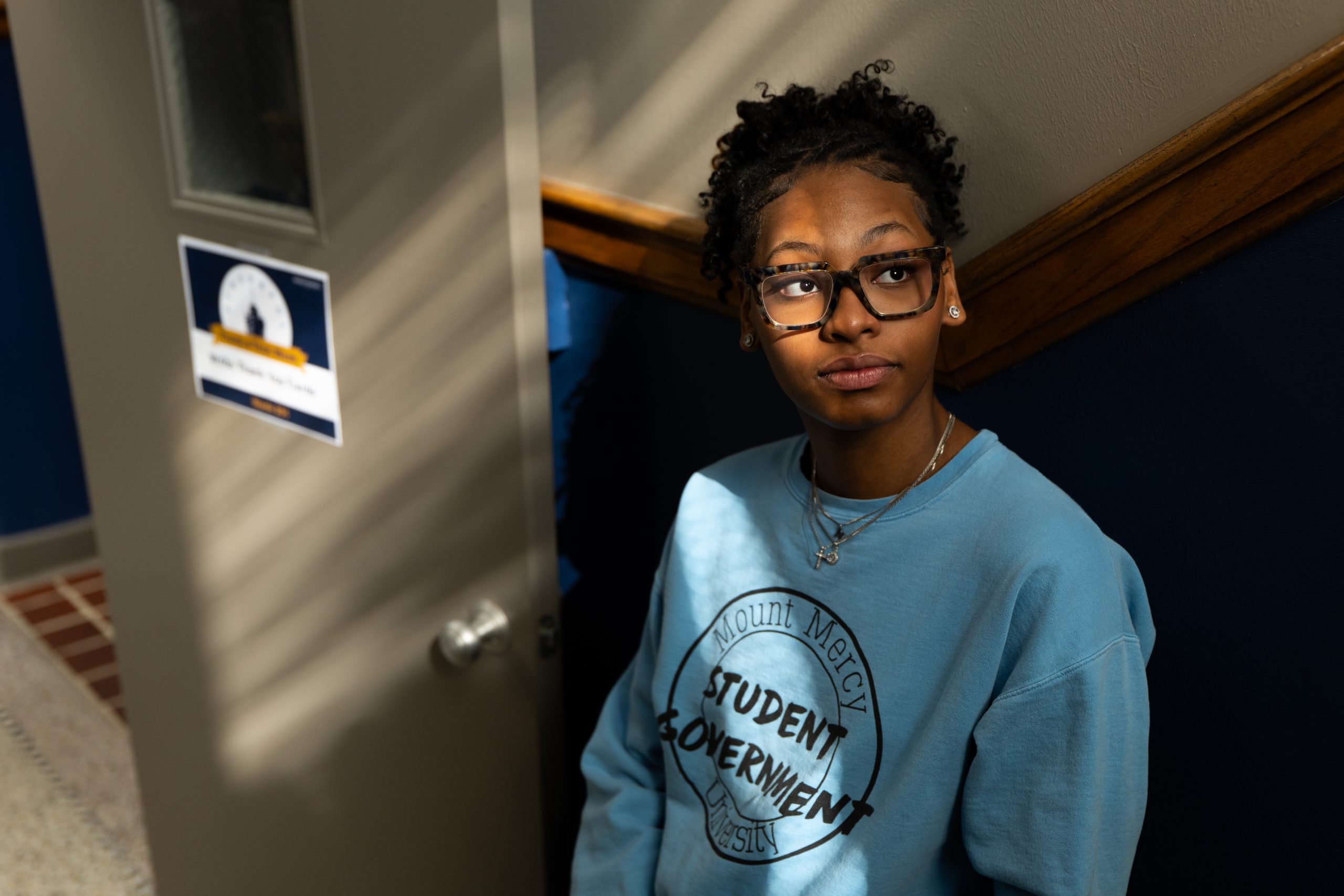
“Honestly, this was probably the biggest student concern,” said Nasharia Patterson, student government president at Mount Mercy, who was wearing a brace on her wrist from an awkward back tuck basket catch during cheer practice. Keeping the athletics teams “gives us a piece of Mount Mercy specifically to just hold on to.”
Among alumni, meanwhile, “there’s mixed feelings” about what’s happening to their alma mater, said Sarah Watson, a leadership development consultant who graduated from Mount Mercy in 2008.
Still, she said, “I know the great challenges that higher ed is facing right now. It’s not just Mount Mercy. It’s not just St. Ambrose. It’s the bigger schools, too. Enrollment numbers have dropped. The desire to go to a traditional four-year college is just not quite what it used to be.”
For Mount Mercy, which was founded by an order of nuns in 1928, Watson said, “If we don’t do this, what’s the alternative? We want to be around for another hundred years.”
After all, said Novak, the St. Ambrose president, “to watch universities close across the heartland because we can’t make it work will leave our communities fallow.”
Carroll, of the Catholic colleges and university association, said that many other religiously affiliated institutions are closely watching what’s happening at St. Ambrose and Mount Mercy.
“It’s a leap of faith,” she said. “And who better to take a leap of faith than a Catholic institution?”
Religiously affiliated colleges that have closed or merged, or announced that they will merge, since 2020
Alderson Broaddus University, West Virginia, Baptist
Alliance University, New York, Christian
Ancilla College, Indiana, Catholic
B. H. Carroll Theological Institute, Texas, Baptist
Birmingham-Southern College, Alabama, Methodist
Bloomfield College, New Jersey, Presbyterian
Cabrini University, Pennsylvania, Catholic
Cardinal Stritch University, Wisconsin, Catholic
Chatfield College, Ohio, Catholic
Clarks Summit University, Pennsylvania, Baptist
College of Saint Rose, New York, Catholic
Compass College of Film & Media, Michigan, Christian
Concordia College New York, Lutheran
Concordia University, Oregon, Lutheran
Eastern Nazarene College, Massachusetts, Christian
Finlandia University, Michigan, Lutheran
Fontbonne University, Missouri, Catholic
Holy Family College, Wisconsin, Catholic
Holy Names University, California, Catholic
Iowa Wesleyan University, Iowa, Methodist
Judson College, Alabama, Baptist
Limestone University, South Carolina, Christian
Lincoln Christian University, Illinois, Christian
MacMurray College, Illinois, Methodist
Magdalen College, New Hampshire, Catholic
Martin Methodist College, Tennessee, Methodist
Marymount California University, California, Catholic
Mount Mercy University, Iowa, Catholic
Multnomah University, Oregon, Christian
Nebraska Christian College, Nebraska, Christian
Notre Dame College of Ohio, Catholic
Ohio Valley University, West Virginia, Christian
Presentation College, South Dakota, Catholic
Rosemont College, Pennsylvania, Catholic
St. Louis Christian College, Missouri, Christian
St. Augustine College, Illinois, Episcopal
St. John’s University Staten Island campus, New York, Catholic
University of Saint Katherine, California, Orthodox Christian
Ursuline College, Ohio, Catholic
Wave Leadership College, Virginia, Christian
Wesley College, Delaware, Methodist
SOURCE: Hechinger Report analysis of news coverage and federal data.
The Hechinger Report provides in-depth, fact-based, unbiased reporting on education that is free to all readers. But that doesn’t mean it’s free to produce. Our work keeps educators and the public informed about pressing issues at schools and on campuses throughout the country. We tell the whole story, even when the details are inconvenient. Help us keep doing that.
“Denver Public Schools to close 7 schools, cut grades at 3 others despite heavy resistance.”
“The list is out: These are the SFUSD schools facing closure.”
Such reports can leave the impression that districts are rapidly closing schools in response to declining enrollment and families leaving for charters, private schools and homeschooling.
But the data tells a different story.
School closures have actually declined over the past decade, a period of financial instability that only increased in the aftermath of the pandemic, according to research from the Brookings Institution.
The analysis, shared exclusively with The 74, shows that in 2014-15, the closure rate — the share of schools nationwide that were open one year and closed the next — was 1.3%. In 2023-24, the rate was just .8%, up from .7% the year before.
“I think it’s important for people to realize how rare school closures are,” said Sofoklis Goulas, a Brookings fellow and the study’s author.
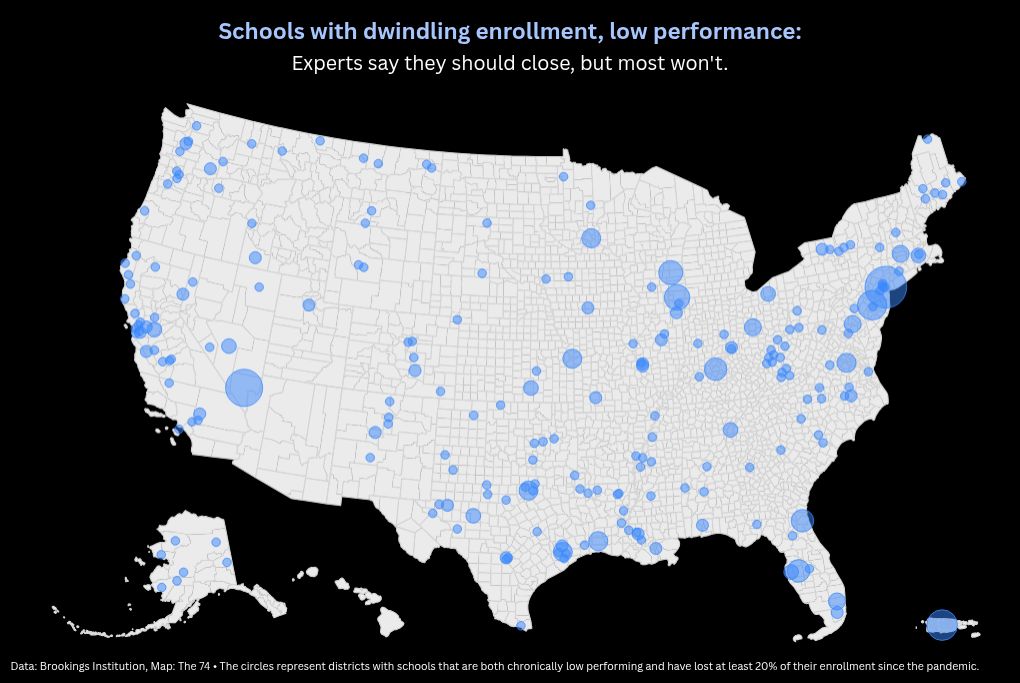
Last fall, his research showed how schools that have lost at least 20% of their enrollment since the pandemic are more likely to be low-performing. The Clark County Public Schools, which includes Las Vegas, had the most schools on the list — 19 — but isn’t currently considering closures. In Philadelphia, with 12 schools in that category, district leaders are just beginning to discuss closures.
When it released Goulas’s initial report, leaders of the conservative Thomas B. Fordham Institute argued that low-performing schools should be the first to close. But efforts to do so are often met with pushback from families, teachers and advocacy groups who argue that shutting down schools unfairly harms poor and minority students and contributes to neighborhood blight. Their pleas often push district leaders to retreat. Working in advocates’ favor, experts say, is the fact that many big district leaders are untested and have never had to navigate the emotionally charged waters of closing schools.
“Closing a neighborhood school is probably one of the most difficult decisions a district’s board makes,” said Michael Fine, CEO of the Fiscal Crisis and Management Assistance Team, a California state agency that provides financial oversight to districts. “They are going to avoid that decision as long as they can and at all costs.”
Such examples aren’t hard to find:
Just weeks after announcing closures, the San Francisco district halted plans to shutter any schools this fall.
In September, outgoing Chicago Public Schools CEO Pedro Martinez pledged to put off school closures for another two years, even though state law allows the city to take action sooner. The district is in the process of absorbing five charter schools to keep them from closing.
In October, Pittsburgh Public Schools recommended closing 14 schools; several others were set to be relocated and reconfigured. About a month later, Superintendent Wayne Walters hit pause, saying the district needed more “thoughtful planning” and community input.
Last May, the Seattle Public Schools announced it would shutter 20 elementary schools next school year in response to a $100 million-plus budget deficit. They later increased the number to 21. By October, the list had dwindled to four schools. Just before Thanksgiving, Superintendent Brent Jones withdrew the plan entirely.
“This decision allows us to clarify the process, deepen our understanding of the potential impacts, and thoughtfully determine our next steps,” Jones wrote to families. While the plan would have saved the district $5.5 million, he said, “These savings should not come at the cost of dividing our community.”
Graham Hill Elementary in Seattle, which fifth grader Wren Alexander has attended since kindergarten, was initially on the list. The Title I school sits on top of a hill in a desirable area overlooking Lake Washington. But it also draws students from the lower-income, highly diverse Brighton Park neighborhood.
Among Wren’s neighbors are students from Ethiopia, Vietnam and Guatemala. Wren, who moves on to middle school this fall, said she looks forward to visiting her former teachers and cried when she heard Graham Hill might close. She wanted her younger brother and sister to develop the same warm connection she had.
“I don’t think I would be who I am if I didn’t go to the school,” she said.
Wren Alexander and her little sister Nico, outside Graham Hill. (Courtesy of Tricia Alexander)
Tricia Alexander, her mother, was among those who opposed the closures, participating in rallies outside the district’s administration building and before board meetings.
“We were really loud,” said Alexander, who’s also part of Billion Dollar Bake Sale, an effort to advocate for more state education funding. She said there was “no real evidence” that closing schools would have solved the district’s budget woes. “In no way would kids win.”
It’s a view shared by many school finance experts, who note that the bulk of school funding is tied up in salaries, not facility costs. Districts may save some money from closing schools, but unless coupled with staff reductions, it’s often not enough to make up for large budget shortfalls.
‘So bad at this’
If enrollment doesn’t pick up, experts say, leaders who delay closures will have to confront the same issues a year later or — perhaps even more likely — pass the problems on to their successors.
“If there continues to be fewer and fewer children …then that doesn’t get better,” said Brian Eschbacher, an enrollment consultant.
One Chicago high school, for example, had just 33 students last year. In Los Angeles, the nation’s second-largest district, 34 elementary schools have fewer than 200 students and 29 of those are using less than half of the building, according to a recent report. The share of U.S. students being educated outside of traditional schools also continues to increase, according to a forthcoming analysis Goulas conducted with researchers at Yale University.
“We don’t see a trajectory of enrollment recovery,” he said. “Things actually got worse in the most recently released data batch.”
But such conditions haven’t stopped advocacy groups from campaigning against closures. One of them, the left-leaning Advancement Project, has joined with local groups in Denver and Pittsburgh to make a case against closures nationally.
“All children deserve to have a local, neighborhood public school in which they and their families have a say,” said Jessica Alcantara, senior attorney for the group’s Opportunity to Learn program. “It’s not just that school closures are hard on families. They harm the full education ecosystem that makes up a school — students, families, school staff and whole communities.”
Last May, Alcantara and other Advancement Project staff urged the U.S. Department of Education to treat school closures as a civil rights issue. Nine of the 10 schools the Denver district planned to close in 2022 had a majority Black or Hispanic student population.
The advocates argued that in cases of enrollment loss, run-down facilities and empty classrooms, there are alternatives to closing schools. They encourage communities to push for renovations and urge district leaders to use vacant spaces for STEM, arts or other programs that might attract families. Opponents of closures also say that districts sometimes underestimate how much of a building is used for non-classroom purposes like special education services, early-childhood programs and mental health.
Eschbacher’s assessment of why districts often back down from closing schools is more blunt.
“Districts are so bad at this,” he said. “If you just do a few things wrong, it could sink the whole effort.”
For one, leaders often target schools with under 300 students for closure, appealing to parents that they can’t afford to staff them with arts programs, a school nurse or a librarian.
But those explanations sometimes fall flat.
“Parents always say, ‘I wanted a small school. I know my teachers and they know my kid. And it’s right down the street,’” Eschbacher said. If they didn’t like their school, he added, they would have likely would have chosen a charter or some other option.
District officials also run into trouble if they try to spin the data. When Seattle officials talked about “right-sizing” the district, they pointed to the loss of 4,900 students since 2019-20.
But Albert Wong, a parent in the district and a lifelong Seattle resident, knew there was more to the story. Not only is the current enrollment higher than it was from 2000 to 2011, the pandemic-related decline seems to have leveled off. In a commentary, he argued that officials presented misleading data “to make current enrollment look exceptionally bad.”
Graham Hill Elementary, fifth-grader Wren’s school, actually saw a slight increase in enrollment this year, including a new class for preschoolers with disabilities. And while Pittsburgh schools are projected to lose another 5,000 students over the next six years, enrollment this year held steady at about 18,400.
To Eschbacher, the “burden of proof is always on the district” to make an airtight case for why students would be better off in larger schools. He has applauded the Denver-area Jeffco Public Schools, which has closed 21 schools since 2021, for having state demographers, not just district officials, explain population trends to families at community meetings.
‘It wasn’t realistic’
Walters, Pittsburgh’s superintendent, can easily rattle off reasons why the district should rethink how it uses its buildings. Early last year, local news reports showed that almost half of the district’s schools were less than 50% full.
“We’ve lost about a fourth of our population, but we have not changed anything to our footprint,” he said.
Meanwhile, the average age of the district’s buildings is 90 years old, and many lack air-conditioning, forcing some schools to send students home in sweltering weather.
But a consulting group’s proposal showed that Black and low-income students and those with disabilities would be disproportionately affected by the changes. Several advocacy groups drew attention to those disparities, calling the effort “rushed.”
412 Justice, an advocacy group, is among the community organizations pushing for alternatives to school closures in Pittsburgh. (412 Justice)
Walters agreed and put the plan on hold last fall, saying he lacked “robust” responses to parents’ tough questions about how schools would change for their kids.
“It doesn’t mean that we don’t see a path forward,” he said. “But it wasn’t realistic that we would have those questions answered within the timeline that we’ve been given.”
In March, parents pushed for another delay, causing the school board to postpone a vote on the next phase in the closure process.
As the Jeffco district demonstrates, some school systems are following through with closures. The school board in nearby Denver unanimously voted in November to close seven schools and downsize three more.
But that’s after community protests pushed the district to put the brakes on a plan to close 19 schools in 2021. Advocates argued that families in low-income areas, who had been heavily impacted by the pandemic, would be most affected. Then the district only closed three in 2023, and now board members are considering a pause on closures for three years.
School boards closing a dozen or more schools are often catching up with work their predecessors let pile up, said Goulas of Brookings.
“Closing a single school allows for easier placement of students and minimizes the political cost and community stress,” he said. “When a district releases a long list of schools to close, it likely indicates that they waited for conditions to improve, but this didn’t happen.”
Angel Gober, executive director of 412 Justice — one of 16 organizations that called on the Pittsburgh district to drop its plan — acknowledged that their fight isn’t over.
“I think we got a temporary blessing from God,” she said. But she wants the district to explore a host of alternatives, like community schools and corporate support, before it shutters and sells off buildings. “We do have very old infrastructure, and that is an equity issue. But can we try five things before we make a drastic decision to close schools for forever?”
This audio is auto-generated. Please let us know if you have feedback.
Dive Brief:
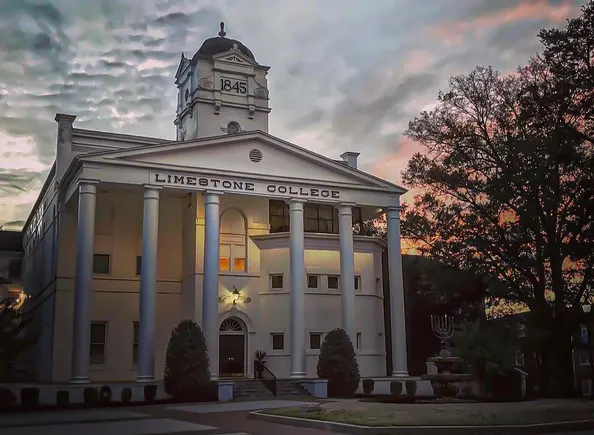
Limestone University, in South Carolina, will close when its current semester ends this week after last-ditch fundraising efforts came up short, the Christian institution announced Tuesday.
The university’s trustee board voted to permanently shutter Limestone despite raising $2.1 million from almost 200 donors in the last two weeks. The board previously said Limestone would need $6 million to stabilize operations.
“In the final analysis, we could not continue operations on-campus or online without a greater amount of funding,” board Chair Randall Richardson said in a Thursday statement.
Dive Insight:
Limestone ended last week on a hopeful note, with Richardson describing the board as “cautiously optimistic.”
“One of the largest in Limestone’s recent history, the transformative donation comes at a pivotal time as the institution rallies to secure critical funding that will help sustain its mission of providing life-changing educational opportunities,” the university said in the Fullerton announcement.
But even for a small university, the multimillion dollar campaign wasn’t enough to sustain Limestone.
Founded in 1845, Limestone’s enrollment has declined in recent years, with fall headcount dipping 27% to 1,782 students between 2018 and 2023, according to federal data. Current enrollment stands at about 1,600 students, the university said last week.
The university’s board has blamed those drops, as well as rising costs, for its financial travails. For fiscal 2024, it logged a budget deficit of $9.2 million, following an $11.4 million shortfall in 2023.
As it prepares to close, the university has promised an “orderly wind-down process” and said it will help students transfer to other institutions.
“More detailed information about the closure timeline, academic records, transfer assistance, employment impact, and other support services will be provided in the coming days,” it said.
Limestone plans to hold its commencement ceremony on Saturday for those students graduating at the end of the term, 246 in all.
“Our Limestone spirit will endure through the lives of our students and alumni who carry it forward into the world,” Richardson said. “Though our doors may close, the impact of Limestone University will live on.”