Consider the work of a personal trainer. They can explain and model a workout perfectly, but if the athlete isn’t the one doing the lifting, their muscles won’t grow. The same is true for student learning. If students only copy notes or nod along, their cognitive muscles won’t develop. Cognitive lift is the mental work students do to understand, apply, and explain academic content. It’s not about giving students harder problems or letting them struggle alone. It’s about creating space for them to reason and stretch their thinking.
Research consistently shows that students learn more when they are actively engaged with the material, rather than passively observe. Learners often forget what they’ve “learned” if they only hear an explanation. That’s why great tutors don’t just explain material clearly–they get students to explain it clearly.
Tutoring, with its small group format, is the ideal space to encourage students’ cognitive lift. While direct instruction and clear explanations are essential at the right times in the learning process, tutorials offer a powerful opportunity for students to engage deeply and productively practice with support.
The unique power of tutorials
Small-group tutorials create conditions that are harder to foster in a full classroom. Having just a few students, tutors can track individual student thinking and adjust support quickly. Students gain more chances to voice reasoning, test ideas, and build confidence. Tutorials rely on strong relationships, and when students trust their tutor, they’re more willing to take risks, share half-formed thoughts, and learn from mistakes.
It’s easier to build space for every student to participate and shine in a tutorial than in a full class. Tutors can pivot when they notice students aren’t actively thinking. They may notice they’re overexplaining and can step back, shifting the cognitive responsibility back to the students. This environment gives each learner the opportunity to thrive through cognitive lift.
What does cognitive lift look like?
What does cognitive lift look like in practice? Picture two tutorials where students solve equations like they did in class. In the first, the tutor explains every step, pausing only to ask quick calculations like, “What’s 5 + 3?” The student might answer correctly, but solving isolated computations doesn’t mean they’re engaged with solving the equation.
Now imagine a second tutorial. The tutor begins with, “Based on what you saw in class, where could we start?” The student tries a strategy, gets stuck, and the tutor follows up: “Why didn’t that work? What else could you try?” The student explains their reasoning, reflects on mistakes, and revises. Here, they do the mental heavy lifting–reaching a solution and building confidence in their ability to reason through challenges.
The difference is the heart of cognitive lift. When tutors focus on students applying knowledge and explaining thinking, they foster longer-term learning.
Small shifts, big impact
Building cognitive lift doesn’t require a complete overhaul. It comes from small shifts tutors can make in every session. The most powerful is moving from explaining to asking. Instead of “Let me show you,” tutors can try “How might we approach this?” or “What do you notice?” Tutoring using questions over explanations causes students to do more work and learn more.
Scaffolds–temporary supports that help students access new learning–can support student thinking without taking over. Sentence stems and visuals guide thinking while keeping responsibility with the student. Simple moves like pausing for several seconds after questions (which tutors can count in their heads) and letting students discuss with a partner also create space for reasoning.
This can feel uncomfortable for tutors–resisting the urge to “rescue ” students too quickly can be emotionally challenging. But allowing students to wrestle with ideas while still feeling supported is where great learning happens and is the essence of cognitive lift.
The goal of tutoring
Tutors aren’t there to make learning easy–they’re there to create opportunities for students to think and build confidence in facing new challenges. Just like a personal trainer doesn’t lift the weights, tutors shouldn’t do the mental work for students. As athletes progress, they add weight and complete harder workouts. Their muscles strengthen as their trainer encourages them to persist through the effort. In the same way, as the academic work becomes more complex, students strengthen their abilities by wrestling with the challenge while tutors coach, encourage, and cheer.
Success in a tutorial isn’t measured by quick answers, but by the thinking students practice. Cognitive lift builds independence, deepens understanding, and boosts persistence. It’s also a skill tutors develop, and with the right structures, even novices can foster it. Imagine tutorials where every learner has space to reason, take risks, and grow. When we let students do the thinking, we not only strengthen their skills, we show them we believe in their potential.
Dr. Halley Bowman, Saga Education
Dr. Halley Bowman is the Senior Director of Academics at Saga Education. She draws on years of teaching and high-impact tutoring experience to help new educators create learning spaces where students thrive.
Latest posts by eSchool Media Contributors (see all)
College students are mastering the art of “doing school” – but far too few are actually learning (Geddes et al., 2018; Stevens & Ramey, 2020; Weinstein et al., 2018). The widespread use of artificial intelligence tools among students complicates the learning process by blurring the line between genuine understanding and task completion (Gawande et al., 2020; Jie & Kamrozzaman, 2024). It is incumbent on faculty to design learning experiences that prevent students from mistaking a passing grade for a genuine education.
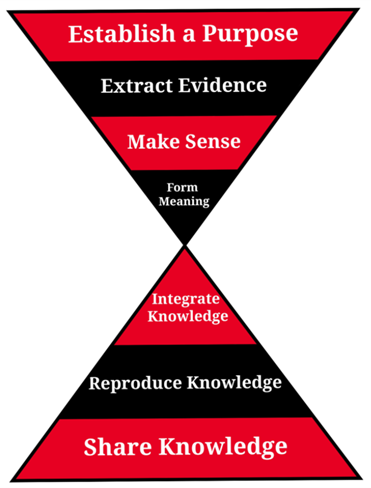
This hourglass paradigm, created by Western Kentucky University education faculty, outlines key stages of effective learning and aligns with current understanding of how the brain processes and retains information (Mahan & Stein, 2014). It functions as a conceptual guide, helping students contextualize instructional content within a broader framework of cognitive engagement. The hourglass shape represents the complexity and intellectual rigor inherent in genuine learning – an endeavor that far exceeds the passive acts of listening, reading, and rote repetition. Many students, shaped by their P–12 educational experiences, have developed habits that emphasize completing tasks over engaging deeply with the learning process. In high school, success often comes from passive methods like re-reading notes or even something as simple as listening attentively in class (Gurung & Dunlosky, 2023). These habits often persist into college, where students may misplace effort on checking boxes rather than meaningful engagement with the content. While this approach may yield favorable academic outcomes in the short term, it infrequently results in deep understanding.
Figure 1 – The Reading and Learning Hourglass Note. This figure was created by the authors.
Top Half of the Hourglass
The top half represents what students are expected to do when first exposed to novel material – either in lecture or when reading.
Step #1 – Establish a Purpose
This requires students orient themselves toward finding specific information. What specific information are they expected to discern while listening or reading? What are they supposed to do with the information they find? Purpose establishes reason for attention – a key component in encoding the visual/auditory stimuli (Dubinsky & Hamid, 2024). Good teaching provides purpose and directs attention to the most important information.
Practical Application for Instructors
Clearly communicate the purpose of each lecture, reading, or activity. Assign reading surgically – not whole chapters at once. Frame lessons with guiding questions or objectives that help students focus their attention and recognize what they are expected to learn and apply.
As students encounter information meeting the established purpose, they deliberately document (extract) the evidence. This, too, is an important part of the encoding process. It focuses attention, moving students from a passive state during which the mind is prone to wander to an active state of responsibility requiring productivity.
Practical Application for Instructors
Assign students a specific task during lectures or readings (e.g., identifying key arguments, examples, or terms) and require them to record and reflect on these findings. This encourages active engagement and accountability during knowledge acquisition.
Step #3 – Make Sense
Sense and meaning are both necessary for long-term learning, but they are different constructs. Sense means that something is readily comprehensible and consistently applied (Sousa, 2011). After students have extracted the evidence, do they comprehend the material? This is a stopping point if the answer is “No.” They should either revert to the material to try to make sense of it or ask questions of the instructor/classmates (or even generative AI, as permitted) to ensure comprehension.
Practical Application for Instructors
Pause periodically to ask comprehension questions or pose simple checks for understanding. Encourage students to identify confusing parts and model how to work through confusion by thinking aloud or unpacking difficult concepts together.
Step #4 – Form Meaning
Meaning is about connections and relevancy. Once the information has been extracted and is comprehensible, the next step is determining how it connects to other information. To what other concepts is it related in the subject/discipline? How does it connect to something the student knows personally? Formation of meaning and sense making are both crucial steps in the process of consolidation – the second step in the formation of long-term memory/learning.
Practical Application for Instructors
Help students connect new content to prior knowledge by explicitly referencing past lessons or real-world examples. Use prompts such as “How does this relate to what we learned last week?” or “Where have you seen this concept applied outside of class?”
Bottom Half of the Hourglass
With the passage of time comes opportunity to study the information. Studying requires consolidation, retrieval, and active production. If students are simply re-reading information or listening again to recorded lectures, they are still in the top half of the hourglass and are not yet studying – they are simply revisiting the knowledge event. Sometimes review is necessary to ensure sense and meaning. However, students need to understand that unless they are producing something new through active retrieval, they are not studying.
Step #5 – Integrate Knowledge
After students have read multiple assignments and listened to numerous lectures, the resulting notes must be integrated into a cohesive body of knowledge. Students must synthesize this information rather than treating each reading or lecture as a discrete element – a process that supports deeper consolidation over time (Squire et al., 2015).
Practical Application for Instructors
Design cumulative tasks that require students to synthesize information into thematic essays, comparative analyses, or concept maps. Encourage students to revisit and reorganize their notes periodically to build coherence across topics.
Step #6 – Reproduce Knowledge
The best way to study to facilitate long-term learning requires active retrieval (Karpicke, 2012; Sosa et al., 2018). This process strengthens neural connections by repeatedly firing related pathways, leading to long-term potentiation – essentially, learning. Crucially, retrieval typically involves unaided recall; the value lies in the act of retrieval itself, not the product it creates. Reflection and verbal production counts as retrieval even though the product is intangible.
Practical Application for Instructors
Design assignments that require students to produce something from memory (e.g., timed short-answer questions, practice exams, or unprompted written explanations). Encourage use of retrieval-based study tools and de-emphasize passive review.
Step #7 – Share Knowledge
Students often do not know when to stop studying. Many are surprised when asked when studying should stop – the answer feels obvious: “When the test is on my desk!” In reality, studying ends when one can teach the material to someone else. As the final step of the process, the reproduction of knowledge should be so comprehensive and fluent that the students can teach the material to a peer or another individual unfamiliar with the subject matter.
Practical Application for Instructors
Create opportunities for students to teach each other. Incorporate peer instruction, study partnerships, or group teaching assignments where students must explain key ideas to classmates or create short instructional videos.
In a time when grades are often mistaken for understanding and AI tools tempt students to outsource cognitive effort, we must reclaim the purpose of education. The hourglass paradigm reframes learning as an active, metacognitive process – one that challenges students to move beyond passive habits and toward lasting intellectual growth. By designing instruction that aligns with how the brain learns best, we as faculty can help students learn how to learn and not just how to pass. This is not just a pedagogical preference; it is a professional obligation.
Dr. Daniel Super is a Clinical Associate Professor in the School of Teacher Education and director of the Barbara and Kelly Burch Institute for Transformative Practices in Higher Education at Western Kentucky University.
Dr. Jeremy Logsdon is an Assistant Professor in the School of Teacher Education and director of the Center for Literacy at Western Kentucky University.
References
Dubinsky, J. M., & Hamid, A. A. (2024). The neuroscience of active learning and direct instruction. Neuroscience & Biobehavioral Reviews, 163, 1-21. https://doi.org/10.1016/j.neubiorev.2024.105737
Gawande, V., Al Badi, H., & Al Makharoumi, K. (2020). An empirical study on emerging trends in artificial intelligence and its impact on higher education. International Journal of Computer Applications, 175(12), 43-47.
Geddes, B. C., Cannon, H. M., & Cannon, J. N. (2018, March). Addressing the crisis in higher education: An experiential analysis. In Developments in Business Simulation and Experiential Learning: Proceedings of the Annual ABSEL conference (Vol. 45). Association for Business Simulation and Experiential Learning. https://journals.tdl.org/absel/index.php/absel/article/view/3188/3106
Gurung, R. A. R., & Dunlosky, J. (2023). Study like a champ. American Psychological Association.
Jie, A. L. X., & Kamrozzaman, N. A. (2024). The challenges of higher education students face in using artificial intelligence (AI) against their learning experiences. Open Journal of Social Sciences, 12(10), 362-387. https://doi.org/10.4236/jss.2024.1210025
Karpicke, J. D. (2012). Retrieval-based learning: Active retrieval promotes meaningful learning. Current Directions in Psychological Science, 21(3), 157–163. https://doi.org/10.1177/0963721412443552
Mahan, J. D., & Stein, D. S. (2014). Teaching adults – Best practices that leverage the emerging understanding of the neurobiology of learning. Current problems in pediatric and adolescent health care, 44(6), 141-149. https://doi.org/10.1016/j.cppeds.2014.01.003
Sosa, P. M., Gonçalves, R., & Carpes, F. P. (2018). Active memory reactivation improves learning. Advances in Physiology Education, 42(2), 256–260. https://doi.org/10.1152/advan.00077.2017
Sousa, D. A. (2011). How the brain learns. Corwin.
Stevens, R., & Ramey, K. (2020, January). What kind of place is school to learn? A comparative perspective from students on the question. In Proceedings of the 14th International Conference of the Learning Sciences: The Interdisciplinarity of the Learning Sciences.
Weinstein, Y., Sumeracki, M., & Caviglioli, O. (2018). Understanding how we learn: A visual guide. Routledge.
College students are mastering the art of “doing school” – but far too few are actually learning (Geddes et al., 2018; Stevens & Ramey, 2020; Weinstein et al., 2018). The widespread use of artificial intelligence tools among students complicates the learning process by blurring the line between genuine understanding and task completion (Gawande et al., 2020; Jie & Kamrozzaman, 2024). It is incumbent on faculty to design learning experiences that prevent students from mistaking a passing grade for a genuine education.
This hourglass paradigm, created by Western Kentucky University education faculty, outlines key stages of effective learning and aligns with current understanding of how the brain processes and retains information (Mahan & Stein, 2014). It functions as a conceptual guide, helping students contextualize instructional content within a broader framework of cognitive engagement. The hourglass shape represents the complexity and intellectual rigor inherent in genuine learning – an endeavor that far exceeds the passive acts of listening, reading, and rote repetition. Many students, shaped by their P–12 educational experiences, have developed habits that emphasize completing tasks over engaging deeply with the learning process. In high school, success often comes from passive methods like re-reading notes or even something as simple as listening attentively in class (Gurung & Dunlosky, 2023). These habits often persist into college, where students may misplace effort on checking boxes rather than meaningful engagement with the content. While this approach may yield favorable academic outcomes in the short term, it infrequently results in deep understanding.
Figure 1 – The Reading and Learning Hourglass Note. This figure was created by the authors.
Top Half of the Hourglass
The top half represents what students are expected to do when first exposed to novel material – either in lecture or when reading.
Step #1 – Establish a Purpose
This requires students orient themselves toward finding specific information. What specific information are they expected to discern while listening or reading? What are they supposed to do with the information they find? Purpose establishes reason for attention – a key component in encoding the visual/auditory stimuli (Dubinsky & Hamid, 2024). Good teaching provides purpose and directs attention to the most important information.
Practical Application for Instructors
Clearly communicate the purpose of each lecture, reading, or activity. Assign reading surgically – not whole chapters at once. Frame lessons with guiding questions or objectives that help students focus their attention and recognize what they are expected to learn and apply.
As students encounter information meeting the established purpose, they deliberately document (extract) the evidence. This, too, is an important part of the encoding process. It focuses attention, moving students from a passive state during which the mind is prone to wander to an active state of responsibility requiring productivity.
Practical Application for Instructors
Assign students a specific task during lectures or readings (e.g., identifying key arguments, examples, or terms) and require them to record and reflect on these findings. This encourages active engagement and accountability during knowledge acquisition.
Step #3 – Make Sense
Sense and meaning are both necessary for long-term learning, but they are different constructs. Sense means that something is readily comprehensible and consistently applied (Sousa, 2011). After students have extracted the evidence, do they comprehend the material? This is a stopping point if the answer is “No.” They should either revert to the material to try to make sense of it or ask questions of the instructor/classmates (or even generative AI, as permitted) to ensure comprehension.
Practical Application for Instructors
Pause periodically to ask comprehension questions or pose simple checks for understanding. Encourage students to identify confusing parts and model how to work through confusion by thinking aloud or unpacking difficult concepts together.
Step #4 – Form Meaning
Meaning is about connections and relevancy. Once the information has been extracted and is comprehensible, the next step is determining how it connects to other information. To what other concepts is it related in the subject/discipline? How does it connect to something the student knows personally? Formation of meaning and sense making are both crucial steps in the process of consolidation – the second step in the formation of long-term memory/learning.
Practical Application for Instructors
Help students connect new content to prior knowledge by explicitly referencing past lessons or real-world examples. Use prompts such as “How does this relate to what we learned last week?” or “Where have you seen this concept applied outside of class?”
Bottom Half of the Hourglass
With the passage of time comes opportunity to study the information. Studying requires consolidation, retrieval, and active production. If students are simply re-reading information or listening again to recorded lectures, they are still in the top half of the hourglass and are not yet studying – they are simply revisiting the knowledge event. Sometimes review is necessary to ensure sense and meaning. However, students need to understand that unless they are producing something new through active retrieval, they are not studying.
Step #5 – Integrate Knowledge
After students have read multiple assignments and listened to numerous lectures, the resulting notes must be integrated into a cohesive body of knowledge. Students must synthesize this information rather than treating each reading or lecture as a discrete element – a process that supports deeper consolidation over time (Squire et al., 2015).
Practical Application for Instructors
Design cumulative tasks that require students to synthesize information into thematic essays, comparative analyses, or concept maps. Encourage students to revisit and reorganize their notes periodically to build coherence across topics.
Step #6 – Reproduce Knowledge
The best way to study to facilitate long-term learning requires active retrieval (Karpicke, 2012; Sosa et al., 2018). This process strengthens neural connections by repeatedly firing related pathways, leading to long-term potentiation – essentially, learning. Crucially, retrieval typically involves unaided recall; the value lies in the act of retrieval itself, not the product it creates. Reflection and verbal production counts as retrieval even though the product is intangible.
Practical Application for Instructors
Design assignments that require students to produce something from memory (e.g., timed short-answer questions, practice exams, or unprompted written explanations). Encourage use of retrieval-based study tools and de-emphasize passive review.
Step #7 – Share Knowledge
Students often do not know when to stop studying. Many are surprised when asked when studying should stop – the answer feels obvious: “When the test is on my desk!” In reality, studying ends when one can teach the material to someone else. As the final step of the process, the reproduction of knowledge should be so comprehensive and fluent that the students can teach the material to a peer or another individual unfamiliar with the subject matter.
Practical Application for Instructors
Create opportunities for students to teach each other. Incorporate peer instruction, study partnerships, or group teaching assignments where students must explain key ideas to classmates or create short instructional videos.
In a time when grades are often mistaken for understanding and AI tools tempt students to outsource cognitive effort, we must reclaim the purpose of education. The hourglass paradigm reframes learning as an active, metacognitive process – one that challenges students to move beyond passive habits and toward lasting intellectual growth. By designing instruction that aligns with how the brain learns best, we as faculty can help students learn how to learn and not just how to pass. This is not just a pedagogical preference; it is a professional obligation.
Dr. Daniel Super is a Clinical Associate Professor in the School of Teacher Education and director of the Barbara and Kelly Burch Institute for Transformative Practices in Higher Education at Western Kentucky University.
Dr. Jeremy Logsdon is an Assistant Professor in the School of Teacher Education and director of the Center for Literacy at Western Kentucky University.
References
Dubinsky, J. M., & Hamid, A. A. (2024). The neuroscience of active learning and direct instruction. Neuroscience & Biobehavioral Reviews, 163, 1-21. https://doi.org/10.1016/j.neubiorev.2024.105737
Gawande, V., Al Badi, H., & Al Makharoumi, K. (2020). An empirical study on emerging trends in artificial intelligence and its impact on higher education. International Journal of Computer Applications, 175(12), 43-47.
Geddes, B. C., Cannon, H. M., & Cannon, J. N. (2018, March). Addressing the crisis in higher education: An experiential analysis. In Developments in Business Simulation and Experiential Learning: Proceedings of the Annual ABSEL conference (Vol. 45). Association for Business Simulation and Experiential Learning. https://journals.tdl.org/absel/index.php/absel/article/view/3188/3106
Gurung, R. A. R., & Dunlosky, J. (2023). Study like a champ. American Psychological Association.
Jie, A. L. X., & Kamrozzaman, N. A. (2024). The challenges of higher education students face in using artificial intelligence (AI) against their learning experiences. Open Journal of Social Sciences, 12(10), 362-387. https://doi.org/10.4236/jss.2024.1210025
Karpicke, J. D. (2012). Retrieval-based learning: Active retrieval promotes meaningful learning. Current Directions in Psychological Science, 21(3), 157–163. https://doi.org/10.1177/0963721412443552
Mahan, J. D., & Stein, D. S. (2014). Teaching adults – Best practices that leverage the emerging understanding of the neurobiology of learning. Current problems in pediatric and adolescent health care, 44(6), 141-149. https://doi.org/10.1016/j.cppeds.2014.01.003
Sosa, P. M., Gonçalves, R., & Carpes, F. P. (2018). Active memory reactivation improves learning. Advances in Physiology Education, 42(2), 256–260. https://doi.org/10.1152/advan.00077.2017
Sousa, D. A. (2011). How the brain learns. Corwin.
Stevens, R., & Ramey, K. (2020, January). What kind of place is school to learn? A comparative perspective from students on the question. In Proceedings of the 14th International Conference of the Learning Sciences: The Interdisciplinarity of the Learning Sciences.
Weinstein, Y., Sumeracki, M., & Caviglioli, O. (2018). Understanding how we learn: A visual guide. Routledge.
I am deeply worried about my vacuuming skills. I’ve always enjoyed vacuuming, especially with the vacuum cleaner I use. It has a clear dustbin, and there’s something cathartic about running it over the carpet in the upstairs hallway and seeing all the dust and debris it collects. I’m worried, however, because I keep outsourcing my downstairs vacuuming to the robot vacuum cleaner my wife and I bought a while back. With three kids and three dogs in the house, our family room sees a lot of foot traffic, and I save a lot of time by letting the robot clean up. What am I losing by relying on my robot vacuum to keep my house clean?
Not much, of course, and I’m not actually worried about losing my vacuuming skills. Vacuuming the family room isn’t a task that means much to me, and I’m happy to let the robot handle it. Doing so frees up my time for other tasks, preferably bird-watching out the kitchen window, but more often doing the dishes, a chore for which I don’t have a robot to help me. It’s entirely reasonable for me to offload a task I don’t care much about to the machines when the machines are right there waiting to do the work for me.
That was my response to a new high-profile study from a MIT Media Lab team led by Nataliya Kosmyna. Their preprint, “Your Brain on ChatGPT: Accumulation of Cognitive Debt When Using an AI Assistant for Essay Writing Task,” details their experiment. The team enlisted 54 adult participants to write short essays using SAT prompts over multiple sessions. A third of the participants were given access to ChatGPT to help with their essay writing, a third had access to any website they could reach through a Google search engine but were prohibited from using ChatGPT or other large language models and a third had no outside aids (the “brain-only” group). The researchers not only scored the quality of the participants’ essays, but they also used electroencephalography to record participants’ brain activity during these writing tasks.
The MIT team found that “brain connectivity systematically scaled down with the amount of external support.” While the brain-only group “exhibited the strongest, widest‑ranging [neural] networks,” AI assistance in the experiment “elicited the weakest overall coupling.” Moreover, the ChatGPT users were increasingly less engaged in the writing process over the multiple sessions, often just copying and pasting from the AI chat bot by the end of the experiment. They also had a harder time quoting anything from the essay they had just submitted compared to the brain-only group.
This study has inspired some dramatic headlines: “ChatGPT May Be Eroding Critical Thinking Skills” and “Study: Using AI Could Cost You Brainpower” and “Your Reliance on ChatGPT Might Be Really Bad for Your Brain.” Savvy news readers will key into the qualifiers in those headlines (“may,” “could,” “might”) instead of the scarier words, and the authors of the study have made an effort to prevent journalists and commentators from overplaying their results. From the study’s FAQ: “Is it safe to say that LLMs are, in essence, making us ‘dumber’? No!” As is usually the case in the AI-and-learning discourse, we need to slow our roll and look beyond the hyperbole to see what this new study does and doesn’t actually say.
I should state now for the record that I am not a neuroscientist. I can’t weigh in with any authority on the EEG analysis in this study, although others with expertise in this area have done so and have expressed concerns about the authors’ interpretation of EEG data. I do, however, know a thing or two about teaching and learning in higher education, having spent my career at university centers for teaching and learning helping faculty and other instructors across the disciplines explore and adopt evidence-based teaching practices. And it’s the teaching-and-learning context in the MIT study that caught my eye.
Consider the task that participants in this study, all students or staff at Boston-area universities, were given. They were presented with three SAT essay prompts and asked to select one. They were then given 20 minutes to write an essay in response to their chosen prompt, while wearing an EEG helmet of some kind. Each subject participated in a session like this three times over the course of a few months. Should we be surprised that the participants who had access to ChatGPT increasingly outsourced their writing to the AI chat bot? And that, in doing so, they were less and less engaged in the writing process?
I think the takeaway from this study is that if you give adults an entirely inauthentic task and access to ChatGPT, they’ll let the robot do the work and save their energy for something else. It’s a reasonable and perhaps cognitively efficient thing to do. Just like I let my robot vacuum cleaner tidy up my family room while I do the dishes or look for an eastern wood pewee in my backyard.
Sure, writing an SAT essay is a cognitively complex task, and it is perhaps an important skill for a certain cohort of high school students. But what this study shows is what generative AI has been showing higher ed since ChatGPT launched in 2022: When we ask students to do things that are neither interesting nor relevant to their personal or professional lives, they look for shortcuts.
John Warner, an Inside Higher Ed contributor and author of More Than Words: How to Think About Writing in the Age of AI (Basic Books), wrote about this notion in his very first post about ChatGPT in December 2022. He noted concerns that ChatGPT would lead to the end of high school English, and then asked, “What does it say about what we ask students to do in school that we assume they will do whatever they can to avoid it?”
What’s surprising to me about the new MIT study is that we are more than two years into the ChatGPT era and we’re still trying to assess the impact of generative AI on learning by studying how people respond to boring essay assignments. Why not explore how students use AI during more authentic learning tasks? Like law students drafting contracts and client memos or composition students designing multimodal projects or communications students attempting impossible persuasive tasks? We know that more authentic assignments motivate deeper engagement and learning, so why not turn students loose on those assignments and then see what impact AI use might have?
There’s another, more subtle issue with the discourse around generative AI in learning that we can see in this study. In the “Limitations and Future Work” section of the preprint, the authors write, “We did not divide our essay writing task into subtasks like idea generation, writing, and so on.” Writing an essay is a more complicated cognitive process than vacuuming my family room, but critiques of the use of AI in writing are often focused on outsourcing the entire writing process to a chat bot. That seems to be what the participants did in this study, and it is perhaps a natural use of AI when given an uninteresting task.
However, when a task is interesting and relevant, we’re not likely to hand it off entirely to ChatGPT. Savvy AI users might get a little AI help with parts of the task, like generating examples or imagining different audiences or tightening our prose. AI can’t do all the things that a trained human editor can, but, as writing instructor (and human editor) Heidi Nobles has argued, AI can be a useful substitute when a human editor isn’t readily available. It’s a stretch to say that my robot vacuum cleaner and I collaborate to keep the house tidy, but it’s reasonable to think that someone invested in a complex activity like writing might use generative AI as what Ethan Mollick calls a “co-intelligence.”
If we’re going to better understand generative AI’s impact on learning, something that will be critical for higher education to do to keep its teaching mission relevant, we have to look at the best uses of AI and the best kinds of learning activities. That research is happening, thankfully, but we shouldn’t expect simple answers. After all, learning is more complicated than vacuuming.
Derek Bruff is associate director of the Center for Teaching Excellence at the University of Virginia.