The concept of shared services in higher education is far from novel. In my early career, back in 1992, I witnessed the ambitious yet ultimately unsuccessful Management and Administrative Computing (MAC) Initiative. This early experience highlighted the deep-seated challenges the sector faces when attempting to collaborate. The MAC Initiative failed due to a ‘we are different’ culture which hindered standardisation, and possessed a lack of strong leadership and absence of clear governance, which allowed institutional size to dictate priorities, overshadowing mutual respect and trust. These factors still hinder collaboration in higher education, as confirmed by the recent Jisc/KPMG report.
However, the current climate leaves institutions with no choice but to explore innovative solutions, focusing on collaboration and efficient spending, as highlighted by Jacqui Smith’s emphasis on these two areas:
‘These are difficult times for government finances, and there won’t be a large injection of public money. Therefore, there will need to be strong sector collaboration and much more effective spending’ – Jacqui Smith, Monday 20th January 2025
Collaboration opportunities are, however, varied and each model has different governance implications and efficiency and risk/reward outcomes. Institutions must define their objectives, either simply cost reduction or a more strategic shift towards greater collaboration, and look at why and what they can change to find the best legal model to suit their needs.
This blog delves into the complexities of collaboration and cost-sharing, examining the current obstacles and proposing potential pathways forward. It draws upon insights from sector stakeholders, whose perspectives illuminate the challenges and opportunities ahead.
Does collaboration save money?
The initial financial hurdles in collaborative cost-sharing arrangements are often significant. Management time and upfront costs for due diligence and legal fees are substantial. The VAT implications of shared services are frequently misunderstood, adding another layer of complexity, especially when budgets are tight. The relevant legislation focuses on cost-sharing between exempt bodies, not the provision of services from one entity to another. By operating on a non-profit basis and charging members only for expenses incurred, cost-sharing groups can effectively navigate VAT concerns. The BUFDG CSR submission proposes an amendment to allow universities to recharge costs ‘at cost,’ without VAT, recognising these as non-business activities.
Joint procurement initiatives through sector bodies have been successful, as shown by Jisc regional consortia like the Southern Universities Purchasing Consortium (SUPC). Our GuildHE Research consortium demonstrates the tangible benefits of collective purchasing by providing services such as an open-access research repository and HIVE tracker which smaller institutions would otherwise be unable to afford individually. However, the power of monopoly suppliers is a challenge, and procurement alone may not be enough for long-term financial resilience.
Protecting institutional identity
The risk of losing institutional identity through more formal collaborative approaches remains a significant concern, particularly for smaller providers. Structural change is also probably one of the most challenging things for Boards. Boards often take a position around defending the independence of an institution rather than taking a broader view of how collaborative structures could create different futures which need to be evaluated on the basis of student provision and choice rather than out-and-out independence. GuildHE does not believe that a homogenised sector is in the interests of the public, students or industry and will continue to advocate for a wide range of institutional types to be protected within the system.
Group structures are an alternative to mergers, allowing institutions to retain their brand and identity while sharing resources. However, the OfS registration process demonstrates the difficulties in maintaining collaborative structures. Due to inflexible accountability requirements for providers in group structures, the long-standing Conservatoire for Dance and Drama consortium was forced to disband in order to join the register. To alleviate Governing Body concerns, a flexible approach to data and metrics is also required to accommodate short-term risks that may arise from merging two institutions with differing metrics. Regulatory reform is therefore needed to remove barriers to collaboration and innovation.
Learning from Examples: Success Stories and Ongoing Initiatives
Falmouth Exeter Plus, a joint venture between Falmouth University and the University of Exeter, demonstrates the potential of cost-sharing groups, particularly where campus assets are shared, such as library services. In another example, the Luminate Group is a tertiary structure encompassing FE colleges and Leeds Conservatoire. Brand identities have been firmly retained whilst allowing for real cost savings and synergies from integrated operations and leadership. A number of other GuildHE institutions also sit within much larger group structures, whilst retaining their own brand and identity. At a national level, the Advanced Procurement for Universities & Colleges (APUC) in Scotland is providing a model for shared service optimisation. Universities Wales is exploring deeper collaboration, recognising common challenges but potential benefits.
These examples illustrate savings in overheads and cost efficiencies from shared assets and operations within collaborations and group structures. These are more complex and nuanced than traditional straight mergers, but ultimately retain the benefits of specialisation and variation in mission to maintain student choice.
Charting a Collaborative Future: Recommendations
Collaboration is essential for the sector’s sustainability. GuildHE has just launched a series of roundtables and a new development programme for our community to help foster the types of discussions and initial explorations needed to determine how to take first steps towards greater collaboration, including joint procurement channels. There are undoubtedly other organisations in the sector offering similar help and support, which we’d be keen to hear from in our own efforts to role-model greater collaboration.
To ensure a more sustainable future for all institutions, the DfE and the OfS should reform regulatory structures to incentivise collaboration. This will help secure a more stable foundation for institutions and ensure that smaller-scale, specialist, and non-traditional institutions are not overlooked during the deepening financial crisis, which is most acutely affecting larger-scale, multi-faculty institutions. Furthermore, a culture of mutual trust and respect needs to be fostered between institutions and their governing bodies.
As Walt Disney famously said, ‘The best way to get started? Quit talking and start doing.’
Co-Authored By Aaliyah Lee-Raji, Amadis Canizales, Amaiya Peterson, Andrew Stillwell, Anessa Mayorga, Aniyah Campbell, A’niyah Leather, Anna Fleeman, Brookelyn Vivas, Cassandra Mathieu, Christian Bennett, Clio Chatelain, Daniel Abernethy, Fatoumata Sow, India Davis, Isabella Maiello, Jazmine Collins, Jennifer Sanchez-Martinez, Joseph Stauffer, Karlee Howard, Kaylee Japak, Keanell Tonny, Kristian Isom, Leonardo Pisa, Mackenzie Lemus, Maddox Wreski, Madelyn Beasley, and Saverio Consolazio
In higher education, one of the greatest challenges is getting students not only engaged in learning but also excited about research. An equally pressing issue is navigating the increasing role of artificial intelligence (AI) in the teaching and learning space. This semester, I aimed to tackle both by teaching a psychology of wellness class that integrated the principles of positive psychology with the use of AI tools. During the two-week module on positive psychology, I wanted students to experience research and writing as positive and engaging activities. I floated the idea of co-authoring an article on student wellness from their perspective, incorporating the responsible use of AI, fostering a passion for research, and ensuring that the process was enjoyable.
Here is how the project unfolded:
Day 1: Setting the Stage for Collaborative Writing
The project began by gauging student interest in co-authoring an article on student wellness. I asked those who wanted front-facing credit and authorship acknowledgment to text me their consent and indicate if they would be comfortable with their photo(s) being included. Importantly, students had the option to opt-out at any time if they felt uncomfortable with the direction of the article. I was fortunate because a large majority of the students showed a genuine interest in this assignment.
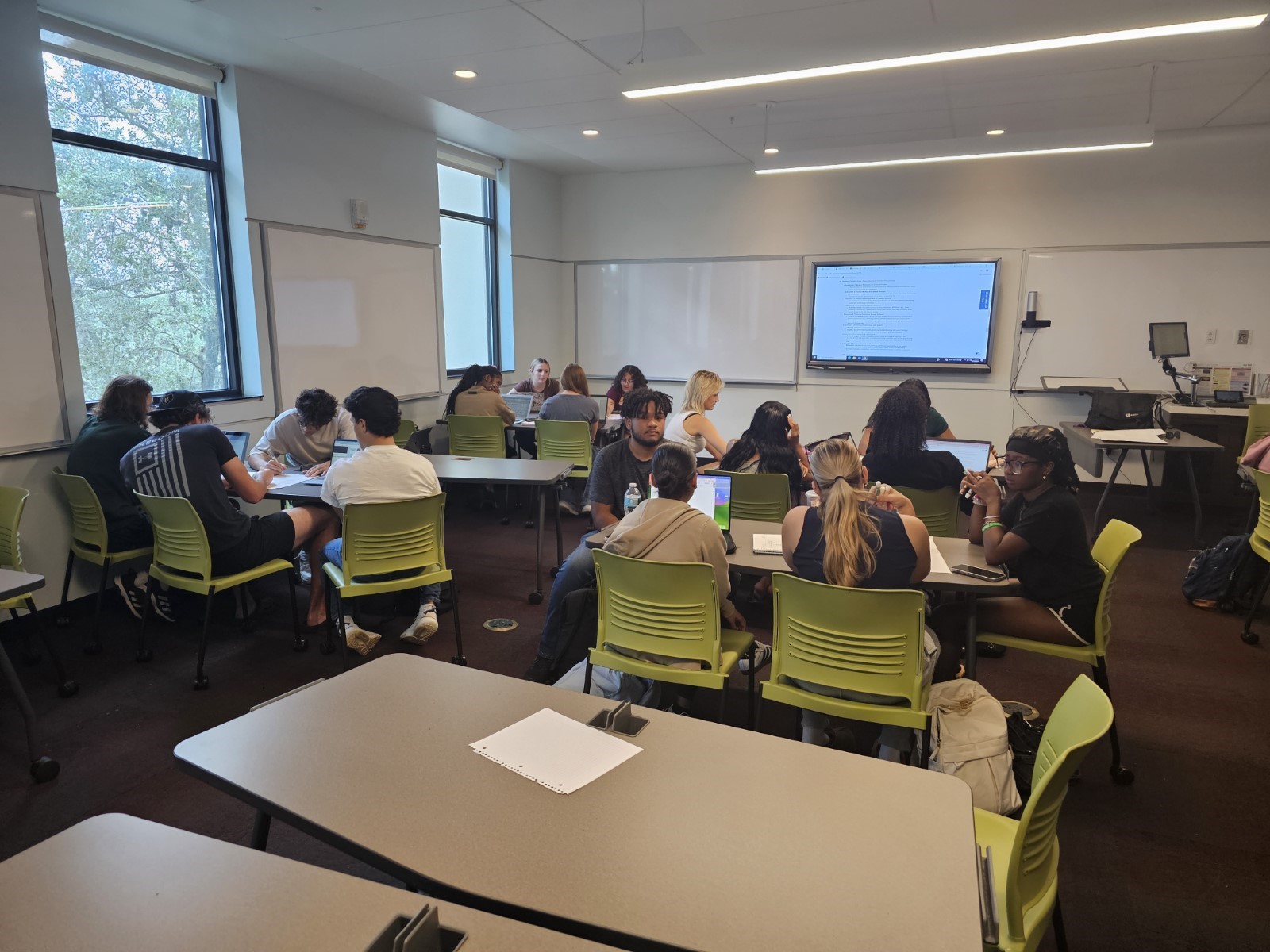
To kick off the project, I used ChatGPT to generate an outline based on positive psychology as aligned with the textbook chapters and student-led ideas and topics. The students were then divided into groups, where each group received a dedicated workspace in our learning management system, D2L. Each group selected a predetermined subtopic to focus on, and I tasked them with using ChatGPT to generate 20 ideas on that subtopic. From those 20 ideas, the groups narrowed it down to three, which they discussed in detail, considering both research-based and personal experiences. Each group member took notes to guide the next stage of the project.
Day 2: Mind Mapping and Cross-Pollination of Ideas
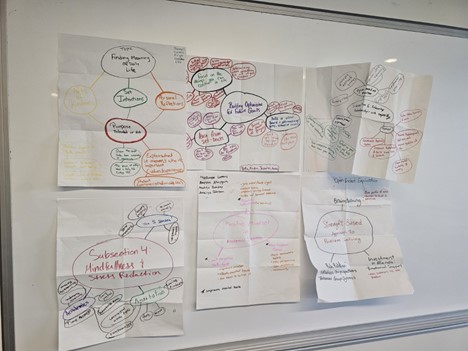
On the second day, students were given poster paper and markers to create mind maps of their ideas and help gain clarity on their discussions from the previous day. Each group placed their chosen topic at the center of the mind map and organized the associated ideas around it. The mind mapping exercise allowed students to visually connect their thoughts and discussions from day one.
One member from each group was nominated to circulate among the other groups, engaging in discussions about each team’s subsection of the article. This not only gave students a broader perspective on how their topics related to the overarching theme of student wellness but also facilitated the flow of information between teams. After gathering input from other teams, the group representative brought the new insights back to their original group, enhancing their understanding of their own topic and how it fit into the larger article. To ensure continuity, students took photos of their mind maps, which would later serve as guides for the writing process.
Day 3: Writing and Research Alignment
On the third day, each group was tasked with creating a document that contained a minimum of five references, with each group member responsible for contributing at least one reference. The document consisted of chunks of article drafts accompanied by their respective references. Students were asked to align these references with the ideas discussed during the earlier sessions and integrate them into their mind maps. Next, students took 15 minutes individually within a shared Google doc to write about their subsection, drawing from their mind maps and class discussions. This individual writing time allowed students to consolidate their thoughts and begin crafting their portion of the collaborative article.
Day 4: Ethical Use of AI in the Writing Process
The fourth day focused on ethical AI usage. We began with a discussion on how students had been using AI tools like ChatGPT and how they envisioned using any type of AI tools in the creation of this article. Together, we created an AI disclosure statement, agreeing on how AI would be used during the editing phase.
We explored specific AI prompts that could enhance their writing, including:
“Rephrase for clarity.”
“Organize this paragraph for the introduction, summary, or conclusion.”
“Give me a starting sentence for this paragraph.”
These prompts were designed to guide students in using AI as a tool to enhance clarity and organization rather than relying on it to write the content.
Day 5: Final Writing and Cohesive Editing
On the final day, students returned to their group documents and spent 15 minutes revising their sections. Afterward, they worked together to co-edit the document without the use of AI, striving to make the article more cohesive and polished. Finally, we revisited the agreed-upon AI prompts, and students were given the option to use AI only when they felt it was necessary for tasks like rephrasing sentences or organizing paragraphs.
The project culminated in a completed article on student wellness, co-authored by students and enhanced by responsible AI usage. The collaborative process not only demystified research and writing but also empowered students to see these activities as positive, engaging, and enjoyable experiences.
Takeaways From This Teaching Experience
The AI writing project was a valuable learning experience for the students, as it incorporated individual and collaborative learning elements alongside technology-based approaches. Reflecting on this experience, I have identified several key takeaways to carry forward into the new semester of teaching and learning.
The Importance of Throwback Learning Experience: Something Familiar Traditional tools like markers and poster boards remain essential in fostering cohesion, socialization, and competence-building. These activities encouraged students to engage in discussions and create visual representations of their ideas, which helped build their confidence and reinforce the collaborative process.
Starting With Original Ideas Matters Students benefited from discussing their ideas within the context of originality before integrating AI-generated content. Generative AI poses a potential threat to originality, emphasizing the need for human thought, discussion, and creativity to provide a benchmark for comparing the quality and intentionality of AI contributions.
Clear Parameters and Prompts Are Essential Defining the role of AI in the writing process was critical for success. Many students initially viewed AI as a tool for producing entire works. By discussing the parameters beforehand, it became clear that AI was to be used to supplement and enhance cohesion rather than replace the creative process.
The Importance of Prompt Development Students gained a growing understanding of the importance of crafting effective prompts for AI. Recognizing how prompts influence AI outputs is a crucial skill that was previously underdeveloped in many students. Moving forward, this skill will be vital as they navigate the intersection of human creativity and AI assistance.
Final Thoughts
Developing effective AI prompts is a pivotal skill that empowers students to use AI intentionally and meaningfully in their learning. A well-crafted prompt acts as the foundation for generating accurate, relevant, and cohesive responses, highlighting the importance of clarity, specificity, and purpose in the initial instructions given to the AI. By understanding how to formulate prompts, students can better harness the potential of AI to support their ideas, enhance their creativity, and improve the quality of their work without relying on AI to replace their original contributions.
This skill also encourages critical thinking, as students must evaluate the type of input needed to achieve a desired outcome, troubleshoot issues in responses, and refine their prompts for better results. Moreover, it aligns with the broader need for digital literacy in education, preparing students to interact responsibly and effectively with technology in academic, professional, and personal contexts.
Lastly, incorporating intentional AI use into teaching strategies ensures that students not only learn how to use these tools but also understand their limitations and ethical considerations. By balancing traditional methods, which foster originality and human connection, with innovative technologies like AI, educators can create a holistic learning environment that values both creativity and technological fluency. This balance will be crucial as AI continues to play an increasingly integral role in education and beyond.
Dr. Courtney Plotts’ students in class.A snapshot of the students’ work.
Special Note of Pride: I would like to note that this group of students worked on this project during class and completed this while two natural disasters accrued, power outages, remote and in person learning and did a great job considering the circumstances. I am so proud of each of them! We originally had bigger visions for the project but due to weather we had to make some changes to the plan!
Freshman College Students’ Advice to Peers for Health & Wellness in 2025
The new year always comes with the possibility of change and growth. As students, much of our growth focus is academics and learning-based. Being academically successful isn’t an easy task. Student wellbeing is an important factor in the learning process (Frazier & Doyle-Fosco, 2024). And for most of us, throwing ourselves into our studies and homework can come with negative side effects like burnout, stress, and decreased mood and motivation. But being successful doesn’t have to come at the risk of your mental health. In our view, academic success means more than good grades and knowledge. Although you may have gone through something last year, or are still going through it now, it doesn’t have to affect you in a negative way. There is so much more that goes into being successful. Success requires dedication, consistency, self-care, and a positive mindset. But for many of us a positive mind set is hard to come by.
The Collective Obstacle
The average age of our class is 19.7 years of age. We have lived with social media all of our lives. A lot of voices have imparted information. Some good, some not so good. The negativity that is readily accessible on social media can lead to negative self-talk. “Negative self-talk refers to your inner voice making critical, negative, or punishing comments. These are the pessimistic, mean-spirited, or unfairly critical thoughts that go through your head when you are making judgements about yourself” (Scott, 2023). Negative self-talk can be detrimental to your psychological well-being. It can really bring you down after you do it for too long. Negative self-talk can also induce stress, depression, and relationship problems. How you can start to believe the negative self-talk: you can start to believe negative self-talk after a while of you doing it. The more you start to tell yourself you can’t do something, the more you’ll start to believe it.
The effects of positive self-talk are the opposite of negative self-talk. It will improve your mental health, can reduce stress, lessen depression, and improve relationships. This not only impacts academics, but other aspects of life. To minimize negative self-talk, you can catch your inner critic when it’s happening and change your thinking to think more positive thoughts, remember that thoughts are not facts, contain your negativity, shift your perspective, think like a friend, or other trusted advisors.
Two Positive Ideas to Embrace in 2025
Two ideas to embrace in the new year that can jumpstart your positivity are evaluating how you think about failure and the control of your future. Failure is an inevitable part of life, but it is through our setbacks that we find opportunities for growth and success. How we respond to failure matters more than the failure itself, and cultivating a mindset of optimism is key to overcoming challenges (Hilppö & Stevens, 2020). Optimism, combined with grit—the perseverance and passion to achieve long-term goals—forms the foundation for a positive and resilient lifestyle. Together, these qualities enable us to turn obstacles into stepping stones and approach life’s difficulties with determination and hope. Think of failures as learning opportunities. Think about the knowledge you gain from hindsight when thinking about failure.
Additionally, understanding the distinction between what we can and cannot control is crucial for maintaining positivity and health (Pourhoseinzadeh, Gheibizadeh,& Moradikalboland, Cheraghian, 2017). Accepting that not everything is within our power allows us to shift our focus to areas where we can make a difference and grow from the experience. Remaining positive during challenging situations and remembering the aspects we can influence help us navigate adversity with a constructive mindset. It’s also important to respect that some factors are beyond our control and may happen for reasons we do not yet understand. By seeking to understand why certain things are outside our control, we can cultivate acceptance and use these moments as opportunities for reflection and personal growth.
The Importance of Health Communication in 2025
Healthy communication is critical to positive personal growth. Asking open-ended questions is important when engaging in meaningful communication because it ensures that there are no assumptions being made. One researcher found that assumptions “lead to consistent and unnecessary community failures” (Macrae, 2018, p.5). Additionally, healthy communication can build true connections among people and better understanding. Also, avoiding assumptions is a way to stay present in the moment allowing you to determine if there is genuine interest in the conversation. Most importantly, health aspects of communication like listening, reflecting, and pausing encourage new thinking and can develop new ideas just about anything.
In addition to healthy communication, think about sharing more of your experiences with peers. Starting from a place of curiosity and health, inquire about someone’s well-being. You can start with a simple phrase like “Are you ok?” Or be ready and willing to share your own personal experience when the time is right. Not only can this help someone else but sharing your story can also help you process what you have been through. Sharing and listening to each other’s experiences can show understanding and help you feel more willing to share now and in the future. Understanding and being present is a power combination for communication.
Lastly, remember that relationships are complex. Whether parental, academic, or personal, everyone has their relationships challenges. One tactic to strengthen relationships is humor. Remember to laugh and enjoy life and the people around you. Most people forget about light heartedness and humor, and how humor can help strengthen and resolve issues within a relationship. Humor can improve the quality of relationships by reducing the stress, tension, and anxiety of the people within the relationship. This effect can only occur if humor is used respectfully in relationships. When used right, humor also can create a more comfortable relationship with less anxiety and sadness for those in it. It’s ok to laugh—even in challenging times.
Summary
A positive mindset is the root of achieving any goal you put your mind to. As a collective voice, we hope the information we shared is valuable information. Our goal was to share meaningful information for your new year and new journey in 2025. As students, we fully understand the importance of mental health, especially because all of us experienced covid at some of the most challenging times of our lives. We hope this information helps you in the new year as much as it helped us learn and grow. Remember to stay happy, healthy, and safe in the new year and think positive!
Dr. Courtney Plotts is a Dynamic Keynote Speaker, Author, and Professor. Dr. Plotts is the National Chair of the Council For At-Risk Student Education and Professional Standards, the country’s only organization that provides standards for working with marginalized and nontraditional students in Kindergarten to College. Her role as National Chair includes training, consulting, and research. Her subject matter expertise has been used in a variety of book publications. Most recently “Small Teaching Online” By Flower Darby with James M. Lang published in June 2019. Dr. Plotts was recognized in 2017 by the California State Legislature for a bold commitment to change in education. She is currently in talks with higher education institutions to launch an institute that focuses on diversity and best practices in online teaching spaces to launch in 2021.
References
Frazier, T., & Doyle Fosco, S. L. (2024). Nurturing positive mental health and wellbeing in educational settings – the PRICES model. Frontiers in public health, 11, 1287532. https://doi.org/10.3389/fpubh.2023.12875
Hilppö, J., & Stevens, R. (2020). “Failure is just another try”: Re-framing failure in school through the FUSE studio approach. International Journal of Educational Research, 99, 101494. https://doi.org/10.1016/j.ijer.2019.101494
Macrae, C. (2018). When no news is bad news: Communication failures and the hidden assumptions that threaten safety. Journal of the Royal Society of Medicine, 111(1), 5–7. https://doi.org/10.1177/0141076817738503
Pourhoseinzadeh, M., Gheibizadeh, M., & Moradikalboland, M., Cheraghian, B. (2017). The Relationship between Health Locus of Control and Health Behaviors in Emergency Medicine Personnel. International journal of community based nursing and midwifery, 5(4), 397–407.
By Professor Katy Mason, PVC Dean at the University of Salford’s Business School.
We’re at a crucial moment in our fight to address climate change, with limited time to end the irreversible damage to our planet. However, higher education institutions (HEIs) could play a more pivotal role on the road to net zero.
Climate-related challenges are considerable and require both technological innovation and the reorganisation of our society and economy. Universities are in a strong position to drive these transitions, but because of the required pace of change, they need to do so in collaboration with government. For example, universities are well positioned to mobilise the STEM (science, technology, engineering and maths) and technical expertise required to evolve the way energy is generated, stored and distributed, as well as the SHAPE and social practice expertise to support the social transitions required to transform energy production and consumption. This broad range of expertise, uniquely perhaps, sits under one organisational umbrella: the HEI.
Reducing carbon footprint with research
HEIs have been working, increasingly over recent years, to structure and support multi, inter and transdisciplinary research, in ways that will ultimately support the reduction of our carbon footprint to deliver net zero.
The formation of UKRI (UK Research and Innovation) has supported many of these initiatives. In April 2018, UKRI brought together the UK’s seven research councils, Innovate UK, and Research England, into a single organisation to support the distribution of government funding for impactful, interdisciplinary research.
Accelerating a green growth economy through collaboration
Climate change mitigation and building the UK’s resilience to climate change impacts has been a central tenant of UKRI’s attention, with funding calls driving collaboration between academics, industry and government. But interdisciplinary research, on its own, is not enough. HEIs and government will have to find new ways of collaborating if we are to accelerate a green growth economy.
There are examples of successful collaboration. The Government’s Open Innovation Team is a platform that supports academic-policy collaboration, curating academic expertise to support and inform policy initiatives. Similarly, the United Nations PRME (Principles of Responsible Management Education) platform supports and accelerates the sustainability of current and future business leaders in Business and Management education. However, at present, its take-up is piecemeal and patchy. Much more collaboration is needed if we are to make a difference to climate change.
Recognition of the advantages afforded by collaboration is long-standing. As far back as 2000, Vangen and Huxman were developing a theory of collaborative advantage, arguing that goals, trust, culture and leadership had to be aligned enough – despite differences and tensions – if advantages were to be gained.[i] In this regard, collaboration is often inconsistent, with inherent contradictions and mutually exclusive elements caused by inevitable differences between partners. While it is these differences that often generate advantage, they require time and investment in understanding. This is perhaps why we have not invested sufficiently in making such partnerships work.
Breaking down barriers to collaboration
The contrasting cultures of academics and policymakers may certainty make collaboration difficult: the epistemologies-in-use (how knowledge, evidence and rigour are framed) are different; the production and use of knowledge objectives is different; and the rules of identity and belonging to the home-culture are different.
However, as Beech et al. argue, we can take advantage of these significant cultural differences if HEIs develop a new kind of platform that acts as a learning zone in which key cultural rules of academics and policymakers are suspended (not ‘solved’).[ii] This will enable different groups to contribute and extract learning insights as if they were collaborating with shared understanding, when this may only partially be the case.
In pursuit of creating a new kind of learning platform, HEIs, particularly those leading knowledge exchange and engagement initiatives, might usefully adopt this set of design principles:
Valuing difference and not seeking to resolve it;
Having the purpose of supporting others’ endeavors in their home-culture by providing knowledge resources;
Be willing to aggregate and disaggregate ideas and evidence in novel ways; and
Be willing to suspend judgement of the other and the self to encourage people to step outside their normal modes of interaction
These design principles will likely help knowledge exchange leads catalyse innovation and accelerate the adoption of cutting-edge practice by bringing local, regional and national policymakers together with academics to advance solutions to overcome climate change obstacles.
‘Making Britain a clean energy superpower’
Academics and policymakers are explicit in their ambition to tackle climate change. The UK Government states one of its key missions as ‘making Britain a clean energy superpower’ by ‘creating jobs, cutting bills and boosting energy security with zero-carbon electricity by 2030.’
Driven by government monies directed towards UKRI for this purpose and by researchers’ concerns, passions, and expertise, some universities have built up significant industrial and third-sector networks to support the development and transformation of our greening economy.
For example, researchers at Lancaster, Swansea, Imperial, and Salford have been studying the farming sector and its potential transformation through agrivoltaics. Agrivoltaics co-locate high-quality food and green energy production on the same land while simultaneously aiming to secure biodiversity net gain. This is a complex and ambitious agenda that will contribute to more than the ‘clean energy’ challenge.
Agrivoltaics requires expertise in physics to understand solar panel efficiency, reliability and maintenance, while plant science knowledge is essential to understand food nutrition and biodiversity complexities. In addition, social science expertise is required to understand the design and transformation of the farming sector, the development of a circular economy for solar panels, and how the proliferation of markets might reconnect across the entire food and energy production and consumption systems to ensure sustainability.
To uncover ‘what works’ will ultimately require us to collaborate with those seeking to use agrivoltaics and all those involved in solar panel production and management upstream and downstream of the supply network.
My involvement in this project has been exciting, frustrating and demanding. I suspect that we could have significantly accelerated our impact if we had not lacked access to a platform that systematically supported policy-academic engagement. In line with our research that shows the desire and difficulty for policymakers to engage with researchers, it seems there is much more we can do, as HEIs to support this.
[i] Huxham, C., & Vangen, S. (2013). Managing to collaborate: The theory and practice of collaborative advantage. Routledge.
[ii] Beech, N., Mason, K. J., MacIntosh, R., & Beech, D. (2022). Learning from each other: Why and how business schools need to create a “paradox box” for academic–policy impact. Academy of Management Learning & Education, 21(3), 487-502
By Darryll Bravenboer, Director of Apprenticeships and Professor of Higher Education and Skills, Middlesex University.
We have all seen the media coverage with packed A&E departments, patients waiting for hours and being treated in corridors. Last week was the busiest for the NHS in England so far this year, with more patients in hospitals than at any other point this winter, and yet without action the situation will get worse.
The NHS currently employs around 1.5 million people, making it the biggest employer in Europe. However, the NHS clinical workforce is not enough to keep pace with demand. The population of England is projected to grow to 61.7 million by mid-2043, and we are living longer which often means more complex illnesses.
There are currently over 112,000 NHS vacancies, the population of England is projected to be 61.7 million by mid-2043, and when combined with demographic changes, a shortfall of between 260,000 and 360,000 health service staff by 2036/37 is predicted by 2036/37.
The NHS Long Term Workforce Plan (2023) has set ambitious clinical workforce commitments with the aim to significantly increase the number of health staff, including doctors, nurses and midwives by 2032.
To achieve this, employers and universities delivering degree apprenticeships need to work together and develop innovative programmes that benefit students, the public sector and ultimately the public.
The University Alliance (UA) represents leading professional and technical universities, educating around 30% of all nursing apprentices in England, plus a substantial number of allied health professionals and healthcare degree apprentices.
Several UA members* have formed the Health Education Consortium to coordinate and expand healthcare degree apprenticeships to meet the NHS Long Term Workforce Plan goals.
By collaborating, we aim to increase the number of apprentice starts, reduce duplication and pool resources, creating a joined-up programme for local, regional and national apprenticeship provision. The Health Education Consortium will work with NHS England to scale operations in partnership with NHS Trusts and Integrated Care Boards, co-designing programmes to meet their needs.
The key benefit for healthcare employers of a higher education collaborative approach is that by working together, we can increase training places while minimising costs.
A comprehensive degree apprenticeship offer – working on their own individual universities are unlikely to have the resources to meet national employer needs. By joining forces, we can pool our funds and expertise and offer a broader range of healthcare degree apprenticeships to meet NHS requirements.
Driving innovation: a commitment to share innovative practice is at the heart of the Health Education Consortium and ensures that we work as an innovation engine creating solutions to the growth barriers employers identify.
Scalability and growth: working together means it is possible to scale up provision to meet the increasing demand outlined in the NHS Long-Term Workforce Plan.
Towards a one-stop-shop for healthcare education: providing a ‘one-stop-shop’ for NHS, employers save time and money as they do not need to communicate and work with a range of universities.
The benefits outlined above make the case for a more collaborative approach to delivering higher education, which, at the same time, better meets the needs of NHS employers. This aligns with the government’s ambition for greater collaboration to drive efficiency and contribute towards economic growth.
At a time of financial challenge for the higher education sector, the significant growth of degree apprenticeships within the NHS, made possible through effective university collaboration, could address government expectations while contributing to the financial sustainability of providers in the sector.
*Middlesex University, Birmingham City University, Oxford Brookes University, University of Hertfordshire, Kingston University and University of Greenwich.