This audio is auto-generated. Please let us know if you have feedback.
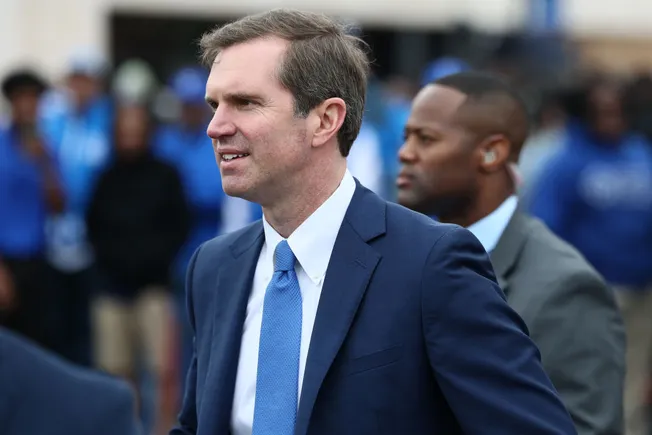
Kentucky Gov. Andy Beshearon Thursday vetoed a bill aiming to ban the state’s public colleges from spending money on diversity, equity and inclusion efforts.
“We’ve worked hard to make our commonwealth a welcoming place,” the Democratic governor said in a social media post Thursday. “House Bill 4 takes us away from that. We should be embracing diversity, not banning it.”
But Beshear’s veto will likely prove to be strictly symbolic, as the state’s Republican lawmakers hold a veto-proof supermajority.
State Rep. Josh Calloway, a co-sponsor of the bill, said Thursday that the Legislature plans to override Beshear’s veto next week and blasted the governor’s decision.
“His veto of our bill to end DEI in colleges is nothing but political theater, and the people of Kentucky see right through it,” he posted on social media.
The legislation — which offered exemptions for programs required by federal and state law — also seeks to bar colleges from requiring students to take classes that would “indoctrinate participants with a discriminatory concept,” which it defines as promoting “differential treatment or benefits conferred to individuals on the basis of religion, race, sex, color, or national origin.”
And it would prohibit Kentucky’s higher education coordinating board from approving degree programs with such courses, as well as ban colleges from using diversity statements or requiring employees to undergo DEI training.
The American Civil Liberties Union of Kentucky praised Beshear’s decision.
“Thank you, Governor, for recognizing that diversity makes us stronger, equity makes us fair, and inclusion is a Kentucky value,” the organization said on social media Thursday.
Should the lawmakers enact the legislation, public colleges would have until the end of June to eliminate all DEI positions and offices.
Kentucky colleges are facing attacks on DEI at the federal level as well.
The University of Kentucky is one of more than 50 colleges facing investigations by the U.S. Department of Education over allegations that they offer programs with race-based restrictions.
On Wednesday, university President Eli Capilouto said that his institution had minimal engagement with the The PhD Project, the organization at the center of the majority of the department’s probes.
Nevertheless, Capilouto said the University of Kentucky had formally cut ties with the group and will fully cooperate with the federal investigation.
The number of colleges being investigated by the Education Department’s Office for Civil Rights over allegations their programs and scholarships have race-based restrictions. The agency opened the probes after issuing guidance last month that said colleges are barred from considering race in any of their policies.
American voters want to see an overhaul in higher education and Republicans are taking advantage of it. Over the course of its first 75 days, the 119th Congress introduced more than 30 pieces of legislation concerning higher education—more than half of which came from members of the GOP.
Historically, conservative lawmakers have taken a laissez-faire approach to governing colleges and universities. But at a time when students and families are demanding greater accountability and a solution to the debt crisis, Republicans—who hold majority in both the House and the Senate—are laying the legislative groundwork to increase federal control over colleges.
But while the bills do in some ways levy penalties against institutions, lawmakers are also aiming to advance key Trump agenda items, an Inside Higher Edanalysis tracking proposed legislation shows. For example, they’ve introduced bills to crack down on immigration and foreign influence by threatening student visas and restricting international donations; to hamper flexibility for borrowers by capping student loan amounts; and to suppress “liberal ideologies,” by establishing penalties for pro-Palestinian protests. Republicans are also escalating their ongoing attacks on wealthy colleges with proposals to significantly increase the tax on university endowments.
Rep. Tim Walberg, a Michigan Republican who chairs the House Committee on Education and Workforce, has applauded Trump’s “enormous strides” and reinforced that these efforts will be a priority.
“Under President Trump, common sense is returning to America, and House Republicans are committed to enacting his bold vision for the country,” he said in a statement after the President’s March 4 joint address. “I will work in lockstep with this administration to protect students, workers, and job creators to ensure every American has a chance to thrive.”
Meanwhile, Democrats have rallied in defiance, introducing many bills that promote the exact opposite of what Republicans are trying to achieve. For example, the Republican bill that would ban transgender women from participating in female sports has a direct Democrat counterpart that would prohibit discrimination in athletics based on gender identity.
And all of that doesn’t even take into account the possibility that Republicans could revive parts of the College Cost Reduction Act—a comprehensive piece of legislation introduced last Congress to overhaul higher education. Although the bill itself has yet to be introduced, many of its provisions—such as requiring colleges to pay back a portion of students’ unpaid loans—could be part of the forthcoming reconciliation bill, a top priority for Congressional Republicans this spring that could mean billions in cuts to higher education. (Reconciliation is a budgetary tool which can be used once a year to quickly advance high-priority—and often controversial—pieces of legislation.)
Combined, the proposed legislation and potential for sweeping changes via reconciliation could lead to an unprecedented amount of federal focus on higher ed that college and university advocates say could heavily discourage international enrollment, indirectly increase the cost of attendance and cause a chilling effect on campus free speech.
“Higher education has moved to the forefront of the minds of our policy makers,” said Emmanual Guillory, senior director of government relations at the American Council on Education. “It has become a point of contention, especially with the increased oversight over institutions themselves by the current administration.”
But regardless of which party’s behind a bill, Guillory said he’s focused on educating lawmakers on how each piece of legislation could also have unintended consequences for institutions and the students they serve.
“Oftentimes what we see with Republicans and Democrats is they have good intentions behind what they’re trying to do, it’s just the way that they go about doing it,” he said. “When we begin to have more detailed conversations. Then [lawmakers] are like, ‘Oh, well no, we didn’t think about that. We didn’t realize this would happen. So it’s just a matter of us still continuing to do our job in advocating and educating.”
Given the emphasis on higher education in this session of Congress and the stakes for colleges, Inside Higher Ed is tracking higher-ed related bills. The searchable database, available here, currently includes 31 bills introduced since January, and we’ll update it regularly. Below you can find a breakdown of the legislation proposed so far.
Legislating at the federal level is complicated, so below you can find more information about how a bill becomes a law in 2025 as well as more details about the legislation raising concerns for institutions.
How a Bill Becomes Law
Few of the introduced bills will ever become law, based on Congress’s recent track record. And while the process is similar to what Schoolhouse Rock! described in the 1970s, partisan divides over policy have led to much gridlock on Capitol Hill.
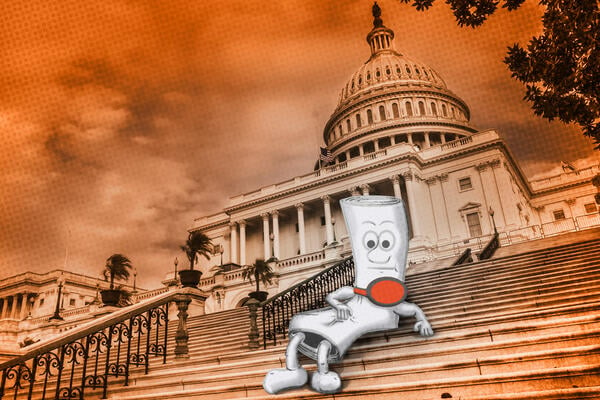
An Inside Higher Ed cartoon showing a bill on the steps of Congress.
Photo illustration by Justin Morrison/Inside Higher Ed dkfielding/iStock/Getty Images
During the 118th Congress—which ran from 2023 to 2025 with a Republican-controlled House and Democrat-controlled Senate—more than 90 percent of measures introduced died in committee and only about 3 percent became law, according to GovTrack.US. Even during the 115th Congress, the last time the Republicans held a trifecta, 85 percent of bills got stuck in committee and only 8 percent became law.
Many pieces of legislation introduced are considered nothing more than messaging bills by which a party or lawmaker signals their priorities. For example, it’s highly unlikely the Democrats will advance either the Closing the College Hunger Gap Act or the Affordable College Textbook Act, but they demonstrate a focus on meeting students’ most basic needs.
But if the legislation comes from Republicans on the House Committee on Education and Workforce and the Senate Committee on Health, Education, Labor and Pensions, it might be more likely to gain traction.
The chairs of those committees hold a lot of power over whether a bill will move forward. They control the schedule for public hearings and mark up sessions—where a bill is debated, amended and then voted on—so if a bill isn’t a priority for the chairs, it’s dead in the water.
But once again, having support and investment from an education committee member is helpful here. If they can make a case for the bill to receive time on the floor, it will face debate, amendments and a final vote. Bills have to pass both chambers and undergo negotiations to settle legislative differences before they go to the White House to become law. And that doesn’t include potential road bumps like the Senate filibuster.
Long story short, it’s a tedious process that can take months or even years. That’s why having support from Republicans on the education-focused committees—especially committee chairs—is critical to gaining momentum this year.
As Guillory said, “There are other members of Congress that are introducing legislation in the higher education space, but it doesn’t mean that those bills will necessarily have legs and actually be able to move through regular order.”
Bills Higher Ed Is Watching
Much of lawmakers’ attention right now is on reconciliation as they work to cut billions in dollars from the federal budget in order to pay for tax cuts and Trump’s other priorities. But outside of that just a handful of bills have received a hearing and/or a markup session so far. One of the most notable and concerning to higher ed advocates is the DETERRENT Act.
Scheduled for a vote on the House floor next week, this bill would require colleges to submit much more information about the foreign gifts and contracts that they receive. Republicans have claimed for years that colleges aren’t sufficiently complying with Section 117 of the Higher Education Act, which requires them to disclose twice a year all foreign gifts and contracts totaling $250,000 or more.
The legislation, which supporters say would discourage foreign influence in higher education, would lower the threshold to $50,000. For gifts and contracts from countries of concern—China, Russia, Iran and North Korea—colleges would have to report gifts and contracts of any amount. Institutions that fail to comply could lose access to federal student aid.
The House passed a nearly identical bill last Congress, but it died in the then-Democrat controlled Senate. House Republicans argued that as tensions with communist countries like China rise, universities have not taken their reporting obligations and vetting processes for international students seriously and in doing so are risking national security by granting foreign governments access to American research.
But institutional advocates say this bill goes well beyond what Section 117 of the Higher Education Act ever intended, making an already time consuming and confusing process more difficult.
Sarah Spreitzer, ACE’s chief of staff for government relations, said that these added steps and the processing workload that will come with it for the shrinking Education Department could lead to major delays in launching countless research collaborations and study abroad programs
In addition to the DETERRENT Act, Guillory said ACE is also paying attention to any measures focused on accountability, affordability and transparency of institutional data, many of which represent threads of last year’s College Cost Reduction Act (CCRA).
For example, the Graduate Opportunity and Affordable Loans Act would put a cap on the amount of loans available to graduate students and terminate their access to PLUS loans. The Endowment Tax Fairness Act would increase the amount of excise tax private institutions pay each year. And the Ensuring Distance Education Act would reverse some components of the Education Department’s 90-10 rule.
“In a lot of ways, CCRA is still alive, even though it has not been reintroduced this Congress,” Guillory said.
Lastly, he noted that many of the bills echo the Trump administration’s focus on more culture war facing topics like campus protests and immigration. The Laken Riley Act, which has already been passed, could impact visa access for international students from countries with a large number of undocumented immigrants. And several bills focused on antisemitism are likely to be discussed in the HELP Committee’s first education-specific hearing, Guillory said.
In general, he noted, a lot of the agenda is left to be determined. “I think it’s a matter of what can we accomplish in reconciliation first? Then, after that, what would we have to move through regular order?”
This audio is auto-generated. Please let us know if you have feedback.
Dive Brief:
Donors gave $61.5 billion to U.S. colleges in the 2023-24 fiscal year, reflecting a 3% increase from the year before after accounting for inflation in the sector, according to an annual report from theCouncil for Advancement and Support of Educationreleased Thursday.
Foundations increased their giving the most, contributing $20.4 billion,a 10.1% year-over-year jump. Conversely, corporations pulled back their higher education donations to $7.6 billion overall, a 9.9% drop from the prior year.
Charitable giving remains a stable source of income for the sector, according to the report, accounting for 10.2% of colleges’ educational and general expenditures in 2024. That’s roughly level with the rate seen a decade prior — 10.5%.
Dive Insight:
The findings, based on an annual survey of higher education institutions, suggest that charitable giving to higher education institutions did not slow in fiscal 2024. That’s despite sectorwide headwinds including painful cost increases, rising scrutiny from state and federal lawmakers, and questions about its value.
“At a time when higher education faces financial and political scrutiny, this sustained giving is a powerful vote of confidence,” Sue Cunningham, president and CEO of CASE, said in a statement.
Strong market conditions in fiscal 2024 likely helped boost charitable donations, as giving to colleges tends to rise when the economy does well, according to CASE’s report. In 2024, both the New York Stock Exchange and the U.S.’ gross domestic product saw increases.
“Voluntary support of higher education institutions in the U.S. expanded at a level between the two, illustrating that the level of giving is based on both economic factors,” the report said.
Foundations weren’t alone in increasing their charitable giving to the higher education sector in fiscal 2024.
Alumni gave $12.9 billion, up 4.4% from the year before, while non-alumni donated $8.9 billion, a 1.7% increase. Donor-advised funds — many of which are funded by alumni, according toCASE — gave $6.5 billion in fiscal 2024, representing an 8.9% jump from the prior year.
Among donor-restricted gifts to colleges’ endowments, 48.3% were designated for student financial aid in fiscal 2024. Roughly a quarter, 23%, went toward academic divisions, while another 15.9% went to employee compensation.The remainder was spread among research, athletics and student life.
Groups also donate to colleges’ current operations. Among those contributions, 43.6% went toward research in fiscal 2024, 28.1% went toward academic divisions and 12.8% went toward athletics. Financial aid, employee compensation and student life received the rest.
The results also indicate the number and value of gifts of securities, such as stocks, are rising. In fiscal 2024, 240 surveyed colleges said they received $2.4 billion in securities spread across nearly 28,200 gifts. That’s compared to $1.7 billion across around 24,400 gifts the previous year.The report also noted that gifts of securities are “worth more in a more robust market.”
SHINGLETOWN, Calif. — On a cold morning in October, the sun shone weakly through tall sugar pines and cedars in Shingletown, a small Northern California outpost whose name is a reminder of its history as a logging camp in the 1800s. Up a gravel road banked with iron-rich red soil, Dylan Knight took a break from stacking logs.
Knight is one of 10 student loggers at Shasta College training to operate the heavy equipment required for modern-day logging: processors to remove limbs from logs that have just been cut, skidders to pull logs out of the cutting site, loaders to stack and sort the logs by species and masticators to mulch up debris.
For centuries, logging was a seasonal, learn-on-the-job trade passed down from father to son. But as climate change and innovations in the industry have changed logging into a year-round business, there aren’t always enough workers to fill jobs.
“Our workforce was dying,” said Delbert Gannon, owner of Creekside Logging. “You couldn’t even pick from the bottom of the barrel. It was affecting our production and our ability to haul logs. We felt we had to do something.”
Related: Interested in innovations in higher education? Subscribe to our free biweekly higher education newsletter.
Around the country, community colleges are stepping in to run apprenticeship programs for heritage industries, such as logging and aquaculture, which are too small to run. These partnerships help colleges expand the workforce development programs central to their mission. The partnerships also help keep small businesses in small industries alive by managing state and federal grants and providing the equipment, courses and staff to train workers.
As industries go, logging is small, and it’s struggling. In 2023 there were only about 50,000 logging jobs in the U.S., but the number of logging companies has been on the decline for several years. Most loggers are over 50, according to industry data, and older generations are retiring, contributing to more than 6,000 vacant positions every year on average. The median annual salary for loggers is about $50,000.
Student logger Bryce Shannon operates a wood chipper at a logging site as part of his instruction at Shasta College in Redding, Calif. Credit: Minh Connors for The Hechinger Report
Retirements have hit Creekside Logging hard. In 2018 Gannon’s company had jobs to do, and the machines to do them, but nobody to do the work. He reached out to Shasta College, which offers certificates and degrees in forestry and heavy equipment operation, to see if there might be a student who could help.
That conversation led to a formal partnership between the college and 19 timber companies to create a pre-apprenticeship course in Heavy Equipment Logging Operations. Soon after, they formed the California Registered Apprenticeship Forest Training program. Shasta College used $3.5 million in grant funds to buy the equipment pre-apprentices use.
Logging instruction takes place on land owned by Sierra Pacific Industries lumber company — which does not employ its own loggers and so relies on companies like Creekside Lumber to fell and transport logs to mills.
Each semester, 10 student loggers like Knight take the pre-apprenticeship course at Shasta College. Nearly all are hired upon completion. Once employed, they continue their work as apprentices in the forest training program, which Shasta College runs in partnership with employers like Gannon. State apprenticeship funds help employers offset the cost of training new workers, as well as the lost productivity of on-the-job mentors.
For Creekside Logging — a 22-person company — working with Shasta College makes participation in the apprenticeship program possible.Gannon’s company often trained new loggers, only to have them back out of the job months later. It can cost tens of thousands of dollars to train a new worker, and Creekside couldn’t afford to keep taking the financial risk. Now Gannon has a steady flow of committed employees, trained at the college rather than on his payroll. Workers who complete the pre-apprenticeship know what they’re getting into — working outdoors in the cold all day, driving big machines and cutting down trees.
Workers who complete the apprenticeship, Gannon said, are generally looking for a career and not just a seasonal job.
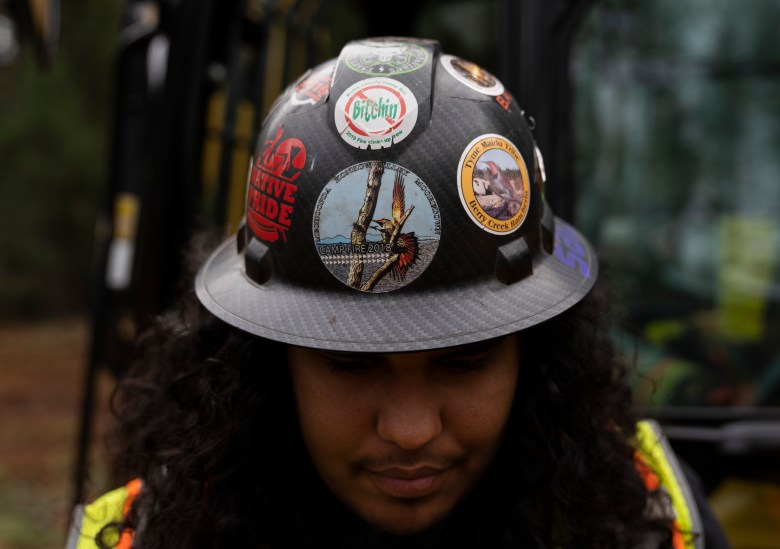
Talon Gramps-Green, a student logger at Shasta College in Redding, Calif., shows off stickers on his safety helmet. Credit: Minh Connors for The Hechinger Report
“You get folks that are going to show up every day,” Gannon said. “They got to test drive the career and know they like heavy equipment. They want to work in the woods. The college has solved that for us.”
Apprentices benefit too. Workers who didn’t grow up around a trade can try it out, which for some means tracking down an elusive pathway into the work. Kyra Lierly grew up in Redding, about 30 miles west of Shingletown, and previously worked for the California Department of Forestry as a firefighter. She’s used to hard work, but when she looked into getting a job as a logger she couldn’t find a way in. Some companies had no office phone or website, she says. Jobs were given out casually, by word of mouth.
“A lot of logging outfits are sketchy, and I wanted to work somewhere safe,” said Lierly, 25. She worked as an apprentice with Creekside Lumber but is taking a break while she completes an internship at Sierra Pacific Industries, a lumber producer, and gets a certificate in natural resources at Shasta College.
“The apprenticeship made forestry less intimidating because the college isn’t going to partner with any company that isn’t reputable,” Lierly said.
Apprenticeships, with their combination of hands-on and classroom learning, are found in many union halls but, until now, was not known to be common practice in the forested sites of logging crews.
State and federally registered apprenticeships have gained popularity in recent years as training tools in health care, cybersecurity and telecommunications.
Federal funding grew steadily from $145 million in 2018 to more than $244 million during the last years of the Biden administration. That money was used to support apprenticeships in traditional building trades as well as industries that don’t traditionally offer registered apprenticeships, including teaching and nursing.
The investment aims to address the shortage of skilled workers. The number of working adults in the U.S. doesn’t align with the number of skilled jobs, a disparity that is only slowly recovering after the pandemic.
Labor shortages hit especially hard in rural areas, where trades like logging have an outsized impact on their local economies. For regional heritage trades like logging, just a few apprentices can make the difference between staying in business and shutting down.
Lucas Licea, a student logger at Shasta College in Redding, Calif., operates a loader. Credit: Minh Connors for The Hechinger Report
“There’s a common misconception of registered apprentices that they’re only in the building trades when most are in a variety of sectors,” said Manny Lamarre, who served as deputy assistant secretary for employment and training with the Labor Department during the Biden administration. More than 5,000 new occupations have registered with the department to offer apprenticeships since 2021, he said. “We can specifically support unique small occupations in rural communities where a lot of people are retiring.”
Education Secretary Linda McMahon, who was confirmed earlier this month, said in her confirmation hearing that she supports apprenticeships. But ongoing cuts make it unclear what the new federal role will be in supporting such programs.
However, “sharing the capacity has been an important way to get apprenticeships into rural and small employers,” said Vanessa Bennett, director at the Center for Apprenticeship and Work-Based Learning at the nonprofit Jobs for the Future. It’s helpful when employers partner with a nonprofit or community college that can sponsor an apprenticeship program, as Shasta College does, Bennett said.
Once Knight, the student logger, completes the heavy equipment pre-apprenticeship, he plans to return to his hometown of Oroville, about 100 miles south of Shingletown. His tribe — the Berry Creek Rancheria of Tyme Maidu Indians — is starting its own logging crew, and Knight will be one of only two members trained to use some of the most challenging pieces of logging equipment.
“This program is awesome,” said Knight, 24. “It’s really hands-on. You learn as you go and it helps to have a great instructor.”
Student logger Dylan Knight drives a masticator, which grinds wood into chips, as Shasta College instructor Chris Hockenberry looks on. Credit: Minh Connors for The Hechinger Report
Across the country in Maine, a community college is helping to train apprentices for jobs at heritage oyster, mussel and kelp farms that have struggled to find enough workers to meet the growing demand for shellfish. Often classified as seasonal work, aquaculture jobs can become year-round careers for workers trained in both harvesting shellfish and planning for future seasons.
“I love the farm work and I feel confident that I will be able to make a full-length career out of this,” said Gabe Chlebowski, who completed a year-long apprenticeship with Muscongus Bay Aquaculture, which harvests in Damariscotta, Maine. A farm boy from rural Pennsylvania, Chlebowski worked in construction and stone masonry after high school. When his parents moved to Maine, he realized that he wanted a job on the water. With no prior experience, he applied for an oyster farming apprenticeship and was accepted.
“I was the youngest by five years and the only person who’d never worked on water,” said Chlebowski, 22. “I grew up in a landlocked state surrounded by corn fields. I had the work ethic and no idea what I was doing in boats.”
The apprenticeship program was launched in 2023 by the Gulf of Maine Research Institute, which joined with the Maine Aquaculture Association and Educate Maine to create a yearlong apprenticeship with Southern Maine Community College. Apprentices take classes in shellfish biology, water safety, skiff driving and basic boat maintenance. Grants helped pay for the boots, jackets and fishing bibs apprentices needed.
“The workforce here was a bottleneck,” said Carissa Maurin, aquaculture program manager for GMRI. New workers with degrees in marine biology were changing their minds after starting training at aquaculture farms. “Farms were wasting time and money on employees that didn’t want to be there.”
Chlebowski completed the apprenticeship at Muscongus Bay in September. He learned how to repair a Yamaha outdoor motor, how to grade oysters and how to work on a 24-foot, flat-bottom skiff. He stayed on as an employee, working at the farm on the Damariscotta River — the oyster capital of New England. The company is known for two varieties of oysters: Dodge Cove Pemaquid and Wawenauk.
Oyster farming generates local pride, Chlebowski said. The Shuck Station in downtown Damariscotta gives oyster farmers a free drink when they come in and there’s an annual summer shucking festival. But the company is trying to provide careers, Chlebowski said, not just high-season jobs.
“It can be hard to make a career out of farming, but it’s like any trade,” he said, adding that there is work to do year-round. “Welding and HVAC have trade schools and apprenticeships. Why shouldn’t aquaculture?”
Chlebowski’s apprenticeship turned into a career. Back in Shingletown, students in the logging program hope for the same result when they finish.
Until then, they spend Mondays, Wednesdays and Fridays in the woods learning how to operate and maintain equipment. Tuesdays and Thursdays are spent on Shasta College’s Redding campus, where the apprentices take three classes: construction equipment operation, introduction to forestry and wood products and milling.
At the end of the semester, students demonstrate their skills at a showcase in the Shingletown woods. Logging company representatives will attend and scout for workers. Students typically get offers at the showcase. So far, 50 students have completed the pre-apprenticeship program and most transitioned into full apprenticeships. Fifteen people have completed the full apprenticeship program and now earn from $40,000 to $90,000 a year as loggers.
Mentorship is at the heart of apprenticeships. On the job, new workers are paired with more experienced loggers who pass on knowledge and supervise the rookies as they complete tasks. Pre-apprentices at Shasta College learn from Jonas Lindblom, the program’s heavy equipment and logging operations instructor.
At the logging site, Lindblom watches as a tall sugar pine slowly falls and thuds to the ground. Lindblom’s father, grandfathers and great-grandfather all drove trucks for logging companies in Northern California.
An axe sticks out of a freshly cut tree at a logging site used to train student loggers enrolled at Shasta College in Redding, Calif. Credit: Minh Connors for The Hechinger Report
This is a good area for apprentices to “just be able to learn at their pace,” he said. “They’re not pushed and they can get comfortable in the machines without developing bad habits along the way.”
Lindblom, who studied agriculture education at Chico State University, spent all his breaks during college working as a logger. He works closely with the logging companies that partner with the program to make sure he’s teaching up-to-date practices. It’s better for new loggers to learn in this outdoor classroom, he said, than on the job.
“The majority of these students did not grow up in logging families,” he said. “This is a great opportunity to pass on this knowledge and share where the industry is going.”
Contact editor Christina A. Samuels at 212-678-3635 or [email protected].
The Hechinger Report provides in-depth, fact-based, unbiased reporting on education that is free to all readers. But that doesn't mean it's free to produce. Our work keeps educators and the public informed about pressing issues at schools and on campuses throughout the country. We tell the whole story, even when the details are inconvenient. Help us keep doing that.
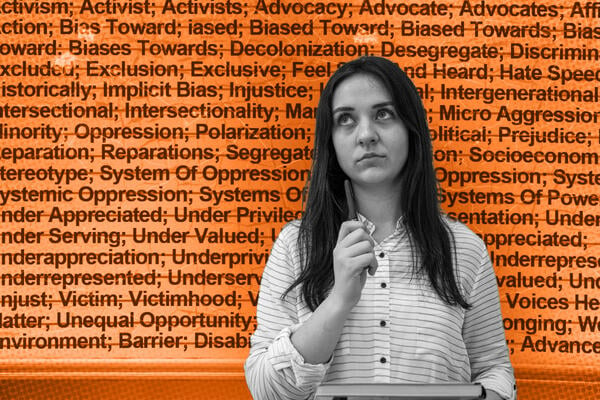
Those are just some of the terms colleges and universities are searching for in their databases to ensure compliance with federal DEI bans and similar directives from states and university systems.
Robin Goodman, distinguished research professor of English at Florida State University and president of the university’s chapter of United Faculty of Florida, said her institution is using a list of keywords to review webpages for DEI language in response to federal and state directives. While not all those terms were scrubbed, the list, which has circulated among faculty, disturbed her.
“From my point of view, those words are now dangerous words” that exacerbate a “culture of fear” on campus, she said.
She’s also mystified by which terms did and didn’t make it onto her university’s list, noting that the word “woman” is flagged, but not “man” or “sex.”
Campuses using keyword lists isn’t entirely new. Some state laws have pressured colleges to avoid using certain terms in the past, said Jon Fansmith, senior vice president of government relations and national engagement at the American Council on Education. But for most campuses, this is a “new space,” as some institutions scramble to comply with federal anti-DEI orders, like the Office for Civil Rights’ Dear Colleague letter, and try to mirror the ways grant-making federal agencies, like the National Science Foundation, have responded.
Colleges and universities are using the same tactics as many federal agencies parsing their grant projects and webpages to comply with federal anti-DEI directives. The National Science Foundation, which temporarily shut down grant reviews, searched for terms like “female” and “male-dominated” in its research grants. The Centers for Disease Control used a list of roughly 20 terms to guide choices about removing DEI-related language from its website. And the Defense Department reportedly flagged tens of thousands of images and web posts for removal because of alleged connections to DEI, including references to service members with the last name Gay and an image of the Enola Gay aircraft, which dropped the atomic bomb on Hiroshima during World War II.
Campus administrators taking this approach argue that, when tasked with reviewing massive numbers of webpages and programs, keywords make it easier to arrive at a smaller, more manageable pool to review. Faculty members, on the other hand, are baffled and outraged by the strategy. Some sympathize with campus leaders’ plight but argue it’s alarming to watch universities treat terms like “female” as red flags.
Fansmith doesn’t believe such lists are an ideal strategy.
Flagged word lists are “a very, very, very blunt tool” for “trying to understand academic content or the merits of research grants or projects,” he said.
‘Not a Perfect Approach’
University leaders recognize that devising keyword lists puts campuses on edge, but some argue it’s the most efficient way to respond to an onslaught of anti-DEI directives.
East Carolina University’s interim provost, Chris Buddo, explained at a recent Faculty Senate meeting that the Office of University Counsel crafted a list of terms over several months, initially used to review the university’s web presence to comply with the University of North Carolina system’s Equality Policy, which pared back DEI. (The North Carolina General Assembly also demanded an inventory of DEI trainings from the system in 2023, offering up a list of concepts and terms to guide the audit, including “accessibility,” “bias,” “racism” and “social justice.”)
Then, in February, a UNC system attorney issued a memo prohibiting campuses from mandating courses focused on DEI, referencing Trump’s January anti-DEI executive order. University officials again used a keywords list to search through the course catalog and ensure no general education or major requirements were focused on DEI.
Faculty at the meeting guffawed at some of the words flagged, including “cultural.”
“I know it’s been controversial, and I understand it is not a perfect approach,” Buddo told faculty. “But given the significant amount of content we are being asked to review, we started by using this blunt tool—and I recognize it is a blunt tool.”
He stressed that none of the words on the list are “inherently problematic.”
But “the list was developed as a way to cast the widest possible net, to make sure we could be aware of all the places that we might be viewed as being noncompliant,” he said.
Anne Ticknor, chair of the faculty and a professor in the College of Education at East Carolina University, said her institution has no choice but to comply with the system’s directives, though she tried to ensure that faculty had a say in any changes to course requirements.
“People were fearful that their academic freedom was being infringed upon, since faculty traditionally oversee curriculum, and that includes course titles, syllabus information, course descriptions, content—all of that is typically a faculty’s domain,” she said.
East Carolina officials told Inside Higher Ed in a statement that most courses flagged using the list were “false positives,” meaning that upon review, they weren’t required or didn’t relate to DEI.
Florida State University also emphasized in a statement to Inside Higher Ed that just because the university is using a list of key terms to review webpages and communications doesn’t mean those words or pages are necessarily being removed.
“For example, contrary to media reports, the words ‘woman’ and ‘women’ are easily found throughout the FSU website and have not been removed, nor are they being removed,” the statement read. “Florida State University, like all universities, routinely reviews its messaging to ensure information is up to date and compliant.”
Florida State president Richard McCullough recognized in a March 4 message to faculty and staff that they may have “feelings of uncertainty and concern.”
“While we are confident that our institution currently complies with the law, it is important that our messaging reflects new interpretations and priorities,” he told employees.
Some campus leaders said they crafted flagged-terms lists out of panic.
Officials at High Point University, a private institution in North Carolina, for example, told Inside Higher Ed in a statement that they created a keyword list in a moment of heightened worry last month after the U.S. Department of Education canceled three grants that supported graduate education programs, totaling $17.8 million. The Feb. 14 Dear Colleague letter, which gave institutions two weeks to rid themselves of race-conscious programming, exacerbated their concerns about losing federal funding for other programs.
According to The News & Observer, the university circulated a list of 49 terms, including “equality” and “gender,” and called for an audit of course descriptions and syllabi, student handbooks and webpages.
But officials quickly rescinded the move.
“Facing a 14-day deadline, we acted quickly based on our care and concern for students and faculty,” the statement from High Point read, “but clearly we overcorrected.”
Provost Daniel Erb sent an apology to academic leaders on March 2, saying he consulted with legal counsel and “there are no terms or words that you are required to change.”
“While many institutions were working towards removing certain terms and words from websites … our legal counsel has helped clarify that our priority should be on ensuring all our program qualifications and requirements do not discriminate on the basis of race, ethnicity, gender, religious beliefs, etc.,” Erb wrote. “Therefore, the concern about the language that is used is no longer a focus.”
ACE generally doesn’t recommend universities undertake such language reviews in response to the Office for Civil Rights’ anti-DEI directive, Fansmith said. He believes campuses’ usual processes for reviewing university communications and curricula should suffice.
“The administration has a view of what compliance with civil rights laws means,” which “I don’t think we necessarily believe the law itself supports,” he said.
The Ripple Effects
While harried administrators say the flagged terms are just a guidance tool, faculty members find the reviews burdensome and say they have a chilling effect in the classroom.
Margaret Bauer, professor of English, distinguished professor of arts and sciences and Rives Chair of Southern Literature at East Carolina University, said her department has a Multicultural and Transnational Literatures concentration. She hasn’t done a count, but she expects the word “cultural”—one of the words on the list—comes up in every course description in that concentration. She feels for her colleagues who’ve had to justify courses or explain why they’re false positives. (Bauer is also in the Faculty Senate but stressed that she’s speaking on her own behalf.)
“We’re already all overtaxed with so much bureaucracy,” she said. “Just to add something that’s so ridiculous—it’s really frustrating … We should have been grading or planning class, things that are productive. This was not productive.”
Bauer believes administrators are well intentioned and “want to protect us.”
But “I want them instead to push back … and say, ‘Curriculum is under faculty. And we don’t teach discrimination. We teach the history of it. We’re not doing anything wrong … These words are things our university believes in,’” she said.
Knowing the word list is out there makes concepts feel taboo in the classroom, she said.
“When I’m teaching Southern literature, I’m going to end up talking about the history of oppression, the history of discrimination … I can’t not talk about it,” she said, but she finds herself feeling “more self-conscious” about it. She worries faculty members without tenure might fear for their jobs if they “teach honestly.”
Goodman, of Florida State University, said she also can’t avoid the topics on her university’s flagged-term list.
“I’m a feminist theorist. I’ve written a lot of books, and they all have ‘feminism’ in the title,” she said. “So, I can’t backtrack it now. It’s all out there in the public.”
The flagged-words list—especially combined with recent Florida state laws allowing students to record professors in class and requiring professors to undergo post-tenure review—creates an environment where “faculty feel like they are being gagged in class, and they’re fearful,” she added.
Fansmith isn’t surprised faculty are worried.
Professors are used to “really complicated, detailed and multi-faceted levels of curriculum construction,” he said. “These are professionals who have spent their lives understanding those nuances, those details and why they matter,” so they’re concerned to see coursework in particular “reduced seemingly to a simplistic list of terms.”
He believes word lists are an acceptable, albeit not ideal, tool to use if they’re part of an internal review process “done with the care and attention that universities generally do with matters of curricular review and with respect for academic freedom.”
But “when it’s being mandated from the outside, by the federal government or a state and it’s getting into really perilous ideas of academic freedom and what can be taught, that’s when we start to really worry about what these lists mean and what they represent,” he said.
This week I dug into how the Trump administration’s anti-climate blitz is hampering schools’ and colleges’ ability to green their operations, plus a new report on the California wildfires’ impact on students. Thank you for reading, and reply to this email to be in touch. — Caroline Preston
LeeAnn Kittle helps oversee the Denver public school district’s work to reduce carbon emissions by 90 percent by 2050.
In January, her job got a lot tougher.
Denver expected to receive tax credits via the Inflation Reduction Act for an additional 25 electric school buses. President Donald Trump attempted to freeze clean energy funds through the IRA in his first days in office. Kittle, the district’s executive director of sustainability, also considered applying for tax credit-like payments for energy-efficient heat pumps for the district’s older buildings that lack air conditioning. And she’d intended to apply this spring for a nearly $12 million grant through Renew America’s Schools, a Department of Energy program to help schools become more energy efficient. Staff working on that program have left and its future is uncertain.
“I think we’re all in shock,” said Kittle. “It’s like someone put us in a snow globe and shook us up, and now we’re asked to stand straight. And it’s like I don’t know how to stand straight right now.”
Since January, the Trump administration has launched a broadside against efforts to reduce gases that cause climate change, including by freezing clean energy spending, slashing environmental staff and research, scrubbing the words “climate change” from websites, and rethinking decades of science showing the harms of global warming to human health and the planet. Experts and education leaders say those actions — some of which have been challenged in court — are disrupting, but not extinguishing, efforts by schools and colleges to curtail their emissions and reduce their toll on the planet.
Related: Want to read more about how climate change is shaping education? Subscribe to our free newsletter.
At the start of the year, the State University of New York was awarded $15 million to buy 350 electric vehicle charging stations. “We have yet to see the dollars,” said its chancellor, John B. King Jr. A webinar on the Department of Transportation grant program, which is funded by the bipartisan infrastructure act, was canceled. “It’s been radio silence,” said Carter Strickland, the SUNY chief sustainability officer.
The SUNY system, which owns a staggering 40 percent of New York State’s public buildings, had also planned to apply for IRA payments for a variety of projects to electrify campuses, reduce pollution and improve energy efficiency. In November, it applied for approximately $1.45 million for an Oneonta campus project that uses geothermal wells to provide heating and cooling. It still expects to get that money since the project is complete and the IRA remains law, but it can no longer count on payments for newer projects, King said.
“What the IRA did was turbocharged everything and gave many more players the ability to see themselves as part of a clean energy economy,” said Timothy Carter, president of Second Nature, a group that supports climate work in higher education. But the confusion that the Trump administration has sowed — even though the IRA has not been repealed — means both K-12 and higher education institutions are reconsidering clean energy projects.
There’s no count of how many colleges have sought funding through the IRA and bipartisan infrastructure act-funded programs, said Carter, but the work is spread across red and blue states, and some education systems have dozens of projects under construction. The University of California system, for example, filed applications for more than 70 projects, including a $1 billion project to replace UC Davis’s leaky and inefficient heating and cooling system and a project at UC Berkeley to phase out an old power plant and replace it with a microgrid.
“We remain hopeful that funding will be provided per the program provisions,” David Phillips, associate vice president for capital programs at the University of California, wrote in an email.
Sara Ross, co-founder of Undaunted K12, which helps school districts green their operations, said her group tells school leaders that for now, “energy tax credits are still the law of the land.”
But she expects those credits could be eliminated in the new tax bill that Congress is negotiating this year.
In the past, entities that begin construction on projects before any changes in a new law go into effect have been grandfathered in and still received that money, she said. “No promises,” Ross said, but historically that’s how such tax credit scenarios have worked. She said some school districts are speeding up projects to beat that possible deadline, while others are abandoning them.
There is some political movement to preserve clean energy tax credits. Roughly 85 percent of the private-sector dollars that have gone into clean energy projects are in GOP-led districts, according to a report last year. Some GOP lawmakers have advocated for maintaining that funding, which has contributed to a surge in renewable energy jobs.
Steven Bloom, assistant vice president of government relations with the American Council on Education, said that gives supporters of the IRA some hope. But he said that many higher education institutions are facing so much pain and uncertainty from other Trump administration actions, like the National Institutes of Health’s plan to slash overhead payments and investigations into alleged antisemitism, that unfortunately “climate investments may get pushed down the ladder of priorities in the near term.”
Another important vehicle for greening schools, the Renew America’s Schools grant program, was started in 2022 with $500 million for school districts. Many of the Department of Energy staff working on that effort have left, Ross said, and some school districts have not heard back about the status of funding for their projects.
In Massachusetts, the Lowell school district won a prize through the Renew America program that could unlock up to $15 million to help the district improve its aged facilities. The district’s facilities for the most part lack air conditioning and schools have been closed on occasion due to high temperatures.
Katherine Moses, the city of Lowell’s sustainability director, wrote in an email that the district had so far pocketed $300,000 that it is using for energy audits to identify inefficiencies and lay the groundwork for a larger investment. It’s unclear what could happen beyond that and if the district will receive more money. She said Lowell is proceeding according to the requirements of the grant “until we hear otherwise from DOE.”
More than 3,400 school districts have applied for money through programs created under the bipartisan infrastructure law and the IRA to electrify school buses. After a federal judge ruled against the administration’s freeze on clean energy spending, grants through those programs appear to have been unfrozen and districts have been able to access payments, said Sue Gander, director of the electric school bus initiative with the nonprofit World Resources Institute.
But rebates for electric buses are still stalled, she said. Districts are submitting forms to receive rebates, she said, “but there’s no communication coming back to them through the system about the status of their award or any indication that any payment that may have been requested is being provided.”
The Transportation and Energy departments and the Environmental Protection Agency, which runs the Clean School Bus Program, did not respond by deadline to requests for comment for this article.
King, of SUNY, noted that climate change is already negatively affecting young people and contributing to worsening disasters like floods and fires. For some faculty, staff and students, the backtracking from climate action at the federal level is stirring disappointment and fear, he said. “There is this very intense frustration that as a society we are stopping efforts to deal with what is truly an existential threat.”
Contact Caroline Preston at 212-870-8965, on Signal at CPreston.83 or via email at [email protected].
This story about clean energy was produced by The Hechinger Report, a nonprofit, independent news organization focused on inequality and innovation in education. Sign up for our climate and education newsletter.
What I’m reading:
My colleague Neal Morton traveled to northwest Colorado for a story on how phasing out coal-powered plants affects school budgets and career prospects for graduates. School districts haven’t done enough to plan for those changes or prepare students for alternate careers, he writes, and renewable energy projects are not popping up fast enough to smooth the financial pain.
Some 725,000 students at more than 1,000 schools faced school closures during the California wildfires in January, according to a new report from Undaunted K12 and EdTrust. The fire had a disproportionate impact on students living in poverty and from underrepresented backgrounds, the report says: Three-quarters of the affected students came from low-income households, and 66 percent were Hispanic.
The U.S. Coast Guard Academy removed the words “climate change” from its curriculum, reports Inside Climate News. The academy falls under the purview of the Department of Homeland Security, whose new director, Kristi Noem, issued a directive in February to “eliminate all climate change activities and the use of climate change terminology in DHS policies and programs.”
Schools with satisfactory heating systems reduce student absences by 3 percent and suspensions by 6 percent, and record a 5 percent increase in math scores, according to a study by researchers at the University at Albany, State University of New York. Schools with satisfactory cooling systems see an increase of 3 percent in reading scores.
Contact editor Caroline Preston at 212-870-8965, on Signal at CPreston.83 or via email at [email protected].
The Hechinger Report provides in-depth, fact-based, unbiased reporting on education that is free to all readers. But that doesn’t mean it’s free to produce. Our work keeps educators and the public informed about pressing issues at schools and on campuses throughout the country. We tell the whole story, even when the details are inconvenient. Help us keep doing that.
The Education Department’s Office for Civil Rights launched investigations into 51 colleges on Friday, accusing them of violating Title VI of the Civil Rights Act and flouting guidance put forth in the department’s Dear Colleague Letter last month, which warned colleges that all race-conscious programs and policies would be considered unlawful.
“The Department is working to reorient civil rights enforcement to ensure all students are protected from illegal discrimination,” Education Secretary Linda McMahon wrote in a statement. “Today’s announcement expands our efforts to ensure universities are not discriminating against their students based on race and race stereotypes.”
According to the department’s statement, all but six of the investigations revolve around colleges’ partnerships or support for The PhD Project, a nonprofit organization that connects prospective business doctoral candidates from underrepresented backgrounds with academic networks and hosts recruitment events for business school faculty. In its statement, the Education Department said the organization “limits eligibility based on the race of participants.”
A spokesperson for the PhD Project told Inside Higher Ed the organization works “to create a broader talent pipeline of current and future business leaders…through networking, mentorship, and unique events.”
The spokesperson also said they changed their membership requirements “this year” to include “anyone who shares that vision,” but did not say exactly when the change was made. Snapshots of the organization’s website, captured on the WayBack Machine, show different language as recently as two weeks ago, including a section on the homepage titled “we believe inclusion is critical,” which has since been scrubbed.
The OCR is also investigating five additional colleges for allegedly using race in scholarship eligibility requirements. One institution, the department said, was included for “administering a program that segregates students on the basis of race.”
Representatives for the education department did not respond to multiple questions from Inside Higher Ed in time for publication.
Inside Higher Ed also contacted the two dozen institutions under investigation, and their responses varied. The University of Wisconsin-Madison and Carnegie Mellon University said they had yet to be formally notified of any complaint by the OCR, and were awaiting more information to determine how to comply with an investigation.
A spokesperson for the University of Notre Dame, which is still listed as a PhD Project partner, said the university “follows the law and in no way practices or condones discrimination.”
“As a Catholic university, we are fully committed to defending the dignity of every human person and ensuring that every person can flourish,” the spokesperson added.
At least one university on the list has already terminated its partnership with the PhD Project. A spokesperson for Arizona State University said the business school “would not be supporting [faculty] travel to the upcoming PhD Project Conference.”
“The school also this year is not financially supporting the PhD Project organization,” the spokesperson added.
A spokesperson for Ithaca College, one of the five institutions accused of limiting scholarship eligibility based on race, denied that the scholarships the department cited violated Title VI. The department targeted two scholarships, the spokesperson said: the African Latino Society Memorial Scholarship and the Rashad G. Richardson “I Can Achieve” Memorial Scholarship. Both recognize students who work with the college’s BIPOC Unity Center, but don’t list any racial eligibility requirements on their respectivewebpages.
The Dear Colleague Letter released by the OCR last month aimed to greatly expand the scope of the Supreme Court’s affirmative action ruling in Students for Fair Admissions v. Harvard and University of North Carolina Chapel Hill, from one squarely focused on the policies and practices of admission offices to a sweeping decree on the illegality of all educational programs that consider race.
Jon Fansmith, senior vice president of government relations and national engagement at the American Council on Education, said the investigations were “cause for concern” among higher ed institutions that may have thought they were in compliance with the Dear Colleague Letter. But he said institutions shouldn’t panic yet.
“This is very clearly [the administration’s] first effort to try and enforce their interpretation of SFFA, as opposed to what most legal scholars accept that case means,” Fansmith said. “I think that schools understand, especially post-SFFA, what constitutes an impermissible benefit to a student based on race…it seems to me that they will probably be on solid ground defending their actions in these cases.”
Recruitment in the Crosshairs
The PhD Project has been a target of conservative activists in the past. In January, Christopher Rufo—a stalwart anti-DEI crusader who Florida Gov. Ron DeSantis appointed to the board of New College in 2023—brought attention to institutions attending the organization’s annual recruiting conference.
In a tweet, Rufo showed screenshots of the organization’s eligibility requirements for attendance, which stated that applicants had to be Black, Hispanic or Indigenous. Shortly after, Texas A&M University announced it would not send business faculty to the conference, following a threat by Texas Gov. Greg Abbott to fire the university president. Rufo did not respond to Inside Higher Ed’s request for comment.
On Friday morning, the PhD Project website included a list of all university partners, accessible via drop-down menu. By that evening, the list had disappeared from the site. A spokesperson for the organization did not say why it was removed.
Inside Higher Ed catalogued the list before its removal. Of the 45 institutions that the department alleges violated civil rights by partnering with the PhD Project, 31 were listed as partners on the organization’s website Friday morning, including ASU. It’s not apparent what connection the other 14 institutions have to the PhD Project, and the education department did not respond to requests for clarification. But more than half of the 97 U.S. partner colleges the organization had listed on its website are not included in the OCR’s investigation. Its unclear why some PhD Project partners are under investigation while others are not.
A spokesperson for Boise State University, which is under OCR investigation but not on the PhD Project’s list of partners, told Inside Higher Ed the institution is “working with our general counsel’s office to look into the matter.” A spokesperson for the California State University system, which has two campuses under investigation—CSU San Bernadino and Cal Poly Humboldt—said the system “continues to comply with longstanding applicable federal and state laws.” A spokesperson from the University of North Texas, also under investigation, said they are “fully cooperating” with investigations but are “not affiliated with the PhD Project.”
The PhD Project’s annual conference is set to start next week in Chicago. A spokesperson for the organization did not say how many universities have pulled their support for attendees, or if they’d seen an uptick in requests to cancel registrations.
Fansmith said that initiatives to recruit a more diverse applicant pool shouldn’t be viewed as discriminatory—especially in academic fields that have struggled to diversify. Only 35 percent of doctoral candidates in business, and 26 percent of business school faculty, are people of color, according to a 2023 report from the Association to Advance Collegiate Schools of Business.
“There’s lots of admissions initiatives seeking to put institutions in front of groups of students so they become aware of the programs they offer. Those are not discriminatory,” Fansmith said. “The reason these programs exist is because there are categories of students who are underrepresented in many fields… it would be a shame to see schools walk away from them.”
The U.S. Department of Education’s Office for Civil Rights launched investigations into more than 50 colleges Friday over allegations that their programs and scholarships have race-based restrictions, a move in line with the agency’s broad crackdown on diversity initiatives.
The civil rights investigations include prominent private colleges, such as Yale University and the Massachusetts Institute of Technology, as well as dozens of large public institutions, including Arizona State University and University of California, Berkeley.
The investigations follow the Education Department’s Dear Colleague letter last month that says colleges are barred from considering race in their programs and policies. The guidance has drawn at least two lawsuits that accuse the letter of being unconstitutional.
Dive Insight:
The new investigations are just one of the aggressive moves the Education Department has taken to carry out President Donald Trump’s policy priorities to reshape higher education.
Trump and his administration’s top officials have not only threatened to pull funding from colleges over their diversity initiatives but also over the way they handle student protests and if they allow transgender women to play on teams corresponding with their gender identity.
Friday’s announcement escalates the Trump administration’s threats to pull federal funding over diversity efforts.
The Education Department said it is investigating allegations that 45 colleges have partnered with an organization for doctoral students that has race-based eligibility criteria. It is also looking into allegations that six have race-based scholarships and that one has a “program that segregates students on the basis of race.”
The probes follow the Feb. 14 Dear Colleague letter, which interpreted the 2023 U.S. Supreme Court decision against race-conscious admissions to also mean that colleges were prohibited from considering race in their policies and programs, including scholarships and housing.
The letter panned diversity, equity and inclusion initiatives, describing them as discriminatory practices aimed at “smuggling racial stereotypes and explicit race-consciousness into everyday training, programming, and discipline.”The guidance threatened to pull federal funding from colleges that didn’t comply with the Education Department’s interpretation of civil rights law.
At least two lawsuits have challenged the legality of the guidance, arguing that the letter is unconstitutionally vague, undermines academic freedom and violates free speech rights.
The plaintiffs and other critics have pointed out that the 2023 Supreme Court decision only touched on admissions.
“OCR’s letter goes beyond that in a way that is simply off-base, encompassing virtually all programs at schools and universities, including race-neutral policies,” researchers at The Century Foundation, a left-leaning think tank, said in a post this week.
Both The Century Foundation and some legal scholars have cautioned colleges to not overly comply with the letter.
“It is important to ensure that educational policy is not changed based on a letter that oversteps legal boundaries,” Liliana Garces, an educational leadership and policy professor at the University of Texas at Austin, wrote in a February op-ed for The Chronicle for Education.
Two weeks later after the Education Department issued the Dear Colleague letter — amid widespread outcry — the agency appeared to walk back some of the most contested provisions of the guidance in a Q&A.
For instance, the Education Department said using words like “diversity,” “equity,” and “inclusion” would not necessarily mean colleges are violating civil rights law. The agency also noted that it doesn’t have the power to control classroom instruction.
Yet the American Federation of Teachers, one of the groups suing over the guidance, said the Q&A only made the letter “murkier.”
The Education Department’s new round of investigations also follow dramatic cuts at the agency, which eliminated nearly half its workforce through mass firings and voluntary buyouts. Department leaders concentrated many of the cuts in OCR, the very division responsible for carrying out the new civil rights investigations.
The number of colleges put on notice this week by the Education Department over allegations of antisemitism. The agency warned the institutions via letters that it could take enforcement action against them if it determines that they aren’t sufficiently protecting Jewish students from discrimination, including by providing “uninterrupted access to campus facilities and educational opportunities.”