Tag: Colorado

  • University of Northern Colorado plans to lay off 50 employees

    University of Northern Colorado plans to lay off 50 employees

    This audio is auto-generated. Please let us know if you have feedback.

    Dive Brief:

    • The University of Northern Colorado plans to lay off about 50 staff members in early November and eliminate roughly 30 vacant roles, CFO Dale Pratt said during a town hall last week. 
    • The layoffs come as the university tries to close a projected $7 million budget shortfall for fiscal 2026 and shrink its scale to meet lower enrollment levels. The job eliminations are expected to save $8 million to $10 million annually, or up to 7.5% of its personnel expenses. 
    • Signaling that layoffs were on the horizon earlier this month, university President Andy Feinstein pointed to unexpected reductions in state funding, lower-than-anticipated revenue from enrollment, inflation and historically low employee turnover.

    Dive Insight:

     Many of the University of Northern Colorado’s financial woes stem from enrollment that is shrinking faster than expenses. Between 2018 and 2023, the public institution’s fall headcount fell by nearly a third, to 9,067 students.

    Following the pandemic, officials had expected a rebound in enrollment that has yet to materialize, Pratt said. Meanwhile Feinstein said the university is still optimistic that growth lies ahead given robust retention rates and other factors.

    Even so, its student body is likely to remain smaller in the years ahead compared to the past. In his presentation, Pratt cited a note from S&P Global Ratings analysts arguing that the university’s financial health depended on its ability to scale down to meet a smaller student body going forward. 

    He also pointed to metrics showing that the university has more employees per student than nearly all other colleges in the state, and that its net operating results per student have been negative since fiscal 2023.

    Going into the fiscal year, officials had a balanced budget drawn up for fiscal 2026, based in part on expected employee turnover and projected enrollment. Leaving jobs unfilled would have allowed University of Northern Colorado to save on costs without having to resort to layoffs, which leaders did consider when initially making the budget earlier this year, Pratt said. 

    But not as many employees left on their own as the university expected, with its turnover rate falling from 19.1% in June 2022 to 11.8% in June of this year, according to Pratt’s presentation. Just between 2024 and 2025, the turnover rate fell by 2 percentage points.

    Moreover, Colorado lawmakers reduced the university’s funding for the current fiscal year by $550,000 to plug an unanticipated hole in the state budget, Pratt said. 

    An even bigger financial blow came as the new school year began. In the fall semester, 391 fewer students enrolled than the institution budgeted for, with an actual headcount of 8,443. That metric includes 119 fewer degree-seeking undergraduate students than anticipated, which Pratt described as especially worrisome. 

    “There were changes here that occurred that really caught us off guard,” Pratt said. 

    Although officials are still analyzing what exactly happened, Pratt pointed to the Trump administration’s aggressive approach to immigration and visas, including for international students, and the recent state budget cuts. 

    That translated into a dip in international enrollment at larger universities in the state, including University of Colorado and Colorado State University. However, to compensate for the declines, those institutions may have recruited and enrolled students that otherwise would have gone to the University of Northern Colorado, Patt and Feinstein said. 

    All of those factors combined to strain the University of Northern Colorado’s budget and pressure leaders to make cuts. Officials were still clearing the layoffs with the university’s legal and human resources offices at the time of the townhall, Pratt noted. 

    He also said that faculty positions would only be eliminated through vacancies or nonrenewals of contracts. 

    In addition to its workforce, the university plans to rein in spending on travel, professional development and services and supplies. It is also reviewing student wages and graduate assistantships. 

    Source link

  • VICTORY: Colorado repeals restrictive media policy

    VICTORY: Colorado repeals restrictive media policy

    Credentialed media at the University of Colorado are once again free to share simulations of game footage. The university has removed a provision from its media policy that barred outlets from sharing “[s]imulated video or slideshows mimicking game action.”

    As FIRE wrote in our letter to CU, the policy impermissibly restrained journalists from choosing to use “‘simulated game action’ or a slideshow to display game data.” That kind of choice is exactly the sort of editorial decision the First Amendment requires be left to journalists, not the government. 

    Conditioning credentials on this unconstitutional requirement restricted the First Amendment freedoms of journalists miles away from the field, court, or swimming pool. While universities can sell exclusive broadcasting rights to their sporting events, they can’t dictate how media members report on what happened in an athletic competition.. 

    Our letter called on CU to repeal the policy. Thankfully, it did.

    This welcome change comes as a direct result of that letter. In his reply, Athletic Director Rick George acknowledged that the university’s policy was far broader than administrators had first realized. He also affirmed CU’s strong commitment to free expression and committed to repealing the policy, which went well beyond the university’s obligations as a member of the Big 12 Conference and signatory to the conference’s media rights deal.

    CU’s response here is exactly what universities should do when their policies fall short of their First Amendment obligations: acknowledge the problem, commit to protecting expression, and promptly fix the issue. And it’s surely part of the reason the university is ranked fifth in FIRE’s College Free Speech Rankings, with a majority of students saying CU is at least somewhat clear that the administration protects free speech on campus.

    FIRE’s Student Press Freedom Initiative is pleased to see CU put the free press over profits. Other universities should take a page from the Buffaloes’ book.


    FIRE defends the rights of students and faculty members — no matter their views — at public and private universities and colleges in the United States. If you are a student or a faculty member facing investigation or punishment for your speech, submit your case to FIRE today. If you’re a college journalist facing censorship or a media law question, call the Student Press Freedom Initiative 24-hour hotline at 717-734-SPFI (7734). If you’re faculty member at a public college or university, call the Faculty Legal Defense Fund 24-hour hotline at 254-500-FLDF (3533).


    Source link

  • Colorado’s 3rd year of Universal Pre-K Gets Off the Ground – The 74

    Colorado’s 3rd year of Universal Pre-K Gets Off the Ground – The 74


    Join our zero2eight Substack community for more discussion about the latest news in early care and education. Sign up now.

    Sign up for Chalkbeat Colorado’s free daily newsletter to get the latest reporting from us, plus curated news from other Colorado outlets, delivered to your inbox.

    The little boy clung to his mother as she carried him through the wooden half-door of the preschool classroom on Tuesday morning. Tears streamed down his face. It was going to be a tough drop-off.

    While other children finished bananas, raisin bagels, and milk, Vraja Johnson, the lead teacher, ushered the mother and son toward a cozy corner in the back of the classroom. She spoke softly in English and Spanish to the nervous preschooler. Several minutes later, when his mother had slipped away, the boy nestled into a large blue beanbag clutching Tucker the Turtle, a stuffed animal that helps preschoolers understand that it’s OK to retreat into your shell — and to come back out when you’re ready.

    It was the first day of preschool in the Otters classroom at El Nidito, a bilingual child care program at The Family Center in Fort Collins. The little boy and his 11 classmates are among 40,000 children enrolled in Colorado’s universal preschool program this year. The $349 million program offers tuition-free preschool — typically a half day — to all children in the year before kindergarten.

    Now entering its third year, Colorado’s preschool for all program has smoothed out since its rocky rollout in 2023. At the time, application system errors, glitches in the state’s preschool matching algorithm, and last-minute reductions in preschool hours for some children caused widespread confusion and frustration.

    A national early childhood group recently ranked Colorado third in the country for the share of children served by state-funded preschool. Around 70% of the state’s 4-year-olds are enrolled in the program, which generally covers about $6,000 a year in preschool costs per child.

    But wrinkles remain. The state is still fighting two lawsuits brought by religious preschools that objected to non-discrimination rules protecting LGBTQ children, families, and employees. Both suits are pending in federal appeals court. And the national early childhood group found that Colorado meets only two of 10 benchmarks meant to ensure that preschool classrooms are high quality.

    Currently, the “universal preschool” label doesn’t indicate anything about the caliber of classroom a child will join. Rather, it simply indicates the state is paying for 10 to 30 hours of class time. Of about 2,000 preschools participating in the program, some have the state’s lowest rating and meet only basic health and safety standards.

    Others, including El Nidito, which has been around for 25 years, have the state’s highest rating.

    A morning in Johnson’s classroom makes it easy to see why. She and her co-teacher, an experienced sub named Maria Chavira, are warm, cheerful, and organized. Their young charges are curious, silly, and always in motion.

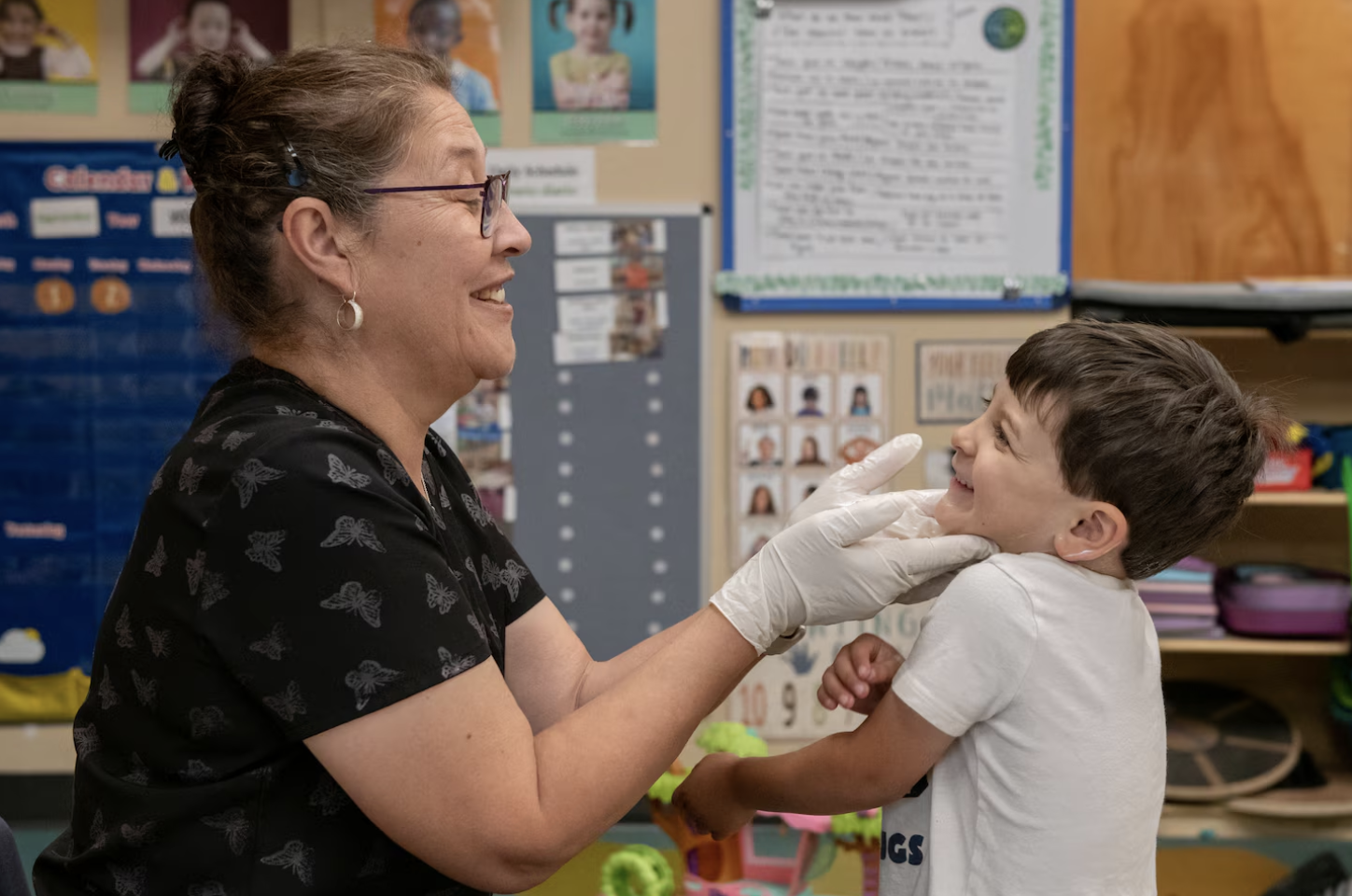
    Maria Chavira, a substitute teacher at the El Nidito child care program in Fort Collins, puts sunscreen on a preschool student before they go outside. (Rachel Woolf for Chalkbeat)

    During breakfast, two boys held bananas up to their ears like phones.

    “Ring, ring, ring. Hi, Henry,” one said as the other burst out laughing.

    Nearby at the sensory table, as one little boy poured dried pinto beans through a cardboard tube, he said, “Did you ever watch ‘Boss Baby?’ The baby is a bossssss. Babies can’t be bosses!”

    Meanwhile, the little boy who’d struggled to leave his mother was getting braver, slowly testing the waters of group play. One minute he crouched next to a little girl in front of a tree house play set. Later, he tried out bear and leopard hand puppets as the Boss Baby skeptic threw Tucker the Turtle up in the air next to him.

    Johnson, who switched from a sales and marketing career to early childhood education in 2007, seems to have a sixth sense for detecting imminent meltdowns, skirmishes, and rule-bending.

    She quickly peeled away from a conversation with a visitor when a little girl dressed in head-to-toe pink accidentally got a squiggle of red marker on her new cowboy boots.

    “Your mom can get that out. The markers are washable,” Johnson said as tears welled in the preschooler’s eyes.

    Then she averted the crisis with five words: “Do you want a hug?”

    Chalkbeat is a nonprofit news site covering educational change in public schools.


    Get stories like these delivered straight to your inbox. Sign up for The 74 Newsletter

    Source link

  • Colorado reversal on misgendering ban is a crisis averted but a danger revealed

    Colorado reversal on misgendering ban is a crisis averted but a danger revealed

    Colorado just dodged a constitutional bullet. Not a legislative win so much as a near-miss.

    The Kelly Loving Act, named after a trans person killed in the Club Q mass shooting in Colorado Springs in 2022, started out as a sweeping and constitutionally suspect bill aimed at protecting transgender individuals from discrimination, but trampling the First Amendment in the process.

    The bill would have classified misgendering and deadnaming in certain contexts as unlawful under the Colorado Anti-Discrimination Act. Its most controversial provision said that if a parent doesn’t use their child’s preferred pronouns, that must be considered “coercive control” in any custody dispute. This would have negatively impacted a parent’s case for custody of their child, regardless of any other context.

    The original bill would have also required parents, journalists, business owners, and educators to use people’s chosen names and pronouns in every piece of public-facing content, from news articles to school newsletters.

    But the Constitution protects the right to call others by any name or pronoun under the sun, even if it causes hurt or offense. Forcing people to use particular language, even with the intention of inclusivity, is compelled speech, and the First Amendment generally forbids it.

    The test of a free society is not how well it protects popular speech, but how well it protects speech that others find uncomfortable or even offensive.

    This important principle also protects the rights of people in states whose government officials would seek to require that people be deadnamed and misgendered, or prohibit other expression in support of trans or queer causes. The First Amendment blocks that kind of speech restriction as well.

    Of course, any speech, including declining to use a child’s preferred pronouns, can be part of a broader pattern of abuse that would be appropriate to consider in decisions about the custody of children. The problem was that the bill automatically counted this speech as a legal mark against parents, regardless of any further context. This served to effectively force all parents to adopt the state’s preferred speech, lest they one day face a custody battle and risk losing their children because of it.

    Another concern was that the Kelly Loving Act included “pre-publication requests” for publishers to use preferred names and pronouns, signaling that the law may be used against journalists simply for quoting a legal name in a criminal proceeding or publishing information already in the public domain that contradicts someone’s preferences or identity. This raised serious concerns that the law could chill legitimate journalistic expression and infringe on press freedoms protected by the First Amendment.

    Thankfully, its sponsors stripped all three provisions — misgendering, deadnaming, custody — out before the state senate approved the bill this week.

    Colorado’s lawmakers did the right thing by cutting these provisions. But we should still reflect on what happened because while the final bill is harmless, the impulse behind it is not.

    There are those in America who believe the state should address speech they oppose by compelling citizens to use approved words, or forbidding them from using disapproved words. This goes beyond political correctness to coercive control, to use a familiar term.

    The right is no stranger to this kind of behavior either. Florida’s Stop WOKE Act, which aims to control what can or cannot be said about race and gender in classrooms and workplaces under the guise of anti-discrimination law, is no better. After FIRE filed a lawsuit challenging the law, a federal court halted enforcement of key parts of it.

    If you think it’s dangerous for Florida’s legislators to have the power to police speech in public school classrooms, then you should find it equally outrageous for Colorado legislators to try to mandate what pronouns parents can use with their own children in their own homes or journalists can use when reporting stories.

    When a state starts dictating which words are acceptable in public discourse and private discussion, it jumps headlong into the culture wars, telling everyone to fall in line or face the consequences.

    Sadly, this is nothing new. Milton, Locke, and Voltaire all warned against the dangers of governments trying to manage thought. In Areopagitica, Milton argued for the liberty to know and argue freely “above all liberties.” In our wisdom, we Americans took note and enshrined this liberty in our First Amendment, understanding it is the one that protects the rest.

    In A Letter Concerning Toleration, Locke eloquently wrote “the care of souls is not committed to the civil magistrate, any more than to other men.” In other words, the state has no business telling you what to think or say any more than your fellow citizens.

    That is not how a free society operates, and that is why in West Virginia v. Barnette, the Supreme Court famously struck down a rule requiring students to salute the flag. In the words of Justice Robert H. Jackson, “If there is any fixed star in our constitutional constellation, it is that no official, high or petty, can prescribe what shall be orthodox in politics, nationalism, religion, or other matters of opinion.”

    Thankfully, we live in a country where the government doesn’t get to tell you what you have to say or what you must believe. The test of a free society is not how well it protects popular speech, but how well it protects speech that others find uncomfortable or even offensive.

    The revisions to this bill should be counted as a victory for the good people of Colorado. But we should also be concerned this was such a close shave in the first place because it indicates a dangerous impulse lurking in our culture. If people want to lead on inclusion, they must do so by persuasion, not coercion.

    Source link

  • Colorado School Attendance Zones Keep Racial, Socioeconomic Segregation Going – The 74

    Colorado School Attendance Zones Keep Racial, Socioeconomic Segregation Going – The 74


    Get stories like this delivered straight to your inbox. Sign up for The 74 Newsletter

    Colorado school districts should revise their school attendance zones at least every four years with a “civil rights focus.” State lawmakers should increase funding to transport students to and from school. And attorneys, advocates, and community organizations should embrace the right to sue over school assignments that increase racial segregation.

    Those are among the recommendations in a new report from the Colorado Advisory Committee to the U.S. Commission on Civil Rights. “Examining the Racial Impact of Public School Attendance Zones in Colorado” concludes that the way Colorado draws school attendance boundaries and assigns students to schools mirrors segregated housing patterns and results in low-income families having less access to high-quality schools.

    “This segregation fuels a widespread belief that schools serving predominantly white and affluent students are inherently better than those serving predominantly students of color or low-income families,” an accompanying policy brief said.

    Other reports from local and national think tanks and advocacy organizations have reached similar conclusions. While some local school officials, such as the Denver school board, have talked about possible solutions, the federal Trump administration has framed efforts to increase racial diversity in schools as discrimination that could trigger civil rights investigations.

    The Colorado Advisory Committee is a 10-person group of bipartisan appointed volunteers. Each state has an advisory committee that produces reports on civil rights issues ranging from housing discrimination to voting rights to the use of excessive force by police officers.

    In its latest report, the Colorado committee found that “thousands — perhaps tens of thousands — of Colorado students are likely to be assigned to schools in violation” of a federal law that says assigning a student to a school outside their neighborhood is unlawful “if it has segregating effects.”

    The committee’s recommended solutions attempt to balance strong support for neighborhood schools with allowing families to choose the best school for their child. School choice, or the ability for a student to apply to attend any public school, is enshrined in state law.

    The committee advocated for what it called “controlled choice,” which it said could mean that popular schools reserve seats for students who live outside the neighborhood or that schools give priority admission to non-neighborhood students who live the closest.

    To produce its report, the committee held hearings in 2023 to gather input from national experts including university professors, the author of a book on school attendance zones, and representatives from think tanks across the political spectrum.

    The committee also convened a group of 10 local experts including Brenda Dickhoner from the conservative advocacy organization Ready Colorado; Kathy Gebhardt, who was then a member of the Boulder Valley school board and now sits on the State Board of Education; former Aurora Public Schools superintendent Rico Munn; and Nicholas Martinez, a former teacher who heads the education reform organization Transform Education Now.

    The committee’s other recommendations include:

    • The civil rights divisions of the federal education and justice departments should review options for enforcing “the permissible and impermissible use of race in drawing attendance boundaries and setting school assignment policies.”
    • Colorado lawmakers should correct “the systemic racial and ethnic disparities” caused by the state’s school transportation system, which does not require school districts to provide transportation to students who use school choice.
    • State lawmakers should improve Colorado’s school choice system, including by adopting a uniform school enrollment window statewide and providing families with more information about schools’ discipline policies, class sizes, and other factors.
    • Colorado school districts should revise their school attendance zones and student assignment policies at least every four years and “consider racial and ethnic integration as part of the rezoning process.”

    “Redrawing school boundaries every few years can help prevent segregation from becoming entrenched while still allowing students to maintain a sense of stability in their educational environment,” the committee’s policy brief said.

    Chalkbeat is a nonprofit news site covering educational change in public schools.


    Get stories like these delivered straight to your inbox. Sign up for The 74 Newsletter

    Source link

  • High School Exit Exams Dwindle to About Half a Dozen States – The 74

    High School Exit Exams Dwindle to About Half a Dozen States – The 74


    Get stories like this delivered straight to your inbox. Sign up for The 74 Newsletter

    Jill Norton, an education policy adviser in Massachusetts, has a teenage son with dyslexia and ADHD. Shelley Scruggs, an electrical engineer in the same state, also has a teenage son with ADHD. Both students go to the same technical high school.

    But last fall, Norton and Scruggs advocated on opposite sides of a Massachusetts ballot referendum scrapping the requirement that high school kids pass a standardized state test to graduate.

    Norton argued that without the high bar of the standard exam, kids like hers won’t have an incentive to strive. But Scruggs maintained that kids with learning disorders also need different types of measurements than standardized tests to qualify for a high school diploma.

    Voters approved the referendum last November, 59% to 41%, ending the Massachusetts requirement. There and in most other states, Scruggs’ position against testing is carrying the day.

    Just seven states now require students to pass a test to graduate, and one of those — New York — will end its Regents Exam as a requirement by the 2027-28 school year. Florida, Louisiana, New Jersey, Ohio, Texas and Virginia still require testing to graduate, according to the National Center for Fair and Open Testing, a group that opposes such mandates.

    In Massachusetts, teachers unions favored getting rid of the exam as a graduation requirement. They argued it forced them to teach certain facts at the expense of in-depth or more practical learning. But many business leaders were in favor of keeping the test, arguing that without it, they will have no guarantee that job applicants with high school diplomas possess basic skills.

    State by state, graduation tests have tumbled over the past decade. In 2012, half the states required the tests, but that number fell to 13 states in 2019, according to Education Week. The trend accelerated during the pandemic, when many school districts scrapped the tests during remote learning and some decided to permanently extend test exemptions.

    Studies have found that such graduation exams disadvantage students with learning disabilities as well as English language learners, and that they aren’t always a good predictor of success in careers or higher education.

    An oft-cited 2010 article by researchers at the University of Texas at Austin may have ignited the trend to scrap the tests. Researchers’ review of 46 earlier studies found that high school exit exams “produced few of the expected benefits and have been associated with costs for the most disadvantaged students.”

    Some states began to find other ways to assess high school competency, such as grades in mandatory courses, capstone projects or technical milestones.

    “Minimum competency tests in the 1980s drove the idea that we need to make sure that students who graduate from high school have the bare minimum of skills,” said John Papay, an associate professor of education at Brown University. “By the mid-2000s, there was a reaction against standardized testing and a movement away from these exams. They disappeared during the pandemic and that led to these tests going away.”

    Despite the problems with the tests for English learners and students with learning disabilities, Papay said, the tests are “strong predictors of long-term outcomes. Students who do better on the tests go on to graduate [from] college and they earn more.”

    Papay, who remains neutral on whether the tests should be required, pointed out that high school students usually have many opportunities to retake the tests and to appeal their scores.

    Anne Hyslop, director of policy development at All4Ed, a think tank and advocacy group for underserved communities, noted that in many states, the testing requirements were replaced by other measures.

    The schools “still require some students or all students to demonstrate competency to graduate, but students have many more options on how they could do that. They can pass a dual credit [high school/college] course, pass industry recognized competency tests. …

    “A lot of states still have assessments as part of their graduation requirements, but in a much broader form,” she said.

    Massachusetts moves

    Scruggs said her son took Massachusetts’ required exam last spring; he passed the science and math portions but fell 1 point short in English.

    “He could do well in his classes, but if he didn’t pass the three tests, he wouldn’t get his regular diploma,” Scruggs said. “How do you go out into the working world, and you went to school every day and passed your classes, but got no diploma?”

    Her son has taken the English test again and is awaiting his new score, she said.

    Norton, by contrast, said the exam, called the Massachusetts Comprehensive Assessment System, or MCAS, gave her son an incentive to work hard.

    “I worry that kids like him … are going to end up graduating from high school without the skills they will need,” Norton said. “Without the test, they will just be passed along. I can’t just trust that my kid is getting the basic level of what he needs. I need a bar set where he will get the level of education he needs.”

    Students in Massachusetts still will have to take the MCAS in their sophomore year of high school, and the scores will be used to assess their overall learning. But failing the test won’t be a barrier to graduation beginning with the class of 2025. The state is still debating how — or whether — to replace the MCAS with other types of required courses, evaluations or measurements.

    High school students in Massachusetts and most states still have to satisfy other graduation requirements, which usually include four years of English and a number of other core subjects such as mathematics, sciences and social studies. Those requirements vary widely across the country, however, as most are set by individual school districts.

    In New York, the State Education Department in 2019 began a multiyear process of rethinking high school graduation requirements and the Regents Exam. The department decided last fall to phase out the exit exam and replace it with something called a “Portrait of a Graduate,” including seven areas of study in which a student must establish proficiency. Credit options include capstone projects, work-based learning experiences and internships, as well as academic achievement. Several other states have moved recently to a similar approach.

    Harry Feder, executive director of FairTest, an advocacy group that works to limit standardized testing, said course grades do a better job of assessing students’ abilities.

    “Standardized tests are poor ways of incentivizing and measuring the kinds of skills and knowledge we should have high school kids focusing on,” Feder said. “You get ‘teaching to the test’ that doesn’t bear much of a relationship to the kinds of things that kids are being asked to do when they go on to college or the workplace.”

    Max Page, president of the Massachusetts Teachers Association union, said phrases such as “teaching to the test” disrespect teachers and their ability to know when students have mastered content and competency. The high school tests are first taken in the 10th grade in Massachusetts. If the kids don’t pass, they can retake the exam in the 11th or 12th grade.

    “Educators are still evaluating students,” he said. “It’s a mirage to say that everything that a student does in education can be measured by a standardized test in the 10th grade. Education, of course, goes through the 12th grade.”

    He added that course grades are still a good predictor of how much a student knows.

    Colorado’s menu

    Several of the experts and groups on both sides of the debate point to Colorado as a blueprint for how to move away from graduation test requirements.

    Colorado, which made the switch with the graduating class of 2021, now allows school districts to choose from a menu of assessment techniques, such as SAT or ACT scores, or demonstration of workforce readiness in various skill areas.

    A state task force created by the legislature recently recommended some changes to the education accreditation system to “better reflect diverse student needs and smaller school populations.” They include creating assessments that adapt to student needs, offering multilingual options, and providing quicker results to understand student progress.

    The state hopes the menu of assessment options will support local flexibility, said Danielle Ongart, assistant commissioner for student pathways and engagement at the Colorado Department of Education.

    “Depending on what the student wants for themselves, they have the ability to show what they know,” she said in an interview. In particular, she said, the menu allows for industry certificates, if a student knows what type of work they want to do. That includes areas such as computer science or quantum computing.

    “It allows students to better understand themselves and explain what they can do, what they are good at, and what they want to do,” she said.

    Stateline is part of States Newsroom, a nonprofit news network supported by grants and a coalition of donors as a 501c(3) public charity. Stateline maintains editorial independence. Contact Editor Scott S. Greenberger for questions: [email protected].


    Get stories like these delivered straight to your inbox. Sign up for The 74 Newsletter

    Source link