Tag: Columbia

  • Columbia Settles With Trump Administration

    Columbia Settles With Trump Administration

    Columbia University has agreed to a $200 million settlement with the federal government after months of scrutiny over how it handled pro-Palestinian student protests and campus antisemitism.

    The long-rumored deal was announced by acting president Claire Shipman Wednesday night.

    “This agreement marks an important step forward after a period of sustained federal scrutiny and institutional uncertainty,” Shipman said. “The settlement was carefully crafted to protect the values that define us and allow our essential research partnership with the federal government to get back on track. Importantly, it safeguards our independence, a critical condition for academic excellence and scholarly exploration, work that is vital to the public interest.”

    Columbia will also pay another $21 million to settle investigations by the U.S. Equal Employment Opportunity Commission. The university also agreed to codify reforms it announced in March that include overhauling disciplinary processes and appointing a new senior vice provost to oversee academic programs focused on the Middle East, among other changes.

    The university will pay out the settlement over three years.

    The settlement is intended to bring an end to months of scrutiny by the Trump administration and restore hundreds of millions of dollars in frozen federal research funding. Access to “billions of dollars in current and future grants” will also be restored, according to the university statement.

    Board members emphasized the university’s commitment to academic freedom in a statement.

    “Today’s agreement with the federal government affirms Columbia’s unyielding commitment to academic freedom, freedom of expression, and open inquiry. It confirms the changes already underway at Columbia to meaningfully address antisemitism on our campus and allows the University to continue to undertake its transformative research and scholarship,” Columbia Board of Trustees co-chairs David Greenwald and Jeh Johnson said Wednesday night.

    News of the deal came one day after Columbia announced that it had disciplined numerous pro-Palestinian protesters for disruptive activities in spring 2024 and in May of this year. Though the university did not specify how many students were disciplined, the student activist group CU Apartheid Divest alleged that as many as 80 were suspended or expelled.

    Columbia’s settlement prompted strong reactions from academics on social media.

    “It is heartbreaking to see Columbia capitulating to the Trump Administration’s attacks on higher education and democracy,” Columbia professor Alex Hertel-Fernandez wrote in a post on Bluesky. “Not only does this legitimize the offensive against civil society and pressure other universities to fold, but it feels like madness to trust the Administration to keep a deal.”

    Columbia lecturer Scott Horton called the move “a total betrayal” by administrators in a social media post calling for the removal of Shipman and Greenwald over the settlement.

    The AAUP took aim at the Trump administration.

    “You can never bend the knee enough to appease an authoritarian bully,” the organization posted on Bluesky. “This is a devastating blow to academic freedom & freedom of speech at Columbia. Never in the history of this nation has there been an administration so intent on the utter destruction of higher education as we know it.”

    Trump administration officials, however, celebrated the news.

    “Columbia’s reforms are a roadmap for elite universities that wish to regain the confidence of the American public by renewing their commitment to truth-seeking, merit, and civil debate. I believe they will ripple across the higher education sector and change the course of campus culture for years to come,” Education Secretary Linda McMahon said in a statement about the settlement.

    Source link

  • Columbia Expels, Suspends Student Protesters

    Columbia Expels, Suspends Student Protesters

    Columbia University expelled and suspended multiple students for participating in allegedly disruptive protest activity in spring 2024 and earlier this year it announced on Tuesday.

    Officials made the decision on Monday, according to the university statement, saying the action is the “final set of findings” by the University Judicial Board (UJB) related to protests “from that period.”

    Sanctions passed down from Columbia relate to a pro-Palestinian protest encampment last spring and a May takeover of a room in the Butler Library, according to the university statement. Columbia responded to that incident by placing 71 students on interim suspension in May.

    “The sanctions issued on July 21 by the University Judicial Board were determined by a UJB panel of professors and administrators who worked diligently over the summer to offer an outcome for each individual based on the findings of their case and prior disciplinary outcomes,” Columbia officials wrote in an unsigned statement. “While the University does not release individual disciplinary results of any student, the sanctions from Butler Library include probation, suspensions (ranging from one year to three years), degree revocations, and expulsions.”

    Officials added that “disruptions to academic activities” are a violation of university policies.

    Though Columbia did not specify how many students were disciplined, the pro-Palestinian student group CU Apartheid Divest alleged that as many as 80 were expelled or suspended. According to CU Apartheid Divest, disciplinary letters sent to suspended students require them to submit apologies in order to return to campus in one to three years.

    Student protesters accused officials of punishing students as a concession to the Trump administration, which froze hundreds of millions of dollars in federal research funding due to alleged antisemitism at Columbia tied to pro-Palestinian protests.

    “The sanctions are believed to be part of a federal deal Columbia is about to announce,” the group wrote in a social media post.

    Earlier this year Columbia agreed to broad demands by the federal government, including overhauling disciplinary processes. However the $400 million in frozen federal funds have not yet been restored despite those concessions.

    Multiple media outlets have reported that Columbia is nearing a deal with the Trump administration to resolve complaints of antisemitism on campus. The Wall Street Journal reported that while a potential deal would likely restore federal research funds, it would also cost the university $200 million in a settlement fee.

    Columbia did not respond to a request for comment from Inside Higher Ed.

    University disciplinary efforts drew a tepid response from the House Education and Workforce Committee which issued a statement from Chairman Tim Walberg, a Michigan Republican.

    “Columbia has more progress to make before Jewish students can truly feel safe on its campus,” he said. “The Committee’s work has underscored the depth and breadth of antisemitism at Columbia that can’t be ignored. We will continue to investigate antisemitism at Columbia and other universities and develop legislative solutions to address this persistent problem.”

    While Columbia reportedly considers a deal with the Trump administration, Ivy League peer Harvard University has started a court battle to regain billions in federal research funding.

    It also sued the government for attempting to block it from enrolling international students. A federal court temporarily blocked the Trump administration from choking off Harvard’s international enrollment, and the same federal judge has not yet ruled on the legality of the government’s freezing of Harvard’s grants and contracts.

    However, the judge appeared skeptical of the government’s position at Monday’s hearing.

    Source link

  • Columbia University formally adopts controversial antisemitism definition

    Columbia University formally adopts controversial antisemitism definition

    Dive Brief:

    • Columbia University’s Office of Institutional Equity plans to formally use a controversial definition of antisemitism when conducting its work, Acting President Claire Shipman said in a message this week. 
    • The Ivy League institution will embrace the International Holocaust Remembrance Alliance’s working definition of antisemitism when investigating discrimination on campus, joining other well-known colleges like New York University and Harvard University. However, critics of the definition say it undermines free speech by potentially chilling and punishing criticism of Israel. 
    • The news comes as Columbia reportedly nears an agreement with the Trump administration to reinstate some of its $400 million in suspended federal funding. 

    Dive Insight: 

    The Trump administration froze the funding earlier this year over claims that Columbia hasn’t done enough to protect Jewish students from antisemitism. And in May, the U.S. Department of Health and Human Services determined that the university violated Title VI by being deliberately indifferent to “student-on-student harassment of Jewish students.” 

    Title VI prohibits federally funded institutions from discriminating on the basis of race, color or national origin. 

    Under a potential deal between Columbia and the federal government, the university would potentially pay some $200 million for alleged civil rights violations and add more transparency around the foreign gifts it receives, anonymous sources told The New York Times last week. 

    In return, the Trump administration would return some of the $400 million in federal funding it suspended earlier this year over allegations that the university hadn’t done enough to protect Jewish students from harassment.

    Shipman referenced Columbia’s ongoing negotiations with the Trump administration in her message Tuesday. 

    The fact that we’ve faced pressure from the government does not make the problems on our campuses any less real; a significant part of our community has been deeply affected in negative ways,” Shipman said. “In my view, any government agreement we reach is only a starting point for change. Committing to reform on our own is a more powerful path.”

    Having the university’s Office of Institutional Equity adopt the IHRA definition is one of several steps Columbia is taking to address harassment and discrimination, she said. 

    “Formally adding the consideration of the IHRA definition into our existing anti-discrimination policies strengthens our approach to combating antisemitism,” Shipman said. 

    IHRA’s definition of antisemitism says that “criticism of Israel similar to that leveled against any other country cannot be regarded as antisemitic.” However, free speech and civil rights groups have raised alarms over some of the definition’s examples of possible antisemitism. 

    Those include “drawing comparisons of contemporary Israeli policy to that of the Nazisand “claiming that the existence of a State of Israel is a racist endeavor.”

    Kenneth Stern, the lead drafter of the definition, has frequently spoken out against using the definition to enforce antidiscriminations laws on campus. He noted that it was developed to help European data collectors monitor antisemitism and has argued the definition could be misapplied to restrict classroom instruction and discussion, including on works critical of Zionism. 

    Stern, who heads Bard College’s Center for the Study of Hate, also opposed the federal government’s adoption of the definition in 2019, when President Donald Trump signed an executive order directing federal agencies to consider it when enforcing Title VI.

    Columbia’s new adoption of the definition has sparked outcry, including from the university’s Knight First Amendment Institute, which aims to defend free speech through research, advocacy and litigation. 

    Restricting criticism of Israel and its policies, including by faculty and students directly affected by those policies, universities compromise the values they should be defendingfree speech, free inquiry, and equality as well,” Jameel Jaffer, executive director of the institute, said in a statement Wednesday. 

    Shipman also said university officials will not meet with or recognize Columbia University Apartheid Divest, a coalition of student groups that has called on the institution to cut ties with Israel and organized the protest encampment last year. 

    Organizations that promote violence or encourage disruptions of our academic mission are not welcome on our campuses and the University will not engage with them,” Shipman said. 

    CUAD slammed Columbia on social media Thursday. 

    “Columbia didn’t ‘capitulate’ to the Trump administration’s Title VI threats — it welcomed the excuse,” the group said. “The university has long sought to implement IHRA and crack down on Palestine solidarity. Federal pressure just gave them the cover to do what they already wanted.”

    Source link

  • Columbia “Incorporating” IHRA Antisemitism Definition

    Columbia “Incorporating” IHRA Antisemitism Definition

    Columbia University’s acting president says the institution is incorporating the controversial International Holocaust Remembrance Alliance definition of antisemitism into the Office of Institutional Equity’s work. That office investigates discrimination complaints against students and employees.

    “Formally adding the consideration of the IHRA definition into our existing anti-discrimination policies strengthens our approach to combating antisemitism,” Claire Shipman said in a statement Tuesday announcing “additional commitments to combatting antisemitism.”

    The IHRA, which calls its definition a “working definition,” says antisemitism “might include the targeting of the state of Israel, conceived as a Jewish collectivity. However, criticism of Israel similar to that leveled against any other country cannot be regarded as antisemitic.”

    It also says antisemitism might include “comparisons of contemporary Israeli policy to that of the Nazis” or “claiming that the existence of a State of Israel is a racist endeavor.”

    Columbia’s leaders, like those at Harvard University, have been negotiating with the Trump administration to restore funding the federal government said it froze over alleged campus antisemitism. Harvard announced in January that it would start using the IHRA definition when evaluating complaints of antisemitic harassment or discrimination—before its public war with the Trump administration began.

    In a statement, Afaf Nasher, executive director of the Council on American-Islamic Relations’ New York chapter, called Columbia’s move “an attack on free speech” and a “shameless weaponization of antisemitism in order to stifle the ability of students to speak out against the ongoing genocide of Palestinians by the Israeli government.”

    Shipman also announced that Columbia would not “recognize or meet with the group that calls itself ‘Columbia University Apartheid Divest’ (CUAD), its representatives, or any of its affiliated organizations. Organizations that promote violence or encourage disruptions of our academic mission are not welcome on our campuses and the University will not engage with them.”

    Source link

  • Lawmakers Confront Columbia President About Old Messages

    Lawmakers Confront Columbia President About Old Messages

    Claire Shipman, acting president of Columbia University, apologized Wednesday for writing messages in 2023 and 2024 that House Republicans say “appear to downplay and even mock the pervasive culture of antisemitism on Columbia’s campus,” Jewish Insider reported

    “The things I said in a moment of frustration and stress were wrong. They do not reflect how I feel,” Shipman wrote in a private email the outlet obtained Wednesday. Shipman said she was addressing “some trusted groups of friends and colleagues, with whom I’ve talked regularly over the last few months.” 

    The apology comes one day after the House Committee on Education and Workforce sent Shipman a letter asking her to explain the intent of internal messages she wrote about antisemitism on the Manhattan campus following the start of Israel’s war in Gaza and the Oct. 7, 2023, Hamas attack. During the time frame in question, Shipman, who became acting president in March, was co-chair of the university’s Board of Trustees. 

    In its letter, the committee, which has subpoenaed numerous documents related to antisemitism at Columbia, cited a message Shipman wrote to now-resigned president Minouche Shafik on Oct. 20, 2023, that said, “People are really frustrated and scared about antisemitism on our campus and they feel somehow betrayed by it. Which is not necessarily a rational feeling but it’s deep and it is quite threatening.” The committee told Shipman her statement was “perplexing, considering the violence and harassment against Jewish and Israeli students already occurring on Columbia’s campus at the time.” 

    The committee, which has already compelled Columbia and numerous other universities to testify about their responses to campus antisemitism, also cited in its letter several messages from Shipman that convey alleged “distrust and dislike” for Shoshana Shendelman, a Jewish member of the university’s board who has been outspoken about perceived inadequacies of Columbia’s antisemitism response. “I just don’t think she should be on the board,” Shipman said in a January 2024 message. In April 2024, Shipman wrote that she was “so, so tired” of Shendelman. 

    In addition to ongoing scrutiny from Republican members of Congress, the Trump administration has attacked Columbia for months, accusing the university of not protecting Jewish students sufficiently and cutting off more than $400 million in federal funds. Although Columbia agreed to the administration’s demands, including overhauling disciplinary processes, Trump hasn’t yet restored the university’s funding. Instead, the Education Department reported Columbia to its accreditor, which has since issued a warning to the university.

    Source link

  • Columbia University Settles Class Action Lawsuit Over Inflated Rankings Data for $9 Million

    Columbia University Settles Class Action Lawsuit Over Inflated Rankings Data for $9 Million

    Columbia University has reached a $9 million settlement agreement with undergraduate students who alleged the institution deliberately submitted false information to U.S. News & World Report to artificially boost its college rankings position.

    The preliminary settlement, filed last Monday in Manhattan federal court and pending judicial approval, resolves claims that Columbia misrepresented key data points to enhance its standing in the influential annual rankings. The university reached as high as No. 2 in the undergraduate rankings in 2022 before the alleged misconduct came to light.

    Students alleged that Columbia consistently provided inaccurate data to U.S. News, including the false claim that 83% of its classes contained fewer than 20 students. The lawsuit argued these misrepresentations were designed to improve the university’s ranking position and, consequently, attract more students willing to pay premium tuition rates.

    The settlement covers approximately 22,000 undergraduate students who attended Columbia College, the Fu Foundation School of Engineering and Applied Science, and the School of General Studies between fall 2016 and spring 2022.

    The controversy began in July 2022 when Columbia mathematics professor Dr. Michael Thaddeus published a detailed analysis questioning the accuracy of data underlying the university’s No. 2 ranking. His report alleged that much of the information Columbia provided to U.S. News was either inaccurate or misleading.

    Following the publication of Thaddeus’s findings, Columbia’s ranking plummeted to No. 18 in September 2022. The dramatic drop highlighted the significant impact that data accuracy has on institutional rankings and reputation.

    In response to the allegations, Columbia announced in June 2023 that its undergraduate programs would withdraw from participating in U.S. News rankings altogether. The university cited concerns about the “outsized influence” these rankings have on prospective students’ decision-making processes.

    “Much is lost when we attempt to distill the quality and nuance of an education from a series of data points,” Columbia stated in explaining its decision to withdraw from the rankings process.

    While denying wrongdoing in the settlement agreement, Columbia acknowledged past deficiencies in its reporting practices. The university stated it “deeply regrets deficiencies in prior reporting” and has implemented new measures to ensure data accuracy.

    Columbia now provides prospective students with information that has been reviewed by an independent advisory firm, demonstrating the institution’s commitment to transparency and accurate representation of its educational offerings.

    Columbia’s decision to withdraw from U.S. News rankings reflects a growing skepticism among elite institutions about the value and impact of college ranking systems. Harvard and Yale have also stopped submitting data to U.S. News for various programs, signaling a potential shift in how prestigious universities approach rankings participation.

    Under the terms of the agreement, student attorneys plan to seek up to one-third of the settlement amount for legal fees, which would leave approximately $6 million available for distribution among affected students. The settlement requires approval from a federal judge before taking effect.

    Student lawyers characterized the accord as “fair, reasonable and adequate” given the circumstances of the case and the challenges inherent in proving damages from ranking manipulation.

    Source link

  • ED Pressures Accreditor to Act on Columbia

    ED Pressures Accreditor to Act on Columbia

    The Department of Education has publicly called on Columbia University’s accreditor, the Middle States Commission on Higher Education, to take action against the university’s alleged noncompliance with federal nondiscrimination laws.

    In a Wednesday news release, officials wrote that Columbia was found to have acted “with deliberate indifference towards the harassment of Jewish students, thereby violating Title VI of the Civil Rights Act of 1964.” Officials said, “Columbia failed to meaningfully protect Jewish students against severe and pervasive harassment on Columbia’s campus and consequently denied these students’ equal access to educational opportunities to which they are entitled under the law.” As a result of that finding, ED called on MSCHE to take action on the matter.

    Education Secretary Linda McMahon accused the university of failing to protect Jewish students on campus in the wake of Hamas’s Oct. 7 terrorist attacks against Israel, arguing that such a lapse “is not only immoral, but also unlawful.”

    McMahon added that accreditors are obligated to ensure members abide by their standards and called on MSCHE to inform the department of compliance actions taken against Columbia. ED indicated that MSCHE should require Columbia to develop a plan to ensure compliance.

    “We are aware of the press release issued today by the United States Department of Education (USDE) regarding Columbia University and can confirm that we received a letter regarding this matter this afternoon,” MSCHE president Heather Perfetti said in a statement. “This letter is part of the commitment reflected within the Executive Order to promptly provide to accreditors any noncompliance findings relating to member institutions issued after an investigation conducted by the Office of [sic] Civil Rights. Consistent with our Commission’s management of investigative findings, we will process these in accordance with our policies and procedures.”

    The call for MSCHE to take action on Columbia is the latest effort by the Trump administration to force further changes at an institution that has been in its crosshairs over how it handled a pro-Palestinian student encampment and related demonstrations in the aftermath of Oct. 7.

    Columbia has already yielded to the Trump administration’s call for sweeping changes, agreeing in March to revise disciplinary processes, hire campus police officers with the authority to make arrests and appoint a new senior vice provost to oversee academic programs focused on the Middle East, among other changes—despite concerns around academic freedom. However, university officials appear to have rejected the administration’s desire for a consent decree.

    The Trump administration has also frozen hundreds of millions of dollars in federal research funding, an effort that has continued even after university officials agreed to various demands.

    Columbia officials acknowledged the exchange between ED and MSCHE in a statement.

    “Columbia is aware of the concerns raised by the U.S. Department of Education’s Office for Civil Rights today to our accreditor, the Middle States Commission on Higher Education, and we have addressed those concerns directly with Middle States. Columbia is deeply committed to combatting antisemitism on our campus. We take this issue seriously and are continuing to work with the federal government to address it,” university officials wrote in a statement posted online.

    Wednesday’s news sparked confusion (and celebrations from some critics) online, as many social media users incorrectly interpreted the news to mean Columbia had lost accreditation. However, the federal government does not have the power to strip accreditation. Only accreditors can determine if universities are out of compliance, as experts have previously noted.

    (This article has been updated to add statements from MSCHE and Columbia.)

    Source link

  • Pro-Palestinian Protesters Arrested at Columbia, UW, Beyond

    Pro-Palestinian Protesters Arrested at Columbia, UW, Beyond

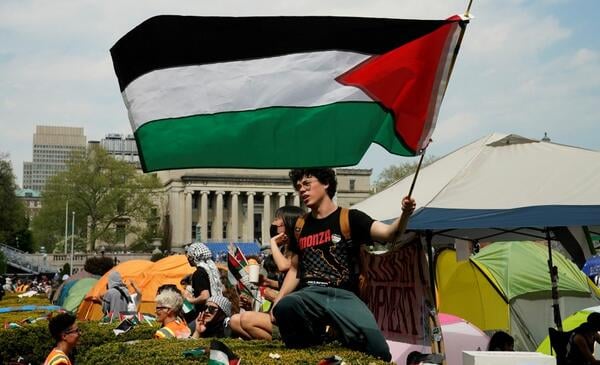
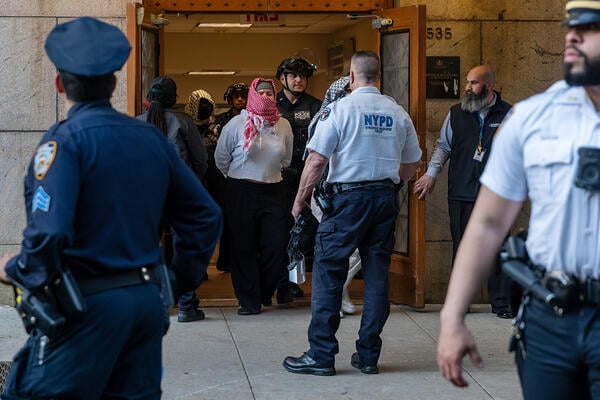
    About 80 pro-Palestinian protesters were arrested at Columbia University Wednesday as they occupied a reading room in the campus’s library, The New York Times and other sources reported.

    The arrests come just over a year after protesters at Columbia occupied Hamilton Hall, an academic building, as part of a massive protest movement that inspired other student demonstrations nationwide but drew ire from Republicans and pro-Israel groups, who argued that the protesters’ chants and signs were antisemitic.

    Columbia isn’t the only campus where protesters are seeking to revitalize the movement as the spring semester winds down. Though their numbers are nowhere near the hundreds that erupted last spring, pro-Palestinian protests have sprung up on several campuses in recent weeks—in some cases honoring the anniversary of last year’s demonstrations or calling for charges against student demonstrators to be dropped.

    “In light of all of the repression that the student movement for Palestine faced in the wake of the encampment last year, it’s important for us to insist on our demands, which have not changed,” a spokesperson for the University of North Carolina at Chapel Hill chapter of Students for Justice in Palestine told The News & Observer regarding a daylong demonstration held at the end of April.

    Ultimately, it seems that most protesters are asking for the same thing they demanded a year ago: for their institutions to divest from companies with ties to Israel. Only an extremely small number of colleges has done so, but that hasn’t deterred students from trying.

    The protests also come amid President Donald Trump’s ongoing attacks on institutions that he believes failed to protect Jewish students during last year’s demonstrations. So far, his administration has frozen billions in federal funding to Columbia and other institutions, and taken steps to deport international students who participated in the protests.

    UW and Columbia

    Columbia students weren’t alone in taking over a campus building in recent weeks. About 75 protesters at the University of Washington occupied a new engineering building, barricading the doors and starting fires in nearby dumpsters Monday night, The Seattle Times reported. The organizers, part of a group called Students United for Palestinian Equality and Return UW, told the paper they wanted to “repurpose a building that is meant to make weapons of war to a place that serves the needs of students and workers and staff at the University of Washington.”

    Three law enforcement agencies were called in to disband the protest; 31 people were arrested.

    Administrators at both Columbia and UW have issued statements condemning the protests on their respective campuses. UW president Ana Mari Cauce called the demonstration “dangerous, violent and illegal building occupation and related vandalism.” She condemned statements by the group celebrating Hamas’s deadly Oct. 7 attack on Israeli civilians, saying the institution would “continue our actions to oppose antisemitism, racism and all forms of biases.”

    In a lengthy message to the Columbia campus, Claire Shipman, the recently installed acting president, called the Wednesday protest “utterly unacceptable.”

    “Let me be clear: Columbia unequivocally rejects antisemitism and all other forms of harassment and discrimination. And we certainly reject a group of students—and we don’t yet know whether there were outsiders involved—closing down a library in the middle of the week before finals and forcing 900 students out of their study spaces, many leaving belongings behind. Our commitment to a safe, inclusive, and respectful campus community is unshakeable, and we will continue to act decisively to uphold these values,” she wrote.

    Both presidents said they attempted to resolve the situation peacefully before sending in police.

    Shipman’s statement earned her the praise from members of the Trump administration’s Task Force to Combat Anti-Semitism, who said in a statement that they are “confident that Columbia will take the appropriate disciplinary actions for those involved in this act.”

    At the same time, the same task force announced it would launch a review of the protest at UW.

    “The Task Force to Combat Anti-Semitism appreciates the university’s strong statement condemning last night’s violence and applauds the quick action by law enforcement officers to remove violent criminals from the university campus,” the task force said in a press release. “While these are good first steps, the university must do more to deter future violence and guarantee that Jewish students have a safe and productive learning environment. The Task Force expects the institution to follow up with enforcement actions and policy changes that are clearly necessary to prevent these uprisings moving forward.”

    Arrests Elsewhere

    In recent weeks, pro-Palestinian protesters have also been arrested at Swarthmore College, Rutgers University, Virginia Commonwealth University and the University of California, Los Angeles.

    At Swarthmore, protesters erected an encampment on Trotter Lawn, a central campus green, on April 30, demanding divestment and the protection of students from the Trump administration. The university began issuing interim suspensions the next day. On May 3, police were called in to tear down the encampment, according to a statement by college president Val Smith. Police arrested nine individuals, including one current and one former student.

    The Rutgers protest, held on April 29, was arranged to oppose an appearance by U.S. Rep. Josh Gottheimer of New Jersey, an Israel supporter who participated in a roundtable on antisemitism at the university’s Hillel. Though they were protesting in a designated area near the Hillel, four individuals—three of them Rutgers students—were charged with rioting after they stepped out of the area, blocking a public sidewalk, according to MyCentralJersey.com.

    At VCU, one person was arrested April 29 during a gathering to commemorate a clash between protesters and police on campus the previous year. A student organizer with the campus’s Students for Justice in Palestine chapter said the event was not a protest. However, university police said it violated a policy that requires authorization for events where students hold signs or banners, The Progress-Index reported. Police asked the students to disperse and arrested one individual who held up a sign chastising police for pepper-spraying protesters last April.

    At UCLA, three individuals were arrested at an on-campus showing of The Encampments, a documentary on the pro-Palestinian encampments of spring 2024. According to the university, the event, which drew about 150 guests, was unauthorized because it was hosted by the campus’s SJP chapter, which was suspended in February. The university indicated that the three individuals were arrested for assaulting a police officer and assaulting and robbing a student.

    ‘Scared to Talk About It’

    Despite the recent increase in protests, the Trump administration’s actions—as well as the penalties levied on student protesters by many institutions over the past year—seem to have quieted some planned demonstrations this spring.

    Emory University was home to an explosive clash between protesters and police on April 25, 2024, which led to 28 arrests. But this year, according to The Emory Wheel, Emory’s student newspaper, only about 50 people showed up to an event commemorating that day.

    One faculty demonstrator told the Wheel that many students no longer felt comfortable protesting.

    “It’s clear that there’s just a lot of people who are afraid,” he said. “You don’t have to actually arrest people sometimes to suppress freedom of speech.”

    Student protesters at the University of Texas at Austin, the site of over 130 arrests in April 2024, expressed a similar sentiment during a protest marking the anniversary of those arrests. About 100 people showed up, according to the university’s student paper.

    “You don’t hear near as many people talking about the genocide that’s going on, even here at UT,” a student told The Daily Texan. “With the 100-plus arrests that [law enforcement] made, people are almost scared to talk about it or to do anything about it.”

    Source link

  • Columbia student Mohsen Mahdawi says "justice will prevail" after ICE release (CBS Mornings)

    Columbia student Mohsen Mahdawi says "justice will prevail" after ICE release (CBS Mornings)

    Columbia University student Mohsen Mahdawi spoke with CBS News in his first TV interview since his release from ICE custody. He spent 16 days in detention and now awaits deportation hearings for protesting the war in Gaza.
     

    Source link

  • Columbia Lays Off 180 Amid “Intense” Financial Strain

    Columbia Lays Off 180 Amid “Intense” Financial Strain

    Columbia University is laying off 180 researchers after the Trump administration cut the university’s research funding by more than $650 million.

    “Columbia’s leadership continues discussions with the federal government in support of resuming activity on these research awards and additional other awards that have remained active, but unpaid,” university leadership wrote in a memo Tuesday morning. “We are working on and planning for every eventuality, but the strain in the meantime, financially and on our research mission, is intense.”

    While federal agencies such as the National Institutes of Health, the National Science Foundation and the Department of Energy have cut research funding at universities across the country, the Trump administration has specifically targeted a handful of high-profile universities, including Columbia, for allegedly failing to curb antisemitism on campus. 

    Columbia is taking a two-pronged approach to navigating the sudden deep cuts to federal research funding. The first focuses on “continued efforts to restore our partnerships with government agencies that support critical research,” and the university said the second prong is about taking “action to adjust—and in some cases reduce—expenditures based on current financial realities.”

    Despite Columbia’s previous president acquiescing to Trump’s demands to enact numerous policy changes to address alleged unchecked antisemitism if it wanted its funding back, the university is still negotiating to recover it. In the meantime, the layoffs announced Tuesday represent about 20 percent of researchers who are funded “in some manner by the terminated grants,” according the statement signed by Claire Shipman, Columbia’s acting president; Angela V. Olinto, provost; Anne Sullivan, executive vice president for finance; and Jeannette Wing, executive vice president for research. 

    And the layoffs this week likely aren’t the end of the financial repercussions of the cuts to Columbia’s federal research funding. 

    “In the coming weeks and months, we will need to continue to take actions that preserve our financial flexibility and allow us to invest in areas that drive us forward,” the statement said. “This is a deeply challenging time across all higher education, and we are attempting to navigate through tremendous ambiguity with precision, which will be imperfect at times.”

    Source link