
Columbia University student Mohsen Mahdawi spoke with CBS News in his first TV interview since his release from ICE custody. He spent 16 days in detention and now awaits deportation hearings for protesting the war in Gaza.
Tag: Columbia
-
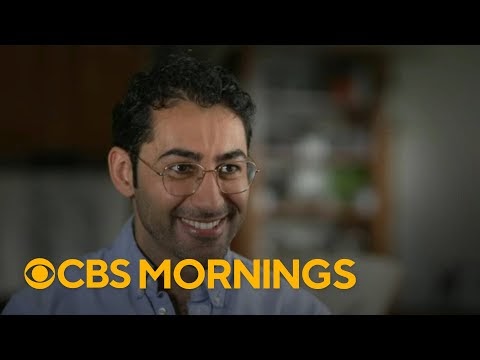
Columbia student Mohsen Mahdawi says "justice will prevail" after ICE release (CBS Mornings)
-

Columbia Lays Off 180 Amid “Intense” Financial Strain
Columbia University is laying off 180 researchers after the Trump administration cut the university’s research funding by more than $650 million.
“Columbia’s leadership continues discussions with the federal government in support of resuming activity on these research awards and additional other awards that have remained active, but unpaid,” university leadership wrote in a memo Tuesday morning. “We are working on and planning for every eventuality, but the strain in the meantime, financially and on our research mission, is intense.”
While federal agencies such as the National Institutes of Health, the National Science Foundation and the Department of Energy have cut research funding at universities across the country, the Trump administration has specifically targeted a handful of high-profile universities, including Columbia, for allegedly failing to curb antisemitism on campus.
Columbia is taking a two-pronged approach to navigating the sudden deep cuts to federal research funding. The first focuses on “continued efforts to restore our partnerships with government agencies that support critical research,” and the university said the second prong is about taking “action to adjust—and in some cases reduce—expenditures based on current financial realities.”
Despite Columbia’s previous president acquiescing to Trump’s demands to enact numerous policy changes to address alleged unchecked antisemitism if it wanted its funding back, the university is still negotiating to recover it. In the meantime, the layoffs announced Tuesday represent about 20 percent of researchers who are funded “in some manner by the terminated grants,” according the statement signed by Claire Shipman, Columbia’s acting president; Angela V. Olinto, provost; Anne Sullivan, executive vice president for finance; and Jeannette Wing, executive vice president for research.
And the layoffs this week likely aren’t the end of the financial repercussions of the cuts to Columbia’s federal research funding.
“In the coming weeks and months, we will need to continue to take actions that preserve our financial flexibility and allow us to invest in areas that drive us forward,” the statement said. “This is a deeply challenging time across all higher education, and we are attempting to navigate through tremendous ambiguity with precision, which will be imperfect at times.”
-
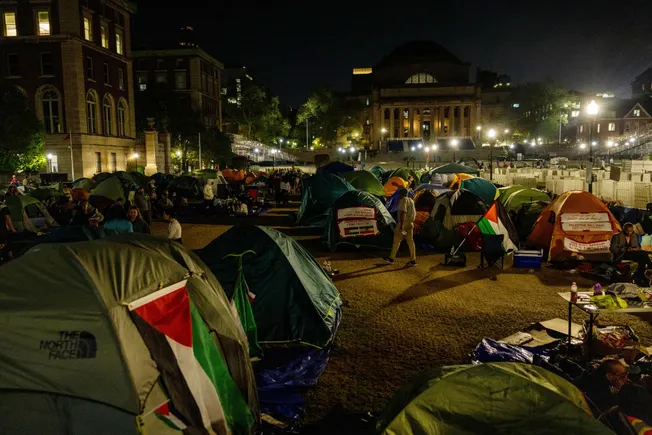
Columbia University vows to remove any future encampments
Columbia University officials said Wednesday they would immediately remove any future encampments on campus and threatened demonstrators with arrest amid reports that students were planning another wave of pro-Palestinian protests.
“We have been made aware of possible plans to establish encampments on Columbia’s campuses,” the New York institution said in a public safety notice. “We want to clearly communicate that camping and encampments on Columbia’s campuses are prohibited by University Policy.”
More than 100 people wearing masks to hide their identities met Tuesday to discuss establishing multiple encampments at Columbia this week, according to an NBC News report based on anonymous sources and a recording of the meeting.
At the time, the protesters intended to begin demonstrating at Columbia’s main campus in the Morningside Heights neighborhood on Thursday, followed by the Ivy League institution’s Manhattanville location on Friday, NBC reported Wednesday.
The planned demonstrations would come about a year after Columbia students first erected an encampment to protest the Israel-Hamas war and call on the university to divest from companies with links to Israel. The encampment at Columbia kicked off similar demonstrations across the nation’s colleges, stoking anger from conservative lawmakers and leading to hundreds of student arrests.
Since then, the university said it has hired more public safety officers, increased campus patrols and restricted access to its main campus.
Still, President Donald Trump threatened to pull federal funding from colleges that don’t crack down on “illegal protests” in a March social media post that drew backlash from free speech and civil rights advocates.
The Trump administration made good on this threat when it pulled $400 million in federal contracts and grants from Columbia in March, claiming it was yanking the funding over concerns the university hasn’t done enough to protect Jewish students from harassment. The administration has since pulled large swaths of funding — or threatened to — from other well-known colleges over similar allegations.
A growing number of lawmakers, free speech experts and academics are accusing Trump of weaponizing antisemitism to target colleges. On Thursday, five Jewish Democratic senators lambasted the president for using “what is a real crisis as a pretext to attack people and institutions who do not agree with you.”
“By doing so, he not only fails to address the threat of antisemitism but also exploits it to delegitimize higher education, while often ignoring or downplaying the rise of antisemitism within his own party,” they said in a statement.
Last month, Columbia ceded to several demands from the Trump administration — including revamping its protest policies — with the hopes of retaining access to its federal funding.
U.S. Education Secretary Linda McMahon, along with other federal officials, has praised the university’s compliance. But the Trump administration has yet to publicly reinstate its funding and is reportedly pursuing a consent decree against Columbia, which would give a federal judge oversight of the institution’s compliance with the administration’s demands.
The administration is facing at least one lawsuit over allegations that it is overstepping its authority at Columbia.
If protesters establish a new encampment at Columbia, the university vowed to immediately remove tents and other structures, restrict access to the campus and instruct demonstrators to leave, according to Wednesday’s announcement. If they don’t leave, they could face “removal from campus and possible arrest,” Columbia’s notice said.
“We value free expression and the right to protest,” the notice said. “These activities must be conducted in accordance with University Rules and Policies to ensure the safety of our community and that academic and other campus activities can continue unimpeded.”
-
Trump administration’s coercion at Columbia is unlawful and unconstitutional
FIRE today filed a “friend of the court” brief in support of the American Association of University Professors and the American Federation of Teachers in their lawsuit against the Department of Justice and other federal agencies. FIRE argues that the Trump administration’s actions against Columbia University are unlawful and unconstitutional attacks on freedom of expression, freedom of association, and academic freedom. The brief’s summary of argument follows.
The federal government characterizes its abrupt revocation of $400 million in federal grants to Columbia University — and the government’s threat to revoke billions more if its demands are not met — as necessary to address anti-Semitism on campus in the wake of pro-Palestinian protests that sometimes veered into unlawful activity. Addressing discrimination is a worthy end. But it cannot justify the government’s flatly unconstitutional means here. While Columbia’s response to campus misconduct may raise questions about the university’s obligations under federal anti-discrimination law, there is no question about the government’s failure to meet its obligations under the First Amendment. The administration’s coercion is a blatant end-run around statutory safeguards and a flagrant attempt to jawbone the university into surrendering its institutional autonomy to federal officials. For the sake of Columbia’s students, faculty, and our free society, this government intimidation cannot stand unanswered.
The same federal statute that governs institutional responses to allegations of anti-Semitism — Title VI — requires funding recipients like Columbia to receive notice, a hearing, and an opportunity to come into compliance voluntarily before the government can terminate funding. These provisions protect students, faculty, and institutions from precisely the kind of repressive, capricious government overreach that now harms Plaintiffs. Yet despite its professed interest in addressing campus anti-Semitism, the administration chose to ignore entirely the lawful statutory means by which it may do so. Instead, it has instituted rule by fiat: arbitrarily declaring Columbia subject to punishment, cancelling hundreds of millions of dollars in grants and threatening worse to come, and leaving Columbia faculty and students at the mercy of unchecked federal authority under the specter of a hostile takeover.
This is unlawful. Just last year, the Supreme Court reaffirmed that the government cannot jawbone private actors into punishing speech that the First Amendment protects from state intrusion. Nat’l Rifle Ass’n of Am. v. Vullo, 2024). But jawboning is exactly what the administration is doing to Columbia — except here, the government’s bullying is so extreme it might more accurately be called extortion. Wielding the threat of crippling financial consequences like a mobster gripping a baseball bat, the government forced Columbia to adopt a restrictive speech code that punishes disfavored or dissenting viewpoints. Not only would it be unconstitutional at a public university, the speech code also violates Columbia’s free speech promises and its right as a private entity to set its own rules regarding speech. The government further forced Columbia to surrender control of an entire academic department and to relinquish its right to make independent decisions about discipline and admissions — all of which violate longstanding precepts of academic freedom, institutional independence, and university self-governance.
These demands are unconstitutional. Again, just last year, the Supreme Court reemphasized the limits the Constitution places on the government in its interactions with private institutions. “On the spectrum of dangers to free expression,” the Court wrote, “there are few greater than allowing the government to change the speech of private actors in order to achieve its own conception of speech nirvana.” (Moody v. NetChoice, LLC, 2024). As Defendants trample constitutional barriers in seeking to effectively outlaw certain political views on campus, this grave danger that the Court identified is fully realized.
The government’s gambit is not permissible simply because federal funding is involved. The Supreme Court long ago established that “even in the provision of subsidies, the Government may not ‘ai[m] at the suppression of dangerous ideas’” — and that the First Amendment demands judicial intervention if funding is “‘manipulated’ to have a ‘coercive effect.’” (Nat’l Endowment for the Arts v. Finley, 1998) (quoting Regan v. Tax’n With Representation of Wash., 1983). Few things could be more manipulative or coercive than revoking grants in an explicit attempt to override the expressive and associational rights of a private institution of higher education, its students, and its faculty.
This case illustrates the grave threat to core First Amendment freedoms posed by expansive — and here, extralegal and unbounded — conceptions of governmental power to address discrimination. For more than a quarter century, amicus FIRE has advocated against overly broad and impossibly vague campus speech codes promulgated under federal anti-discrimination law. To that end, FIRE successfully led the charge against the Obama administration’s attempt to pressure institutions to adopt a federal definition of “sexual harassment” — advanced as a national “blueprint” — that subjected wide swaths of protected speech to investigation and punishment. And yet as misguided as that initiative was, those pressure tactics pale in comparison to the scope and intensity of the unlawful shakedown Defendants mount here.
The government’s aggression against Columbia is alarming not just because it is unlawful and unconstitutional, but because its plain aim is “suppression of free speech and creative inquiry in one of the vital centers for the Nation’s intellectual life, its college and university campuses.” Rosenberger v. Rector & Visitors of the Univ. of Va., 1995). While Columbia was the first institution targeted by the administration, it has not been the last — the list of colleges facing coercive funding cuts and chilling demands is growing.
Addressing anti-Semitism does not and cannot require violating the First Amendment. Left unchecked, the administration will continue to deploy its distorted conception of federal anti-discrimination law as a battering ram against institutional autonomy and to seize for itself power to control permissible speech and instruction on our campuses. The stakes are high: “Teachers and students must always remain free to inquire, to study and to evaluate, to gain new maturity and understanding; otherwise our civilization will stagnate and die.” Sweezy v. New Hampshire, 1957). This Court must act now to protect freedom of expression, academic freedom, and our institutions of higher education from a hostile federal takeover.
-
Antisemitism Task Force Weighing Consent Decree for Columbia
The federal task force investigating Columbia University for its alleged failures to address antisemitism is considering putting the Ivy League institution under a consent decree, The Wall Street Journal reported, citing people familiar with the matter.
A consent decree would add legal heft to the task force’s recent demands and hold Columbia accountable to following through on its recent commitments to overhaul disciplinary processes, ban masks at protests and review academic programs focused on the Middle East, among other changes. Under a consent decree, a federal judge would have oversight over the university.
Columbia would have to agree to enter a consent decree, according to the Journal. The government has used consent decrees in the past to force police departments to make reforms, particularly after high-profile incidents of brutality, and also to hold companies, such as Live Nation, accountable.
The university recently agreed to make a number of changes in order to restore its federal funds after the task force canceled $400 million in grants and contracts to Columbia. More recently, the Trump administration reportedly froze all of Columbia’s NIH funding, an additional $250 million.
The task force “doesn’t think Columbia is a good-faith actor willing to make the significant changes on campuses necessary to curb what it thinks are civil-rights infractions against Jewish students,” the Journal reported.
-
NIH Freezes Millions More in Funding for Columbia
Columbia University was dealt another blow to research funding this week.
DNY59/iStock/Getty Images
The Trump administration has frozen all U.S. National Institutes of Health funding for research grants at Columbia University, Science reported, cutting off the flow of $250 million to the private institution mere weeks after it yielded to sweeping demands related to pro-Palestinian campus protests.
The federal government had already clamped down on $400 million in research funding for Columbia last month. But after the university agreed to enact various reforms the Trump administration demanded to address alleged antisemitism on campus, it appeared a reprieve was in order. Education Secretary Linda McMahon said last month that she believed Columbia was “on the right track” toward final negotiations to unfreeze the research funds.
Instead, the Trump administration has gone in the opposite direction, cutting off even more research funding. According to Science, the NIH froze Columbia’s funding Monday at the direction of the U.S. Department of Health and Human Services. NIH is reportedly not only blocking new funding but also ceasing payments for work on existing projects. In addition, the agency will require prior approval to tap existing disbursements.
“HHS strongly condemns anti-Semitic harassment against Jewish students on college campuses,” a department spokesperson told Inside Higher Ed by email. “In line with President Trump’s mission to combatting discrimination and promoting fairness, HHS is partnering with other federal agencies to conduct a comprehensive review of grants awarded to universities that have failed to protect students from discriminatory behavior. We will not tolerate taxpayer-funded institutions that fail to uphold their duty to safeguard students from harassment.”
Critics assailed the move.
“It’s shocking, but not surprising, as with so many previous developments in this matter,” said Michael Thaddeus, a Columbia math professor and vice president of the institution’s American Association of University Professors chapter. “And it shows that the Trump administration just has an animus against American universities.”
Thaddeus called the actions “so patently unlawful” that litigation against the Trump administration would have a strong chance of success—yet Columbia hasn’t sued. The AAUP and the American Federation of Teachers union, with which the AAUP is affiliated, have filed a lawsuit over the prior $400 million cut.
“If what you’re dealing with is threats from an extortionist, then capitulating to the threats of an extortionist is not a wise move,” Thaddeus said. “What’s happening is not an enforcement action, it’s a political vendetta.”
Reinhold Martin, president of the Columbia AAUP chapter and an architecture professor, said “the defunding of science” reflects a structural pattern: “the movement of public funding out of the nonprofit sector into, eventually, we can fully expect, the for-profit sector. So that’s what this is about.”
A Columbia spokesperson told Inside Higher Ed the university has not yet been notified of the freeze. “At this time, Columbia has not received notice from the NIH about additional cancellations,” the spokesperson said via email. “The University remains in active dialogue with the Federal Government to restore its critical research funding.”
Columbia would not be the first university to learn about the loss of federal funding indirectly. The Trump administration also froze $790 million in federal research funding at Northwestern University earlier this week, which officials learned about via media reports. Cornell University was also dealt a $1 billion blow to its federal funding this week.
Elsewhere in the Ivy League, the Trump administration has frozen $510 million at Brown University, $175 million at the University of Pennsylvania and $210 million at Princeton University. The funding freezes mainly come in response to allegations of antisemitism related to pro-Palestinian campus protests, though federal investigations into the claims are ongoing.
Outside of Columbia, scholars noted that even though the university gave in to Trump’s demands, the administration still seemed unsatisfied.
“The NIH just froze ALL grant funding owed to Columbia University, meaning that the university’s concessions to the Trump administration clearly didn’t go far enough to satisfy the federal government,” Robert Kelchen, a professor of education and head of the Department of Educational Leadership and Policy Studies at the University of Tennessee at Knoxville, wrote in a BlueSky post.
-
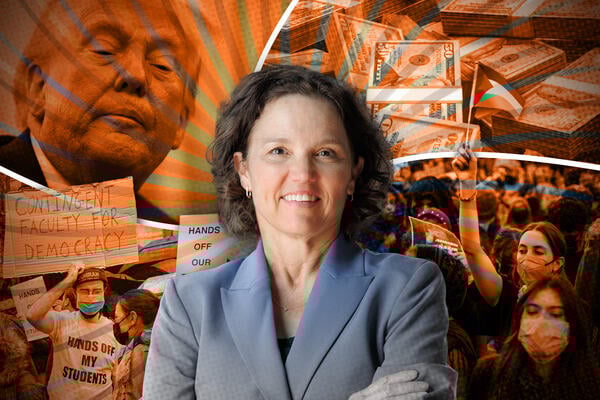
Armstrong to Take Sabbatical from Columbia
Armstrong led Columbia for seven tumultuous months.
Photo illustration by Justin Morrison/Inside Higher Ed | Sirin Samman/Columbia University | Anna Moneymaker and Spencer Platt/Getty Images | mirza kadic/iStock/Getty Images | Ryan Quinn/Inside Higher Ed
After stepping down as interim president of Columbia University late last month, Katrina Armstrong will take a sabbatical from Columbia’s Irving Medical Center, where she has served as chief executive officer since 2022, the institution announced Sunday in a brief statement.
Armstrong is taking a sabbatical to spend time with her family, the university noted.
Armstrong led Columbia for a mere seven months after her predecessor, Minouche Shafik, resigned abruptly in August amid scrutiny from Congress and faculty members over her handling of pro-Palestinian protests. As president, Armstrong yielded to a list of sweeping demands from the Trump administration, overhauling disciplinary processes, adding 36 officers with the authority to make arrests and enacting other changes in an effort to regain $400 million in federal funding frozen by the administration.
Armstrong’s acquiescence to the Trump administration sparked concerns among many Columbia faculty members and others in higher education who wanted to see the university fight back. The Trump administration has not restored the frozen funds but has voiced approval of the changes.
Columbia announced the sabbatical the same day that the Washington Free Beacon, a conservative news outlet, published a transcript of a deposition Armstrong gave to the Department of Health and Human Services as part of the ongoing civil rights investigation into the university.
In the transcript from the April 1 deposition, Armstrong responded multiple times that she had “no memory” of various antisemitic events alleged to have occurred at Columbia.
Armstrong also seemed fuzzy on the changes she enacted in response to Trump’s demands.
“Did you do anything as the interim president to implement these recommendations?” asked Sean Keveney, acting general counsel at the Department of Health and Human Services.
Armstrong responded that she had “stood up against all forms of harassment and discrimination, including antisemitism. While the last year is very much a blur … the administration is deeply committed to addressing antisemitism,” she said, adding that she would “need to look at specifics.”
Armstrong also expressed uncertainty about whether or not she had reviewed a letter from the General Services Administration stating that Columbia’s funding was under review, responding that she had received what “feels like dozens of letters,” some of which had multiple signatories.
“Do you remember a point in the last month when the federal government stopped funding to the University of Columbia?” a government official asked, incorrectly stating the institution’s name.
“I think I would have to understand more specifically what you’re referring to,” she responded.
Armstrong’s lack of recollection seemed to prompt frustration.
“I guess I’m just trying to understand how you have such a terrible memory of specific incidents of antisemitism when you’re clearly an intelligent doctor?” Keveney asked Armstrong at one point.
That question and a related one drew objections from Columbia’s legal counsel.
In other parts of the deposition, Keveney pressed Armstrong on whether she walked back an agreement to clamp down on masks at protests. While Armstrong enacted certain changes that would require protesters to remove their masks when asked to do so by university officials, she reportedly downplayed the notion of a ban on face coverings in a meeting with faculty members last month.
“Isn’t it true that in private with the faculty, you backed away from what you said the university was going to do?” Keveney asked, referencing a faculty meeting held on Zoom in late March.
Armstrong denied doing so, citing a public statement after that meeting that reiterated her commitment to the agreement with the Trump administration. She told the HHS attorney, “I have been and remain and have always been fully committed to the steps in that statement.” She added that those steps “are the right thing to do for Columbia” and for its students.
The deposition also revealed the challenges she faced on the job in recent months.
“It’s obviously been an incredibly difficult period for me, for the university,” Armstrong said in one of multiple responses that showed the immense pressure she was under as interim president.
Columbia’s Board of Trustees responded to Inside Higher Ed’s request for comment on the latest news about Armstrong with a statement that read, “Columbia University is firmly committed to resolving the issues raised by our federal regulators, with respect to discrimination, harassment, and antisemitism, and implementing the policy changes and commitments outlined in our March 21st letter. This testimony does not reflect the hard work undertaken by the University to combat antisemitism, harassment, and discrimination and ensure the safety and wellbeing of our community.”
Columbia’s medical school will continue under interim leadership, which has been in place since Armstrong assumed the interim presidency. Columbia also has a new interim president in place: Last month the Board of Trustees elevated fellow member and co-chair Claire Shipman to the role.
-
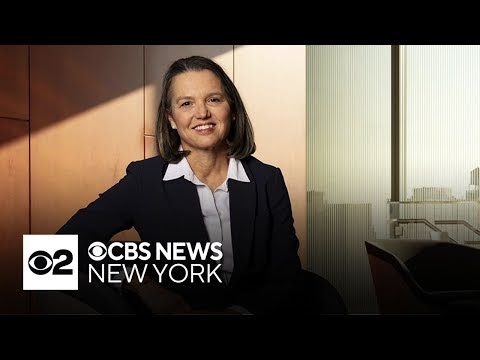
Columbia University’s Interim President Resigns Amid Trump Administration’s Pressure Over Campus Activism
Columbia University’s interim president, Dr. Katrina A. Armstrong, resigned on Friday, just days after the university made significant concessions to the Trump administration in exchange for the restoration of $400 million in federal research funding. Armstrong’s resignation follows a tumultuous period for the institution, already reeling from the departure of her predecessor, Minouche Shafik, in August 2024.
Armstrong, who had stepped into the role of interim president during a time of political and social unrest, faced mounting pressure over the university’s handling of pro-Palestinian student activism, which sparked national controversy and calls for accountability from political leaders, including former President Donald Trump and his administration. Armstrong’s resignation marks the latest chapter in a series of leadership shifts at Columbia as it navigates the increasingly polarized political environment surrounding campus protests.
Effective immediately, Claire Shipman, co-chair of Columbia’s Board of Trustees, has been appointed acting president. David J. Greenwald, chair of the Board of Trustees, praised Armstrong for her dedication to the university, acknowledging her hard work during a time of “great uncertainty.” Greenwald’s statement highlighted Armstrong’s contributions to the university, saying, “Katrina has always given her heart and soul to Columbia. We appreciate her service and look forward to her continued contributions to the University.” Armstrong, who will return to lead the Irving Medical Center, had taken on the interim presidency in a period marked by increasing tensions on campus over political activism and its fallout.
Political Pressure and Concessions to the Trump Administration
The resignation comes amid significant political pressure, as the Trump administration imposed a set of demands on Columbia in exchange for the release of crucial federal funding. Earlier this month, the administration presented the university with nine conditions to restore the $400 million in research grants that had been frozen over accusations of antisemitism linked to campus protests.
In an effort to regain the funding, Columbia conceded to these demands, which included a ban on students wearing masks to conceal their identities during protests, except for religious or health reasons. Additionally, Columbia agreed to hire 36 new campus security officers with the authority to arrest students involved in protests. The university also committed to increasing institutional oversight by appointing a new senior vice provost to monitor the university’s Department of Middle East, South Asian, and African Studies.
Perhaps most notably, Columbia pledged to adopt a stance of “greater institutional neutrality,” a policy that the university said would be implemented after working with a faculty committee. The decision was seen as an attempt to quell political tensions while navigating the contentious issues surrounding student activism.
A Leadership Crisis at Columbia University
Armstrong’s resignation follows the departure of Minouche Shafik, who faced widespread criticism for her handling of campus protests against the war in Gaza. Under Shafik’s leadership, Columbia became a focal point of national debates about free speech, activism, and the role of universities in responding to global conflicts. Shafik ultimately resigned after facing intense scrutiny for her handling of the protests and the occupation of an academic building by students, an incident that ended with NYPD officers forcibly removing the students.
In Armstrong’s case, her tenure was similarly marred by controversies surrounding the university’s response to the growing political activism on campus. The university’s handling of pro-Palestinian protests, particularly those related to the ongoing Israel-Palestine conflict, led to calls for stronger action from political figures, especially within the Republican Party. Armstrong’s decision to oversee negotiations with the Trump administration over the university’s federal funding placed her at the center of a storm of political and social unrest, further intensifying the pressure on her leadership.
Columbia’s Future Amidst Political Turmoil
The resignation of Armstrong is a significant moment for Columbia, as the institution grapples with the broader implications of political activism within academia and the increasing role of government in shaping university policies. As the university enters another phase of leadership instability, the question remains: how will the next president balance the competing demands of activism, free speech, and political pressures from outside forces?
Columbia’s decision to adopt a policy of institutional neutrality and increase security measures reflects the complex and polarized environment that universities are navigating in today’s political climate. The growing influence of political figures like Trump and the scrutiny placed on universities over their responses to student protests signal a new era for higher education, one where the lines between campus activism and political power are increasingly blurred.
As the search for a permanent president continues, Columbia University will need to chart a course that both addresses the concerns of its diverse student body and faculty while navigating the external pressures that have shaped the university’s recent trajectory. The role of universities in fostering open dialogue, supporting activism, and protecting the rights of students will likely continue to be a central issue in higher education for years to come.
Conclusion
The resignation of Katrina Armstrong adds to a growing list of university presidents who have faced intense political pressure and scrutiny over campus activism, particularly surrounding Middle Eastern and global conflicts. Columbia’s next steps will be crucial not only for the future of the institution but also as a bellwether for how universities across the country navigate the increasingly complex landscape of political activism, academic freedom, and government intervention. The institution’s response to these challenges will undoubtedly have long-term implications for the role of higher education in a polarized society.
-
Education Department Cuts and an Ultimatum for Columbia: The Key
The third month of the second Trump administration is coming to a close, and the White House has shown no signs of slowing down on the number of actions it’s taking that directly impact the higher education sector.
In the latest episode of The Key, Inside Higher Ed’s news and analysis podcast, Editor in Chief Sara Custer checks in on the latest developments with news editor Katherine Knott and federal policy reporter Jessica Blake.
They discuss the huge staff cuts at the Department of Education, an executive order to shutter the agency, arrests and intimidation of international students and scholars, and a $400 million ultimatum to Columbia University. They share what IHE has learned from the people at the center of these stories.
They also consider what legal and policy experts have said about the potential for these actions to be challenged in courts or through Congress.
Listen to the latest episode here and find more episodes of The Key here.
-
Columbia University, Mahmoud Khalil, DEI, law firms, and more
We explore how censorship is impacting institutions —
from universities to law firms to the Maine House of
Representatives.Timestamps:
00:00 Intro
01:40 Federal government cuts Columbia’s funding
16:57 Updates on the Mahmoud Khalil case
27:01 Ed Martin’s Georgetown letter
34:59 Trump targeting law firms
55:01 Maine House censure of Rep. Laurel Libby
01:03:37 Outro
Guests:
– Will
Creeley, FIRE’s legal director– Conor
Fitzpatrick, FIRE’s supervising senior attorney– Lindsie
Rank, FIRE’s director of campus rights advocacyEnjoy listening to the podcast? Donate to FIRE today and
get exclusive content like member webinars, special episodes, and
more. If you became a FIRE Member
through a donation to FIRE at thefire.org and would like access to
Substack’s paid subscriber podcast feed, please email
[email protected].Show notes:
– “DOJ,
HHS, ED, and GSA announce initial cancelation of grants and
contracts to Columbia University worth $400 million” U.S.
Department of Justice (2025)–
HHS, ED, and GSA follow up letter to Columbia. U.S.
Department of Health & Human Services, U.S. Department of
Education, U.S. Government Services Administration (2025)– “Columbia
yields to Trump in battle over federal funding” The Wall
Street Journal (2025)– “Advancing
our work to combat discrimination, harassment, and antisemitism at
Columbia” Columbia University (2025)– “Columbia
caves to feds — and sets a dangerous precedent” FIRE
(2025)– “ED,
HHS, and GSA Respond to Columbia University’s Actions to Comply
with Joint Task Force Pre-Conditions” U.S. Department of
Education (2025)– “FIRE
demands answers from Trump admin officials on arrest of Mahmoud
Khalil” FIRE (2025)– “Brief
of Amici Curiae in Support of Petitioner’s Motion for Preliminary
Injunction – Khalil v. Joyce” FIRE (2025)– “We will be
revoking the visas and/or green cards of Hamas supporters in
America so they can be deported.” Secretary of State Marco
Rubio via X (2025)– “‘ICE proudly
apprehended and detained Mahmoud Khalil, a radical foreign
Pro-Hamas student on the campus of @Columbia University. This is
the first arrest of many to come.‘ President Donald J.
Trump” The White House via X (2025)– “WATCH: White
House downplays stock market declines as ‘a snapshot’” PBS
NewsHour (2025)– “Secretary
Rubio’s remarks to the press” U.S. Department of State
(2025)– “Mahmoud
Khalil. Notice to appear.” Habeeb Habeeb via X (2025)– “Alien
and Sedition Acts” National Archives (1798)–
Ed Martin’s letter to Georgetown Law Dean William Treanor.
(2025)–
Dean Treanor’s response to Ed Martin. (2025)– “Trump,
Perkins Coie and John Adams” The Wall Street Journal
(2025)– “Suspension
of Security Clearances and Evaluation of Government
Contracts” The White House (2025)– “Addressing
Risks from Perkins Coie LLP” The White House (2025)– “Addressing
risks from Paul Weiss” The White House (2025)– “Lawyers
who anger the Feds face new penalties by decree” The CATO
Institute (2025)– “Today,
President Donald J. Trump agreed to withdraw his March 14, 2025
Executive Order regarding the Paul, Weiss, Rifkind, Wharton &
Garrison LLP law firm (‘Paul, Weiss’), which has entered into the
following agreement with the President…” President Trump
via TruthSocial (2025)– “Head
of Paul, Weiss says firm would not have survived without deal with
Trump” The New York Times (2025)– “House
resolution relating to the censure of Representative Laurel D.
Libby of Auburn by the Maine House of Representatives”
Maine House of Representatives (2025)– “Maine’s
censure of lawmaker for post about trans student-athlete is an
attack on free speech” FIRE (2025)– “Maine
State Rep. Laurel Libby disagreed with biological males competing
in women’s sports, and now, the Maine State House is censuring
her.” Sen. Kennedy via X (2025)– “The
open society and its enemies” Karl Popper (1945)– “Cyber
rights: Defending free speech in the digital age” Mike
Godwin (1995)