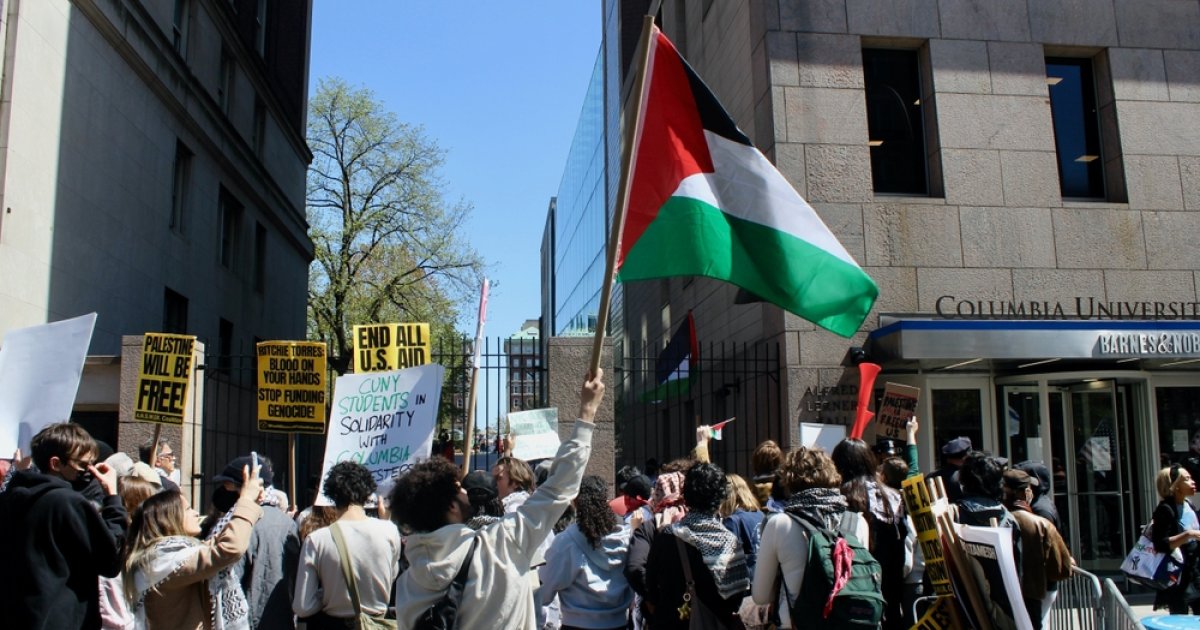
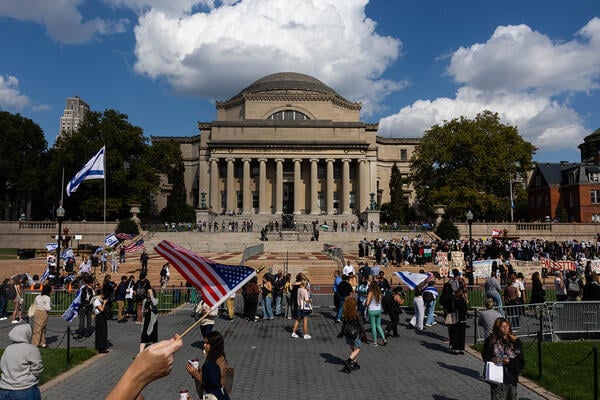
Days after Columbia University yielded to a list of demands from the Trump administration, the American Association of University Professors and the American Federation of Teachers filed a lawsuit on behalf of members at Columbia over $400 million in frozen federal research funding.
The lawsuit names multiple government agencies, including the Departments of Justice, Education and Health and Human Services and the General Services Administration.
Columbia had been in a standoff with the Trump administration over the decision to freeze federal research funding due to alleged antisemitism stemming from pro-Palestinian student protests last year. Ultimately, university leaders decided to avoid a legal fight, even as legal scholars at Columbia and in conservative circles questioned whether the demands were lawful.
In a news release Tuesday, the same day they filed the lawsuit, the AAUP and AFT alleged that the Trump administration used “cuts as a cudgel to coerce a private institution to adopt restrictive speech codes and allow government control over teaching and learning.”
The 87-page lawsuit was filed in the Southern District of New York.
The AAUP and AFT have cast Trump’s demands and the freezing of $400 million in grants and contracts as a “coercive tactic” that undermines institutional autonomy and harms scientific research. Plaintiffs are asking the court to order the Trump administration to lift its freeze on Columbia’s research funding and declare the government’s demands for reform unlawful. They have also requested unspecified damages.
“We’re seeing university leadership across the country failing to take any action to counter the Trump administration’s unlawful assault on academic freedom,” Reinhold Martin, president of Columbia-AAUP and a professor of architecture, said in the statement announcing the lawsuit. “As faculty, we don’t have the luxury of inaction. The integrity of civic discourse and the freedoms that form the basis of a democratic society are under attack. We have to stand up.”
The Department of Education did not respond to a request for comment from Inside Higher Ed.
Today Columbia University announced policies to address government demands after the Department of Health and Human Services, the Department of Education, and the U.S. General Services Administration canceled $400 million in federal grants and contracts, alleging an anti-Semitic hostile environment at the school. The following statement can be attributed to FIRE Lead Counsel Tyler Coward.
Higher education reform shouldn’t resemble a shakedown. Colleges and universities shouldn’t be bullied into accepting speech-restrictive demands because the government dangles a $400 million check over an institution’s head. Any changes made as a result of this flawed process are inherently suspect.
FIRE is looking into the steps Columbia pledged to take in response to government demands, and their implications for free speech and academic freedom. But one stands out instantly: Columbia crafted its own definition of anti-Semitism that is vague and sweeping enough that it will imperil speech otherwise protected by the First Amendment.
The federal government shouldn’t pressure any college, private or public, to censor speech critical of any country.
Shaking under government pressure, Columbia crumbled. If Columbia — with its immense resources and influence — can’t stand up to government demands that threaten free speech, what are other colleges to do?
Behavior that gets rewarded gets repeated. Free speech and academic freedom are worth fighting for. FIRE will stand with any institution willing to stand up for itself.
Acquiescing to demands from the Trump administration to address alleged antisemitism on campus, Columbia University has agreed to overhaul disciplinary processes, ban masks at protests, add 36 officers with the authority to make arrests and appoint a new senior vice provost to oversee academic programs focused on the Middle East, among other changes.
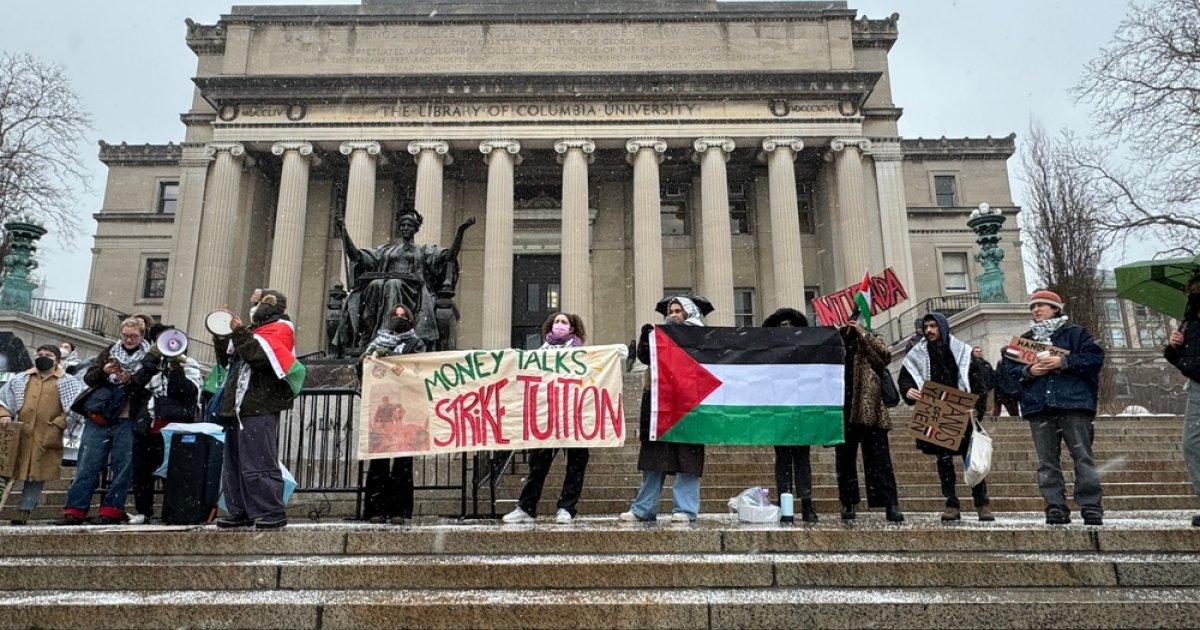
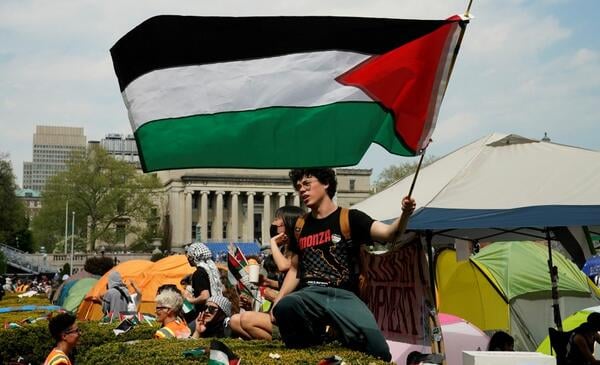
The decision, announced Friday afternoon, is the latest move in Columbia’s ongoing face-off with the federal government over last year’s pro-Palestinian protests, which spawned the nationwide encampment movement. Columbia yielded despite concerns about the legality of the demands, as well as of an associated effort by the Trump administration to strip the university of $400 million in research funding.
“We have worked hard to address the legitimate concerns raised both from within and without our Columbia community, including by our regulators, with respect to the discrimination, harassment, and antisemitic acts our Jewish community has faced in the wake of October 7, 2023,” university officials said in a Friday statement.
Columbia announced additional efforts that the Trump administration didn’t request, including advancing the university’s Tel Aviv Center (though initial details are sparse) and creating a K-12 curriculum “focused on topics such as how to have difficult conversations, create classrooms that foster open inquiry, dialogue across difference and topics related to antisemitism.” That curriculum will be free for schools.
Columbia did not place the Middle East, South Asian and African Studies Department into “academic receivership” for a minimum of five years, as the Trump administration demanded, but the parties appeared to reach a compromise. A new senior vice provost will review a broader range of programs, expanding beyond the department targeted by Trump to include “the Center for Palestine Studies; the Institute for Israel and Jewish Studies; Middle Eastern, South Asian, and African Studies; the Middle East Institute; the Tel Aviv and Amman global hubs; [and] the School of International and Public Affairs Middle East Policy major,” according to the university.
The new senior provost, who has not yet been named, will review programs “to ensure the educational offerings are comprehensive and balanced” and evaluate “all aspects of leadership and curriculum” among other changes, which may include academic restructuring.
Interim president Katrina Armstrong announced the move in a statement titled “Sharing Progress on Our Priorities,” calling it “a privilege to share our progress and plans” after a difficult year of protests and scrutiny.
“At all times, we are guided by our values, putting academic freedom, free expression, open inquiry, and respect for all at the fore of every decision we make,” Armstrong wrote in the message posted Friday afternoon, which she signed, “Standing together for Columbia.”
Critics, however, have argued that yielding to the Trump administration undermines academic freedom and urged Columbia to fight the demands.
Legal scholars at Columbia and in conservative circles have noted that the Trump administration’s demands were likely unlawful. However, it seemed the university had no desire for a protracted legal fight.
In a Friday press call, American Association of University Professors President Todd Wolfson blasted Columbia for failing to stand up to Trump.
“This is not the outcome we wanted to see we wanted to see Columbia stand up for their rights for academic freedom and freedom of speech on their campus and we did not expect for them to not only capitulate to the demands of the federal government but actually go beyond the initial demands as far as we can tell,” Wolfson said.
“This is an unprecedented intervention into academic freedom—never before in Columbia’s 250+ years has the federal government tried to exert control over a department before. And Trump et al. are only getting started,” Columbia history professor Karl Jacoby wrote on Bluesky.
Outside experts pointed to the likelihood that more universities will give in to Trump’s threats now that Columbia has yielded.
“Trump gets exactly what he wants from Columbia. Next up: most of the big-name institutions in American higher education. This is a turning point in the history of our industry,” Robert Kelchen, a professor of education and head of the Department of Educational Leadership and Policy Studies at the University of Tennessee at Knoxville, wrote in a Bluesky post.
The American Association of University Professors chapter at Columbia University is urging officials there to reject the Trump administration’s demands, which include putting an academic department under receivership, abolishing the University Judicial Board and giving security employees arrest authority.
“Compliance would make Columbia complicit in its own destruction, stripping shared control of academic and student affairs from the faculty and administration and replacing the deliberative practices and structures of the university with peremptory fiats from outside the institution,” the AAUP chapter said in a statement Tuesday. “We see no evidence that compliance would assuage the hostility of the White House.”
The Trump administration announced March 7 it was canceling about $400 million in federal grants and contracts for Columbia due to what it claims is the university’s “continued inaction in the face of persistent harassment of Jewish students.” Then, in a letter last week, federal officials listed “next steps that we regard as a precondition for formal negotiations regarding Columbia University’s continued financial relationship with the United States government.” They set a March 20 deadline for complying with the demands, which also include a mask ban, a plan for changing admissions and more.
The Columbia AAUP’s statement said, “The government’s demands read like a ransom letter, dictating to the university what principles it must sacrifice and what ideological positions it must adopt to restore research funding.” As for the justification of fighting antisemitism, the AAUP chapter said the university took “many actions over the last year to accommodate its Jewish students, sometimes at the expense of the grievances of other campus groups.”
The AAUP chapter said this “assault on Columbia will serve as a model for attacks on other universities across the nation” and urged colleagues to speak out and “march in the streets.”
The White House didn’t return a request for comment Tuesday.
If Columbia University wants a financial relationship with the federal government, the Ivy League institution will need to overhaul its discipline process, ban masks, expel some students, put an academic department under review, give its campus security “full law enforcement authority” and reform its admissions practices.
Those are just some of the sweeping and unprecedented demands the Trump administration made Thursday in a letter to the Manhattan-based institution. They come less than a week after the cancellation of $400 million in federal grants and contracts at the university. Columbia has until March 20 to respond.
“We expect your immediate compliance with these critical next steps,” three Trump officials wrote. “After which we hope to open a conversation about immediate and long-term structural reforms that will return Columbia to its original mission of innovative research and academic excellence.”
The demands escalate an already precarious situation for Columbia as it simultaneously faces pressure from the White House to comply and pressure from students and faculty to fight back.
“We are in a state of shock and disbelief, and we are working with our administration to … reaffirm free speech and shared governance on campus, and to resist all Trump efforts to take academic decisions out of the hands of academics,” said Jean Howard, a member of the executive committee of the Columbia chapter of the American Association of University Professors. “Our administration has been cautious in dealing with Trump up to now. We’re hoping they will take a more aggressive posture in the future.”
A Columbia spokesperson told Inside Higher Ed that officials are reviewing the letter but didn’t say Friday whether the university will comply with the demands. Several free speech and higher ed policy experts say the letter amounts to an unprecedented assault on higher education that could threaten foundational principles such as academic freedom. The demands, which don’t appear rooted in any specific legal authority, also offer yet another hint at how President Trump could reshape higher education.
“The subjugation of universities to official power is a hallmark of autocracy,” Jameel Jaffer, executive director of the Knight First Amendment Institute at Columbia, said in a statement. “No one should be under any illusions about what’s going on here.”
But the Trump administration says canceling the grants and contracts is necessary due to Columbia’s “continued inaction in the face of persistent harassment of Jewish students.” In the letter, officials said that the university “has fundamentally failed to protect American students and faculty from antisemitic violence.”
Building Tensions
Ted Mitchell, president of the American Council on Education, criticized the letter as an “outrageous” example of “extreme federal overreach,” adding that institutional autonomy is a critical part of American higher education.
“It’s perfectly reasonable for the federal government to hold all of those institutions accountable to civil rights laws, and we expect that,” he said. “But for the government to prescribe changes in academic structure, changes essentially in curriculum and to curtail research, that’s beyond the pale.”
One of the letter’s 12 demands is for Columbia to put its Middle East, South Asian and African Studies department under academic receivership for at least five years. This would mean that faculty lose control of the department and the university puts an outside chair in charge. The letter didn’t specify why officials focused on this particular department. But it’s worth noting the academic division is home to Joseph Massad, a controversial tenured professor whom lawmakers have accused of making anti-Israel and anti-Jewish statements over the years.
Federal scrutiny of colleges and universities, especially by Republicans, ratcheted up after the wave of pro-Palestinian protests in fall 2023 and spring 2024. But the Trump administration has only added to the pressure on colleges since it took office in January, quickly moving to cut funding to programs and institutions seemingly at odds with the president’s priorities.
Columbia has been at the epicenter of the scrutiny, particularly after an encampment popped up on the small Manhattan campus’s central lawn last April. The protests culminated in early May, when students occupied a campus building and New York City police officers eventually stormed the hall, arresting those inside.
Although other colleges faced protests and were accused of mishandling reports of antisemitic harassment and discrimination, Columbia took a hard line with protesters and was one of the few to bring in law enforcement. But that hasn’t stopped the Trump administration from targeting the university, nor has it led Columbia to draw a line and start fighting back.
On Thursday, the same day the letter was sent, Columbia handed down student sanctions related to the building occupation. The sentences ranged from multiyear suspensions and expulsions to temporary degree revocations for graduates.
Professors and other experts have warned that federal scrutiny—including high-profile grillings and subpoenas from Capitol Hill—could have damaging consequences for colleges. But alarm escalated significantly last week when the Trump administration bypassed the typical investigation process for civil rights violations and slashed Columbia’s access to grants and contracts.
The cuts, made by Trump’s novel multidepartment antisemitism task force, are the first but likely not the last.
The task force has already said at least 10 other universities are under review, including Harvard University and the University of California, Berkeley. Meanwhile, the Office for Civil Rights is investigating allegations related to antisemitism at at least 60 colleges.
Ryan Enos, a professor of government at Harvard, said Columbia needs to reject the demands and other universities need to speak up now in defense of higher education. If left on its own, Columbia could fail to defend itself, he said.
“Other universities have an imperative to come to the defense of Columbia, because this is not just about Columbia,” Enos said. “The Trump administration is trying to attack all of higher education, and Columbia cannot try to mount a defense on its own.”
Frustrations Abound
Outside policy analysts and scholars on both sides of the political spectrum are frustrated with the situation—but for different reasons.
Frederick Hess, director of education policy studies at the American Enterprise Institute, a right-leaning think tank, described Columbia’s handling of antisemitism on campus over the course of the past year as “egregious” and a “clear violation” of Title VI of the Civil Rights Act of 1964, which prohibits discrimination based on ethnicity or national origin. But at the same time, he said the Trump administration’s unclear process for determining a remedy is problematic.
“Some of the things on the list I find pretty facially plausible. Others require a much higher standard of justification,” he said. “But because they have not been transparent and … there has not been any back-and-forth, there has not been a proper demonstration of the misconduct, which would be necessary to convince me that these specific remedies are called for.”
Benjamin Ginsberg, a Johns Hopkins University professor who studies American politics and Jewish history, sees the situation as one of “competing truths.”
“The Columbia administration has needed for a long time to act against antisemitic demonstrators and vandals on the campus,” Ginsberg said, noting that arrests without indictments or suspensions are not enough. But at the same time, “the Trump administration has overreached by threatening Columbia with dire consequences,” he added.
He noted that the situation presents Columbia administrators with an opportunity.
“Sure, the [Trump] administration has overstepped. It’s threatening to fire a cannon, drop a nuclear bomb,” Ginsberg said. “But as I say, that threat gives the Columbia administration an opportunity to do things that it has needed to do and probably wanted to do for some time.”
He added that though he’s certainly hesitant when the government tries to dictate what departments are valid, in this instance, higher education has failed in its responsibility to its students. He also trusts that the Trump administration will be satisfied so long as Columbia carries out disciplinary action against students who disrupt academic life and threaten others’ safety.
“Anytime the federal government tells the university how to organize its admissions processes, or which, if any, academic departments are valid and legitimate, of course I’m concerned,” Ginsberg said. “But my guess is that nothing will come of those particular demands. I mean, I hope the university won’t cave in.”
On the other hand, Eddy Conroy, a senior education policy manager at New America, a left-leaning think tank, said all the Trump administration’s recent actions should be “deeply troubling.”
Columbia has already demonstrated an aggressive response to student protests, which should be protected by the First Amendment, Conroy said, and it’s not up to the federal government to determine whether those disciplinary procedures were adequate.
“We have an important history of peaceful protest in the United States, and sit-ins are part of that. Columbia can choose if it wants to deal with those things through its own disciplinary procedure or by pursuing trespassing charges,” he said. But to Trump, this “is a test case of how far we can push things when it comes to suppressing speech.”
Conroy believes that the president is trying to make an example of Columbia in the hops that other institutions will then capitulate without fight, and the university’s response as a test dummy isn’t helping.
“The [Trump] administration hits Columbia, and Columbia cowers and says, ‘Please hit us harder,’” he said.
To Howard, the Columbia AAUP representative, Trump’s actions are a threat to the gemstone that is American higher education.
We’ve become “the greatest university system in the world. But that requires independence. It requires the free expression of differing viewpoints,” she said. Trump’s demands are “so undemocratic, so against the norms and conventions of university life, that to comply would just destroy the heart of the institution.”
This audio is auto-generated. Please let us know if you have feedback.
Columbia University received a daunting laundry list of tasks Thursday from the Trump administration: Suspend or expel protesters. Enact a mask ban. Give university security “full law enforcement authority.”
The Ivy League institutionmust comply with these and other demands by March 20 or further endanger its “continued financial relationship with the United States government,”according to a copy of the letter obtained by multiple news sources.
Last week, the Trump administration’s newly created Joint Task Force to Combat Anti-Semitism canceled $400 million of Columbia’s federal grants and contracts,alleging the university had failed to take action “in the face of persistent harassment of Jewish students.” It also noted that Columbia has $5 billion in federal grant commitments at stake.
The stunning move came only four days after the task force opened an antisemitism investigation into the university.
On Monday, the U.S. Department of Education also sent warnings to 60 colleges — including Columbia — that it could take punitive action if it determines they aren’t sufficiently protecting Jewish students from discrimination or harassment.
In Thursday’s letter, Trump administration officials said they expected Columbia’s “immediate compliance” after which they hope to “open a conversation about immediate and long-term structural reforms that will return Columbia to its original mission of innovative research and academic excellence.”
The letter’s edicts are just the latest in a series of decisions made by the Trump administration and Columbia officials that have put the well-known New York institution into a tailspin.
Strong language, few details
Officials at the Education Department, U.S. Department of Health and Human Services, and U.S. General Services Administrationsent Columbia Interim President Dr. Katrina Armstrongnine policy changes the Trump administration expects the university to make to retain federal funding.
The agencies — all of which are part of the Trump administration’s antisemitism task force — accused Columbia of failing “to protect American students and faculty from antisemitic violence and harassment,” along with other alleged violations of civil rights laws.
But despite the high stakes, the task force’s demands are ambiguous.
For example, its letter orders the university to deliver a plan on “comprehensive admissions reform.”
“The plan must include a strategy to reform undergraduate admissions, international recruiting, and graduate admissions practices to conform with federal law and policy,” it said.
The task force’s letter offers no further insight into what it expects Columbia to change or how it believes the university is out of line with federal standards.
The letter goes far beyond what is appropriate for the government to mandate and will chill campus discourse.
The Foundation for Individual Rights and Expression
The GSA directed an emailed request for comment to the Education Department. Neither the Education Department nor HHS responded to inquiries Friday.
The task force also ordered the university to ban masks that “are intended to conceal identity or intimidate others,” while offering exceptions for religious and health reasons.But it did not give criteria to determine why someone is wearing a mask.
“We are reviewing the letter from the Department of Education, Department of Health and Human Services, and General Services Administration,” a spokesperson for Columbia said Friday. “We are committed at all times to advancing our mission, supporting our students, and addressing all forms of discrimination and hatred on our campus.”
The Foundation for Individual Rights and Expression, a civil rights watchdog, criticized the federal officials’ demands Friday.
While the group has been critical of Columbia’s handling of student protesters, it said the letter does not follow “the normal procedure for revocation of federal financial assistance for violations of Title VI.” Title VI refers to the law barring discrimination on race, color and national origin at federally funded educational institutions.
“While these include some policy steps that Columbia should already have taken, the letter goes far beyond what is appropriate for the government to mandate and will chill campus discourse,” FIRE said in a statement.
A change in due process
The Trump administration’s task force is demanding Columbia completeongoing disciplinary proceedings against pro-Palestinian protesters who occupied campus buildings and organized encampments last year. The university must dole out meaningful discipline — meaning expulsions or multi-year suspensions — the letter said.
The same day the task force’s letter is dated, Columbiaannounced it had issued “multi-year suspensions, temporary degree revocations, and expulsions” related to the occupation of Hamilton Hall.
In April 2024,pro-Palestinian protesters occupied the university’s Hamilton Hall after then-President Minouche Shafik announced Columbia would not divest from companies with ties to Israel.
Columbia brought New York City Police onto its private campus for the second time that month — and only the second time since 1968— against the authority of the University Senate. Officers arrested more than 100 people.
The disciplinary rulings from Columbia’s University Judicial Board, the panel that reviews misconduct cases and issues sanctions, came 11 months later.
It is unclear if the UJB issued its rulings before or after Columbia received the task force’s letter. And a university spokesperson said in an email Friday that Columbia could not confirm who or how many protesters had been sanctioned due to student privacy laws.
Columbia University Apartheid Divest, a coalition of student organizations that helped organize the protests, said on social media Thursday that 22 students had been disciplined.
Columbia University’s immediate submission and betrayal of the core mission of higher education reflects cowardice and capitulation to a government that seems intent on destroying US higher education.
Todd Wolfson
President of the American Association of University Professors
And the United Auto Workers union announced that the university had expelledGrant Miner, president of UAW Local 2710, which represents student workers at Columbia.
The move, effectively firing Miner, came “one day before contract negotiations were set to open with the University,” the union said in a statement.
“It is no accident that this comes days after the federal government froze Columbia’s funding, and threatened to pull funding from 60 other universities across the country,” it said. “It is no accident that the University is targeting a union leader whose local went on strike in the last round of bargaining.”
Todd Wolfson, president of the American Association of University Professors, condemned Columbia’s decision against Miner as “a severe violation of student and worker rights aimed at silencing all voices of dissent who have spoken out for peace and against the war in Gaza.”
He also accused the university of being willing to “sacrifice its own students to the demands of an authoritarian government.”
“Columbia University’s immediate submission and betrayal of the core mission of higher education reflects cowardice and capitulation to a government that seems intent on destroying US higher education,” he said in a Friday statement.
The task force also told Columbia to dissolve UJB.The five-member board includes representatives from the faculty, student body and the university’s noninstructional employees such as librarians and administrative staff.
In lieu of this due process system, the letter instructed the institution to shift its disciplinary proceedings entirely under Armstong’s office.
Columbia must enact “primacy of the president in disciplinary matters,” giving the president’s office unilateral power to suspend and expel students and oversee the appeals process, the letter said.
Law enforcement on campus
The Trump administration also demanded that Columbia give its security force the power to arrest and remove “agitators who foster an unsafe or hostile work or study environment” or interfere with classroom instruction.
President Donald Trump has sought to crack down on campus demonstrations, threatening to pull federal funding from colleges that allow “illegal protests” and to arrest, deport and expel student demonstrators.
U.S. Immigration and Customs Enforcement took the first step toward fulfilling that promise last week, again putting Columbia at the center of a firestorm.
On Saturday, ICE agents arrested Mahmoud Khalil, a Columbia student who completed his graduate studies in December, in his university housing.
Khalil, a permanent U.S. resident who holds a green card, served as a driving force behind the pro-Palestinian protests onColumbia’s campus and represented student activists in negotiations with the university’s administration.
A U.S. Department of Homeland Security spokesperson alleged that he “led activities aligned to Hamas,” according to The Associated Press.
Khalil’s arrest and continued detention by ICE immediately drew condemnation from free speech and civil rights groups, including the American Civil Liberties Union, which joined his legal team this week.
His detainment, which is shaping up to be a landmark civil rights case, has not deterred the Trump administration.
An official at the U.S. Department of Justice, which is also on the antisemitism task force, said Friday that the agency is investigating if campus protesters broke federal anti-terrorism laws and whether Columbia’s handling of earlier incidents violated civil rights laws.
“This is long overdue,” Deputy Attorney General Todd Blanche said at a press conference.
And on Thursday, agents from Homeland Security searched two on-campus residences at Columbia, according to Armstrong.
“The University requires that law enforcement have a judicial warrant to enter non-public University areas, including residential University buildings,” she said in a statement. “Tonight, that threshold was met, and the University is obligated to comply with the law.”
No one was arrested or detained, and nothing was taken from the residents, Armstrong said.
“I understand the immense stress our community is under,” Armstrong said. She closed the letter with counseling and well-being resources for students and, in a separate statement that day, reiterated Columbia’s commitment to its international community.
On Friday, over 100 demonstrators gathered outside of the campus’ gates to protest the sanctions against the Hamilton Hall occupiers and the university’s response to Khalil’s detainment, according to the Columbia Daily Spectator.
Last week, the Department of Health and Human Services, the Department of Education, and the U.S. General Services Administration announced the immediate cancellation of $400 million in federal contracts with Columbia University.
The announcement corresponded with ongoing Title VI investigations alleging an anti-Semitic hostile environment at Columbia. Last night, the agencies sent a follow-up letter sidestepping important procedures and including demands that will seriously erode free speech and academic freedom on campus.
There is significant evidence to suggest that Columbia failed to respond effectively to unlawful conduct directed against Jewish students based on their Jewish identity and that this has resulted in Title VI violations. Indeed, Columbia responded to the agencies’ March 7 announcement about canceling contracts by stating it is “committed to working with the federal government to address their legitimate concerns.” [Emphasis added].
However, the departments’ demands in last night’s letter to Columbia go too far. The letter announces steps the school must take “that we regard as a precondition for formal negotiations regarding Columbia University’s continued financial relationship with the United States Government.” While these include some policy steps that Columbia should already have taken, the letter goes far beyond what is appropriate for the government to mandate and will chill campus discourse.
Our nation’s colleges need to protect free expression and comply with anti-discrimination laws, but too often … they enact overbroad or vague policies that do not track the Supreme Court’s definition for discriminatory peer harassment.
For instance, the letter demands that Columbia “Formalize, adopt and promulgate a definition of anti-Semitism.” It cites President Trump’s 2019 executive order on anti-Semitism — which orders the government to consider the International Holocaust Remembrance Alliance’s definition and examples of anti-Semitism for civil rights enforcement — hinting strongly that Columbia should adopt that definition.
While the IHRA definition was originally crafted to study incidents of anti-Semitism in Europe, its primary author has repeatedlystated that it was never intended to be used for anti-discrimination enforcement because it risks chilling speech on the Israeli-Palestinian conflict on campus. The examples of anti-Semitism cited by IHRA include criticisms of Israeli policy that can, depending on the situation, be political speech protected by our First Amendment.
Other demands may be of even greater concern. The government’s demand that an academic department be put under “academic receivership” is a clear intrusion on academic freedom, and its deadline of March 20 for a “full plan” to do so is likely impossible to meet. And there is no basis to believe that the federal government has the power to demand that Columbia eliminate its University Judicial Board or to mandate specific punishments (“expulsion or multi-year suspension”) be given to student demonstrators.
The demands in the letter pose a problem, but so is the process the government is using to issue those demands. This is not the normal procedure for revocation of federal financial assistance for violations of Title VI. Instead, the government appears to rely on authority under Federal Acquisition Regulations (FAR) to cancel contracts based on “termination for convenience of the government” clauses that exist in most federal contracts. As a Biden-era document states: “the Government has a lot of latitude to terminate contracts for convenience and the Federal Acquisition Regulations do not require a lot from the Government when terminating contracts for convenience.”
Federal anti-discrimination law has been one of the most frequently cited justifications for campus censorship throughout FIRE’s history. Our nation’s colleges need to protect free expression and comply with anti-discrimination laws, but too often — and sometimes at the federal government’s behest — they enact overbroad or vague policies that do not track the Supreme Court’sdefinition for discriminatory peer harassment. As a result, their policies and actions end up targeting speech protected by the First Amendment. This has long been a problem in the Title IX context relating to sex discrimination, and has more recently become a problem in the Title VI context as well.
One important protection that colleges have against improper pressure from the federal government to censor students and faculty is the process federal civil rights law provides for colleges accused of failing to address unlawful discrimination. Civil rights investigations should not be handled through ad hoc directives from the government. Existing procedures, which include an attempt at a voluntary resolution followed by either an administrative hearing with the opportunity for the institution to defend itself or a trial in federal court, are intended to reduce the risk of error, individual biases, and overreach.
None of those safeguards are in evidence in the Columbia process, which increases the likelihood of abuse. Title VI processes are in place for a reason, and those procedures, when followed in good faith, are more likely to generate just outcomes for colleges, students, and faculty.
Earlier this week, the Department of Education announced it was launching Title VI anti-Semitism investigations into 60 colleges and universities across the country. Any of those institutions that have contracts with the federal government would reasonably expect to be treated similarly to Columbia and risk losing federal government contracts unless they enact policies similar to those outlined in last night’s letter.
The threat to both free speech and academic freedom are clear, and last night’s letter is a blueprint to supercharge campus censorship.
Columbia University handed down sanction decisions for student protesters who occupied Hamilton Hall in April of last year, the university announced in a statement Thursday.
The sanctions come as the university faces crippling attacks from the Trump administration over its handling of the protests last year, including the loss of $400 million in federal funding, which could lead to mass layoffs and program cuts.
The university has not released the names of affected students, nor more details about how many will be expelled or suspended.
The punishments, determined by the university judiciary board, are unusually harsh, ranging from multiyear suspensions and expulsions to temporary degree revocations for graduates, according to the email. While occupying the building—which students renamed Hind Hall in honor of a 5-year-old Palestinian girl killed by Israeli soldiers—students damaged property and broke windows.
Last year, only a few of the students who occupied the building were punished, and most remained in good standing with the university, according to documents the university gave to Congress last year. Of the 22 students who occupied the hall, only three received sanctions, the most severe being short-term suspension. At the time, Columbia said the disciplinary process was “ongoing for many students.”
University spokespeople told Inside Higher Ed that the decisions were the culmination of a months-long investigation. For all other student protests last spring, the judiciary board “recognized previously imposed disciplinary action,” according to the email.
Last weekend, Columbia graduate and legal U.S. permanent resident Mahmoud Khalil was arrested and threatened with deportation for his role in the pro-Palestine protests. Yesterday, Khalil sued the university, along with Barnard College, for allegedly sharing private student disciplinary records with members of Congress and other third-party groups.
When the Trump administration announced Friday it was cutting about $400 million in grants and contracts from Columbia University, it didn’t specify what exactly it was slashing. But news of the scope of the cuts has begun trickling out of the institution over the past couple of days.
So far, much of the information about the canceled grants has come via social media, as neither the Trump administration nor the university have provided a comprehensive accounting of what’s being cut. The National Institutes of Health did say earlier this week that it was pulling more than $250 million in grants from Columbia, though the agency wouldn’t share more details. And it’s hard to tell whether specific cuts are part of the $400 million or a continuation of the Trump administration’s general national reduction of federal funding to universities, such as axing grants it deems related to diversity, equity and inclusion.
On Tuesday, Joshua A. Gordon, chair of the university’s psychiatry department, emailed colleagues to tell them the National Institutes of Health had terminated nearly 30 percent of grants to Columbia’s medical school—including many within his own department.
“All of our training grants and many fellowships have been terminated,” Gordon wrote in the email, which a postdoctoral research fellow provided Inside Higher Ed.
Gordon wrote that he’s still working with university administrators “to find out the full extent of these terminations” and that “the institution is committed to identifying the resources that can be brought to bear to support the people and projects affected by the terminations.” He added, “We remain dedicated to ensuring that our trainees and early-career scientists have the support needed to continue their work and achieve their career goals.”
The Trump administration said this unprecedented $400 million cut was due to Columbia’s “continued inaction in the face of persistent harassment of Jewish students.” More cuts at Columbia and other universities could follow as Trump follows through on his pledge to crack down on alleged antisemitism and punish elite universities. Columbia has more than $5 billion in federal grants and contracts.
Columbia postdocs and faculty have taken to social media to announce canceled grants, fellowships and funding for Ph.D. students, showing some of the individual impacts on people and research wrought by the Trump administration’s actions. They include nixed training for researchers of depression and schizophrenia and a grant that would’ve provided free mental health resources to K-12 students.
Sam Seidman, a postdoc and a steward for the Columbia Postdoctoral Workers union, told Inside Higher Ed that, “as a Jew,” it’s “particularly outrageous” to hear the Trump administration justifying the cuts by saying it’s fighting antisemitism.
Seidman said he found out Monday that his T32 grant, an NIH training fellowship for new scientists, had been canceled. “I certainly don’t feel protected,” he said.
He said it’s clear the Trump administration doesn’t have an issue with antisemitism or even with Columbia specifically. Its issue, Seidman said, is with “public funding of science and it’s with public funding, period,” adding that “Columbia makes a convenient scapegoat.”
In an emailed statement, a Columbia Irving Medical Center spokesperson said, “Columbia is in the process of reviewing notices and cannot confirm how many grant cancellations have been received from federal agencies” since Friday.
The spokesperson said, “We remain dedicated to our mission to advance lifesaving research and pledge to work with the federal government to restore Columbia’s federal funding.”
In a separate statement Wednesday, interim president Katrina Armstrong, herself a medical doctor, didn’t mention the cuts and instead said she stands by broad principles such as “intellectual freedom” and “personal responsibility.”
“I have no doubt that the days and weeks ahead are going to be extremely difficult,” Armstrong said. “The best I can promise is that I will never stray from these principles and that I will work tirelessly to defend our remarkable, singular institution.”
Marcel Agüeros, secretary of Columbia’s chapter of the American Association of University Professors, said, “It’s already looking very grim.”
Agüeros said it’s a slow process to try to understand how the cuts are affecting such a large and decentralized university. But he said he has learned “it’s not just the kind of classic lab-based biomedical research that’s being impacted.”
Like Seidman, he said the cuts don’t seem to be about the grants themselves or Columbia. Instead, Agüeros said, it’s “an assault on universities in general” and the concept of peer review that the grants went through.
“It’s coming for you; it doesn’t really matter where you are or what you research,” Agüeros said
Cut Off at the Knees
In its Wednesday statement, the university medical center said that “from pioneering cancer treatments to innovative heart disease interventions and cutting-edge gene and cell therapies, research conducted by Columbia faculty has helped countless people live healthier, longer and more productive lives.”
Seidman said his NIH grant was for research on family and biological risk factors that predispose kids to develop eating disorders, depression and suicidal thoughts and behaviors. He thinks university higher-ups are trying to find alternative funding but “haven’t been any more specific than ‘we’re looking.’”
“It’s tragic, I mean these are lifesaving, potentially, interventions,” Seidman said. Yet the researchers developing them have been “cut off at the knees,” he said.
Gordon Petty, a postdoc in Columbia’s psychiatry department, said his T32 training grant, which has also been canceled, was to study schizophrenia. He said he heard that the department is still dedicated to supporting him, “but it’s unclear where that money’s coming from.”
Trump’s cuts appear to have also hit Teachers College of Columbia University, which is a separate higher education institution from Columbia with its own board. But it’s unclear if that’s part of the $400 million cut for allegedly not properly addressing antisemitism or part of nationwide cuts to grants perceived as being related to diversity, equity and inclusion. A Teachers College spokesperson said, “We are still sorting through the full impact on the college and will be in touch when we have more to say.”
Prerna Arora, an associate professor of psychology and education at Teachers College, said she got an email Friday from a deputy assistant U.S. education secretary announcing the cancellation of a five-year Education Department grant. Arora said most of the funds went directly to graduate students training to become K-12 school psychologists serving children in New York City.
The email, according to Arora, alleged that the grant funded “programs that promote or take part in initiatives that unlawfully discriminate on the basis of race, color, religion, sex, national origin or another protected characteristic” or that “violate either the letter or purpose of federal civil rights law” or “conflict with the department’s policy of prioritizing merit, fairness and excellence in education.”
“We already have students that are funded under this, and they are at the university and we are in the middle of our admissions cycle for next year,” Arora said. She said, “I’ve spoken to very scared and tearful students” who are afraid of what this means for their training and “for their future.”
And, beyond the impact on college students, Arora lamented the loss of the grant’s free help to K-12 students and families. “We could’ve helped many children who need this,” she said.
It’s unclear whether the Trump administration will restore the grants. Education Secretary Linda McMahon said after the announcement Friday that she had a “productive” meeting with Armstrong. Meanwhile, Columbia said in a statement that it’s “committed to working with the federal government to address their legitimate concerns.”
Agüeros, with the AAUP, said Columbia has already “gone overboard in an attempt to silence any kind of dissent.” Its previous president called in the New York Police Department to remove a pro-Palestinian protest encampment last spring and publicly criticized and revealed investigations into her own faculty in front of Congress.
“There’s this assumption that if we just go along with things we’ll escape somehow unscathed,” Agüeros said. But he noted the cuts still arrived.
“What did all of that get us—all of the sort of compliance that was put in place? It got us nothing.”
Columbia University remained on edge Wednesday following the Immigration and Customs Enforcement arrest of Mahmoud Khalil, a green card–holding recent graduate who helped lead the pro-Palestinian protests that roiled the campus last spring. A federal judge in New York ruled Tuesday that Khalil could not be deported, but following a procedural hearing on Wednesday, the judge said he will remain in ICE custody in Louisiana for now, CNN reported.
Hundreds of people took to the streets of Manhattan to protest Khalil’s detention; police arrested 12 protesters outside City Hall Park Tuesday night, charging 11 with disorderly conduct, The New York Daily News reported.
Meanwhile, faculty at Columbia warned other student protesters to be careful. Stuart Karle, a First Amendment lawyer and adjunct professor at Columbia Journalism School, advised students who are not U.S. citizens to avoid publishing opinions that could attract the attention of the Trump administration, The New York Times reported.
“If you have a social media page, make sure it is not filled with commentary on the Middle East,” he told students and faculty gathered in Pulitzer Hall.
“Nobody can protect you,” journalism school dean Jelani Cobb added, according to the Times. “These are dangerous times.”
During a news briefing Tuesday, White House press secretary Karoline Leavitt said the Trump administration was using intelligence gathered by the Department of Homeland Security to identify people who participated in campus protests, CNN reported. She accused Columbia of holding back information.
“Columbia University has been given the names of other individuals who have engaged in pro-Hamas activity, and they are refusing to help DHS identify those individuals on campus,” Leavitt said. “As the president said very strongly in his statement yesterday, he is not going to tolerate that and we expect all of America’s colleges and universities to comply with this administration’s policy.”
Columbia’s interim president, Katrina Armstrong, released a statement Wednesday reiterating her guiding principles. She wrote, “A great institution, and particularly a great university, depends upon an unwavering commitment to following fair and just processes, no matter the internal and external pressures.”