Tag: coming

  • Universities in England can’t ignore the curriculum (and students) that are coming

    Universities in England can’t ignore the curriculum (and students) that are coming

    What has schools policy got to do with higher education?

    The Westminster government has published Becky Francis’s Curriculum and Assessment Review, unveiling what Education Secretary Bridget Phillipson calls “landmark reforms” to the national curriculum.

    Interestingly, the revitalised curriculum is to be a “core part” of how the government will deliver the Prime Minister’s target of two-thirds of young people participating in higher-level learning by age 25.

    The review treats higher education as an explicit destination, not a distant afterthought.

    When it invents a new “third pathway” at level 3, it insists those V Levels must carry higher education credibility and be built so that young people can progress to degree-level study as well as work – hence Ofqual regulation and sector-standard-linked content. In other words, this isn’t a dead-end vocational cul-de-sac – it is designed to be read and trusted by admissions tutors.

    On T Levels, the panel recognises reality on the ground – many universities do already accept T Level learners – but says the acceptance landscape is messy, confusing and poorly signposted. Its answer is that government should keep working with providers and HEIs to promote understanding across the HE sector so applicants know which courses take T Levels and on what terms. The implication for universities is making recognition statements clearer, and aligning them with national guidance as it emerges.

    Why the anxiety about clarity? Because the authors kept bumping into learners who don’t grasp how subject and qualification choices at 16–19 play out later for university admission. That includes confusion introduced by new badge-sets like AAQs and TOQs. It turns out that if you design a landscape that looks like alphabet soup, you shouldn’t be surprised when applicants misread the signposts.

    Bacc to the future

    The EBacc gets a particular dressing-down. It’s true that taking an academic portfolio at GCSE correlates with applying to – and attending – university. But the review finds that EBacc combinations do not boost the chance of getting into the Russell Group, (although the only source for this is a paper from 2018, which doesn’t really come down conclusively against it), and that EBacc’s accountability pull has constrained subject choice in ways that squeeze arts and applied options. For HE, that means any lingering myth that EBacc equals elite-entry advantage gets killed off.

    There’s a financial edge to all this that the review politely doesn’t mention. When the previous government tried to defund BTECs, analysis showed the policy could strip £700 million in tuition fee income from the sector, with catastrophic effects for subjects like nursing, sport science, and computing – some facing 20 per cent recruitment losses. Those shortfalls would land heaviest on lower-tariff universities already wrestling with flat domestic recruitment and collapsing international numbers.

    The stakes for getting pathway reform right are existential for parts of the sector. If V Levels don’t recruit at scale, if T Level recognition remains patchy, and if the “simplification” just creates new barriers for disadvantaged students rather than removing old ones, some universities and programmes will struggle to recruit. The review’s optimism about legibility needs to meet reality – student choice is sticky, established qualifications have brand recognition, and centrally-planned qualification reform has a patchy track record. T Levels attracted just 6,750 students after £482 million of investment.

    As well as all of that, the panel seems super keen to stress the continuing strength of A levels as a pipeline, noting that in 2022/23 some eighty-two per cent of A level learners progressed to higher education by age 19. Whatever else changes, the academic route remains a robust feeder – and universities should expect the report’s other reforms to orbit around, not replace, that core.

    Crucially, the review refuses the tired binary that “vocational” equals “non-HE.” It records evidence that large applied or technical programmes can carry real weight with HE providers – precisely because they demonstrate breadth and depth in a way that can be benchmarked consistently across learners. If you run foundation years or applied degree routes, you are being invited to read these programmes seriously.

    It also acknowledges the contested evidence on outcomes for legacy qualifications like unreformed BTECs while still affirming their role in widening participation. The nuance matters – some qualifications have varied quality and mixed university performance data, yet for those who succeed in HE, BTECs and other AGQs have often been the bridge in. A credible vocational pathway that keeps that bridge open – while simplifying the current maze – is the intended fix.

    Are universities actually ready to make good on these promises? The sector has spent years documenting how BTEC students – despite “equivalent” tariff points – have systematically worse outcomes than A-level students. Arguably, the problem in some providers isn’t the qualification – it’s that first-year curricula and pedagogy remain stubbornly designed around A-level assumptions. Group projects, applied assessment, practical skills – the things BTEC students excel at – routinely get squeezed out in favour of essays and exams that privilege academic writing developed through A-levels.

    So when the review insists V Levels must “carry higher education credibility” and enable progression to degrees, the translation work required isn’t just clearer admissions statements – it’s a more fundamental rethink of how universities teach first-year students, assess them, and support their transition.

    Put together, the narrative runs something like this. Design V Levels to be legible to universities, clean up T Level recognition so applicants aren’t left guessing, stop pretending EBacc is a golden ticket to elite admission, and keep A levels stable, but value applied depth where it’s rigorous.

    And above all, help students understand how choices at 16–19 map to HE doors that open, or close, later.

    What (or who) is coming?

    There are some wider bits of note. The review has things to say about AI:

    …generative artificial intelligence has further heightened concerns around the authenticity of some forms of non-exam assessment… It is right, therefore, that exams remain the principal form of assessment.

    As such, it urges no expansion of written coursework and a subject-by-subject approach to non-exam assessment where it is the only valid way to assess what matters. It also tasks DfE and Ofqual to explore potential for innovation in on-screen assessment – particularly where this could further support accessibility for students with SEND – but cautions that evidence for wider rollout is thin and equity risks from the digital divide are real.

    Digital capability stops being taken-for-granted. Computing becomes the spine for digital literacy across all key stages, explicitly incorporating AI – what it is, what it can and can’t do – and broadening the GCSE so it reflects the full curriculum rather than a narrow slice of computer science. Other subjects are expected to reference digital application coherently, but the foundations live in Computing. Online safety and the social-emotional ethics of tech use sit in RSHE, while the “is this real?” critical discernment is anchored in Citizenship.

    The ambition is a cohort that can use technology safely and effectively, understands AI well enough to question it, and can interrogate digital content rather than drown in it.

    More broadly, English is recast so students study “the nature and expression of language” – including spoken language – and analyse multi-modal and so-called “ephemeral” texts. That builds media-literate readers and writers who can spot persuasion, evaluate sources, and switch register across platforms, backed by a Year 8 diagnostic to catch gaps early. Drama regains status as a vehicle for performance, confidence and talk.

    In parallel, an “oracy framework” is proposed to make speaking and listening progression explicit across primary and secondary – something schools say is currently fuzzy and inconsistently taught. The sector should expect clearer outcomes on expressing ideas, listening, turn-taking and audience awareness, with specific hooks in English and Citizenship.

    Citizenship is made statutory at primary with a defined core – financial literacy, democracy and government, law and rights, media literacy, climate and sustainability – and tightened at secondary for purpose, progression and specificity. The point is to guarantee exposure, not leave it to chance. If implemented properly, you’d expect clearer outcomes on budgeting and borrowing, evaluating claims and campaigns, understanding institutions and rights, and participating respectfully in debate.

    And climate education also steps out of the margins. Expect refreshed content in Geography and Science and an explicit sustainability lens in Design and Technology, with an eye on green skills and the realities of local, affordable fieldwork. The intent isn’t a new silo called “climate” – it’s to make the concepts visible, current and assessed where they logically belong.

    What’s next?

    If this all lands as intended – and that’s a big “if” given implementation timelines and school capacity – universities should expect a cohort that’s been taught to interrogate sources, question AI outputs, and articulate arguments aloud, not just on the page.

    Whether all of this survives contact with reality should be the sector’s real concern. The review’s timeline assumes schools can execute sweeping curriculum reform, embed new pathways, and deliver enhanced oracy and media literacy by 2028 – all while navigating funding pressures, teacher shortages, and the usual chaos of system change. That’s ambitious even in favourable conditions.

    And universities know from painful experience that when school reform stumbles, they inherit the mess. BTECs were supposed to be the accessible applied route, until differential outcomes data revealed the sector hadn’t actually adapted to teach those students effectively. The EBacc was positioned as the passport to elite universities, until evidence showed it just constrained subject choice without improving Russell Group entry. The Francis Review has laudable intentions – genuine pathways, informed choice, rigorous applied options – but intentions aren’t infrastructure.

    If the 2028 cohort arrives at university having been promised that V Levels are “trusted by admissions tutors” but finds patchy recognition, or discovers their oracy training doesn’t translate because seminars still privilege A-level-style discourse, the sector will be cleaning up another policy gap between aspiration and delivery. The review knows this risk exists – hence the repeated insistence on clarity, signposting, and sector cooperation.

    But cooperation requires capacity, and capacity requires resources neither schools nor universities currently have a box full of. Nevertheless, the intent is to send universities young people who can think critically, speak confidently, and navigate complexity.

    Source link

  • The Coming Federal Cuts – Part 3: ISED

    The Coming Federal Cuts – Part 3: ISED

    Monday, we looked at the country’s overall financial situation (dire), and yesterday we looked at how cuts of a magnitude of 15% might affect key programs like the Canada Education Savings Program and the Canada Student Financial Assistance Program. Today, we’re going to look at how a 15% cut might affect the Government of Canada’s research subsidies, which in the main are run through the Ministry of innovation, Science and Economic Development (ISED). 

    (I will be speaking about “the tri-councils” as a single funding line; I am aware that the Canadian Institute for Health Research (CIHR) is funded through Health Canada but for this exercise it is easier just to lump them together).

    Let’s start by acknowledging that ISED is a sprawling mess of a department with small programs with very little political protection littered all over the place. I wouldn’t bet the farm on the $12 million “Futurpreneur Canada” making it out of this budget round alive. I also doubt the Universal Broadband Fund is going to continue at $900 million per year. Computers for Schools (sounded great in the 90s, less so now) and Computers for Schools Interns would also be on my endangered list. I suspect that the various regional development funds might be in for an outsized hit as well. All of which is to say that it is possible that the research enterprise – that is, the tri-Councils, the National Research Council (NRC), the Canada Foundation for Innovation (CFI) and all those organizations that get part or all their money through the Strategic Science Fund – might not get hit with a 15% cut. It’s quite possible all these other areas might take an outsized hit and allow the actual science stuff to get off with a lighter cut.

    That said, remember this key point: the budget exercise is not about cutting 15% of funding from where it should theoretically be in three years’ time (the government has a fiscal framework that extends out four or five years). It is about cutting expenditures from a 2024-25 baseline. That means that to get through any previously planned increase in spending, the cuts to existing programs must be more than 15%. 

    This matters for two reasons. First, it is because the government runs its subsidies to electric vehicles manufacturers through ISED. Those subsidies were worth $39M in 2024-25; they were planned to cost $2.1 billion this year and $4.2 billion in 2027-28 (i.e. it’s about half the department’s direct budget spend come two years from now, and about a third of total sci/tech spend if you include the tri-councils). To accommodate that increase while following the letter of the budget reduction request would basically mean requiring the entire department to shut down. That’s probably not happening (though one presumes that Carney’s announcement last week releasing Canadian auto manufacturers from their 20% EV sales target in 2026 might also lead to a reduction in EV subsidies to manufacturers). 

    Second, remember budget 2024? The one where the Liberals promised $1.8 billion in new spending on research and the whole sector cheered with relief? Yeah, well only $75 million went into the budget framework for 2024-25; 87% of that 1.8 billion is backloaded until after spring 2026. So, basically none of it is protected, and it’s all at risk. I wouldn’t be surprised in the least if they just cancelled the whole thing. And then, on top of that, we must worry about what happens to existing programs, and whether they take a 15% hit.

    CIHR transfers about $1.2 billion to Canadian post-secondary institutes each year, while the National Science and Engineering Research Council (NSERC) transfers about $1 billion, and the Social Sciences and Humanities Research Council (SSHRC) transfers about $440 million (although a fair bit of that last one includes combined tri-council projects which administratively run through SSHRC, including – if I am not mistaken – funding for the Canada First Research Excellence Fund). CFI is another $550 million a year or so. NRC is about $1.7 billion per year. The Strategic Science Fund is another $900 million or so, closer to a billion if you include base funding for Genome Canada. Canada Research Chairs are another $300 million. Call it $6.2 billion in total. Required savings to get to a 15% cut is therefore just under $1 billion.

    Where to start?

    Ask most researchers at universities what they would prefer, and the answer is likely that they would eliminate everything except the tri-council funding. Ditch CFI, significantly cut NRC, definitely obliterate the Strategic Science Fund – anything, anything, anything but touch tri-Council grants. I understand the preference, but as I noted last week, this is a monumentally detrimental position for the sector to take. Yes, basic research and the existing grant system are the basis of the existing tenure and promotion system, and as such is naturally dear to those in the system, but almost no one in Ottawa thinks that’s what these systems are for. If we’re going to keep research funding afloat, it’s probably going to be through more spending on things like the Strategic Science Fund.

    I have very little insight into the state of official Ottawa’s current thinking on the relative value of these various programs, but I could imagine three basic scenarios that get us to $1 billion in savings.

    Option 1 is a straight 15% cut across the board. Take out $400 million or so from the granting councils, $80 million from CFI, $250 million from NRC, cut the Strategic Science Fund and Genome Canada to the tune of $150 million or so, and lose about 350 Canada Research Chairs. 

    Option 2 would be the spare the professors approach. Now, you probably can’t spare them entirely, because they are such a big proportion of the overall expenditure, but if you jacked up the cuts to CFI, NRC and Strategic Science to say 25%, you could hold the losses to CRCs and the tri-councils to under $100M. I think this is unlikely, but it is a possible scenario.

    Option 3 would be the hammer the tri-councils approach. Because, as I said, I don’t think they are particularly well-liked at Finance/PMO. This is close to the inverse of option 2; zero cuts to NRC and Strategic Science, keep the CFI cut at 15% and take the rest of the necessary money out of the tri-councils. That would mean a cut of about $800 million or about 30% to council funding.

    And remember, all of this is on top of walking back the measures announced in the 2024 Budget. Ugly doesn’t even begin to cover it.

    To be clear: I suspect it is unlikely that the research area will get a cut of 15%, in part because officials will feel bad about doing serious damage to existing budgets after, I suspect, already taking away the Budget 2024 measures. If I had to guess, I would say that the department will probably come down hardest on regional development subsidies. Nevertheless, the scenarios above are possible even if not probable. Universities should start thinking about what they might mean and how they might cope. 

    Source link

  • The Coming Federal Cuts – Part 2: ESDC

    The Coming Federal Cuts – Part 2: ESDC

    Yesterday, I explained why the federal government now finds itself in a position where it has to cut program budgets by at least 15% just to keep the budget deficit to $50 billion by 2028. Today, I am going to explain how this will play out at Employment and Social Development Canada (ESDC), which plays a major role in funding for skills and education in Canada, mainly through the Canada Education Savings Program (CESP) and the Canada Student Financial Assistance Program (CSFAP).

    Now, just a note at the start. It is vanishingly unlikely that the feds will actually look for 15% savings in every program. The 15% rule is for the Department as a whole, and ESDC is one big mother of a department. It includes all sorts of programs including EI (which in theory is exempt from cuts), and child care.

    So, let’s start with CESP, which delivers about a billion dollars a year via matching grants to parents saving for their kids’ education via Registered Education Savings Plans (RESPs). This program doesn’t allow for a lot of nuance in cutting. The program gives out about $1.1 billion a year in Canada Education Savings Grants (CESGs), roughly 85% of which goes on a basic 20 cent-to the dollar match rate and about 15% of which goes to “additional” (i.e. higher) matching rates for lower-income Canadians (A-CESGs). It also runs the Canada Learning Bond Program, which is another roughly $150 million per year which is a non-matching grant of up to $2000 to children from low-income backgrounds to start their educational savings.

    There are basically four options here:

    1) The government could cut program spending across the board by 15%. That is, it could lower the base CESG matching rate from 20% to 17%, and A-CESG payment rates for lower income contributors to 26.5% and 34% from the current 30% and 40%. That would save about $150 million/year. It could also reduce the CLB payout to $1700.  

    2) The government could eliminate the A-CESG pieces entirely and go with a flat 20% coverage. That’s a pretty quick way to a 15% reduction.

    3) The government could axe the CLB. Again, a very quick way to get close to 15% reduction.

    4) The government could hold the A-CESG and CLB harmless and reduce the CESG base rate even further, to about 15%.  

    Now, personally, I think CESG probably comes out of this unscathed – that is, a 0% cut – because it’s one of the most popular government programs in existence. But these options give you a sense of what cuts might be, if applied uniformly across the department.

    (Yes, there are also presumably some savings to be made on the personnel side, but it’s a pretty simple and lean program – if you could get savings equal to even 0.5% of total expenditures from that, I’d be shocked).

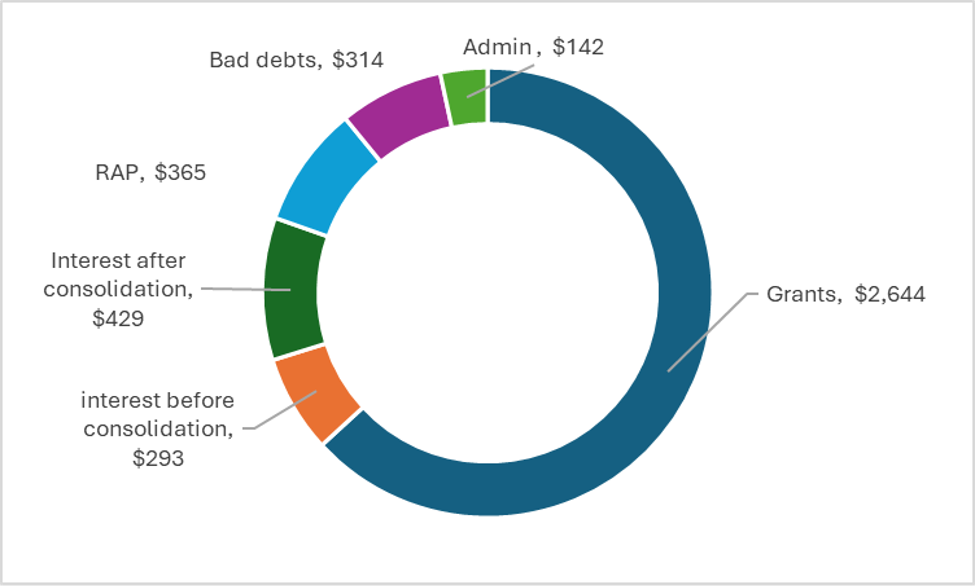
    Let’s now head over to CSFAP spending and see how that might fare. It’s a bit more complex than CESG so it’s worth looking at its basic cost-structure. Using data from the CSFAP’s 2023 Actuarial report, it’s possible to look at overall direct program costs, as shown below in Figure 1. Technically, this is not a full state of program costs because there’s another billion or so in “alternative payments” to jurisdictions that do not participate in the CSFAP (i.e. Quebec, Nunavut and the NWT). But since this sum is calculated as a fraction of direct programs, we can more or less ignore them here – a 15% cut of the direct costs automatically translates through to a 15% cut in alternative payments as well. And our target number – given that CSFAP direct expenses are about $4.2 billion – would be about $628 million.

    Figure 1: Major areas of CSFAP spending, in millions, 2023-24

    So where do you carve out that much money from CSLP? Well for starters we could and should get rid of the $429 million we spent eliminating interest on loans after graduation. These subsidies do nothing for access; rather, they boost the incomes of middle-class 20–30-year-olds who have already finished school. And it is not a long-standing program. It is, in fact, a quite recent thing, announced by then-finance minister Chrystia Freeland in 2023 when the Liberals were desperately trying to throw a bone to house-poor urban twenty-somethings who at the time were threatening to vote not-Liberal. Now cutting this wouldn’t be a straight $429 million savings – loss of that subsidy would likely lead to increases in bad debt and Repayment Assistance program (RAP) charges somewhat. So, let’s call that a $350M win.  

    Where to find the other $275 million? Not administration: most of the admin money is tied up in payments to provinces for running the front end of the program or to the National Student Loans Service Centre (an outsourced agency which resides over by Square One in Mississauga for running the back end), neither of which can easily be changed in the short term. Maybe you could lose a couple of million in staff costs but not much more. Very little you can do about bad debts either.  RAP and interest subsidies before consolidation could be made less generous. In particular, the income threshold for access to RAP could be brought back down from the current $45K (roughly – it depends on family size) to say $38K, and interest during school could be brought up from zero to the current inflation rate or the government rate of borrowing (i.e. somewhere between 2 and 2.5%). I don’t have access to detailed financial figures on this, but my guess is that the RAP measure might save $50M or so; in-school interest might get you $100M.

    That still doesn’t quite get us to the required $625 million, so the only option left here is to start hacking away at grants. A straight cut in the maximum grant would be the easiest way to cut costs; bringing that down from $4200/year to, say, $3500/year would reduce spending by something along the lines of $400M/year. Another and more likely option would be for the feds to copy what Doug Ford did when he wanted to contain student aid costs – change grant eligibility criteria in such a way as to make grants harder to obtain. The obvious way to do this, I think, would be to change the rules for dependent/independent student status (i.e. the point at which students are considered to no longer get money from their parents) so that it took students five years to reach such independent status instead of four. I am not exactly sure how much that would save, but I’d wager it would be a minimum of a quarter-billion. 

    So, your menu of cut options for cutting CSFAP is, essentially:

    Bring back interest after graduation $350 million
    Admin $3-5 million
    Reduce RAP threshold to $38K $50 million
    Introduce in-school interest of 2.5% $100 million
    Cut maximum grants by $700/year $400/million
    Change definition of independent student $250 million

    (To be clear here, I am guessing a bit on some of these numbers. Intelligently, I hope, but they are guesses. Don’t take the numbers here as gospel. And if any friends at CSLP want to correct me, please do!)

    If it were me, to get to (roughly) the required $625 million I’d bring back interest after graduation – or introduce an equal-to-government-rate-of-borrowing interest rate for the entire life of the loan, which probably ends up with similar savings – and change the definition of independent students. Neither are pleasant but these are the ones that would probably affect access the least.  

    (Again, the Liberals may choose not to cut anything in CSFAP, because hey this is an income security program of a sort, and if we’re obsessing about “affordability” – but that just means cuts elsewhere in the portfolio will be larger).

    Of course, ESDC is much more than these two programs. Take a gander at the full list of programs the programs the Ministry runs (I make it about fifty if you include everything). A lot of those are scattered skills initiatives like Youth Employment and Skills, Indigenous Skills and Employment Training, the Skills and Partnership Fund, Skills for Success Program, the Innovative Work-integrated Learning Initiative. I have no idea what most of these do exactly, nor is it easy to access any budget data about them. But let’s put it this way – few of these programs have a particularly large policy constituency to back them up. My guess is that cuts across these programs will be significantly higher than 15% and some of them may cease to exist altogether.  

    Enough for today.  Tomorrow we’ll do research funding.

    Source link

  • The Coming Federal Cuts – Part 1

    The Coming Federal Cuts – Part 1

    The biggest thing everyone is going to be talking about this year – barring another university doing a surprise Laurentian – is the set of federal cuts coming down the pike. They are big. And they are nasty. So, it’s worth understanding exactly the scale of what is heading in our direction. This is going to be a three-parter. Today, I will talk about the overall size of the cuts to come, and on Tuesday and Wednesday I will talk about how this will affect the two ministries that have the most to do with post-secondary education: Employment and Skills Development Canada (ESDC, tomorrow) and Innovation, Science and Economic Development Canada (ISED, Wednesday).

    So: we don’t know the exact scope of the budget cuts the government is contemplating. What we do know is the following:

    Preliminary budget figures for Fiscal 2024-25 show that the government of Canada posted a budget deficit of $43.2 billion on revenues of $495B, program expenses of $480B, debt charges (that is, interest on existing debt) of $54B and actuarial losses of $4B. We didn’t have a budget this spring, but spending projections for 25-26 from the 2024-25 budget show a projected deficit of $39 billion on revenues of $515B, program expenses of $496B, debt charges of $55B and actuarial losses of $2B.

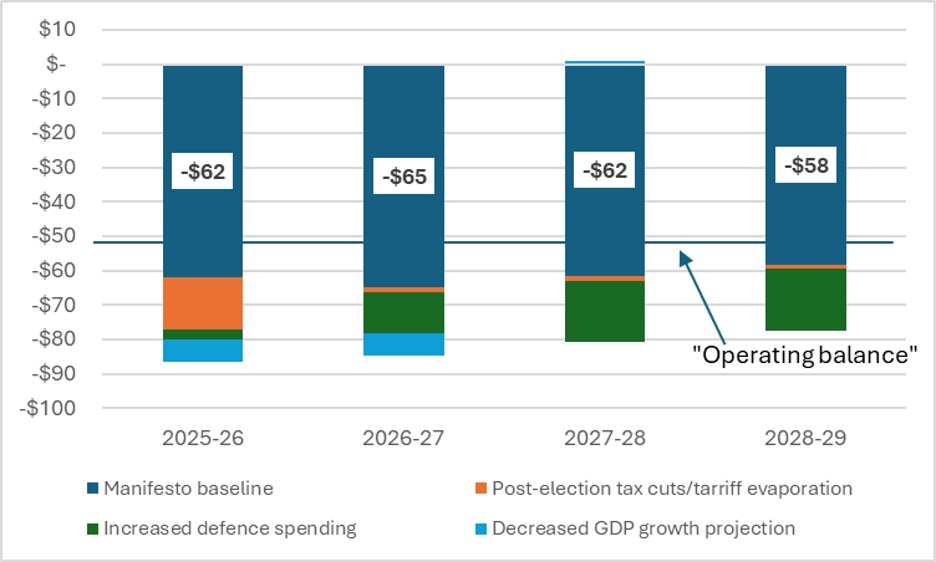
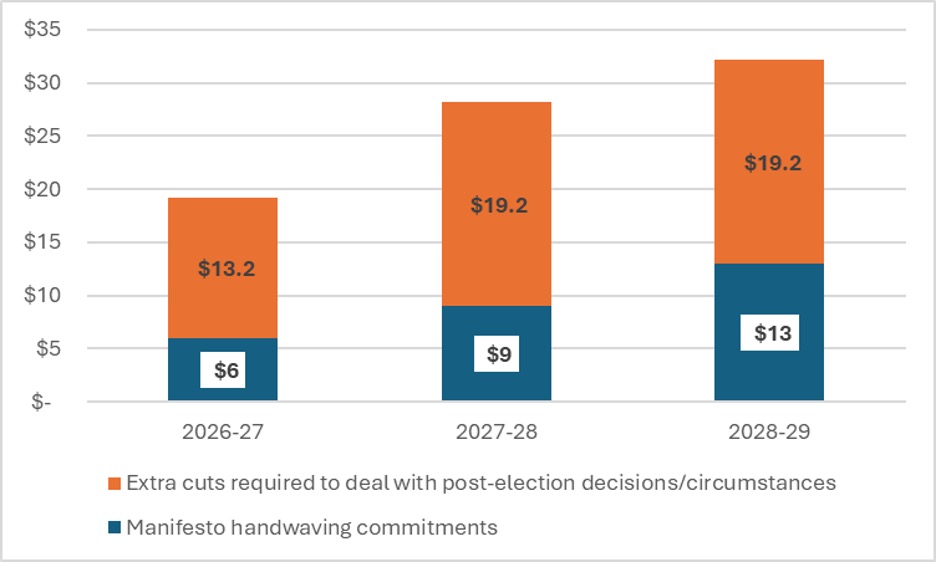
    The Liberal Manifesto for election 2025 planned deficits of $60 billion or so right through to 2028-29. Its fiscal plan was basically i) existing spending commitments, ii) 30-odd billion in new spending and tax cuts and iii) tiny revenue changes, plus $20 Billion or so in counter-tariffs for 2025-26. (Yes, they also promised “savings from increased productivity” – otherwise known as “frantic handwaving” – of $6B, $9B and $13B in fiscal years ’27, ’28 and ’29. I am excluding them here but will return to them in a sec).

    Figure 1: Government of Canada fiscal picture according to the Liberal manifesto, minus the handwaving, in Billions.

    (The foregoing might all sound strange to those of you who recall Carney making pledges about balanced budgets. But, of course, as I pointed out back here, he never actually promised that. He promised balanced operating budgets, that is budgets with an only vaguely defined “capital spending” netted out. By a complete coincidence, the Liberal platform claimed the government spent roughly $50 billion in capital, so basically the government is already basically in balance.  Neat trick, but not sure bondholders will see it that way. I digress.)

    Since the election, a few things have happened. Counter-tariffs are not collecting anything like the $20 billion forecast, we ditched the Digital Services Tax in a futile attempt to get the Americans to be nicer to us, and, most importantly of all, the prime minister promised to up defense spending by about $18 billion over the next four years in order to reach 2% of GDP by 2028. That means the actual fiscal picture, before any handwaving about savings, looks like this:

    Figure 2: Government of Canada fiscal picture, according to the Liberal Manifesto, minus the handwaving, including proposed spending and tariffs since April 28, in Billions.

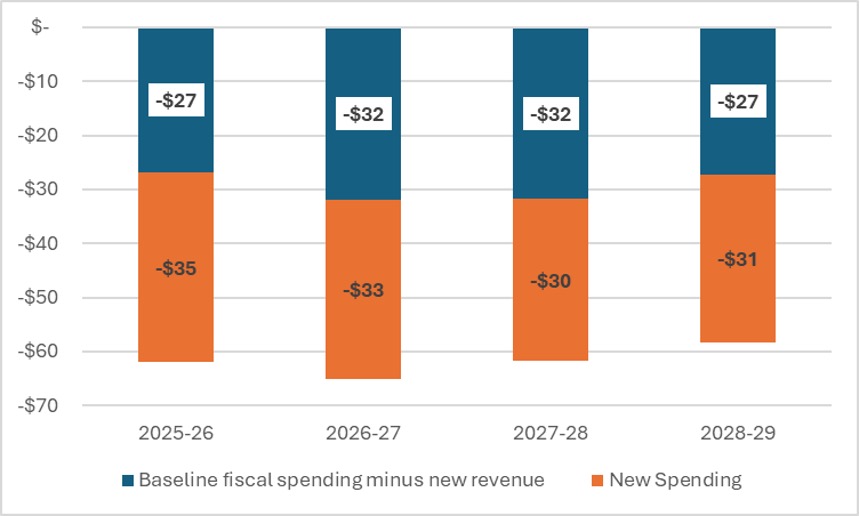
    As you can see, we are a lot further away today from “operating balance” (i.e. a $50B deficit) than we were when Carney was elected. And this is where the handwaving/cuts come into play. So, let’s start thinking about how much money it would take to keep us at “operating balance”. In Figure 3, we see that by 2028-29, we are looking at about $32 Billion in cuts. The handwaving “efficiencies” in the Liberal manifesto were meant to cover just $13 billion of that, leaving another $19.2 billion or so to be made up, somewhere, somehow.

    Figure 3: Cuts Required Just to Keep the Government of Canada at Operating Balance (i.e. a $50B deficit), By Source, in Billions.

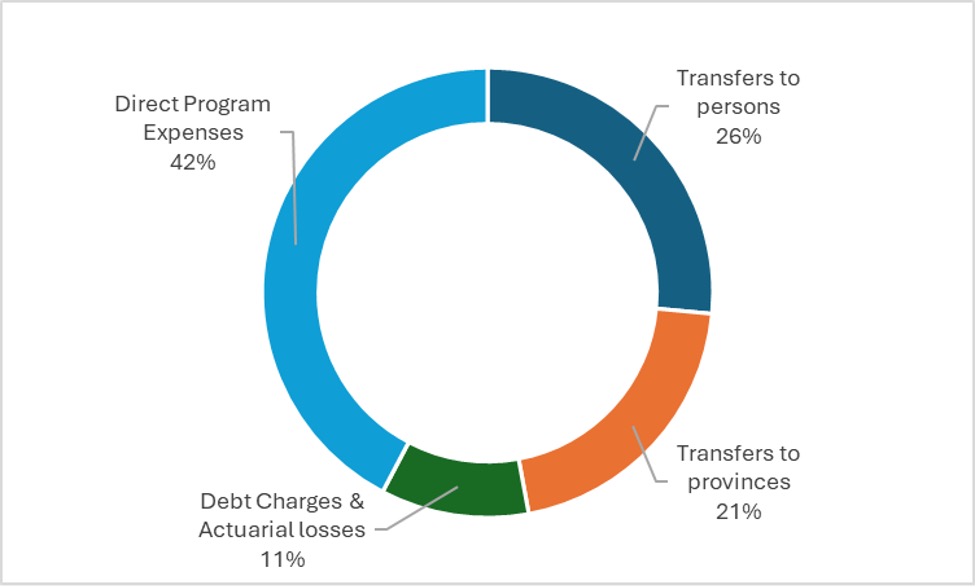
    I said “somewhere”, but there isn’t much mystery here. As Figure 4 shows, you divide government spending into four categories: debt charges (which the government has to pay regardless), transfers to provinces (which Carney has promised he won’t touch), transfers to individuals (ditto) and then “program spending”. As Figure 4 shows, the first three areas make up 58% of total spending. That means that the last area, program spending, is going to take up the entirety of these cuts. In 2025-26, program spending is estimated at $227 billion; a $32 billion cut to that equals an overall reduction in program spending of 14% by 2028. (Coincidentally, this was more or less exactly the size of the program cuts in the “savage” 1995 budget – $7 billion phased in over three years on a base budget of about $52 billion. Government grew back, as you can see.)  

    Figure 4: Government of Canada Expenditures by Category, 2025-26

    It’s worth being careful here. Overall program spending is $227 billion, but $46 billion of that is currently being spent on defense and housing, two areas that are almost certainly immune to cuts given the government’s overall priorities. Excluding these two fields from cuts means that the field of “cuttable” programs shrinks to $181 billion, and the size of the cuts required to meet the $50 billion target balloons to 17.7%.  

    This brings us to the program review that has been going on in Ottawa since July. Recall that Minsters were asked to bring forward scenarios that involved cuts of 7.5% for next year, 10% the year after that and 15% the year after that. Many thought initially that these numbers were deliberately overdone so that big cuts could be made in some departments so as to shield other departments from having to do the same. Now I am not so sure. That 15% target is awfully close to the 17% overall target the Liberals need to hit just to keep the deficit at $50 billion, and so I am starting to think that in fact the cuts might not be dispersed unequally between departments. They might really need 15% from everybody – and then some.

    There are a couple of alternatives of course that could lessen the blow. For instance, while Carney promised not to cut transfers to provinces, to my knowledge he never ruled out cutting the rate of growth of transfer payments (currently about 5% per year, across CHT, CST and equalization combined). Slash that in half and you’ve got yourself another $8 billion to play with by 2028, thereby reducing by a quarter the required amount of program cuts. Something similar could be achieved by de-indexing pensions for a couple of years. Or, unlikely as it seems, the Government could actually increase taxes (elbows up requires some sacrifices, no?). But, absent those measures, I think we need to seriously brace for impact. These cuts are real, they are huge, and even if they don’t hit this fall (it’s not impossible that the alleged fall budget might actually just be the usual fall economic statement under another name), they are for sure going to hit in early 2026.

    The question, really, is, what needs to be saved? What should the sectors’ priorities be? I’ll discuss that over the next two days.

    Source link

  • What’s coming up for HE policy in 2025–26

    What’s coming up for HE policy in 2025–26

    It was early November 2024 when Secretary of State for Education Bridget Philipson issued her edict to heads of institution in England, confirming the government’s plans to increase the undergraduate fee threshold to £9,535 from 2025–26, and setting out her five priorities for higher education.

    Ten months on and there remains not a great deal of additional flesh on those bones. The planned summer white paper on post-16 education and skills, incorporating HE reform, has been pushed to the autumn. In the interim, while the Office for Students (OfS) has stepped up its work on financial sustainability, it’s clear that the government is not minded to ride to the rescue of the sector at system level, whatever it might decide to do about financially challenged institutions.

    The Spending Review was accompanied by the announcement of a further squeeze on the Strategic Priorities Grant. The immigration white paper proposed a six per cent levy on international fees. The prospect of an ongoing annual inflationary fee threshold uplift remains unconfirmed. And the rollout of the Lifelong Learning Entitlement, while potentially paradigm-shifting in the long term, offers mostly short-term pain and expense for rather limited gains.

    This area is getting greyer

    Though ministers probably wouldn’t articulate it like this, at stake is the status of higher education as a “public realm” sector. It’s not currently politically or economically advantageous for government to be seen to take seriously the sector’s financial concerns even where there are signs of systemic weakness in the funding model. That pragmatic (or cynical, if you prefer) position is bolstered by a regulatory framework that views higher education providers primarily through the lens of service provision to students rather than as public institutions providing a range of public goods in places.

    Yet for a government that is politically and economically concerned with the provision of public goods in places, nor is it especially politically palatable to lean into the notion of independent higher education providers doing whatever they can to ensure their own success and sustainability rather than acting with reference to wider common purposes.

    There’s often a strong degree of overlap between institutional interests and the public interest – arguably one critical dimension of higher education leadership is being able to locate and occupy that common ground. Two things can be true: institutions can, and do, pursue both their own self-interest and the common good, simultaneously. And discussion of abstract concepts like public and private obviously ignores the actions and motivations of individual institutions, many of whom go to quite a lot of trouble and expense to work with and for the interests of their stakeholders.

    But at system level what you think an “HE reform package” should include depends very much on how much you think the private interests of HE institutions diverge from the wider public interest, in what areas of activity, and the extent to which you think the government can or should do something about it. And I don’t think those questions have yet been resolved in the corridors of power, where arguably the locus of responsibility for “higher education” as an object of policy remains scattered.

    It is relatively easy to point to examples of where the HE market model has created areas of concern – particularly when it comes to loss of subject diversity in particular regions or localities, or a lack of a subject offer in an area of known skills gaps, or to the rising costs to students and parents of sustaining full-time study, or to the risks to academic quality arising from particular modes of delivery or from instability in institutional finances. It’s much harder to articulate a policy settlement that articulates appropriate, measured, inexpensive and effective government intervention at system level to realign institutional and public interest where there appears to be divergence.

    In particular, when it comes to questions of “transformation” – in the sense of individual institutions changing their academic portfolio, or use of technology; in the sense of institutions joining together to create efficiencies or realise additional value from scale or coordination; and in the sense of the future overall size and shape of the sector – the role of government remains opaque. It may be possible that “transformation” will happen in response to market demand and financial pressure and be funded from private sources. It may also be possible that “transformation” will only occur with some active convening (and financing) from government. Whatever the claims made about what ought to be happening, nobody really has a firm view on how much transformation is really required, what it should look like, or whose responsibility it is to make it happen.

    It’s possibly not all that surprising, then, that what has emerged from government on higher education in the last academic year has been rather “bitty” – to use the appropriate technical term. A consultation on franchised provision here, a revision to free speech legislation there, a slide deck on preparing for the LLE over here, a cheeky new levy over there. Don’t expect a grandiose new vision for HE to emerge this year; instead turn your mind to deciding whether the sum total of all the things that will be occupying minds in the year ahead add up to something that equals a material change of state for the sector.

    It’s all coming up

    When the post-16 education and skills plus HE reform paper does show up, it will almost certainly hit some familiar notes: regional economic growth; skills; opportunity. We know there’s an appetite in government to think about “coordination” of post-16 providers in places and an aspiration to deploy a more coordinated approach to streamline everything from the regional skills offer to employer engagement.

    Policy architecture available includes the Devolution Bill, Skills England, the planned Growth and Skills Levy replacing the Apprenticeships Levy, and the Lifelong Learning Entitlement – as well as OfS’ signals on a shift to a more regional approach to widening access. There is significant support in principle for the notion of coordination for the benefit of places, but a glaring absence of ideas of how independent providers might be not only brought to the table but arrive at a consensus about who should offer what kind of education opportunity to whom.

    Also potentially in the mix for an “HE reform” package, if Bridget Phillipson’s priorities haven’t shifted in the last ten months, are academic quality, civic engagement, and efficiency. The Department for Education has not yet said what its plans are with regard to tightening up oversight of franchised provision, following its consultation earlier this year, so that may well appear also. OfS is already planning to consult on its planned new integrated quality framework in the autumn, so assuming there is effective coordination between government and the regulator there should be alignment between what the government proposes and what OfS consults on.

    One wild card to look out for is institutional governance – OfS has signalled in the past year that it has concerns about the ability of boards of governors to effectively manage financial sustainability challenges, whether that is in securing academic quality under pressure or retaining effective oversight of new partnerships and income streams, and that concern has been reinforced in communications from DfE. While it would be surprising to see government take a view on the constitution of boards or on the codes of practice they are encouraged to adhere to, it would not be entirely unexpected to see a request for OfS to further extend or strengthen regulatory oversight in this area. Elsewhere on the site, incoming Advance HE chief executive Alistair Jarvis has signalled some key priorities for development in governance within weeks of taking up the role.

    A further wild card would be something on graduate employability – previously ministers have suggested that institutions whose graduates do less well in the labour market by the current measures should cut the pay of their heads of institution. While that’s a proposal that obviously plays well for media, it doesn’t amount to a serious policy. But with (probably wildly overstated) concerns doing the rounds about graduate jobs and AI, and (much more sensible) questions about the value of graduate skills in different parts of the country feeding directly into ideas about equity of opportunity, government may well feel this is an area it wants to make a target for policymaking.

    Doing more with less

    The future of research funding seems increasingly lashed to the mast of economic growth. It is the golden thread that runs through UKRI’s latest plans, the basis of the industrial strategy, and UKRI rates financial sustainability within the research system as high risk and high likelihood.

    2025–26 is going to be about who gets paid, on what basis, and how the impact of the resulting research activity will be measured. Everyone’s favourite forever debate, the future of REF, fits neatly within this financial triangle. 2025–26 should bring certainty, if not consensus, on the shape of the next REF, even if the overall sum up for grabs is a fraction of the overall R&D budget. Given the timescales involved in REF it is likely that there will be some kind of announcement in the next few weeks on its future.

    Place is going to continue to be the primary lens through which economic growth is discussed. The Local Innovation Partnership will launch this academic year with at least £30 million for each of ten regions across the UK, including one in each of the devolved nations. The success of the industrial strategy is entirely reliant on improving productivity across the country so expect to see new funds, tweaks to existing funds, debates on devolutions deals, and a raft of place based initiatives coming from the sector.

    Once UKRI’s new mission leads are in post, along with UKRI’s new chief executive who is now in his role, the sector should have a clearer sense of how their work will align with the government’s missions. It would be refreshing if the new personnel also usher in a new era of stability across the research ecosystem. The evolving work into research evaluation may prove a useful tool in this mission.

    Of course economic growth is limited by the financial reality universities find themselves in. There is lots of concern about full economic costing (FEC) but very little action on reducing the financial burden of research. There are clear signals of reduced capital spending and following UKRI’s outgoing chief executives statement on the possibility of research consolidation it looks like frugality will continue to be a reality for many.

    Away from home this version of Horizon Europe enters its penultimate year with the UK’s entrance to the new scheme the government’s preferred option. The ongoing trampling of academic norms in America will continue to shape UK-US partnerships while the future of UK-China research partnerships will once again be at the mercy of global politics.

    At a more institutional level an outcome on the publishers agreements negotiations between the sector and five of the major publishers looks to be coming to a head. The sector currently spends £112 million annually on Jisc negotiated agreements with the five largest publishers. A decision on whether to accept or reject the publishers proposals is due imminently. If the offer is rejected there will be significant pressure to find agreement or an alternative before the end of the current deals in 2026.

    Source link

  • What’s coming for higher education in the spending review?

    What’s coming for higher education in the spending review?

    The breadth of what we expect from the public sector is such that expertise needs to be distributed around the civil service.

    There are numerous costly initiatives, allocations, and activities fueled by state spending – all of them have advocates and skeptics, and hidden pitfalls and tensions.

    Even if there was a single brain that had a grasp of everything, how would that person weigh up the costs and benefits of spending on lifesaving drugs against maintaining housing benefits? Or expanding school breakfast clubs against meaningful support for public libraries? Or properly maintaining research infrastructure against properly maintaining flood defences?

    A spending review is an exercise in compromise – a search for the least worst answer – that almost by design disappoints nearly everyone. If there’s good news in one area of spending, there is pain coming elsewhere.

    Where did spending reviews come from?

    The idea of taking the time every few years to gather together all current public sector spending demands and assess the possibilities for savings feels like it has been around for ever.

    In fact, the first multi-year spending review took place as recently as 1998.

    Before this, UK spending and taxation was decided based on prevailing economic conditions – leading to accusations of short-termism in government thinking. After all it is difficult to plan sustainable programmes of spending with only one year of funding confirmed.

    The first multi-year comprehensive spending review was a Gordon Brown innovation – coming off the back of two years with public sector finance (politically) constrained by the previous government’s last year of allocations, it represented (in the language of the time) an opportunity for a newish Labour government to demonstrate ongoing “prudence”.

    As Brown put it:

    By looking not just at what government spends but at what government does, the review has identified the modernisation and savings that are essential. The first innovation of the Comprehensive Spending Review is to move from the short-termism of the annual cycle and to draw up public expenditure plans not on a one year basis but on a three year basis. And the review‘s second conclusion is that all new resources should be conditional on the implementation of essential reforms, money but only in return for modernisation

    Labour stuck a pattern of three year reviews throughout their last period of office – including another comprehensive spending review in 2007. Under Conservative-led administrations the pattern became more irregular (largely for reasons of political expediency, but also to respond to one off events like the Covid-19 pandemic). The last spending review was in 2021 – three governments (and three Prime Ministers) ago.

    How a spending review works

    The specifics may vary, but the review is a series of conversations conducted by the treasury (usually under the auspices of the Chief Secretary to the Treasury) and each department. Starting with officials modelling the impact of broad-brush cuts at various levels and arguing about what constitutes the work their department is required to do (the ambit) and what (for non-zero based spending reviews) the baseline funding should be, the process ends with ministers taking the argument directly to the treasury – or overhead to the prime minister and via carefully placed stories in the press.

    Eventually – the key date this year was as recent as late May – ministers and the Chancellor will come to a final agreement over what will be allocated and what, in broad terms, it will be spent on.

    Those who have been closely involved tend not to be enamoured of the process – former DfE adviser Sam Freedman recently described it as “demented” and “not a good or strategic way to make decisions about government spending”.

    In 2024

    The current iteration kicked off straight after the 2024 election, with the first part of it announced by Rachel Reeves alongside the autumn budget. Alongside some punchy political lines (that “£22bn black hole” for one) she confirmed the overall envelope for the spending review:

    Day to day spending from 2024-25 onwards will grow by 1.5 per cent in real terms, and total departmental spending, including capital spending, will grow by 1.7 per cent in real terms.

    We also got some broad promises on education spending – an extra £300m for further education, a £2.3bn increase in the schools core budget and a reform of special educational needs provision. However, the Institute for Fiscal Studies is warning that given other promises, most notably on defence and health, “unprotected” DfE recurrent spending (which would include spending on higher education) is likely to fall by around 3 per cent over the three years the review covers – and significant schools and FE spending (which the government is likely to want to protect) also appears within that bucket.

    Higher education is by no means alone in facing a very tight multi-year settlement – but it suffers in terms of public salience. While, thanks to the efforts of universities and trade unions, there is a general consensus that the sector is struggling it is neither as totemic (NHS, schools, defence) or visible (local services, adult skills, social care) as the recipients of other public spending. There’s been a lot of work done in making the arguments for investment, but these arguments are never going to be as strong as they need to be.

    That’s (flat) capital

    What Reeves appears to be promoting in the run up to the review is the availability of capital. Traditionally, spending reviews have only addressed departmental expenditure limits (DEL) – recurrent funding that can reasonably be controlled by the department in question – involving capital spending only really started in 2020 and 2021. Changes to, for example, eligibility rules for benefits can also have an impact on recurrent annual managed expenditure (AME) and spending reviews have moved further in that direction in recent times.

    Capital is more traditionally allocated and spent in fiscal events – it makes for big numbers and eyecatching infrastructure investments and doesn’t usually form a part of the spending reviews, but it was always in scope for 2024 to set capital budgets for at least five years.

    And the big sector-focused news has been about research and development funding. While by no means all R&D funding goes to universities, a substantial proportion will end up there – and the news that the overall allocation for R&D will keep pace with inflation until 2029-30 is undoubtedly good in the context of a very tight overall recurrent settlement. As my colleague James Coe sets out elsewhere on Wonkhe, there are other calls on R&D beyond the traditional UKRI allocations (though we know UKRI allocations will be broadly stable this year): there are calls for increased spending in defence research, there will be small (£30m to each current mayoral strategic authority) regional allocations, and there will likely be funding streams attached to each of the government’s missions.

    Recall also, the manifesto promise of ten-year funding settlements for some research activity. Five years of flat (inflation-compensated) funding represents exactly the kind of stable and predictable income that some parts of the sector have been asking for – if there are people unhappy with that, promising stability for ten years isn’t going to feel much different.

    Teaching funding

    Fans of the national accounts will know that the majority of funding allocated to teaching in higher education (the student loan outlay) is, in fact, AME capital. There has been some initial hope that the portion that isn’t (the recurrent DEL that is allocated via the grant letter to the Office for Students) would form a part of the long promised review of funding – but this looks less likely than a commitment to continue inflationary fee-cap uplifts alongside measures to improve efficiency in spending (rooting out fraudulent applications and suchlike, promoting shared services).

    The parallel is with funding for 16-19 students – an extra £190m will push per-student funding up an inflation-busting 5.9 per cent next year, to £5,105. The recurrent funding simply isn’t there to do anything like that for direct higher education funding, but using an increase in capital spending offers a release valve via the tuition fee loan mechanisms.

    Fee increases would be unpopular (a tax on aspiration, if you like) with young people and their parents. The temptation would be to favourably tweak the conditions of repayment, and there may be some headroom here – if you recall last year’s earnest and sporadically understood talk around PSNFL in the fiscal rules, one of the upshots was that loans count as assets, and the more loans we have the more (in the short-to-medium term at least) assets we have. While this could fuel a further expansion of the sector, the current policy weather suggests that this flexibility could instead be used to offer young people a better loan deal.

    On the day

    While a multi-year spending review is an exercise in demonstrating the long term planning capacity of a government, the event itself has to interface with the short-term news cycles. There needs to be some good news in there – and the pre-announced transport capital, R&D capital, and above-inflation settlement for health are part of that.

    Good news could also take the form of announcing popular savings. Very few people will be disappointed in cuts to bureaucracy (at least in the short term, people do tend to become very upset when waiting times rise and services become less effective) and measures to address fraud. Here we’ve already heard a lot of mood music around fraud within the higher education funding system – the very high profile case of Oxford Business College suggests that ministers see the opportunity to better manage the current allocations of funding, and there is a consultation response ready to drop. We’d assumed this would come alongside the promised white paper, but I wouldn’t be surprised to see at least headline proposals sneak out earlier.

    Finally we have the broader favourite that is “efficiency” savings. Universities have been very engaged with this agenda ever since the HE Reform letter – the conjunction of the Universities UK report, the release of TRAC data (slightly delayed over last year), and the spending review may not be entirely coincidental.

    Source link

  • For women athletes, world recognition is a long time coming

    For women athletes, world recognition is a long time coming

    Last year was arguably the best year for women’s sports yet.

    According to data analysis company S&P Global, in-person attendance and viewership were higher, with women’s professional sports sponsorships increasing by 22% since 2023. According to UN Women Australia, globally, there has been a lack of interest in women’s sports. But it seems that they might finally be getting the attention they deserve.

    To find out what is driving this change in attitude towards women’s sports, I interviewed 10 women athletes across high school, university, and coaching. 

    Historically, women’s sports have not gotten the recognition that they deserve. However, during 2024, women’s collegiate basketball had a significant increase in viewership compared to the previous year. The Final Four game in 2024 was a showdown between two players from two U.S. universities: Caitlin Clark of the University of Iowa and Paige Bueckers of the University of Connecticut. The game drew in a peak audience of 16.1 million, according to an article in Sports Illustrated

    Women’s media coverage has tripled since 2019. At this rate, if coverage trends continue, women’s share of coverage could reach 20% by the end of this year, according to Women.org, an organization within the United Nations devoted to gender equality and the empowerment of women. 

    Gender parity in sports

    The Paris Olympic and Paralympic Games were officially the first to see 50:50 coverage in gender equality.

    Avery Elliot, a track and field athlete from the University of Pennsylvania, attended the Paris Olympics as a spectator and said she noticed the change – more social media presence and sponsorships, particularly highlighting women of color, especially in women’s gymnastics, spurred by the popularity and success of U.S. athletes Simone Biles and Jordan Chiles and Brazilian Rebeca Andrade. 

    The lack of media coverage of women has always played a role in the lack of recognition that they receive. Lanae Carrington, a track star at Lehigh University in the U.S. state of Pennsylvania, said that in the past, women athletes would get dismissed for getting a low number of views or for the belief that women’s games were not as entertaining as those of men. “Overall, women are making a stronger impact in the entertainment industry, whether that’s more highlight reels on TikTok or screen time on TV,” Carrington said. “It’s finally becoming normalized.” 

    One of the hardest things to deal with as an athlete is a lack of support, whether from the media, in person or on the sidelines. 

    Brianna Gautier, a volleyball and basketball sensation at Neumann University in Pennsylvania, said it is hard to play a game where you’re not going to have a full house. “But it’s kind of helped me learn to just play for myself instead of waiting for people to show up and relying on that to bring some type of energy because I feel like it starts within you and your teammates,” she said.

    Play for yourself first

    As a track and field athlete, I have seen this firsthand. It is unfortunate to see people walk away after the men are finished competing. But I found that when you start showing up for yourself with energy, success comes rolling in. Gautier has embraced the idea of playing for herself and nobody else.

    It used to be that at Neumann, people would attend the men’s basketball games but never stay afterward to support the women. She also expressed the importance of the support of NBA players such as Steph Curry, who came out to watch several women’s Stanford basketball games in 2023. Gautier said that people think to themselves that if their favorite male basketball players are tuning in to watch women’s sports, it must be worthwhile. 

    Carrington said parents also need to support their daughters in athletics. “This is important because many girls don’t have parents who encourage them to play more traditionally masculine sports, such as basketball and soccer,” she said. 

    Most of the women I interviewed commented on the change in the WNBA as the catalyst for the change in women’s sports.. 

    Liz Spagnolo is a soccer player at Tower Hill High School in the U.S. state of Delaware who appreciates the opportunities she now has. “Women in sports is big for us because based on women 100 years ago, we wouldn’t be expected to play sports, or be expected to do something like cheer,” Spagnolo said. 

    The Caitlin Clark effect

    Arianna Montgomery, an athlete at The Tatnall School, the private school in Delaware that I also attend, said she appreciates the change in women’s basketball.

    “It’s gotten a lot more fame, definitely more college sports have gotten a lot more fame,” Montgomery said. “I think women’s games are starting to become more popular. People are starting to look more towards women’s sports as well as men’s sports, and even since before, instead of men’s sports now, a decade ago, that wasn’t the case.”

    Many of the women I spoke to said that a big contributor to the success of women’s sports is due to the Catlin Clark effect. The Caitlin Clark effect is a term that was created after her record-breaking seasons playing women’s basketball at the University of Iowa during the years of 2023-2024.

    As a result, she has become the all-time leading scorer in college basketball before entering the WNBA,  and has reportedly signed sponsorship deals worth more than $11 million. 

    Ruth Hiller, a lacrosse coach at my school said that are a number of successful women athletes that young women can now look up to, including tennis superstars Venus and Serena Williams and Alex Morgan, the former captain of the U.S. women’s soccer team, women’s tennis pioneer Billie Jean King and Charlotte North, a professional lacrosse player who broke the all-time goals record in college lacrosse. 

    Women now rack up medals and points

    Daija Lampkin, my track and field coach, pointed to Alison Felix, who won more medals than any other U.S. track and field athlete, and tennis superstar Serena Williams.

    It is important, Lampkin said, that women support women. “Our body is critical, and some women are self-conscious that they are going to be muscular,” Lampkin said. “It can tear down your confidence. It’s not talked about in sports how women look at their bodies. People tear down Serena Williams and her body all the time, but look at where she is and how much she has accomplished”. 

    I have been participating in sports since I was 3 years old, when my parents signed me up for gymnastics. I run track and field and am a runner, jumper and hurdler. I began training for track and field competitions at the age of 8, and my dad has been my coach since the very beginning. 

    In my experience, my father was instrumental in encouraging me to participate in dance and gymnastics growing up, while also encouraging me to run track and play basketball and soccer for fun.

    With opportunity comes pressure, and Gautier said it is important for girls not to put too much pressure on themselves. “When you are an athlete, you tend to feel that you have to perform a certain way to be successful or please everyone else, but I feel you kind of get blinded by the fact that you are doing it for yourself,” she said. 


    Questions to consider:

    1. Why have women not gotten the same recognition and pay as male athletes in sports? 

    2. What does “parity” mean when it comes to gender in sports?

    3. Should there be any differentiation when it comes to gender in sports and why?


    Source link

  • In an era of permacrisis, higher education needs to get better at coming up with solutions

    In an era of permacrisis, higher education needs to get better at coming up with solutions

    Readers of Wonkhe need no reintroduction to the storm surge of bad news that, wave after wave, is washing over the sector’s defences and causing the majority of UK institutions to take drastic financial evasive action.

    Given that the government’s response to the growing financial crisis in UK higher education seems to be “let’s do a ranking of vice chancellor salaries compared to graduate salaries” and “let’s introduce an international student levy that the Australian Government decided was a bad idea,” it also seems pretty clear that the sector isn’t exactly cutting through with its political affairs arguments.

    In other words, the sector has to generate our own solutions to the problems we face.

    On the back foot and retreating

    On 25 June The Venn University Leaders Forum will convene senior academic and professional service leaders from across the sector to provide them with the space, inspiration and facilitation needed to help develop these solutions.

    The Venn will feature interactive sessions focused on geopolitical scenario response, unconferences, challenges “from the vice chancellor’s desk” and perspectives from North America and from outside higher education. Most importantly it will take the conversations in the margins’ of conferences that so many of us find the most valuable part of these forums – and provide the space and format for that to happen during the main programme.

    We need a better playbook

    In adjusting to permacrisis, one of the challenges universities and the sector has as a whole is that we risk spending all our time and energy raising the shield to fend off each individual wave of issues; and wielding the sword only in a defensive, reactive measures to trim staff numbers, cut courses and reduce expenditure.

    There are two risks to this approach. First, institutions can’t “take a breath” to think about how they adapt to the new reality, leading to constant reactive churn, burnout of staff, and leadership feeling under siege. This reminds us of that moment in about February 2021 when the adrenaline of dealing with successive Covid impacts and new variants started to seriously ebb away from those within universities, and institutional leaders started to think longer term about how to turn ‘crisis-response mode’ into ‘crisis-as-usual’.

    Second, the sector misses the tsunami lurking on the horizon and fails to invest in measures that either avert or prepare for a much larger impact. Given that on almost every occasion in the last decade we’ve said, “oh, that couldn’t possibly happen” only for the Darkest Timeline to be victor – it’s now odds-on that a Farage-Badenoch ticket will sweep to victory in the next General Election. How is higher education preparing for this possibility?

    “Telling people what do” isn’t working

    When I was in the US recently as part of the CASE Global Leaders Programme, a senior representative from one of the US university associations said they had a shared bingo card with their colleagues that they used every time a university president said “we just need to tell our story better… we need a ‘Got Milk’ campaign.” But we’ve been trying versions of that for a while, and nothing has changed. It’s no longer sufficient for higher education to “tell” better. It needs to “do” better.

    For universities, the question is now no longer “how do you do more with less?” Instead, it is becoming “how do you do less with less?” – and what do you stop doing entirely? As difficult as the current situation may seem, the sector still has the resources, political capital and ingenuity to make bold, impactful choices about what it does differently. This includes new models of delivery that might change the public and political narrative, shift the dial financially and maybe even divert the worst case scenario. Critically it has the opportunity to look at what is happening around the world – most strikingly in the US – and learn what to do (and what not to do).

    This article is published in association with The Venn – find out more about The Venn and apply to attend here. Wonkhe is partnering with The Venn to create a dialogue between the event and our upcoming Festival of Higher Education on 11–12 November – early bird tickets are now on sale.

    Source link

  • “The accreditors are coming!” 4 ways to use student satisfaction scores to prepare

    “The accreditors are coming!” 4 ways to use student satisfaction scores to prepare

    Does your campus fully utilize its student satisfaction scores at accreditation time? As a reminder, regular assessments of student satisfaction provide data for four key institutional activities:

    • Retention/student success
    • Strategic planning
    • Recruiting new students
    • Accreditation documentation

    The accreditation process can be time-demanding and stressful for your campus staff and leadership, yet it is essential to complete on the designated cycle. And while the official process is something you address once every decade, regularly gathering data from your students and maintaining proactive processes can make the official requirements go much more smoothly.

    My colleague Charles Schroeder likes to say that during self-studies, people on campus begin running around gathering data and shouting, “The accreditors are coming! The accreditors are coming!” To avoid this reaction, our recommendation is don’t just assess student satisfaction as part of your self-study, but assess student satisfaction on a regular cycle, once every two or three years (if not annually).

    4 ways to use student satisfaction scores to prepare for accreditors

    How can you use data from student satisfaction surveys in your accreditation process? I have four suggestions for you.

    1. Match the survey items to your accreditation requirements. As a resource for you, we have mapped the individual items on the Ruffalo Noel Levitz (RNL) Satisfaction-Priorities Surveys (including the Student Satisfaction Inventory, the Adult Student Priorities Survey, and the Priorities Survey for Online Learners) to the individual criteria for all of the regional accreditors across the United States. You can download the relevant mapping document for your survey version and region here. By seeing how the items on each survey are mapped to the regional accrediting agency requirements, you can take  the guesswork out of determining how the student feedback lines up with the documentation you need to provide.

    2. Respond to student-identified challenge items. The RNL Satisfaction-Priorities Surveys identify areas of high importance and low satisfaction as challenge items. These are priority areas for improvement based on the perceptions of your students. By actively working to improve the student experience in these areas, you can potentially improve overall student satisfaction, which studies have correlated with better individual student retention, higher institutional graduation rates, higher institutional alumni giving, and lower loan default rates. Improvements in these areas are going to look good for your accreditation.

    3. Document your student-identified strengths. The RNL Satisfaction-Priorities Surveys also reflect student-identified strengths, which are items of high importance and high satisfaction. These are the areas that your students care about, and where they think you are doing a good job. Mentioning your strengths to your accreditors helps to position you in a positive light and to focus the conversation on where you are meeting or exceeding student expectations.

    4. Show improvements over time. As indicated earlier, student satisfaction surveys should not be a “once and done” activity, or even an activity done just once every five to ten years. The institutions we work with which assess student satisfaction systematically every two or three years, and actively work to improve the student experience in the intervening years, are seeing student satisfaction levels increase year over year. This process shows your commitment to your students and to your accreditors, and reflects that continuous quality improvement is valued by your institution.

    Ready to learn more?

    Are you ready to regularly assess student satisfaction? Are you interested in connecting the results to your accreditation criteria? Do you want to learn more about moving forward with a satisfaction assessment? Contact RNL with any questions you have and we will look forward to assisting you.

    Note: This blog was originally published in November 2016 and was updated with new content in May 2025.

    Source link