Tag: commentary

  • The Arts Aren’t ‘Nice to Have’ — They Can Boost Student Engagement & Attendance – The 74

    The Arts Aren’t ‘Nice to Have’ — They Can Boost Student Engagement & Attendance – The 74


    Get stories like this delivered straight to your inbox. Sign up for The 74 Newsletter

    Chronic absenteeism is a longstanding problem that has surged to troubling levels. Recent data show that in 20 states, more than 30% of students are chronically absent, about twice the rate seen before the pandemic. Absenteeism is a multifaceted problem, and the reasons students stop showing up aren’t always academic. Sometimes it’s because they don’t feel connected to their school, or they are not engaged in the curriculum. Other times, they face adversity outside the classroom. While the problem is complicated, it’s easy to overlook one of its simplest, most effective solutions: What if the key to keeping students is a performance stage, a music room or an art studio — a creative outlet to shine?

    Despite decades of research, arts education is still treated as a “nice-to-have” when education budgets allow. From 2015 to 2019, the NAMM Foundation conducted a four-year study across 1,700 New York City public schools serving over 1.1 million students. They found that schools offering music and arts programming had lower rates of chronic absenteeism and higher overall school-day attendance than those that didn’t. Similarly, a comparison of cohort data over seven years found that dropout rates fell from 30% to just 6% among students participating in consistent arts programming.

    Clearly, the arts are a powerful tool for academic engagement, resilience and, most importantly, graduation. For example, after tracking more than 22,000 students for 12 years, the National Dropout Prevention Center found that those with high levels of involvement in the arts were five times more likely to graduate from high school than those with low involvement.

    But while over 90% of Americans feel the arts are important for education, only 66% of students participate, and access remains uneven. Charter schools, the fastest-growing segment of public education, have the lowest availability of arts courses: Just 37% of public charter high schools offer arts instruction. Students in charter schools, military families and homeschool programs are too often the ones with the fewest opportunities to engage with the arts, despite needing them most.

    This is an issue that the Cathedral Arts Project in Jacksonville, Florida, is trying to solve.

    In partnership with and with funding from the Florida Department of Education, our program piloted a year-long arts education initiative during the 2024-25 school year, reaching more than 400 students in charter schools, homeschools, military families and crisis care. Our teaching artists visited classrooms weekly, providing instruction in dance, music, visual arts and theater. Throughout the year, students in kindergarten through high school found joy, confidence and connection through creative learning. Homeschool students brought history to life through art projects, children from military families found comfort and stability during times of deployment and young people in crisis discovered new ways to express themselves and heal. Each moment affirmed the power of the arts to help children imagine what’s possible.

    To better understand the impact of this work, we partnered with the Florida Data Science for Social Good program at the University of North Florida to analyze reports and survey evaluations collected from 88% of program participants. Here’s what we found:

    Students grew not only in artistic skill, but also in self-confidence, teamwork, problem-solving and engagement. After completing the program, over 86% of students said they “like to finish what they start” and “can do things even when they are hard” — a key indicator of persistence, which is a strong predictor of long-term academic success. Students rated themselves highly in statements like, “I am good at performance.”

    Families noticed, too. In the age of screens, nearly three-quarters reported that their child had increased in-person social interaction since beginning arts programming and had improved emotional control at home. Nearly one-third saw noticeable gains in creative problem-solving and persistence through challenges.

    According to the State of Educational Opportunity in America survey conducted by 50CAN, parents view the arts as a meaningful contributor to their child’s learning, and they want more of it. In Florida, where families have been given the power of school choice, they’re increasingly seeking out programs that inspire creative thinking and meaningful engagement while promoting academic success. But finding them isn’t always easy. When funding allows, traditional public schools may offer band or visual arts, but these options are often unavailable to families choosing alternative education options for their children.

    Now in its second year, our program fills this critical gap by working directly with school choice families across northeast Florida, bringing structured arts instruction to students who otherwise wouldn’t have access. 

    What makes the arts such an effective intervention? It’s structure, expression and connection. When students learn through the creative process, they navigate frustration, build resilience and find joy in persistence. These are not soft skills — they’re essential for survival, and increasingly important in today’s workplaces.

    Arts education is a necessary investment in student achievement. It’s time for other states to treat it that way and follow Florida’s lead.


    Did you use this article in your work?

    We’d love to hear how The 74’s reporting is helping educators, researchers, and policymakers. Tell us how

    Source link

  • What the NAEP Proficient Score Really Means for Learning – The 74

    What the NAEP Proficient Score Really Means for Learning – The 74


    Get stories like this delivered straight to your inbox. Sign up for The 74 Newsletter

    In September, The 74 published Robert Pondiscio’s opinion piece discussing how people without strong reading skills lack what it takes “to effectively weigh competing claims” and “can’t reconcile conflicts, judge evidence or detect bias.” He adds, “They may read the words, but they can’t test the arguments.”

    To make his case, Pondiscio relies on the skill level needed to achieve a proficient score or better on National Assessment of Educational Progress, a level that only 30% of tested students reached on 2024’s Grade 8 reading exam. Only 16% of Black students and 19% of Hispanics were proficient or more.

    Yet naysayers argue that the NAEP standard is simply set too high and that NAEP’s sobering messages are inaccurate. There is no crisis, according to these naysayers.

    So, who is right?

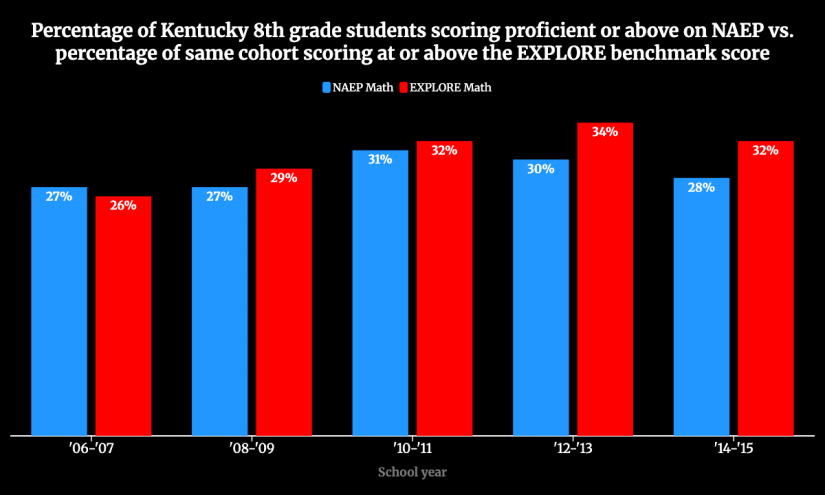
    Well, research on testing performance of eighth graders from Kentucky indicates that it’s Pondiscio, not the naysayers, who has the right message about the NAEP proficiency score. And, Kentucky’s data show this holds true not just for NAEP reading, but for NAEP math, as well.

    Kentucky offered a unique study opportunity. Starting in 2006, the Bluegrass State began testing all students in several grades with exams developed by the ACT, Inc. These tests include the ACT college entrance exam, which was administered to all 11th grade public school students, and the EXPLORE test, which was given to all of Kentucky’s public school eighth graders.

    Both the ACT and EXPLORE featured something unusual: “Readiness Benchmark” scores which ACT, Inc. developed by comparing its test scores to actual college freshman grades years later. Students reaching the benchmark scores for reading or math had at least a 75% chance to later earn a “C” or better in related college freshman courses.

    So, how did the comparisons between Kentucky’s benchmark score performance and the NAEP work out?

     Analysis found close agreement between the NAEP proficiency rates and the share of the same cohorts of students reaching EXPLORE’s readiness benchmarks. ​

    For example, in Grade 8 reading, EXPLORE benchmark performance and NAEP proficiency rates for the same cohorts of students never varied by more than four percentage points for testing in 2008-09, 2010-11, 2012-13 or 2014-15.

    The same, close agreement was found in the comparison of NAEP grade 8 math proficiency rates to the EXPLORE math benchmark percentages. 

    EXPLORE to NAEP results were also examined separately for white, Black and learning-disabled students. Regardless of the student group, the EXPLORE’s readiness benchmark percentages and NAEP’s proficient or above statistics agreed closely.

    Doing an analysis with Kentucky’s ACT college entrance results test was a bit more challenging because NAEP doesn’t provide state test data for high school grades. However, it is possible to compare each student cohort’s Grade 8 NAEP performance to that cohort’s ACT benchmark score results posted four years later when they graduated from high school. Data for graduating classes in 2017, 2019 and 2021 uniformly show close agreement for overall average scores, as well as for separate student group scores.

    It’s worth noting that all NAEP scores have statistical sampling errors. After those plus and minus errors are considered, the agreements between the NAEP and the EXPLORE and ACT test results look even better.

    The bottom line is: Close agreement between NAEP proficiency rates and ACT benchmark score results for Kentucky suggests that NAEP proficiency levels are highly relevant indicators of critical educational performance. ​Those claiming NAEP’s proficiency standard is set too high are incorrect.

    That leaves us with the realization that overall performance of public school students in Kentucky and nationwide is very concerning. Many students do not have the reading and math skills needed to navigate modern life. Instead of simply rejecting the troubling results of the latest round of NAEP, education leaders need to double down on building key skills among all students.


    Did you use this article in your work?

    We’d love to hear how The 74’s reporting is helping educators, researchers, and policymakers. Tell us how

    Source link

  • What Football Can Tell Us About How to Teach Reading – The 74

    What Football Can Tell Us About How to Teach Reading – The 74


    Get stories like this delivered straight to your inbox. Sign up for The 74 Newsletter

    When I go to my son’s football games, I can tell you which team will win — most of the time — just by watching them warm up. It’s not necessarily having the flashiest uniforms or the biggest player; it’s about the discipline, the focus and the precision of their routines.

    A school is no different.

    In my Texas school district, I can walk into a classroom and, in the first five minutes, tell you if effective reading instruction is happening. I don’t need to see the lesson plan or even look at the teacher. I just need to look at the kids. Are they engaged? Are they in a routine? Are they getting the “reps” they need?

    For too long, districts have been losing the game before it starts. They buy a new playbook (i.e., a curriculum) as a “hail Mary,” hoping for a fourth-quarter miracle. Still, they ignore the fundamentals, practice and team culture required for sustainable success.

    Chapel Hill Independent School District is committed to educating all children to compete in an ever-changing world. To that end, we’ve made literacy a nonnegotiable priority across all campuses. We anchor our approach in research-based practices and a culture of continuous learning for both students and staff.

    We’re building for the long run: a literacy dynasty. But our literacy success hasn’t come without putting in the work. We have a relentless focus on the fundamentals and, most importantly, a culture where every player — every teacher and administrator — fits our system.

    Trust the Analytics, Not Your Gut

    In reading instruction, we can’t make assumptions; all instruction has to start with the fundamentals. For decades, instruction was based on gut feelings, like an old-school coach deciding whether to go for it on fourth down or punt based on a hunch. But today, the best coaches trust the analytics, not their gut. They watch the game film.

    Chapel Hill is an analytics district; we do our research. And our game film is the science of reading.

    Many years ago, we started using structured literacy for a small group of students with dyslexia. It worked so well that we asked ourselves: If structured literacy is effective for a small group of students with dyslexia, shouldn’t it be essential for all students?

    We didn’t just adopt a new curriculum; we redesigned our literacy infrastructure — from structured literacy professional development for every teacher to classroom coaching and a robust tiered system of support to ensure no student falls through the cracks.

    That logic is our offensive strategy. It’s why we use tools like the Sold a Story podcast to show our staff why we’ve banned the strategies of a bygone era, like three-cueing. We have to be willing to reprogram the brain to align with what research proves works. But having the right playbook is only half the battle.

    A great playbook is useless without the right team to execute it.

    This is the most crucial part: “First who, then what.” In the NFL draft, teams don’t always draft the most talented player available. They conduct interviews and personality assessments and ultimately draft the player who best fits their system—the cultural fit.

    Tom Brady is arguably the greatest quarterback of all time, but he couldn’t run a read-option offense, which requires a fast, running quarterback. He wouldn’t fit the system, and the team would fail. But put Brady in a play-action offense, sit back and watch the magic happen.

    We operate the same way. When we interview, we’re not just looking for a teacher with excellent credentials and experience; we’re looking for a “Chapel Hill Way” teacher. It’s a specific profile: someone who believes in our philosophy of systematic, explicit, research-based instruction.

    This culture starts with our team captains: our campus principals. We need them to believe in our playbook, not just buy in because the district office said so. We invest in their development so they can champion literacy daily, monitor instruction and ensure every classroom executes our playbook with fidelity. It’s their conviction that turns a curriculum on a shelf into a living, breathing part of our culture.

    Talented teams win games. Disciplined, team-first organizations build dynasties.

    Building a dynasty requires sacrifice. When an educator joins our team, whether they’re a rookie or a seasoned veteran, we ask them to let go of the “I’ve always done it this way” mindset. That’s the equivalent of a player prioritizing their personal stats over a team win.

    It’s a team-first mindset. It’s about a willingness to put personal preference aside to build a championship team. For Chapel Hill ISD, our championship is ensuring every child learns to read.

    Our team-first philosophy has translated into measurable results: Across campuses, students are gaining the foundational skills they need, and data shows growth for every subgroup, including students with dyslexia and multilingual learners. We want students to become a product of our expectations, rather than their environment. Our district, which serves a diverse population, including a high percentage of students classified as low socioeconomic status, consistently scores above the state average in third-grade reading.

    At Wise Elementary, our largest campus[MOU1] , 56% of third graders met grade-level standards, and 23% scored above grade level on the 2023-2024 STARR assessment. And we had similar results across the district.

    So to my fellow education leaders: Before you shop for a new playbook, ensure you have the right team culture in place. Define your culture. Draft the right players. Build your team. Coach your captains. And obsess over the fundamentals.

    That’s how you win.


    Did you use this article in your work?

    We’d love to hear how The 74’s reporting is helping educators, researchers, and policymakers. Tell us how

    Source link

  • A Teacher’s Take on Game-Based Learning – The 74

    A Teacher’s Take on Game-Based Learning – The 74


    Get stories like this delivered straight to your inbox. Sign up for The 74 Newsletter

    I see it every fall: A student suddenly needs to go to the bathroom mid-lesson. Another zones out completely, distracting nearby classmates during a lesson. Tears well up as a child struggles with a problem they just can’t get through.

    These are the telltale signs of math anxiety creeping back into my classroom, and it’s heartbreakingly common. Between 70% and 78% of students experience a decline in math skills over the summer across elementary grades. By the time they reach fifth grade, students can lag behind their peers by two to three years.

    That means students are missing out on crucial math skills that form the foundation for everything that comes later. As many teachers can attest, math remains one of the hardest subjects to teach because the basics aren’t always as black and white as they seem.

    I’ve had to look for new ways to break down those barriers and ease the pressure. That’s why I’ve leaned into game-based learning. It takes something stressful and makes it approachable. In teaching math, that makes all the difference.

    I first brought games into my math block because I wanted to try something different. A student suggested we review a concept with a math game he had used, and I decided to give it a shot.

    There are plenty of games: Math Reveal, Quizizz and Coolmath among them. In my class we use Prodigy, which allows students to play as wizards exploring different fantasy worlds. They progress through the game by engaging in math-based quests and battles, answering a series of math questions to power spells, cast attacks or heal their wizard. Behind the scenes, the platform analyzes each student’s strengths and gaps, then adjusts and tailors content to the appropriate learning level.

    The benefits were clear almost immediately, and the atmosphere in my classroom shifted. Kids who normally avoided eye contact were leaning in, laughing and actually asking to do math. It was a small change at first, but it began breaking down the anxiety that had been holding students back.

    Their anxiety turns into curiosity, and their avoidance shifts into active participation. Students knew they could make mistakes, try again and keep moving without the fear of failure they often carried into traditional lessons.

    Over time, I’ve learned that these games weren’t just fun. They were powerful teaching tools. Game-based learning platforms helped students review after new lessons and revisit older concepts to keep their skills sharp. As a result, when we moved on to fractions or multi-step problems, they weren’t burdened by forgotten fundamentals.

    Now, I incorporate game-based learning throughout my curriculum. I may introduce a new lesson with a quick round or have students partner up to practice and reinforce a concept. Before a test, I can assign relevant game modules that give students a low-stakes way to practice and prepare.

    I noticed students catching up quicker than in previous years. At the start of one school year, I had eight students who were pulled out of my class for extra math help. By the end of the year, only two needed the extra support.

    And let’s be honest: These tools have helped me, too. Teaching math can be overwhelming, especially with constant pressure to get every student up to speed and prepared for benchmark tests.

    Game-based learning became a comforting resource for me because it offers new ways to personalize lessons and celebrate small wins. As students play, I can track their learning in real time to see which skills they’ve mastered, where they’re struggling and how their performance is shifting over time. Students can move at their own pace now, and I can step into the role of guide rather than taskmaster.

    Like any classroom tool, game-based learning works best when you use it with intention. Over the years, I’ve learned some strategies that make it more than just “play time.”

    • Play along: When I first started using game-based learning platforms, I didn’t fully understand how each game worked or the way they built in rewards, challenges, and storylines that keep kids engaged.

      That changed when I created my own character and began playing alongside my students. Suddenly, when a student shouted, “I just beat the Puppet Master!” I knew exactly what that meant, and I could celebrate and learn with them.

      By experiencing the games myself, I learned how to implement them in the classroom. I could see firsthand how to weave them into lessons, when to use them for review versus pre-teaching, and how to keep the fun from becoming a distraction.

    • Assign with purpose: I don’t just let students log in and click around. I strategically tie games to the key concepts we’re learning that week or use them to revisit skills. For example, I might assign a short warm-up where they tackle problems from earlier in the year so they’re never losing touch with old material. Cyclical practice helps build long-term retention while lowering the stress of new concepts.
    • Differentiate lessons: One of the biggest wins with game-based learning is how easy it is to differentiate and personalize learning. In any classroom, I have students at wildly different levels: Some need extra review, others are ready to race ahead. With games, I can assign work that meets each child where they are.

      That flexibility saves me time, but more importantly, it saves students from unnecessary stress. They can master concepts step by step, and I can gently move them up without overwhelming them.

    When I first introduced game-based learning, I didn’t know what to expect. It felt like one more thing to manage. But I let students guide me, and the results spoke for themselves. They were more engaged, less anxious and more willing to try.

    For teachers who are unsure, my advice is simple: Give it a chance. Watch your students light up when math feels less like a hurdle and more like a game. For me, the greatest reward has been seeing kids who once dreaded math start to relax, build confidence and move from “I can’t do this” to “Can we play again?”

    Game-based learning isn’t about replacing rigor. It’s about sparking curiosity, reducing fear and creating the kind of engagement that fosters a genuine love of learning. Most of all, it reminds us — and our students — that math can, and should, be fun.


    Did you use this article in your work?

    We’d love to hear how The 74’s reporting is helping educators, researchers, and policymakers. Tell us how

    Source link

  • Can AI Keep Students Motivated, Or Does it Do the Opposite? – The 74

    Can AI Keep Students Motivated, Or Does it Do the Opposite? – The 74

    Imagine a student using a writing assistant powered by a generative AI chatbot. As the bot serves up practical suggestions and encouragement, insights come more easily, drafts polish up quickly and feedback loops feel immediate. It can be energizing. But when that AI support is removed, some students report feeling less confident or less willing to engage.

    These outcomes raise the question: Can AI tools genuinely boost student motivation? And what conditions can make or break that boost?

    As AI tools become more common in classroom settings, the answers to these questions matter a lot. While tools for general use such as ChatPGT or Claude remain popular, more and more students are encountering AI tools that are purpose-built to support learning, such as Khan Academy’s Khanmigo, which personalizes lessons. Others, such as ALEKS, provide adaptive feedback. Both tools adjust to a learner’s level and highlight progress over time, which helps students feel capable and see improvement. But there are still many unknowns about the long-term effects of these tools on learners’ progress, an issue I continue to study as an educational psychologist.

    What the evidence shows so far

    Recent studies indicate that AI can boost motivation, at least for certain groups, when deployed under the right conditions. A 2025 experiment with university students showed that when AI tools delivered a high-quality performance and allowed meaningful interaction, students’ motivation and their confidence in being able to complete a task – known as self-efficacy – increased.

    For foreign language learners, a 2025 study found that university students using AI-driven personalized systems took more pleasure in learning and had less anxiety and more self-efficacy compared with those using traditional methods. A recent cross-cultural analysis with participants from Egypt, Saudi Arabia, Spain and Poland who were studying diverse majors suggested that positive motivational effects are strongest when tools prioritize autonomy, self-direction and critical thinking. These individual findings align with a broader, systematic review of generative AI tools that found positive effects on student motivation and engagement across cognitive, emotional and behavioral dimensions.

    A forthcoming meta-analysis from my team at the University of Alabama, which synthesized 71 studies, echoed these patterns. We found that generative AI tools on average produce moderate positive effects on motivation and engagement. The impact is larger when tools are used consistently over time rather than in one-off trials. Positive effects were also seen when teachers provide scaffolding, when students maintain agency in how they use the tool, and when the output quality is reliable.

    But there are caveats. More than 50 of the studies we reviewed did not draw on a clear theoretical framework of motivation, and some used methods that we found were weak or inappropriate. This raises concerns about the quality of the evidence and underscores how much more careful research is needed before one can say with confidence that AI nurtures students’ intrinsic motivation rather than just making tasks easier in the moment.

    When AI backfires

    There is also research that paints a more sobering picture. A large study of more than 3,500 participants found that while human–AI collaboration improved task performance, it reduced intrinsic motivation once the AI was removed. Students reported more boredom and less satisfaction, suggesting that overreliance on AI can erode confidence in their own abilities.

    Another study suggested that while learning achievement often rises with the use of AI tools, increases in motivation are smaller, inconsistent or short-lived. Quality matters as much as quantity. When AI delivers inaccurate results, or when students feel they have little control over how it is used, motivation quickly erodes. Confidence drops, engagement fades and students can begin to see the tool as a crutch rather than a support. And because there are not many long-term studies in this field, we still do not know whether AI can truly sustain motivation over time, or whether its benefits fade once the novelty wears off.

    Not all AI tools work the same way

    The impact of AI on student motivation is not one-size-fits-all. Our team’s meta-analysis shows that, on average, AI tools do have a positive effect, but the size of that effect depends on how and where they are used. When students work with AI regularly over time, when teachers guide them in using it thoughtfully, and when students feel in control of the process, the motivational benefits are much stronger.

    We also saw differences across settings. College students seemed to gain more than younger learners, STEM and writing courses tended to benefit more than other subjects, and tools designed to give feedback or tutoring support outperformed those that simply generated content.

    There is also evidence that general-use tools like ChatGPT or Claude do not reliably promote intrinsic motivation or deeper engagement with content, compared to learning-specific platforms such as ALEKS and Khanmigo, which are more effective at supporting persistence and self-efficacy. However, these tools often come with subscription or licensing costs. This raises questions of equity, since the students who could benefit most from motivational support may also be the least likely to afford it.

    These and other recent findings should be seen as only a starting point. Because AI is so new and is changing so quickly, what we know today may not hold true tomorrow. In a paper titled The Death and Rebirth of Research in Education in the Age of AI, the authors argue that the speed of technological change makes traditional studies outdated before they are even published. At the same time, AI opens the door to new ways of studying learning that are more participatory, flexible and imaginative. Taken together, the data and the critiques point to the same lesson: Context, quality and agency matter just as much as the technology itself.

    Why it matters for all of us

    The lessons from this growing body of research are straightforward. The presence of AI does not guarantee higher motivation, but it can make a difference if tools are designed and used with care and understanding of students’ needs. When it is used thoughtfully, in ways that strengthen students’ sense of competence, autonomy and connection to others, it can be a powerful ally in learning.

    But without those safeguards, the short-term boost in performance could come at a steep cost. Over time, there is the risk of weakening the very qualities that matter most – motivation, persistence, critical thinking and the uniquely human capacities that no machine can replace.

    For teachers, this means that while AI may prove a useful partner in learning, it should never serve as a stand-in for genuine instruction. For parents, it means paying attention to how children use AI at home, noticing whether they are exploring, practicing and building skills or simply leaning on it to finish tasks. For policymakers and technology developers, it means creating systems that support student agency, provide reliable feedback and avoid encouraging overreliance. And for students themselves, it is a reminder that AI can be a tool for growth, but only when paired with their own effort and curiosity.

    Regardless of technology, students need to feel capable, autonomous and connected. Without these basic psychological needs in place, their sense of motivation will falter – with or without AI.

    This article is republished from The Conversation under a Creative Commons license. Read the original article.

    Source link

  • How D.C. Public Schools Are Reimagining What’s Possible for Every Student – The 74

    How D.C. Public Schools Are Reimagining What’s Possible for Every Student – The 74


    Get stories like this delivered straight to your inbox. Sign up for The 74 Newsletter

    Every morning in the District of Columbia, nearly 100,000 students step into 251 public schools with hopes and ambitions for their future. After years of pandemic disruption, recent results show clear signs of progress in how students are recovering and advancing.

    In our roles as deputy mayor for education and state superintendent, we see something remarkable taking shape — a citywide education system leading the nation in how to reimagine what’s possible for every child.

    This year’s statewide assessment results tell a clear story of momentum. On the D.C. Comprehensive Assessment of Progress in Education, students made the largest gains in English Language Arts and math proficiency since the pandemic. Forty percent of schools raised proficiency by at least 5 points in one of these subjects, and more than 60% showed measurable progress in both. Across the city, 137 of 223 tested schools boosted English scores, while 141 schools improved in math.

    ELA proficiency has now surpassed pre-COVID levels, increasing from 37.5% in 2019 to 37.6% in 2025. Math proficiency reached a record high since COVID, rising from 19.4% in 2022 to 26.4% this year. This is evidence that students are not only recovering, but moving forward at a faster pace than before the pandemic.

    National data confirms this progress. The Harvard Center for Education Policy and Research’s 2024 Education Recovery Scorecard ranked D.C. first in the nation for learning recovery in both math and reading for grades 3 to 8 between 2022 and 2024. In that two-year period, D.C. students gained back the equivalent of half a grade level in math and a quarter of a grade level in reading. Just a few years ago, D.C. ranked 32nd in math recovery since 2019; today, it leads the country.

    Federal relief dollars helped make this possible. D.C. received more than $600 million in K-12 pandemic recovery funds, about $6,800 per student — nearly double the national average of $3,700. Research shows that targeting these dollars toward tutoring, summer learning and other evidence-based strategies contributed directly to the rebound.

    Together, these results demonstrate what families and educators across the city already feel in classrooms: Students are making meaningful, historic gains in learning.

    Several factors are driving this progress. Since 2015, local per-student funding has increased from $16,032 to $28,040 — a 75% rise — with more money provided for serving students with the greatest needs.

    D.C.’s early education stands above national enrollment levels, with 95% of 4-year-olds and 82% of 3-year-olds citywide enrolled in pre-K. At the high school level, more students are graduating in four years than in 2010-11, with nearly a 20- point increase since 2010-11, growing from 58.6% to 76.1%. These students now graduate with college credits, industry certifications and real-world experience in high-demand fields through career and technical Education programs, dual enrollment and our growing network of citywide Advanced Technical Centers, preparing them for success in their next chapter.

    The Education Through Employment Pathways initiative enables the Office of the Deputy Mayor for Education to connect data from pre-K-12 with postsecondary outcomes to better identify which programs propel students forward in college and careers, helping D.C. make future investments accordingly.

    Teachers are a cornerstone of this progress. Thanks to big investments in recent years, D.C. Public School educators now earn an average salary of $109,000, among the highest in the nation, with comparable pay in charter schools. Investments in professional development, coaching, structured literacy training, high-quality instructional materials in literacy and math and high-impact tutoring have also helped to strengthen classroom instruction, so students feel challenged, supported and inspired. At the same time, D.C. is tackling barriers outside the classroom, securing school-based mental health supports, providing safe passage to schools and expanding the District’s Out of School Time programming. As a result, chronic absenteeism overall has declined 18.3% between 2021-22 and 2023-24, while profound chronic absenteeism — a student missing 30% or more of school days — is down 34.2% over the same time period. 

    The vast majority of families receive one of their top choices of district and charter schools through a universal enrollment lottery, helping drive D.C.’s national leadership in parent satisfaction. This system, combined with investments in quality and variety, has helped drive the city’s sustained enrollment growth since the 2008-09 school year and added more than 5,000 students after COVID. This is at a time when many large districts across the country experienced declines.

    D.C.’s education success isn’t just about test scores. It’s about the child who now walks into class with confidence because tutoring makes reading click. It’s about the high schooler graduating with a resume that includes a paid internship and college credits already earned. It’s about showing the nation that D.C. students — no matter their background or income — can succeed at the highest levels.

    D.C.’s experience shows how large urban education systems can rebound and thrive when funding is deep and sustained, resources meet student needs, teachers are well supported and compensated, and learning starts early.

    While challenges remain, the data show encouraging momentum that is worth studying nationally. D.C.’s educational vision invariably focuses on ensuring every child is prepared for higher education and a family-sustaining career, while making certain that the city continues to be the nation’s talent capital.

    D.C.’s public education leaders can keep proving to the nation what happens when a city dreams big for every student, invests strategically and stays the course: Students and schools will surpass expectations.

    Paul Kihn is deputy mayor for education in the District of Columbia. Dr. Antoinette Mitchell is state superintendent of education for the District of Columbia.


    Get stories like these delivered straight to your inbox. Sign up for The 74 Newsletter

    Source link

  • How We Outperformed National Reading Scores – And Kept Students at Grade Level – The 74

    How We Outperformed National Reading Scores – And Kept Students at Grade Level – The 74


    Get stories like this delivered straight to your inbox. Sign up for The 74 Newsletter

    As reading scores remain a top concern for schools nationwide, many districts are experimenting with ability-based grouping in the early grades. The idea is to group students in multiple grade levels by their current reading level — not their grade level. A classroom could have seven kindergartners, 10 first graders, and three second graders grouped together for reading because they all read at the same level.

    While this may work for some schools, in our district, Rockwood School District in Missouri, we’ve chosen a different path. We keep students together in their class during whole-class instruction — regardless of ability level — and provide support or enrichment by creating flexible groups based on instructional needs within their grade level.

    We’re building skilled, confident readers not by separating them, but by growing them together.

    Children, like adults, learn and grow in diverse groups. In a Rockwood classroom, every student contributes to the shared learning environment — and every student benefits from being part of it.

    Our approach starts with whole-class instruction. All students, including English multilingual learners and those working toward grade-level benchmarks, participate in daily, grade-level phonics and comprehension lessons. We believe these shared experiences are foundational — not just for building literacy, but for fostering community and academic confidence.

    After our explicit, whole-group lessons, students move into flexible, needs-based small groups informed by real-time data and observations. Some students receive reteaching, while others take on enrichment activities. During these blocks, differentiation is fluid: A student may need decoding help one day and vocabulary enrichment the next. No one is locked into a static tier. Every day is a new opportunity.

    Students also engage in daily independent and partner reading. In addition, reading specialists provide targeted, research-based interventions for striving readers who need additional instruction.

    We build movement into our instruction, as well — not as a brain break, but as a learning tool. We use gestures for phonemes, tapping for spelling and jumping to count syllables. These are “brain boosts,” helping young learners stay focused and engaged.

    We challenge all students, regardless of skill level. During phonics and word work, advanced readers work with more complex texts and tasks. Emerging readers receive the time and scaffolded support they need — such as visual cues and pre-teaching or exposing students to a concept or skill before it’s formally taught during a whole-class lesson. That can help them fully participate in every class. A student might not yet be able to decode or encode every word, but they are exposed to the grade-level standards and are challenged to meet the high expectations we have for all students.

    During shared and interactive reading lessons, all students are able to practice fluency and build their comprehension skills and vocabulary knowledge. Through these shared experiences, every child experiences success.

    There’s a common misconception that mixed-ability classrooms hold back high achievers or overwhelm striving readers. But in practice, engagement depends more on how we teach rather than who is in the room. With well-paced, multimodal lessons grounded in grade-level content, every learner finds an entry point.

    You’ll see joy, movement, and mutual respect in our classrooms — because when we treat students as capable, they rise. And when we give them the right tools, not labels, they use them.

    While ability grouping may seem like a practical solution, research suggests it can have a lasting downside. A Northwestern University study of nearly 12,000 students found that those placed in the lowest kindergarten reading groups rarely caught up to their peers. For example, when you group a third grader with first graders, when does the older child get caught up? Even if he learns and progresses with his ability group, he’s still two grade levels behind his third-grade peers.

    This study echoes what researchers refer to as the Matthew Effect in reading: The rich get richer, and the poor get poorer. Lower-track students are exposed to less complex vocabulary and fewer comprehension strategies. Once placed on that path, it’s hard to catch up. Once a student is assigned a label, it’s difficult to change it — for both the student and educators.

    In Rockwood, we’re confident in what we’re doing. We have effective, evidence-based curricula for Tier I phonics and comprehension, and every student receives the same whole-class instruction as every other student in their grade. Then, students receive intervention or enrichment as needed.

    At the end of the 2024–25 school year, our data affirmed what we see every day. Our kindergarteners outperformed national proficiency averages in every skill group — in some cases by more than 17 percentage points, according to our Reading Horizons data. Our first and second graders outpaced national averages across nearly every domain. We don’t claim to have solved the literacy crisis — or know that our model will work for every district, school, classroom or student — but we’re building readers before gaps emerge.

    We’ve learned that when every student receives strong Tier I instruction, no one gets left behind. The key isn’t separating kids by ability. It’s designing instruction that’s universally strong and strategically supported.

    We recognize that every community faces distinct challenges. If you’re a district leader weighing the trade-offs of ability grouping, consider this: When you pull students out of the room during critical learning moments, the rich vocabulary, the shared texts and the academic conversation, you are not closing the learning gap, but creating a bigger one. Those critical moments build more than skills; they build readers.

    In Rockwood, our data confirms what we see every day: students growing not only in skills, but also in confidence, stamina and joy. We’re proving that inclusive, grade-level-first instruction can work — and work well — for all learners.


    Get stories like these delivered straight to your inbox. Sign up for The 74 Newsletter

    Source link

  • How Charlie Kirk Changed Gen Z’s Politics – The 74

    How Charlie Kirk Changed Gen Z’s Politics – The 74


    Get stories like this delivered straight to your inbox. Sign up for The 74 Newsletter

    This analysis originally appeared at The Up and Up, a newsletter focused on youth culture and politics. 

    There’s been a massive effort to understand why Gen Z shifted right in the 2024 election. Part of that movement was thanks to Charlie Kirk and his work to engage young people — on and offline.

    Whether it was his college tours or the campus debate videos he brought to the forefront of social media, he changed the way young people think about, consume and engage in political discourse.

    Over the past few years, as I’ve conducted Gen Z listening sessions across the country, I’ve watched as freedom of speech has become a priority issue for young people, particularly on the right. The emphasis on that issue alone helped President Donald Trump make inroads with young voters in 2024, with Kirk as its biggest cheerleader. Just a few years ago, being a conservative was not welcomed on many liberal college campuses. That has changed.

    Even on campuses he never visited, Kirk, via his massive social media profile and the resonance of his videos online, was at the center of bringing MAGA to the mainstream. Scroll TikTok or Instagram with a right-leaning college student for five minutes, and you’re likely to see one of those debate-style videos pop into their feed. Since the news broke of the attack on his life last week, I’ve heard from many young leaders — both liberal and conservative — who are distraught and shook up. The reality is that Kirk changed the game for Gen Z political involvement. Even for those who disagreed with his politics, his focus on young voters inevitably shifted how young people were considered and included in the conversation.

    Like many of you, I’ve followed Kirk for years. Whether you aligned with his policy viewpoints or not, his influence on the conversation is undeniable. And, for young people, he was the face of the next generation for leadership in the conservative party.

    Kirk’s assassination was the latest in a string of political violence, including the political assassination in Minnesota that took the life of former House Speaker Melissa Hortman and her husband, and left state Sen. John Hoffman wounded. One of the most common fears I hear from young people across the country and the political spectrum is that political division has gone too far. Last week’s shooting also coincided with a tragic school shooting in Colorado. The grave irony of all these forces coinciding — gun violence, political violence and campus violence — cannot be ignored.

    In all my conversations with young people, one thing is clear: they are scared.

    Gen Z perspectives 

    After Wednesday’s tragedy, I reached out to students and young people I’ve met through listening sessions with The Up and Up, as well as leaders of youth organizations that veer right of center. Others reached out via social media to comment. Here’s some of what they shared.

    California college student Lucy Cox: “He was the leader of the Republican Party and the conservative movement right now especially for young people. He’s probably more famous than Trump for college students. He had divisive politics, but he never went about it in a divisive way. He’s been a part of my college experience for as long as I’ve been here. He felt like somebody I knew. His personality was so pervasive. It feels very odd that I’m never going to watch a new Charlie Kirk video again.”

    Jesse Wilson, a 30-year-old in Missouri: “From the first time I saw him, it was on the ‘Whatever’ podcast, I’ve watched that for a long long long time. Just immediately, the way he carried himself and respected the people he was talking to regardless of who they were, their walk of life, how they treated him. Immediately I just thought, ‘Man, there’s just something different about him.’ He was willing to engage. It was the care, he didn’t want to just shut somebody down. He was like, ‘These are my points, and this is what I’m about,’ and it seemed like there was a willingness to engage and meet people where they’re at. I found it really heartwarming. And we need it. That’s what’s going to make a difference.”

    Ebo Entsuah, a 31-year-old from Florida: “Charlie had a reach most political influencers couldn’t even imagine. I didn’t agree with him on a number of things, but there’s no mistaking that he held the ear of an entire generation. When someone like that is taken from the world, the impact multiplies.”

    Danielle Butcher Franz, CEO of The American Conservation Coalition: “Charlie changed my life. The first time I ever went to D.C. was because of him. He invited me to join TPUSA at CPAC so I bought a flight and skipped class. When we finally met in person he grinned and said, ‘Are you Republican Sass?’ (My Twitter at the time) and gave me a big thumbs-up. I owe so much of my career to him. Most of my closest friends came into my life through him or at his events. Because of Charlie, I met my husband. We worked with him back when TPUSA was still run out of a garage. Charlie’s early support helped ACC grow when no one else took us seriously. He welcomed me with open arms to speak at one of his conferences to 300+ young people when ACC was barely weeks old. I keep looking around me and thinking about how none of it would be here if I hadn’t met Charlie.”

    A 26-year-old woman who asked to remain anonymous: “I would be naive to not admit that my career trajectory and path would not have been possible without Charlie Kirk. He forged a path in making a career with steadfast opinions, engaging with a generation that had never been so open-minded and free, slanting their politics the exact opposite of his own. He made politics accessible. He made conservatism accessible. But damn, he made CIVICS accessible. He dared us to engage. To take the bait. To react. He was controversial because he was good at what he was doing. Good at articulating his beliefs with such conviction to dare the other side to express. He died engaging with the other side. In good or bad faith is one’s own to decide, but he was engaging. In a time where the polarization is never more clear. So I will continue to dare to engage with those I agree and those I disagree with. But it’s heartbreaking. It feels like we’ve lost any common belonging. There has not been an event in modern political history that has impacted me this much. Maybe it hits too close to home.”

    Disillusioned by a divided America 

    Over the summer, I wrote about Gen Z’s sinking American pride. Of all generations, according to Gallup data, Gen Z’s American pride is the lowest, at just 41%. At the time, I wrote that this is not just about the constant chaos which has become so normalized for our generation. It’s more than that. It’s a complete disillusionment with U.S. politics for a generation that has grown up amid hyperpolarization and a scathing political climate. What happened last week adds a whole layer.

    Beyond the shooting, there is the way in which this unfolded online. There’s a legitimate conversation to be had about people’s reactions to Kirk’s death and an unwillingness to condemn violence.

    As a 19-year-old college student told me: “This reveals a big problem that I see with a lot of members in Gen Z — that they tend to see things in black and white and fail to realize that several things can be true at once.”

    There’s also the need for a discussion about the speed at which the incredibly graphic video of violence circulated — and the fact that it is now seared into the minds of the many, many young people who watched it.

    We live in a country where gun violence is pervasive. When we zoom out and look toward the future, there are inevitable consequences of this carnage.

    Since The Up and Up started holding listening sessions in fall 2022, young people have shared that civil discourse and political violence are two of their primary concerns. One of the most telling trends are the responses to two of our most frequently asked questions: “What is your biggest fear for the country, and what is your biggest hope for the country?” 

    Consistently, the fear has something to do with violence and division, while the hope is unity.

    I think we all could learn from the shared statement issued by the Young Democrats and Young Republicans of Connecticut before Trump announced Kirk’s death, in which they came together to “reject all forms of political violence” in a way we rarely, if ever, see elected officials do.


    Get stories like these delivered straight to your inbox. Sign up for The 74 Newsletter

    Source link

  • English Teachers Work to Instill the Joy of Reading. Testing Gets in the Way – The 74

    English Teachers Work to Instill the Joy of Reading. Testing Gets in the Way – The 74


    Get stories like this delivered straight to your inbox. Sign up for The 74 Newsletter

    A new national study shows that Americans’ rates of reading for pleasure have declined radically over the first quarter of this century and that recreational reading can be linked to school achievement, career compensation and growth, civic engagement, and health. Learning how to enjoy reading – not literacy proficiency – isn’t just for hobbyists, it’s a necessary life skill. 

    But the conditions under which English teachers work are detrimental to the cause – and while book bans are in the news, the top-down pressure to measure up on test scores is a more pervasive, more longstanding culprit. Last year, we asked high school English teachers to describe their literature curriculum in a national questionnaire we plan to publish soon. From responses representing 48 states, we heard a lot of the following: “soul-deadening”; “only that which students will see on the test” and “too [determined] by test scores.”

    These sentiments certainly aren’t new. In a similar questionnaire distributed in 1911, teachers described English class as “deadening,” focused on “memory instead of thinking,” and demanding “cramming for examination.” 

    Teaching to the test is as old as English itself – as a secondary school subject, that is. Teachers have questioned the premise for just as long because too many have experienced a radical disconnect between how they are asked or required to teach and the pleasure that reading brings them.

    High school English was first established as a test-driven subject around the turn of the 20th Century. Even at a time when relatively few Americans attended college, English class was oriented around building students’ mastery of now-obscure literary works that they would encounter on the College Entrance Exam. 

    The development of the Scholastic Aptitude Test in 1926 and the growth of standardized testing since No Child Left Behind have only solidified what was always true: As much as we think of reading as a social, cultural, even “spiritual” experience, English class has been shaped by credential culture.

    Throughout, many teachers felt that preparing students for college was too limited a goal; their mission was to prepare students for life. They believed that studying literature was an invaluable source of social and emotional development, preparing adolescents for adulthood and for citizenship. It provided them with “vicarious experience”: Through reading, young people saw other points of view, worked through challenging problems, and grappled with complex issues. 

    Indeed, a national study conducted in 1933 asked teachers to rank their “aims” in literature instruction. They listed “vicarious experience” first, “preparation for college” last.

    The results might not look that different today. Ask an English teacher what brought her to the profession, and a love of reading is likely to top the list. What is different today is the  unmatched pressure to prepare students for a constant cycle of state and national examinations and for college credentialing. 

    Increasingly, English teachers are compelled to use online curriculum packages that mimic the examinations themselves, composed largely of excerpts from literary and “informational” texts instead of the whole books that were more the norm in previous generations. “Vicarious experience” has less purchase in contemporary academic standards than ever. 

    Credentialing, however, does not equal preparing. Very few higher education skills map neatly onto standardized exams, especially in the humanities. As English professors, we can tell you that an enjoyment of reading – not just a toleration of it – is a key academic capacity. It produces better writers, more creative thinkers, and students less likely to need AI to express their ideas effectively.

    Yet we haven’t given K-12 teachers the structure or freedom to treat reading enjoyment as a skill. The data from our national survey suggests that English teachers and their students find the system deflating. 

     “Our district adopted a disjointed, excerpt-heavy curriculum two years ago,” a Washington teacher shared, “and it is doing real damage to students’ interest in reading.” 

    From Tennessee, a teacher added: “I understand there are state guidelines and protocols, but it seems as if we are teaching the children from a script. They are willing to be more engaged and can have a better understanding when we can teach them things that are relatable to them.”

    And from Oregon, another tells us that because “state testing is strictly excerpts,” the district initially discouraged “teaching whole novels.”  It changed course only after students’ exam scores improved. 

    Withholding books from students is especially inhumane when we consider that the best tool for improved academic performance is engagement – students learn more when they become engrossed in stories. Yet by the time they graduate from high school, many students  master test-taking skills but lose the window for learning to enjoy reading.

    Teachers tell us that the problem is not attitudinal but structural. An education technocracy that consists of test making agencies, curriculum providers, and policy makers is squeezing out enjoyment, teacher autonomy and student agency. 

    To reverse this trend, we must consider what reading experiences we are providing our students. Instead of the self-defeating cycle of test-preparation and testing, we should take courage, loosen the grip on standardization, and let teachers recreate the sort of experiences with literature that once made us, and them, into readers.


    Get stories like these delivered straight to your inbox. Sign up for The 74 Newsletter

    Source link

  • 5 Trends Reshaping K-12 Education Across the U.S. – The 74

    5 Trends Reshaping K-12 Education Across the U.S. – The 74


    Get stories like this delivered straight to your inbox. Sign up for The 74 Newsletter

    Since 2020, interest in homeschooling, microschooling, and other alternatives to conventional education has soared. Entrepreneurial parents and teachers have been building creative schooling options across the U.S. Kerry McDonald, a senior fellow at the Foundation for Economic Education and contributor to The 74, was so inspired by these everyday entrepreneurs that she wrote a book about them: Joyful Learning: How to Find Freedom, Happiness, and Success Beyond Conventional Schooling.The following is an adapted excerpt from McDonald’s book. It is reprinted here with permission from the publisher.

    In 2019, I gave a keynote presentation at the Alternative Education Resource Organization’s (AERO) annual conference in Portland, Oregon. Founded in 1989 by Jerry Mintz, AERO has long supported entrepreneurial educators in launching new schools and spaces, with a particular focus on learner‑centered educational models. It was about a month after my previous book Unschooled was published, and I was talking about the gathering interest in unconventional education. Homeschooling numbers were gradually rising, and more microschools and microschooling networks were surfacing. I predicted that these trends would continue, but I said they would remain largely on the ­edge— as alternative education had for decades. They would offer more choices to some families who were willing to try new things, similar to those of us who eagerly embraced Netflix’s mailed DVDs when they first appeared. But I didn’t think these unconventional models would upend the entire education sector the way Netflix ultimately did with entertainment. I thought they would remain small and niche. I was wrong.

    The COVID crisis catapulted peripheral educational trends into the mainstream, not only creating the opportunity for new schools and spaces to emerge but, more importantly, permanently altering the way parents, teachers, and kids think about schooling and learning. The pre‑pandemic tilt toward homeschooling and microschooling has converged with five post‑pandemic trends that are profoundly reshaping American education for families and founders. Together, these trends are shifting the K–12 education sector from being an innovation laggard to an innovation leader.

    Trend #1: The growth of homeschooling and microschooling

    The nearby microschool for homeschoolers that my children attended before COVID was one of only a sprinkling of schooling alternatives in our area. Now, it’s part of a wide, fast‑growing ecosystem of creative schooling options— both locally and nationally— representing an array of different educational philosophies and approaches. Families today are better able to find an education option that aligns with their preferences. From Maine to Miami to Missouri to Montana, the majority of the innovative schools and spaces I’ve visited have emerged since 2020, and many already have lengthy waitlists, inspiring more would‑be founders. The demand for these options will grow and accelerate over the next ten years, as will the number of homeschooling families, many of whom will be attracted to homeschooling as a direct result of these microschools and related learning models. Indeed, data from the Johns Hopkins University Homeschool Hub reveal that homeschooling numbers continued to grow during the 2023/2024 academic year compared to the prior year in 90 percent of the states that reported homeschooling data, shattering assumptions that homeschooling’s pandemic‑era rise was just a blip. Parents that otherwise wouldn’t have considered a homeschooling option will do so because homeschooling enables them to enroll at their preferred microschool or learning center.

    One particularly striking and consistent theme revealed in my conversations with founders as I’ve crisscrossed the country is that their kindergarten classes are filling with students whose parents chose an unconventional education option from the start. These parents aren’t removing their child from a traditional school because of an unpleasant experience or a failure of a school to meet a child’s particular needs. They are opting out of conventional schooling from the get‑go, gravitating toward homeschooling and microschooling before their child even reaches school age. This trend is also likely to accelerate, as younger parents become even more receptive to educational innovation and change.

    Trend #2: The adoption of flexible work arrangements

    Today’s generation of new parents grew up with a gleeful acceptance of digital technologies and the breakthroughs they have facilitated in everything from healthcare to home entertainment. These parents see the ways in which technology and innovation enable greater personalization and efficiency, and expect these qualities in all their consumer choices. It’s no wonder, then, that parents of young children today are generally more curious about homeschooling and other schooling alternatives. They are often perplexed that traditional education seems so sluggish.

    The response to COVID gave these parents license to consider other options for their children’s education. The school closures and extended remote learning during the pandemic empowered parents to take a more active role in their children’s education. That trend persists, as does the remaking of Americans’ work habits. The number of employees working remotely from home rather than at their workplace has more than tripled since 2019. 

    As more parents enjoy more flexibility in their work schedules, they will seek similar flexibility in their children’s learning schedules. While remote and hybrid work generally remain privileges of the so‑called “laptop class” of higher‑income employees, the growing adoption of flexible work and school arrangements is driving demand for more of these alternative learning models, including many of the ones featured in Joyful Learning that offer full‑time, affordable programming options for parents who don’t have job flexibility. Remote and hybrid work patterns are here to stay, and so is the trend toward more nimble educational models for all.

    Trend #3: The expansion of school choice policies

    The burst of creative schooling options since 2020 is now occurring all across the United States, in small towns and big cities, in both politically progressive and conservative areas, and in states with and without school choice policies that enable education funding to follow students. 

    Education entrepreneurs aren’t waiting around for politicians or public policy to green‑light their ventures or provide greater financial access. They are building their schools and spaces today to meet the mounting needs of families in their communities.

    That said, there is little doubt that expansive school choice policies in many states are accelerating entrepreneurial trends. Founders I talk to who are developing national networks of creative schooling options, are intentional about locating in states with generous school choice policies that enable more parents to choose these new learning models. Other entrepreneurs are moving to these states specifically so that they can open their schools in places that enable greater financial accessibility and encourage choice and variety. Jack Johnson Pannell is one example. The founder of a public charter school for boys in Baltimore, Maryland, that primarily serves low‑income students of color, Jack grew discouraged that the experimentation that defined the early charter school movement in the 1990s steadily disappeared, replaced by an emphasis on standardization and testing that can make many—but certainly not all—of today’s charter schools indistinguishable from traditional public schools. He saw in the choice‑enabled microschooling movement the opportunity for ingenuity and accessibility that was a hallmark of the charter sector’s infancy. In 2023, Jack moved to Phoenix, Arizona, to launch Trinity Arch Preparatory School for Boys, a middle school microschool that families are able to access through Arizona’s universal school choice policies. 

    Trend #4: The advent of new technologies and AI

    New technologies are also accelerating the rise of innovative educational models, while making it harder to ignore the inadequacies of one‑size‑fits‑all schooling. The ability to differentiate learning, personalizing it to each student’s present competency level and preferred learning style, has never been easier or more straightforward. It no longer makes sense to say that all second graders or all seventh graders should be doing the same thing, at the same time, in the same way—and failing them if they don’t measure up. 

    Emerging and maturing technologies help prioritize students over schools and systems, but the widespread introduction of artificial intelligence (AI) tools, and bots like ChatGPT, will hasten this repositioning. New AI bots can act as personal tutors for students, helping them navigate through their set curriculum. The real promise, according to founders focused more on agency‑ based or learner‑directed education, is for AI tools to work for the students themselves, helping them to control their own curriculum.

    “We don’t have a set pathway for our learners. It’s personalized,” said Tobin Slaven, cofounder of Acton Academy Fort Lauderdale, which he launched with his wife Martina in 2021. Part of the global Acton Academy microschool network, Tobin’s school prioritizes student‑driven education in which young people set and achieve individual goals in both academic and nonacademic areas, participate in frequent Socratic group discussions, engage in collaborative problem‑solving and shared decision‑making, and embark on their own “hero’s journey” of personal discovery and achievement. 

    When we spoke in 2024, Tobin had recently founded an educational technology startup building AI companion tools that act as a personal tutor, life coach, and mentor all in one. He sees AI tools like his as being instrumental in helping learners have more independence and autonomy over their learning. Rather than AI bots guiding a student through a pre‑established curriculum, Tobin thinks the truly transformative potential of AI lies in tools that help students lead their own learning—answering their own questions and pursuing their own academic and nonacademic goals.

    “When I hear the visions of some other folks in the education space, their visions are very different from mine,” Tobin said, referring to many of today’s emerging AI‑enabled educational technologies. He offered the example of a device known as a jig, used often in carpentry, to further illustrate his point. “The jig tells you exactly where the curves should be, where the cut should be. It’s like a template. The template that most of the AI folks are using is traditional education. It was broken from the start. It’s a bad jig,” Tobin said.

    Instead, he sees the potential of AI to help reimagine education rather than reinforce a top‑down, traditional model. He is helping to create a new and better educational jig.

    Trend #­ 5: Openness to new institutions

    The final trend that is merging with the others to transform American education is the shift away from established institutions toward newer, more decentralized ones. Some of this is undoubtedly due to emerging technologies that can disrupt entrenched power structures and lead to greater awareness of, and openness to, new ideas, but the trend goes beyond technology. Annual polling by Gallup reveals that Americans’ confidence in a variety of institutions has fallen, with their confidence in public schools at a historic low. Only 26 percent of survey respondents in 2023 indicated that they had a “Great deal/Quite a lot” of confidence in that institution. The good news is that confidence in small business remains high, topping Gallup’s list with 65 percent of Americans expressing a “Great deal/Quite a lot” of confidence in that institution in 2023. The falling favor of public schools occurring at the same time that small businesses continue to be well‑liked creates ideal conditions for today’s education entrepreneurs. Families who are dissatisfied with public schooling may be much more interested in a small school or space operating or opening within their community. 

    For another signal of the shift away from older, more centralized institutions toward newer, more customized options, look at what the Wall Street Journal calls the “power shift underway in the entertainment industry,” as YouTube increasingly draws viewers away from traditional television networks. Individual YouTube content creators, such as the world’s top YouTuber, MrBeast, who has some 300 million subscribers, appeal to more viewers than the legacy media networks with their more curated content. New content creators are particularly attractive to younger generational cohorts like Gen Z, who prefer decentralized, user‑generated content over traditional, top‑ down media models. Consumers today are looking for more modern, responsive, personalized products and services, especially those being developed by individual entrepreneurs who bear little resemblance to legacy institutions. This is as true in education as it is in entertainment and will be an ongoing, indefinite, and transformational trend in both sectors.

    Shortly before completing this manuscript, I spoke again at the annual AERO conference, this time in Minneapolis. Gone was my measured optimism of 2019. In its place was a mountain of evidence showing how popular alternative education models have become since 2020, and how steadily that popularity continues to grow. This isn’t a pandemic- era fad or an educational niche destined for the edges. This is a diverse, decentralized, choice‑filled entrepreneurial movement that is shifting American education from standardization and stagnation toward individualization and innovation.

    We are only at the very early stages of a fundamental change in how, where, what, and with whom young people learn. Over the next decade, homeschooling and microschooling numbers will continue to grow, work flexibility will trigger greater demand for schooling flexibility, expanding education choice policies will make creative schooling options more accessible to all, AI and emerging technologies will help create a new “educational jig” fit for the innovation era, and declining confidence in old institutions will enable fresh ones to arise. The future of learning is brighter than ever. Families and founders are finding freedom, happiness, and success beyond conventional schooling, inspiring the growth of today’s joyful learning models and the invention of new ones yet to be imagined.


    Get stories like these delivered straight to your inbox. Sign up for The 74 Newsletter

    Source link